
As Moscow demanded NATO’s surrender, its own military bloggers confessed to fabricated victories while winter fog reshaped the battlefield and exposed the widening gap between Russian propaganda and reality.
The Day’s Reckoning
The day began underground. In Kyiv, commuters crowded into metro stations as air-raid sirens wailed and explosions echoed across the capital—routine now, but no less disorienting. Above ground, missiles and drones traced familiar paths. Across the country, the war moved forward on parallel tracks that barely acknowledged one another.
In Moscow, diplomacy hardened into performance. Deputy Foreign Minister Sergei Ryabkov went on state television to declare that Russia would not sign peace agreements and that any settlement must force NATO back to its pre-1997 borders. Ukraine barely figured in the demand. The message was broader and blunter: peace would only come after Western capitulation.
On Russian Telegram channels, a different reality broke through. Military bloggers—many long absorbed into the Kremlin’s propaganda ecosystem—began admitting what had been denied for months. Commanders had lied about controlling Kupyansk. Settlements announced as “liberated” were never held. Ukrainian advances exposed not just tactical setbacks, but a culture of fraud embedded deep in the command structure. Victories had been reported into existence. Now the fiction was collapsing.
Along the front, winter rewrote the rules. Fog rolled across the fields near Siversk and Pokrovsk, blinding drones and patrols alike. Russian forces slipped forward in small groups, infiltrating positions that would have been impossible to approach in clear weather. Ukrainian units adapted—hitting supply lines, adjusting fire, preparing counterstrokes—but the conditions favored the side willing to trade lives for meters. In Hulyaipole, that calculus produced gains through sheer concentration of force, even as it thinned Russian defenses elsewhere.
This was the war, distilled. Maximalist demands divorced from battlefield limits. Propaganda undone by accumulated lies. Tactical movement without strategic resolution. On the 1,402nd day, nothing converged—except the evidence that neither fiction nor force had yet found a way to end it.
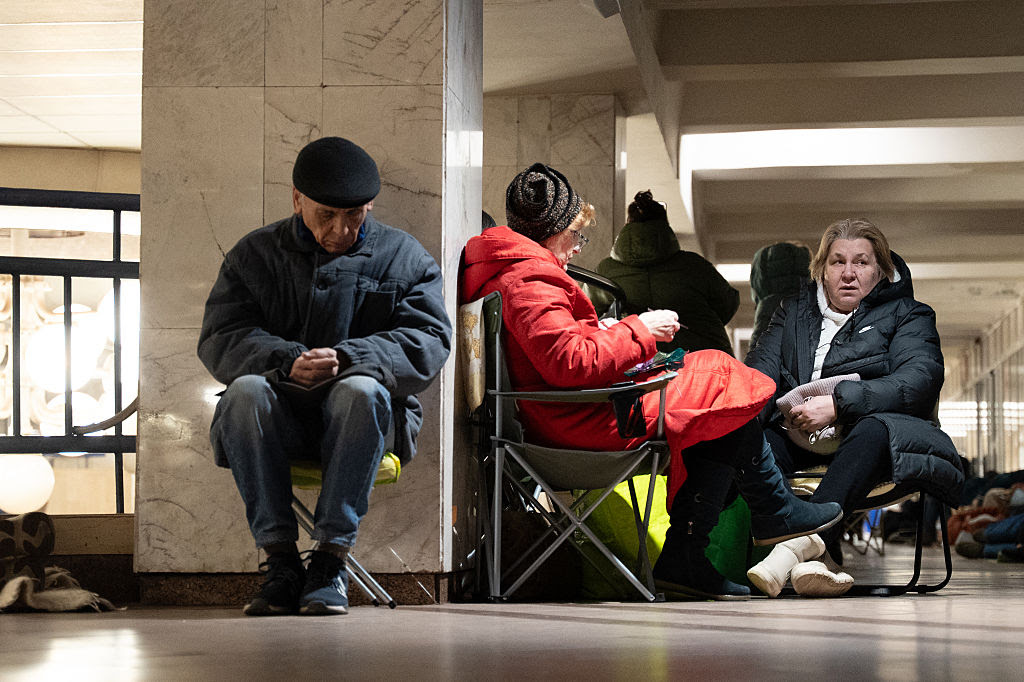
People take shelter at a metro station during Russian air attacks in Kyiv, amid the Russian invasion of Ukraine. Several powerful explosions rocked Kyiv as authorities warned that the Ukrainian capital was under threat of missile attack. (Serhii Okunev / AFP via Getty Images)
“No Calendar, No Compromise”: Moscow Draws the Line on Peace
Sergei Ryabkov sat beneath studio lights on Russian state television and methodically closed the door on peace. Deadlines, he said, were “inappropriate.” Timetables were pointless. Negotiations, in other words, would go nowhere—by design. The message aired just as President Volodymyr Zelensky was preparing to meet Donald Trump to push a peace framework forward.
Then Ryabkov tightened the terms. Any agreement outside what Moscow called the “Alaska framework” was unacceptable. There was no alternative, he insisted. The framework was “fundamental,” “imperative,” and immutable. Russia could not—and would not—move beyond it.
The problem was simple: the framework didn’t exist.
Trump himself had said the Alaska meeting was “productive” but produced “no deal.” No text. No commitments. No binding concessions. Yet Moscow spoke as if promises had been made and debts incurred, treating Trump’s vague public language as a diplomatic contract. Translation: Russia was attempting to lock negotiations into positions Washington had never agreed to, and daring anyone to dispute the premise.
The Russian Foreign Ministry reinforced the illusion, releasing an annual report claiming an “understanding” had been reached with the United States to address the war’s “root causes.” Those causes, Moscow argued, were not invasion or occupation, but NATO expansion and alleged discrimination against Russian speakers in Ukraine—a reframing that turned Ukrainian sovereignty into Western provocation.
Ryabkov’s appearance was choreography, not negotiation. It projected engagement while foreclosing compromise. It leveraged ambiguity to claim leverage. And it made one reality unmistakable: Russia’s demands were no longer about Ukraine’s borders, but Europe’s security architecture itself.
With Zelensky set to meet Trump on December 28, Moscow moved first—declaring that any peace not built on NATO’s retreat was dead on arrival.
“We Never Took the City”: The Day Russia’s War Bloggers Broke Ranks
It began as murmurs on Telegram—then turned into something closer to confession. Russian military bloggers, many nurtured and amplified by the Kremlin itself, started saying the quiet part out loud: Kupyansk had never been what Moscow claimed.
One blogger wrote it plainly. Russian forces were not holding central Kupyansk. Another, aligned with the state narrative for years, admitted Ukrainian troops were operating across almost the entire city and still controlled Kupyansk-Vuzlovyi to the south. Reports piled up—Ukrainian advances near Zapadne, positions southeast of Holubivka, lost ground in Kindrashivka, Radkivka, Myrove. Piece by piece, the map the Kremlin had published dissolved.
Then came the line that changed everything. A milblogger assessed the situation on the west bank of the Oskil River as “hopeless.” Supply routes were gone. Units would have to abandon large sections of their positions immediately. The word was not tactical setback. It was collapse.
What followed was worse than battlefield loss: exposure of fraud. Bloggers acknowledged that commanders had been planning based not on reality, but on reports designed to flatter superiors. Control was declared where none existed. Victories were announced before positions were secured. One blogger summarized the disaster with brutal clarity—Russia had announced Kupyansk’s capture while holding barely half the city. A soldier’s remark circulated widely: you cannot surrender something you never fully took.
Some tried to soften the blow. Counteroffensives were “natural,” they said. The city was a “gray zone.” Nothing was truly lost. But others admitted stabilization was impossible. Kupyansk, they warned, mattered because a frozen front might make losses permanent—and Russia had never prepared its public for that truth.
The scale of the backlash was unprecedented. This wasn’t dissent from the margins. It was an admission from inside the system that the system had been lying—to the public, to commanders, to itself. Careers advanced on fiction. Strategy followed fantasy. And when reality finally intruded, it did so all at once.
“Meters Bought in Blood”: How Hulyaipole Fell to Sheer Weight
The advance came the way Russian advances so often do—slow, crushing, and expensive. Ukrainian military sources confirmed that Russian forces pushed into central Pryluky northwest of Hulyaipole, while geolocated footage the same day showed Russian troops entering the city center itself. It wasn’t surprise or maneuver that opened the door. It was mass.
Two combined arms armies. An air force army. Tens of thousands of troops pressed into a narrow sector where Ukrainian defenders, disciplined and determined, simply did not have the numbers to match what was coming. When Russia stacked force high enough, the line bent.
Moscow’s Defense Ministry quickly declared success. Elements of the 37th Motorized Rifle Brigade, it said, had seized Kosivtseve. Milbloggers echoed the claims, describing advances from multiple directions and steady momentum around Hulyaipole. The language was familiar—progress measured not in tactics, but in accumulation. By some estimates, 80,000 to 90,000 Russian servicemembers were committed, with another 10,000 to 12,000 waiting behind them.
On the ground, the method was brutally consistent. Small assault groups slipped forward under cover of artillery and airstrikes, probing, dying, regrouping. More men followed. Then more. When enough bodies were in place, massed assaults rolled forward. Ukrainian units fought stubbornly, trading space for time, but numbers eventually told.
Yet even here, success carried a price. The concentration that forced Hulyaipole open pulled strength from elsewhere. Supply lines stretched thinner. Other sectors weakened. This was the arithmetic Russia could never escape: it could buy ground with overwhelming force, but every meter gained added strain to a system already near its limits.
Hulyaipole fell not because the formula changed—but because it was applied again, at tremendous cost.
“Ninety Percent Ready”: Zelensky Walks Toward a Deal That May Never Come
Volodymyr Zelensky spoke carefully, measuring each word as if already halfway across the Atlantic. On December 28, he said, he would sit down with Donald Trump at Mar-a-Lago to continue finalizing a U.S.–Ukrainian–European peace plan—twenty points meant to define the war’s end and the country that would emerge afterward. Security guarantees. Territory. Reconstruction. Weeks of diplomacy were funneling into a single meeting.
The plan, Zelensky said, was ninety percent ready.
What remained unresolved was the most sensitive part. The framework included a referendum that would allow Ukrainians themselves to decide certain “sensitive issues”—a U.S.-backed proposal that marked a sharp break from earlier negotiations. Parliamentary groups in Kyiv were already discussing how such a vote could be held. But the president was clear about the limits: the plan could not be signed without Russia. Or Europe.
Asked whether Moscow would agree, Zelensky did not pretend optimism. He wasn’t thinking about Russia’s answer, he said, because Russia was always looking for reasons to say no. Ukraine, he emphasized, was acting constructively. If talks failed, it would mean pressure had not been strong enough.
Translation: diplomacy without leverage was theater.
The implication hung in the air. Russia was demanding surrender while absorbing no real consequences for refusal. Zelensky’s next conversation with Trump, he suggested, would have to be about force—economic, political, strategic—and whether Washington was prepared to apply more of it.
In Moscow, the choreography continued. Kremlin spokesman Dmitry Peskov confirmed that presidential aide Yuriy Ushakov had spoken by phone with U.S. representatives after recent meetings. Lines stayed open. The process moved forward. Everyone kept talking.
Whether those conversations would produce peace—or simply buy time for more fighting—remained unanswered. Zelensky was preparing for an agreement. Russia was preparing for none. And the gap between those positions had yet to narrow.
“The Northern Shadow”: How Belarus Became Russia’s Launchpad Again
The drones didn’t come from the east this time. They came from the north—slipping past familiar air-defense patterns and striking where Ukrainians had learned, cautiously, to feel safer. President Volodymyr Zelensky said Russian forces were now exploiting Belarusian territory to intensify drone attacks on western Ukraine, using geography and technology to bypass interception systems designed for earlier threats.
One target made the shift unmistakable. Kovel railway station, just 64 kilometers from the Belarusian border, was hit by Shahed drones. A Lviv Railway locomotive and a freight wagon were damaged. Windows shattered in a depot workshop. It wasn’t a symbolic strike. It was logistical—aimed at the arteries that move fuel, equipment, and aid across the country.
Zelensky’s warning carried a familiar weight. Belarus had served as Russia’s staging ground once before, when invasion columns rolled south in 2022. Now the sanctuary was being repurposed. Russian forces were building the capacity to launch strikes from Belarusian territory, opening a new axis of pressure against regions that had previously escaped the war’s daily rhythm.
The implication was strategic, not just tactical. Air defenses calibrated for attacks from the east and south now had to look north as well. Resources that once shielded frontline cities and energy infrastructure were being pulled westward, stretched across a wider map. Every adjustment created gaps elsewhere.
This was how Russia fought when momentum stalled—by widening the battlefield. Subordinate states became force multipliers. Geography became a weapon. From Belarus, Moscow could reach deeper, strike quieter regions, and force Ukraine to defend everywhere at once.
The north, long quiet by comparison, was no longer a rear area. It was part of the front again.
“From Plumbing to Power”: Moscow Bets Its War on Drones
The man now tasked with shaping Russia’s unmanned war once sold plumbing fixtures. Lieutenant Colonel Yuri Vaganov, according to BBC Russia and multiple military bloggers, has been appointed commander of Russia’s Unmanned Systems Forces—a decision that says as much about the war’s evolution as it does about Moscow’s desperation to catch up.
Vaganov was not forged in traditional military academies. He entered the war economy instead. After founding the Sudoplatov Battalion volunteer group, he helped produce first-person-view drones, trained operators, and became one of the Russian military’s primary suppliers. By October, he was advising the deputy defense minister for armaments. Now, he was placed in charge.
The logic was familiar—and borrowed. Ukraine had already shown what happened when technical competence mattered more than rank. Major Robert “Magyar” Brovdi, a civilian businessman before the invasion, became one of Ukraine’s most effective drone commanders by translating logistics, scaling, and innovation into battlefield advantage. Russia was trying to replicate the formula.
Defense Minister Andrei Belousov, himself a former economics minister with no combat background, leaned into that shift. Businessmen, not generals, were being handed keys to the future. Production pipelines mattered more than parade-ground doctrine.
The Ministry of Defense announced a new regiment within the Unmanned Systems Forces, training in the Moscow Military District to counter drones and deploy unmanned ground vehicles. The unit would operate at grouping-of-forces level—no longer an experiment, but doctrine.
The changes were real. The adaptation was undeniable. But the question lingered beneath the announcements. Could new structures and new people fix a system poisoned by false reporting and career-saving lies? Russia was learning how to build drones at scale.
Whether it could build trust, accuracy, and truth inside its command structure remained an entirely different challenge.
“When the World Vanished”: Fog Turns Siversk into a Knife Fight
The fog came first. Thick, low, and persistent, it erased the battlefield around Siversk until sightlines collapsed to a few dozen meters. In that gray silence, Russian assault groups began moving.
Geolocated footage later showed advances north of Svyato-Pokrovske, southwest of the city. Moscow’s Defense Ministry claimed full control of the settlement, though even Russian military bloggers had already warned that official reports often outran reality. On the ground, what mattered more than claims was what the fog allowed.
Colonel Dmytro Zaporozhets, spokesperson for Ukraine’s 11th Army Corps, explained the shift plainly. Drone surveillance faltered. Infantry observation became guesswork. Russian troops exploited the cover, advancing in small groups, slipping between positions that would have been exposed in clear weather. A Ukrainian servicemember in the sector described it as a sudden change in rhythm—more probing, more infiltration, more close contact.
Russian forces paired the movement with strikes from Geran, Gerbera, and Italmas drones, hitting the Slovyansk–Lyman highway and nearby civilian infrastructure. The aim was disruption as much as destruction—cut movement, complicate resupply, keep defenders off balance while assault teams crept forward.
Siversk’s lowland terrain still favored Ukraine once targets were found. When Russian elements revealed themselves, Ukrainian units localized and destroyed them. But finding them was the problem. Fog blunted sensors, muffled movement, and compressed reaction time. The battlefield shrank into something intimate and dangerous.
Winter had changed the math. What had once been a drone-dominated fight became a contest of proximity and patience. Ukrainian forces adapted—striking supply lines, preparing counterblows—but the question hung over every position: how do you watch the ground when the world disappears?
“Worn Down, Not Broken”: Kostyantynivka Under the Weight of Numbers
The fighting around Kostyantynivka no longer surged—it pressed. Ukrainian military observer Kostyantyn Mashovets described a battlefield shaped less by breakthroughs than by accumulation, as Russian forces fed more men into a front already choking on artillery smoke. Mobilization reserve units were likely reinforcing the Chasiv Yar area, while naval infantry regrouped in the Kostyantynivka–Druzhkivka sector. The numbers were stark: 80,000 to 90,000 Russian troops in the fight, with another 10,000 to 12,000 waiting behind them.
From Toretsk, Russian forces pushed forward in frontal assaults toward Kostyantynivka, leaning heavily on superior artillery and mortar fire. Near Chasiv Yar, progress stalled. Elsewhere, it crept. South and southwest of the city, Russian units edged forward meter by meter, testing defenses, probing for seams. Mashovets warned that commanders might attempt a deeper push—an offensive from the south toward the Novodmytrivka–Chervone line, paired with infiltration into Kostyantynivka itself.
Ukrainian troops on the ground recognized the pattern. A brigade spokesperson described weeks of small-group Russian assaults, with heavy equipment kept back, hidden from drones and counterfire. The rhythm rarely changed: infiltration teams moved first, bodies accumulated, then massed assaults followed under artillery and airstrikes. Ukrainian forces struck back where they could—hitting positions, disrupting supply lines—but the imbalance remained. In key sectors, defenders were simply outnumbered.
Mashovets assessed that Russia’s 51st Combined Arms Army had solidified its bridgehead west of the Kazennyi Torets River. From there, attacks could come from both banks, with the potential to push toward Druzhkivka’s outskirts from the southwest. The plan was clear. The sustainability was not.
Kostyantynivka was being ground down, not shattered—an attritional test of how long pressure could be applied before the machine applying it began to fail.
“They Came One by One”: Pokrovsk in the Fog
The fog settled over Pokrovsk like a curtain, and behind it the fight changed shape. Intelligence officers and brigade commanders described a battlefield where winter weather erased distance and dulled the tools Ukrainian forces had relied on for months. Drones still flew. Artillery still fired. But visibility collapsed—and Russian forces moved into the gaps.
An intelligence officer said the tactics were familiar: infiltration supported by first-person-view drones, artillery, and airstrikes. What was new was how easily it worked. Fog blinded surveillance, letting Russian troops slip toward Ukrainian positions where clear skies would have meant near-certain detection.
A brigade commander in the sector described the same pattern. Russian units advanced under cover of poor weather, probing Ukrainian lines. In response, Ukrainian forces struck Russian positions and ground lines of communication, adapting as best they could. But adaptation took time, and fog shortened every warning.
A Ukrainian special forces officer put it most starkly. Russian troops were advancing in ones and twos—single figures moving through the gray—until enough men had gathered to launch a coordinated assault. Elite Spetsnaz forces were held back. Regular servicemembers absorbed the risk, preserving specialized units for later phases.
This was not recklessness. It was evolution. Russian commanders avoided the costly frontal assaults that had fed Ukrainian drones in clear weather. Instead, they used fog as cover, building strength just meters from Ukrainian positions before striking all at once.
Ukrainian forces responded when the weather allowed—hitting supply routes, targeting assembly areas—but winter had already shifted the balance. Pokrovsk became a place where the enemy did not charge. He appeared, quietly, until suddenly he was everywhere.
“Ninety-Nine in the Dark”: Russia’s Night of Fire Across Ukraine
The attack came after midnight, wave after wave, filling the sky with engines and warning tones. By morning, Ukraine’s Air Force counted it: ninety-nine Shahed-type, Geran-type, and other drones, followed by a single Iskander-M ballistic missile. Air defenses destroyed seventy-three of them. The rest got through. Sixteen locations paid the price.
The targets were not random. In Mykolaiv Oblast, energy and transportation infrastructure burned. In Odesa Oblast, port facilities took direct hits—terminals, warehouses, barges, and ships struck in the dark. Governor Oleh Kiper confirmed damage to both energy and port infrastructure. Among the vessels hit were ships flying Slovakian and Palauan flags, reminders that the war’s shockwaves traveled far beyond Ukraine’s borders.
DTEK, Ukraine’s largest private energy company, reported “significant damage” to two of its facilities in southern Odesa Oblast. In Mykolaiv, a terminal strike damaged a ship under a Liberian flag. Governor Vitalii Kim said parts of the region lost power as emergency crews worked through the night.
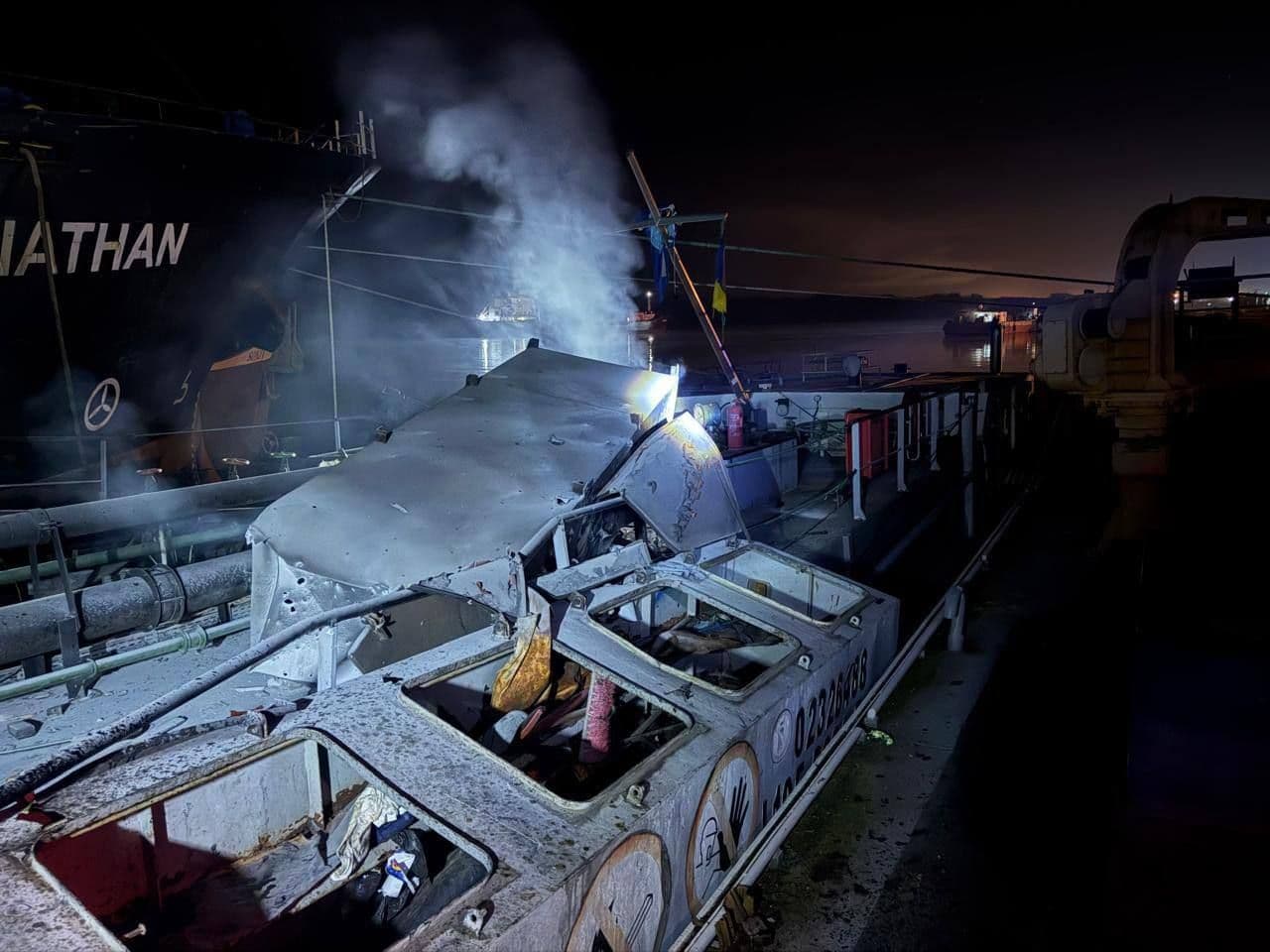
The aftermath of Russian drone attack on Odesa Oblast port infrastructure. (Oleksii Kuleba Telegram)
Farther west, near Poland, the war reached rail lines thought safer by distance. In Volyn Oblast, drones struck near Kovel station, damaging a locomotive and a freight car—another link in the logistics chain bent but not broken. The strike echoed President Zelensky’s warning that Russia was exploiting Belarusian territory to reach deeper into western Ukraine.
Ukrenergo, the state transmission operator, confirmed power outages across multiple regions. The intent was unmistakable. Energy grids. Ports. Railways. The systems civilians depended on and armies relied upon—hit together, again.
This was not escalation. It was routine. A familiar strategy executed with precision: wear down morale, strain logistics, and remind Ukrainians that no night passed entirely untouched by the war.
“There Were People in the Cars”: A Day Measured in Civilians
The numbers came first, as they always do. At least five killed. Twenty-three wounded. The count stretched across oblasts and cities, a map of impact points tied together by nothing except the fact that civilians were standing there when the weapons arrived.
In Chernihiv, a drone struck a five-story apartment building in broad daylight. An 80-year-old woman was killed inside her own home. Ten others were wounded, among them three children. Governor Viacheslav Chaus confirmed the details, but the scene needed no interpretation: a military weapon, a residential block, families caught where they lived.
The pattern repeated itself across the country. In Kherson Oblast, one person was killed and six injured. In Zaporizhzhia, another life lost, four more wounded. In Donetsk Oblast, a strike on Kostiantynivka killed one and injured two; Druzhkivka saw another civilian hurt. In Kharkiv Oblast, a 63-year-old man was wounded in shelling that never touched a military target.
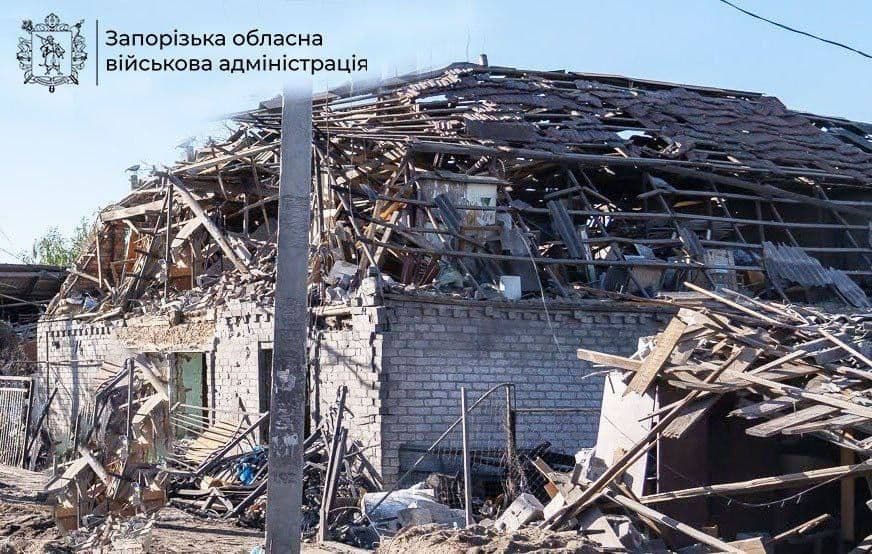
Aftermath of Russian strikes against Zaporizhzhia Oblast, Ukraine. (Zaporizhzhia Regional Military Administration / Telegram)
The deadliest moments came in Kharkiv and Uman. Kharkiv Oblast was hit with three guided bombs, one slamming into the city itself. Two people were killed. Eight others were injured, including a nine-month-old girl. Mayor Ihor Terekhov said one bomb struck the city’s busiest road. Cars burned. Windows shattered. “There were people in the burning cars,” he said. Governor Oleh Syniehubov stressed what residents already knew: there were no military facilities there. Only civilians.
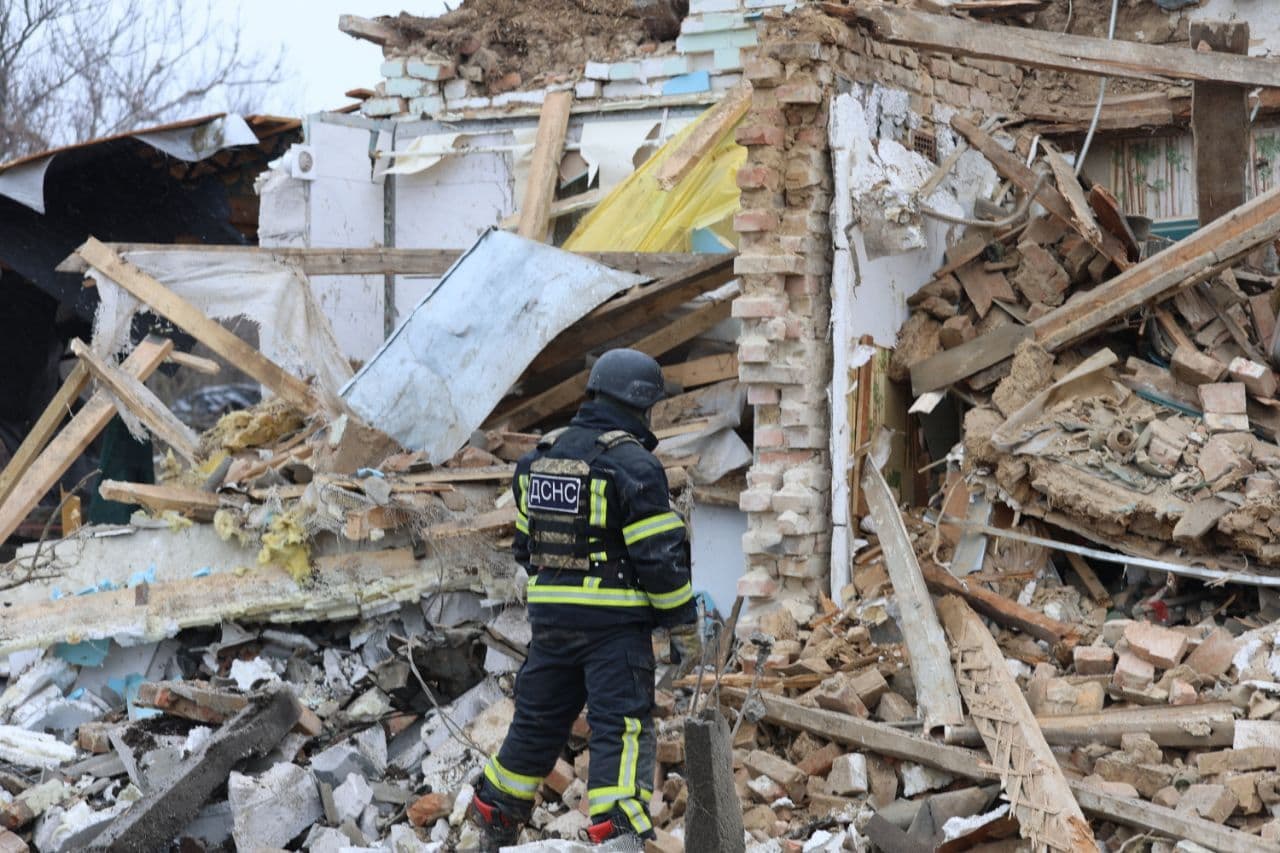
In Cherkasy Oblast, central Ukraine, Russia attacked the city of Uman with a missile injuring six people, including two children. (Governor Ihor Tabyrets / Telegram)
In central Ukraine, a missile hit Uman. Six people were injured, two of them children. Governor Ihor Taburets said at least fifty houses were damaged as emergency crews worked through debris and glass.
The strikes came after Russia rejected a proposed Christmas truce. Dates didn’t matter. Appeals didn’t matter. The message was delivered the same way it had been for months: through apartment blocks, roads, and neighborhoods. Not to win ground—but to remind civilians that nowhere, at any hour, was beyond reach.
𝗧𝗵𝗲 𝗗𝗮𝘆’𝘀 𝗠𝗲𝗮𝗻𝗶𝗻𝗴: 𝗪𝗵𝗲𝗻 𝗣𝗲𝗿𝗳𝗼𝗿𝗺𝗮𝗻𝗰𝗲 𝗠𝗲𝘁 𝗥𝗲𝗮𝗹𝗶𝘁𝘆
Three versions of the war ran in parallel—and none of them aligned. In Moscow, diplomats spoke as if peace were a matter of theater, rejecting negotiations while demanding NATO’s retreat as the price of ending a war they insisted they could still win. On Russian Telegram channels, the script collapsed. Military bloggers admitted that victories had been invented, that maps had been drawn from fiction, and that Ukrainian advances were undoing gains that never truly existed. Along the front, soldiers fought in fog and mud, where visibility vanished and numbers mattered more than declarations.
The diplomatic posture was never ambiguous. By refusing timelines and insisting on maximalist demands, Russia signaled that negotiations were not a path to compromise but a tool to legitimize surrender. Ukraine’s territory was no longer the true objective. The aim was to reshape European security itself—peace in Ukraine reduced to a bargaining chip in a larger confrontation with the West.
The blogger confessions cut deeper. When even Kremlin-aligned voices acknowledged systematic lying about battlefield control, it exposed a command culture hollowed out by fraud. Decisions had been made on imagined successes. Careers advanced on false reports. Strategy followed illusion. The result was not just lost ground, but lost coherence—an army struggling to understand the war it was actually fighting.
Winter completed the picture. Fog erased drone dominance and turned battles into close, grinding tests of endurance. Ukrainian forces adapted, but the conditions favored mass and expendability. Russia could still advance—at enormous cost—while Ukraine absorbed pressure without collapse.
With Zelensky preparing to meet Trump, diplomacy accelerated. But December 26 revealed the truth beneath the motion: the war had settled into a state where talking and killing advanced side by side, neither able to end the other.
After 1,402 days, the central question remained unchanged—not whether peace was imaginable, but whether any price paid would ever be enough.