
Russia fabricated a massive drone attack that never happened, used it to pressure peace negotiations, and exposed the widening gap between Kremlin propaganda, battlefield reality, and Western political vulnerability.
The Day’s Reckoning
The claim broke first, loud and confident. Sergey Lavrov announced that Ukrainian drones had swarmed Vladimir Putin’s residence overnight—ninety-one of them—only to be heroically destroyed without leaving so much as a scorch mark. No videos followed. No residents heard air defenses firing. Even Russia’s own Defense Ministry quietly undercut the story, revising the number downward. But the call had already been made. Putin phoned Donald Trump and treated the phantom attack as real, warning that Russia might now “reconsider” its position in peace talks.
While the fiction raced ahead diplomatically, the real war moved in slower, heavier steps. Putin gathered his generals for another televised display of confidence. Maps were presented. Numbers were inflated. Territorial gains grew by tens of percentage points with each retelling. This time, even Russia’s pro-war bloggers hesitated, publicly questioning claims that no longer matched what could be seen on the ground. Outside the propaganda bubble, Ukrainian drones struck actual targets—refineries, depots, air bases—producing smoke, damage, and evidence that did not require explanation.
In Kyiv, Volodymyr Zelensky rejected the fabricated provocation and pressed forward anyway, defending a fragile peace framework that had tentative American interest and unmistakable Russian hostility. He warned that the invented attack served a familiar purpose: creating justification for escalation already planned.
By nightfall, the shape of the day was unmistakable. A war where imaginary strikes disrupted diplomacy more effectively than real ones. A command structure inflating victories its own supporters no longer believed. And negotiations conducted in an information space so degraded that confidence alone—not proof—was enough to bend the conversation.
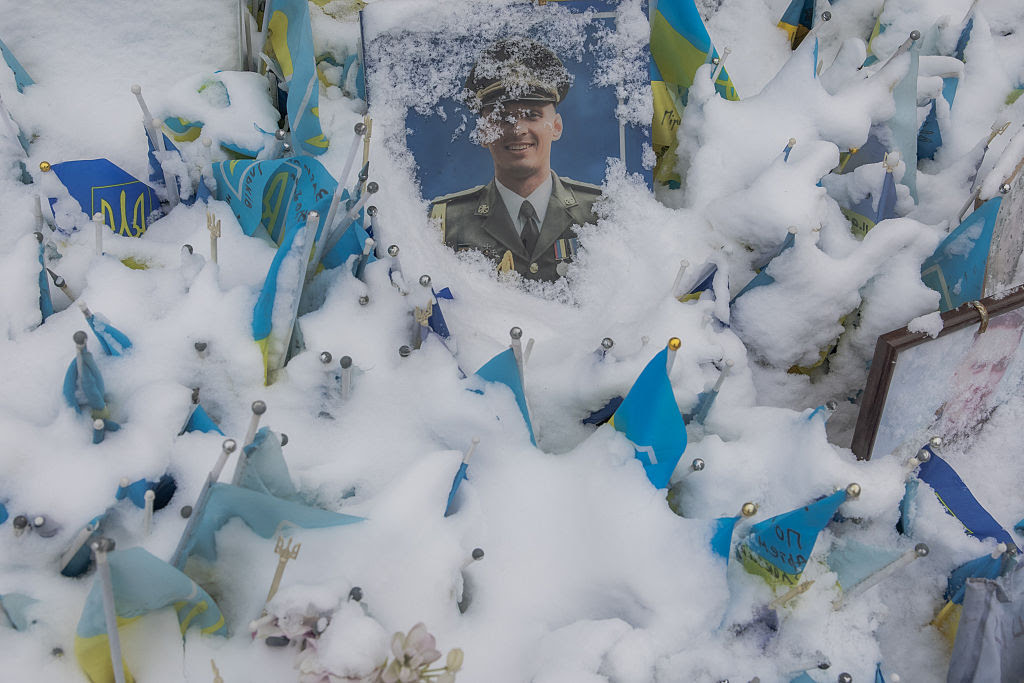
This photograph shows a portrait of a soldier amid the snow at the makeshift memorial for killed Ukrainian and foreign fighters at the Independence Square in Kyiv. (Roman Pilipey / AFP via Getty Images)
The Drone Strike That Never Touched the Ground
The accusation landed with certainty. Sergey Lavrov announced that Ukraine had launched ninety-one long-range drones at Vladimir Putin’s residence in Valdai overnight. Every drone, he said, had been destroyed. No damage. No injuries. No explanation for how such a massive attack left no trace behind.
For anyone familiar with Ukrainian strikes, the silence was deafening. Real attacks announce themselves quickly—flashes on the horizon, videos online, frantic posts from locals, reluctant confirmations from officials trying to minimize damage. That pattern has repeated for nearly three years. But for this supposed swarm of drones breaching some of Russia’s most heavily defended airspace, nothing appeared. No footage. No smoke. No shaken windows.
Russian opposition journalists from Sota checked the ground reality. Residents near Valdai heard nothing unusual. No air defenses fired audibly—an impossibility if dozens of drones were being intercepted. Downing that many targets would require sustained anti-aircraft fire impossible to conceal. The geography made the claim even thinner. Any drones launched from Ukraine would have had to pass through multiple Strategic Missile Forces zones and overlapping air-defense layers. Radio Free Europe reported earlier this year that Valdai’s defenses had expanded from two systems to twelve since 2022. Penetration without evidence bordered on fiction.
Then the story fractured. Russia’s own Defense Ministry contradicted Lavrov, claiming only forty-seven drones were intercepted. Two official versions. Zero proof.
Putin acted anyway. His aide Yuri Ushakov announced that the president had informed Donald Trump of the “attack” and warned Russia might now reconsider its negotiating position. The lie became leverage.
Zelensky dismissed the claim as “typical Russian lies” and warned it was a pretext for strikes Russia already planned. Trump, visibly unsettled, said he was “very angry”—then added that the attack “maybe did not take place.”
That hesitation was the point. The drone strike never happened. The diplomatic damage did.
Maps That Lied: Inside Putin’s Staged Victory Briefing
The meeting looked familiar. Vladimir Putin sat at the head of the table, cameras rolling, as his generals laid out maps and numbers meant to signal momentum. Chief of the General Staff Valery Gerasimov spoke confidently of sweeping gains—hundreds of square kilometers taken in December, thousands more over the year. On paper, it sounded like victory advancing on schedule.
On the ground, it didn’t match.
Independent analysts at the Institute for the Study of War checked the same battlefields using geolocated footage and combat reporting. Their numbers were smaller. Much smaller. Roughly forty percent smaller. Settlements Gerasimov claimed as seized appeared contested or untouched. Territory declared captured remained firmly outside Russian control. The inflation wasn’t accidental. It was calibrated—bold enough to impress, restrained enough to sound plausible.
Other commanders followed the script and exposed its cracks. Claims of advances near Sumy quietly revealed how shallow those advances actually were. Deadlines for encircling Kupyansk slipped from October to November to “early next year,” even as Ukrainian forces pushed Russian units back out of much of the city. Victories were announced, reannounced, then revised without explanation.
The contradictions piled up. One general claimed control of nearly half of Kostyantynivka. Another insisted Russian forces held most of it. Observable evidence showed operations in only a fraction of the city. Similar gaps appeared around Lyman, Orikhiv, and Zaporizhzhia. The war on the maps bore little resemblance to the war outside the briefing room.
What made the day different was who noticed. Russian military bloggers—normally loyal amplifiers of Kremlin messaging—began pointing out the lies. Not liberals. Not dissidents. Pro-war nationalists with audiences hungry for victories. They questioned claims, cited counterattacks, and openly described commanders as “witnesses to a lie.”
The performance still served Putin’s purpose: projecting inevitability to strengthen his hand in negotiations. But the spell was weakening. When even your own propagandists hesitate, the theater stops building confidence—and starts exposing fear.
Where the Explosions Were Real
While Moscow talked, things were burning.
Ukrainian Defense Intelligence confirmed that overnight strikes had destroyed a Russian fuel and ammunition depot near Volnovakha in occupied Donetsk Oblast. The target belonged to a logistics brigade—the kind of place wars depend on but rarely admit. Fuel gone. Ammunition gone. Supply lines interrupted where Russia believed them safest.
Farther east, the evidence surfaced quickly. Geolocated footage posted by the Russian opposition outlet Astra showed air-defense systems firing near Maykop in the Republic of Adygea. Ukrainian defense analysts assessed the likely target: Khanskaya air base, a rear-area aviation logistics hub critical to Russian Aerospace Forces operations. Air defenses activated. Bases disrupted. The response was visible, audible, undeniable.
This was not symbolism. It was reach.
The strikes marked how far Ukraine had come since the early months of 2022, when its leaders pleaded publicly for basic weapons just to survive. Now Ukrainian forces were hitting Russian military infrastructure hundreds of kilometers from the front, forcing Moscow to defend territory it once treated as untouchable. Depth no longer guaranteed safety.
For Ukrainian planners, the purpose went beyond destruction. These attacks reminded Russian commanders that rear areas were no longer rear. They signaled to Western partners that continued support translated directly into operational results. And they applied pressure where Russia least wanted it—on logistics, aviation support, and the illusion of control behind the lines.
The contrast with Lavrov’s phantom outrage could not have been sharper. Ukraine struck real targets, produced real evidence, and forced real reactions. Russia responded to an invented attack that existed only in statements and phone calls.
One side had smoke, footage, and damage reports.
The other had words.
In a war increasingly fought over narratives, the difference still mattered.
Speaking Into the Lie: Zelensky Confronts Fiction at the Negotiating Table
Volodymyr Zelensky did not raise his voice. He didn’t need to. When he addressed Ukrainian media, he dismantled Russia’s phantom attack claim the way someone names a familiar threat—calmly, precisely, without surprise. The alleged strike on Putin’s residence, he warned, wasn’t about damage done. It was about damage planned.
“They are preparing the ground,” Zelensky said, most likely for strikes on Kyiv and government buildings. It was pattern recognition born of experience. Russia fabricates a provocation. Russia claims outrage. Russia escalates anyway. The sequence had repeated before nearly every major diplomatic moment of the war.
The timing mattered. Zelensky pointed out that the fabrication arrived just as Ukraine and the United States were making progress on a revised peace framework. Progress, he noted, was failure for Moscow. When negotiations move forward without scandal, Russia creates one. Not to end the war—but to control the terms under which it might someday pause.
Zelensky pulled back the curtain on those terms. The proposed security guarantees stretched fifteen years, with the possibility of extension. He had pushed for more—thirty, forty, even fifty. Trump, he said, was considering it. The guarantees would be “NATO-like,” not NATO itself. A crucial difference. One meant automatic defense. The other meant promises that still required belief.
Territory, Zelensky insisted, was not abstract. “People live there,” he said. Withdrawal without guarantees wasn’t diplomacy—it was abandonment. Any framework demanding it would place hundreds of thousands of Ukrainians back under occupation, trusting future enforcement Russia had already proven it would ignore.
He spoke plainly about trust. He did not trust Putin. He did not trust Russian intentions. And without American support, he admitted, Ukraine could not defend its skies.
Later that day, calls continued. Drafts moved. Meetings were planned.
Zelensky’s message was clear: Ukraine would negotiate—but not by pretending fiction was reality, or that peace built on lies could ever hold.
The Money That Might Not Arrive
The warning didn’t come with explosions or sirens. It arrived as a report.
While diplomatic theatrics consumed attention, a briefing from RRR4U—a consortium of Ukrainian think tanks—outlined a quieter threat. Ukraine had missed nine reform benchmarks in the final quarter of 2025, more than in any previous quarter since the EU’s Ukraine Facility began. The failure immediately placed 2.3 billion euros in jeopardy, adding to another 1.3 billion already at risk from earlier missed conditions. Together, 3.6 billion euros now hung in the balance.
For a country fighting a full-scale war while keeping the lights on, the number mattered. European funding had kept ministries functioning and salaries paid. The 10.7 billion euros disbursed in 2025 stabilized the state, but it came with strings—judicial reform, energy restructuring, institutional alignment with EU norms. Miss too many, and the money pauses.
The problem wasn’t ignorance. It was gravity. Wartime governments triage relentlessly. Ammunition contracts outrank judicial rewrites. Air defense maintenance crowds out energy-market liberalization. Reforming courts and untangling energy monopolies requires political capital, time, and stability—three things in short supply during missile strikes and rolling blackouts.
European officials acknowledged the strain, but Brussels runs on procedures as much as sympathy. Progress must be documented. Benchmarks must be met.
Kyiv’s response was careful and bloodless. The Ministry of Economy announced updates to “mechanisms for managing, monitoring and controlling implementation.” Translation: systems would be adjusted. Whether outcomes would change remained unclear.
The risk was structural. Europe wanted Ukraine to reform as if at peace while fighting as if fully supplied. Both expectations were reasonable in isolation. Together, they collided.
The 3.6 billion euros at stake didn’t dominate headlines. But for planners staring at winter budgets and strained infrastructure, it represented something immediate: how long the state itself could keep functioning while the war ground on.
Dark Hours: Winter Without Power
The notice was brief and clinical. Ukrenergo warned that scheduled power outages would continue across most regions through the next day. Behind the wording sat broken transformers, damaged substations, and crews working in freezing air to keep systems alive just long enough to cycle electricity from one neighborhood to the next.
This was not about lights. In winter, power means heat.
Russian missiles and drones had been striking Ukraine’s energy infrastructure for weeks, and the latest overnight assault kept the pressure on. Twenty-five Shahed, Gerbera, and other drones launched from multiple directions—Oryol, Millerovo, occupied Donetsk, occupied Crimea. Ukrainian air defenses intercepted most of them. Four got through. Two locations took hits. That was enough.
The imbalance was cruel and structural. Ukraine had to shield thousands of sites spread across an entire country—power plants, substations, transmission lines—while protecting millions of civilians who depended on them. Russia needed only occasional success. One breach could darken entire districts. Even with Western air-defense systems, perfection was impossible.
As outages rolled across oblasts, the damage stacked on top of earlier strikes. Heating systems slowed. Backup generators strained. Families layered clothing indoors and timed meals around electricity windows posted hours earlier. Daily life contracted around the grid.
This was siege warfare rewritten for the modern age. No encirclement. No starving city gates. Just sustained pressure on power and heat until winter itself became a weapon. The aim was simple: exhaust civilians, erode resilience, and turn cold nights into political leverage.
Missiles didn’t need to destroy everything. They only had to destroy enough.
Where the War Shows Its Teeth
The war announced itself first through a crime scene.
Near the village of Shakhove outside Pokrovsk, Ukrainian prosecutors said Russian soldiers executed two unarmed Ukrainian prisoners of war. One was forced to partially undress at gunpoint. Both were shot. Their bodies were searched afterward. The investigation was opened as a war crime resulting in death, one of at least three such cases reported that month alone.
By October, Ukraine had documented the execution of at least 322 captured soldiers. More than 2,500 remained imprisoned in Russia, many unaccounted for. The killings were not anomalies. They were part of the battlefield reality.
North near Kupyansk, the war looked different but no less brutal. Russian forces shifted their focus to the east bank of the Oskil River, probing Ukrainian positions while snow made movement easier to spot. If the river froze solid, infantry might try to cross on foot. Ukrainian drones waited for clear weather.
Even Russian military bloggers contradicted Moscow’s triumphal claims. Kupyansk, they admitted, was split—some streets held by Russians, others by Ukrainians, much of it a gray zone. In several pockets, bloggers said Ukrainian forces had encircled isolated Russian groups, not the other way around.
Farther south near Huliaipole, there was no clear front line at all. Ukrainian commanders described a continuous field of battle: up to two dozen clashes a day, Russian units infiltrating rear areas, seizing buildings room by room. Once inside, they were hard to remove. Airstrikes followed. Losses mounted—hundreds of Russian troops and dozens of vehicles each day—but the assaults continued.
Around Pokrovsk and toward Druzhkivka, Russian advances were measured in rail lines and roads, often announced prematurely and later denied by Ukrainian units holding the ground.
Taken together, the reports described a war of exhaustion—men, machines, and cities consumed at rates once thought unsustainable. But the fighting went on anyway, testing not tactics, but endurance.

Image allegedly showing Russian troops executing captured Ukrainian soldiers near the village of Shakhove, Donetsk Oblast. (Ukraine’s Prosecutor General’s Office / Telegram)
A Navy That Stayed in Port
The sea was quiet because there was no one left to sail it.
Ukraine’s navy spokesman, Captain Dmytro Pletenchuk, said Russian warships and submarines were absent from both the Black Sea and the Sea of Azov. Not patrolling. Not hiding. Simply not there. The once-feared Black Sea Fleet had retreated into port, reduced to a presence measured more by memory than movement.
Only two cruise-missile submarines remained operational, Pletenchuk said, and even those were used sparingly. Maintenance problems lingered. Fear did, too. Every sortie carried the risk of damage from Ukrainian strikes that could not be easily repaired. In Novorossiysk, dry docks sat within Ukrainian range, turning routine maintenance into a gamble.
Three years earlier, Russian vessels had dominated the Black Sea, enforcing blockades and launching missiles with impunity. That era was gone. Ukrainian strikes had chipped away at hulls, ports, and confidence. Each successful hit forced Russia to choose between presence and preservation—and preservation kept winning.
The result was strategic silence. Shipping lanes reopened. Ukrainian ports breathed. A fleet designed to project power now avoided contact altogether.
This collapse wasn’t sudden. It came from sustained pressure applied to specific, vulnerable assets—ships, docks, logistics—targets Russia could not quickly replace. Ukraine lacked the resources to challenge Russia at sea in conventional terms. Instead, it dismantled the fleet piece by piece until staying docked became the safest option.
The Black Sea hadn’t been secured by a naval battle. It had been emptied by attrition.
The Day’s Meaning: When Lies Bought Leverage
The pattern was no longer subtle. Russia invented an attack that left no physical trace, then treated the invention as a diplomatic fact. Generals inflated battlefield gains even as their own loyal bloggers questioned the numbers. A phone call carried fiction across borders faster than evidence ever could—and it worked well enough to bend the conversation.
This was not a failure of intelligence. It was a failure of consequence.
Moscow’s strategy was visible to anyone who had watched the war closely: use diplomacy as a holding action, information warfare as a force multiplier, and negotiations as another battlefield. The phantom drone strike was never meant to convince analysts or journalists. It was designed for a narrow audience—leaders tired of war, eager for exits, willing to treat claims and counterclaims as morally equivalent. When Donald Trump said he was “very angry” about an attack he then conceded might not have happened, the calculation in Moscow was validated.
That willingness to pause on proof was the danger. If fabrications could reshape negotiating atmospheres, then any agreement became temporary—lasting only until the next manufactured incident justified revision. Security guarantees, no matter how carefully drafted, meant little if enforcement depended on adjudicating truth in an environment where lies carried equal diplomatic weight.
Meanwhile, reality moved forward without debate. Ukrainian drones hit real targets. Russian missiles cut real power. Civilians adjusted to blackouts. Soldiers died in numbers that would have once ended wars, but now simply measured endurance.
For Ukraine, the dilemma sharpened. Victory was no longer only about holding ground or inflicting losses. It was about surviving an information environment where truth competed with performance—and sometimes lost. The West’s resolve, not Ukraine’s resilience, became the variable.
December 29 did not answer whether Ukraine would prevail.
It revealed what the war had become: a contest where belief itself was a weapon, and the cost of disbelief was sovereignty.