
As Dmitry Medvedev declared Ukraine would be absorbed by Russia, European security advisors met in Kyiv to design troop deployments meant to make that ambition impossible.
The Day’s Reckoning
The morning began in two rooms, five hundred kilometers apart, moving in opposite directions.
In Moscow, Dmitry Medvedev sat at a keyboard and typed the end of negotiations. Ukraine, he wrote, would “return to Russia”—not in parts, not through talks, but entirely, absorbed as history corrected itself. Western aid, he added, only financed “gold-plated toilets” for Kyiv’s leaders. The message was blunt, absolutist, and deliberately timed. This was not leverage. This was a declaration of intent.
At the same hour in Kyiv, fifteen national security delegations filed into conference rooms with Ukrainian military commanders. Germany, Britain, France, Italy, Spain, the Baltics, Poland, the Nordics. NATO officials. European Council staff. European Commission representatives. They weren’t debating abstractions. They were finalizing a multilateral framework that envisioned European-led forces deploying on Ukrainian soil, with the United States as a strategic backstop rather than the visible front line.
Two realities unfolded in parallel. Moscow proclaimed total victory while still struggling to secure Pokrovsk. Europe drafted deployment plans while Czech politicians argued over whether sending Storm Shadows amounted to stealing from pensioners. Maximalist rhetoric collided with practical architecture, neither acknowledging the other.
On the ground, the war refused to conform to declarations. Russian forces pressed across eastern Ukraine without achieving breakthrough. In Kupyansk, fewer than 100 Russian soldiers remained trapped in basements. Ukrainian counterattacks collapsed the Dobropillya salient, forcing Russia’s 51st Combined Arms Army onto the defensive when it was supposed to be tightening the noose around Pokrovsk. Overnight, 95 Shahed drones and missile strikes killed six civilians—including a 22-year-old woman and a three-year-old boy in Kharkiv.
Day 1,049 ended where it began: Medvedev’s keyboard declaring absorption, Kyiv’s conference tables constructing deterrence. Between them lay the war’s defining gap—the distance between what Russia claims and what it can actually achieve.
When Plans Turned Into Presence: Europe Draws the Lines in Kyiv
The meeting didn’t happen in Brussels or Washington, where distance softens urgency. It happened inside Ukraine’s General Staff building, close enough to the front that abstraction felt dishonest.
On January 3, fifteen national security delegations took their seats in Kyiv with a shared understanding: guarantees designed far from war rarely survive first contact with it. German, British, French, Italian, Spanish, Baltic, Polish, Finnish, Canadian, Dutch, Swedish, Norwegian, and Danish officials joined representatives from NATO, the European Council, and the European Commission across the table from Ukraine’s leadership—Rustem Umerov, Andriy Hnatov, Serhiy Kyslytsya. The guest list alone signaled a shift. This was no longer about signaling unity. It was about building something that could be deployed.
After the doors closed, the language sharpened. Presidential advisor Oleksandr Bevz later outlined the framework with striking clarity. Ukraine’s Armed Forces would hold the first line. European-led multinational forces would deploy inside Ukraine—on land, at sea, and in the air. The United States would stand behind them as a strategic backstop, powerful but deliberately not in front.
This was a break from the past. Earlier security guarantees leaned on resolutions, clauses, and promises triggered after catastrophe. The Kyiv framework assumed presence instead of reaction—troops on the ground, under multilateral command, backed by American capability but not American primacy.
Coordination mattered as much as commitment. Bevz stressed that Ukraine and its partners were aligning equipment, command structures, and timelines to avoid the early-war chaos when aid arrived late, mismatched, or politically symbolic rather than militarily useful.
By the time advisors left Kyiv, they carried documents prepared for the January 6 leaders’ summit in Paris. Zelensky would arrive not with appeals, but with blueprints.
Whether Europe would sustain casualties, funding, and political cohesion remained an open question. But the framework itself was no longer theoretical. If it failed, it would fail by choice—not by design.
A Keyboard Claiming a Country: Medvedev Erases the Map
Dmitry Medvedev didn’t hedge on January 3. He didn’t hint. He erased.
From behind a keyboard in Moscow, the former president and current Security Council deputy chairman typed away any remaining fiction about negotiations or limited aims. “The more the West supports Ukraine,” he wrote to his English and Russian Telegram audiences, “the larger the amount of Ukrainian territory that Russia will eventually return to its native Russia.” Not seize. Not annex. Return.
Translation was immediate and brutal. All of it. Not Donbas. Not Crimea plus land corridors. Not buffer zones or frozen lines. Complete absorption. Ukrainian statehood dissolved into a grammatical trick—territory framed as misplaced property finally coming home.
The timing was not accidental. As European security advisors sat in Kyiv drafting frameworks for troop deployments and deterrence, Medvedev wanted the meaning of Russian advances in places like Pokrovsk stripped of ambiguity. These were not bargaining chips. Not leverage for talks. They were incremental steps toward total incorporation.
The message carried a second payload. By claiming that Western aid would only cost Ukraine more land, Medvedev flipped blame with practiced cynicism. Support Ukraine and you doom it, he implied. Help the victim and you become responsible for the crime. The aim wasn’t logic. It was doubt—planted inside European parliaments already uneasy about cost, casualties, and duration.
The contradiction was obvious and irrelevant. Russian conquest was both inevitable and somehow caused by Western restraint. The pretzel held as long as it confused.
While Medvedev declared a country absorbed with keystrokes, fifteen European delegations in Kyiv were doing something harder—designing the machinery to stop it. Proclamations collided with planning. Ambition met architecture.
The gap between what Moscow claimed and what Europe was preparing to prevent remained the war’s unanswered question.
A Script Read Too Many Times: Moscow Juggles Crises It Can’t Afford
The Russian Foreign Ministry reached for its template on January 3—and everyone could tell.
As Washington conducted military operations against Venezuela, Moscow issued the familiar response: condemnation of the United States, affirmation of solidarity with Venezuelan leadership, a call for dialogue, and an offer to help mediate. Foreign Minister Sergei Lavrov followed up with a phone call to Vice President Delcy Rodríguez, repeating the same lines. Then came the clean-up—an official denial of a Reuters report that Rodríguez was in Russia.
It was all executed smoothly. And that was the problem.
The statement read like muscle memory, not strategy. Condemn the West. Support the partner. Promise diplomacy that would go nowhere. Deny inconvenient reporting. The boilerplate revealed more than the content itself: Moscow was running on scripts because it no longer had the bandwidth to improvise.
Russia was managing too many fronts at once. Venezuela. Iran. Belarus. North Korea. Each partnership demanded public attention, rhetorical reinforcement, and symbolic gestures—while Ukraine continued to drain military stockpiles, finances, and political focus. Every new crisis required a response. Every response consumed time Moscow didn’t have.
Even Russia’s own war commentators noticed. Military bloggers reacted to the Venezuela episode by mocking the weakness of the Venezuelan armed forces while boasting about Russia’s missiles and nuclear deterrent. The subtext was unflattering: these alliances looked impressive on paper but offered little when tested against real power.
The Venezuela episode wasn’t about Latin America. It was about capacity. Russia could still speak everywhere—but it was struggling to act anywhere decisively beyond Ukraine.
Every partnership needed maintenance. Every statement was another plate spinning. And behind the diplomatic choreography lay a quieter truth: Moscow was fighting a war it couldn’t finish while pretending it had the energy for everything else.
Flags Pulled Down, Lines Drawn: Prague Turns on Itself
The rupture began with a speech—and then spread through the building.
On January 3, Czech opposition parties moved to unseat Parliamentary Speaker Tomio Okamura, igniting a constitutional confrontation that exposed how fragile European unity on Ukraine still was. The trigger was not a procedural dispute. It was language—raw, conspiratorial, and delivered from one of the highest offices of the state.
In his New Year’s address posted on X, Okamura discarded diplomatic restraint. He accused Ukraine’s leadership of using Western aid to install “gold-plated toilets,” dismissed military assistance as a “completely senseless war,” and claimed Czech money was being stolen from pensioners and disabled citizens to fund Kyiv. Then he widened the target. “Let them steal—but not from our money,” he wrote. “This country should not be in the European Union.”
The response was immediate. Five parties—ODS, STAN, Pirates, KDU-ČSL, and TOP 09—announced they would gather the signatures needed to force a parliamentary vote on his removal. Their argument was blunt: words like these, spoken by the third-highest constitutional official, damaged the Czech Republic’s international standing and betrayed the country’s commitment to democratic solidarity.
Politics complicated the reckoning. Okamura’s far-right SPD party had entered Prime Minister Andrej Babiš’s coalition after October’s elections. Babiš shared Okamura’s opposition to military aid and EU loans for Ukraine—but said nothing about the speaker’s rhetoric. Silence became a strategy.
The symbolism had already turned physical. In November, Okamura’s first act as speaker was ordering the Ukrainian flag removed from parliament. Opposition lawmakers answered by hanging multiple flags from their offices, transforming the building into a quiet battlefield of allegiance.
While European planners built deployment frameworks in Kyiv, Prague fought over banners and words. Unity, it turned out, was still a work in progress.
Basements, Not Battalions: Russia’s Advance Stalls Inside Kupyansk
The briefing landed quietly on January 3—and upended weeks of assumptions.
Colonel Viktor Trehubov, speaking for Ukraine’s Joint Forces Task Group, described a city that was not collapsing but constricting. Kupyansk had not fallen into Russian hands. It had swallowed them.
Fewer than one hundred Russian servicemembers remained inside the city. Not battalions clearing blocks. Not columns consolidating control. Under a hundred men—scattered through central and northwestern districts, hiding in basements, dependent on fragile drone resupply, increasingly cut off from their own lines.
What had looked like the opening act of another Bakhmut revealed itself as something else entirely. A failed infiltration. Russian units had slipped into contested urban terrain and become trapped there. Colonel General Sergei Kuzovlev, commander of Russia’s Western Grouping, had set February 2026 as the deadline to seize Kupyansk. Instead of exploiting momentum, his forces were digging in and trying to survive.
Russian units continued probing from the north, but the tempo slowed. Assaults gave way to regrouping. Geolocated footage published January 2 showed Ukrainian forces advancing near the P-79 Kupyansk–Chuhuiv highway—retaking positions Russian sources had already declared “secured.”
The pattern was unmistakable. Tactical penetration without operational breakthrough. Entry without control. Reinforcement stalled. Supply lines contested. Those hundred soldiers were no vanguard—they were liabilities.
Russia intensified glide-bomb strikes, but even here the limits showed. It had taken two years to level Vovchansk with glide bombs, a far smaller settlement. Kupyansk would not fall quickly.
Even Russian milbloggers sensed the weakness, complaining about the lack of footage proving control west of the city. Maps claimed gains. Cameras did not.
Basements instead of battalions. Deadlines slipping. Ukrainian counterattacks tightening the trap. Kupyansk was no longer a warning sign for Kyiv—it was a measure of Russia’s limits.
A Salient That Started to Bleed: Dobropillya Turns the Tables
General Oleksandr Syrskyi’s January 3 briefing didn’t sound dramatic. It didn’t need to be. The details did the work.
Ukrainian forces, he said, were increasing pressure east of Dobropillya—right where Russia least wanted to feel it. The Russian salient there, once a springboard, was becoming a liability. Troops were being pulled, dispersed, redirected. Momentum was leaking away.
The geography explained everything. Since August, elements of Russia’s 51st Combined Arms Army had pushed through Dobropillya while simultaneously driving toward Pokrovsk from multiple directions. It was textbook encirclement. The 51st CAA tightened from the north and northeast. The 2nd Combined Arms Army pressed from the south and southwest. Pokrovsk was supposed to be squeezed until it broke.
Instead, Ukrainian counterattacks hit the hinge point.
Pressure on the Dobropillya salient forced the 51st CAA into defensive posture at the worst possible moment. Units meant to surge forward were digging in. Forces assigned to close the noose were defending exposed flanks that Ukrainian troops were methodically collapsing.
Russian commanders faced a choice they could not escape. Exploit gains near Pokrovsk—or save Dobropillya. They chose to defend. And with that decision, the encirclement lost its second arm.
What had been a two-pronged operation became one. Timelines slipped. Resources stretched. Combat power bled away in the wrong place.
This wasn’t luck. It was adaptation. Ukrainian commanders weren’t simply reinforcing threatened sectors. They were identifying where Russian plans were most fragile—and attacking those fault lines relentlessly.
Force Russia to react. Make Moscow fight battles it didn’t plan. Turn momentum into friction.
The 51st Combined Arms Army was supposed to be tightening a noose. Instead, it was bleeding men and matériel into Dobropillya—feeding a salient that had turned into a sinkhole.
Moving the Pieces Before Paris: Zelensky Rewires the War Cabinet
The changes came quickly, almost deliberately so—announced across January 2 and 3 as Ukraine prepared for its next diplomatic test.
President Volodymyr Zelensky reshuffled the top tiers of government and military leadership, signaling that the next phase of the war would be managed differently from the last. This was not cosmetic. It was structural.
The most consequential move placed Digital Transformation Minister Mykhailo Fedorov at the head of the Defense Ministry. Fedorov was not a career general or bureaucratic survivor. He was the architect of Ukraine’s “Drone Line”—the system that fused aerial reconnaissance, strike drones, and ground units into a single operational ecosystem. He also led the digitalization of state services under wartime pressure. His elevation suggested a clear priority: speed, integration, and technological edge over inherited command culture.
Denys Shmyhal, Ukraine’s longest-serving prime minister, shifted sideways—and forward—into the role of energy minister and first deputy prime minister. The move placed him directly over the infrastructure Russia kept trying to break. With Iskanders and drones targeting power plants and substations, Zelensky assigned a veteran administrator with deep experience at DTEK, Ukraine’s largest private energy firm, to defend the grid.
Diplomacy moved inward. First Deputy Foreign Minister Serhiy Kyslytsya was tapped to become first deputy head of the Presidential Office while remaining part of Ukraine’s negotiating team. The dual role tightened the chain between talks abroad and decisions at home—centralizing diplomacy where Zelensky could control tempo and messaging.
Regional authority shifted as well. Zelensky signaled upcoming changes to military administrations in Vinnytsia, Dnipropetrovsk, Poltava, Ternopil, and Chernihiv. Too many moves at once to be coincidence. This was redesign, not repair.
The timing mattered. Paris was coming on January 6. Zelensky was walking in with a retooled team—technologists in defense, specialists guarding infrastructure, diplomats pulled close.
Whether the reshuffle proves visionary or merely necessary will depend on results. But Ukraine entered the next round of the war with the board reset—and the pieces deliberately placed.
Seconds to Run, No Time to Live: Kharkiv Counts Its Dead
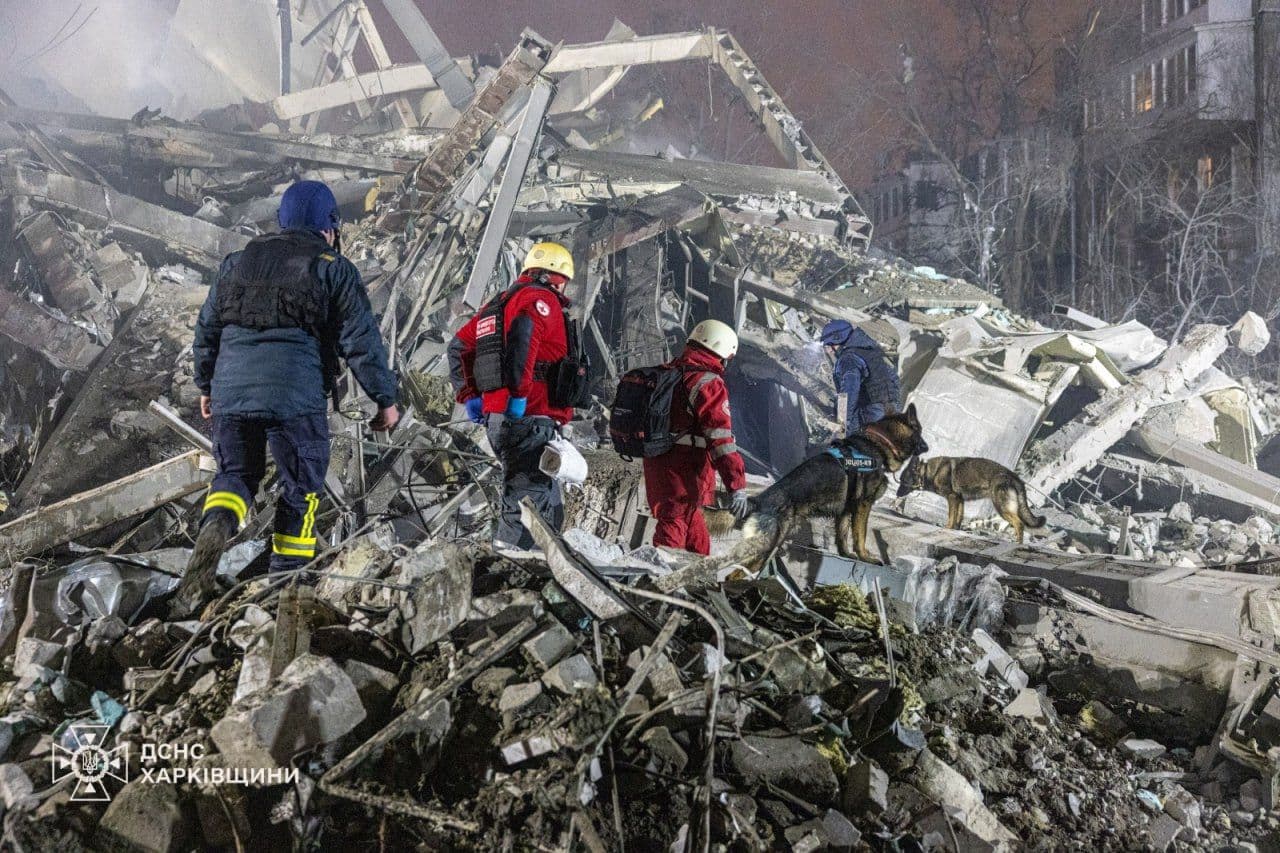
The rubble gave up its answers slowly.
Rescue crews worked through January 3, lifting concrete slabs piece by piece from what had been an office building and a torn-open apartment block in Kharkiv’s Kyivskyi district. By the time the dust settled, the numbers were no longer abstract. A 22-year-old woman. A three-year-old boy. Six dead. Thirty-one injured, including a six-month-old infant.
The strike had come the night before. Two Russian Iskander ballistic missiles hit on January 2, collapsing part of a four-story residential building and obliterating the structure beside it. Unlike drones or cruise missiles, Iskanders allow almost no warning. Seconds, not minutes. No time to reach shelters. No time to gather children. When they come, civilians can only hope the trajectory bends elsewhere.
Rescuers clawed through the wreckage overnight, calling into voids where apartments had been. Twelve people were pulled out alive. But the woman and the child were not among them. Their bodies emerged in the early hours of Saturday morning as crews removed the last slabs of shattered concrete.
Even the numbers refused to settle. Governor Oleh Syniehubov’s casualty reports shifted throughout the day—31 injured, then 27, then five residents still unaccounted for beneath the debris. Buildings collapse unevenly. People move. Records lag behind reality.
On paper, the three-year-old was a statistic. One of six. In Kharkiv, he was a bedroom that would never be used again, toys left where he dropped them, parents learning there would be no return home.
The office building lay flattened. The apartment block stood broken and hollowed. Rescuers stood exhausted in the cold morning light.
And beneath the numbers, the truth remained: ballistic missiles don’t just strike targets. They erase futures.
The Sky Filled at Once: Ninety-Five Drones and a Night That Wouldn’t End
The screens lit up before dawn.
In Ukrainian Air Force command rooms on January 3, tracking displays bloomed with incoming signals as Russia launched another overnight swarm. Ninety-five drones in total, most of them Shaheds, rising from multiple directions at once—Millerovo, Kursk, Oryol, Bryansk, Primorsko-Akhtarsk, and from occupied Crimea: Hvardiiske, Kacha, Cape Chauda. About sixty were confirmed Shahed-type. The rest were Gerbera variants and other strike drones, mixed in to complicate defense.
Ukrainian air defense crews went to work. Eighty drones were destroyed—an interception rate of roughly 84 percent. A technical success. But air defense is a math problem that never resolves cleanly. Fifteen drones slipped through. Eight locations were hit. Wreckage from downed drones fell on two more sites.
In Mykolaiv Oblast, thirty drones targeted critical infrastructure. Power went out in parts of the region as repair crews moved in under blackout conditions. The pattern was familiar: enough damage to hurt, not enough to provoke immediate escalation abroad.
Elsewhere, the map filled with scattered wounds. In Shostka, Sumy Oblast, drones struck civilian non-residential buildings, igniting large fires that rescuers fought through the night. In Synelnykove, Dnipropetrovsk Oblast, a man and a woman were injured. In Krasnopillia, an FPV drone wounded a sixty-year-old man. In Donetsk Oblast, strikes killed one person and injured four in Kostiantynivka, then killed another and wounded two more in Druzhkivka.
Ukrainian officials also reported a cruise missile strike against residential infrastructure in Cherkasy Oblast—another axis added to the same night.
The purpose went beyond damage. The swarm reminded Ukrainians that nowhere was truly distant from the war. It showed Russia still had drones to spare. And it warned that winter would bring repetition, not relief.
Eighty drones destroyed. Fifteen broke through. Eight places burned.
Another night where defenders saved what they could—knowing they could never save everything.
Where the River Decides Who Lives: Kherson Under Constant Fire
The numbers looked almost restrained at first glance.
Two dead. Two wounded. Then the rest of the line landed: twenty-six settlements struck across Kherson Oblast in a single cycle of attacks. The local military administration’s report didn’t need embellishment. It described a place where nowhere counted as quiet anymore.
Compared with the Iskander strike in Kharkiv or the overnight drone swarm, the casualty figures seemed modest. But Kherson doesn’t measure danger by body counts. It measures it by coverage. Russian forces on the east bank of the Dnipro could reach every settlement on the west bank with artillery, drones, or missiles. Distance offered no protection. Neither did routine.
The math was cruel. Twenty-six settlements hit. Two people killed. Which meant twenty-four places absorbed strikes without fatalities—this time. Each impact reinforced what residents already knew: survival depended on timing, caution, instinct, and luck, in that order.
Along the river, the military balance stayed frozen and tense. Ukrainian units pushed cautiously toward the Antonivskyi Bridge east of Kherson City, testing pressure points. Across the water, elements of Russia’s 331st VDV Regiment from the 98th Airborne Division maintained their positions, answering probes with fire. Neither side broke through. Neither side disengaged.
The Dnipro enforced the stalemate. Ukraine held the west bank with logistical freedom. Russia controlled the east bank with artillery dominance. The river blocked large-scale offensives while guaranteeing that no one could stand down. Ukrainian settlements stayed within range. Russian gun lines stayed exposed to drones.
Two dead. Twenty-six settlements struck.
Kherson existed inside the war’s most exhausting equation—attrition without movement, pressure without progress, violence distributed so widely that nowhere could ever feel spared.
Pressure Everywhere, Progress Nowhere: The East Refuses to Break
The attacks came anyway.
Across eastern Ukraine on January 3, Russian forces pushed forward along nearly every familiar axis—Kharkiv, Lyman, Siversk, Kostyantynivka, Dobropillya. The maps lit up with movement. The lines, stubbornly, did not.
North of Kharkiv, Russian units probed near Vovchansk and its surrounding villages, but the cold slowed everything. Long approaches turned punishing. The gray zone widened as neither side fully controlled the ground. Russian commanders paused to accumulate forces instead of pressing assaults. Even where geolocated footage showed recent movement near Sotnytskyi Kozachok, it produced no momentum.
Farther east, the pattern repeated. Near Khatnie, near Bohuslavka, near Borova—attacks without advance. Elements of Russia’s 1st Guards Tank Army remained committed, but commitment alone wasn’t moving the line.
In the Slovyansk-Lyman sector, drones replaced infantry surges. Operators from Russia’s Rubikon Center hunted targets from the air while ground assaults stalled. Technology substituted for mass, and still nothing broke.
Southwest of Siversk, Russian channels claimed gains—Bondarne taken, Riznykivka advanced. Cameras failed to confirm it. Ukrainian strikes caught infiltrators moving without effect on terrain control. Claims piled up faster than evidence.
Around Kostyantynivka and Druzhkivka, Russian forces edged along highways, pressed villages, struck with drones and artillery. The E-40 saw movement. It did not see collapse.
Near Dobropillya, Russian units attacked Shakhove and stalled inside Ukrainian kill zones, struggling to move in or out. Naval infantry and motorized rifle units fired and held. They did not advance.
Everywhere, the rhythm stayed the same. Russian forces attacked. Ukrainian forces absorbed, countered, held. Gains, where they appeared, measured in meters and moments.
The eastern front did not explode or retreat. It resisted motion itself—grinding, consuming effort, refusing decision.
Pressure without breakthrough. Resistance without reversal.
Another day where the war moved constantly, and nowhere at all.
Maps Say Occupied, Streets Say Otherwise: Pokrovsk Holds
The footage looked convincing—until it didn’t.
Russian forces pushed toward and into Pokrovsk on January 3, pressing through Rodynske, Bilytske, Chervonyi Lyman, Myrnohrad, Kotlyne, Udachne, and Molodetske. Geolocated clips showed Russian troops moving through southern Myrnohrad and edging into eastern Rodynske. On screens, the advance appeared orderly. On the ground, control proved elusive.
Ukraine’s East Group of Forces reported a different reality. Ukrainian units still held positions in Myrnohrad and northern Pokrovsk. One brigade confirmed control of Molodetske outright. Another described parts of Myrnohrad as gray zone—streets contested at night as Russian infiltration groups slipped forward in small numbers, using weather and darkness as cover rather than mass and momentum.
The pattern was familiar by now. Russian forces penetrated without consolidating. They entered neighborhoods but struggled to hold them. Carefully curated videos suggested occupation, while Ukrainian strikes continued landing inside areas Moscow claimed secured.
Elements of Russia’s 5th Motorized Rifle Brigade from the 51st Combined Arms Army operated in Myrnohrad. FPV drones from the 80th Sparta Separate Reconnaissance Battalion hunted Ukrainian equipment near Novooleksandrivka. The presence was real. But presence alone did not produce control.
Ukrainian logistics told the deeper story. The 7th Rapid Reaction Corps reported creating windows to resupply and reinforce positions around Pokrovsk. The H-32 Pokrovsk–Myrnohrad highway—repeatedly targeted—remained open. Attempts to sever it failed. Russian pushes in northern Pokrovsk stalled.
This was the paradox playing out in real time. Russia could infiltrate and declare. It could film and announce. What it could not do—without hemorrhaging forces—was turn movement into security.
Every Russian soldier checking documents in Pokrovsk was one not attacking Kupyansk. One not holding Dobropillya. Occupation demanded troops Russia could not spare.
Maps shaded red. Streets still contested.
Presence without control. Authority without safety. Pokrovsk remained the gap between Russian projection and Russian reality.
Snow That Gave Them Away: Novopavlivka Waits in the White
The front near Novopavlivka went quiet for a reason.
Russian units probed the area itself, then pressed south toward Yalta, Filiya, and Dachne. Nothing stuck. No confirmed advances. The line held, not because the fighting stopped—but because the ground betrayed anyone who tried to move across it.
A deputy commander of a Ukrainian battalion operating in the sector explained the pause with a detail only winter reveals. Russian forces were waiting for worse weather before attempting a major push. On its face, it sounded backwards. Snow and cold usually favor defenders, limiting visibility and movement.
Here, it did the opposite.
Fresh snow turned the battlefield into a ledger. Every bootprint showed. Every vehicle track cut a dark line across white ground. Assembly areas that would vanish into broken terrain in summer stood out plainly to Ukrainian drones and observation posts. Movement became confession. Russian troops spent as much effort hiding their approach as preparing to fight.
Russian commanders understood the problem. They waited for conditions to deteriorate further—hoping for whiteout snowfall, heavy overcast, anything that would ground Ukrainian drones and blind long-range observation. Ukrainian forces understood this calculation too, adjusting defenses and watching the weather as closely as the enemy.
The pause brought temporary relief, but no one mistook it for safety. Winter does not hold still. Sooner or later, visibility would drop. When it did, Russian forces would try again.
Elsewhere in the sector, attacks flickered without progress—northeast of Oleksandrivka near Zelenyi Hai and Andriivka-Klevtsove, southeast near Vorone, Oleksandrohrad, and Vyshneve. Each attempt stalled, leaving the line unchanged.
Novopavlivka froze in place, suspended between footprints already exposed and the next storm yet to come. The snow had bought time. No one believed it would buy peace.
Nowhere to Hide: Zaporizhzhia’s Open Ground Devours Attacks
The steppe offered no favors.
Across western Zaporizhzhia Oblast on January 3, Russian forces kept attacking—near Hulyaipole, near Orikhiv, across villages scattered like reference points on a firing range. The assaults came from many directions. None changed the map.
Around Hulyaipole, Russian units struck northeast toward Uspenivka, Rybne, and Zlahoda; north near Dobropillya; northwest toward Zelene; and south near Dorozhnyanka. Glide bombs fell near Zaliznychne. Motorized rifle units from Russia’s 57th Brigade operated in and around Hulyaipole itself. Drones hunted targets near Tsvitkove, Vozdvyzhivka, and Verkhnya Tersa as artillery and loitering munitions churned the open ground.
West of Orikhiv, the pressure continued—Bilohirya, Stepnohirsk, Stepove, Novoandriivka, Prymorske, Plavni. Infantry attacks increased in frequency, a Ukrainian brigade spokesperson said, but not in effectiveness. Russian troops advanced on foot, without armor, across terrain that offered nothing to hide behind.
Zaporizhzhia is open country. Flat. Exposed. The same steppe that punished Ukrainian forces during the 2023 counteroffensive now punished Russian attackers just as severely. There were no hedgerows, no folds of ground, no cover to mask movement. Ukrainian observers saw everything. Artillery answered quickly.
Even Russia’s drones struggled. Poor weather disrupted connections, Russian milbloggers admitted, cutting links at critical moments. The sky, like the ground, refused to cooperate.
Airborne units, motorized rifle formations, specialized drone groups—elements from Russia’s 108th Airborne Regiment, 4th Military Base, 104th VDV Regiment, and Nemets Group all operated in the sector. The presence was undeniable. The breakthrough never came.
Zaporizhzhia reduced the war to a simple equation. You could commit forces. You could fire weapons. But without concealment, momentum bled away under observation and fire.
The terrain did not bend. The defenses did not break.
And every attack dissolved into the same open ground it crossed.
A Border That Refused to Quiet: Sumy Lives in the Crossfire
The fighting never drifted far from the line.
On January 3, Russian forces again pressed along northern Sumy Oblast—north of the city near Kindrativka, Oleksiivka, Andriivka, and Varachyne, and southeast near Hrabovske. Glide bombs reportedly fell near Ryasne. Drones from Russia’s Rubikon Center hovered above the fields, searching for openings that never quite appeared.
Nothing changed on the map. And that, in Sumy, was the story.
For nearly three years, Moscow has tried to turn Ukraine’s northern border into something stable—a buffer zone it could hold, defend, and forget. It never worked. Russian units could strike from Belgorod and Kursk. Ukrainian forces could hit back just as easily. Control never settled on either side of the line.
The stalemate carried a price. Russia had to keep troops tied down defending territory in Kursk Oblast that Ukrainian forces seized during their August 2024 counteroffensive. Ukraine, in turn, had to watch the border constantly, answering every probe southward. Neither side could afford to strip forces from the north without inviting trouble.
The result was a quiet drain on momentum. Units stationed in Sumy were not reinforcing Pokrovsk. They were not rotating toward Kupyansk. They were holding ground that refused to become secondary.
Sumy lay far from the war’s headline battles, but it shaped them all the same. Every attack here absorbed attention. Every defense consumed manpower. The geography of the war stretched long and thin, denying either side the luxury of focus.
The border never stabilized. It never went silent. And as long as Sumy remained exposed, neither army could fully commit elsewhere without leaving something vital behind.
Cargo in the Dark: How Belarus Became a Bridge to Tehran
The movement showed up first on civilian tracking screens.
On December 30 and 31, air traffic monitors recorded at least four Belarusian Air Force Il-76 transport aircraft touching down in Tehran. According to Ukrainian defense outlet Militarnyi, the planes carried military cargo originating from Russia and China. No announcements. No ceremonies. Just heavy transports landing, unloading, and turning back into the night.
The flights told a larger story than their flight paths.
Belarus was no longer just hosting Russian troops or serving as a launch pad for strikes against northern Ukraine. It was moving hardware—actively participating in the logistics that bound Russia, Iran, and China into a single supply system. Cargo moved west to east, then back again, threading through Minsk and Tehran as if sanctions were obstacles to route around, not barriers to stop movement.
This was integration, not convenience. Russian matériel flowed through Belarus to Iran. Iranian systems and expertise flowed back. Chinese components followed the same corridors. Three authoritarian states aligning their supply chains to keep Russia’s war effort alive.
For Ukrainian planners, the implications were immediate and unsettling. Every cargo flight meant another capability arriving somewhere down the line. Iranian trainers sharpened Belarusian drone operations. Chinese electronics kept Russian production lines running. Belarus provided the airframes and the airspace to make it all connect.
Sanctions had not isolated Russia’s war. They had reshaped it. Alternative routes were functioning. Partnerships were hardening into systems. What once sounded like rhetorical alignment now showed up as tonnage on a runway.
Four flights. Heavy cargo. Quiet landings.
The alliance was no longer theoretical. It was airborne—and operational.
The Day’s Meaning: Two Wars Running in Parallel
Watch the split-screen unfold.
In Kyiv, fifteen European security advisors leaned over maps and frameworks, designing deployments that assumed foreign troops on Ukrainian soil. In Moscow, Dmitry Medvedev sat at a keyboard, declaring that Ukraine would be absorbed whole. One room planned deterrence. One man proclaimed inevitability.
Day 1,049 caught the war in this tension with unusual clarity.
On the ground, reality undercut rhetoric. Colonel Viktor Trehubov described fewer than one hundred Russian soldiers trapped in Kupyansk basements while their commander’s February deadline loomed. General Oleksandr Syrskyi bled Russia’s 51st Combined Arms Army at Dobropillya, turning a salient into a liability, even as Russian forces struggled to consolidate Pokrovsk beyond curated footage.
Russia declared total victory while failing to secure control across multiple sectors. Ambition collided with limits. Maps turned red faster than supply lines could follow. The gap between what Moscow announced and what it could actually hold remained wide and costly.
Europe faced its own fracture. Advisors built operational architecture in Kyiv while Czech politicians argued over whether Storm Shadow missiles were theft from pensioners. Capability met politics. Planning met public resistance. The question wasn’t whether Europe could design deployments—but whether it could sustain them once casualties arrived.
Meanwhile, the war collected its price. An overnight drone swarm killed six Ukrainians, including a three-year-old boy. An Iskander strike in Kharkiv buried a 22-year-old woman beneath concrete. Costs accumulated while outcomes stayed unresolved.
European delegations left Kyiv preparing for Paris. Medvedev’s declarations echoed online. Russian forces attacked without breakthrough. Ukrainian forces countered without decisive reversal.
The questions hung in the air. Could Russia outlast its limitations? Could Ukraine hold until promises became presence? Could Europe turn blueprints into endurance?
January 3 offered no answers—only two wars running in parallel, grinding forward until one side finally exhausted.
Five Prayer Requests
- For Protection of Civilians Under Fire
Pray for God’s covering over Ukrainian cities and villages still exposed to missiles, drones, and artillery—that families would be spared, shelters would hold, and lives would be preserved even when warning comes too late. - For Strength and Wisdom for Ukraine’s Defenders
Pray for Ukrainian soldiers holding contested ground—from Kupyansk basements to the open fields of Zaporizhzhia—that they would have clarity in chaos, endurance in exhaustion, and protection amid relentless pressure. - For Restraint and Fracturing of Russia’s Capacity for Violence
Pray that Russia’s offensive capabilities would continue to be disrupted—through logistical strain, operational failure, and internal limits—so that declared ambitions collapse under their own weight. - For Moral Courage and Endurance Among European Leaders
Pray that European governments would not only design security frameworks but sustain them—that fear of cost, casualties, or political backlash would not weaken commitments made to defend life and justice. - For Comfort and Healing for the Grieving
Pray especially for families mourning children, spouses, and loved ones lost this day—that God would meet them in the rubble, in hospital corridors, and in silent homes with comfort deeper than words.