
Russia struck a Kyiv hospital in a massive drone assault as Ukraine’s top spy fell to political backlash and Trump’s envoys headed for Paris—showing how destruction, diplomacy, and power struggles collided in one relentless day of war
The Day’s Reckoning
At 2:00 a.m. in Kyiv, a hospital burned.
Russian drones punched through the night sky in their largest wave in weeks—165 launched at once, air defenses firing until ammunition ran thin. Most were stopped. Some were not. One struck a medical center. Patients died in their beds. Rescue teams moved through smoke and shattered glass in a place meant for healing.
By morning, Ukraine’s most feared spymaster was gone.
Vasyl Maliuk, the intelligence chief who had overseen some of the war’s boldest deep-strike operations, resigned under political pressure as President Zelensky tried to contain the fallout from a botched anti-corruption crackdown. The war removed him not through failure at the front, but through pressure behind closed doors.
North of Europe, another line went dark.
Authorities in Lithuania and Latvia opened an investigation into fresh damage to an undersea Baltic cable—another episode in the shadow war that never announces itself, never claims responsibility, and never quite stops.
And while fires smoldered and investigations began, diplomats packed their bags.
Trump’s envoys prepared to fly to Paris for security talks that could shape the war’s next phase, even as the president threatened India over its continued purchases of Russian oil—economic pressure unfolding alongside military escalation, not in place of it.
All of it happened at once.
This was Day 1,047 of the war: a conflict where hospitals no longer guarantee safety, political survival can outweigh battlefield success, and diplomacy advances without any pause in violence. The machinery of war did not slow for negotiations. It accelerated alongside them.
When the Place Meant to Heal Became a Target
At approximately 2:00 a.m., the Medikom Medical Center was already burning when rescue teams reached it.
Above Kyiv, the night had been filled with engines and explosions—165 Russian drones launched in a single wave from multiple directions: Millerovo in Rostov Oblast, Kursk and Oryol, Shatalovo in Smolensk. Ukrainian air defenses fought through the darkness and did their work well. One hundred thirty-seven drones were destroyed.
Twenty-six were not.
One of them descended on a hospital.
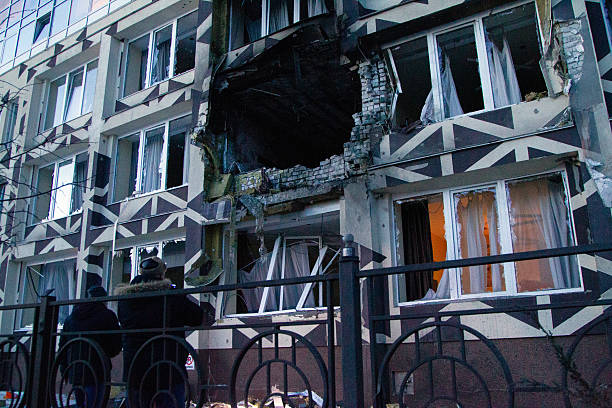
A private hospital sits damaged as a result of a Russian drone strike in the Obolonskyi district of Kyiv. Law enforcement officials confirm the death of a man born in 1995 who was undergoing inpatient treatment at the clinic (Kyrylo Chubotin/Ukrinform/NurPhoto via Getty Images)
Inside the Medikom Medical Center were roughly seventy patients—people connected to monitors, people unable to move quickly, people who believed the red cross on the building still meant something. The strike killed at least one patient instantly and wounded three others. Fire followed the blast, spreading smoke through corridors as emergency crews rushed to evacuate patients from rooms designed for recovery that had become lethal traps.
This was not an accident of war. It was a method.
Russia’s strategy relies on saturation: flood the sky with drones, overwhelm defenses, and let probability do the rest. If a drone hits a military site, claim success. If it hits a hospital, a school, an apartment block—deny intent, blame Ukrainian air defenses, suggest hidden military use. Volume creates deniability. Terror does the rest.
The same overnight assault struck the Bunge vegetable oil facility in Dnipro—an American-owned agribusiness operation based in St. Louis, Missouri. The impact ruptured storage, spilling roughly 300 metric tons of oil and creating an environmental hazard alongside the destruction. Energy infrastructure in Kharkiv and Kyiv oblasts was also hit, part of Russia’s ongoing effort to freeze civilian life into submission during winter.
President Zelensky responded with words Ukrainians have heard too often: air defense every day, interceptor drones every day, energy equipment every day. Not rhetoric—requirements.
By morning, Medikom was a blackened shell. Another hospital removed from the map. Another patient reduced to a line in a casualty report.
In this war, even places built to save lives no longer offer shelter.
When the Sea Went Quiet: Europe’s Wires Cut in the Dark
The Baltic Sea does not explode when it is attacked.
It simply goes silent.
On January 5, Lithuanian officials confirmed that something had severed an undersea fiber-optic cable—another critical artery cut beneath cold water where no cameras watch and no witnesses speak. Vilmantas Vitkauskas, head of Lithuania’s National Crisis Management Center, announced that Lithuanian and Latvian authorities were investigating deliberate damage. A ship sat in Liepāja port. Its crew was being examined. No name was released. No accusation made.
That was the point.
This was not a conventional attack. It was Phase Zero—the war before the war. The space where Russia tests Europe’s nerves without triggering NATO’s defenses. No missiles. No troops. Just a blade—or an anchor—dragged across the seabed, severing a line that carries data, commerce, and command signals between nations.
For European security planners, this is the nightmare scenario. There is no obvious target to strike back at. No clear threshold crossed. Only questions that never resolve themselves. Who did it? How do you prove it? And how do you deter an enemy who relies on ambiguity as a weapon?
The pattern is now familiar. Cables fail under “unclear circumstances.” Ships with Russian links appear nearby. Investigations open. Attribution stalls. The public is told systems are resilient—while quietly absorbing the truth that modern life depends on fragile threads lying exposed on the ocean floor.
Each incident does real damage. Communications degrade. Coordination slows. But the deeper effect is psychological. Populations realize that their connectivity—banking, emergency response, military command—can be disrupted without warning and without consequence.
The Baltic did not roar that day.
It whispered a reminder.
The war is already inside Europe’s infrastructure. It just hasn’t announced itself yet.
When the War Came Home: Smoke Over Russia’s Battery Factory
Smoke rose over Yelets before dawn.
At the Energiya chemical plant in Lipetsk Oblast, alarms sounded as Ukrainian drones reached deep into Russian territory overnight from January 4 to 5. The facility was not symbolic. It was practical. Energiya produces batteries—sealed lead-acid, nickel-cadmium, lithium-ion—and uninterruptible power systems used by Russia’s Ministry of Defense and its defense-industrial customers. Quiet components. Essential ones.
By morning, Lipetsk Oblast Governor Igor Artamonov issued the familiar explanation: a downed Ukrainian drone had caused a fire in an industrial zone. The phrasing followed Moscow’s script—acknowledge damage, deny effectiveness. But inside the plant, the distinction meant nothing. Whether intercepted or not, the drone had arrived. Production was disrupted. Military customers would feel the delay.
This was not retaliation. It was method.
Ukraine has chosen a different kind of air war. While Russia saturates cities with drones and missiles, Ukraine hunts the systems that keep those weapons flying. Batteries that power guidance systems. Chemical plants that feed explosives production. Oil refineries that fuel logistics. Ammunition depots. Transportation hubs. The arteries, not the neighborhoods.
The Energiya strike fit a pattern that has become routine for Ukrainian long-range units. Identify a target hundreds of kilometers from the front. Plot routes around known air defenses. Launch drones in waves. Some will fall. Some will not. The ones that reach their destination don’t need to level a facility—they just need to interrupt it.
This is industrial attrition, not spectacle. Damage measured in delayed shipments, idle machines, and missed deadlines rather than fireballs on city skylines.
For Russia’s defense industry, the message was simple and unmistakable.
The war no longer stops at the border.
He Won the Shadow War—and Lost the Political One
Vasyl Maliuk did not fall because he failed.
On January 5, Ukraine’s Security Service chief resigned after months of political pressure that had little to do with battlefield performance and everything to do with power, perception, and damage control. President Zelensky announced the move carefully, stressing that Maliuk would remain inside the SBU and continue directing asymmetric operations against Russia. It was reassurance wrapped around removal.
The pressure had been building quietly. According to Ukrainian Pravda, Zelensky’s team identified Maliuk as a central figure in the July arrests of National Anti-Corruption Bureau detectives—operations the SBU framed as counterintelligence against Russian infiltration. Anti-corruption activists saw something else entirely: political interference aimed at investigators probing figures close to the president.
The detectives were eventually released. The damage was not.
When parliament moved to strip independence from NABU and the Specialized Anti-Corruption Prosecutor’s Office, Western partners recoiled. The legislation crystallized fears of institutional capture at the worst possible moment—while Ukraine depended on foreign trust, funding, and weapons. Someone had to absorb the consequences.
Maliuk reportedly argued against his own removal, warning that multiple large-scale operations were in their final stages and that disrupting leadership would carry real costs. It didn’t matter. Political containment outranked operational continuity.
Senior commanders understood what was being sacrificed. Robert “Madyar” Brovdi, commander of the Unmanned Systems Forces, and Joint Forces Commander Mykhailo Drapatyi broke protocol to urge against Maliuk’s dismissal—a rare, public intervention from officers still fighting an active war.
Yevhenii Khmara, head of the SBU’s Alpha unit, stepped in as acting chief immediately. A seasoned special forces officer, he inherited not just a security service at war—but a political environment that had already claimed his predecessor.
In Ukraine, even success can be expendable.
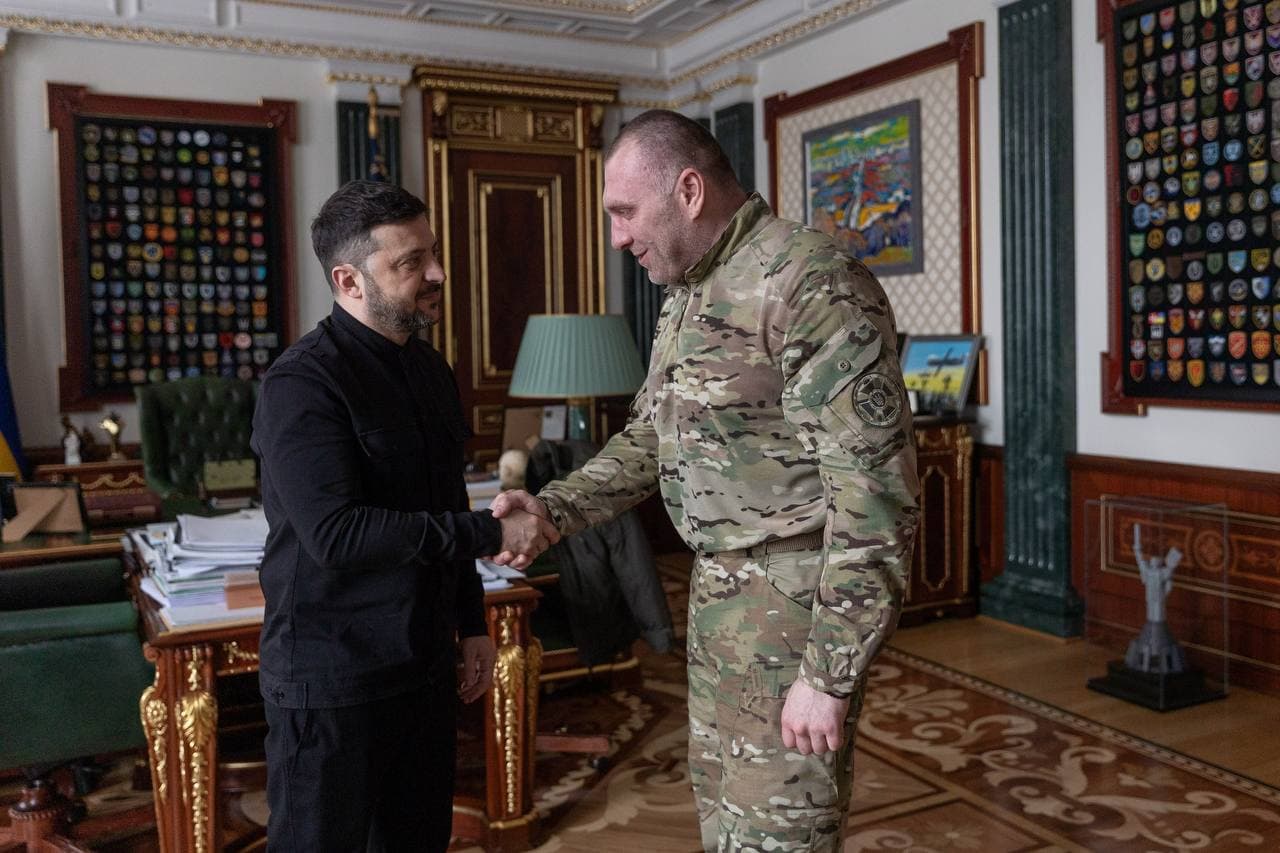
President Volodymyr Zelensky meets Security Service of Ukraine (SBU) head Vasyl Maliuk in Kyiv. (Volodymyr Zelensky / Telegram)
Diplomacy Under Fire: Paris Talks Begin While Kyiv Burns
Suitcases were being packed as smoke still hung over Kyiv.
On January 6, Trump’s special envoy Steve Witkoff and his son-in-law Jared Kushner prepared to fly to Paris, inserting American power into what had largely been a European diplomatic effort. The meeting would bring together the so-called “Coalition of the Willing”—roughly thirty countries searching for a way to guarantee Ukraine’s security if the guns ever fell silent.
The numbers were precise. The commitments were not.
President Zelensky said bilateral security guarantees with Washington were “100% agreed.” Trump corrected him publicly—“close to 95%.” The gap was small in percentage terms, vast in meaning. Still, officials insisted a broader U.S.–Europe–Ukraine framework was nearing completion, as parallel negotiations converged toward something that could be called a settlement.
The unresolved questions loomed over Paris. Would foreign troops deploy inside Ukraine or only along its borders? Would a ceasefire force have the authority to fight—or merely to observe? And what would stop Russia from signing an agreement, waiting a few years, then returning once attention drifted?
Moscow’s answer came in advance. Russian officials warned that NATO troops on Ukrainian soil would be “legitimate targets.” The threat sounded forceful. It was also revealing. If intimidation alone could stop Western deployments, it wouldn’t need to be repeated. The warnings betrayed Moscow’s fear that real security guarantees—troops, hardware, permanence—would make renewed invasion prohibitively costly.
Zelensky was blunt. Paper promises had failed too many times, from Budapest to Minsk. Deterrence required presence. Not months. Not years. Generations. Commitments measured in decades, not election cycles.
NATO Secretary General Mark Rutte’s decision to attend signaled alliance seriousness, even as European leaders wrestled with how much risk they were willing to accept. Emmanuel Macron and Keir Starmer would host, placing France and Britain at the center of Europe’s security future.
All of it unfolded against continued violence. Russia did not pause for diplomacy. The hospital strike in Kyiv the night before the talks made Moscow’s strategy plain: negotiate with one hand, escalate with the other—betting exhaustion would do what threats could not.
Buried Alive: The War Fought in the Pipes Beneath Kupiansk
They crawled in the dark, one after another.
Near Novoplatonivka, Russian forces tried again to turn civilian infrastructure into a weapon—sending roughly fifty soldiers into the decommissioned Soyuz gas pipeline north of Borova. The plan was familiar by now: move unseen beneath the battlefield, surface west of the Oskil River, and threaten Kupiansk from behind Ukrainian lines.
The pipe became their tomb.
Ukraine’s 7th Rapid Response Corps detected the movement and sealed the route. At least forty of the infiltrators were killed. Few tactics in this war fail as completely—or as brutally—as pipeline infiltration when discovered.
On paper, the method makes sense. Underground movement avoids drones, artillery spotters, and satellites. In reality, it replaces exposure with suffocation. Confined space magnifies every error. Panic spreads faster than oxygen runs out.
A Russian soldier interviewed by the independent outlet Astra described the chaos inside a pipe during a failed operation in Kursk Oblast months earlier. “People were going crazy,” said Igor Garus from St. Petersburg. “One shot himself. One pointed a machine gun at himself. The second smashed his head in.” Others suffocated. Some lost their minds before their bodies failed.
Inside a pipeline, every sound is terror. Every vibration might mean discovery. Every meter forward is another meter that must be crawled backward if escape becomes possible at all. Ukrainian forces can flood the pipe, seal exits, or wait. Time does the rest.
Yet Russia keeps trying.
The tactic works just often enough to survive scrutiny. In September, Russian troops crawled eight kilometers beneath the Oskil River over four days, emerging behind Ukrainian positions near Kupiansk and briefly achieving surprise. That success keeps commanders gambling with lives.
Ukrainian defenders have adapted. Every abandoned pipeline is treated as a threat. Sensors listen. Quick-reaction teams wait. The 77th Airborne Brigade has turned pipeline defense into a grim specialty.
This war is fought everywhere—sky, soil, sea, and screen.
And sometimes, in silence, beneath the earth.
Closing the Noose: Russia Grinds Toward Zaporizhzhia City
The push is measured in meters, not breakthroughs.
On January 5, Colonel Vladyslav Voloshyn put words to what Ukrainian commanders were already seeing on their maps: Russian forces are advancing in western Zaporizhzhia Oblast with a single objective—bringing Zaporizhzhia City within tube-artillery range. Not capturing it yet. Just getting close enough to make civilian life untenable.
Zaporizhzhia is not just another city. Before the war, it was a sprawling industrial hub with hundreds of thousands of residents. On the Dnipro’s east bank sits the Zaporizhzhia Nuclear Power Plant, already under Russian occupation—the largest in Europe. Taking the city would give Moscow dominance over southern Ukraine and sever supply routes running through the country’s center.
To get there, Russian units are probing forward settlement by settlement.
Additional assault groups have been pushed toward Orikhiv, using small-team infiltration tactics to threaten from the east. Pavlivka and Stepnohirsk matter not for their names, but for their distance. Capture them, and artillery can begin to speak directly to the city.
In Hulyaipole, the fighting is intimate and relentless. Voloshyn described intense ground attacks inside the town and north toward Varvarivka. Russian artillery units in the sector have been heavily resupplied—an unmistakable signal of high-level prioritization. Ukrainian defenders hold what they can in what has become a “gray zone,” where control shifts room by room, floor by floor, sometimes stairwell by stairwell.
This is not a conscript push.
Order-of-battle reports show Russia committing elite formations: the 14th Spetsnaz Brigade, the 143rd Motorized Rifle Regiment, the 60th Motorized Rifle Brigade. These are professional units, sent because Moscow believes Zaporizhzhia is worth the cost.
The strategy is attrition, not speed. What failed in 2022 through rapid assault is now being pursued through slow erosion. If the line keeps creeping forward, Russian guns will eventually range the city.
And when they do, Zaporizhzhia’s civilians will face the same decision Mariupol once did—leave, or endure a siege measured not in days, but in months.
Rewiring the War: Ukraine Bets Its Survival on Technology
The meeting on January 5 was brief, but its implications were vast.
When President Volodymyr Zelensky sat down with Digital Transformation Minister Mykhailo Fedorov, he confirmed what had been circulating quietly for days: Fedorov was being tapped to lead the Defense Ministry. The decision was less about reshuffling personnel than about redefining how Ukraine intended to fight—and survive—the next phase of the war.
Zelensky framed the move around two futures unfolding at once. One assumed diplomacy might work and rapid recovery would follow. The other assumed the war would grind on. Ukraine, he made clear, had to prepare for both.
“Ukraine is fully committed to diplomacy,” Zelensky said afterward. “But Russia is not demonstrating a similar approach.” The response, he added, would not be rhetorical. It would be technological.
Fedorov arrived with timelines, not talking points. Draft decisions aimed at strengthening defense capabilities would be implemented within a week. The emphasis was clear: technological solutions that had already reshaped the battlefield—especially drones. More drones. Faster delivery. Better integration with frontline units.
Since 2019, Fedorov had been the quiet constant in Zelensky’s cabinet—the only minister never replaced. His “state within a smartphone” vision cut bureaucracy through the Diia app. His ministry helped launch domestic drone production, built the Brave1 platform linking engineers and the military, and reoriented education toward technical skills Ukraine would need not someday, but now.
The appointment acknowledged an uncomfortable truth. This war is no longer won by mass alone. Victory belongs to the side that iterates faster, builds cheaper, adapts quicker, and outpaces the enemy’s learning curve.
But transforming a defense ministry mid-war is perilous. Bureaucracy resists speed. Institutions resist disruption. Fedorov’s predecessor, Denys Shmyhal, lasted less than six months in the role.
Zelensky hinted that this was more than a personnel change—new formats, new structures, a military increasingly organized around drones rather than divisions.
Ukraine is betting that innovation can outrun attrition.

Digital Transformation Minister Mykhailo Fedorov met with President Volodymyr Zelensky, to discuss potential reforms at the Defense Ministry, which he is expected to lead soon. (Volodymyr Zelensky/Telegram)
War by Ledger: Ukraine Brings a Global Financier Inside the Bunker
The front line now runs through spreadsheets.
On January 5, President Zelensky brought Chrystia Freeland directly into his inner circle as Ukraine’s economic advisor—an acknowledgment that the war’s outcome will be shaped as much by balance sheets as by battlefield maps. Freeland is no symbolic appointment. She arrives with the weight of experience: former Canadian deputy prime minister, finance minister, foreign minister, and trade negotiator with deep ties across Europe and Washington.
She had already been working on Ukraine’s future as Canada’s special representative for reconstruction. This move pulled her closer, into the daily calculus of survival. Zelensky is planning for two futures at once. One assumes diplomacy works and recovery must begin immediately. The other assumes the war drags on, and Ukraine must endure prolonged economic combat alongside military pressure.
His explanation was blunt. Ukraine, he said, must increase its internal resilience—whether peace arrives quickly or partners delay long enough that defense becomes the overriding priority. The uncertainty is no longer theoretical. It shapes every decision.
That dual-track thinking defines Freeland’s role. Ukraine will pursue negotiations while strengthening its defenses. It will court foreign investment while reducing vulnerability to external shocks. It will rebuild even as it fights. The contradictions are real. So is the necessity.
Nearly three years of war have taught Kyiv what doesn’t work. Hope without preparation fails. Dependency without leverage invites pressure. Planning for only one outcome is a luxury Ukraine cannot afford.
Freeland’s appointment followed Zelensky’s earlier move to name former Washington ambassador Oksana Markarova as advisor on reconstruction and investment. Together, they represent a shift. Ukraine is no longer waiting for outside experts to design its future. It is recruiting them on its own terms—to serve Ukrainian priorities, not impose foreign ones.
This is the economic front of the war.
And Ukraine has decided it belongs inside the bunker, not in postwar plans.
Oil as Leverage: Trump Aims at Moscow Through India
The pressure point wasn’t military. It was financial.
On January 5, Donald Trump threatened to raise tariffs on Indian goods if New Delhi did not curb its purchases of Russian oil. The warning targeted one of Moscow’s most critical lifelines: energy revenue flowing to Asia despite Western sanctions.
Since February 2022, India has sharply increased imports of discounted Russian crude, stepping into a market European buyers abandoned. The trade has benefited both sides. Russia kept cash moving into its war economy. India secured cheaper fuel for its expanding industrial base.
Trump’s message aimed to disrupt that balance.
Rather than escalating militarily, he signaled a strategy built on economic coercion—forcing Russia’s partners to bear the cost of continued engagement. If sanctions were to matter, he implied, they would need enforcement beyond Europe and North America.
For India, the threat introduced a new calculation: cheaper oil weighed against access to U.S. markets. For Russia, it underscored a vulnerability often masked by headline resilience—its war effort depends on buyers willing to look the other way.
Trump offered no ceasefire plan. He pointed instead to trade flows, tariffs, and pressure applied at a distance.
In his view, the war could be shortened not by force of arms—but by cutting the money that fuels them.
Where Armies Collide: Kostyantynivka Under the Weight of Three Fronts
The pressure around Kostyantynivka is no longer local. It is systemic.
On January 5, Ukrainian military observer Kostyantyn Mashovets described a concentration of Russian forces rarely seen along a single axis. Elements of three combined arms armies—the 3rd CAA, 8th CAA, and 51st CAA—along with the 3rd Army Corps were converging on the city. This was not a probing action. It was the kind of mass that precedes decisive attempts.
Russian units have already pushed north of Yablunivka along the H-20 Pokrovsk–Kostyantynivka highway. Infiltration teams have slipped deeper into southeastern Kostyantynivka, focusing attacks on the city’s eastern and southeastern edges. The objective is not subtle: spread Ukrainian defenses thin, then break them.
The force mix tells its own story. When Moscow commits multiple combined arms armies to one sector, it signals strategic intent. Kostyantynivka is the gate. If it falls, Russian forces gain access toward Druzhkivka and the broader Kramatorsk–Sloviansk agglomeration—the last major urban bastion in Donetsk Oblast under Ukrainian control.
Russian units are pushing toward the Stepanivka–Berestok line, seeking angles that bypass the city’s strongest defenses. Regular army formations operate alongside former proxy units and specialized forces, including Chechen elements of the 78th Sever-Akhmat Regiment—units whose presence signals political attention as much as battlefield necessity.
Poor weather has aided the advance. Assaults have intensified near Chasiv Yar. Small Russian fireteams—six to eight soldiers—probe north of Pokrovsk, skirting the Pokrovsk–Myrnohrad agglomeration through villages like Hryshyne and Rodynske.
Ukrainian defenders still hold northern Myrnohrad. But the arithmetic is unforgiving. Months of continuous fighting against overwhelming numbers leave little margin.
Kostyantynivka is becoming what Russian planners intend it to be.
A grinder.
Everywhere at Once: January 5 and the Machinery of Attrition
Across the front on January 5, nothing collapsed—and nothing paused.
Near Kupyansk, geolocated footage showed Ukrainian units clawing back marginal ground in the city center. The gains were small, but they mattered. They proved Ukraine still had offensive capacity even as Russian pressure mounted. East and southeast of the city, Russian attacks pressed on near Petropavlivka, Pershotravneve, Kurylivka, Stepova Novoselivka, and Hlushkivka, trading manpower for meters.
Along the northern border in Sumy Oblast, Russian forces briefly pushed into Hrabovske. Colonel Andriy Demchenko confirmed the advance—but also its limits. The attackers could not consolidate. Casualties mounted. The pattern repeated itself: probe, bleed, stall.
Near Borova, the war slipped underground again. The 7th Rapid Response Corps stopped another attempt to move Russian troops through the Soyuz gas pipeline north of Novoplatonivka. Around fifty tried. Roughly forty did not return. The tactic failed, but it was attempted anyway.
In the Lyman sector, Ukrainian brigades reported Russian commanders feeding poorly trained conscripts forward in small groups—human sensors meant to draw fire and reveal Ukrainian positions. Behind them came more capable units and skilled drone operators, deploying “sleeper drones” that waited silently before striking supply routes.
Further south near Siversk, Russian forces intensified efforts to bypass Ukrainian positions using the T-0513 highway. Rubber boats crossed the Siverskyi Donets from Yampil. Artillery and drone teams pushed closer through the Serebryanske forest.
In Kherson Oblast, three drones struck a humanitarian aid site in Darivska Hromada, killing one civilian and wounding two others. Pressure continued near the Antonivskyi Bridge, even as Ukrainian forces held the west bank.
Different sectors. Same arithmetic.
Russia advanced by spending lives. Ukraine answered by making every meter costly. No breakthroughs. No relief.
Just the grind.
The Day’s Meaning: A War That Adapts Faster Than Fatigue
January 5 revealed a war no longer defined by fronts or phases, but by simultaneous adaptation across every domain. Technology, politics, diplomacy, economics, and raw attrition are no longer sequential chapters—they are operating in parallel, feeding off one another, accelerating rather than resolving the conflict.
The most striking pattern was convergence. Military innovation now unfolds at the same pace as political instability and diplomatic maneuvering. No sphere waits for another to settle. Leaders reshuffle power structures while combat systems evolve mid-battle. Diplomacy advances without slowing violence. Economic pressure is applied not as an alternative to force, but alongside it. The war has learned how to multitask.
What January 5 exposed most clearly was the erosion of traditional boundaries. The line between civilian and military space continues to dissolve—not only physically, but conceptually. Protection is no longer assumed. Authority is no longer secure. Infrastructure built for peace is repurposed for conflict. Institutions once considered stabilizing forces now carry their own vulnerabilities under wartime pressure.
At the same time, the battlefield itself has reverted to its oldest logic. Despite drones, sensors, and digital coordination, progress is still measured in ground held and bodies spent. Innovation has not replaced attrition; it has optimized it. Technology does not shorten the war—it makes endurance the decisive variable.
The diplomatic track mirrors this reality. Negotiations no longer promise resolution; they promise management. Security guarantees are debated in generational terms because no one expects compliance to last beyond attention spans. The future is planned in overlapping contingencies, not outcomes.
Day 1,047 did not clarify how the war ends. It clarified something more unsettling: the conflict has become structurally comfortable sustaining itself. It adapts to pressure. It absorbs shocks. It generates new methods faster than exhaustion can force compromise.
The danger now is not escalation or collapse—but continuation.
And wars that learn how to continue are the hardest to stop.
Prayer Focus
For the wounded and traumatized after the hospital strike
Pray for the patients, medical staff, and families affected by the attack on the Kyiv hospital—that the injured would receive healing, the traumatized would find peace, and medical workers would have strength to continue serving despite fear and exhaustion.
For wisdom and integrity within Ukraine’s leadership
Pray for President Zelensky and Ukraine’s security and political leaders as they navigate internal pressure, reforms, and wartime decisions—that truth, accountability, and unity would prevail over fear, political calculation, or division.
For protection against hidden and hybrid attacks
Pray for those guarding Europe’s critical infrastructure—undersea cables, energy systems, logistics networks—that sabotage and covert attacks would be exposed, prevented, and fail to destabilize civilian life or international cooperation.
For endurance and protection of soldiers on every front
Pray for Ukrainian defenders facing relentless pressure in Zaporizhzhia, Kostyantynivka, Kupyansk, and other sectors—that they would have protection, strength, and timely support, and that commanders would have wisdom to preserve lives while holding the line.
For just peace and discernment in diplomacy
Pray for upcoming diplomatic efforts, including the Paris talks—that negotiations would be guided by truth rather than fatigue, that empty guarantees would be rejected, and that any steps toward peace would genuinely protect Ukraine from future aggression.