
As European leaders debate future security frameworks in Paris, Ukrainian drones burn ammunition depots and oil facilities hundreds of kilometers inside Russia—exposing how battlefield reality is racing far ahead of diplomacy.
The Day’s Reckoning
The first explosions came far from any negotiating table.
In the darkness near Neya, deep inside Russia’s Kostroma Oblast, Ukrainian drones tore into an ammunition depot, setting off secondary blasts that rolled through the night—shells, rockets, and missiles meant for the front burning where they sat.
By morning, diplomats were gathering beneath chandeliers.
In Paris, thirty-five nations assembled at the Élysée Palace to sign declarations and sketch frameworks for a multinational force that might one day protect Ukraine after the guns fell silent. The language was careful. The timelines abstract. The commitments conditional. While pens moved across paper, smoke still rose from Russian depots hundreds of kilometers beyond the reach Western weapons were ever allowed to travel.
This was day 1,413 of the war—a conflict that no longer respected distinctions between front and rear, diplomacy and combat, symbolism and bloodshed. As European leaders debated monitoring mechanisms, Ukrainian F-16 pilots acknowledged publicly that their Western training had prepared them for a different kind of war altogether. As Italy’s prime minister explained—again—why Italian troops would never set foot on Ukrainian soil, Ukrainian security forces were launching strike packages that would hit targets across five Russian regions before dawn reached the Kremlin.
In Kyiv, the contrast turned personal.
At Baikove Cemetery, mourners gathered to bury Lana “Sati” Chornohorska—an artist who became a drone operator and was killed by a Russian strike five days earlier. Her death stood for everything the Paris declarations promised to prevent, someday. Around the country, the present pressed on: 856 Russian strikes across Zaporizhzhia Oblast alone, one civilian killed, dozens wounded, more names added to lists already too long to read aloud.
The gap between words and reality was not subtle.
It was the shape of the war itself.
Italy Draws the Line: Promises on Paper, No Boots on the Ground
The words were chosen carefully, the kind that sound supportive until you listen closely.
From the Paris summit, Giorgia Meloni’s office announced that Italy would back Ukraine’s security “in line with what has always been done.” Then came the boundary. No Italian troops. Not now. Not later. Not as part of any security guarantee.
It was not a negotiating stance. It was a wall.
In Rome, the political math is unforgiving. Supporting Ukraine polls well. Sending Italian soldiers into a war that could turn into a direct fight with Russia does not. Meloni has repeated this position often enough that it no longer sounds like caution—it sounds like doctrine. Italy will send weapons. Training. Money. Diplomatic support. But Italian boots on Ukrainian soil remain untouchable territory, something no government in Rome believes it could survive at home.
The announcement landed as leaders from thirty-five countries gathered beneath the chandeliers of the Élysée Palace, Emmanuel Macron hosting a summit meant to turn years of promises into something sturdier. The symbolism was elegant: Europe stepping forward, filling gaps left by American hesitation, translating solidarity into structure.
Meloni called the meeting “constructive and concrete.” The phrase soothed without answering the central question hanging over the room: if Russia attacks again, who fights back? Her statement spoke of a “broader package of agreements,” coordinated with the United States, built around monitoring ceasefires and strengthening Ukraine’s military.
Translation: after violations, there will be reports. After attacks, there will be consultations.
Deterrence works differently. Real deterrence forces an aggressor to imagine consequences so immediate and costly that the attack never comes. Monitoring mechanisms observe damage after it happens. Military aid helps Ukraine survive it. But without the credible threat of allied forces already in place, the guarantees remain documents—well drafted, carefully worded, and strategically hollow.
For Ukrainian negotiators, Italy’s declaration felt familiar. Almost every Western partner offers nearly everything except the one thing that would change Moscow’s calculus. The support is real. The help matters. But the physical presence Ukraine keeps asking for—the kind that signals attacking Kyiv means fighting far more than Ukraine—remains absent.
Declarations can be signed. Frameworks can be built. But Italy’s red line made something painfully clear: when theory meets violence, Ukrainian soldiers may still be the only ones standing in front of Russian fire.
Flying Blind Into a Different War
The pilot didn’t sound bitter. Just honest.
“When we returned home, we faced reality,” he said in a Ukrainian Air Force video. “The tactics we were taught were not entirely suitable for the war we are fighting.”
For him, that wasn’t a critique. It was a survival report.
Abroad, Ukrainian F-16 pilots had trained inside NATO’s muscle memory—wars where air superiority was assumed, where enemy air defenses were degraded early, where fighters hunted targets below rather than being hunted themselves. Iraq. Afghanistan. Syria. The Balkans. Conflicts where Western aircraft owned the sky.
Ukraine’s sky belonged to no one.
When the pilots came home, every assumption collapsed. The front line sat beneath a permanent ceiling of Russian air defenses—modern S-400 batteries, Pantsir systems, electronic warfare platforms that blinded sensors and distorted signals. Above them, Russian fighters patrolled patiently: Su-35s scanning with powerful radars, MiG-31s firing long-range missiles from deep inside Russian airspace, Su-57s appearing just often enough to remind Ukrainian pilots what they were up against.
“Almost every mission near the front involves missile launches at us,” the pilot said. Mostly air-to-air. Mostly unseen until warning tones screamed in the cockpit.
So they flew lower.
Not because doctrine demanded it—but because survival did. Flying low reduced exposure to long-range systems, even as it increased vulnerability to short-range threats. It was a trade no textbook recommended, learned only through trial, error, and loss. NATO doctrine prized altitude, radar dominance, electronic cover. Ukraine had none of those luxuries.
Then came improvisation.
In some missions, F-16s providing air cover deliberately exposed themselves, tempting Russian fighters into firing. Missiles burned toward the decoys while Ukrainian strike aircraft slipped through to release precision-guided bombs. In one operation, three Ukrainian jets forced launches from multiple directions, opened a corridor, hit the target—and all made it home.
Using irreplaceable pilots as bait would horrify Western planners. But Ukraine flew without stealth fleets, without layered electronic warfare, without endless replacements. The aircraft became something new—missile interceptors, drone hunters, low-altitude fighters pressed into roles no designer intended.
One mission ended with a single F-16 shooting down six Russian cruise missiles. When missiles ran out, the pilot used the cannon. The engagement looked less like modern air combat than World War II—closing distances, visual targeting, raw flying skill.
The lesson unsettled Western air forces watching from afar. Decades spent perfecting wars of dominance had left NATO exquisitely prepared for conflicts it chose. Ukraine was fighting the war it was given.
And rewriting the textbook in real time.
A Life Measured in Silence at Baikove Cemetery
The hall at Baikove Cemetery was full, but it was quiet in the way only grief can make a room quiet.
Artists stood beside soldiers. Friends beside commanders. People who had known Lana “Sati” Chornohorska before the war, and those who had known her only inside it.
Five days earlier, she had been withdrawing from positions in southern Ukraine when a Russian drone found her. Now the Unmanned Aviation Service of the Ukrainian Volunteer Army gathered “to share the pain of loss and honor the heroine,” a phrase that tried—and failed—to contain who she had been. Her journey from artist and cultural activist to combat drone operator was not unusual in Ukraine. It was simply complete.
The Institute of Mass Information counted her as the 122nd media worker killed since the full-scale invasion began. Ninety-three of them died not as civilians, but in uniform. Statistics like that were meant to explain the war. Standing in that hall, they explained nothing.
“Lana was a dedicated warrior, a principled person and a true friend,” her unit wrote. In practice, that meant she did everything. She prepared drones. Flew them. Navigated missions. Learned a form of warfare that barely existed a decade ago and mastered it because the war demanded mastery. This was not symbolic service. It was lethal, technical, exhausting work—and she embraced it fully.
Before the invasion, she had been known in Kharkiv’s cultural circles through Lyuk Media. “The word ‘was’ feels impossible next to her name,” said Kateryna Pereverzeva, the outlet’s co-founder. Their years together had been loud with ideas and arguments, laughter and creation. The war did not pause that life. It consumed it.
In 2024, she joined the Ukrainian Volunteer Army’s “Udachnyky” unit and chose the call sign “Sati.” Like many artists and intellectuals, she gravitated toward volunteer formations—flatter structures, faster decisions, fewer illusions. She trained. She deployed. She fought.
The memorial brought both of her worlds together one last time. The one where she made meaning. The one where she died defending it.
As mourners stood in Kyiv, diplomats in Paris drafted frameworks meant to prevent future deaths. But nothing in that hall required explanation. No guarantees. No mechanisms. Just absence—proof of what war actually costs, long before it ever ends.
Signed, Smiled, and Deferred: The Promise That Waits for Tomorrow
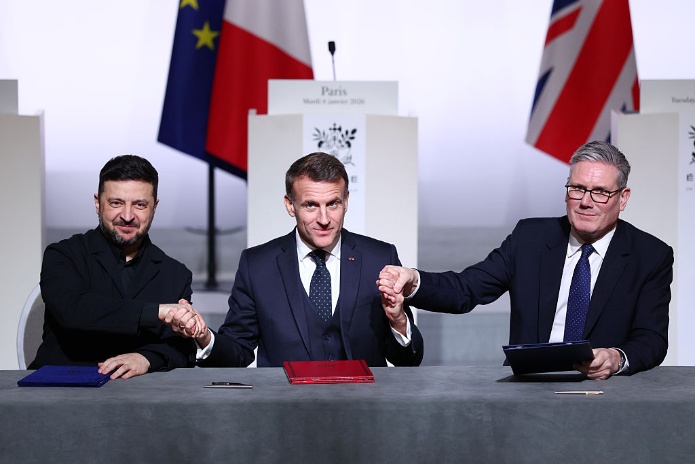
(L-R) President Volodymyr Zelensky, French President Emmanuel Macron, and U.K. Prime Minister Keir Starmer sign a Declaration of Intent to deploy forces to Ukraine after a peace deal, during a ‘Coalition Of The Willing’ summit in Paris. (Tom Nicholson/Getty Images)
The pens moved smoothly across the page.
Volodymyr Zelensky, Emmanuel Macron, and Keir Starmer leaned in, signed the declaration of intent, and smiled for the cameras—three leaders sealing a vision for multinational forces that would one day stand on Ukrainian soil after the war ended.
What the document promised sounded substantial. A force to strengthen Ukraine’s military and secure the land, sea, and air. U.S.-led ceasefire monitoring. Continued military support. Binding commitments if Russia attacked again. Long-term defense cooperation. Five pillars, carefully stacked.
What it avoided mattered just as much.
The multinational force would “help ensure” security—not guarantee it. The commitments would be “binding,” but binding on whom, to do what, and when remained undefined. Support would come “in case of a future Russian attack,” without clarifying whether that meant weapons shipments, intelligence sharing, or soldiers returning fire. Each option carried radically different consequences. The language treated them as interchangeable.
Zelensky, posting afterward, stressed that plans included details—troop numbers, deployments, weapon types—and that partners understood “which country is ready for what.” It was a diplomatic way of acknowledging an uncomfortable truth: readiness varied, commitment varied, and unity ended where domestic politics began. His gratitude toward those who “truly wish” to be part of peace quietly admitted that wishing and delivering were not the same thing.
The summit itself was an achievement. Thirty-five countries, NATO and EU leadership included, agreeing on anything in wartime is no small feat. But the joint statement was still “subject to changes,” still awaiting final approvals. This was not architecture. It was scaffolding.
The idea of a U.S.-backed, European-led force tried to square the circle. Europe would lead, because Washington would not. Washington would back it, without saying how far that backing went. European forces alone lacked the weight to deter Russia; American forces alone would make deterrence real. The compromise delivered neither fully.
Zelensky’s private talks with Macron focused on what mattered now—air defenses, assistance packages, protecting the skies. Immediate help, not hypothetical guarantees.
Italy’s announcement that it would never send troops to Ukraine lingered over the signatures like a footnote written in ink. If key partners ruled out ground forces before the framework was finished, the meaning of the signatures narrowed sharply.
The declaration moved diplomacy forward. But deterrence remained parked—waiting for answers everyone had agreed to discuss later.
Fire Beyond the Maps: Ukraine Reaches Where Promises Cannot
The drones left Ukrainian territory long before midnight and kept going—past radar lines, past electronic warfare zones, past the distances that once defined “safe” Russian rear areas. Near the town of Neya in Kostroma Oblast, more than 900 kilometers from Ukraine, they found their target: a vast ammunition depot feeding Russia’s war.
Then the night lit up.
“Explosions rang out all night,” an SBU source said, as secondary detonations tore through stored shells, rockets, and tactical missiles. The site—Russia’s 100th Arsenal—was not a symbolic target. It was a logistics heart, a place where ammunition was counted, serviced, and pushed forward to the front. When it burned, supply lines across multiple sectors felt it. Every round destroyed there was one that would never be fired at Ukrainian cities.
Hours later, Alpha’s second strike hit an oil facility near Usman in Lipetsk Oblast, south of Moscow. Officials first called it an “industrial fire.” By daylight, the truth was obvious. Flames still climbed skyward as firefighters struggled to contain blazes fueled by stored oil. The General Staff confirmed the strike openly—no denials, no coy silence. Ukraine wanted the message heard.
And it didn’t stop there.
Across five Russian regions, drones appeared like questions Russian air defenses struggled to answer. In Penza, residents counted explosions after 2 a.m. In Sterlitamak, blasts echoed without clear targets. In Belgorod Oblast’s Stary Oskol, oil tanks burned, confirmed by Governor Vyacheslav Gladkov himself. Even in Tver, where an apartment fire was later blamed on a gas explosion, the initial assumption told its own story: Russians now expect the war to arrive from the sky.
The geography mattered. From northwest of Moscow to the Volga region to the southern approaches of the capital, defenses were forced to react everywhere at once. No single interception zone could keep up. No city within roughly 1,000 kilometers could assume immunity.
For Russian civilians, the war stopped being something watched. Air raid alerts, evacuations, mobile internet shutdowns—these became lived experiences. Fear traveled faster than debris.
For Ukraine, the strikes proved something else. Denied long-range Western weapons and permissions, Kyiv built its own. Ukrainian-made drones, flown by Ukrainian operators, now reach deeper than diplomacy ever has—destroying the infrastructure that fuels attacks on Ukrainian homes while leaders in Paris debate how to prevent the next war.
That night, Ukraine didn’t wait for guarantees.
It acted.
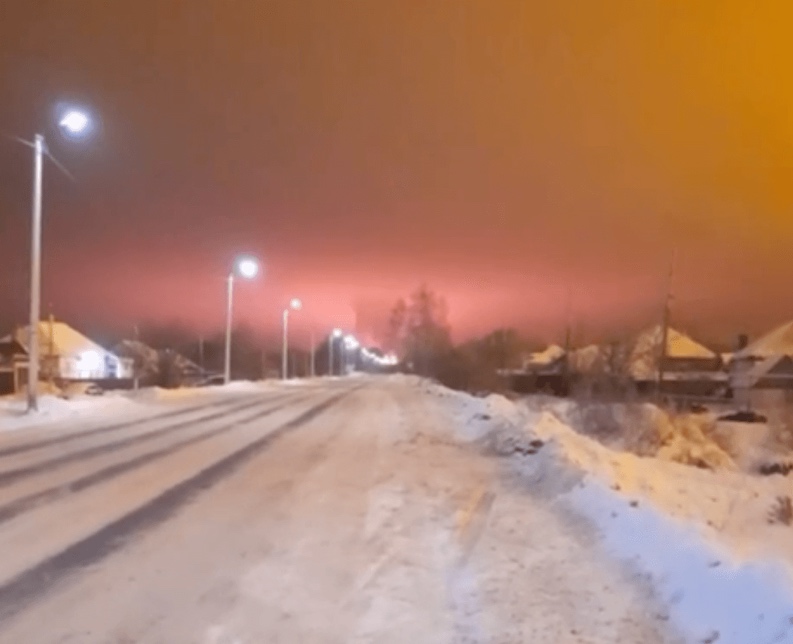
A screenshot from a video posted on social media on the morning, purportedly showing a fire at an oil facility in Usman, Lipetsk Oblast, in central Russia. (Telegram)
No Rear Area, No Refuge: The War Keeps Coming Home
The shelling did not pause to announce itself.
Across Zaporizhzhia Oblast, Russian forces fired 856 strikes into twenty-nine settlements—another day in a war that has learned to aim not just at front lines, but at routines. One civilian was killed. Others were wounded as the hours passed. By evening, Governor Ivan Fedorov reported three more injured when a first-person-view drone hunted down a police vehicle, turning precision into terror.
This was no longer crude area fire. It was selection.
In Kharkiv, Russia struck the city again. A 58-year-old man. A 64-year-old woman. Injured in attacks Governor Oleh Syniehubov described as continued pressure on Ukraine’s second-largest city. Their wounds barely registered amid the scale of the war—numbers drowned out by larger numbers. Ukraine’s General Staff reported 940 Russian casualties in the previous twenty-four hours alone, pushing the total since February 2022 to more than 1.2 million.
The statistics blur quickly.
Tanks destroyed: 11,512.
Armored vehicles: 23,863.
Artillery systems: 35,831.
The figures describe industrial collapse as much as battlefield loss—the factories required to replace them, the crews needed to man them, the supply chains keeping them alive. But numbers don’t explain what happened in Zaporizhzhia when ordnance found a home instead of a trench. Or in Kharkiv when a morning became a hospital visit.
Behind every tally is a person who did not expect the war to choose them that day. Russian soldiers who woke up alive. Ukrainian civilians who never wore uniforms. Families who will not appear in communiqués.
The daily reports have become ritual—press releases, governor updates, scrolling casualty lines. Mass death normalized into routine. In Ukraine, this is how endurance looks: absorbing loss to prevent erasure.
For civilians in Zaporizhzhia and Kharkiv, three years of adaptation have not produced safety. Air raid alerts still cut through meals. Basements still serve as shelter. Evacuation bags still wait by doors.
There is no home front anymore.
Only places the war has not reached yet.
Shells Over Slogans: Prague Blinks and Keeps the Guns Fed
For weeks, Andrej Babiš had played to the gallery.
The Czech-led ammunition initiative, he said, was overpriced. Opaque. A symbol of everything voters were tired of paying for. The ANO leader promised to end it—Prague’s most visible contribution to Ukraine’s defense reduced to a talking point in a domestic campaign.
Then Paris happened.
After the Coalition summit, the tone shifted. “I have decided,” Babiš announced, “that we will not disrupt the ammunition initiative. The project will continue, and the Czech Republic will be in the role of coordinator.” The reversal was swift and unmistakable. The shells would keep coming.
A qualifier followed immediately, carefully placed for home consumption: no money from Czech citizens would be used. The distinction allowed Babiš to claim fiscal purity while preserving a program whose collapse would have rattled allies and embarrassed Prague on the international stage. Whether voters believed the accounting mattered less than the outcome.
The initiative, launched in early 2024 when Ukraine was burning through shells faster than factories could replace them, had already delivered millions of artillery rounds. This was not symbolism. It was fire support. For Ukrainian gunners, it meant holding lines, breaking assaults, surviving nights when silence would have meant defeat.
Babiš’s earlier attacks had put that flow at risk for reasons rooted more in politics than strategy. Some coalition partners still wanted the program handed to NATO—technically preserved, but stripped from Czech leadership. Paris changed the calculus. Control stayed in Prague.
The reversal exposed the tension running through Czech politics. Since the invasion, Czechia had earned a reputation as one of Ukraine’s most reliable supporters—sending tanks, rocket systems, helicopters, and sheltering hundreds of thousands of refugees. But fatigue had crept in. Economic pressure followed. Populist rhetoric found an audience.
In the end, pragmatism won.
For Ukraine, the decision mattered in the most basic way possible. Artillery remains the war’s backbone. Ukrainian consumption still dwarfs domestic production. Lose the Czech supply line, and commanders would face impossible choices about where to fight—and where to bleed.
Paris produced declarations.
Prague kept the shells moving.
After the Speech, the Phone Call: Prague Walks It Back
The cleanup began quietly, by phone.
Czech Foreign Minister Petr Macinka dialed Kyiv to smooth over damage done days earlier, after parliament speaker Tomio Okamura used his New Year’s address to question continued military aid to Ukraine. “We clarified the matter,” Macinka said afterward, adding that he now considered it “closed.” The phrasing was diplomatic. The problem beneath it was not.
Okamura had not spoken carefully. He warned against “giving away our citizens’ money to foreign nationals simply because military propaganda demands it,” dismissing Russia’s war as “absolutely senseless” and suggesting Czech support was, too. In Kyiv, where soldiers were dying daily, the remarks landed hard. Ukrainian ambassador Vasyl Zvarych called them “unworthy and absolutely unacceptable.”
From Ukraine’s perspective, the argument missed the point entirely. Aid was not charity. It was self-defense by proxy. A Russian victory would not stop at Ukraine’s borders; it would move the threat line west—toward NATO, toward Czechia itself. To frame support as generosity was to ignore geography.
But Okamura’s words carried weight. His Freedom and Direct Democracy party draws strength from nationalist fatigue and skepticism toward an open-ended war. Its coalition partnership with Andrej Babiš’s ANO party elevated that rhetoric from fringe complaint to institutional voice. When the parliamentary speaker talks, allies listen—even when they wish he wouldn’t.
Macinka’s call with Ukrainian Foreign Minister Andrii Sybiha went beyond apologies. The two discussed Czech attitudes toward Ukrainians living in the country and agreed that improving them was “a joint task.” A visit to Kyiv was promised. Dialogue would continue. Public escalation would not.
Sybiha called the conversation “substantive and constructive.” Another diplomatic phrase, meaning both sides understood the risk of letting words spiral.
The episode captured a widening challenge for Ukraine. Early unity has thinned into maintenance work—managing war fatigue, domestic politics, and economic strain across allied capitals. Support now requires constant tending.
Turning the page did not erase the tension. It merely moved it offstage, where it could be handled without microphones.
Oil, Silence, and the Trade No One Says Aloud
The announcement landed like a side note—and then kept echoing.
Donald Trump declared that Venezuela would hand over “up to 50 million barrels of sanctioned oil” to the United States. The oil would be sold at market price, he wrote, and the money would be controlled by him. It sounded transactional. It wasn’t.
For Ukraine, the words pulled an old thread.
Years before Russia’s full-scale invasion, Trump adviser Fiona Hill had testified about a Kremlin idea that never quite went away. Russian officials, she told Congress, were floating a “very strange swap”—Venezuela for Ukraine. Moscow would step back in Latin America in exchange for unimpeded control over Eastern Europe. At the time, it sounded abstract. Now it sounded familiar.
From the Kremlin’s view, the math was simple. Venezuela was influence. Ukraine was leverage—forty million people, industry, agriculture, and a physical barrier to NATO’s eastward reach. Trading one for the other made strategic sense. The invasion proved how long that calculation had been forming.
Trump’s reported demands on Caracas—expel Russia, China, Iran, and Cuba; cut economic ties; accept American control before oil flows—made the old proposal feel suddenly less theoretical. The mechanism had changed. The logic had not. Whether Putin would accept losing Venezuela in exchange for a free hand in Ukraine remained unclear, but Moscow’s subdued response to U.S. action in Venezuela was telling. Russia did not rush to Maduro’s defense.
In Kyiv, the implications were chilling. If Washington was prepared to accept Russian dominance in Eastern Europe as the price for dominance in Latin America, then the security guarantees debated in Paris were theater. No monitoring mechanism, no multinational framework could deter aggression already accepted as negotiable.
The White House offered no clarification. No denials. No reassurance.
That silence forced Ukrainian officials to read between posts, parse phrasing, and plan under uncertainty. Were Paris guarantees real commitments—or diplomatic cover for a bargain struck elsewhere?
Everything connected. Oil fields in Venezuela. Quiet responses in Moscow. Careful words in Paris. And in Ukraine, a war still being fought while others weighed what parts of it might be traded away.
The Day’s Meaning: When Actions Matter More Than Declarations
January 6 revealed a war moving on two clocks that no longer align. One ticked at diplomatic speed—summits, signatures, frameworks, carefully managed ambiguity. The other ran at battlefield speed—innovation under fire, logistics burned in the night, lives ending before dawn.
The contrast mattered because it exposed where power is actually being exercised. Ukrainian deep-strike operations showed how necessity accelerates change: denied certain weapons and permissions, Ukraine built alternatives and used them decisively. Adaptation happened not through doctrine or consensus, but through pressure. The battlefield rewarded those who acted, not those who promised to act later.
Diplomacy, by contrast, revealed its limits. The Paris summit demonstrated cohesion and intent, but also avoidance. Security architectures were discussed without resolving who would bear risk when deterrence failed. Italy’s refusal to deploy troops crystallized a broader pattern: strong rhetorical support paired with carefully drawn red lines. The result was assistance sufficient for resistance, but insufficient for prevention.
The Ukrainian Air Force’s experience underscored the same lesson from a different angle. Western training reflected wars NATO preferred to fight. Ukraine was fighting the war it had. The gap between those realities forced improvisation that saved missions—and cost lives. Those lessons will reshape future doctrine, but they are being paid for now, by Ukrainians.
The Czech ammunition decision offered a counterpoint. When politics collided with battlefield necessity, practicality prevailed. Shells mattered more than slogans. That choice didn’t end debates, but it kept consequences from becoming immediate.
Underlying all of this ran a deeper uncertainty. Signals from outside Europe—oil, influence, unspoken trades—suggested that some actors still viewed Ukraine not as a line that must hold, but as a variable that could be negotiated. That possibility alone weakened every abstract guarantee discussed in Paris.
What January 6 ultimately showed was simple and unsettling: deterrence is not built from intentions. It is built from commitments that impose cost. Until words carry weight equal to actions, the war will continue to be decided where it always has been—by those forced to act while others decide what they are willing to risk.
Pray For Ukraine
- For protection over civilians under fire
Pray for families in Zaporizhzhia, Kharkiv, and other targeted regions—those who live with air raid alerts, shattered homes, and sudden loss. Ask God to shelter the innocent, preserve life, and bring comfort to those wounded in body and spirit. - For strength and wisdom for Ukraine’s defenders
Pray for pilots adapting to a war they were never trained for, drone operators striking far from home, and soldiers holding lines with limited resources. Ask for clarity in decisions, protection in danger, and endurance amid relentless pressure. - For leaders to choose courage over caution
Pray for political leaders in Europe and beyond to move from declarations to commitments that genuinely deter aggression. Ask that fear of cost or consequence would not outweigh responsibility to defend life, justice, and peace. - For unity to overcome fatigue and division
Pray for nations wrestling with war weariness, internal politics, and competing interests. Ask God to strengthen resolve among Ukraine’s supporters, sustaining practical aid where it matters most and resisting voices that normalize aggression. - For comfort for the grieving and honor for the fallen
Lift up the family, friends, and comrades of Lana Chornohorska and all who have been lost. Pray that their lives would not be reduced to numbers, that their sacrifice would not be forgotten, and that God would draw near to those who mourn with a hope stronger than death.