
American commandos boarded a newly Russian-flagged tanker in the North Atlantic just as diplomats in Paris began drawing the real blueprint for Ukraine’s post-war security order.
The Day’s Reckoning
The call came from the North Atlantic, not the front line.
A Russian-flagged tanker sat under American control in open water, its crew detained and its voyage ended by U.S. Coast Guard commandos hundreds of kilometers south of Iceland.
At the same hour, in Paris, Ukrainian President Volodymyr Zelensky sat across from American envoys as negotiators began sketching the real architecture of a post-war security order—who would deploy, who would monitor, and who would guarantee that any ceasefire would hold.
And back on the battlefield, Ukrainian military analysts were counting divisions that never materialized.
January 7 unfolded across three arenas at once. On the sea, sanctions enforcement crossed a new threshold, shifting from paperwork and banking restrictions to armed boarding operations against vessels flying Russia’s flag. In conference rooms, diplomacy moved past principles and into operational design—command structures, deployments, and the mechanics of deterrence. On the front, the war continued to devour men faster than Moscow could build new formations, leaving Russia’s expansion plans trapped in a cycle of attrition.
The day revealed a war that no longer lived only in trenches and shattered towns. It now ran through shipping lanes, court orders, reconstruction funds, and multinational security frameworks. It moved through ministries and naval task forces, investment boards and intelligence briefings.
This was the moment when sanctions became seizures, negotiations became blueprints, and military ambition collided with industrial and human limits.
A single day when enforcement turned physical, diplomacy turned technical, and the arithmetic of casualties began to shape what peace might one day look like.
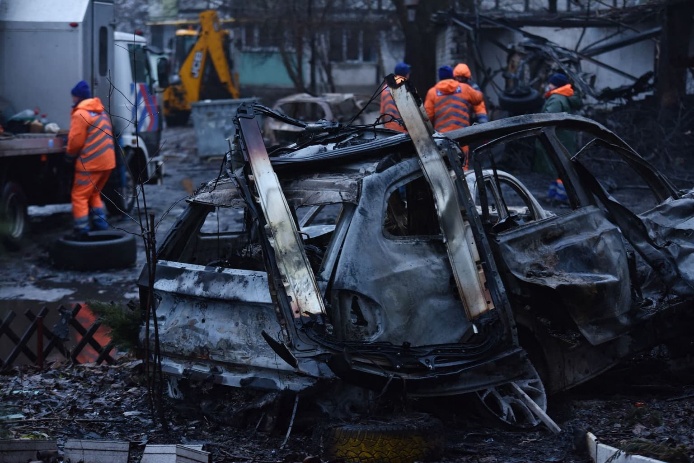
Communal workers clear debris from the courtyard of a damaged residential building in Dnipro, Dnipropetrovsk Oblast,, after a drone strike destroyed nearby cars amid Russia’s invasion of Ukraine. (Mykola Synelnykov / AFP via Getty Images)
Eighteen Miles of Steel and Sea: The Day America Took a Russian Tanker
The North Atlantic was gray and restless when the order came down.
A Russian-flagged tanker—freshly rebranded and freshly protected—was to be boarded.
U.S. Coast Guard teams closed on the Bella-1, also known as the Marinera, roughly 300 kilometers south of Iceland. In the Caribbean, another target—the M/T Sophia—was intercepted on a parallel track. Both ships had touched Venezuela or were bound for it. The Bella-1 carried no oil. The Sophia carried up to two million barrels of Venezuelan crude.
This was not paperwork. This was steel on steel.
U.S. officials said Russia had sent a submarine and other naval assets to shadow the Bella-1 as it crossed open water. The tanker’s paper trail told the rest of the story: a vessel linked to Louis Marine Shipholding Enterprises S.A.—sanctioned for backing Iran’s Revolutionary Guards—once sailing under Panama’s flag, then rushed onto Russia’s registry on December 24 and renamed to claim sovereign cover.
Moscow said the flag change was lawful. Washington said a court order was already in hand.
White House Press Secretary Karoline Leavitt confirmed the detention of the Bella-1 and the arrest of its crew, who now faced potential prosecution in U.S. courts. The Russian Foreign Ministry acknowledged Russian citizens were aboard and asked for their return—carefully stopping short of threats while Paris talks pressed on.
The Sophia’s seizure deepened the message. Linked to Sunne Co Limited—sanctioned for shipping Russian crude above the price cap—the tanker embodied the shell-game ownership that keeps oil moving when sanctions tighten.
Then came the politics. Senator Lindsey Graham said President Trump had approved moving forward on legislation to impose secondary sanctions on countries buying Russian oil and gas—China, Brazil, India. Translation: the net was about to widen.
Sanctions had crossed a line. From ledgers to ladders. From banks to boarding parties.
Every shadow-fleet tanker now sailed with a new risk: an American team on the rail and nowhere to run.
Inside the Paris War Room: Where Ukraine’s Future Was Drawn in Real Ink
The meeting rooms in Paris no longer felt ceremonial.
They felt operational.
For a third straight day, Ukrainian and American officials sat across from each other with maps, draft texts, and deployment models spread across the table. President Volodymyr Zelensky moved between sessions with U.S. Special Envoy Steve Witkoff and presidential adviser Jared Kushner, while Ukraine’s newly appointed presidential office head, Kyrylo Budanov, emerged only long enough to say the talks had produced “tangible results”—and then disappeared back into closed doors.
This was no longer about principles.
Zelensky confirmed progress on bilateral security guarantees and trilateral documents—frameworks that could define everything from ceasefire monitoring to post-war force deployments. The signatures, he said, could come soon. What still stood in the way were the hardest questions of the war itself: borders and the fate of the Zaporizhzhia Nuclear Power Plant. If negotiators stalled, Zelensky signaled he would take those questions straight to President Trump.
Ukraine’s delegation reflected the weight of the moment. National Security Council Secretary Rustem Umerov led the team, joined by military chief of staff Andrii Hnatov, diplomat Serhii Kyslytsya, parliamentary leader David Arakhamia, and adviser Oleksandr Bevz. These were not observers. They were architects.
Behind the scenes, negotiators were no longer debating whether security guarantees were necessary. They were building command structures, outlining monitoring mechanisms, and assigning force components. The peace framework was being engineered.
French President Emmanuel Macron acknowledged the final reality hovering over every discussion: Russia would eventually have to accept whatever emerged. Paris, he said, would seek dialogue with Putin “in the coming weeks.” But he drew a line in public. “We don’t want this peace to be a Ukrainian capitulation.”
Zelensky, speaking at the Cyprus EU presidency ceremony, set a clock on the table. The war, he said, could end in the first half of 2026. Cyprus’s presidency runs through June. Six months. A narrow window.
Then came the money.
The U.S. International Development Finance Corporation opened applications for the U.S.-Ukraine reconstruction fund—seeded with $150 million, topped with $23 million from hydrocarbon auctions, and projected to reach $200 million by the end of 2026. The fund would invest in minerals, power, transport, energy, communications, and emerging technologies—not as aid, but as equity.
Translation: America was buying a long-term stake in Ukraine’s recovery.
In Paris, the war’s end was no longer a theory.
It was being drafted, line by line.
Seventeen Divisions That Never Arrived: Russia’s Army Runs Out of Time and Steel
The numbers landed like a quiet verdict.
Seventeen divisions planned.
Four divisions built.
Ukrainian military observer Kostyantyn Mashovets tallied Russia’s 2025 force expansion and found the gap where an army was supposed to be. Moscow had promised seventeen maneuver divisions and up to nine brigades. What actually emerged were fragments: the 68th and 71st Motorized Rifle Divisions in Leningrad Military District, the 55th Naval Infantry Division from the Pacific Fleet, and the 120th Naval Infantry Division from the Baltic Fleet—units likely short of men, vehicles, and equipment before they ever reached the field.
The deeper problem was structural.
Russia had quietly abandoned its prewar model of motorized rifle divisions. Drone surveillance had made massed armor too visible, too vulnerable. So, the new formations were built differently: assault infantry, light vehicles, few tanks, thin air defense, minimal artillery, fragile logistics. Units designed to survive under drones—but not to maneuver at speed or punch through fortified lines.
Adaptation, yes.
But also scarcity.
Mashovets assessed that Russia was unlikely to generate more than 70,000 surplus troops in 2026—far short of what would be needed to form the remaining divisions. The reason was simple. Every reserve Russia tried to build was immediately fed into the front. As Ukraine’s former intelligence chief Kyrylo Budanov had warned, Moscow was “constantly” burning its operational reserves just to hold the line.
And the line was devouring men.
Ukrainian General Staff data showed Russian forces suffered 416,570 casualties in 2025—an average of 1,141 every day. Roughly a division every ten days. Mashovets warned the toll would climb in 2026 as Russian troops pushed into Ukraine’s increasingly fortified Fortress Belt in Donetsk Oblast.
Without reserves, Russia cannot break through.
Without armor, it cannot exploit success.
Without time, it cannot rebuild.
The result is an army locked in a grinder—feeding replacements into battles it cannot win fast enough to build the force it needs for the next one.
Fire Behind the Front: The Night Russia’s Fuel Went Up in Flames
The flames lit the sky near Kotel.
Ukrainian strike drones hit the Oskolneftesnab oil depot in Russia’s Belgorod Oblast, igniting a facility that supplied fuel to Russian frontline forces. Ukraine’s General Staff confirmed the site was a military target located roughly ninety kilometers from the front. Belgorod Governor Vyacheslav Gladkov acknowledged the strike. Geolocated images showed the depot burning.
The attack sent a clear message: nowhere is safe.
Each successful strike forces Moscow to divert air defenses away from the battlefield to protect rear-area fuel hubs. Every burning depot slows Russian logistics and spreads uncertainty over which facility will be next.
The war now follows Russia’s fuel lines.
Forests of the Wounded: Where Russia’s Offensive Bled Into the Trees
The forest west of Vovchansk swallowed them.
Twenty-five Russian soldiers from the 82nd Motorized Rifle Regiment pushed into the trees and never made it out. They could not advance. They could not dig in. Sixteen were wounded and trapped under Ukrainian fire, unable to retreat or receive reinforcements. A Russian milblogger admitted they were “without the strength to either advance or consolidate.” Another forty men from the regiment’s 3rd Battalion were quietly listed as missing in action since the start of 2026—almost certainly dead.
Nearby, Ukrainian troops slipped forward.
Geolocated footage confirmed a marginal Ukrainian advance in western Vovchanski Khutory, northeast of Kharkiv. It was a small movement measured in meters, but it proved Ukraine could still counterattack under pressure. Russian drones and artillery from the Chechen Zapad-Akhmat Battalion and the 128th Motorized Rifle Brigade tried to halt the push.
Across the Kharkiv sector, Russian forces attacked near Zelene, Buhruvatka, Vilcha, Vovchansk, Lyman, Starytsya, Prylipka, and Tykhe, and toward Ternova. To the north, they probed near Milove and Ambarne without confirmed gains.
In Sumy Oblast, Russian units claimed to seize Andriivka—again. The same ground had changed hands before. The fighting churned through Varachyne, Bilovody, Oleksiivka, Nova Sich, Khrapivshchyna, Yablunivka, Hrabovske, and toward Krasnopillya. Russian troops struggled to advance toward Ryasne.
Inside Kupyansk, the war folded in on itself. Russian infiltration teams moved through outer districts while Ukrainian forces held the center. Both sides operated in the same streets. FPV drones from Russia’s 68th Motorized Rifle Division hunted Ukrainian positions while infantry pressed from Kindrashivka and Tyshchenkivka.
Near Borova, Ukraine quietly retook Nova Kruhlyakivka and held Bohuslavka, reversing earlier Russian claims. Along the Slovyansk-Lyman axis, Russian assaults stalled near Derylove, Shandryholove, Serednie, Karpivka, Kolodyazi, and Zarichne.
In Zaporizhia, Russian troops crept into northern Hulyaipole under poor weather while Ukrainian intelligence cleared infiltration groups from rear villages including Svyatopetrivka, Staroukrainka, Pryluky, and Zelene.
Around Pokrovsk, Russian units infiltrated industrial zones north of the city while Ukraine counterattacked near Hryshyne and Udachne. Ukrainian drone commanders reported fire control over Russian supply routes, forcing troops to abandon vehicles five to seven kilometers from the front and carry ammunition forward on foot.
From Novopavlivka to Oleksandrivka, from Siversk to Kostyantynivka and Druzhkivka, Russian forces attacked village by village—often advancing, often pushed back, always losing men.
Fog-covered rubber boats tried to cross the Siverskyi Donets. Infantry crept through the Serebryanske forest. Drones hunted every movement.
The map shifted by hundreds of meters.
The casualty lists grew by the thousands.
This is how the war now moves: step by step, tree line by tree line, bleeding into the ground and advancing on bodies.
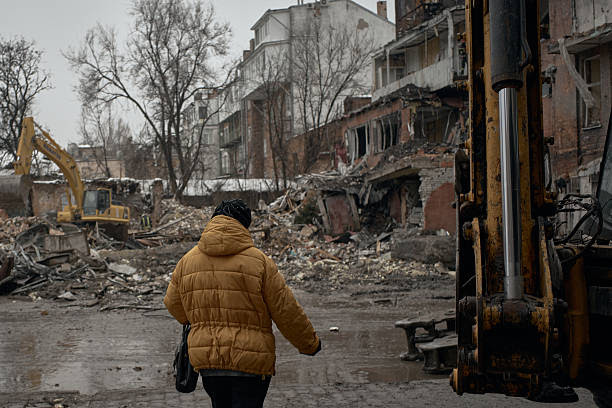
A local resident stands at the site of a Russian missile strike in the central part of Kharkiv following an attack. (Kostiantyn Liberov/Libkos/Getty Images)
Night of Sirens and Fire: When Russia Brought the War to Ukraine’s Homes
The sirens began before midnight.
From Taganrog in Russia’s Rostov Oblast, an Iskander-M ballistic missile lifted into the sky. Behind it came 95 drones—Shaheds, Gerberas, and attack UAVs—launched from Oryol, Primorsko-Akhtarsk, occupied Donetsk City, and occupied Hvardiiske in Crimea.
Ukraine’s air defenders fought them across the country.
The Air Force shot down 81 drones.
Fourteen still got through.
Eight locations were hit.
In Dnipro, explosions tore into residential districts. Acting regional head Vladyslav Haivanenko said at least ten people were wounded, including two children. Shattered windows, torn facades, and burned cars marked the blast zones.
In Kryvyi Rih, strikes wounded three civilians, according to Defense Council head Oleksandr Vikul. In Odesa Oblast and Zaporizhzhia City, Russian missiles and drones hit port and commercial infrastructure, killing two people and wounding eight more.
The targets were not bases.
They were homes.
Ports.
Workplaces.
And the timing was deliberate.
As diplomats sat in Paris debating ceasefire frameworks and security guarantees, Russia sent its answer through the night sky. The message was the same as it has been for nearly three years: pressure the cities, break the civilians, shape the battlefield before any paper agreement can.
Missiles for leverage.
Drones for terror.
Infrastructure for bargaining chips.
This is how Moscow negotiates—one crater at a time.
Ten O’clock Darkness: When Two Regions Went Cold at Once
The lights went out at 10 p.m.
In Dnipro, residents heard an explosion near a thermal power plant. Within minutes, entire neighborhoods fell dark. Authorities could not yet confirm which facilities had been hit—but the effect was immediate.
By morning, more than one million people across Dnipropetrovsk Oblast were without water and heating, according to Communities and Territories Development Minister Oleksii Kuleba. Hospitals switched to generators. The metro stopped running. Buses filled the streets. Mobile phone service flickered. Internet connections dropped.
The city was running on backup power.
Schools closed. Holidays were extended through January 9, with Dnipro pushing them to January 11. Energy crews from DTEK worked through the night, restoring electricity to critical infrastructure around 9:30 a.m., but the wider grid remained fragile.
Two hundred kilometers south, Zaporizhzhia Oblast went completely dark at the same hour.
A full regional blackout cut electricity and heating across the province. Power began returning after 3 a.m. Governor Ivan Fedorov called it “the first total blackout across the entire region in recent years,” though emergency services responded immediately.
The timing made it worse.
Ukraine is bracing for freezing temperatures, with daytime highs expected to fall below minus ten degrees Celsius next week. Hospitals are now dependent on generators. Families are heating rooms with what they can find. Entire cities are counting kilowatts and candles.
This is winter warfare.
Not at the front.
But in living rooms, hospital wards, and darkened stairwells.
Messages, Visas, and Handshakes: When Private Words Met Public Power
In Vilnius, a residency permit became a security question.
Lithuanian authorities opened a review of Russian opposition figure Leonid Volkov after his private messages surfaced with sharp attacks on Ukrainian officials. The Migration Department contacted the State Security Department to assess whether his statements posed a threat to national security.
The messages dated to late December. In them, Volkov welcomed what he believed was the death of Denis Kapustin, commander of the Russian Volunteer Corps fighting on Ukraine’s side. He called Kapustin a “Nazi” and a “gift to Kremlin propaganda.” The report was false—Ukrainian military intelligence had faked Kapustin’s death—but the words were real. Volkov also disparaged senior Ukrainian officials including Kyrylo Budanov, Andriy Yermak, and Mykhailo Podolyak.
When the messages became public, Volkov acknowledged sending the “sharp” note and said he “should have better controlled” his emotions. He reiterated his opposition to any “tactical alliance” with neo-Nazis. Under Lithuanian law, a foreigner’s temporary residence permit can be revoked if authorities judge their presence a national security risk.
While Vilnius weighed words and visas, Kyiv was doing diplomacy in daylight.
President Volodymyr Zelensky arrived in Cyprus for meetings with President Nikos Christodoulides and senior EU leaders as the island assumed the rotating presidency of the EU Council. Zelensky held bilateral talks with Christodoulides, European Council President Antonio Costa, European Commission President Ursula von der Leyen, and Moldovan President Maia Sandu.
Cyprus has pledged to make Ukraine’s EU accession a priority. The agenda included air defense support, drone production, Cyprus’s role in the Prioritized Ukraine Requirements List and the EU’s SAFE project, and progress on opening negotiating clusters.
Two tracks, one day.
Private messages reshaping public status.
Public meetings shaping Ukraine’s path into Europe.
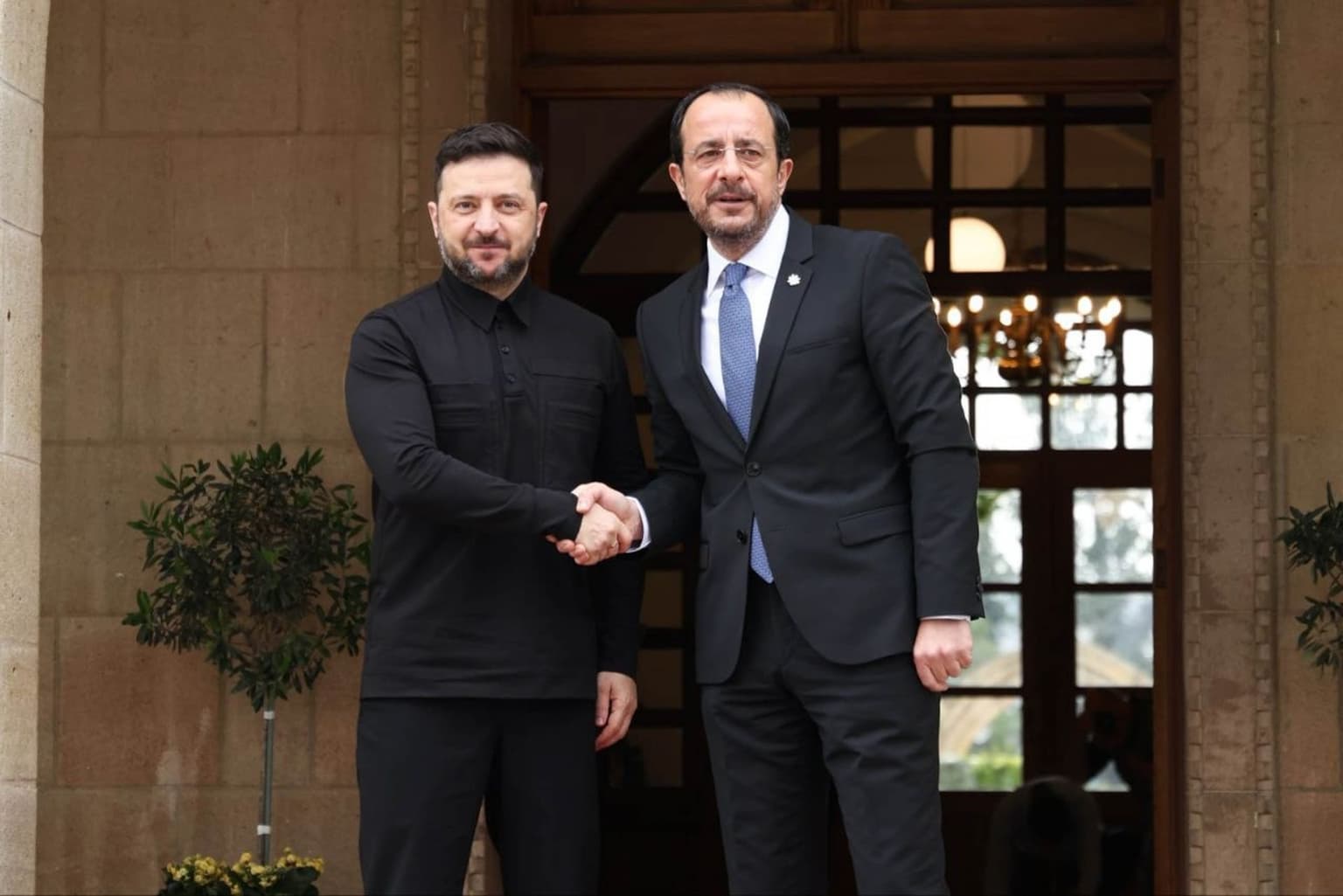
President Volodymyr Zelensky (L) meets Cypriot President Nikos Christodoulides in Cyprus. (President Volodymyr Zelensky/X)
From Game Chat to Battlefield: How Russia Turned Discord Players into Soldiers
It started in a chat window.
Two young men in South Africa were playing the military simulation game Arma 3 when a stranger using the handle “@Dash” struck up a conversation. The talk moved from tactics to opportunity. Then to travel. Then to contracts.
Within weeks, both men were on a flight through the United Arab Emirates to Russia.
Bloomberg reported that the pair, both in their twenties, signed one-year military contracts near St. Petersburg and were sent to basic training in early September. Not long after, one of them was rushed to the front as an assistant grenade launcher operator. He was killed near Verkhnekamenskoye in Luhansk Oblast on October 23, 2024.
His family learned the truth two months later.
A medical certificate arrived in December confirming he had died in October.
The recruitment trail ran through Cape Town, where “@Dash” met the pair in person before escorting them to the Russian consulate. They departed on July 29. Within weeks of arrival, one was already in combat.
South African law has banned citizens from fighting for foreign armed forces since 1998. Ukrainian Ambassador Olexandr Shcherba warned that at least seventeen South Africans had been “fooled” into fighting for Russia, calling it “especially insane” to see Africans “fighting a colonial war against a free country.”
The method reveals Russia’s deeper problem.
Unable to meet manpower targets at home, recruiters reached into gaming communities on a platform Russia itself had officially restricted. Young men with no connection to the war were offered money, citizenship, and education.
The path from joystick to rifle had never been shorter.
The Day’s Meaning — When Paper Promises Turned Into Steel and Orders
January 7 was the day the war stepped out of conference rooms and onto decks, runways, and deployment maps.
In the Atlantic, American commandos climbed the rail of a newly Russian-flagged tanker and took control of it under court order. Sanctions were no longer entries in spreadsheets or warnings from treasury departments. They were boarding teams, detention orders, and a ship under guard in open water.
In Paris, negotiators stopped arguing over principles and started drafting force structures. The talks moved past slogans about security guarantees and into questions of command chains, monitoring missions, and who would actually deploy when guns fell silent. The war’s end was no longer a concept. It was becoming an operational problem.
And on the battlefield, Russia’s expansion plans met the arithmetic of attrition. Military observers counted only four completed divisions out of seventeen promised. Casualties were consuming replacements faster than Moscow could build reserves. The army was adapting—shifting toward infantry-heavy formations with fewer armored vehicles—but it was also revealing the limits of its industry and manpower.
Three arenas. One reality.
Sanctions became seizures.
Diplomacy became blueprints.
Military ambition became constraint.
Together, they marked a turning point. The war entered a phase where abstract frameworks were being translated into physical preparations—ships detained, forces designed, deployments sketched. Whether those preparations would produce peace or simply a more organized confrontation remained unanswered.
Borders were still disputed.
Nuclear facilities were still unresolved.
Security guarantees were still theoretical.
But January 7 proved that the major players were no longer just talking about the shape of a post-war order. They were beginning to build it—while artillery still thundered across Ukraine and infantry continued fighting village by village.
The war had not paused for diplomacy.
Diplomacy had simply learned to move at the speed of war.
Prayer for Ukraine
1. Pray for civilian protection in cities under air attack.
Pray for families in Dnipro, Kryvyi Rih, Odesa, and Zaporizhzhia who endured missile and drone strikes. Ask God to shield residential neighborhoods, hospitals, schools, and shelters, and to protect children who are sleeping under the sound of sirens.
2. Pray for warmth, power, and medical resilience during winter blackouts.
Pray for the more than one million people in Dnipropetrovsk and Zaporizhzhia oblasts without heating and water. Pray for hospitals running on generators, for emergency crews restoring power, and for elderly and vulnerable residents facing sub-zero temperatures.
3. Pray for wisdom and integrity for leaders shaping Ukraine’s security future.
Pray for President Zelensky, European leaders, and American officials negotiating in Paris and Cyprus. Ask God to guide them as they design security guarantees, ceasefire monitoring, and post-war reconstruction frameworks.
4. Pray for protection and endurance for Ukrainian forces on the front lines.
Pray for soldiers holding forests, villages, and cities under constant attack. Pray for drone operators, medics, and infantry units facing daily combat, and for wounded soldiers trapped under fire.
5. Pray for the dismantling of the war’s supply and recruitment networks.
Pray that the oil trade, shadow fleet operations, weapons pipelines, and foreign recruitment networks sustaining Russia’s war effort would be exposed, disrupted, and shut down.