
Hours after Moscow dismissed Western security guarantees as “legitimate targets,” explosions rocked Lviv—turning diplomacy into theater and missiles into the message.
The Day’s Reckoning
At 11:30 p.m., air-raid sirens cut through western Ukraine. Minutes later, explosions rippled across Lviv Oblast as air defenses searched the sky for a ballistic launch traced to Kapustin Yar.
Earlier that day in Moscow, Maria Zakharova stood before cameras and rejected every pillar of the peace framework Ukraine, the United States, and Europe were finalizing. Multinational security forces, she said, were “militaristic declarations” from an “axis of war.” Any peacekeepers would be “legitimate targets.”
In Kyiv, President Volodymyr Zelensky told the nation the draft Ukraine–U.S. security agreement was “essentially ready.” Negotiations had reached “new milestones.” The architecture of a post-war order was taking shape.
In Lviv, windows shattered and fires flared after warnings of a ballistic launch from Russia’s Astrakhan region. Monitoring channels pointed to a possible Oreshnik intermediate-range missile. Officials could not yet confirm the weapon type. The uncertainty itself spread faster than the blast wave.
Across Ukraine, the day unfolded in parallel lines. Diplomats refined guarantees meant to deter future attacks. Russian officials dismissed those guarantees as acts of aggression. Intelligence services warned of a major overnight strike. Air defenses braced for impact.
This was day 1,415 of a war where talks and strikes move on separate clocks. Peace language advanced by paragraphs. Missiles advanced by minutes.
The meaning of the day was not subtle. While frameworks were drafted and signatures prepared, Moscow showed what it thinks of guarantees—and how it answers them.
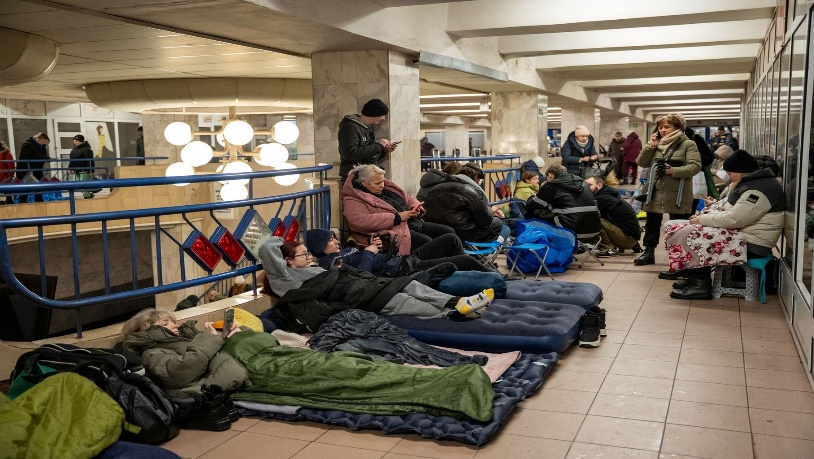
People take shelter at a metro station during Russian drone and missile attacks in Kyiv, Ukraine, amid Russia’s invasion of Ukraine. (Serhii Okunev / AFP via Getty Images)
“They Will Be Targets”: Moscow Turns Peacekeepers into Prey
The cameras were already rolling when Maria Zakharova stepped to the podium on January 8. Her words landed like a slammed door. The Western plan to deploy multinational forces to guarantee a future ceasefire, she said, was not peacekeeping at all. It was an “axis of war.” A provocation. An act of aggression.
Then came the line meant to echo far beyond the briefing room.
Any foreign troops sent to Ukraine, Zakharova warned, would be treated as “foreign intervention,” a “direct threat” to Russian security—and therefore “legitimate combat targets.” Peacekeepers would be hunted. Ceasefire guarantors would be shelled. The promise of stability would arrive under fire.
She did not stop there.
Reading from the Kremlin’s familiar script, Zakharova recited Moscow’s conditions for peace: Ukraine must accept neutrality and abandon its alliances. Its army must be cut below the level of self-defense. Its elected government must be replaced under the banner of “denazification.” Russian-speakers must be protected on Moscow’s terms. And Ukraine must recognize the “territorial realities” created by Russia’s staged referendums in 2014 and 2022.
Translation: surrender.
The territorial demand revealed the core of the ultimatum. Moscow wants Crimea and all of Luhansk, Donetsk, Zaporizhia, and Kherson—on paper, in law, and forever. Including cities and regions Russian forces never fully captured. Including land they failed to take on the battlefield.
Across the border in Kyiv, President Volodymyr Zelensky was telling Ukrainians the draft Ukraine–U.S. security agreement was “essentially ready.” Negotiations had reached “new milestones.” The architecture of peace was being drawn.
In Moscow, Zakharova set it on fire.
The message could not have been clearer. Russia was not negotiating. It was dictating. And the only peace it would accept was Ukrainian capitulation—no matter how elegantly that surrender might be wrapped in diplomatic language.
Midnight Over Lviv: When the Missile Itself Was Only Half the Weapon
At 23:30, phones across Ukraine lit up at once.
The air-raid alert was different this time. Specific. Urgent. The Ukrainian Air Force warned of a ballistic launch from Kapustin Yar in Astrakhan Oblast—the base where Russia is believed to store its Oreshnik intermediate-range missiles.
Minutes later, the sky over Lviv Oblast flashed.
Explosions rolled through the western city. Windows rattled. Car alarms screamed. Fire crews raced toward rising smoke as residents scanned the darkness, trying to understand what had just crossed half a continent to reach them.
Monitoring channels were already buzzing. BBC Ukrainian reported that unofficial trackers had detected launch activity at Kapustin Yar. Telegram channels claimed Russia had fired an Oreshnik. Videos surfaced showing multiple impacts in rapid succession—possibly the signature of a missile designed to release several warheads at once.
Russian milbloggers said the strike hit gas fields and storage facilities near Stryi. Lviv Mayor Andriy Sadovyi confirmed a series of powerful explosions. Regional military chief Maksym Kozytskyi said a critical infrastructure site had been hit.
Then the fog settled in.
Sadovyi later said it was “currently unknown” whether an Oreshnik had been used. Ukrainian officials could not identify the missile type. The blast was real. The damage was real. The weapon remained a question mark.
Earlier that afternoon, President Volodymyr Zelensky had warned of a “new massive Russian strike” overnight. The U.S. Embassy in Kyiv told staff it had received intelligence pointing to a significant air attack “over the next several days.” Something unusual was coming. Everyone felt it.
Russia has confirmed only one previous Oreshnik strike—against Dnipro in November 2024. Since then, the Kremlin has used the missile’s name as a threat, a reminder, a shadow over Western decision-making.
Whether Lviv was hit by an Oreshnik mattered less than what people believed it might have been.
The uncertainty was the point.
A city far from the front lines was reminded that nowhere is safe. Ukrainian air defenses were forced to prepare for every possibility. Western capitals were forced to imagine escalation.
The missile struck Lviv.
The doubt struck everywhere.
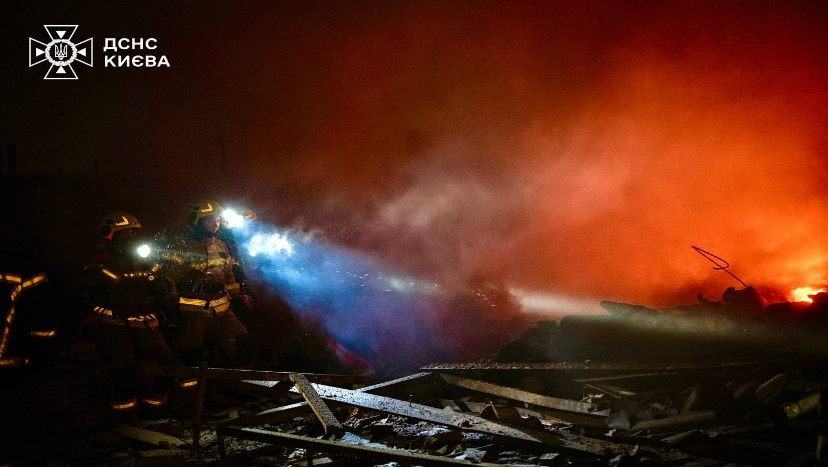
Emergency workers respond to a fire sparked by Russia’s mass missile and drone attack on Kyiv, overnight. (State Emergency Service/ Telegram)
The Ghost Tanker: How Bella-1 Slipped Through Flags, Front Men, and Sanctions
When the U.S. Coast Guard boarded the Bella-1 on January 7, they seized more than an oil tanker. They cracked open a floating ledger of shadow money, false flags, and political betrayal that stretched from Venezuela’s blacklisted ports to Moscow’s sanction-proof fleet.
The paper trail surfaced the next day.
Investigators traced the vessel—re-registered in late December under the name Marinera—to Burevestmarine, a Russian firm run by Ilya Bugai. Bugai, it turned out, also serves as CEO of Rusneftekhimtorg, a company owned by Viktor Baransky, a former Odesa city councilman who chose Moscow over Kyiv and lost his Ukrainian citizenship in 2024.
Follow the money and the names repeat.
Baransky is tied to Fides Ship Management and Rustanker—both sanctioned by the United States in 2021 for smuggling Venezuelan oil. Russian outlet Verstka reported that companies inside Baransky’s Palmira Group moved Venezuelan and Russian crude alongside Iranian goods. Different hulls. Same routes. Same playbook.
The Bella-1 itself had already been sanctioned for cooperating with Iran’s Revolutionary Guards Quds Force. Its December switch to a Russian flag was supposed to be a shield—a way to keep moving illicit cargo under Moscow’s protection.
But protection only lasts until it becomes inconvenient.
On January 8, Russia’s Foreign Ministry condemned the seizure, denied sanction-evasion, and insisted the ship had only “temporary permission” to fly a Russian flag. They carefully avoided calling it Russian—despite its Russian registration and ownership. The vessel, they admitted, had been headed to a Russian port.
The denial was choreography.
At the same time, The New York Times reported that five tankers operating in Venezuelan waters—all under U.S. sanctions—had quietly switched to Russian flags and declared home ports in Sochi and Taganrog.
Russia was handing out flags to shadow ships.
And disowning them the moment they were caught.
Armies on the Drawing Board: Russia’s New Units and the Men Who Aren’t There
On paper, the Russian army is growing.
Recruitment ads flickered across military sites and milblogger feeds in early January, calling for men to join a new formation: the 1244th Guards Artillery Brigade. The unit, a reserve element of the 31st Combined Arms Army, was advertised as a modern strike force—self-propelled guns, Giatsint-B and D-30 howitzers, Uragan and Grad rocket systems, drone battalions with Orlan, Zala, Supercam, even Lancet loitering munitions.
The equipment lists looked impressive.
The problem was the men.
Military analyst John Hardie reported that the brigade was likely based in Tver Oblast, though even its district assignment remained unclear. The unit existed in announcements, in job postings, in spreadsheets. Whether it existed in reality was another question.
A day later, Hardie traced another formation taking shape: the 76th Rocket Artillery Brigade in the Leningrad Military District. Its soldiers had marched in the May 2025 Victory Day parade in Luga. Regional officials in Kurgan confirmed many of the brigade’s recruits came from their oblast. Russian social media claimed the unit was operating in the “Chernihiv direction.” A letter from its commander spoke of “counterterrorism” operations along the Ukrainian border. Leaked documents placed it near Bryansk.
Different locations. Different labels. Same fog.
Hardie also tracked the attempted creation of an entire artillery division—the 34th—inside the Moscow Military District, complete with the 273rd and 303rd brigades. Ukrainian analyst Kostyantyn Mashovets had warned a year earlier that Russia was already missing its own deadlines to stand the division up.
All of it fit the blueprint drawn by then-Defense Minister Sergei Shoigu: rebuild the Moscow and Leningrad districts, expand the army, project strength.
But war eats faster than Russia can build.
Frontline units burn through manpower every day. Losses hollow out battalions. Veterans rotate out wounded or broken. The command can create designations, stamp seals, and publish order-of-battle charts.
What it cannot do is print trained soldiers.
Russia is building armies on paper while bleeding them in Ukraine. The formations look full in doctrine. In reality, they will likely arrive thin, understaffed, and incomplete—ghost divisions marching in parades, then disappearing into the arithmetic of attrition.
Britain Sends Shields into the Storm: Ravens and Gravehawks Join Ukraine’s Air War
The delivery came as Russia’s missiles were already in the air.
On January 6, Britain quietly moved 13 Raven air defense systems and two prototype Gravehawks into Ukraine. By January 8, as long-range strikes intensified, the news spread through military channels and command posts: new eyes and new interceptors had arrived.
For Ukraine’s air defenders, every night is a calculation under pressure. Protect the front or the rear. A power plant or a hospital. The east or the west. Russia’s missile and drone campaign is built to stretch those defenses thin and force choices measured in lives and megawatts.
Ravens and Gravehawks narrow those gaps.
Each system thickens the defensive net. Each radar widens the search. Each launcher forces Russian planners to spend more missiles and drones to achieve the same damage. Attrition shifts when interception becomes routine.
The timing mattered. On January 8, President Volodymyr Zelensky warned of another major overnight strike. The U.S. Embassy in Kyiv told staff it had intelligence pointing to a significant Russian air attack in the coming days. Infrastructure was once again in the crosshairs.
Thirteen Ravens and two Gravehawks will not stop every missile.
But they are not promises. They are hardware. And in a war fought across the sky, hardware is survival.
A Village in the Fog of War: Who Holds Andriivka Tonight?
The denial came sharp and public.
On January 8, Ukraine’s “Kursk” Group of Forces pushed back against reports that Russian troops had captured the village of Andriivka in Sumy Oblast. The claim, first mapped by the DeepState project a day earlier, was dismissed outright.
“Andriivka was and remains under the complete control of the ‘Kursk’ Group of Forces,” the statement read. “There can be no question of its occupation.”
But Andriivka sits less than five kilometers from the Russian border, and it has lived this story before. Russian troops took it in June 2025. Ukrainian forces liberated it in August. Now, after months of Russian pressure across Sumy Oblast, its status is once again contested.
Behind the statements, the fighting told a harder story.
On January 7, Russian forces launched a coordinated assault between Andriivka and nearby Oleksiivka. Five assault groups tried to slip through Ukrainian lines using a gas pipeline—the same tactic that had worked for Russian units near Kupyansk. All-terrain vehicles followed, pushing toward Ukrainian positions.
The attempt failed.
Russian milbloggers said shelling of Andriivka began in December to soften defenses. Others claimed Ukrainian soldiers were still inside the village even after Moscow declared it seized on January 7 and again in late December.
Maps show lines.
Soldiers fight in fields, basements, and trenches.
In places like Andriivka, both sides can claim control at once—because control is not a flag on a map. It is who survives the night.
Across the Frozen Line: Infiltrators, Flags, and the Slow Grind Forward
The fighting never stopped on January 7 and 8. It only shifted shape.
In Sumy Oblast, Russian units pushed southwest of Yablunivka and probed toward Andriivka, Oleksiivka, and Yunakivka. Naval infantry moved south of Oleksiivka. Airborne drone crews hunted Ukrainian positions. The advances were small. The pressure was constant.
Near Kharkiv, Russian forces pressed along villages already chewed into rubble—Zelene, Vovchansk, Vilcha—testing for cracks that never quite opened.
East of Kupyansk, Russian soldiers slipped forward in camouflage suits during bad weather, filming themselves waving flags in Podoly before disappearing again. Ukrainian troops hunted them through basements and alleys. Some attackers wore civilian clothes. Some came through pipelines. None came in daylight.
South near Borova, Ukrainian units pushed back toward Zahryzove while Russian tanks fired from treelines. In the forests around Lyman, Russian assault groups tried again to widen their footholds. They were met by artillery and drones.
Outside Kostyantynivka, Russian infantry crept into the eastern outskirts under drone cover. FPV teams struck Ukrainian supply routes. Fiber-optic drones stretched kill zones out to twenty kilometers—until winter winds snapped their cables.
Near Pokrovsk, Russian commanders pushed mechanized columns toward Rodynske and Hryshyne, trying to cut the city’s lifelines. In Myrnohrad, urban fighting burned room by room. Infiltration teams moved in groups of two and four, hunting for weak doors and open cellars.
Further south, tanks rolled toward Novopavlivka and were burned by Ukrainian drones. In Hulyaipole, Russian soldiers planted a flag in Bratske for the cameras—then vanished again.
Everywhere, the pattern repeated.
Russia advanced by meters. Ukraine held by blood.
No breakthroughs. No collapse.
Just the slow arithmetic of a war that grinds forward village by village.
Fire in Moscow, Drones in Chechnya, Sabotage on the Border
The flames rose over Moscow before dawn.
Geolocated footage posted on January 7 showed a large fire tearing through the Salyut plant inside the Russian capital. The facility, operated by state defense giant Rostec, builds and services engines for both military and civilian aircraft. By morning, the blaze was already circulating across Russian opposition channels.
Hundreds of miles south, in Chechnya, another target was hit. A Chechen opposition outlet reported that Ukrainian drones struck the Vladimir Putin Spetsnaz University in Gudermes—a training center tied directly to Russian special forces. The Russian Defense Ministry claimed its air defenses shot down a Ukrainian drone somewhere in the republic. It did not address the strike itself.
Then came the quietest operation.
On January 8, the Freedom of Russia Legion revealed that its sabotage teams had destroyed 15 KamAZ, Ural, and ZIL trucks belonging to Russia’s 350th Motorized Rifle Regiment in Kochegury, Belgorod Oblast. The village sits just 65 kilometers from the front. The trucks were part of a logistics hub moving troops and ammunition toward Ukraine.
The explosions in Moscow were loud.
The drone in Gudermes was symbolic.
But in Kochegury, a regiment woke up without its wheels.
Keeping the Lights On: Europe Sends Power to a Country Under Fire
The money arrived with the weight of survival behind it.
On January 8, Ukraine’s largest hydropower company secured a 75 million euro lifeline from the European Bank for Reconstruction and Development. The loan will buy replacement parts, stockpile critical supplies, and restore turbines and generators damaged by Russian missile strikes. It will also modernize aging equipment that now runs under wartime stress.
The funding is part of a broader 120 million euro recovery package, backed by 20 million euros in international grants and Ukrhydroenergo’s own reserves. Engineers will be retrained. Environmental standards strengthened. A gender action plan implemented. The grid will be rebuilt not just for today, but for what comes after.
Ukraine gets about 10 percent of its electricity from hydropower. Russia knows that. Its missiles have repeatedly targeted the dams and plants that keep cities lit and hospitals running. Ukrhydroenergo’s Zaporizhzhia facility lost a third of its generating capacity after strikes in 2024. In June 2023, Russian troops blew up the Kakhovka dam, flooding entire regions and triggering a humanitarian catastrophe.
The destruction has cost Ukrhydroenergo $2.7 billion. Rebuilding could take seven years.
“This will enhance the reliability of hydropower plants and the stability of Ukraine’s power system,” said supervisory board chairman Valentyn Gvozdiy. For Ukraine’s engineers, that means fewer blackouts. For families, it means heat in winter and light after dark.
The loan is backed by an EU guarantee under the Ukraine Investment Framework. It follows a 200 million euro package signed with Italy in 2024.
In a war where electricity is a weapon, this was power delivered in another form.
Frozen Gas, Flowing Money: Europe’s Billions Still Fuel Moscow’s War
The tankers kept coming through the ice.
On January 8, German watchdog group Urgewald published a report that cut through Europe’s sanctions promises with a hard number: Russia’s Yamal LNG terminal shipped 7.2 billion euros worth of liquefied natural gas to Europe in 2025—even as the European Union prepares to ban Russian gas.
The ban is coming. Russian pipeline gas is set to be prohibited starting January 1, 2028. LNG imports will be blocked beginning in 2027.
But for now, the money still flows.
Using data from global tracking firm Kpler, Urgewald found that Yamal LNG alone accounted for nearly 15 percent of all LNG imported into the EU. Of the terminal’s 19.7 million tons exported last year, more than 15 million tons went to European ports. France took the largest share—6.3 million tons. Belgium’s Zeebrugge terminal absorbed another 4.2 million.
“This trajectory suggests the EU will continue to funnel billions of euros to Moscow for at least another year,” Urgewald warned.
The irony is logistical. Yamal depends on specialized Arc7 ice-class tankers to move gas through the frozen Arctic routes. Those ships have no viable alternative destination.
Cut the routes, and the terminal stalls.
“Without these vessels, Yamal’s operations would reach a total standstill,” Urgewald noted—especially during the brutal winter months.
The report landed as President Trump pressed Europe to accelerate a full Russian energy embargo. After months of holding back, he sanctioned Rosneft and Lukoil in October. Senator Lindsey Graham said a bipartisan Russia sanctions bill could reach the Senate floor within days.
Europe has drawn the line.
But the tankers are still crossing it.
A Watchdog for Wartime Business: Feldhusen Takes the Helm in Kyiv
The Cabinet decision came quietly on January 7.
Anka Feldhusen—Germany’s ambassador to Ukraine from 2019 to 2023—was approved to become the country’s next business ombudsman, stepping into the role in February as Ukraine fights not only a war, but corruption, bureaucracy, and exhaustion on its home front.
She replaces Roman Washchuk, the former Canadian ambassador who spent four years pressing ministries and regulators to clean up practices that strangle legal businesses while letting shadow firms thrive. Feldhusen was chosen in November after an international competition run by the EBRD-appointed firm Boyden. There were no Ukrainian applicants.
The office she inherits is not a courtroom. It is a pressure valve.
Since its creation after the EuroMaidan Revolution in 2014, the Business Ombudsman Council has acted as a mediator between entrepreneurs and the state—taking complaints about abuse of power, malpractice, and corruption and forcing them into daylight. It has operated as an independent body since 2015, backed by the EU and a multi-donor fund managed by the EBRD.
“The continuity of the council’s work is critically important,” the Economy Ministry said, when Feldhusen’s appointment awaited approval. For companies trying to survive wartime taxes, inspections, and regulation, trust in the state is as fragile as supply lines.
Washchuk used public pressure to force reforms and curb illegal, tax-dodging firms. Feldhusen now inherits that mission at a moment when every honest business is part of Ukraine’s economic defense.
Her job begins in February.
The war is not waiting.
A Joke at the Edge of War: Zelensky Invokes Maduro and Names Kadyrov
The room laughed. Then it went quiet.
On January 7, President Volodymyr Zelensky leaned into the microphone and urged Washington to press harder—much harder—on Moscow. The United States, he said, had the tools. It knew how to use them. And when it truly wanted results, it moved fast.
Then he reached for an example.
“Look at Maduro,” Zelensky told reporters, referring to Venezuela’s captured leader. “They carried out an operation. The whole world saw the result. They did it quickly. Let them do something like that with—what’s his name—Kadyrov. With this murderer. Maybe then Putin will think twice.”
The line drew nervous smiles. The point landed anyway.
The quip came days after U.S. forces launched major strikes in Venezuela, Moscow’s ally, captured Nicolas Maduro and his wife, and flew them to the United States to face narcoterrorism charges. Regime change by precision raid.
Kadyrov, who calls himself “Putin’s foot soldier,” has ruled Chechnya since 2007. His domain is infamous for disappearances, torture, and extrajudicial killings. The United States and its allies have sanctioned him and his family for years.
Zelensky’s dark humor arrived as U.S.-led peace talks pushed forward and Russia refused to stop fighting. He said negotiations had reached a “new milestone” with European partners and Washington, and that a draft Ukraine–U.S. security agreement was “essentially ready,” pending President Trump’s approval.
Washington plans to engage Moscow directly, Zelensky acknowledged. Ukraine expects to see whether the aggressor is serious.
Because, he said, guarantees only matter if pressure follows.
The Day Diplomacy Spoke While Missiles Answered
January 8, 2026 unfolded like two different worlds sharing the same clock.
In conference rooms, diplomats refined security guarantees and finalized deployment frameworks. In briefing halls, Maria Zakharova dismissed every proposal as an “axis of war.” In western Ukraine, explosions rolled across Lviv Oblast as preliminary reports suggested Russia had fired an Oreshnik missile. On the front lines, Russian assault groups crawled through gas pipelines and snow-choked fields.
Peace was being discussed.
War was being executed.
The contradiction was not an accident. It was the design.
Moscow stayed at the table while rejecting every outcome the table could produce. It talked frameworks while rejecting guarantees. It discussed timelines while firing missiles. It negotiated publicly while grinding forward privately, turning meters of frozen ground into bargaining chips for some future deal.
Zakharova’s message stripped away the pretense. Russia would accept only Ukrainian neutrality that meant no protection. Demilitarization that meant no defense. Denazification that meant regime change. Territorial recognition that meant surrendering land Russia had not even fully conquered.
These were not peace terms.
They were ultimatums.
The reported Oreshnik launch served its purpose whether confirmed or not. The threat of intermediate-range missiles over western cities carried psychological weight far beyond the blast radius. Uncertainty itself became a weapon.
While Britain delivered air defense systems and Europe approved emergency energy loans, Russia demonstrated its timeline was different. It could wait. It could grind. It could bleed Ukraine’s infrastructure and manpower while betting Western attention would fade.
Shadow tankers slipped through sanctions. New Russian units formed on paper. Infiltration teams moved at night. Drones hunted supply roads. The machinery of war kept turning.
Zelensky joked about Kadyrov meeting Maduro’s fate because humor was the only language left to express the absurdity: negotiations advancing while cities burned.
On this single winter day, the distance between diplomatic language and battlefield reality stretched wider than ever.
Missiles spoke louder than meetings.
And Russia made clear it intended to let them.
Prayer for Ukraine
- Pray for protection over Ukrainian cities and civilians as Russia continues long-range missile and drone strikes, especially over western regions like Lviv that were previously considered safer. Ask that air defenses be strengthened, warnings be heeded, and lives be spared during nightly attacks.
- Pray for frontline defenders holding the frozen lines in Sumy, Kharkiv, Kupyansk, Kostyantynivka, Pokrovsk, and Zaporizhzhia directions, where Russian forces are advancing by infiltration, drone warfare, and mechanized assaults. Ask for endurance, clarity under pressure, and protection for units fighting in brutal winter conditions.
- Pray for wisdom and resolve among Western leaders as security guarantees and peace frameworks are finalized. Ask that negotiations not drift into illusion or delay while Russia continues fighting, and that pressure on Moscow be real, unified, and effective.
- Pray for Ukraine’s critical infrastructure and energy system, especially hydropower facilities repeatedly targeted by Russian missiles. Ask that new funding, repairs, and air defenses keep electricity flowing to homes, hospitals, and frontline industries through the winter.
- Pray for moral clarity and courage inside Russia and occupied territories, where sabotage, resistance movements, and truth-telling continue despite repression. Ask for protection over those undermining Russia’s war machine from within and for cracks to widen inside the system sustaining the war.