
As Britain turns security guarantees into budget reality, Russia answers with missile threats, drone swarms, and a winter campaign designed to freeze Ukrainian cities into submission.
The Day’s Reckoning
The money came first.
In London, line items appeared in a defense budget that hadn’t existed before: vehicle upgrades, communications gear, force-protection equipment. £200 million set aside to prepare British troops for deployment to post-war Ukraine. Not a speech. Not a communiqué. A purchase order.
Across Europe, Moscow answered with threats.
Russian officials warned that any Western forces sent to Ukraine would be “legitimate targets.” The language was blunt, meant to travel quickly through foreign ministries and newsrooms. Deterrence by declaration. Fear by press release.
And while capitals traded statements, the lights went out.
In Dnipropetrovsk Oblast, Russian drones punched into the electrical grid. One hundred thousand families lost power as temperatures slid toward minus ten. Apartments darkened. Radiators cooled. The mathematics of winter returned: no electricity meant no heat, and no heat meant danger measured in hours, not days.
Three theaters. One day.
A war that began with tanks crossing borders now stretched from parliamentary chambers to frozen stairwells. Britain budgeted for a future presence. Russia promised missiles for anyone who dared show up. Ukrainian civilians wrapped themselves in coats inside their own homes.
This was day 1,417 of a conflict that no longer resembled its opening act. A war where security guarantees are written in spreadsheets. Where drones are redesigned every six weeks. Where survival depends on whether an interceptor arrives before a transformer explodes.
On January 10, the geography widened. The commitments hardened. And winter pressed its advantage.
Europe prepared.
Russia threatened.
Ukraine shivered.
The shape of the next phase was already visible.
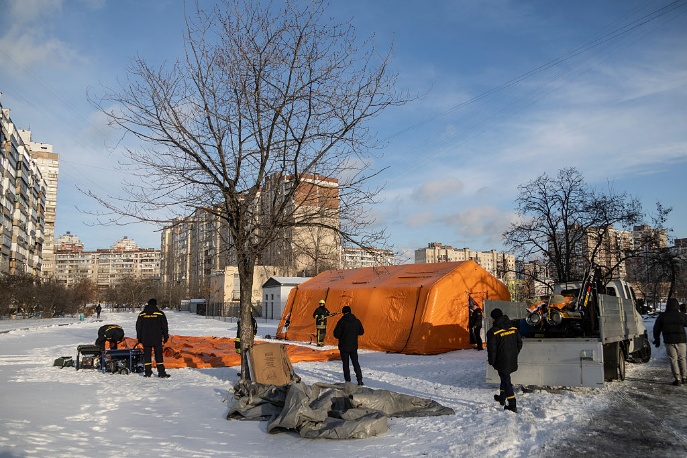
Kyiv State Emergency Service workers are setting up tents to warm people whose homes were left without heating, following Russian attacks on critical infrastructure on Jan. 9, 2026, as numerous districts of Kyiv remain without heating and water. Emergency and scheduled power outages are being implemented across the city. (Andriy Dubchak/Frontliner/Getty Images)
When the Spreadsheet Became a Promise: Britain Puts Boots on the Balance Sheet
The story was written in procurement codes.
Vehicle upgrades. Communications kits. Counter-drone systems. Force-protection gear. Not the language of speeches or summits—but the quiet grammar of deployment. The kind of items you only buy when you expect people to use them.
On January 10, Britain put £200 million into its defense budget to prepare troops for service in post-war Ukraine. Not for exercises. Not for planning conferences. For a real mission, in a real country, with real risks. It was the first time a NATO member had written future security guarantees into an actual budget.
A down payment.
European leaders had talked for months about a multinational assurance force under the Coalition of the Willing. London was the first to move from words to wiring diagrams.
The timing was not subtle.
As Russian officials escalated threats—warnings that Western troops would be “legitimate targets”—Britain answered with purchase orders. Dmitry Medvedev spoke. Maria Zakharova sharpened the language. And the British Treasury signed the check.
Translation: we heard you. We’re going anyway.
Moscow reacted as expected. Western guarantees were “unacceptable.” Foreign soldiers would be treated as enemy combatants. But the threats landed differently now. Britain wasn’t proposing to march on Russian soil. It was preparing to deploy to a sovereign state that had invited help—after a peace deal Russia itself would be asked to sign.
The argument revealed the gap.
Russia demanded veto power over who Ukraine could invite onto its own territory. International law said otherwise.
And beneath the politics was the larger shift. The equipment Britain was buying wasn’t just for Ukraine. It was for a future where European security depends on European forces. Where Washington’s priorities rotate and Europe can no longer outsource deterrence.
The war has taught hard lessons.
And on January 10, one of them became a budget line.
When Moscow Points the Missile at the Peacekeepers
The warnings rolled out on social media first.
Dmitry Medvedev posted in English so no one would miss it: Russia could use its new Oreshnik missiles against European or NATO troops sent to post-war Ukraine. The verb mattered. Could, not will. A threat polished for diplomats and headlines alike.
Then came the chorus.
Leonid Slutsky, who chairs the Duma’s foreign affairs committee, said retaliation for any “blatant violations of red lines” would be inevitable. Maria Zakharova sharpened the blade: any such units and facilities would be treated as legitimate military targets.
It was deterrence by declaration.
The Kremlin was brandishing its newest symbol—the intermediate-range Oreshnik missile, recently fired toward Lviv and built for nuclear payloads—and aiming it at the idea of peacekeepers. The goal was to make European capitals picture convoys and cantonments under the same flight path. To turn planning meetings into political risk.
This was theater with a live prop.
But the stage reaction went the wrong way.
Instead of freezing London into caution, the threats pushed Britain to put money on the table. £200 million for vehicles, comms, counter-drone gear—everything needed to move and survive in a war zone. The very deployment Moscow warned it might strike became a line item.
Deterrence inverted.
The message from Moscow was meant to say: Don’t come.
The answer from London read: We’re budgeting anyway.
By tying its intimidation to a missile designed for strategic shock, Russia hoped to scare Europe out of commitment. Instead, it forced a choice—and watched a government choose to prepare.
The Kremlin wanted anxiety.
It got procurement.
The Drone That Flips the Math: How Ten Percent Hunts One Hundred
The factory lines are about to start moving.
On January 10, Britain’s defense secretary, John Healey, announced that the UK would begin producing Ukraine’s “Octopus” interceptor drone—thousands a month, starting in 2025. Not for trials. Not for prototypes. For the sky that hums every night over Ukrainian cities.
The math is the point.
Each Octopus costs less than ten percent of the Russian Shahed it’s built to kill. A cheap hunter chasing an expensive predator. For the first time in this war, the economics tilt against mass drone terror. If it costs Moscow ten times more to attack than it costs Kyiv to stop the attack, the swarm becomes a liability.
But the Octopus isn’t just a bargain. It’s a clock.
Healey said the design will be updated every six weeks. Not annually. Not after field reports stack up. Every six weeks—because Russia changes its drones that fast. Cameras added to hunt moving trains. Thermobaric warheads for bigger blast. Even shoulder-fired air-defense systems bolted on, turning strike drones into flying traps.
Each tweak demands a counter. Each counter becomes the next version.
This is war as software.
The winner isn’t the side with the biggest stockpile. It’s the side that ships updates faster.
For Ukraine, the interceptors mean more than saved transformers and quiet nights. They mean a chance to make Russia’s long-range campaign unsustainable. Moscow can build Shaheds by the thousand. But if every launch bleeds cash faster than it breaks power, the strategy collapses under its own weight.
For Europe, the line matters too. Russia’s drone factories won’t stop at Ukraine’s borders. The architecture being built now—cheap interceptors, fast iteration, industrial scale—is the skeleton of future air defense.
Britain is betting that production can outrun terror.
That factories can answer flight paths.
That ten percent, multiplied by speed, can defeat one hundred.
Cold as a Weapon: The Night Dnipropetrovsk Went Dark
The power failed before the temperature did.
Overnight on January 10, Russian drones tore into Dnipropetrovsk Oblast’s grid, and 100,000 families watched their lights blink out. The forecast slid toward minus ten. In apartments built for Soviet-era central heating, electricity is heat. When the sockets go dead, the radiators follow—and winter moves in.
DTEK crews rolled before dawn, chasing damage reports across districts. The Air Force said 94 of 121 drones were intercepted. The 27 that got through were enough. That’s the math of this campaign: you don’t need every drone to hit—only enough to break the system.
Inside dark stairwells, neighbors counted candles. Parents layered coats on children. Elderly residents boiled water while it was still possible and listened for the next engine overhead. Three people were injured in the overnight strikes. The harder tally would come later, measured in cold rooms and ambulance calls.
The attack followed a daylight strike the day before that killed a 43-year-old man in the oblast. The pattern is seasonal and deliberate.
Across the country, the map lit up with red.
In Donetsk Oblast, one civilian was killed and two wounded. In Zaporizhzhia, Russian guns fired 743 times in 24 hours, injuring three. In Kharkiv, a 56-year-old woman was hurt as shelling punched through eleven apartment blocks, cars, and farm warehouses. In Kherson, six were injured when shells tore into homes and a gas pipeline.
These aren’t battlefield moves. They are messages.
Make life unlivable.
Turn winter into leverage.
Force civilians to choose between staying and surviving.
On January 10, the cold wasn’t just weather.
It was policy.
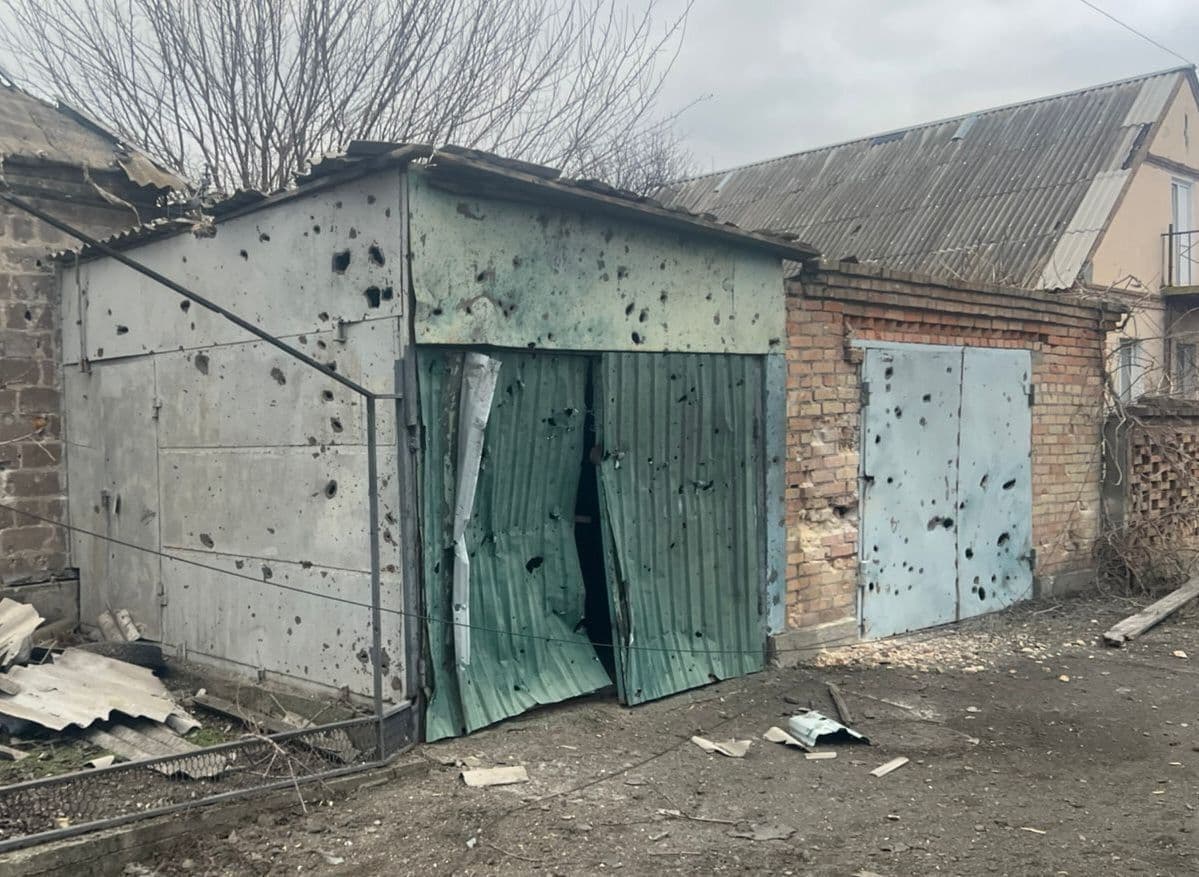
A damaged garage in Nikopol region. (Oleksandr Hanzha/Telegram)
Fire in the Heartland: When Ukraine Reaches Volgograd
The flames rose where war was never supposed to go.
Overnight on January 9–10, Ukrainian drones flew deep into Russia’s southern interior and found the Zhutovskaya oil depot in Oktyabrsky Raion, Volgograd Oblast. A fuel hub that fed Russian forces. A place mapped for pipelines, not air defense.
By morning, geolocated footage showed smoke curling above the tanks. NASA satellites marked the heat. And the governor reached for the familiar script: the strike had been “repelled,” he said, but “debris” caused a fire. The ritual denial—admit the blaze, deny the breach—as if falling fragments ignite fuel farms on their own.
It didn’t matter. The message had already traveled.
While Russian missiles were flying 1,500 kilometers west toward Lviv, Ukrainian drones were flying roughly the same distance east. The ranges matched. The risks matched. The illusion of distance did not.
Volgograd sits far from the front. For decades, that mattered. Geography meant safety. Depth meant time. Rear areas stayed rear.
Not anymore.
This war has stretched the map until the edges touch. There is no clean line between battlefield and backyard. No sanctuary behind rivers and rail hubs. The old grammar of war—front and rear, safe and exposed—has collapsed into a single, continuous sky.
For Russians living near depots and plants, it means a new routine: checking alerts, counting seconds, learning the sound of engines overhead. Distance no longer buys sleep.
For Ukrainian planners, Russia’s vastness has flipped from shield to weakness. An enormous perimeter, impossible to seal. Thousands of kilometers of fuel farms, substations, and depots that small, cheap drones can reach.
The strike in Volgograd wasn’t about one depot.
It was about telling a country that once believed in strategic depth that depth is gone.
The war has arrived everywhere.
Three and a Half Kilometers: The Forest That Eats Armies
The battle didn’t have a name. It had a distance.
Three and a half kilometers of forest north of Sumy City. Trees packed tight. Mud underfoot. Ukrainian and Russian positions tangled together like roots. No clear line. No clean rear. Just a narrow strip of land that Russian commanders had been trying—and failing—to take for months.
On January 10, Russian units pushed again. Attacks rolled north of Sumy toward Mala Korchakivka, northeast toward Myropillya, and southeast near Hrabovske. Artillery spoke. Drones hovered. Infantry moved.
And the line did not.
One Russian milblogger tied to the Northern Grouping of Forces described what the official communiqués never show. The commander of the 1st Motorized Rifle Regiment planned to send two companies into that same forest. The same ground where earlier units had vanished into shellfire and never broken through. The same ground that had swallowed months of effort.
The troops already there, he wrote, were in complete disarray. No food. No water. No rotation. Men living in holes while drones watched every path and artillery registered every clearing.
Three and a half kilometers.
Not a city. Not a river crossing. Not a highway. A patch of trees that cost lives one squad at a time.
This is the war when the cameras leave.
While missiles fly 1,500 kilometers and drone factories hum, infantry crawl through wet leaves and broken branches. While speeches promise victory, men trade blood for meters. While maps show arrows, soldiers measure progress in tree lines held for a single night.
In Sumy Oblast, the front didn’t move.
But the cost kept climbing.
And somewhere in that forest, another company waited for the order to walk into the same killing ground their predecessors could not cross.
A Step Forward Under Fire: The Ground Kyiv Took Back
The message was brief. The meaning was not.
On January 10, Ukraine confirmed an advance in the Kostyantynivka–Druzhkivka sector. No map. No coordinates. No victory video. Just the acknowledgment that Ukrainian troops had pushed the line forward.
In this war, that usually means hundreds of meters.
A trench cleared. A tree line retaken. A position wrestled from shellfire and held through counterattacks. Ground that must be walked, searched, secured, and then defended while drones circle overhead and artillery waits for the first mistake.
Operational security kept the details quiet. The soldiers who moved forward already knew what it cost.
The advance mattered because it happened at all.
Russia holds the advantage in numbers and guns. More men. More barrels. More shells. Yet Ukraine keeps finding seams—places where discipline, planning, and timing still beat mass. Every step forward forces Russian commanders to shift reserves, reroute supply, and abandon attack plans written for a line that no longer exists.
Momentum in this war is measured in pressure.
Take a few hundred meters here and the enemy must respond there. Push the line in Kostyantynivka and something breaks near Toretsk. Gain a ridge and an entire battery has to relocate.
January 10 showed the board in motion.
In the north, Russia pressed forests for months without gain. In the east, Ukraine clawed back ground in the middle of Russia’s offensive push. No breakthrough. No collapse. Just the steady exchange of space for blood.
This is what progress looks like now.
Not flags on city halls.
Not columns on highways.
But a line nudged forward under fire.
And soldiers digging in where yesterday belonged to the enemy.
Warships for Oil: The Day the Shadow Fleet Found Its Friends
The flags told the story before the speeches did.
In South African waters on January 10, warships lined up for the opening ceremony of Chinese-led naval drills called “Will for Peace 2026.” Russia. Iran. China. South Africa. Observers from Brazil, Egypt, Ethiopia, and Indonesia. An unlikely armada gathered beneath a banner about “protecting maritime economic activity.”
The phrase was diplomatic varnish.
Everyone knew what it meant.
In the weeks before, U.S. forces had boarded and seized five tankers tied to Russia’s shadow fleet—the rusting, flag-hopping ships that move sanctioned oil and fund Moscow’s war. One of them, the Marinera, sailed under a Russian flag. The message from Washington had been blunt: the sea lanes are no longer a sanctuary.
So Moscow and its partners answered with steel.
Naval drills focused on “shipping safety” were a signal to anyone watching the tanker routes: pressure on Russian oil will be met with presence. Interdiction with intimidation. Boarding ladders with gun decks.
South Africa’s role carried weight. Pretoria had walked a careful line since the invasion—neutral on paper, trading in practice. Hosting Russian warships alongside Chinese and Iranian vessels moved the needle. It said where priorities lie when sanctions collide with energy and commerce.
The choreography mattered.
This was not about search-and-rescue. It was about escort and denial. About reminding insurers, port authorities, and shipping firms that a shadow fleet can travel with friends.
What began as a land war in eastern Europe now steamed through the Indian Ocean. Sanctions became sea power. Oil flows became naval formations. The fight over Ukraine’s future reached the capes and currents of the Global South.
On January 10, the shadow fleet did not just hide.
It assembled.
And the ocean became another front.
From Tehran’s Streets to Ukraine’s Skies: The Regimes That Fear Their People
The message crossed borders as easily as the drones.
On January 10, Ukraine’s foreign minister, Andrii Sybiha, spoke directly to Iran’s streets. As protests surged across more than one hundred cities—from shopkeepers shuttering their doors to crowds filling squares over collapsing currency and runaway inflation—Sybiha drew a line from Tehran’s crackdowns to the explosions over Ukrainian neighborhoods.
“Iran’s support for Russia’s war of aggression and its oppression of its own citizens are part of the same policy of violence and disrespect for human dignity,” he wrote.
The demonstrations that began on December 28 had grown into the most serious challenge to Ayatollah Khamenei’s rule in years. Tens of thousands poured into the streets. Government buildings burned. Security forces clashed with crowds. When authorities cut the internet on January 8, the protests continued anyway.
For Ukrainians watching Shahed drones scream across their skies, the connection felt personal. The same factories that build weapons for Russia are run by a regime now beating and arresting its own people for demanding a livable future.
Kyiv’s statement was more than solidarity. It was strategy.
Iran’s drone production depends on stable supply chains, trained engineers, and political control. Mass unrest threatens all three. And global attention on Tehran’s repression complicates its partnerships with governments trying to stay “neutral” on Ukraine while doing business with Moscow’s suppliers.
Sybiha reached for history to make the point.
“As a country that has overcome totalitarian and authoritarian rule,” he wrote, “that protested oppression and defended its democratic choice,” Ukraine stands with those now doing the same in Iran.
From Kyiv’s Maidan to Tehran’s boulevards, the pattern is familiar: regimes that fear their people export violence abroad and import fear at home.
And when citizens rise, dictators reach for batons, bullets—and drones.
The Day’s Meaning: When Commitments Stopped Being Abstract
January 10 was the day the war stepped off the page and into the ledger.
In London, security guarantees became procurement. Vehicles, comms, counter-drone kits—£200 million set aside to prepare British troops for post-war Ukraine. Not a pledge. Not a promise. A purchase order. In this war, budgets speak louder than communiqués.
Moscow answered with threats. “Legitimate targets,” they said. The intent was to freeze Europe into hesitation. It did the opposite. The more Russia pointed missiles at peacekeepers, the more Europe priced out the mission. Intimidation hardened into resolve.
At the same time, the shape of modern war sharpened. Britain’s decision to mass-produce Ukrainian “Octopus” interceptor drones—updated every six weeks—signaled a new model of defense: speed over scale, iteration over inventory. Survival now belongs to whoever ships updates faster than the enemy changes tactics.
And beneath the theater, the grind never paused. Three and a half kilometers of forest north of Sumy still swallowed companies. One hundred thousand families in Dnipropetrovsk lost power as temperatures slid toward minus ten. In Zaporizhzhia, hundreds of shellings blurred into routine. The arithmetic of attrition kept ticking.
This was the convergence: grand strategy and cold stairwells, missile warnings and factory lines, spreadsheets and foxholes. Europe’s intent is no longer in doubt. The money says so.
The question now is time.
Can preparation outrun pressure?
Can production beat persistence?
Can commitments arrive before the winter and the meters take their toll?
January 10 didn’t just show where the war is going.
It showed how fast it has to move.
Prayer For Ukraine
- Pray for protection over Ukraine’s cities and energy workers as winter deepens — that repair crews are shielded from attack, power is restored quickly in Dnipropetrovsk and other regions, and civilians are kept safe from the freeze campaign.
- Pray for Ukrainian soldiers on the front lines — especially those fighting in the forests north of Sumy and around Kostyantynivka — for endurance, protection, and strength in battles measured in meters and paid for in lives.
- Pray for wisdom and resolve among European leaders as security guarantees move from words to action — that commitments will be delivered at speed and scale, and that intimidation will not delay protection for Ukraine.
- Pray for success in Ukraine’s air defense and interceptor drone programs — that innovation stays ahead of Russian adaptation, that production ramps quickly, and that civilian neighborhoods are spared from nightly drone terror.
- Pray for the people living in darkness and cold tonight — families without heat or electricity, the elderly and children most at risk, and those sheltering through another winter of war — that they would receive warmth, aid, and hope.