
Russia debuted a drone built to kill other drones as Ukraine answered with 1,500-kilometer strikes—and civilians paid the price when an entire region went dark in the middle of winter.
The Day’s Reckoning
At 2:11 a.m., Zaporizhzhia Oblast blinked out—382,500 households losing power at once, as if someone had flipped a regional switch in the dark.
In the same hours, the sky kept filling. Russia sent 154 drones, forcing Ukraine’s air defenses and electronic warfare to fight another long night of attrition—less a single strike than a sustained pressure test, repeated until something gives.
Far from the front, the war’s geometry widened again. Ukrainian Special Operations Forces hit three Lukoil oil drilling platforms in the Caspian Sea, a strike 1,500 kilometers from the nearest Ukrainian border—another reminder that distance no longer guarantees safety, and that the map keeps stretching.
Moscow, meanwhile, signaled where it thinks the next contest is heading: Geran-5, a drone built less to smash buildings than to hunt what protects them—Ukrainian aircraft and interceptor drones—turning the air war into predator-versus-predator.
And in London, Britain announced Project Nightfall, a race to develop 500-kilometer-range missiles tailored to Ukraine’s needs, as allies leaned into speed and customization over speeches.
The body count still arrived—dead and wounded across multiple oblasts—but the deeper cruelty lived in the cold: Kyiv neighborhoods without heat in minus-18°C, a region blacked out twice in a day, and infrastructure hit as deliberately as any trench line.
Zelensky marked the 1,418th day with a World War II comparison, but the meaning of this day was sharper: the war keeps evolving upward—new tools, longer reach—while dragging civilian life downward, one broken wire and frozen apartment at a time.
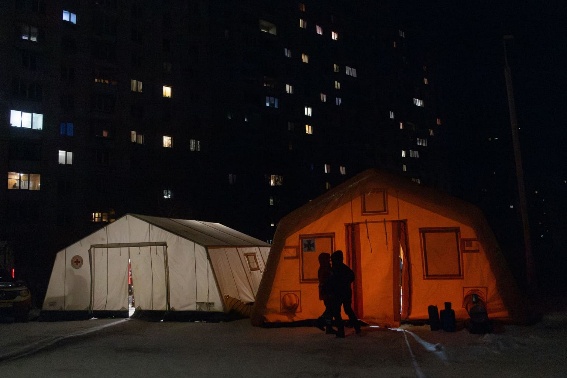
Kyiv State Emergency Service workers are setting up tents to warm people whose homes were left without heating after the Russian army shelled critical infrastructure in the capital. (Andriy Dubchak/Frontliner/Getty Images)
A Predator in the Sky: When Ukraine’s Defenses Become the Target
Somewhere between the first days of January and the eleventh, Russia slipped a new shape into the air war—one that isn’t built for rooftops or substations, but for the space above them. Ukrainian military intelligence says the Geran-5 has entered combat: a drone meant to hunt.
Until now, “Geran” usually meant the familiar dread of a 90-kilogram warhead and the grind of nightly interception—Shahed-born airframes rolling out of the Alabuga zone, pushing toward cities and power lines. Geran-5 points to a different intent. It is tied to Iran’s Karrar interceptor lineage, and Ukraine believes Russia is working on launching it from Su-25 attack aircraft and arming it with R-73 air-to-air missiles—an aerial knife, not a flying bomb.
The details read like a checklist for a smarter predator: roughly six meters long, a 5.5-meter wingspan, a Telefly jet engine with more shove than earlier models, navigation through a 12-channel Cometa satellite system. Even the tracking guts feel improvised and modern at once—Raspberry Pi microcomputers, 3G/4G modems—cheap components repurposed into something that can reach out to a thousand kilometers and still look upward for prey.
For Ukraine, that “prey” is painfully clear. The interceptor drones built to swat Shaheds. Western-supplied air defenses that have kept cities breathing. Fighter jets that rise into black skies to push the threat away. Geran-5 isn’t just another drone in the swarm; it is aimed at the hands that are trying to stop the swarm.
And it arrived with almost no warning—noticed only after deployment. Every successful Geran-5 engagement doesn’t just remove a Ukrainian asset; it opens a gap, and through that gap the next wave of strike drones can pour.
Caspian Nightfire: When “Too Far” Stopped Meaning Safe
Out on the Caspian, the drilling platforms sat where maps usually promise protection—nearly 1,500 kilometers from Ukraine, farther than Kyiv to London. On the night of January 10–11, that promise burned. In the black sea air, Ukrainian drones found three steel islands, arrived without warning, and turned them into torches.
The targets had names that sounded like paperwork and investment brochures: V. Filanovsky, Yuri Korchagin, Valery Graifer. They belonged to Lukoil, one of Russia’s largest producers. This wasn’t a strike for symbolism. These were working industrial nodes—oil and gas processing that Ukraine says directly supplies the Russian military. Ukraine’s General Staff and Special Operations Forces reported direct hits, and video showed flames climbing metal in the middle of open water.
It was also not a one-off. This marked the fifth attack on Caspian oil infrastructure since December 10, 2025—an arc that began as experiment and hardened into method. The message is no longer subtle: distance is not sanctuary, and Russia’s vast geography can be turned into vulnerability.
For Russian planners, the fear isn’t only what was damaged; it’s what the strike implies. If platforms this far out can be reached, then anything within roughly 1,000 kilometers of Ukraine’s borders sits under the same question mark—refineries, chemical plants, bases, logistics hubs. Protecting all of it, all the time, is a problem Russia cannot solve comprehensively.
For energy companies, each hit becomes a choice: accept risk, spend heavily on protection, or scale back. Offshore platforms are not replaced with quick repairs; they demand months or years, and money that sanctions make harder to find. And the coordination itself—multiple drones, maritime terrain, timing, angles—suggests careful study, not luck.
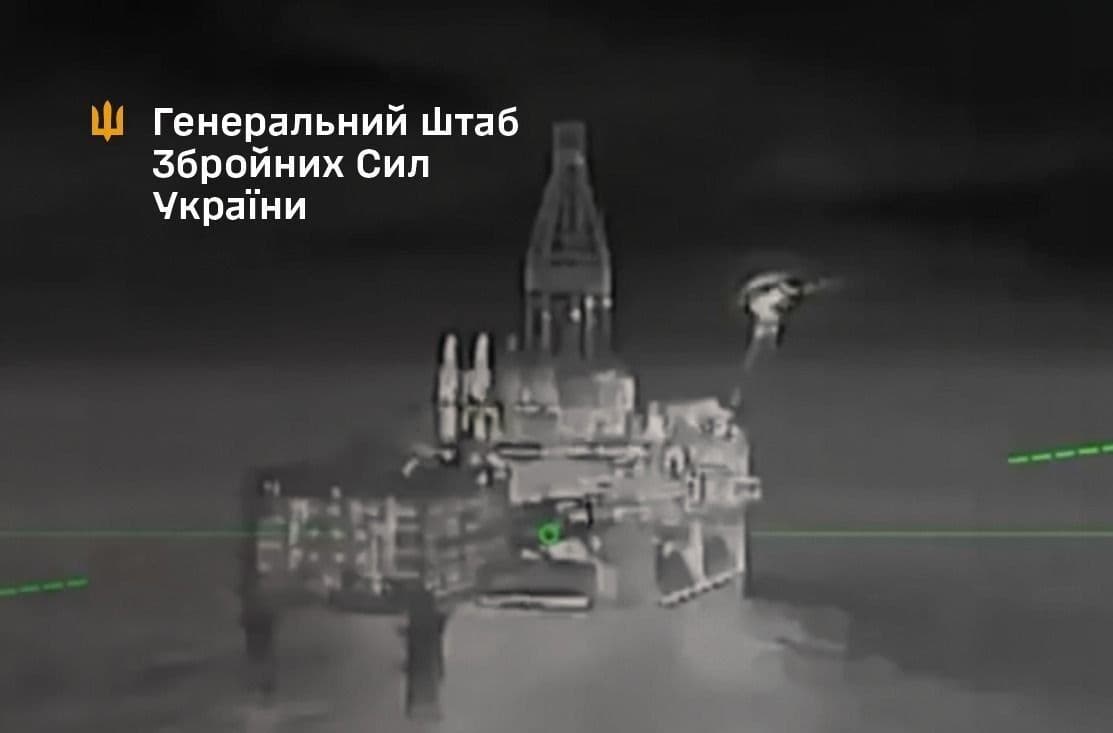
The photo of drilling platforms belonging to Lukoil in the Caspian Sea that were allegedly hit by the Ukrainian military. Photo published. (The General Staff / Telegram)
When the Grid Went Silent: Zaporizhzhia’s 2:11 a.m. Winter Drop
It happened at 2:11 a.m. on January 11—the hour when even anxious homes finally try to sleep. Zaporizhzhia Oblast vanished into darkness. All at once, 382,500 consumers—apartments, shops, small businesses, street corners—lost electricity. In multiple areas the water stopped. Hospitals fell back on generators, the kind of humming lifeline you notice most when everything else is quiet.
The region’s grid operator said critical facilities started getting power within an hour, and by 7:00 a.m. the blackout was fully restored. The message was competence, steadiness, control. But the careful refusal to name a cause carried its own meaning, because nothing about Zaporizhzhia’s last 24 hours looked like a simple technical accident. Russia had struck 27 settlements in the oblast—821 attacks in a day. Neighboring Dnipropetrovsk had damage to high-voltage transmission. The wider pattern was unmistakable: hit the grid hardest when the cold turns unforgiving.
The same day, Dnipropetrovsk—including Dnipro—sank into extensive outages. DTEK called it the most difficult electricity situation of the winter, confirming what people already felt in their bones: winter doesn’t wait for repairs.
And repairs are where the math turns cruel. Crews can only fix one place at a time. Strikes can land in many places at once. Even excellence loses ground if the attacker’s pace stays faster than the wrench.
Kyiv still lived inside that imbalance. Three days after the January 9 mass attack, more than 1,000 buildings remained without heat. DTEK logged over 200 outage reports by late afternoon on January 11 and sent nearly 60 crews across the city—yet in some eastern districts electricity had been on for only five hours in three days.
Raisa Donbekirova, 65, lit an alcohol “trench candle” because it was all she had. Inside her apartment it was 12°C; outside it was minus 18. Warming tents went up so people could charge phones and borrow a few minutes of heat, and lines formed for something as basic as an outlet. Officials said real improvement might not come until January 15. That meant days more of cold designed to wear people down—whether the weapon was a missile, or the darkness it left behind.
Nightfall Over the Rear Lines: Britain Builds Ukraine a Longer Reach
On January 11, Britain didn’t offer another speech about resolve. It offered a blueprint with numbers on it—Project Nightfall, a fast-track competition to build long-range ballistic missiles for Ukraine, sized for the war as it actually exists.
The requirements read like a hard-eyed lesson learned at close range: a 200-kilogram warhead, more than 500 kilometers of reach, ground-launched, built to fire quickly and disappear before the counterstrike arrives. Ten missiles a month. A ceiling price of $1.07 million each. No romance—just speed, distance, and survivability.
Defense Secretary John Healey had recently seen why those numbers matter. Traveling through Lviv Oblast on January 8–9, he was close enough to hear air-raid sirens as Russia launched an Oreshnik ballistic missile at targets only 60 kilometers from Poland. He described it as a stark reminder of drones and missiles falling on Ukrainians in sub-zero conditions. It is one thing to read that sentence in London. It is another to hear it in real time.
Nightfall is built around a simple battlefield truth: anything that shoots must move. Russian counterbattery tactics have punished artillery that lingers, and Ukraine has survived by learning to strike, relocate, and vanish. Britain is trying to translate that rhythm into long-range missiles—hit high-value targets before they can respond, then pull the launcher away like a door closing.
Three industry teams will compete for $12 million development contracts. Proposals run through early February, contracts targeted for March 2026. Britain wants this inside a year, not inside a committee.
Officials said the logic plainly: a secure Europe needs a strong Ukraine, and new long-range British missiles give Putin another thing to worry about. The point isn’t only destruction—it’s dispersal. Every new Ukrainian capability forces Russia to spread defenses, shift manpower, and guard more rear areas.
With 500 kilometers, Ukraine could threaten bases, hubs, fuel, and ammo storage beyond the immediate front without risking aircraft. At ten missiles a month, it becomes pressure that returns—again and again—at a price that can be sustained. Nightfall signals a shift: support that doesn’t just help Ukraine endure, but helps Ukraine reach back.
A New Shield, Quietly Arrived: Tempest Joins Ukraine’s Night Watch
On January 11, Ukraine’s Air Force posted a New Year’s video that looked, at first glance, like another hard-won intercept in another long night. Then people started watching more closely. The weapon in the clip wasn’t one of the familiar names that get announced at press conferences. It was Tempest—an American-made surface-to-air system that had apparently already arrived, already deployed, and already fired in anger.
The video didn’t label it. It didn’t need to. A Tempest interceptor climbs into the darkness and meets a Russian drone midair, turning the threat into fragments before it can reach a roofline or a transformer yard. Later, the Ukrainian analyst group Vodohrai confirmed what the footage suggested: this was a new layer of protection that had slipped into the fight without public fanfare.
Tempest had only been publicly shown months earlier, when V2X debuted the platform at the Association of the United States Army exhibition in October 2025. Its delivery to Ukraine wasn’t announced. It simply appeared—like so much of modern military aid now does—first as capability, then as proof, then as a quiet understanding that something has changed.
The system is built for the kind of war Ukraine lives every day: drones, helicopters, low-flying aircraft, bad weather, no pause button. V2X did not publicly specify the interceptor missile, but it likely uses radar-guided AGM-114L Hellfire Longbow missiles—each with a 9-kilogram warhead meant to destroy drones while limiting the danger of heavy debris raining down.
For Ukrainian air defenders, that detail matters because the drone war is not occasional. It is weekly, nightly, relentless—hundreds of incoming threats that force split-second choices about what to shoot, what to conserve, what to risk.
Ukraine has leaned on a layered Western air-defense web—Patriot, IRIS-T, NASAMS, SAMP/T for larger missiles; Gepard and Skynex for drone work. Tempest slides into that architecture as a mobile, rapidly deployable answer to the drone-saturated sky, one more set of eyes and one more hand on the trigger when the sirens start again.
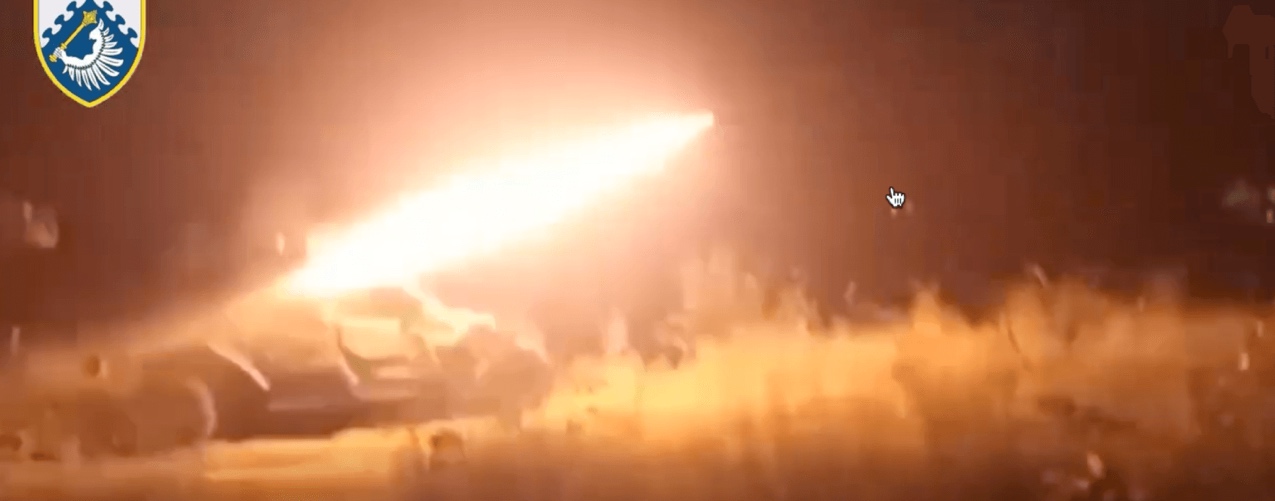
Screenshot from an Air Force Command Center video showing the Tempest air defense system in action. (Air Force Command Center)
The Mudline War: Where the Map Moves in Meters and Men Pay in Blood
While new weapons steal the headlines, the frontline keeps doing what it has done for years: grinding. Not in sweeping arrows across maps, but in short, brutal increments—hundreds of meters here, a shattered treeline there, a village name that becomes a code word for another day of loss.
Near the Kostyantynivka–Druzhkivka area, geolocated footage published January 10 showed Russian forces pushing into eastern Kostyantynivka. Russian milbloggers claimed more gains in central Minkivka and west of Stepanivka, though those claims still waited for independent confirmation. Behind the claims sat a familiar pattern: concentrated Russian units and specialized drone operators working in coordination—an assembly of brigades, regiments, and divisions designed to press, probe, and wear down.
In the Borova direction, January 11 footage confirmed Russian advances in western Ridkodub, new positions appearing where they hadn’t been before. Attacks fanned out toward a scatter of settlements—Bohuslavka, Zahryzove, Hrekivka, Karpivka—moves that can be reconnaissance, or the first breath before something larger.
On the Hulyaipole axis, Ukrainian observer Kostyantyn Mashovets reported Russian advances in the northwest and center of the sector. Geolocated footage showed movement west of Pryluky and northwest of Hulyaipole. A Russian milblogger said Pryluky had fallen entirely, but that, too, remained unconfirmed. Mashovets noted Russia had redeployed elements of the 76th Airborne Division from the Sumy direction months earlier, quietly stacking weight for an offensive here.
In western Zaporizhzhia Oblast, pressure continued. Mashovets described advances toward the mouth of the Kinka River west of Prymorske. Russia claimed it seized Bilohirya southeast of Orikhiv, still awaiting independent confirmation, while footage refined the ground picture around Lukyanivske.
Near Pokrovsk, geolocated footage published January 10 showed Russian forces edging into northern neighborhoods where earlier infiltration had tested the seams. Ukraine’s 7th Rapid Reaction Corps warned that Russian drones were complicating logistics, forcing supply lines into a daily duel of jammers and counter-drones.
Toward Slovyansk, Ukrainian officials said Russia was prioritizing the sector but failing to gain ground despite heavy effort. Even a Russian milblogger described command “overworking forces and lowering morale,” and reported friendly-fire casualties near the Zherebets River.
Around Kupyansk, geolocated footage showed Russians operating in southern Podoly in what analysts assessed as an infiltration mission without a terrain shift. Colonel Viktor Trehubov said preliminary estimates suggested 25 to 90 Russian soldiers remained in Kupyansk, with most estimates between 50 and 60, and that Ukrainian positions north and east across the Oskil River were blocking a crossing.
This is what the war looks like when you zoom in close enough to see the cost: village names, unit numbers, tiny gains—and the steady truth underneath them. Every meter is purchased. Every village that tilts hands sends another wave of families away from home. The war can innovate in the sky and still remain, at its core, a fight where young men die for ground neither side can surrender.
Hitting the Backbone: Ukraine Reaches for Russia’s Air Shields and Supply Veins
While Russian units kept pushing at the front, Ukraine’s war kept unfolding in the spaces behind it—the places commanders prefer to believe are safe. On January 11, Ukraine’s General Staff reported two strikes that weren’t about spectacle. They were about weakening the machinery that makes pressure possible.
Near Baranycheve in Luhansk Oblast, roughly 20 kilometers behind the line, Ukrainian forces hit a Russian Buk-M3 air defense system. The report described fire and secondary explosions, the kind that suggest more than a single vehicle burning—ammunition cooking off, fuel igniting, the unseen stockpiles that turn a “system” into a working shield. For Ukraine, taking a Buk off the board is not just a tactical win; it is a moment when the air becomes a little less hostile for the next mission.
The second strike landed farther back, near Novotroitske in occupied Kherson Oblast—about 79 kilometers from the eastern bank of the Dnipro. Ukraine said it struck a depot and technical support unit tied to Russia’s 49th Combined Arms Army, the main force grouping in the region. That target choice tells you what Ukraine is trying to do: not merely punch holes, but slow the flow. Ammunition, fuel, spare parts, the quiet churn of maintenance that keeps units moving—remove enough of it and the frontline pressure begins to stutter.
These are mid-range attacks—beyond artillery reach, but not the extreme distances of the Caspian strikes. They are also aimed at military infrastructure, not civilian survival systems. Where Russia’s winter campaign has often chased darkness and cold, these Ukrainian strikes chase capability: air cover and logistics.
The Buk-M3 hit forces Russia into an uncomfortable choice. Accept a thinner air-defense umbrella, or pull scarce systems from elsewhere, creating new gaps. The Kherson depot strike creates a different kind of pain: rerouted supply lines, delayed repairs, reduced tempo. In a war where momentum is fed by trucks and protected by radar, Ukraine is trying to starve the push and blind the shield—one strike at a time.
Hitting the Backbone: Ukraine Reaches for Russia’s Air Shields and Supply Veins
While Russian units kept pushing at the front, Ukraine’s war kept unfolding in the spaces behind it—the places commanders prefer to believe are safe. On January 11, Ukraine’s General Staff reported two strikes that weren’t about spectacle. They were about weakening the machinery that makes pressure possible.
Near Baranycheve in Luhansk Oblast, roughly 20 kilometers behind the line, Ukrainian forces hit a Russian Buk-M3 air defense system. The report described fire and secondary explosions, the kind that suggest more than a single vehicle burning—ammunition cooking off, fuel igniting, the unseen stockpiles that turn a “system” into a working shield. For Ukraine, taking a Buk off the board is not just a tactical win; it is a moment when the air becomes a little less hostile for the next mission.
The second strike landed farther back, near Novotroitske in occupied Kherson Oblast—about 79 kilometers from the eastern bank of the Dnipro. Ukraine said it struck a depot and technical support unit tied to Russia’s 49th Combined Arms Army, the main force grouping in the region. That target choice tells you what Ukraine is trying to do: not merely punch holes, but slow the flow. Ammunition, fuel, spare parts, the quiet churn of maintenance that keeps units moving—remove enough of it and the frontline pressure begins to stutter.
These are mid-range attacks—beyond artillery reach, but not the extreme distances of the Caspian strikes. They are also aimed at military infrastructure, not civilian survival systems. Where Russia’s winter campaign has often chased darkness and cold, these Ukrainian strikes chase capability: air cover and logistics.
The Buk-M3 hit forces Russia into an uncomfortable choice. Accept a thinner air-defense umbrella, or pull scarce systems from elsewhere, creating new gaps. The Kherson depot strike creates a different kind of pain: rerouted supply lines, delayed repairs, reduced tempo. In a war where momentum is fed by trucks and protected by radar, Ukraine is trying to starve the push and blind the shield—one strike at a time.
The Longest War: When History’s Echo Offers No Solace
When President Zelensky spoke on the night of January 11, his words carried the weight of two wars separated by eighty years. That day marked the 1,418th since Russia’s full-scale invasion—a number with haunting symmetry. Nazi Germany’s war against the Soviet Union had lasted exactly the same length of time. The echo was deliberate, but it was not meant for triumph. It was a reminder that history’s endurance offers no comfort.
“Russia’s large-scale war against Ukraine has been going on for as long as Nazi Germany’s war against the Soviet Union,” Zelensky said. “They wanted to repeat fascism—and they have.” His voice caught the fatigue of a nation that has endured what few could imagine: cities frozen and rebuilt, graves that outnumber maps, children who can recognize missile sirens by sound alone.
But his sharpest point was not about memory—it was about failure. After nearly four years, Russia stood no closer to its goals. Donbas was still contested. Kupiansk, Zaporizhzhia, the same names repeated in cycles of attack and retreat. “This says everything about the system Putin has built,” Zelensky said—a war machine grinding forward but going nowhere.
The comparison to World War II wasn’t romantic. Operation Barbarossa had been launched with the same arrogance—quick victory, easy occupation. It ended in exhaustion, collapse, and ash after 1,418 days. Russia’s invasion, too, has turned into a war of attrition that consumes soldiers faster than it creates meaning.
Zelensky’s message reached beyond Ukraine’s borders. He called on the U.S. and Europe to hold the line together, warning that every day of hesitation gives tyranny another breath. The number 1,418 was not a statistic. It was a mirror held up to history—a reminder that endurance, not calculation, decides who survives. Ukraine still stands, bloodied but unbroken, proof that defiance
When 154 Drones Fill the Sky: A Night Measured in Sirens and Cold
They came in waves through the dark—154 Shahed, Gerbera, and other strike drones launched from Kursk, Oryol, Bryansk, Millerovo in Rostov Oblast, Primorsko-Akhtarsk in Krasnodar Krai, and occupied Hvardiiske in Crimea. For Ukrainians, it wasn’t one attack so much as a test of endurance: how long defenses could hold, and what happens when they don’t.
The Air Force said air defenses and electronic warfare brought down 125—an 81% interception rate that still leaves wreckage. Twenty-two drones got through, striking 18 locations, while falling debris damaged two more. Alerts carried into the morning.
In Chernihiv Oblast, drones hit residential buildings in Sheptaky and civilian infrastructure in Nizhyn and Semenivka. Kharkiv was struck. So was Sarny in Rivne Oblast. Ukrzaliznytsia reported hits on railway infrastructure in Rivne, the kind of damage that ripples into movement, supply, and ordinary life.
Zelensky widened the lens: since about January 4, Russia launched nearly 1,100 long-range strike drones, over 890 guided glide bombs, and more than 50 cruise and ballistic missiles—aimed mainly at energy systems and homes, where winter outages can kill.
The day’s casualties put names into the math: four civilians killed in Donetsk Oblast; eight injured in Kharkiv; two injured in Kherson; one killed and three injured in Dnipropetrovsk; one injured in Chernihiv.
But the deeper cost lived in the cold and the dark—382,500 households without power in Zaporizhzhia, over 1,000 buildings in Kyiv still without heat, and some districts with only five hours of electricity across 72.
Russia’s 821 strikes against 27 settlements in Zaporizhzhia in 24 hours—about one every 105 seconds—showed the design of this campaign: sustained pressure meant to outrun repairs and overwhelm defenses.
The Trophy Ceremony Became a Dispatch From Home
The match in Brisbane ended the way finals often do—two sets, a handshake expected, the winner smiling for cameras. Marta Kostiuk had just lost in straight sets to Aryna Sabalenka, and the arena was already drifting toward the next headline.
Then she stayed at the microphone and pulled the room back across continents.
“I wanna say a few words about Ukraine,” she began, and the language of sport fell away. She told the crowd she plays every day with pain in her heart. She spoke of thousands of people without light and warm water, of winter that doesn’t feel like weather anymore but like a weapon. “It’s -20°C outside,” she said, and suddenly the bright court lights didn’t seem so warm.
And then she made it smaller—so it couldn’t be ignored. Her sister, she said, sleeps under three blankets because their home is cold. The world number 20 wasn’t describing footwork or unforced errors. Her voice cracked over the kind of detail that turns distant suffering into something you can picture in your own bedroom.
The reaction came fast and predictable. Online, some accused her of bad sportsmanship for not shaking Sabalenka’s hand—part of the stance many Ukrainian players have kept since the invasion, refusing physical contact with Russian or Belarusian opponents. Kostiuk didn’t apologize. She framed it as a conscious choice, a way of forcing remembrance when the world’s attention keeps sliding away.
Sabalenka, who has said she doesn’t support the war, still congratulated Kostiuk in her own on-court remarks. But the moment hung there anyway: two athletes asked to carry flags they didn’t choose, in a sport that pretends it can stay neutral.
Both would head to the Australian Open on January 19, where Sabalenka was favored to win a third title in four years. But Brisbane had already shifted. For a few minutes, a final became something else—a reminder that even under stadium lights, Ukraine’s winter was still waiting at home.
The nets that keep soldiers alive: Lviv’s quiet war behind the war
In Lviv, the front line has another address: a 1911 building with children’s murals. Volunteers have made camouflage nets and helmet covers since February 25, 2022—one day after the invasion began. Finished nets are stacked for pickup. Frames wrapped in fairy lights wait for the next weave. A small Christmas tree with blue-and-yellow ornaments sits in an empty HE D-30 propellant cartridge.
Oksana is 34. She was already volunteering when her husband enlisted in July 2024. Before the war he ran a pump manufacturing company in Kharkiv and had no military experience. They rebuilt in Lviv, started a new business, and when he joined the Armed Forces she became the director—then kept coming to the center daily. For his first year, they didn’t see each other at all; rotation was impossible. She finally traveled with her daughter to meet him near the front. The place where they reunited no longer exists; it is now under Russian occupation.
Svitlana, 47, coordinates the center while building drones and fundraising; her husband also serves. She remembers writing take care of yourself and getting the reply: we take care of you. Another soldier wrote, you give us the net, and we will give you victory.
Nina, 65, works from eight in the morning until eight at night. Second home, she says. Soldiers tell her the nets can make a tank vanish. One told her he hid under their net in an open field while a Russian drone searched overhead.
More than 350 foreign volunteers have come through, leaving notes in Liuba’s booklets. When a net is finished, the room rises to sing the national anthem, sending luck forward with the last knot.
The Day’s Meaning: The War Becomes a Contest of Systems, Not Just Front Lines
January 11 didn’t feel like a turning point because the map suddenly shifted. It felt like a turning point because the war kept revealing what it is becoming.
The air is no longer just a highway for strike drones. It is turning into a hunting ground. When one side builds drones to hunt the other side’s drones, it is admitting that defenses have grown strong enough to threaten the whole strike model—and it is also admitting the answer will be escalation, not restraint. The sky is evolving into predator versus predator, and whoever adapts faster will own the night.
At the same time, distance is losing its old power. When Ukrainian strikes can reach far-off energy assets, Russia’s depth becomes an exposure, not a shield. Rear areas that once felt untouchable now demand protection, manpower, and attention—resources that must be pulled from somewhere else. That is the quiet strategic purpose of deep strikes: not only damage, but distraction and dispersion.
But the day’s deepest truth was still the oldest one. Infrastructure warfare is being used to make ordinary life unlivable. Blackouts at night, heat cut in lethal temperatures, repairs forced into a race against the next wave—this is pressure applied to civilians with the precision of planning and the cruelty of winter.
Ukraine’s answer, visible in the speed of restorations and the stubborn work of volunteers, is distributed resilience: many hands, many workarounds, many small acts that keep the state functioning even when systems are hit. Western support is beginning to mirror that reality too—less about speeches, more about tailored tools that let Ukraine keep reaching back.
What this signals next is a long duel between two bets: Russia betting that cold and darkness will break cohesion, Ukraine betting that adaptation, allies, and endurance will outlast the grind.
Prayer For Ukraine
- Pray for protection over families living through blackouts and extreme cold, especially in Zaporizhzhia and Kyiv, that heat, power, and water would be restored quickly and that the most vulnerable would be sheltered before exposure turns deadly.
- Pray for strength and discernment for Ukraine’s air defenders and repair crews, that they would have endurance for repeated nights of drone attacks, clear thinking under exhaustion, and the tools needed to keep lives and infrastructure intact.
- Pray for frontline soldiers in the grinding sectors named today, that God would preserve life, steady their minds under constant pressure, and provide wisdom for commanders making decisions measured in meters and minutes.
- Pray for the volunteer network behind the lines—especially the women making camouflage nets, suits, and supplies—that God would sustain their bodies, guard their families, and let their work continue to save lives in moments when there is nowhere else to hide.
- Pray for unity and resolve among Ukraine’s allies, that promised capabilities would arrive in time, that new defensive and long-range systems would be fielded effectively, and that Russia’s strategy of fear and freezing would fail to break Ukraine’s will.