
As Moscow escalates its fantasy-map demands, the real story is Russia’s war budget cracking under sub-$40 oil while Europe bankrolls Ukraine’s fight and Kyiv hands a staggering mobilization crisis to a 35-year-old reformer to fix fast.
The Day’s Reckoning
January 14, 2026, was a day when the war’s headlines split in two—one half fantasy, one half math. Sergei Lavrov widened Russia’s “peace” demands to an eight-oblast wish list that included major Ukrainian cities Russian forces have never taken, a reminder that Moscow can always make talks impossible by redefining surrender as compromise. But the financial engine under that posture sputtered as Urals crude slid below $40, putting real pressure on a war budget built on higher oil.
Europe answered with a fresh surge of support—€90 billion—even as the plan to fund it through frozen Russian assets faltered. In Kyiv, Mykhailo Fedorov stepped into the Defense Ministry facing a staggering personnel and funding crisis. And overnight, 113 drones and three ballistic missiles hit Ukrainian cities and energy systems as Ukraine struck back inside Russia, turning the day into a grim question: which breaks first—Ukraine’s grid, or Russia’s bankroll?
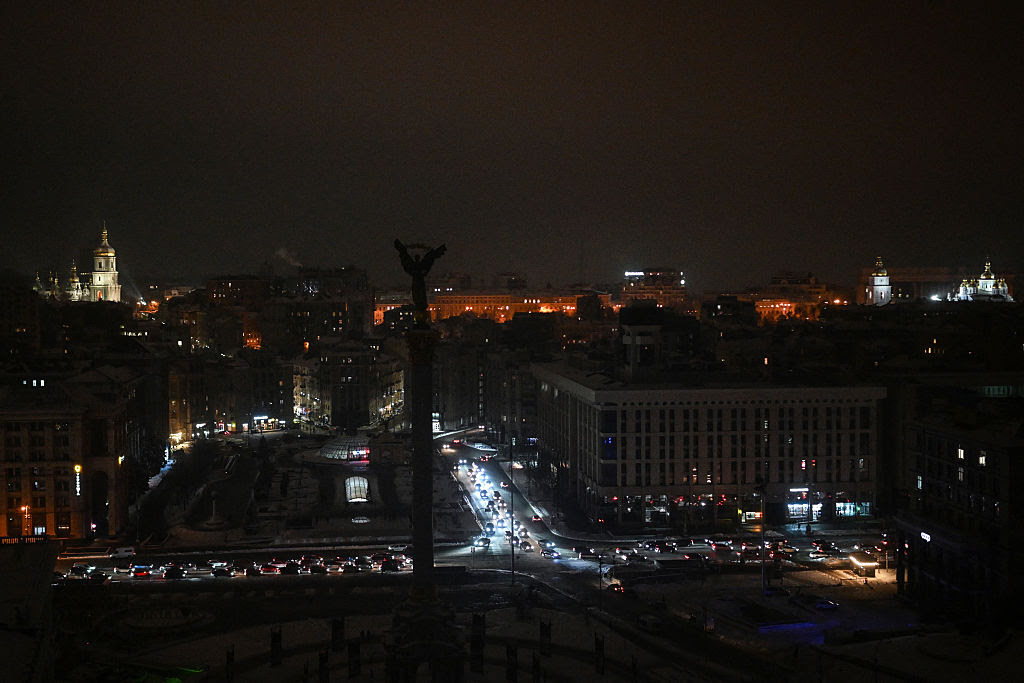
Cars drive along Independence Square during a power outage in Kyiv, following relentless Russian strikes on heat and electricity infrastructure during freezing winter temperatures. (Sergei Gapon/AFP via Getty Images)
A Map Made of Demands: Lavrov Reaches for Half a Country
Lavrov didn’t sound like a man describing a front line. He sounded like a man reading a will—calm, official, inevitable—as if ink alone could decide the “fate” of people in Crimea, Donbas, and the invented word Moscow keeps polishing for television: “Novorossiya.”
Listen closely to what that word tries to smuggle in. It isn’t just the land Russia already occupies—Crimea, slices of Donetsk and Luhansk, parts of Zaporizhzhia and Kherson. In Lavrov’s mouth it swells into eight oblasts, into cities that have lived this war without ever seeing a Russian banner raised over their squares: Kharkiv, where Moscow holds only a thin scrape of territory; Dnipropetrovsk, where it holds none; Mykolaiv, where Russian forces haven’t set foot since the 2022 retreat; Odesa—Ukraine’s crucial Black Sea gateway, home to more than two million people, a city Russian troops have never even approached.
The arithmetic is the tell. A U.S.-floated peace outline already dangled enormous concessions—Crimea, all of Luhansk and Donetsk, plus the occupied parts of Zaporizhzhia and Kherson, about 18% of Ukraine. Lavrov’s “Novorossiya” tries to turn that into a demand for roughly 45%—the kind of ask that makes negotiation impossible by design.
It’s like catching a burglar halfway through your window and hearing him insist the house, the neighbors’ homes, and the mineral rights down the block were always his. And the timing matters: as rumors of meetings and “deals” circulate, Moscow doesn’t soften—it hardens, rehearsing the familiar play where peace is promised, then priced so high it must fail.
Meanwhile, winter and Ukrainian resistance keep the real Russian army from matching the paper empire Lavrov claims—yet that gap is part of the weapon: a message to the West that if you blink, the demands only grow.
When Moscow Said No to Silence: The Ceasefire That Exposed the War’s True Purpose
Lavrov spoke of negotiations the way arsonists talk about fire safety. In the same moment he reached for more Ukrainian land on a map, he brushed aside the one thing that could stop the killing: a ceasefire. Permanent? No. Sixty days? Also no. Russia, he said, was “willing to negotiate with Europe”—just not willing to stop shooting.
The refusal landed with a bitter symmetry. For months, Kremlin officials had scolded Kyiv for not holding elections, questioning the legitimacy of a wartime government under bombardment. President Zelensky answered with a simple proposal: pause the war so Ukrainians could vote. When Russia was offered exactly what it claimed to want, it recoiled. A ceasefire, Lavrov explained, would give the West time to help Ukraine. Translation: silence would be dangerous for Moscow. Quiet would mean rebuilt defenses, fresh weapons, and a stronger Ukrainian hand when talks resumed.
So, the war had to keep breathing.
The contradictions stacked up like stage props. Russia said it wanted peace while rejecting the pauses that make peace possible. It demanded negotiations while inflating its claims to cities it does not control. It derided Ukraine’s wartime politics while blocking the elections that would settle the question. Each position canceled the last—and that, too, was the point. Confusion is cover. Ambiguity is armor.
The chorus in Moscow joined in. A Duma defense official waved off Europe’s security guarantees as “meaningless, formal documents.” Another warned that any foreign troops sent to safeguard a post-war Ukraine would be “legitimate” targets—threats dressed up as reminders. And all of it arrived as reports circulated of deputies heading to meet U.S. lawmakers about “peace.”
This is how the Kremlin keeps the lights on in its theater: invite dialogue, veto substance, and blame the West for the war that Russia insists must continue.
A Village Turned Into a Headline: How Komarivka Was Drafted Into a Phantom Offensive
Komarivka sits where borders blur into tree lines—a quiet settlement ninety kilometers northwest of Sumy City, a place the war had passed by since 2022. Then, on cue, Moscow said it had fallen.
The timing was too perfect. The Russian Defense Ministry announced the “seizure” as if it were the opening note of a new campaign, proof of a brewing push to carve a “buffer zone” across northern Kharkiv and Sumy. But nothing on the ground matched the music. No air campaign softened the area. No surge of troops rolled north. The nearest Russian salient lay sixty-seven kilometers away, and the front around Komarivka had been dormant for years.
Even Russia’s own war bloggers—quick to map real advances—had little to say. Independent observers saw no evidence at all. The village itself offered no tactical prize. Yet suddenly Komarivka was being asked to carry a story far bigger than its fields and roads: that a new offensive had begun, that Ukrainian lines were giving way, that Russian momentum was unstoppable.
This was not a battlefield communiqué. It was a message.
Each time Western capitals reached for decisions—aid votes, security guarantees, arguments over frozen assets—a fresh Russian “breakthrough” appeared on the wires. The pattern was precise. A claim here. A “new axis” there. The goal wasn’t to capture terrain; it was to capture attention and bend it toward inevitability.
But reality kept intruding. Russian forces had not set conditions for a northern push. In many sectors, the lines had steadied. The distance between what Moscow said and what soldiers saw had grown into a chasm.
Komarivka became a symbol not because it mattered militarily, but because it could be made to matter in headlines—another village conscripted into a war for the Western mind.
When Moscow’s Friends Became Hostages to Events: Lavrov Defends an Axis Under Siege
Lavrov tried to sound steady, but the ground under Russia’s alliances was shifting. He spoke of “strategic relations” with Venezuela just as the image of Nicolás Maduro—once untouchable—was being processed through American custody. The operation that lifted a Russian ally off his throne and into a U.S. cell was a message in itself: Washington could reach where Moscow could not, and Moscow could do nothing to stop it.
The foreign minister protested anyway. He condemned the raid, wrapped his words in the language of sovereignty, and insisted that Russia would stand by Caracas. Yet the complaint landed like an admission. For years, the Kremlin had sold the idea that its partnerships formed a counterweight to Western power. Now one of those pillars had been carried across an ocean in handcuffs.
Iran hovered in the same uneasy light. As talk of U.S. tariffs for countries doing business with Tehran grew louder, Lavrov declared that no outsider could alter the “fundamental nature” of Russian-Iranian ties. He warned that America was “unreliable,” that its edge was fading. But the urgency in his tone betrayed the fear beneath the rhetoric. Iran’s drones and missiles have powered Russia’s strikes on Ukrainian cities; unrest in Tehran would mean a broken supply line at the worst possible moment, when Russia’s own factories strain to replace battlefield losses.
The calendar tells the story. Moscow inked strategic partnerships with Iran and Venezuela in early and mid-2025—formal vows in a world that had turned away. Months later, one partner’s leader sat in a U.S. jail and the other faced its most serious internal crisis in years.
Lavrov’s words were meant to project resolve. What they revealed instead was a shrinking circle and a Kremlin watching its few remaining friends slip from its grasp.
A 35-Year-Old Takes the Helm of a War: Fedorov Walks Into the Storm

Mykhailo Fedorov was appointed as the new Defense Minister. ( STR/NurPhoto via Getty Images)
When the vote board lit up in the Verkhovna Rada—277 green lights—Mykhailo Fedorov rose knowing the applause was the easy part. At 35, Ukraine’s youngest defense minister stepped into a building weighed down by four years of total war and numbers that read like a warning label.
He arrived with a reputation for turning paper into code. As minister of digital transformation, Fedorov dragged Ukraine’s bureaucracy into the present—moving services online, cutting queues, and making the state work from a phone. Now he was handed a ministry that doesn’t run on apps and dashboards, but on people pushed to their limits.
He told parliament the truth without varnish: a Hr.300 billion hole in the budget. Two million citizens wanted for mobilization evasion. Two hundred thousand soldiers absent without leave. Each figure carried a story—factories that can’t keep up, families worn thin by years of sirens, units rotating back to the line with too little rest.
Fedorov promised audits that would follow the money, inspections that would reach into territorial recruiting centers, and reforms that would judge commanders by performance, not rank. He talked about breaking the old top-down habits, cutting paper chains, and getting gear where it’s needed—now.
Outside the chamber, the strain showed itself. Near Lviv, an unknown gunman fired at a recruiting center vehicle. No one was hurt, but the shots echoed far beyond the road—into kitchens where families argue over summonses, into towns where trust in the draft has thinned.
President Zelensky’s reshuffle signaled a bet on fresh hands and technical minds. Fedorov’s first test won’t be code. It will be convincing a tired country—and a tired army—that reform can still arrive on time.
When Europe Opened Its Wallet and Closed a Door: The €90 Billion Lifeline
Ursula von der Leyen stood at the podium and called it a plan. Behind the numbers, it felt more like a confession.
€90 billion for Ukraine—€60 billion for weapons, €30 billion to keep the state running. Money raised through common borrowing, backed by the EU’s budget headroom, and wrapped in the language of unity. It sounded decisive. It was. And it was also the shape of a retreat from a bolder idea that had just collapsed: using frozen Russian assets themselves.
Two-thirds of the package went straight to the front. Europe was no longer pretending that diplomacy alone could hold back missiles. Survival meant steel, air defenses, ammunition—now. The remaining third came with reform strings attached, a reminder that even in wartime, Brussels keeps score on courts and corruption.
Von der Leyen promised priority for European manufacturers, a nod to a continent trying to rebuild its own defense industry while feeding Ukraine’s urgent needs. But the fine print told another story: if the right weapons weren’t available in Europe, Kyiv would have to shop elsewhere. Patriots still come from America. Ballistic missiles don’t wait for factories to scale.
The math is unforgiving. Ukraine needs about €135 billion across 2026–2027—€83 billion for defense, €52 billion to keep the lights on. Europe’s package covers roughly two-thirds. The last third is supposed to come from Washington and other G7 partners, even as signals from the White House flicker between support and doubt.
The loans themselves are an act of faith. Ukraine repays only when Russia pays reparations—which is to say, not anytime soon. Frozen Russian assets stay locked, their proceeds a backstop if needed. It sidesteps the legal minefield of outright seizure after Belgium, Hungary, Slovakia, and the Czech Republic balked.
So, Brussels improvised. Plan B, dressed as Plan A. A lifeline thrown across a legal gap—strong enough to keep Ukraine fighting, fragile enough to show how hard Europe had to bend to make it happen.
The Price That Punched a Hole in the Kremlin’s War Chest: Urals Slips Under $40
When the screen flashed $39, it felt like a crack in the glass. Russian Urals crude—once the engine of the state—slid below $40 a barrel for the first time in five years. Not a blip. A breach. The war budget in Moscow was built on $59. The market answered with something closer to two-thirds of that—and kept falling.
Behind the number is a chain reaction the Kremlin can’t unwind. Sanctions tightened. Enforcement sharpened. Ukraine’s campaign against the shadow fleet turned shipping into a gamble. Tankers now run with false flags and quiet radios, priced for risk and insured at ruinous rates. Buyers demand discounts so deep they look like desperation—$26–$28 off Brent, the widest spread on record.
For a while, India and China made the arithmetic work, taking cheap barrels and keeping Russian wells flowing. Now secondary sanctions loom, and access to Western finance suddenly costs more than a bargain cargo. In New Delhi and Beijing, cheap oil has started to look expensive.
At sea, the danger is real. Drones strike port facilities. Vessels are tracked, chased, boarded. Some limp home scarred. Others don’t make it back at all. Every voyage carries a surcharge for fear.
On land, the consequences stack up. By late 2025, 56 of Russia’s 89 regions were already in deficit. Energy provinces—the ones meant to cushion the blow—are among the worst hit. In Khakassia, a 65–70% revenue gap froze pay for teachers and doctors. In Saratov, officials begged Moscow for bailouts to keep basic services alive.
The Kremlin says everything is fine. The ticker says otherwise. When oil falls through the floor, it doesn’t just dent profits—it starves the machine that feeds the war.
When the Sky Turned Hostile: A Winter Night of Missiles and Fire
The first alerts came before midnight. Then the engines. Then the blinking icons crawling across radar screens from every direction at once.
From Rostov and Voronezh, Iskander-M ballistic missiles lifted into the dark. From Kursk, Oryol, Millerovo, Primorsko-Akhtarsk, and occupied Crimea, waves of drones followed—113 in all, most of them Shahed-type—fanning out across Ukraine like a swarm. By dawn, air defenders had torn 89 drones and one missile from the sky. But not all of them.
Twenty-four drones and two missiles broke through. They found 13 targets. Debris rained down in three more places. Later in the day, ten jet-powered drones raced toward Kyiv Oblast—fast, loud, unforgiving. All ten were shot down, but the message had already landed: nowhere sleeps through winter.
Energy facilities, apartment blocks, and civilian sites were hit in Dnipropetrovsk, Kharkiv, and Kyiv oblasts. In Kramatorsk, glide bombs came first, then cluster rockets, walking fire through residential streets and industrial yards. Buildings burned. One civilian did not make it out.
Farther south, in Kizomys, a Russian drone found a life and ended it. The day before, another strike ripped into a civilian car in Kherson City, wounding its driver. These are the edges of the map where the war keeps writing names.
This is the pattern now: strike the grid when the cold bites hardest. Turn outages into emergencies. Make darkness and frost do the work of artillery. For millions, the question is no longer comfort—it is heat, water, and light.
On this night, Ukraine held the line in the air. On the ground, families counted windows, checked boilers, and waited for the power to come back. Winter listened. And the sky did not answer.
Fire on the Don: When Ukraine Carried the War Into Rostov
The flames were visible from across the river. In the early hours of January 14, drones slipped into Rostov-on-Don and found their mark inside an industrial zone. Videos traced the glow near the Empils varnish and chemical plant as smoke folded over the skyline. By morning, the governor conceded the hits—industrial sites and residential blocks both struck.
Then came the second blast, the one that turned the night into farce and tragedy at once. Eyewitnesses filmed a missile tearing into an apartment building. Russia’s Defense Ministry said its air defenses had shot down 48 Ukrainian drones, 25 over Rostov Oblast. But the crater in the living room told a different story: in the scramble to swat the swarm, a Russian interceptor appears to have fallen on Russian civilians.
A man died when an apartment caught fire. Four others were wounded, including a four-year-old child. Officials said debris did it. Residents watched the footage and drew their own conclusions. It wouldn’t be the first time Russian air defenses proved as dangerous as the drones they chase.
Out at sea, the war kept moving. Moscow acknowledged that Ukrainian drones struck the Matilda oil tanker in the Black Sea—another cut at the shadow fleet that ferries sanctioned crude. Tankers now sail with quiet radios and nervous crews, knowing that the water itself has become a battlefield.
Together, the strikes told the same story in two theaters. In Rostov, industry burned and a family paid the price for a hurried defense. In the Black Sea, a tanker smoldered under the weight of sanctions and pursuit. Nearly four years in, Ukraine is still reaching deep—into factories, ports, and the nerves of a country that can no longer keep the war at a distance.
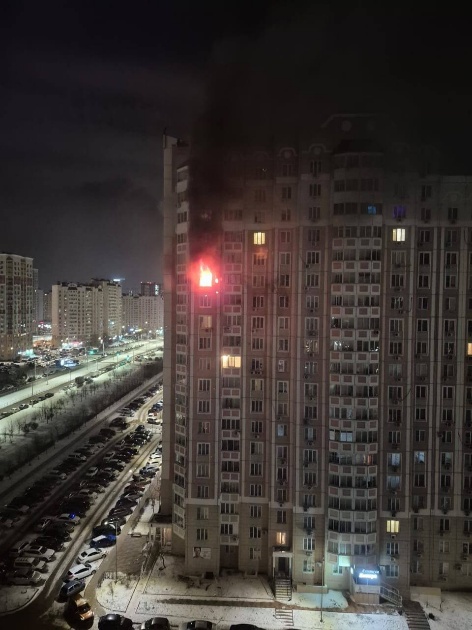
Damage to an apartment building in the Russian city of Rostov overnight. The building was reportedly hit by a Russian air defense missile. (Exilenova-Plus / Telegram)
When the City Went Cold: Zelensky Declares an Energy Emergency
The lights went out first. Then the heat. Then the water. In Kyiv, winter pressed its face to darkened windows as Russian strikes tore through the systems that keep a city alive.
President Volodymyr Zelensky answered with an emergency declaration for the energy sector, placing the capital at the center of a round-the-clock rescue effort. A permanent task force was ordered into motion, led by the new energy minister, Denys Shmyhal, to coordinate crews, equipment, and relief for neighborhoods stranded in subzero air. “The consequences of Russian strikes and worsening weather are severe,” Zelensky wrote, and the understatement landed hard on streets where breath already fogged inside apartments.
The government moved on multiple fronts at once. Foreign partners were tapped for critical equipment. Electricity imports were pushed higher. Stockpiles were checked and stretched. The midnight curfew—an unbroken line since the first days of the invasion—was set for review so residents could reach the city’s “invincibility points,” warm shelters with power and heat. More would open. All would be inspected. No one would be turned away from warmth.
Schools waited for guidance as families weighed safety against routine. Energy crews worked through ice and smoke, splicing lines and swapping transformers with numb hands, racing a thermometer that punished every delay. Replacement parts were running thin. The cold did not negotiate.
From the field came a blunt assessment. DTEK, the country’s largest private energy company, backed the move and pledged its teams around the clock. Gratitude followed for workers repairing grids under falling snow and falling debris.
This is what an energy war looks like: missiles for substations, drones for boilers, winter as an accomplice. Kyiv held on in the dark, waiting for the hum to return.
When the Front Crept Closer: Children Pulled from Zaporizhzhia’s Villages
The order came quietly, the way the hardest decisions often do. Mandatory evacuation. Children first.
In southern Zaporizhzhia, shelling had edged closer and the map had begun to lean the wrong way. The government moved before the lines could move again. About forty children would leave their villages with their parents or guardians, bound for the central Cherkasy region—away from the thud of artillery and the sudden crack of rockets.
“Mandatory evacuation is always a hard step,” Deputy Prime Minister Oleksiy Kuleba wrote. Under constant fire, he said, it is the only responsible way to save lives—especially the lives of children. This time, he did not name the villages. The message was enough. When officials stop listing places, it’s because naming them can paint a target.
For months, this stretch of the front had been quieter than the killing fields farther east. Then the tempo changed. Russian assaults picked up. Pressure mounted. The line bent toward Zaporizhzhia city itself—once home to around 840,000 people, now only thirty kilometers from Russian positions.
Evacuation notices mean the calculus has turned. They mean the risk has outrun the routines. They mean families packing what fits in their hands while neighbors watch from doorways, promising to feed the animals left behind and water the gardens that won’t be tended for a while.
The buses wait. The lists are checked. A teacher counts heads twice. The road north opens. And another pocket of childhood slips away from the front, carried by the hope that distance can still buy time.
A Ledger of Loss: The Year the Civilians Paid
The report arrived without sirens. No blast, no smoke—just a document that put a year into columns and dates. The United Nations confirmed what Ukrainians had lived through: 2025 was the deadliest year for civilians since the invasion began.
Nearly four years on, the strikes did not ease. They pressed harder—into apartment blocks and markets, into power stations and streets meant for evening walks. The campaign against energy turned winter into a weapon, widening the circle of harm and pulling whole neighborhoods into darkness.
The figures are clean on the page. The reality is not. Each number is a person—a parent, a child, a grandparent—killed where international law says civilians should be safe. The accounting is clinical by necessity. In Ukraine, it has names.
A Mirror World in Washington: When the Blame Ran Backward
Donald Trump told Reuters that Vladimir Putin was “ready to make a deal” and Ukraine was not. He said the quiet part out loud: “We have to get President Zelensky to go along with it.” In that telling, the country being invaded had become the obstacle, and the country doing the invading had become the peacemaker.
The claim flipped the record on its head. Ukraine had said yes to multiple U.S.-backed peace proposals. Russia had said no to all of them—and kept the war burning. Moscow rejected ceasefires, widened its demands to eight Ukrainian oblasts, and stepped up attacks on civilian infrastructure while insisting it wanted talks.
Asked about U.S. security guarantees, Trump hedged. “If we can get something done, we’d help,” he said, then added a number that landed like a flare: 30,000 soldiers a month, between both sides. No one publishes reliable monthly totals. The figure sounded designed to hurry the room, not describe it.
The message, though, was unmistakable. In Trump’s version of events, Ukraine stands in the way of peace. Russia does not. It is a story Moscow loves—and one that alarms Kyiv’s supporters, who watch missiles fall even as the word “deal” gets passed around.
When Allies Drew a Line: The Day Republicans Said No to Greenland
Don Bacon didn’t hedge. He went straight for the words most politicians avoid. A U.S. invasion of Greenland, he said, would be “one of the dumbest things I’ve ever heard.”
The Nebraska Republican was reacting to a White House that kept pressing the idea that Greenland—Denmark’s autonomous territory—was vital to American security and would be acquired “one way or the other.” Military force, Trump said, was still on the table. Bacon answered with legislation of his own: the No Funds for NATO Invasion Act, written to block any move against allied soil.
A month earlier, Bacon admitted, he would have dismissed the talk as absurd. But the rhetoric didn’t stop. “(Trump) and his team keep saying that the military option is on the table,” he said, and that changed the stakes.
Bacon argued the path not taken was obvious. Denmark and Greenland, he said, would likely have welcomed deeper cooperation if Washington had approached them as partners. “President Trump could have done all of this as a friend, not as an enemy.” Instead, the threats risked tearing at NATO itself—“the most successful alliance” of the modern era.
On the island, the answer was already clear. Greenland’s 56,000 residents had no desire to become American. Copenhagen rejected any notion the territory could be sold or seized. At home, a Reuters/Ipsos poll found just 17 percent of Americans backed efforts to acquire Greenland.
Yet the pressure continued, as if wanting something were reason enough to take it—treaties, alliances, and the wishes of the people living there be damned.
The Door Slam: America Freezes Immigrant Visas Across 75 Countries
The notice moved quietly through embassies and consulates, then stopped the lines. Immigrant visa processing for citizens of 75 countries would be suspended, effective January 21, with no end date. Russia and Belarus were on the list, according to Fox News. So were Somalia, Afghanistan, Brazil, Iran, Iraq, Egypt, Nigeria, Thailand, and Yemen. The door did not close with a bang. It simply would not open.
A State Department spokesperson confirmed the pause—seventy-five countries, processing on hold—while declining to name them. The reason given was a sweeping review of procedures. Until it finishes, cases wait.
The justification arrived in a single sentence. The department, said spokesperson Tommy Pigott, would use its authority to bar applicants who might become a public charge or “exploit the generosity of the American people.” In practice, that meant files frozen midstream and families left counting weeks that no longer had dates.
The freeze follows a year of tightening screws. In 2025, more than 100,000 visas were revoked, including about 8,000 student visas. For 2026, the refugee admissions cap was slashed from 125,000 to 7,500—the lowest in the program’s history.
For would-be immigrants, the policy is not an abstraction. It is an unanswered email. A canceled appointment. A medical exam that expires while a case sits untouched. Seventy-five countries woke up to the same message: wait.
Who Gets the Chair at the Table: Europe’s Fight to Be Heard on Ukraine
In European capitals, the worry has a name: being cut out. As Washington and Moscow trade calls, ministers in Paris and Rome are pushing for the EU to appoint a special negotiator on Ukraine—someone who can carry Europe’s red lines into any room where a deal might be sketched.
France and Italy are driving the effort, telling partners they’ve lined up support inside the Commission and across several member states. The argument is simple and urgent: Europe must have a voice on questions that shape its own security—Ukraine’s territorial integrity, its path toward NATO, the terms of any ceasefire. With the war grinding into its fifth year, no one wants to wake up to an agreement written elsewhere.
The fear is fed by precedent. President Trump has pursued direct talks with Vladimir Putin, leaving European capitals on the sidelines. Those channels haven’t produced peace—Moscow still refuses to bend on its land claims—but they’ve made the exclusion feel real. Emmanuel Macron and Giorgia Meloni have urged opening lines to Putin’s inner circle, wary that silence is the same as consent.
“There are issues that can’t be discussed with only the U.S. when they have direct implications for our security,” one EU diplomat said. Yet the proposal cuts both ways. Critics warn that naming a negotiator could flatter the Kremlin with the appearance of good-faith talks where none exist.
Then there’s the question of who would speak for the continent. Kaja Kallas, the EU’s foreign policy chief and a steadfast ally of Kyiv, looks like the obvious choice. Others float Mario Draghi for his reach in Washington, or Finland’s Alexander Stubb for his diplomatic muscle.
The chair is empty for now. But the room is filling, and Europe is moving so it won’t be standing in the hallway when the door closes.
When the Road Turned Back: Young Ukrainians Choose Home
They came from everywhere—Italy and Japan, the United States and Morocco, New Zealand and France—and they came back. Twenty-five young professionals boarded planes and trains not to escape the war, but to step into it, returning through the Ukrainian-Lithuanian Create Ukraine program to live and work where their country needs them most.
They had left before the invasion or in its first shockwave, trading sirens for lecture halls and internships. Abroad, they learned in universities, companies, ministries, and NGOs. They built résumés across continents. And then, one by one, they decided the safest place for their ambitions was no longer enough.
“Being Ukrainian is not only about a passport,” Culture Minister Tetiana Berezhna said. “It is about responsibility—acting when the country needs you.” She points to the first cohort’s projects already reshaping public life. The new arrivals, she believes, will keep the bar high.
For Darka Harnyk from Donbas, New York offered stability and glass-tower certainty. She watched the invasion begin from across the ocean and felt the distance like a wound. “There is a lot of stability in New York,” she said. “But I need a challenge.” She is heading into Ukraine’s energy sector, where winter and missiles have made every kilowatt a fight.
Hanna Velykova returns from France, bringing her work in refugee and migrant law and an award for volunteering. Alisa Lytvynova leaves Columbia University for the Ministry of Economy, choosing privatization over comfort. “Life in New York was very good,” she said. “But I wanted to do something for my country right now.”
They arrive with luggage and lessons, accents softened by distance and resolve sharpened by choice. In a war that empties cities, these twenty-five are moving the other way.
Seats Still Turning: A Government in Motion
The reshuffle kept moving, chair by chair. Parliament tapped Dmytro Natalukha of the Servant of the People party to run the State Property Fund, filling a post left open since Vitaliy Koval’s dismissal last fall and months of interim stewardship by Ivanna Smachylo.
Around him, other desks remained marked “acting.” The Security Service still waits for a permanent chief; Yevhen Khmara, who leads the Alpha special operations unit, continues in the role on an interim basis. The digital transformation ministry is also in limbo after Mykhailo Fedorov’s move to Defense. And the justice portfolio sits empty following the November corruption scandal that swept out its leadership.
In Kyiv, the message is momentum without closure: appointments to keep the machine running, vacancies that signal more changes ahead. A government at war doesn’t pause. It rotates.
The Day’s Meaning: When Words Ran Far Ahead of Power
January’s war wrote itself in two scripts that no longer matched. On one stage, Moscow spoke as if it could redraw a continent. On the other, the math and the mud told a different story.
In diplomatic light, Sergei Lavrov claimed eight Ukrainian oblasts with the calm of a man announcing weather, even as Russian units strained to hold their most recent, modest gains. The Kremlin rejected ceasefires while insisting it wanted peace, widened its demands while losing leverage, and posed as a great power while its oil sold at prices that belong to history books, not war budgets.
In markets, the noose tightened. Urals crude slipped under $40—far below the assumptions propping up Moscow’s 2026 plans—while Europe assembled a €90 billion lifeline for Ukraine. Sanctions and enforcement, long promised, were finally biting in ways that show up on balance sheets.
In the air, the war kept its old habits. Russia sent 113 drones and three ballistic missiles into Ukrainian cities, killing civilians and tearing at the grid. Ukraine answered in Rostov and at sea, where tankers now sail with fear as a surcharge. Neither side found a decisive break after 1,421 days. Both paid in blood and steel.
At home, Kyiv handed the defense portfolio to its youngest minister ever, along with the hardest ledger in government: a Hr.300 billion hole, two million wanted for draft evasion, two hundred thousand absent without leave, and a nation worn thin by years of sirens.
Across the ocean, politics bent the mirror. Donald Trump said Putin was ready for peace and Ukraine was not, a reversal so stark that even Republican lawmakers rebuked it, warning that alliances were being bartered for whims and antique notions of conquest.
This war began with tanks crossing borders. It has become a contest of factories and finances, of ports and parliaments, of drones and debt—and of claims so audacious they try to make a world of their own. Russia cannot win outright and will not concede. Ukraine cannot lose and struggles to break through. The West backs Kyiv, counting the cost.
On this day, nothing snapped. But the ground shifted. Revenues shrank. Positions hardened. Reforms were set in motion. And the distance between what Moscow says and what it can do widened again—until one day, that gap will be too wide to cross, and reality will end the speech.
Prayer For Ukraine
- Pray for protection over Ukrainian cities and communities under drone and missile attack — especially families enduring winter blackouts, damaged homes, and disrupted heating, that lives would be spared and infrastructure restored quickly.
- Pray for strength, wisdom, and endurance for Ukraine’s energy workers, emergency crews, and repair teams laboring in freezing conditions to keep power, heat, and water flowing.
- Pray for Ukraine’s leaders — especially President Zelensky, Defense Minister Fedorov, and the national security team — as they confront budget shortfalls, manpower exhaustion, and the weight of nearly four years of total war.
- Pray for the children and families evacuated from frontline villages in Zaporizhzhia, that they would find safety, stability, and hope far from the sound of shelling.
- Pray for the international community — that resolve would not weaken, that truth would overcome propaganda, and that justice, not aggression, would shape the path toward peace.