
As Moscow declares sweeping battlefield gains and expands its war aims beyond Ukraine, millions of Ukrainians endure subzero nights without heat or power under a campaign of deliberate winter strikes.
The Day’s Reckoning
The camera lights flick on in Moscow. General Valery Gerasimov steps to the podium and announces victory: 300 square kilometers seized in two weeks, Ukrainian units “surrounded” and being destroyed in Kupyansk.
Three time zones away, Kyiv shivers at −11°C. Around 300 apartment buildings sit without heat. Families huddle in dark rooms. Breath hangs in the air. Energy officials use two words to describe the situation: extremely serious.
The two scenes run in parallel.
In the Kremlin, Vladimir Putin declares the war a “direct response” to NATO expansion and makes clear Russia’s aims stretch far beyond Ukraine’s borders. His spokesman, Dmitry Peskov, warns that Kyiv’s “corridor for decision-making is narrowing.”
In western Ukraine, a Russian drone slams into a playground in Lviv. Across the country, energy infrastructure burns. Power grids flicker. Heating systems fail. Elevators stall. Stairwells go dark.
This is year four of the war.
In Moscow, generals present scripted triumphs as settled fact. In Kyiv, millions live inside a winter battlefield that did not exist in Europe a generation ago. The contrast could not be sharper: phantom victories on television, real cold in living rooms.
The distance between what Russia claims and what Ukrainians endure has become the war itself.
Day 1,422 — when propaganda spoke of conquest and an entire capital fought to stay warm.
The Theater of Lies: Where Moscow Declares Victories That Don’t Exist
The cameras roll. The podium gleams. And General Valery Gerasimov steps forward as if delivering a war-ending announcement.
Russian forces, he says, are advancing “in virtually all directions.” Three hundred square kilometers seized in two weeks. Ukrainian units surrounded and being wiped out in Kupyansk. Street fighting underway in Kupyansk-Vuzhlovyi. A front collapsing in real time.
It sounds decisive. It sounds unstoppable.
Then he reaches for proof.
Two villages. Hrabovske and Komarivka. Tiny border settlements southwest and northwest of Sumy City. He presents them as trophies—evidence of a growing “buffer zone,” proof that new sectors of the front are opening. On the map, they are dots. On the battlefield, they are fields and farm roads. Their elevation to strategic triumph tells its own story.
But Gerasimov saves his boldest fiction for Kupyansk.
There, he says, Russian troops are eliminating encircled Ukrainian forces along the east bank of the Oskil River. Ukrainian flags raised inside the city are dismissed as stage props—cheap theater meant to hide Russian control. Street fighting, he insists. Final seizures. The end is near.
Outside the briefing room, reality refuses to cooperate.
Geolocated footage shows Ukrainian units still holding ground. In some sectors, expanding it. Video contradicts every major claim. The battlefield tells a different story than the general.
It doesn’t matter.
The speech is not for analysts who track satellite imagery. It is for politicians who scan headlines. For diplomats weighing pressure. For citizens told that victory is already written.
This is how the Kremlin fights when tanks stall.
By declaring outcomes into existence. By turning fabrications into facts. By insisting that Ukraine’s resistance is already broken and that surrender is the only rational choice.
On Gerasimov’s battlefield, wars are won at the podium.
Putin Expands the War Map: Ukraine as the First Front
On January 15, Vladimir Putin steps forward and makes the war bigger.
This, he says, is not only about Ukraine. It is a “direct response” to NATO expansion — to a West that ignored Russia’s interests and broke promises not to move east. The words are framed as grievance, but they carry a strategic warning.
Ukraine is not the end point.
It is the opening move.
Putin reminds the world what Moscow has wanted all along: a rollback of Europe’s security order. NATO pushed back to its 1997 borders. Eastern Europe stripped of the guarantees that reshaped the continent after the Cold War.
The battlefield is in Ukraine.
The demand is continental.
Kremlin spokesman Dmitry Peskov follows with pressure. Ukraine’s position, he says, is “deteriorating day by day.” Kyiv’s “corridor for decision-making is narrowing.”
Translation: surrender now — or suffer later.
The message is designed for more than Kyiv. It is aimed at European capitals, at Washington, at anyone calculating how far Russia is willing to go.
This is not a war for territory.
It is a war for the map.
City of Ice and Fire: Kyiv Endures a War Meant to Freeze It into Silence
At 3 p.m. on January 15, Kyiv sits at −11°C. The kind of cold that bites skin in minutes. In ordinary winters, it would mean scarves and heavy coats. This winter, it means apartments without heat.
Around 300 buildings across the capital remain cold and dark. Down from 6,000 after Monday’s strikes — progress measured in survival, not comfort. Inside, families wear coats and hats. Breath clouds kitchens. Indoor temperatures fall into single digits. The city runs on emergency blackout schedules with no reliable timetable. Power might return at midnight. Or not at all.
The night before, the sky filled with engines.
Eighty-two drones lift off from across Russia and occupied territory — Kursk, Bryansk, Oryol, Millerovo, Primorsko-Akhtarsk, Hvardiiske in Crimea. A map-wide launch. Not harassment. A campaign.
Ukrainian air defenses destroy 61 of them. Mobile teams. Missile batteries. Electronic warfare. But 21 break through. They hit 13 locations across Kyiv, Chernihiv, Sumy, Kharkiv, Odesa, and Zhytomyr. Homes. Energy facilities. Administrative buildings. No region untouched.
In Sumy Oblast, one person dies. Nine are wounded.
Since January began, Russia has launched 256 aerial attacks on energy and heat systems — more than 17 a day. Eleven hydro plants. Forty-five combined heat and power plants. Forty-nine thermal stations. One hundred fifty-one substations. Each strike means months of repair. Millions in equipment. Crews working under sirens and falling debris.
President Zelensky declares an energy emergency. A crisis headquarters meets in Kyiv. DTEK’s CEO calls the situation “extremely serious.” Energy analysts say strikes at −15°C on centralized heating systems are “unprecedented anywhere in the world.”
At the United Nations, Russia says the attacks will continue until Zelensky “comes to his senses.”
Kyiv keeps waiting for the lights.
Playgrounds Under Fire: The War Hits Where Children Should Be
The playground in central Lviv is quiet in winter. On January 15, a Russian strike hits it anyway.
Governor Maksym Kozytskyi confirms the attack. No casualties are reported in preliminary information. But the blast wave tears through nearby buildings, shattering windows at a Polytechnic Institute and in surrounding apartments, Mayor Andrii Sadovyi says. The playground sits near the monument to Stepan Bandera — a symbolic address.
In Kyiv’s Solomianskyi district, debris from a Russian strike crashes onto the roof of a residential building. Tymur Tkachenko, head of the Kyiv City Military Administration, confirms the damage. Another home becomes part of the battlefield.
In Kharkiv, explosions echo through the city. Mayor Ihor Terehov reports that Russia has destroyed a major critical energy facility. Power fails. The emergency response headquarters switches to 24-hour operations.
This is how the war reaches civilians now — through playgrounds, rooftops, and power stations.
No front line required.
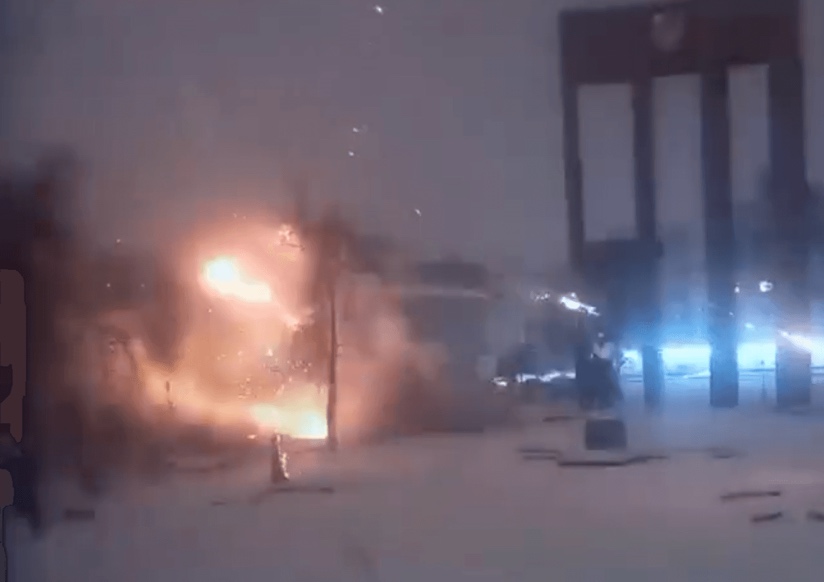
Russia strikes a playground in the western Ukrainian city of Lviv early. (Andrii Sadovyi/Telegram)
“Come Sit in the Cold”: Kyiv Confronts the Red Cross
The statement lands in Kyiv like a slap.
The International Committee of the Red Cross says recent strikes have left “millions of people with little or no electricity, water, and heating” in Kyiv, Dnipro, Donetsk, Belgorod, and other cities — placing Russian and Ukrainian attacks on the same moral plane.
On January 15, Foreign Minister Andrii Sybiha fires back.
“This is a disgrace,” he writes. “False moral equivalence between an aggressor and a country defending itself is unacceptable.”
Ukraine, he says, is acting within international humanitarian law and its right to self-defense. Russia is waging a deliberate campaign against civilian infrastructure. The distinction is not academic. It is the difference between survival and submission.
Sybiha points to another silence: the Red Cross’s failure to secure systematic access to Ukrainian prisoners of war and civilians illegally detained by Russia.
Then comes the invitation.
He announces he will summon the head of the ICRC delegation to the Foreign Ministry. And he extends a challenge to the authors of the statement themselves.
“Leave your warm offices,” Sybiha writes. “Come to Ukraine. Spend a day in a freezing home. Perhaps you will regain your sense of reality.”
Outside, temperatures stay below zero.
Inside, millions wait for the lights.
Meters of Blood: Where the War Grinds Forward One Field at a Time
On the northern border, Russian troops push across Sumy Oblast and gain nothing. Attacks roll through Oleksiivka, Yunakivka, Kindrativka, Andriivka. No advance. No breakthrough. A Russian milblogger admits what the briefings do not: the wounded cannot be evacuated. Bodies are collected when the shelling pauses. One mortally wounded soldier waits more than a week for retrieval.
Ukrainian units counterattack near Yunakivka and Andriivka. The line bends. It does not break.
North of Kharkiv, Russian columns strike again and again—Vovchansk, Starytsya, Tykhe, Zelene, Kruhle, Hrafske. Southeast near Dvorichanske, more assaults. Still no confirmed gains.
Near Kupyansk, the picture reverses. Geolocated footage shows Ukrainian troops advancing north of the city. Russian formations regroup along the Oskil River—68th Motorized Rifle Division, 27th Brigade, elements of the 47th Tank Division—trying to reach a bridge east of the central market. Infiltration teams slip toward Holubivka. Ukrainian fire turns them back.
Street by street, Russians attack Podoly, Petropavlivka, Pishchane, Kurylivka, Kupyansk-Vuzlovyi. Toward Borova, the push stalls again.
East of Slovyansk, Ukrainian forces move into central Svyato-Pokrovske. In Dibrova, Russian infiltrators are caught and struck. Along the Siverskyi Donets, small assault groups probe Dronivka, trying to cross and dig in near Platonivka. Every road is under Ukrainian fire.
South at Kostyantynivka, Russian infantry comes in pairs and trios—ten, twelve times a day—probing Berestok, Stepanivka, Pleshchiivka, Ivanopillya. A brief advance from Chasiv Yar gains up to a kilometer, then collapses. The encirclement plan exists on paper. The manpower does not.
Around Pokrovsk, Russian units rotate battered brigades and push forward on motorcycles, ATVs, armored trucks. Molniya drones buzz overhead. The aim is Hryshyne. The cost is constant.
From Oleksandrivka to Hulyaipole to western Zaporizhzhia, the pattern repeats: attacks everywhere. Breakthrough nowhere.
This is the real battlefield.
Progress measured in meters. Paid for in lives.
Fire in the Factory Belt: Ukraine Reaches Deep into Russia’s War Machine
The strike comes in the dark.
On the night of January 14–15, Ukrainian drones reach deep into Russia and hit the Nevinnomyssk Azot plant in Stavropol Krai. Flames rise from the complex. Smoke rolls across the industrial skyline. Geolocated footage posted January 14 shows the fire still burning.
This is not a random target. The plant produces acetic and nitric acids — chemicals vital to Russia’s artillery shell supply chain.
Another blow follows. Ukrainian Navy spokesman Captain Third Rank Dmytro Pletenchuk says Ukraine’s January 12–13 missile strike has severely damaged the Atlant Aero drone factory in Taganrog, disrupting Molniya drone production.
Then comes the air-defense hunt.
Between January 13 and 15, Ukrainian forces strike a Tor system and VITYAZ 50N6E radar in occupied Mariupol. In Volnovakha, a Buk M1 is hit. In Polohiv Raion, a Buk, a Strela-10, and a Tor-M2 are destroyed.
Commander Major Robert “Magyar” Brovdi lists the targets.
These are not symbolic raids.
They are precision blows meant to blind Russia’s skies and slow its guns.
The New Arsenal: Missiles Unveiled and Fighters on the Way
On January 15, a new weapon enters the war.
Defense firm Destinus rolls out the Ruta Block 2 cruise missile — heavier, longer-ranged, and built to slip through defenses. Its warhead exceeds 250 kilograms. Its reported range stretches beyond 450 kilometers. Artificial-intelligence guidance steers it in flight. A redesigned airframe reduces visibility. Folding wings allow launch from ground containers or aircraft.
At the nose sits a thermal-imaging homing head, sharpening accuracy in the final seconds before impact.
Destinus was founded by Russian-born entrepreneur Mikhail Kokorich, who fled Russia and renounced his citizenship. The missile integrates GPS-independent, electronic-warfare-resistant navigation from Spain’s UAV Navigation, with plans to add Shield AI’s Hivemind combat system.
Then comes the aircraft.
Poland approves the transfer of nine MiG-29 fighter jets to Ukraine. Deputy Defense Minister Pawel Zalewski confirms the decision on January 15. Technical talks continue. Kyiv, he says, appears ready to accept.
“I believe… Ukrainians made the decision to accept this offer,” Zalewski says. “Of course, there are some technical aspects which shall be clarified.”
In a war defined by attrition, every new system changes the math.
Missiles extend reach.
Fighters extend the sky.
Diplomacy in a War Zone: Kyiv Hosts the World While the Sirens Fade
Kristalina Georgieva steps into Kyiv on January 15 for her first visit since 2023, meeting President Zelensky, Prime Minister Yulia Svyrydenko, and senior officials. The agenda is survival math: progress on the 2026 budget, closing tax leaks, and shoring up revenue.
She sits down with central bank governor Andriy Pyshnyy to review IMF support and the role of monetary policy in keeping the economy steady under fire.
Across the city, Zelensky meets Ukraine’s ambassador to the UK and former commander-in-chief Valerii Zaluzhnyi. The message is unity and resilience. “I thanked him for his work as part of Ukraine’s team,” Zelensky says, as they map diplomatic tasks for the months ahead.
The cabinet turns, too. Oleksandr Borniakov becomes interim digital transformation minister after Mykhailo Fedorov moves to defense.
While drones fade into the distance, Kyiv keeps governing.

International Monetary Fund (IMF) chief Kristalina Georgieva and Ukrainian central bank governor Andriy Pyshnyy meet in Kyiv. (Georgieva/ X)
Ice and Ultimatums: The Arctic Becomes the Next Flashpoint
On January 15, European troops land on Greenland’s frozen runways as Washington raises the stakes.
France, Germany, Norway, Sweden, and the UK begin joint exercises on the world’s largest island just as U.S. President Donald Trump warns that America will acquire Greenland “one way or the other” — even by force.
French units are already on the ground. President Emmanuel Macron confirms that an advance team has deployed and will soon be reinforced with land, air, and maritime assets.
Berlin frames the mission as preparation for a changing Arctic. The German Defense Ministry says the drills are meant to test how stability can be preserved as Russian and Chinese activity grows across the polar north. Defense Minister Boris Pistorius stresses the need for close NATO coordination under Danish leadership.
The numbers are small but the signal is not. France sends 15 troops. Germany sends 13. Norway, Sweden, and Britain join in.
From Moscow, former president Dmitry Medvedev mocks the moment, urging Trump to move quickly and annex the island.
The same day, Russian Prime Minister Mikhail Mishustin speaks with Belarusian counterpart Alexander Turchin about deeper Union State and Eurasian Economic Union integration — expanding trade, science, and joint projects.
The war map keeps widening.
And now it stretches into the ice.
The Day’s Meaning: When Propaganda Meets Winter
Two wars ran in parallel on January 15.
In Moscow, generals claimed sweeping victories. In Ukraine, the front lines barely moved.
The contrast defined the day. Russian military leadership spoke of hundreds of square kilometers seized and Ukrainian units destroyed. On the ground, progress measured in meters. Small-group infantry assaults. Limited counterattacks. Gains bought with blood and held at great cost. A grinding war with no breakthrough in sight.
At the political level, the ambitions widened. Vladimir Putin made clear that Ukraine was only part of a larger demand: a rollback of Europe’s security order itself. Dmitry Peskov warned that Kyiv’s “corridor for decision-making” was narrowing. The message was not subtle. Surrender now, or suffer later.
At the human level, winter became a weapon.
Millions of Ukrainians lived through nights without heat or reliable power. Apartment blocks went dark. Families slept in coats. Electricity came, if it came at all, in brief windows after midnight. Energy infrastructure was not collateral damage. It was the target. A campaign designed to make daily life unbearable.
The gap between Moscow’s declarations and Ukraine’s reality exposed the true nature of the war. This was not a conflict approaching resolution. It was an attritional struggle where both sides claimed momentum while neither achieved decisive advantage.
Yet the day also showed what endurance looks like.
Zelensky met with Zaluzhnyi, former rivals standing together in a country fighting for survival. Poland approved MiG transfers. European troops deployed to Greenland as global fault lines widened. The IMF chief arrived in Kyiv to discuss budgets and stability while Ukrainian drones struck Russian military production facilities deep inside Russia.
In Lviv, a playground took a hit. In Kharkiv, infrastructure burned. In Kyiv, residents adapted again.
Oleksandr Kharchenko called attacks on centralized heating at −15°C unprecedented anywhere in the world. He was right. No modern city has been forced to live this way.
And yet Kyiv kept functioning.
The lights flickered back on after midnight. Phones charged. Water warmed. Another day began.
On day 1,422, Russia promised inevitability. Ukraine answered with survival.
And the outcome remained as uncertain as it was on the first morning of the invasion.
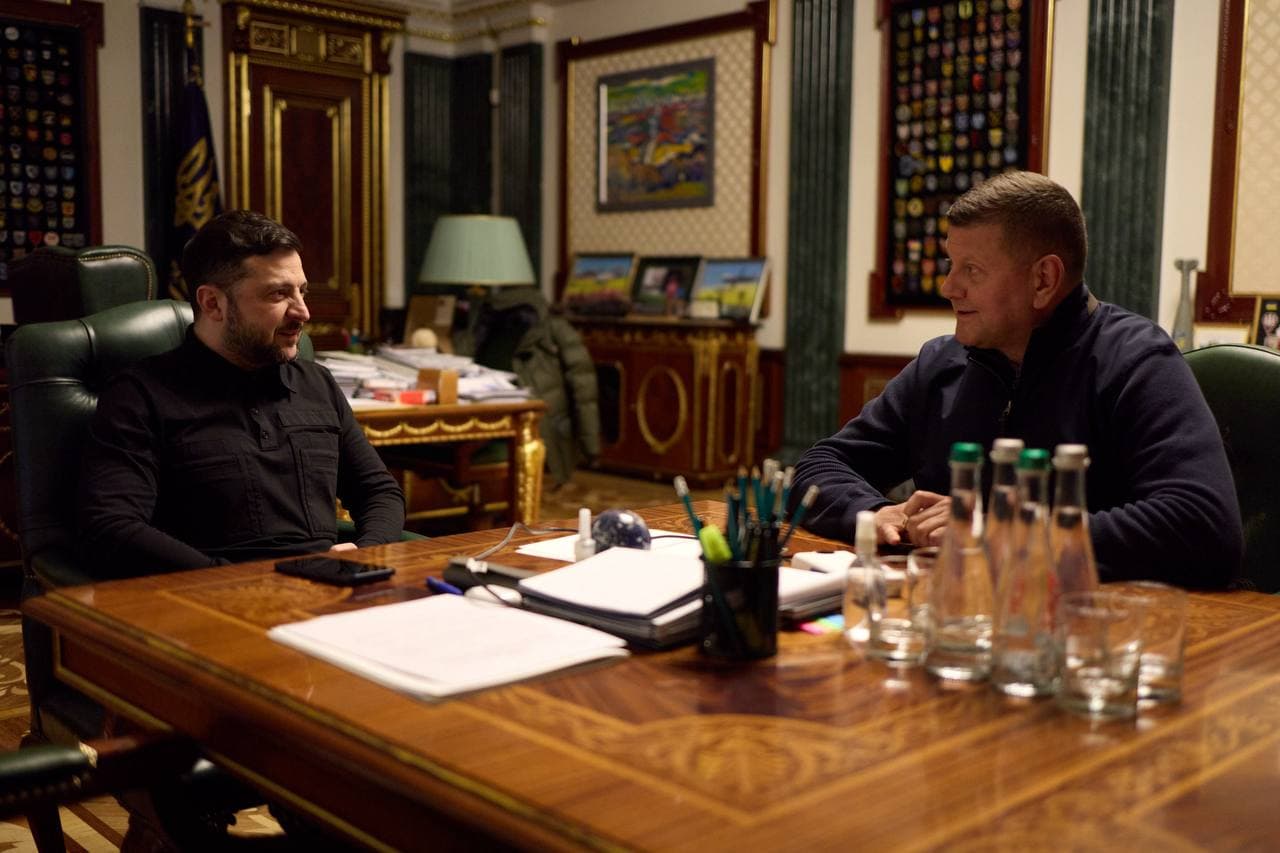
President Volodymyr Zelensky meets Ukraine’s Ambassador to the U.K. Valerii Zaluzhnyi at the President’s Office in Kyiv, Ukraine. (Volodymyr Zelensky/Telegram)
Prayer For Ukraine
- For warmth, light, and shelter
Pray for families across Kyiv, Kharkiv, Sumy, Odesa, and Chernihiv enduring winter nights without reliable heat or power. Ask God to protect the elderly, children, and the sick from cold-related illness, and to grant strength to those sleeping in darkened apartments, waiting for brief windows of electricity to cook, charge phones, and warm water. - For those under fire in civilian neighborhoods
Lift up the people of Lviv, Kharkiv, and Kyiv whose playgrounds, rooftops, and power facilities were struck. Pray for emotional healing where fear now lingers, for swift repairs to shattered windows and damaged homes, and for peace in places where children should be safe. - For the defenders on the front lines
Pray for Ukrainian soldiers holding positions where progress is measured in meters and paid for in blood. Ask for protection in small-group assaults and counterattacks, for wisdom in command decisions, and for courage that does not fail in the long grind of attrition. - For those restoring life under sirens
Pray for energy workers, engineers, medics, and emergency crews repairing power plants, substations, and heating systems under constant threat. Ask God to guard them as they work through freezing nights and falling debris, and to hasten the restoration of light and heat. - For leaders and allies making hard decisions
Pray for President Zelensky and Ukraine’s leadership as they carry the weight of survival. Pray for unity at home, clarity in diplomacy, and steadfast support from partners providing aid, aircraft, and defenses. Ask that wisdom prevail over propaganda and that justice outpace cruelty.