
As Ukrainian negotiators arrive in Miami seeking peace, Russian forces prepare strikes that could plunge the country into nuclear-powered darkness—while Trump targets NATO allies with tariffs and Europe finally moves to choke off Moscow’s shadow oil fleet.
The Day’s Reckoning
The Ukrainian government jet lifted off for Miami before dawn. Across Ukraine, Russian reconnaissance drones were already in the air, tracing the outlines of ten energy substations tied to the country’s three active nuclear power plants.
Diplomacy was heading west. Darkness was coming from the east.
As Kyiv’s negotiators crossed the Atlantic to discuss peace terms with the Trump administration, Russian planners were finalizing strike packages designed to sever nuclear stations from the national grid. Not to win territory. To turn off the heat. To plunge millions into freezing blackouts in the dead of winter.
This was the 1,424th day of the war. A war that no longer pretended to follow battlefield logic. It followed leverage.
In Miami, Ukrainian officials prepared to argue for security guarantees and a sustainable peace. In Ukraine’s skies, Russian drones mapped the infrastructure that keeps reactor cooling systems alive and apartment radiators warm. The message was unmistakable: Moscow would negotiate with one hand while reaching for the breaker switch with the other.
And the contradictions didn’t stop at Ukraine’s borders.
The same American president urging peace talks announced sweeping tariffs against NATO allies — the very governments that had armed, financed, and defended Ukraine for nearly four years. Capitals that had spent billions standing up to Russian aggression suddenly found themselves targeted by Washington’s economic fire.
At sea, a different signal flashed. German and Italian authorities turned back shadow-fleet tankers carrying Russian oil, the first real interdictions of a sanctions-evasion armada that funds missile strikes on Ukrainian cities. Europe, at last, was putting steel behind its statements.
So the war ran on parallel tracks.
In Miami, diplomats spoke of frameworks and timelines.
In Ukraine, engineers braced for strikes that could collapse the grid.
In European waters, patrol boats finally closed in on Russia’s floating treasury.
Peace talks moved forward. So did preparations for a blackout.
This was diplomacy under threat of nuclear darkness.
And it was the day the war made clear that negotiations and coercion were no longer separate acts — they were part of the same strategy.
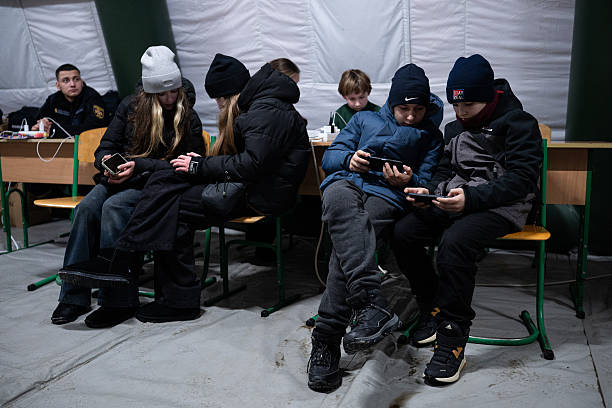
Ukrainian children are seen using their mobile devices in a tent set up to provide heat and electricity to residents of Kyiv, amid ongoing heat and power shortages caused by Russian strikes on critical infrastructure. (Danylo Antoniuk/Anadolu via Getty Images)
At the Table While the Lights Go Out: Ukraine Bargains for Survival in Miami
The Ukrainian jet touched down in Miami with frost still clinging to the news from home. While the delegation crossed warm tarmac and flashing cameras, Russian missiles were carving holes in substations that keep apartment radiators alive. Peace talks began with the sound of generators humming in the background of a nation going dark.
Kyrylo Budanov, Rustem Umerov, and Davyd Arakhamia arrived carrying drafts and redlines—and the weight of a country that needed guarantees, not slogans. Their mandate was impossible on its face: sell a durable peace while families queued at warming tents and cities counted blackout hours.
Across the table sat Steve Witkoff, Jared Kushner, and Army Secretary Daniel Driscoll. They represented an administration whose posture had shifted by the hour. The previous week, President Trump had accused Volodymyr Zelensky of blocking peace and praised Moscow’s supposed openness to deal. The optics were brutal: Ukraine pleading its case while Russian strikes kept landing on civilian infrastructure.
“The main task,” Zelensky wrote as his team departed, “is to provide all the real information about what is happening—the consequences of Russian strikes. This terrorism discredits diplomacy.” Translation: you can’t negotiate in good faith while someone is cutting the power.
The 20-point framework on the table still had a hollow center. Security guarantees—the only thing that could stop Russia from regrouping and returning—remained unresolved. Kyiv needed ironclad commitments. Washington wanted a fast win and a headline.
“Ukraine needs a fair peace,” Budanov told reporters on arrival. Determined. Uncertain. Both at once.
Then came the tremor beyond the conference room. Hours before the landing, Trump had threatened tariffs on eight NATO allies over Greenland. European leaders who might have reinforced Ukraine’s hand were suddenly fighting a trade war with Washington. The alliance that had carried Kyiv through four winters was cracking in real time.
What haunted the talks most were the side channels. Evidence mounted that Trump’s team was also sounding out Moscow. Ukrainians knew Russia had to sign any deal—but not over Ukraine’s head. The nightmare wasn’t failure. It was success purchased with sovereignty, wrapped in a victory lap.
When the Switch Becomes a Weapon: Russia’s Plan to Black Out a Nation
The warning landed like a cold hand on the throat.
On January 17, Ukrainian military intelligence said Russia had finished mapping ten critical substations tied to the country’s three active nuclear power plants. The plan was blunt: hit them together, cut the reactors from the grid, and drop Ukraine into a darkness no schedule of rolling blackouts could prepare for.
“Russia is planning to strike substations connected to Ukraine’s three active nuclear plants to completely disconnect Ukrainians from heat and power,” intelligence officials said. Translation: this isn’t about territory. It’s about forcing capitulation by freezing cities into submission.
Nuclear plants don’t just make electricity. They need it—constantly—to run safety systems and cool reactors. If the grid goes down, diesel generators take over. If fuel runs out, equipment fails, or follow-on strikes hit, a meltdown can follow within hours. Moscow is threatening to turn Ukraine’s own reactors into a doomsday clock.
Those three facilities—locations kept deliberately vague—now carry the country’s load. Russia has wrecked most thermal stations and hydro plants over months of strikes. Nuclear is what’s left. Sever it, and the grid collapses.
“Russia is always trying to disconnect our nuclear plants,” said Ukrenergo CEO Vitaliy Zaichenko. “It’s dangerous not only for Ukraine but for all of Europe.” A radiation plume wouldn’t stop at borders.
Foreign Minister Andrii Sybiha pushed the intelligence to partners. “Moscow knows no limits in its genocidal goal of depriving Ukrainians of power amid freezing winter,” he wrote, urging the IAEA and major powers to issue clear warnings.
The IAEA said it would send a team to assess the ten substations. No timeline.
On the ground, the preview had already begun. Overnight strikes on January 16–17 hit energy sites in Odesa and Kyiv oblasts. Tens of thousands lost power. In Bucha, 56,000 families woke in the dark. Crews worked in ice and wind to restore lines, knowing each fix thins reserves.
“This is not patch it up and move on,” Kharkiv Mayor Ihor Terekhov wrote after another heavy hit. “Reserves aren’t unlimited. Any new damage eats the capacity needed for stabilization.”
Jan Vande Putte of Greenpeace called it a step-by-step strategy to raise the risk. Rosatom knows which switches matter. Each strike inches the system closer to the edge.
This is nuclear blackmail. Coercion scaled to continental danger. Terror dressed as strategy—and a mockery of any peace talk conducted while the hand hovers over the breaker.
When the Ally Turns the Knife: Trump Targets Europe Over Greenland
The threat dropped like a thunderclap across European capitals.
Ten percent tariffs on eight NATO allies starting February 1. Twenty-five percent by June. The condition for lifting them: a “complete and total purchase of Greenland.”
France. Sweden. Denmark. Norway. Germany. The United Kingdom. The Netherlands. Finland. The backbone of Europe’s support for Ukraine—now staring down American economic punishment.
It was economic warfare against Washington’s closest partners, announced with the same blunt force Trump reserved for adversaries. And for Ukraine, it could not have come at a worse moment.
The countries targeted were the ones shipping weapons, training troops, funding hospitals, and carrying Kyiv’s diplomatic case through four years of war. Their crime: participating in joint NATO exercises on Greenland, meant to test Arctic defenses against growing Russian and Chinese activity.
Trump called the drills a “very dangerous game.” He said Denmark’s coordination with allies threatened American interests. Translation: NATO defending NATO territory had somehow become hostile to the United States.
Russia’s invasion of Ukraine and its catalog of war crimes, meanwhile, drew only hedged language from the White House.
Paris answered first. “Unacceptable,” President Emmanuel Macron wrote. “No intimidation or threat will influence us—neither in Ukraine, nor in Greenland, nor anywhere else.” He linked the two fights in a single sentence: sovereignty is sovereignty.
London followed. Prime Minister Keir Starmer called the tariffs “completely wrong” and promised a direct confrontation with Washington. Stockholm came next. “We will not let ourselves be blackmailed,” said Swedish Prime Minister Ulf Kristersson, announcing urgent talks with Britain and Norway.
Brussels moved into emergency mode. Cyprus convened EU ambassadors for January 18. Ursula von der Leyen and Antonio Costa warned that tariffs on allies would “undermine transatlantic relations” and risk a dangerous spiral.
For Kyiv, the damage was immediate. Leaders who should have been reinforcing Ukraine’s hand in Miami were now fighting a trade war with Washington.
“China and Russia must be having a field day,” said EU foreign policy chief Kaja Kallas. “They benefit from divisions among Allies.”
The fallout spread. The pending U.S.–EU trade deal stalled. Manfred Weber said approval was impossible under tariff threats. In Copenhagen and Nuuk, protesters filled the streets: “Hands off Greenland.” “Make America Go Away.”
James Goldgeier, an American foreign policy scholar, put it plainly: the alliance was in deep trouble—for no strategic reason.
And across the Atlantic, Ukrainian negotiators watched the floor shift beneath them. If Washington could threaten its closest allies over Arctic real estate, what would stop it from trading Ukrainian sovereignty for a headline?
In Miami, that question hung over every handshake.
The Ghost Tankers Meet Steel: Europe Finally Closes the Sea Lanes
The order went out quietly on January 17.
The Arcusat was not coming through.
German Federal Police cutters moved into position and turned the tanker away from territorial waters — the first time a European country had physically blocked a suspected shadow-fleet vessel carrying Russian oil. After years of watching sanctions get sidestepped on the high seas, Berlin finally drew a line.
The Arcusat was a perfect specimen of Moscow’s floating evasion network. Built in a Chinese shipyard. Sailing under shifting flags — Tanzania, Cameroon, others. No reliable registration. When challenged, the crew claimed an identity no shipping registry could confirm.
A ghost ship. Except for the oil in its belly.
Denied passage between Denmark and Sweden, the Arcusat swung north and began the long, expensive run toward Russia’s Arctic coast. Its original route would have slipped sanctioned crude into willing markets through European waters. Germany’s move turned that shortcut into a costly detour.
And it wasn’t alone.
German police confirmed that several Russian-linked ships had recently been denied passage. Then Italy followed suit. In the Mediterranean, the Guardia di Finanza seized a Tuvalu-flagged bulk carrier — the Hizer Reis — hauling 33,000 tons of Russian ferrous material out of Novorossiysk.
These were not random inspections.
European intelligence services had been mapping the shadow fleet for years: satellite tracks, port calls, registry shells, flag swaps. Tankers off Venezuela flipping to Russian colors. Ships sanctioned for Iranian cargo quietly loading Russian oil. A web of floating money laundering for autocracies.
For years, the fleet sailed on one assumption: Europe would write reports but never stop ships.
January 17 broke that assumption.
The timing was no accident. Every tanker that slips through funds missile strikes on Ukrainian cities. Every barrel that reaches market helps buy drones and artillery. As Russia escalated its winter campaign against power grids, the contradiction became unbearable.
Paper sanctions weren’t enough. So Europe reached for steel.
The EU’s coming sanctions package will ban reinsurance and tighten liability. But the real shift is visible at sea: patrol boats replacing press releases.
For Russia, the message is clear. The ocean is no longer a loophole.
Every ship turned back, every cargo seized, every policy canceled raises the cost of war.
The shadow fleet made billions by staying invisible.
On January 17, it ran into the coast guard.
Holding the Line in the Killing Fields: Ukraine Strikes Back Outside Pokrovsk
The footage surfaced on January 17, grainy and wind-shaken, but unmistakable. Ukrainian infantry pushing forward through frozen fields northwest of Svitle. Not retreating. Advancing.
Near Pokrovsk — a city Russia has tried to strangle for months — Ukrainian troops surged into ground the enemy thought was already theirs. It was a small move on the map. On the front, it was a statement.
Pokrovsk has lived under constant assault. Russian forces have hammered its outskirts, probing for weak seams, hunting the roads that keep the city supplied. The goal has been isolation, then collapse. Instead, Ukrainian units counterpunched, proving that even under relentless pressure, defense could still turn into attack.
The pattern repeated across the eastern front.
In Kupyansk, Russian units pushed into the city and nearby villages — Dvorichna, Krasne Pershe, Petropavlivka, Podoly, Kucherivka, Pishchane, Kurylivka — testing lines, burning ammunition, trading lives for meters. Ukrainian forces answered with counterattacks near Kindrashivka and Radkivka, forcing Russian commanders to keep shifting reserves instead of consolidating gains.
Around Pokrovsk itself, Russian assaults rolled in from Hryshyne, Rodynske, Bilytske, Sukhetske, Myrnohrad, Rivne, Kotlyne, Udachne, Molodetske. A Ukrainian brigade reported infiltration attempts into Myrnohrad and renewed efforts to cut supply routes. Russian milbloggers confirmed Ukrainian counterstrikes — reluctant proof that Kyiv’s forces were shaping the fight, not just absorbing it.
Farther north near Slovyansk, Russian small-unit teams slipped into western Zakitne. Photos showed soldiers posing with flags. Ukraine’s Eastern Grouping of Forces answered with artillery fire and drone strikes. The flags stayed. Control did not change.
Prisoners taken in the sector described preparations for a push toward the ridgeline between Zakitne and Kryva Luka — high ground that would let Russian guns reach Slovyansk, Lyman, Mykolaivka. Reserves gathered near Dronivka. Rubber boats probed river crossings.
Near Kostyantynivka, Russian infantry crept forward on foot and motorcycles, using fog and wind to mask movement from drones. Ukrainian operators hunted them anyway.
This is how the war opens 2026.
Russia presses everywhere. Ukraine bends, then strikes back.
No breakthroughs. No collapse. Just frozen ground, burning armor, and casualties measured in platoons.
The front is holding.
But it is holding at a terrible price.
The Rear Is No Longer Safe: Ukrainian Drones Strike Deep Behind Russian Lines
The night over occupied Donetsk broke with the whine of engines and the crack of explosions.
On January 16–17, Ukrainian drones slipped past Russian defenses and struck a drone storage and launch facility near Donetsk City, about 39 kilometers behind the front. Inside were Iranian-designed Shahed drones — the same weapons used to hunt Ukrainian power stations and apartment blocks. The hangar burned before the next launch could begin.
Farther south, another strike reached even deeper.
In occupied Kalmiuskyi Raion near Mariupol, Ukrainian drones hit the Azovska power substation, roughly 175 kilometers from the frontline. Power vanished across Mariupol, Manhush, and Yalta. Tens of thousands were left in the dark in a city Russia claims to have “liberated.”
Occupation authorities scrambled. Control rooms went silent. Backup systems failed.
The message was clear: the rear is no longer a sanctuary.
Ukraine’s medium-range drone campaign is shrinking the map. What once felt safely behind Russian lines is now within reach. Drone depots. Power nodes. Logistics hubs. One by one, the systems that keep the occupation running are being found and broken.
For Russian forces, the war now follows them into the night.
For occupied cities, it is proof that Kyiv’s reach has not been cut.
Nowhere is truly beyond the front.
The Arithmetic of Death: How the War Is Being Counted in Bodies and Wreckage
The numbers arrived on January 17 like a ledger of ruin.
Ukraine’s General Staff said Russian forces had lost roughly 1,225,590 troops since February 24, 2022 — killed, wounded, and missing. 1,130 more in a single day. A figure so large it defies comprehension, yet still climbing even as public support inside Russia slips.
Then came the wreckage.
11,569 tanks. 23,914 armored vehicles. 74,601 trucks and fuelers. 36,261 artillery systems. 108,605 drones. Each digit hides a factory line, a training pipeline, a supply convoy. Replace the metal and you must replace the men who drive it.
Independent Russian journalists have been naming the dead one by one. Mediazona and the BBC’s Russian Service have confirmed 163,606 soldiers killed — nearly 54,000 volunteers, 20,000 prisoners pressed into service, 16,500 mobilized troops, and more than 6,300 officers. They warn the real toll is far higher; their count depends on obituaries and regional reports.
This is the war’s brutal math.
Russia can absorb about 1,000 casualties a day by recruiting contract soldiers, keeping its offensives grinding forward. Ukraine, by contrast, is running short of infantry. Defense Minister Mykhailo Fedorov says two million Ukrainians are wanted for draft evasion and another 200,000 soldiers are absent without leave. Units holding the line struggle to refill their ranks.
The machines tell the same story. Russia has lost more tanks than most countries own. More artillery than several major powers combined. It keeps fighting because Soviet stockpiles and domestic plants still feed the front.
Drones are different. They can be built fast and cheap. The sky has become a factory race.
For Kyiv’s planners, the conclusion is stark: Russia’s population and tolerance for loss give it a grim advantage in a long war. Without major Western aid or a defensive breakthrough, Ukraine risks being ground down by numbers alone.
Peace is urgent.
But a peace without security would only reset the clock.
The War Crosses the Border: A Drone Falls in Moldova and NATO Scrambles
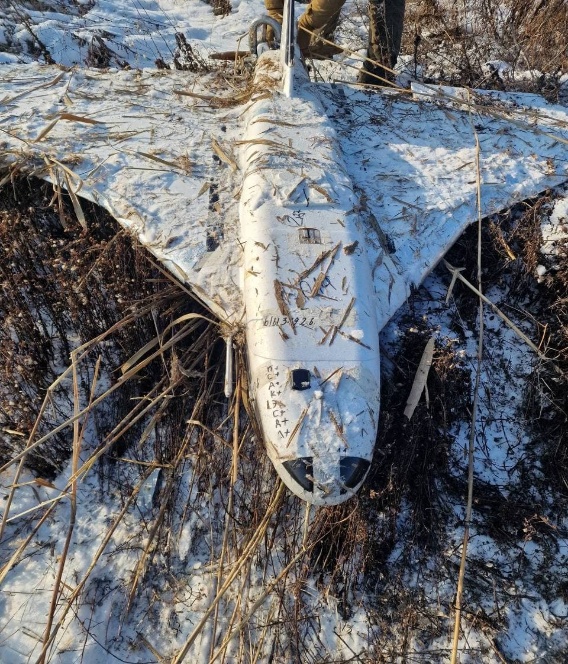
Pictured are the remnants of a crashed Russian drone found in the village of Nucareni, in the Telenesti District of Moldova. (Moldova’s National Police/Telegram)
A hunter walking a frozen field near Nucareni found the wreckage first.
On January 17, a Russian Gerbera-type drone lay twisted on Moldovan soil, about 54 kilometers from the Ukrainian border. It wasn’t armed. It didn’t explode. But it had crossed a line. Chisinau called it what it was: a violation of sovereignty and a threat to national security.
It wasn’t an accident in isolation.
Across Europe, Russian drones keep slipping into foreign airspace—by error, by provocation, or as collateral from strikes aimed at Ukraine. Each incursion pushes the war outward, past the front lines and into countries that are supposed to be watching from the sidelines.
NATO’s answer now comes on afterburners.
From bases in Estonia, Italian Eurofighter Typhoons lift into Baltic skies to meet Russian aircraft probing alliance airspace. By 2026, the scrambles are routine. They weren’t a few years ago. What once would have dominated headlines is now part of the daily rhythm of deterrence: radar blips, cockpit calls, intercept vectors.
Analysts call these flights “Phase Zero” operations—moves meant to unsettle Europe, test response times, and probe for seams. Each approach forces higher alert levels. Each intercept burns fuel, time, and attention. Each close pass asks the same question: when does monitoring become action?
For Europeans, the war is no longer distant. They hear the jets. They read about drones falling in neighboring fields. The buffer zone is gone.
Russia’s provocations created the very fears that pushed Finland and Sweden into NATO. The bid to stop expansion accelerated it. The effort to fracture the alliance hardened resolve.
A drone in a Moldovan field.
Fighters in Baltic skies.
And a continent learning that the war does not stop at Ukraine’s borders.
Cold Without End: Ukraine’s Power Grid Buckles Under Winter Fire
The meeting began with frost in the windows and outage maps on the walls.
On January 17, President Zelensky convened an emergency energy session as temperatures slid toward –20°C, the country endured 16-hour blackouts, and repair crews climbed frozen pylons to undo the damage from the night’s strikes—knowing more were coming.
“We need to accelerate electricity imports and bring in more equipment now,” Zelensky wrote afterward. The urgency was arithmetic. Ukraine can generate 11 gigawatts and needs 18. The seven-gigawatt gap—about 40% of demand—can only be partly filled by imports capped at 2.3 gigawatts by transmission limits. Even at full throttle, the lights won’t all come back. And Europe’s prices often force Kyiv to import less than it technically could.
The night of January 16–17 showed how fast the hole deepens. Russian strikes hit energy sites in Odesa and Kyiv oblasts. About 16,000 customers went dark in Odesa region. In Bucha, 56,000 families woke without power. Crews worked in ice and wind to reconnect lines, hoping to finish by evening—“hoping” doing heavy lifting.
In Kharkiv, another heavy strike tore into critical infrastructure and injured one person. Mayor Ihor Terekhov was blunt: this isn’t patch-and-go. Reserves are thin. Load is maxed. Every new hit eats the capacity meant for stabilization.
Repairs are brutal. Subzero metal. Live wires. Russian reconnaissance drones circling to spot the next target. In frontline zones, shelling halts work altogether—and energy crews have been deliberately hunted, with hundreds killed or wounded.
The pressure isn’t only electric. Naftogaz CEO Serhii Koretskyi said gas facilities at six sites were hit in a week. Russia is striking the whole energy ecosystem—power and heat.
A state of emergency is in effect. A task force runs round-the-clock. Aid is coming—€60 million from Germany, £20 million from the UK—but it’s a fraction of what rebuilding demands. Near the front, blackouts can be indefinite.
For families, the calculus is simple. You can hide from missiles. You can’t warm a home by willpower when the power is off for 16 hours.
Winter is winning the clock.
No Neutral Ground: Ukraine Takes the Fight to Russia’s Olympic Facade
The announcement landed less than a month before Milan lights the Olympic flame.
On January 17, President Zelensky opened a new front—aimed not at trenches or tank parks, but at Russia’s global image. Ukraine sanctioned the Russian Paralympic Committee and its president, the Russian Computer Sports Federation and its president, and a Russian boxer. The charge: using stadiums and arenas to launder war and sell propaganda.
“These individuals and entities use sports venues to spread anti-Ukrainian narratives,” the Presidential Office said. Translation: Moscow is trying to look normal while waging a criminal war.
The timing was deliberate. In Milan, Russian and Belarusian competitors are preparing to enter individual events as “neutral athletes,” even as their national teams remain banned. The label is a fig leaf. Many of the athletes have documented Kremlin ties or have voiced support for the invasion. Their presence turns competition into a billboard—proof, for Russian state media, that the world still accepts them.
Ukraine is done playing along.
The move punctures a comforting fiction: that sport floats above politics. It never has. Not when missiles crater training halls. Not when coaches are buried in uniform. Not when teammates vanish from locker rooms to front lines.
The cost to Ukrainian sport has been brutal. Hundreds of athletes and coaches killed. Hundreds of facilities smashed by drones and rockets. Olympians train in patched gyms while their former teammates rest in military cemeteries. Against that ledger, Russia’s parade of “neutral” competitors is obscene.
The sanctions won’t bar Russians from Milan—that call belongs to the IOC and federations. But they raise the temperature. They complicate travel and partnerships. They put officials on notice: Ukraine is watching who carries water for aggression.
Zelensky says more measures are coming, coordinated with partners. The point is simple. Soft power pays for hard war. Legitimacy buys time. Applause buys cover.
For athletes who lost friends and homes, the action is at least a signal that their country will not let Moscow weaponize sport without a fight.
There is no neutral ground.
The Day’s Meaning — Peace at the Table, Fire in the Sky
The picture could not have been starker.
On January 17, Ukrainian diplomats sat in air-conditioned rooms in Miami discussing peace while Russian planners prepared strikes meant to turn off the lights for millions back home. Diplomacy unfolded under fluorescent bulbs. Coercion waited in the cold.
It was a day that showed the war’s central contradiction in full daylight.
Negotiations conducted while one side is actively trying to make the other’s country unlivable are not negotiations. They are leverage plays. Moscow was pressing Kyiv to discuss borders and sovereignty while systematically dismantling the grid that keeps homes warm and hospitals running. Documents can be drafted. Communiqués can be issued. But there is no durable peace when one party is rewarded for continued destruction.
Washington made the balance worse.
President Trump’s tariff threats against NATO allies over Greenland fractured the Western unity that had sustained Ukraine’s defense. At the same time, reports of parallel U.S. contacts with Moscow fueled fears of a deal cut for speed, not security. European leaders who should have been reinforcing Kyiv’s position were instead fighting a trade war with their closest ally.
On the battlefield, the war kept its tempo. Russian forces pressed across multiple sectors. Ukrainian units counterattacked where they could. The casualty ledger kept climbing. Europe finally turned back shadow-fleet tankers, a late but real step toward choking off the revenue that buys missiles and drones.
Then came the most dangerous turn yet: nuclear blackmail.
Russia’s plan to strike substations tied to Ukraine’s nuclear plants is coercion scaled to continental risk. It is a threat that should have triggered immediate international action. Instead, the IAEA scheduled assessments while Moscow readied strikes that could push an entire region toward catastrophe.
For families enduring 16-hour blackouts in subzero temperatures, the distance between diplomatic process and physical reality is measured in frozen pipes, dark stairwells, and nights without heat. Each day talks continue while attacks proceed is another day of destroyed capacity and accumulated loss. The calendar favors the aggressor.
January 17 revealed the requirement for ending the war. Not more paper. Deterrence that changes Moscow’s math—or a Western intervention that does.
As envoys discussed guarantees in Florida, reconnaissance drones traced the substations that keep Ukraine alive.
That is the truth of this war: diplomacy without deterrence is performance.
Peace without security is delayed defeat.
Prayer For Ukraine
- For the families in darkness and cold
Pray for the millions enduring 16-hour blackouts in subzero temperatures. Ask God to protect the elderly, children, and the sick, to strengthen repair crews working in dangerous conditions, and to provide warmth, shelter, and endurance through the long winter nights. - For protection over Ukraine’s energy and nuclear infrastructure
Pray for God’s covering over Ukraine’s power plants, substations, gas facilities, and energy workers. Ask that planned attacks be thwarted, that disaster be prevented, and that wisdom guide international leaders to act decisively to stop nuclear and energy blackmail. - For the soldiers holding the front lines
Pray for Ukrainian defenders near Pokrovsk, Kupyansk, Slovyansk, Kostyantynivka, and across the front. Ask for strength, courage, protection from drones and artillery, and comfort for those carrying the weight of constant combat and loss. - For wisdom and integrity in diplomacy
Pray for Ukrainian negotiators and international leaders engaged in peace talks. Ask that no deal be made that sacrifices Ukraine’s sovereignty, that truth would prevail over propaganda, and that peace would come with real security and justice. - For hope among the occupied and the displaced
Pray for Ukrainians living under occupation and for families forced from their homes by destroyed infrastructure. Ask God to remind them they are not forgotten, to sustain their spirits, and to hasten the day when freedom, light, and peace return to their cities.