
As Kyiv plunged into darkness, Poland shut the door on refugees, Russian oil terminals burned, and Trump stunned Davos with a Greenland deal while his envoy prepared to fly to Moscow.
The Day’s Reckoning
The lights went out across Kyiv before dawn.
By morning, President Volodymyr Zelensky confirmed what residents already knew from dark stairwells and frozen apartments: almost 60 percent of the capital had lost electricity. Repair crews worked through the night. Emergency generators hummed where they could. But whole neighborhoods remained cold and black.
In Warsaw, the political weather shifted just as sharply. Poland’s government announced it would begin phasing out special benefits for Ukrainian refugees, including healthcare access and child payments. After nearly four years of open doors, Europe’s largest host country signaled that wartime hospitality had limits.
In Davos, the world’s attention drifted north. President Donald Trump told business and political leaders that Washington had formed a “framework of a future deal” on Greenland. His special envoy prepared to fly to Moscow the next day. NATO’s secretary general used his platform to plead for focus, warning that Arctic bargaining must not replace support for Ukraine.
Far from the conference halls, Ukraine’s defense minister laid out a different arithmetic. His goal: at least 50,000 Russian soldiers killed every month through expanded drone warfare and deep strikes.
That strategy was already visible inside Russia. Late that night, Ukrainian drones struck oil terminals in Krasnodar Krai, killing three people and igniting massive fires that lit the sky near the Kerch Peninsula. Another wave of strikes hit southern refineries, tightening pressure on Moscow’s fuel network.
And in Davos, Trump claimed Vladimir Putin had accepted an invitation to join a new Board of Peace for Gaza, even as the Kremlin offered no public confirmation.
Diplomacy, distraction, destruction. Aid cuts, blackouts, oil fires, peace boards.
January 21 showed how a war of attrition strains more than armies. It tests alliances, exhausts compassion and pulls attention away from the cities still freezing in the dark.
When the Door Begins to Close: Poland Signals the End of Sanctuary
The decision landed in Warsaw with the dull finality of winter.
Government spokesperson Adam Szłapka stepped before reporters and announced that Poland would begin phasing out the special protections granted to Ukrainian refugees—healthcare access, monthly child payments of 800 złoty, and the legal framework that had turned emergency shelter into daily life.
Four years after the first trains arrived packed with mothers and children, Poland was changing the rules.
The Interior Ministry framed it as normalization. The refugee crisis, officials said, had “stabilized.” Most Ukrainians were now working. Their children were in Polish schools. The extraordinary measures, once built for mass flight, would be replaced by “systemic, equal rules for all foreigners.”
Translation: the war was no longer reason enough.
Szłapka told reporters Poland was no longer facing a simultaneous wave of arrivals. The emergency phase was over. The country needed to move on.
Behind the language of reform sat an uncomfortable reality. Poland had absorbed more Ukrainian refugees than any other nation. Hospitals were crowded. Social services stretched thin. Patience, once boundless, was wearing down.
Yet outside government offices, a different Poland still existed.
Earlier this month, ordinary citizens raised more than one million złoty in three days to buy generators for Kyiv, where Russian strikes had left whole districts without power. While lawmakers drafted benefit cuts, donors were wiring money to keep Ukrainian apartments warm.
Two Polands. One calculating sustainability. The other acting on instinct.
For hundreds of thousands of Ukrainians still living in Polish cities, the message was unmistakable. The era of automatic protection was ending. Survival would now depend on paperwork, employment, language, and legal status.
The welcome mat was still there.
But it was being folded.
A City in the Dark: Kyiv Freezes While the Grid Collapses
The morning arrived without light.
President Volodymyr Zelensky confirmed what Kyiv residents already knew from stairwells lit by phone screens and kitchens warmed by candles: almost 60 percent of the capital had no electricity. Across the country, Kharkiv, Sumy, Chernihiv, and Dnipro were facing what he called “the most difficult” conditions—an energy catastrophe stretching across Ukraine’s largest cities.
Repair crews worked through the night. So did the State Emergency Service, utility workers, and municipal teams. Zelensky acknowledged the effort in a Telegram post. He did not promise relief.
Ukrenergo, the state grid operator, said the situation around Kyiv remained critical. Scheduled power cuts continued nationwide. Russian strikes overnight and again in the morning hit energy facilities in multiple regions, knocking out substations and transformers in Dnipropetrovsk, Odesa, Zaporizhzhia, and Kharkiv. The pattern was unmistakable. This was winter warfare—designed to break civilian morale by turning heat and light into luxuries.
Mayor Vitali Klitschko filled in the human cost. Of 5,635 high-rise apartment buildings left without heating, 4,000 were still cold. Families were living in subzero apartments where indoor air felt no warmer than the streets outside.
Then came the number that stunned the city.
Klitschko’s press service said 600,000 people had left Kyiv this month alone—nearly one in five residents—based on mobile phone data tracking vanished subscribers. A city built for millions was emptying under the pressure of cold and darkness.
The Kyiv Military Administration pushed back, saying the figure was unconfirmed. But the argument over statistics could not hide the truth on the streets.
Kyiv was bleeding people. And every packed suitcase was another small victory for Russia’s campaign against the grid.

Members of President Donald Trump’s cabinet listen to Trump address the World Economic Forum (WEF) in the Davos Congress Center in Davos, Switzerland. Later in the day, Trump would announce Washington formed a “framework of a future deal” on Greenland, backing off threats that it would seize the island militarily. (Chip Somodevilla/Getty Images)
Greenland on the Brain: Trump Steals the Spotlight as Ukraine Freezes
The announcement rippled through Davos like a dropped glass in a quiet room.
President Donald Trump stepped into the World Economic Forum and declared that Washington had reached a “framework of a future deal” on Greenland. At the same time, he said he would pause tariff threats against European allies after talks with NATO Secretary General Mark Rutte.
Weeks of confrontation evaporated into a headline.
“This solution, if consummated, will be a great one for the United States of America, and all NATO Nations,” Trump posted online, offering no details on what the framework actually contained. To reporters, he claimed the U.S. was getting “everything we wanted,” including permanent national security guarantees lasting for an “infinite” period.
The words were sweeping. The substance was missing.
Behind the scenes, CNN reported Denmark was considering allowing additional U.S. military bases on Greenland, though no plans were finalized. Rutte told Reuters any deal would center on Arctic security, not mineral extraction—despite Greenland’s vast rare-earth reserves.
Danish Foreign Minister Lars Løkke Rasmussen welcomed the cooling of tensions. “The day is ending on a better note than it began,” he said, relieved that a transatlantic trade war had been pulled back from the edge.
But the détente followed weeks of coercion.
Trump had threatened sweeping tariffs unless Europe agreed to negotiations over acquiring Greenland. The pressure campaign stunned European capitals, where leaders heard echoes of the territorial demands Russia was making against Ukraine.
Sweden’s finance minister called the approach “sad and totally absurd.” The European Central Bank’s president questioned whether threatening to seize allied territory was compatible with NATO membership. France’s president warned that international law was being replaced by raw power.
In Davos, as Kyiv froze in the dark, the world’s attention drifted north.
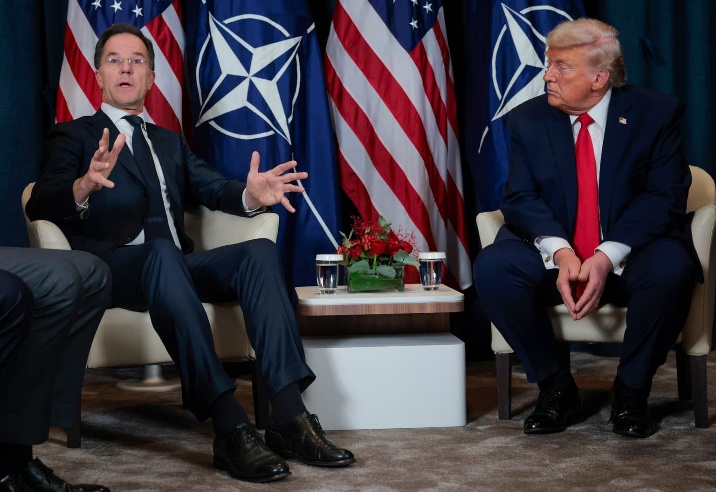
U.S. President Donald Trump (R) listens as NATO Secretary General Mark Rutte speaks during a meeting, in Davos, Switzerland. (Chip Somodevilla/Getty Images)
“That’s Our Territory”: Trump Redraws the Map While Kyiv Freezes
The hall was full. The cameras were rolling. The world’s CEOs leaned forward in their seats.
President Donald Trump took the Davos stage and told them the United States wanted “immediate negotiations” over Greenland.
“It’s the United States alone that can protect this giant mass of land,” he said. Protect it. Develop it. Make it safe for Europe. The justification rolled out in confident, sweeping sentences. Greenland, he argued, sat on America’s northern frontier. It belonged in Washington’s orbit.
Then he said the word no one in Europe expected to hear.
Acquisition.
“This enormous unsecured island is actually part of North America,” Trump said. “That’s our territory. After the war, we gave Greenland back to Denmark. How stupid were we to do that?”
He insisted there would be no invasion. No military action. “People thought I would use force. I don’t have to use force,” he said, adding that the military was “not on the table.”
The pitch was framed as protection, not coercion. Security, not conquest.
Then Trump pivoted south.
Ukraine, he told the room, was Europe’s problem.
“What does the U.S. get out of all of this work, all of this money, other than death, destruction, and massive amounts of cash going to people who don’t appreciate what we do?” he asked. Europe, he said, “has to work on Ukraine.” America was separated by “a big, beautiful ocean.”
In Kyiv, apartments sat dark and frozen.
In Davos, the leader of the Western alliance questioned why America should care.
“Don’t Look Away”: Rutte Tries to Drag the World Back to Ukraine
The room was packed with presidents, ministers, and financiers. The Arctic dominated the conversation.
So Mark Rutte cut through it.
On a Davos panel, NATO’s secretary general leaned forward and delivered a warning meant to refocus a drifting alliance. Ukraine, he said, must remain the world’s priority.
“The focus on Ukraine should be the number one priority,” Rutte told the audience. “It is crucial for European and U.S. security.”
He warned against the illusion of progress. Europe had pledged €90 billion. Diplomats were talking about peace frameworks. But none of that, he said, meant the war was close to ending.
“If we Europeans here in NATO think that because of the €90 billion, or because a peace process seems to be moving in the right direction, we can forget about the defense of Ukraine—don’t,” he said. “They need our support now, tomorrow, and the day after.”
Rutte acknowledged he was working quietly to contain tensions over Greenland. But he refused to let Arctic bargaining eclipse a nation fighting for survival.
Canada’s prime minister, Mark Carney, followed with a darker warning: the world order itself was cracking.
“A rupture in the world order,” he said. “The end of a nice story.”
The Numbers of Death: Fedorov’s Plan to Bleed Russia Dry
The strategy fits on a page. The math fits on a napkin.
Ukraine’s new defense minister, Mykhailo Fedorov, stepped before reporters and laid out the war as a numbers problem. Russia, he said, must lose at least 50,000 soldiers every month. Killed. Not wounded. Gone.
That is the threshold where Moscow breaks.
Fedorov, 35 and newly confirmed to the post, was delivering his first blueprint for how Ukraine intends to win: not through a single breakthrough, not through negotiations, but through relentless attrition that makes the war impossible for Russia to sustain.
“President Volodymyr Zelensky has set a clear task,” Fedorov said. Stop the enemy in the sky. Halt it on the ground. Strike its economy. Make the price of war unbearable.
Ukraine is already inflicting roughly 35,000 Russian casualties each month—more than Moscow can replace. Russian recruitment stands at about 33,000. The war is already running at a deficit for the Kremlin.
But Fedorov wants to widen the gap.
If Russia recruits 33,000 and loses 50,000, the math collapses. Units hollow out. Quality drops. Offensives stall. The war ends not with a signature, but with exhaustion.
His answer is technology.
Digitized battlefield command. Standardized FPV strike drones. Mass production of bomber drones. Killer drone teams hunting Russian operators. Ukrainian-built aircraft to rival China’s MAVIC. Real-time tracking of munitions. Full integration of drones with artillery.
“More technology—fewer casualties,” Fedorov said.
Behind it all, a sweeping reform of a military structure he called outdated. A deep audit. Less bureaucracy. More lethality.
This is not a peace plan.
It is a countdown.
Oil in Flames: Ukraine Brings the War to Russia’s Fuel Heartland
The night sky over Krasnodar burned orange.
Near the village of Volna, an oil terminal erupted into flames after a Ukrainian drone strike, killing three people and injuring eight. Four fuel tanks burned at once. Fire crews rushed in with 97 responders and 29 vehicles, battling an inferno that lit the horizon and turned the terminal into a beacon visible for kilometers.
The target was no accident.
Volna sits just east of Crimea’s Kerch Peninsula, about 325 kilometers from Ukrainian-controlled territory near Nikopol—well within range of Ukraine’s growing fleet of long-range strike drones. The terminal feeds fuel into Russia’s logistics chain for occupied Crimea and southern Ukraine. It is a war artery.
Governor Veniamin Kondratyev said this was the second straight night Krasnodar Krai had come under attack. Not harassment. A campaign.
Further north, drones struck the Afipsky oil refinery, one of southern Russia’s largest processing hubs. Flames tore through part of the facility after drone debris fell onto refinery grounds. Regional officials insisted there were no casualties and no serious damage, even as residents filmed the fires from their balconies.
Afipsky turns crude into fuel for both civilians and the military. Every shutdown tightens supplies. Every repair drains resources. The refinery has been hit before. Ukraine knows where Russia is vulnerable.
Then came the strike in Adygea.
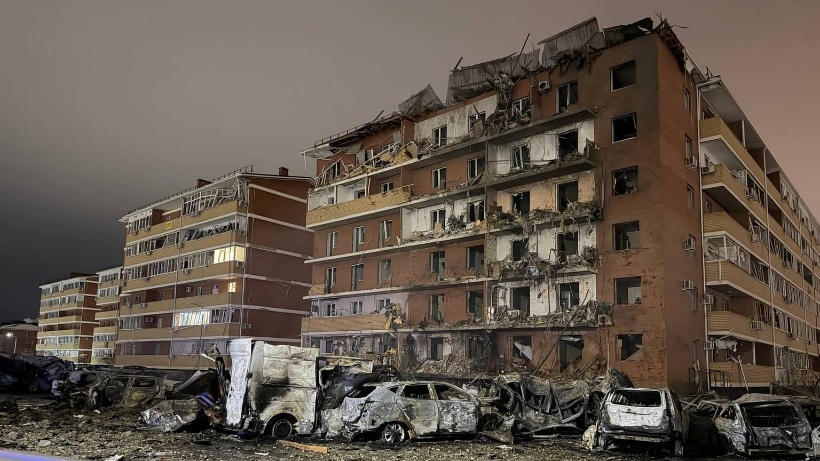
Fire in a high-rise residential building in the Republic of Adygea, Russia. (Murat Kumpilov/Telegram)
In Takhtamukaysky District, a residential building was ripped open. Fires spread through an apartment block and a nearby parking lot. One person was killed. Eleven were injured.
State media blamed Ukrainian drones. Independent outlet ASTRA said video and eyewitness accounts told a different story: a Russian air defense missile had malfunctioned or missed its target and slammed into the building.
It is a familiar pattern. Interceptors falling back onto Russian cities. Shrapnel killing civilians. Moscow blaming Kyiv.
Later, rescuers pulled human remains from the rubble.
Oil terminals, refineries, fuel depots—these are not symbolic targets. They fund Russia’s war machine. And now they are burning.
The Kremlin Door Opens: Trump’s Envoy Gets the Call
The message came from Davos.
U.S. special envoy Steve Witkoff told Bloomberg TV that he and Jared Kushner were flying to Moscow the next day for a meeting with Vladimir Putin.
“The Russians have invited us to come,” Witkoff said. “That’s a significant statement from them.”
After years of diplomatic isolation, the Kremlin was reopening its doors—at least to Washington’s new peace team.
Witkoff said President Trump remained focused on a peace deal and claimed “even more significant improvement” had already been made. The process, he insisted, was moving forward.
“I think everybody is embedded in the process and wants to see a peace deal happen,” he said.
The Kremlin confirmed the meeting hours later. Spokesman Dmitry Peskov told state agency TASS that Putin would receive Witkoff.
Then came another signal: Witkoff said he believes Russia will join Trump’s new Board of Peace.
The destination was set. The channel was open.
“He’s Accepted”: Trump Announces Putin’s Seat at the Peace Table
The claim landed in Davos with the weight of a diplomatic earthquake.
President Donald Trump told reporters that Vladimir Putin had accepted an invitation to join his new Board of Peace for Gaza.
“He was invited. He’s accepted,” Trump said.
In Moscow, the answer sounded different.
Speaking at a Russian security council meeting, Putin stopped short of confirming anything. Instead, he said Russia would “consult with our strategic partners” while the Foreign Ministry reviewed the proposal.
Then he made a counteroffer.
Putin proposed paying Russia’s $1 billion permanent seat fee using frozen Russian assets held by the United States and suggested those funds could help rebuild territories “damaged during military actions.”
He said he would discuss the plan directly with Steve Witkoff and Jared Kushner.
Inviting Putin to join a world peace forum, critics said, would be like inviting Hitler to help establish a Jewish homeland.
Trump offered no response.
Betting on a Nation in Flames: Investors Back Ukraine’s Future
In a warm conference hall in Davos, the contracts were signed while Kyiv froze in the dark.
At Ukraine House, the Amber Dragon Ukraine Infrastructure Fund announced it had secured an additional €200 million for rebuilding renewable energy, transport, and digital networks. Outside, snow fell on Swiss rooftops. Inside, bankers placed long bets on a country still under missile attack.
The fund—created by Kyiv-based Dragon Capital and U.S.-based Amber Infrastructure—was the first designed solely to rebuild Ukraine’s shattered backbone. Launched last summer, it aimed to raise €350 million for sectors devastated by nearly four years of Russian air strikes.
The money came from Europe’s financial pillars. The European Bank for Reconstruction and Development pledged €60 million. The European Investment Bank added €50 million. The International Finance Corporation committed €40 million. Swedish and Danish development funds joined in, signaling Nordic faith in Ukraine’s recovery.
“Infrastructure is suffering enormously,” said Alona Shkrum, Ukraine’s deputy minister for communities and territories. Ports. Railways. Roads. “But nevertheless, we restore. We reconstruct. Even during the war.”
The timing was jarring.
Kyiv had just reported that 60 percent of the capital had no electricity. The mayor said hundreds of thousands had fled the cold. Yet inside Davos, institutions were wiring hundreds of millions for a future that barely seemed imaginable from a frozen apartment block.
Ukraine’s rebuilding bill is staggering: $170 billion in direct damage, according to the Kyiv School of Economics. Full recovery could reach $800 billion over a decade.
But investors see what missiles cannot erase: Ukraine’s location, workforce, farmland, minerals. Someone will rebuild it.
The only question is who gets there first.
Phantom Power: A Presidential Insider Charged as Ukraine Sits in the Dark
The charges landed as much of Ukraine sat without electricity.
The National Anti-Corruption Bureau announced it had charged Rostyslav Shurma, former deputy chief of staff to President Zelensky, with embezzlement and money laundering. Nine suspects were named in a scheme involving solar power plants in occupied Zaporizhzhia Oblast.
Investigators say the group stole ₴141.3 million ($3.28 million) by claiming state payments for electricity that was never produced.
The facilities were under Russian occupation. The panels were silent. The grid received nothing.
Yet the companies kept filing paperwork and collecting money under Ukraine’s “green tariff” program.
Shurma’s brother, Oleh, who co-owned the firms, was also charged.
“In reality no electricity was being supplied to Ukraine’s energy system,” the bureau said.
NABU chief Semen Kryvonos said investigators searched Shurma’s home in Germany, where he now lives.
He Died Keeping Ukraine Lit
The power station was still damaged. The cables were still live.
Oleksii Brekht, chairman of Ukrenergo’s management board, was supervising emergency repairs when the electricity surged through him. He died from electrocution while working at the site.
For the second day in a row, Brekht had been personally overseeing restoration.
“In the most difficult times for our state,” the Energy Ministry wrote, “he took on colossal responsibility.”
The Day’s Meaning
Two wars unfolded in parallel.
In Ukraine, the war for survival pressed on. Cities sat dark and cold. Families cooked on camping stoves. Elevators stopped between floors. Repair crews chased damage faster than they could fix it, racing from substation to substation while missiles and drones hunted the grid. The country endured another winter day shaped by blackout schedules and frozen apartments.
In Davos, the war for attention took over.
Poland signaled that its extraordinary welcome for Ukrainian refugees was ending. Four years of open doors had given way to political limits and domestic pressure. Hospitality, once unconditional, was now being recalculated.
At the same time, the world’s most powerful leaders gathered to discuss Greenland.
President Trump unveiled a vague framework for Arctic negotiations and questioned why the United States should continue carrying the burden of a European war across “a big, beautiful ocean.” His envoy prepared to fly to Moscow. Trump claimed Putin had accepted a seat on a new Board of Peace. The Kremlin did not confirm it.
The contrast was stark. Ukrainian cities were fighting for electricity while global diplomacy drifted north.
On the battlefield, Ukraine made its own intentions clear. Defense Minister Mykhailo Fedorov laid out a strategy built on attrition: kill more Russian soldiers each month than Moscow can replace. Victory not through breakthroughs, but through arithmetic.
That logic was already playing out inside Russia. Ukrainian drones struck oil terminals and refineries. Fires burned across Krasnodar Krai. Fuel depots lit the night sky. Moscow’s war economy felt the pressure.
At NATO’s table, Mark Rutte tried to pull the conversation back to Ukraine. In another room, investors committed hundreds of millions to rebuilding a country still under attack. In Kyiv, prosecutors charged a former presidential aide with stealing energy funds. And at a shattered power facility, Ukrenergo’s chairman died trying to restore light to a frozen nation.
This was a day of fractures.
Alliances stretched thin. Attention wandered. Compassion hardened into policy. Diplomacy multiplied while certainty vanished.
The war is no longer only a test of weapons.
It is a test of will.
And will, across the world, is beginning to strain.
Prayer For Ukraine
- For warmth, light, and protection for civilians
Pray for families living in darkness and freezing apartments, for the elderly and children trying to endure another winter day without power, and for the repair crews risking their lives to restore electricity. Ask God to cover them with protection and provide strength beyond exhaustion. - For leaders to remain focused and faithful
Pray for Ukraine’s leaders and for allied governments, that their resolve would not fracture under pressure, distraction, or fatigue. Ask that political calculations would not outweigh moral responsibility, and that Ukraine would not be forgotten while other priorities compete for attention. - For courage and wisdom for Ukraine’s defenders
Pray for soldiers, drone operators, medics, and commanders carrying the burden of attrition warfare. Ask for wisdom in every decision, protection in every mission, and mercy for those who must face death daily. - For integrity and justice inside Ukraine
Pray that corruption would be rooted out completely, even during wartime, and that Ukraine would emerge from this conflict not only free, but cleaner, stronger, and more righteous in its institutions. - For endurance of heart and unity among allies
Pray that compassion would not harden into indifference, and that nations who once opened their doors would not close their hearts. Ask God to sustain unity, generosity, and long-term commitment until peace is finally secured.