
As Trump and Zelensky talked peace from Davos and envoys shuttled to Moscow, Russian missiles hit Ukrainian homes, exposing the widening gap between diplomatic promises and the war’s brutal reality.
The Day’s Reckoning
The day began far from Ukraine, in rooms warmed by Alpine sunlight. In Davos, Donald Trump stood before leaders from nineteen countries and unveiled a Board of Peace, declaring that settlement was close. Volodymyr Zelensky spoke of documents nearly finished and talks soon to begin with the United States and Russia in the United Arab Emirates. From the outside, the war looked procedural, negotiable, almost contained.
By afternoon, it looked very different.
Russian missiles struck residential buildings in Dnipro and Kryvyi Rih. Apartments burned. Stairwells filled with smoke. Nineteen people were injured, including four children. One was eighteen months old, a child born well into the full-scale invasion, old enough to fear sirens and explosions but too young to remember anything else. Rescue crews worked through rubble while families waited below, counting floors and hoping.
Elsewhere, the state kept moving. Anti-corruption investigators charged the former head of the State Border Guard with organizing cigarette smuggling through diplomatic vehicles. Energy Minister Denys Shmyhal called it the most difficult day for the power system in more than two years as nearly 3,000 Kyiv buildings remained without heat. In freezing water, emergency divers finished a sixth day repairing a flooded thermal plant, their work determining whether thousands of homes would stay warm.
Along the front, Ukrainian units gained ground in some sectors while Russian forces advanced in others. In Kyiv, Defense Minister Mykhailo Fedorov dismissed five deputies and brought a former critic into government to help scale drone warfare.
This was day 1,429. Diplomacy moved forward. Corruption was exposed. Infrastructure failed and was patched back together. Children were pulled from rubble. The war did not pause for any of it.

The aftermath of a Russian attack on Kryvyi Rih, Dnipropetrovsk Oblast. (State Emergency Service of Dnipropetrovsk Oblast)
Snow Rooms and Red Lines: Peace Talked in Davos, Territory Demanded in Moscow
The room in Davos was calm, almost serene. Snow lay thick on the Alps outside the windows as Volodymyr Zelensky sat across from Donald Trump for an hour, discussing air defenses, security guarantees, and documents said to be nearly complete. Around them, aides leaned over briefing papers and timelines. The conversations assumed a future — Ukraine alive, sovereign, rebuilding, anchored in Europe.
That assumption evaporated within hours.
In Moscow, Steve Witkoff and Jared Kushner sat across from Vladimir Putin for more than three hours. These rooms did not speak of recovery. They spoke of borders. Of land. Of how much Ukraine would have to surrender to make the war stop.
Kremlin aide Yuri Ushakov removed any remaining ambiguity. Without settling the territorial question, he said, there was no point in peace. Until then, Russia would keep fighting. Translation: talks would not replace the battlefield. They would run beside it.
From the air, Trump sounded confident. Speaking aboard Air Force One, he said Zelensky wanted a deal. Responsibility subtly shifted, as if Ukraine’s survival were a negotiating posture rather than a necessity. He drifted into language about boundaries and property lines, acknowledging Ukrainian winter suffering only in passing. “It’s no way to live,” he said — a phrase so small it collapsed under the weight of reality.
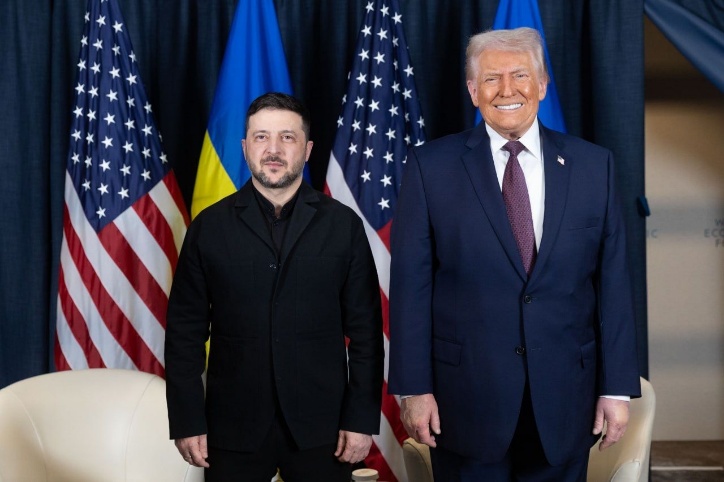
President Volodymyr Zelensky during negotiations with U.S. President Donald Trump, in Davos, Switzerland. (Volodymyr Zelensky / X)
Witkoff called negotiations “down to one issue.” That issue was Russia’s demand that Ukraine give up the Donbas, including land Russian troops do not control. Financial Times reported discussions of a limited ceasefire: Russia pauses attacks on Ukrainian energy sites; Ukraine halts strikes on Russian oil infrastructure. A trade that would freeze advantage in Moscow’s favor.
Delegations revealed priorities. Russia sent its intelligence chief and its frozen-assets negotiator. Ukraine named its defense minister and intelligence director. One side prepared to bargain over territory and money. The other prepared to defend its existence.
Zelensky said the deal was 90 percent ready.
The missing ten percent was whether Ukraine would still be a country.
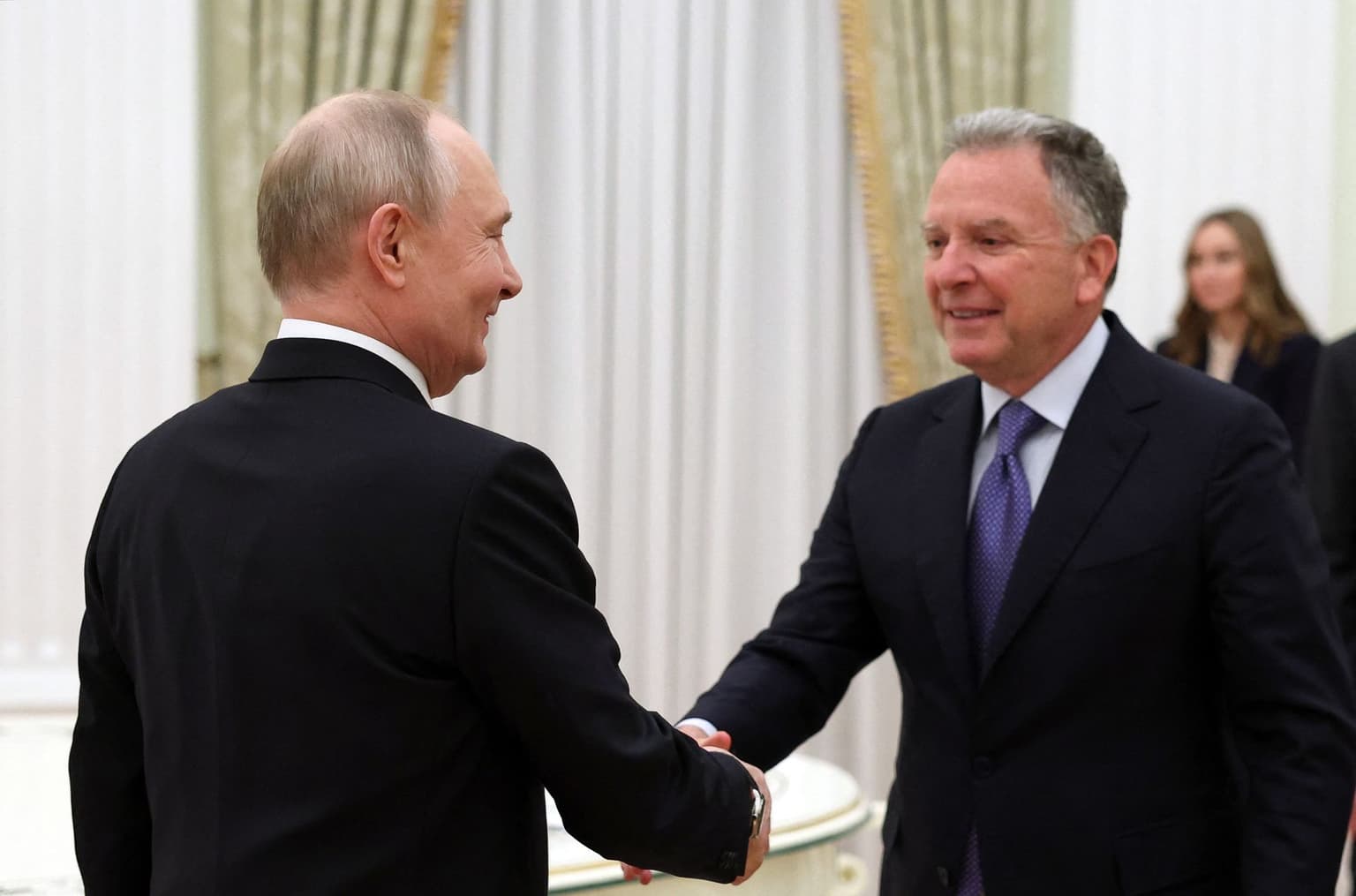
Russia’s President Vladimir Putin and US special envoy Steve Witkoff in Moscow. (Alexander Kazakov/AFP via Getty Images)
The Price of a Seat: How Peace Became a Marketplace
The ceremony looked grand enough to suggest legitimacy. Nineteen leaders gathered as Donald Trump unveiled the Board of Peace, a new body that felt like a hastily assembled substitute for the United Nations. Officially, it was created to pursue a ceasefire in Gaza. Unofficially, US officials acknowledged it could be used elsewhere — including Ukraine — at the discretion of its chairman.
Secretary of State Marco Rubio called it a “board of action,” though what that action would look like remained undefined. The guest list told its own story. Turkey, Hungary, Azerbaijan, Armenia, Argentina, Pakistan, Qatar, the UAE, and Saudi Arabia signed on. Belarus, Israel, and Vietnam signaled future participation. France, Norway, and Sweden declined. Momentum existed, but it was uneven and politically selective.
Trump designed the structure with a price tag: one billion dollars for a permanent seat. Russia was invited and said to be weighing its options. Ukraine also received an invitation. Zelensky declined. With Russia as an enemy and Belarus as its ally, he said, participation could only make sense after the war ended — diplomacy without legitimacy laundering.
Trump spoke confidently of peace in the Middle East and repeated his claim of having settled eight conflicts, hinting Ukraine would be next. He acknowledged this war was harder than the rest, a qualification that quietly undercut the earlier boasts.
Putin’s response revealed the real opportunity he saw. Rather than paying the fee outright, he proposed using Russian assets frozen in the United States, then tapping remaining frozen funds to rebuild “territories damaged by fighting.” The phrase was deliberate. It blurred occupied Ukrainian regions with Russian territory, transforming frozen penalties into reconstruction capital.
With only a fraction of Russian assets frozen in the US, Putin’s proposal amounted to financial judo: buy influence with inaccessible money, then recycle the rest back into Russia through rebuilding projects. War, reframed as an investment cycle.
The Echo in Davos: Europe Hears the Warning, Again
Volodymyr Zelensky did not raise his voice in Davos. He did not need to. The power of his message came from its familiarity. A year earlier, standing in the same place, he had warned Europe that it needed to learn how to defend itself. Now he was saying the same words again. Nothing, he told them, had changed.
That repetition was the indictment.
Zelensky described a continent caught in a loop — leaders who recognize danger, discuss it at length, then fail to build the strength needed to stop it. Europe talked about strategic autonomy while Russian missiles continued to roll off assembly lines and into Ukrainian cities. “If Europe is not seen as a global force,” he said, “if its actions don’t scare bad actors, then Europe will always be catching up.” It was a challenge delivered without theatrics, but it landed hard.
He pointed to Iran as proof of what hesitation invites. Delayed responses, he warned, send messages long before sanctions or speeches do. Tehran’s support for Moscow was not an accident; it was the result of years of unanswered tests. Europe, he suggested, was teaching the same lesson again.
Zelensky reminded the audience how recently confidence had filled those same halls. Last year, leaders spoke confidently about long-range weapons for Ukraine. Solutions were said to be within reach. Now, the subject barely surfaced. Russia, meanwhile, kept building missiles. “Today they target Ukraine,” he said. “Tomorrow it could be any NATO country.”
His meeting with Donald Trump later that day lasted about an hour. Zelensky called it important, saying he pressed again for stronger air defenses. Ukraine was working honestly and relentlessly, he said. The documents to end the war were close. But Russia would not stop on goodwill alone. It would have to be forced.
The Hour Children Were Home: Missiles in the Middle of the Day
The missiles came in the afternoon, not before dawn. That choice mattered.
By then, people were home. Children were awake. Families were together in kitchens and living rooms, moving through an ordinary winter day already shaped by power outages and cold apartments. When the explosions hit Dnipropetrovsk Oblast on January 22, they struck not infrastructure, but presence.
In Kryvyi Rih, a missile tore into a two-story residential building. Eleven people were injured. Four were children — one and a half, two, eight, and ten years old. The youngest had been born in July 2024, long after the full-scale invasion began. For that child, the sound of sirens, the concussion of blasts, the sight of rescuers climbing through broken walls were not interruptions. They were normal life. There was no memory of peace to fall back on.
Dnipro was hit next. A sixteen-story apartment building burned as fires broke out in two flats. Seven people were injured, including a fourteen-year-old girl. Emergency crews pulled sixteen residents from smoke-filled stairwells. Mayor Borys Filatov spoke in the language officials have learned to use in catastrophe, saying teams were working to support “the undamaged part of the building,” as if damage could be neatly contained.
More than fifty rescuers and seventeen units of equipment responded across the sites. Governor Oleksandr Hanzha listed the casualties — eleven injured in Kryvyi Rih, seven in Dnipro — but numbers flattened what families were living through. Homes had become front lines.
The strikes landed as scheduled power outages remained in effect across the region, compounding fear with cold and darkness. And yet the response was immediate, practiced, precise. Crews knew where to search, how to shore up walls, which apartments might still be livable.
That competence was its own indictment.
No country should have to become this good at saving children from rubble.
Six Days Under Ice: Kyiv Freezes While the Lights Flicker
When Denys Shmyhal called January 22 the most difficult day for Ukraine’s energy system in more than two years, it was not rhetoric. It was diagnosis. Russian strikes had damaged generation, shattered transformers, and broken distribution lines, forcing emergency shutdowns that rippled through the capital. The system was holding, barely, and only because it was being held together by people working past exhaustion.
By Thursday morning, nearly 3,000 high-rise buildings in Kyiv — about a quarter of the city — had no heat. In a city of more than three million, some apartments had gone nearly two weeks without warmth. Crews restored heating to 227 buildings overnight, not for the first time, but for the second, fixing what had already been destroyed once before. Repairs had become a loop: rebuild, get hit, rebuild again.
Mayor Vitaly Klitschko could offer no timelines. There were none. Emergency outages continued. President Zelensky said nearly 60 percent of the city had no electricity. Klitschko said as many as 600,000 people had left Kyiv in January. The number was debated. The scale of departure was not.
Then came the image that defined the day.
For six days — not hours — a team of emergency divers worked inside a flooded thermal power plant after shelling ruptured a pipe. The water was icy. The air temperature fell to minus fifteen. Artem Orlov, Denys Frolov, Mykhailo Khyzhnyak, Andriy Vlasenko, and Anton Gaitan dove again and again, knowing that failure meant thousands of homes would stay dark and cold.
They stopped the leak. Restoration could continue.
Zelensky awarded them Orders of Courage. It was deserved, and still inadequate. Infrastructure Minister Oleksiy Kuleba announced additional cogeneration units would arrive, including three small plants from Germany. Compared to what Ukraine had lost, it was a teaspoon against an ocean.
As crews worked into the night, air raid alerts kept sounding — nearly 2,000 of them.
The enemy was not just trying to break machines.
It was trying to break the city.
Growing Under Fire: Ukraine Balances the Books While the Heat Flickers
Oleksiy Sobolev stood on the World Economic Forum stage talking about gas, numbers that usually belong in spreadsheets. Ukraine needed more than four billion cubic meters of fuel to make it through the heating season. Most of the money, he said, had been found. The gap was about one hundred million dollars. In Davos, it sounded small. In a Ukrainian winter, with pipelines damaged and power plants targeted, it was the margin between endurance and disaster.
The ministry quickly followed with reassurance. There were no threats to gas imports, officials said. Half the heating season was already over. The clarification betrayed the pressure beneath it. When everything is stable, governments do not rush to explain stability.
Despite constant strikes, Ukraine had stored 13.2 billion cubic meters of gas. Russian attacks wiped out half of domestic production in early 2025. Six months later, with allied help, it was back. In the fall, another forty percent was destroyed. That too was restored. The pattern had become grimly familiar: hit, repair, hit again. Officials recited it almost casually, as if describing routine maintenance rather than survival under bombardment.
The broader economy told the same story in numbers that felt almost unreal. Ukraine’s real GDP grew in 2025, somewhere between 1.8 and 2.2 percent, depending on whose calculations you trusted. In peacetime, those figures would disappoint. In a country absorbing missile strikes, power outages, and mass displacement, they bordered on astonishing.
The economy was expanding while infrastructure burned. Businesses adapted. Workers kept going. Supply chains bent instead of snapping. It was resilience measured in decimals, fragile and hard-earned.
But the question lingered beneath every statistic. Growth this small, achieved at this cost, depended on constant repair, constant aid, and constant luck. The numbers proved Ukraine could endure. They did not promise it could do so forever.
The Border Sold Quietly: Smuggling Behind the Lines
The charge felt grimly familiar. Ukraine’s National Anti-Corruption Bureau announced that former State Border Guard chief Serhiy Deineko had been accused of facilitating cigarette smuggling. Predictable, yes — but no less damaging. Deineko led the border service from 2019 until January 4, 2026, covering the entire period of the alleged crimes and nearly two years of full-scale war.
The operation was simple and cynical. In 2023, smugglers moved cigarettes across Ukraine’s western border using vehicles registered in the Czech Republic and Austria. The cars carried fake diplomatic plates and were driven by relatives of Ukrainian diplomats holding diplomatic passports. That status mattered. It meant inspections could be bypassed with a glance.
Investigators say border guards ensured exactly that.
Between July and November 2023, sixty-eight vehicles crossed unhindered. The price was about €3,000 per car, adding up to roughly €204,000 in bribes. Some officials involved had previously served alongside the diplomats whose families later became part of the scheme, turning professional familiarity into a pipeline for corruption.
The timing made the revelations sting. While Ukrainian soldiers fought and died to hold the border, officials entrusted with guarding it were accused of selling passage through it. While foreign partners sent billions to help Ukraine survive, a handful of insiders quietly undermined the same system.
The case captured Ukraine’s hardest contradiction: courage at the front, rot behind desks, reform advancing even as old habits refused to disappear.
From Outsider to Insider: When a Critic Crossed the Threshold
The announcement landed quietly but carried weight. Defense Minister Mykhailo Fedorov named Serhii Sternenko as an adviser, even as he dismissed five deputy defense ministers in a single day. Some of those deputies would remain as advisers themselves, blurring the line between reform and reshuffle. The move raised a familiar question in Kyiv: was this real change, or political theater?
Sternenko’s appointment felt different.
At thirty-one, the activist had become a central figure in Ukraine’s drone war, helping popularize first-person-view drones and raising funds to supply units at the front. His credibility came not from rank, but from results. More striking was his recent history. Just four months earlier, Sternenko publicly accused Ukraine’s military and political leadership of failure, writing that “our defense is falling apart.” In most systems, that kind of criticism ends careers before they begin.
Instead, it opened a door.
Fedorov made the mandate explicit. Sternenko would advise on expanding UAV use at the front. The problem, Fedorov said, was stark: only about fifty units out of four hundred were responsible for roughly seventy percent of enemy losses. The task was not invention, but scale — helping the other three hundred and fifty units catch up, fast.
The appointment suggested a shift in how power was being exercised. Either Zelensky’s talk of greater openness had become real, or the pressure of war had reached a point where criticism mattered less than competence. Possibly both.
What mattered most was not the symbolism, but the implication. A government under existential threat had decided it could no longer afford to ignore voices that knew how to fight — even if those voices had once accused it of failing.
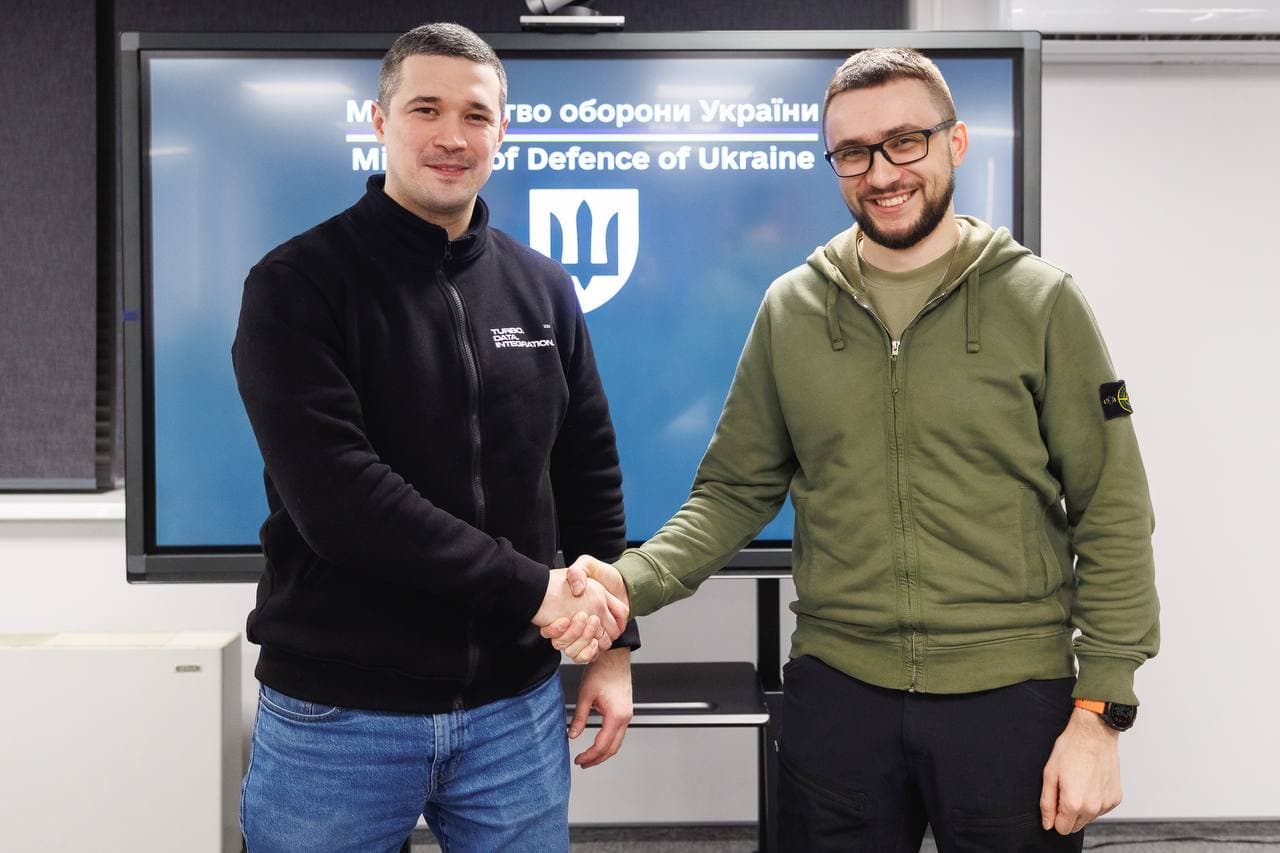
Defense Minister Mykhailo Fedorov (L) appears with activist and volunteer Serhii Sternenko, appointed to advise Fedorov. (Mykhailo Fedorov / Telegram)
Fire at Sea, Fire at the Source: The War Reaches the Waterline
The naval war unfolded on two fronts, separated by thousands of kilometers but tied by the same flow of oil.
At dawn in the Mediterranean, French naval forces boarded the tanker Grinch in the Alboran Sea. The vessel, sailing from Murmansk under a false flag, was diverted and inspected for sanctions violations. British intelligence had helped track it. President Emmanuel Macron’s message was blunt: France would not tolerate evasions. International law, he said, would be enforced. Zelensky praised the move and urged other countries to follow suit — praise that doubled as a quiet rebuke to those who had not.
While Europe intercepted tankers at sea, Ukraine struck them at the source.
Overnight, Ukrainian drones hit the Tamanneftegaz oil terminal near Volna in Russia’s Krasnodar Krai. Explosions tore through pipelines and storage tanks. Shutoff valves failed. Fuel spilled and ignited, spreading fire across roughly 7,000 square meters. A Security Service source said the Alpha special operations unit carried out the strike. Preliminary damage estimates reached fifty million dollars.
Russian officials confirmed the attack and said four oil tanks were burning. The regional governor claimed two enterprise workers were killed — civilian deaths that complicated Ukraine’s position even as Russia continued its far larger, daily campaign against Ukrainian cities.
Elsewhere, Ukrainian strikes targeted military infrastructure across occupied territories. Radar stations in Crimea went dark. A drone storage facility was destroyed in Kherson Oblast. Command posts and ammunition depots were hit in Donetsk Oblast, each strike aimed at blunting Russian operations.
Russia answered with drones of its own. Ninety-four were launched overnight. Ukrainian defenses downed eighty. Ten reached their targets, striking residential and energy sites across eight oblasts.
Oil, ports, homes, and radar screens all burned.
The war no longer stopped at the shoreline.
Adapting Under Fire: How Russia Rebuilds Its Army for a Drone War
Russian forces are learning the hard way. According to Ukrainian military observer Kostyantyn Mashovets, Moscow has accepted that heavy armor no longer dominates the battlefield. Too visible. Too slow. Too easy for Ukrainian drones. In response, Russian command plans to issue more than 2,600 light vehicles in 2026 — buggies, motorcycles, all-terrain vehicles — pulled from General Staff reserves and pushed toward assault units. Infantry would ride closer to the line, then move on foot, trading protection for speed and survivability.
The sourcing mattered. Many of these vehicles would come not from Russia’s defense industry, but from improvised channels: volunteer groups, donations, regional budgets. The reliance on patchwork supply underscored both industrial limits and battlefield urgency. Russian advances, Mashovets noted, remained slow, measured in meters rather than breakthroughs.
More ambitious was Moscow’s push to digitize command itself. Russian planners accelerated development of the Svod situational awareness system, designed to fuse satellite imagery, aerial reconnaissance, electronic and engineering data, and open-source intelligence into a single operational picture. Artificial intelligence would sift the data, identify targets, and model battlefield scenarios — an attempt to compensate for weaknesses in junior officer training with algorithms.
Testing was expected to begin at battalion level in the 2nd and 41st Combined Arms Armies by spring 2026, likely in the Pokrovsk sector. The goal was clear: replicate Ukrainian digital advantages while centralizing decision-making.
That same instinct drove creation of the 50th Unmanned Systems Brigade, a massive formation on paper, combining thousands of operators controlling ground robots, surface drones, reconnaissance UAVs, Lancets, Gerans, fiber-optic drones, and interceptors. Its scale and command rank defied traditional brigade logic.
This was less evolution than consolidation.
Russia was pulling scattered innovation back under control, reshaping its army not for speed — but for endurance.
Measured in Meters: Where the War Advances by Inches and Blood
The footage from southeastern Kostyantynivka did not show a breakthrough. It showed something harder to explain. Ukrainian forces pushed forward, yes — but they also held strongpoints that Russian units slipped past using infiltration tactics. The front was not a line. It was a mosaic. Control changed by buildings, intersections, and fields, with both sides occupying pockets the other could not easily dislodge.
Elsewhere, Ukrainian units advanced in central Zelene north of Hulyaipole and held ground in southern Kosivtseve. Russian military bloggers described Kosivtseve as a gray zone, admitting their presence amounted to small groups moving under drone cover. Ukrainian drones kept them from consolidating, turning every attempt to retake ground into a risk calculation.
To the east, Russian forces edged forward in Riznykivka near Slovyansk. Ukrainian commanders reported holding favorable casualty ratios. Near Lyman, Russian infiltration groups kept coming — small units, often poorly trained. One Ukrainian brigade spokesperson said the exchange ran roughly eleven Russian casualties for every Ukrainian loss. Occasionally, better-trained Russian troops appeared, a sign commanders were feeding whatever forces were available into the same grinder.
Further south, Russian units advanced near Dobropillya and Pokrovsk, but winter slowed everything. Snowstorms and cold dragged movement down. Ukrainian officers said it was a pause imposed by weather, not intent. Once temperatures rose, pressure would return.
Near Kupyansk, only about fifty Russian soldiers remained, according to Ukrainian Joint Forces. Ukrainian fire control now covered a pipeline Russian troops had once used to move unseen. One side learned to crawl underground. The other learned to target it.
Near Synelnykove, Ukrainian forces reported heavy Russian losses and rising refusals to fight within the 1009th Motorized Rifle Regiment. Whether morale mattered was unclear. Moscow continued sending men forward.
Here, progress was counted in meters.
The cost was counted in lives.
The Day’s Meaning: When Promises Traveled Faster Than Missiles
January 22 revealed the war as it now exists — not as a single story, but as several truths unfolding at once, none strong enough to cancel the others. In Davos, diplomacy spoke in confident tones, unveiling boards, frameworks, and documents said to be nearly finished. In Ukraine, missiles struck apartment buildings, drones hunted targets, and power crews worked in darkness. Both realities moved forward without waiting for the other.
Courage and failure shared the same hours. Divers spent six days submerged in freezing water to keep a thermal plant alive, their quiet endurance holding heat and light in thousands of homes. In the same day, a former border guard chief was charged with smuggling, a reminder that corruption still hollowed institutions even as the country fought for survival. Reform pushed forward by pulling critics inside government, while old habits resisted from within.
For civilians, these layers did not feel like complexity. They felt like dissonance. An eighteen-month-old injured in Kryvyi Rih knew only explosions and sirens. Families in thousands of Kyiv buildings waited for heat. Neighbors stood in courtyards watching rescue crews pull people from shattered homes. The optimism of conference halls existed somewhere far beyond their reach.
The talks would proceed. Envoys would fly. Proposals would circulate. And the war would continue alongside them — infrastructure destroyed and repaired, ground gained and lost, lives broken and sustained — until something deeper finally shifted.
This was day 1,429.
Not an ending.
Not a turning point.
But a day that contained the whole war, compressed into twenty-four hours of hope, damage, resolve, and unresolved violence.
Prayer For Ukraine
- Pray for the children and families struck by the afternoon missile attacks — especially the youngest victims who have never known peace — that God would protect their bodies, calm their fear, and surround them with comfort, healing, and long-term care amid trauma no child should bear.
- Pray for the exhausted civilians of Kyiv and other cities facing cold, darkness, and uncertainty, asking God to sustain those without heat or power, strengthen emergency workers and repair crews, and preserve life as winter and war press in together.
- Pray for courage, endurance, and protection for those risking their lives to keep the country functioning — the divers in frozen water, the medics, rescuers, engineers, and soldiers — that their strength would not fail and their sacrifices would not be in vain.
- Pray for integrity and repentance within Ukraine’s institutions, that corruption exposed this day would be rooted out, justice would prevail, and leaders would be given wisdom and humility to reform systems even under the strain of war.
- Pray for discernment and truth in diplomacy, that peace efforts would be grounded in justice rather than illusion, that aggressors would be restrained, defenders protected, and that God would guide decisions toward an end to violence that does not come at the cost of Ukraine’s people or its future.