
As Trump presses forward with Ukraine and Europe, the Kremlin deploys a phantom Alaska deal—testing whether information warfare can derail real negotiations.
The Day’s Reckoning
The meeting happened after midnight in Moscow. Vladimir Putin sat across from US envoy Steve Witkoff, with Jared Kushner and Josh Gruenbaum nearby. Cameras flashed. Hands shook. The Russians agreed to trilateral working groups in Abu Dhabi. On paper, diplomacy was moving.
Then the counterstrike came—without missiles.
Within hours, the Kremlin released its version of events. Presidential aide Yuriy Ushakov invoked an “Anchorage formula,” an alleged US-Russian understanding from an Alaska summit that supposedly required Ukraine to surrender all of Donbas and freeze the war in place. Dmitry Peskov called the details too sensitive to discuss—while openly declaring Ukrainian withdrawal from Donbas a precondition for peace. Ambiguity as a weapon.
The timing was deliberate. Trump had been advancing real talks with Ukraine and Europe, producing tangible movement: revised peace frameworks, electoral law changes, security guarantees nearing signature. Moscow wanted him to drop that path and accept a shortcut that existed only in Kremlin talking points.
While words flew, the war kept answering. Ukrainian drones reached deep into Russia, igniting the Penzanefteprodukt oil depot hundreds of kilometers from the front. Russian assaults ground forward in Donetsk while Ukrainian counterattacks forced unwanted defensive holds. A Moscow military court briefly published an admission that Ukrainian Neptune missiles sank the cruiser Moskva—then erased it, as if deletion could undo truth.
In Davos, Volodymyr Zelensky left his meeting with Trump expecting progress on PAC-3 missiles. A security treaty waited. An $800-billion reconstruction framework remained unfinished. Europe talked about armies and guarantees but stopped short of commitment.
Elsewhere, reality intruded quietly. A Russian An-124 sat immobilized in Toronto, its million-dollar parking bill becoming a test of whether frozen assets could finally be seized. In the Mediterranean, a sanctioned oil tanker drifted powerless, shadow-fleet vulnerability made visible.
Day 1,429 revealed the fault line. Real negotiations versus phantom formulas. Fire and fact versus narrative and mirage. And a Kremlin betting that confusion could succeed where force had not.
Selling a Peace That Never Existed
The first strike came in words, not weapons.
Hours after the Moscow meeting, Yuriy Ushakov stepped before microphones and declared there was “no hope” for peace without resolving territorial issues under an alleged “Anchorage formula” supposedly agreed to in Alaska. Dmitry Peskov followed with deliberate contradiction—calling it “inadvisable” to discuss details while openly demanding Ukraine’s withdrawal from Donbas. A Reuters source supplied what the Kremlin would not: full surrender of Donbas and a frozen front elsewhere.
The power of the move lay in what wasn’t visible. By keeping the Alaska summit’s outcome non-public, Moscow created a vacuum it could fill at will. Ambiguity became leverage. With no document to contradict them, Russian officials could claim Washington had already accepted Russia’s original war aims—and recast Ukraine as the obstacle.
But the illusion ran into reality.
Trump had been conducting real negotiations with Ukraine and Europe, not shadows. Those talks produced measurable movement: changes to Ukrainian law allowing elections during martial law, and a reshaped peace framework cut from 28 points to 20. Progress that required consultation, compromise, and persistence.
The Kremlin offered something easier. No Europeans. No sovereignty debates. No multilateral friction. Just accept the “formula,” they suggested, and the war would end.
It was a gamble—that Trump would trade the hard work of real diplomacy for the comfort of a deal that only existed in Moscow’s narrative.
The Price Moscow Never Stopped Asking
Publicly, the Kremlin framed Donbas as the final obstacle to peace. Privately, and at home, the list was much longer.
Dmitry Peskov repeated the familiar demand: Ukraine must withdraw from all of Donbas. A Reuters source expanded the map, describing Russian claims over southern and eastern Ukraine—while leaving conspicuously vague what Moscow intended for occupied areas of Sumy and Kharkiv in the north. That ambiguity didn’t last long. Russian officials began speaking openly about “buffer zones,” with Defense Minister Andrei Belousov justifying advances near Kupyansk as necessary to shield occupied northern Luhansk.
Then the domestic voices spoke more clearly.
In Moscow, where rhetoric is meant to reassure and mobilize, not negotiate, State Duma officials dismissed any idea of freezing the war where it stood. Defense Committee member Andrei Kolesnik said Russia required full international and Ukrainian recognition of the “constituent entities” written into the Russian Constitution—Crimea, Luhansk, Donetsk, Zaporizhia, and Kherson, in their entirety. Not lines on a map. Whole regions.
The demands didn’t stop at Ukraine’s borders.
Putin and senior officials revived requirements that NATO halt expansion and roll back to its 1997 posture. Federation Council foreign affairs chair Grigory Karasin said Russian negotiators in Abu Dhabi were authorized to pursue the same strategic and political objectives Moscow issued before the invasion—language that pointed directly back to Russia’s 2021 ultimatums to the West.
Seen together, the pattern was unmistakable. Putin’s demands had already exceeded those in the US-proposed 28-point plan and every framework that followed. The “Alaska formula” was never a compromise. It was a narrative device—designed to make maximalist goals appear pre-approved, and inevitable.
Two Tables, Two Wars
They arrived in Abu Dhabi with very different intentions written into their seating charts.
Russia sent uniforms. Admiral Igor Kostyukov, head of the General Staff’s Main Directorate, led a delegation built almost entirely from Defense Ministry ranks—officers trained to think in lines, buffers, and enforcement. Security first. Politics later.
Ukraine came with a fuller map of the war. Defense Council Secretary Rustem Umerov led a delegation that blended intelligence chiefs, generals, political leadership, and security services. Kyrylo Budanov. Davyd Arakhamia. Senior presidential advisers and intelligence deputies. The composition itself told the story: this wasn’t just about ceasefire lines. It was about sovereignty, governance, economics, and survival after the guns fell quiet.
Across the table, the contrast mattered.
Russia approached the talks as a military problem to be contained and shaped. Ukraine treated them as a national reckoning touching every layer of the state. One side arrived to manage outcomes. The other to define a future.
Even as the trilateral meetings began, Moscow split the process. Kremlin aide Yuriy Ushakov said Kirill Dmitriev—head of the Russian Direct Investment Fund—would meet separately with Steve Witkoff to discuss economic issues. Parallel tracks. Parallel messages. Negotiations inside the room, narrative pressure outside it.
Despite the noise, the talks themselves were real. Delegations met. Agendas were exchanged. The machinery of diplomacy turned forward, however cautiously.
Russia was negotiating—and simultaneously trying to dictate what negotiation was allowed to mean.
A Rebuilt Nation Left Exposed
The numbers were impressive. The promises sounded solid.
Zelensky said Trump backed the idea of a free trade zone—oxygen for Ukrainian businesses battered by war. Ursula von der Leyen spoke of a near-finished “prosperity package,” stitched together by the EU, the United States, and Ukraine. Politico described a 10-year framework: fast-tracked EU membership, US and European investment, international capital flowing into reconstruction.
On paper, Ukraine’s future looked funded.
But money alone could not stop tanks.
Economic recovery, Ukrainian officials warned, meant nothing without security guarantees strong enough to deter the next invasion. Factories could be rebuilt. Power grids restored. But if Russian forces could simply return once Ukraine demobilized and Western focus drifted, prosperity would become a liability rather than protection.
Zelensky said the core US-Ukrainian security guarantees document was ready—awaiting ratification in Kyiv and Washington. Von der Leyen confirmed Europe was closing in on its own guarantees, first discussed by the Coalition of the Willing in Paris. The architecture of deterrence was taking shape.
Moscow made its position clear. The Kremlin rejected any meaningful security guarantees outright. Russian officials demanded deep cuts to Ukraine’s military and ruled out foreign troops on Ukrainian soil. Russia’s vision was blunt: a rebuilt Ukraine without the strength to defend itself.
The debate exposed two futures. Western partners saw economic growth as the bedrock of lasting peace. The Kremlin saw it as preparation for a second conquest—richer cities, better roads, and a defenseless prize waiting to be taken again.
Paying for the Crime With the Victim’s Wallet
The offer sounded almost generous.
Kremlin aide Yuriy Ushakov said Putin had proposed sending $1 billion from Russian assets frozen in the United States to Trump’s Board of Peace. The rest, he added, could be used to rebuild Ukrainian territory damaged by the war. Dmitry Peskov sharpened the picture, saying the funds could help reconstruct Donbas. Zelensky later revealed the final twist: Putin had suggested directing the money toward rebuilding Russia’s own Kursk Oblast.
Look closer, and the logic collapsed.
At the same time Moscow floated the proposal, it was demanding Ukraine surrender all of Donbas. That meant the “reconstruction” funds would flow not to Ukrainian-held cities shattered by Russian missiles, but to territory Russia intended to occupy permanently. Rebuilding Donbas under Russian control—or Kursk inside Russia itself—would effectively return frozen money to Moscow and help pay the bill for its own invasion.
The mechanism was elegant in its cynicism. Russia would access funds it could no longer touch, channel them into occupied Ukrainian land, and then extract value back into the Russian economy. Factories, infrastructure, and housing rebuilt with frozen assets would fuel exploitation and accelerate forced integration into Russia.
What was framed as generosity was leverage.
The proposal turned accountability upside down. Russia would appear benevolent while recovering losses, strengthening its grip on stolen territory, and externalizing the costs of war. Ukraine, meanwhile, would watch as money frozen to punish aggression financed the consolidation of occupation.
The offer wasn’t aid. It was laundering conquest through reconstruction—and asking the victims to sign the receipt.
The Quiet Crisis Beneath the Kremlin’s Grip
Behind the war maps and summit readouts, Moscow was watching Grozny.
The Kremlin was quietly preparing for a succession it could not afford to mishandle. Reports from Vazhnye Istorii said officials close to the Kremlin and United Russia were scrambling for solutions as rumors spread that Chechen leader Ramzan Kadyrov was seriously ill—and that his son Adam, the presumed heir, had just been injured in a car crash.
The details were unsettling. Russian insider sources said the January 16 accident left Adam Kadyrov with fractures, facial injuries, and damage to his spleen. Even if he recovered quickly, the larger problem remained: Adam was 18. Chechen law barred him from governing until age 30.
Power could not sit vacant.
A former Federal Security Service officer and a Chechen diaspora member said the answer would almost certainly come from within the Benoi teip, Chechnya’s largest clan and Kadyrov’s own. Two names surfaced repeatedly—State Duma deputy Adam Delimkhanov and Chechen parliamentary leader Magomed Daudov. Both men carried weight. Delimkhanov, in particular, coordinated Chechen units fighting in Ukraine and managed the delicate balance between Moscow’s authority and Chechnya’s internal loyalties.
For Putin, the stakes were existentially practical. Kadyrov’s grip kept Chechnya quiet and its fighters deployable abroad. Lose that control, and unrest could pull Russian troops home at the worst possible moment. Elements of the 58th Combined Arms Army were already stationed there. Many Chechen units remained tied down in Ukraine.
The Kremlin didn’t have spare forces for another fire.
Succession planning wasn’t politics. It was risk containment—one more front Moscow could not afford to lose.
The Target Moscow Failed to Kill
The decision was understated, but its meaning was not.
Defense Minister Mykhailo Fedorov appointed Serhiy Sternenko to advise the Ministry of Defense on scaling Ukraine’s drone war. His mandate was clear: bring order to drone supply, fix units that weren’t lethal enough, and turn battlefield innovation into a system that could be sustained under fire.
Sternenko earned the role long before the title. As a volunteer and fundraiser, he supplied Ukrainian forces with FPV and fiber-optic drones capable of autonomous detection and strikes. On January 15, 2025, he built the largest non-state FPV supply network feeding Ukraine’s military—faster and more flexible than traditional procurement.
Russia noticed.
In May 2025, Russian intelligence tried to assassinate him. He survived. The attempt served as confirmation his work mattered.
By bringing Sternenko inside the defense structure, Ukraine acknowledged a hard truth of this war: drones were no longer a supplement to combat. They were central to it. Winning required coordination, scale, and professional management—not just volunteer brilliance.
Moscow had already tried to remove him. Now he was positioned to make sure Ukrainian drones kept finding their targets.
Fire That Reached Too Far to Ignore
The strike came from farther than Moscow liked to admit.
Overnight, Ukrainian drones reached Penza City and tore into the Penzanefteprodukt oil depot. Geolocated footage captured the hit. Penza Oblast governor Oleg Melnichenko confirmed the result: fire, damage, and another reminder that distance no longer guaranteed safety.
Penza sat roughly 545 kilometers from Ukraine’s northeastern border. That number mattered. It meant Ukrainian drones were still slipping past layered Russian air defenses and finding targets deep inside Russia’s economic bloodstream.
The night did not end there.
Elsewhere, an explosion marked a Ukrainian strike on an unidentified Russian air defense system in Novaya Adygea. Satellite imagery from January 22 showed the aftermath of a January 21–22 attack on the Tamannefttegaz oil terminal near Volna in Krasnodar Krai—damaged tanks, ruptured pipelines, disrupted flow.
Farther south, Ukrainian forces hit a Podlyot radar station near Bahaily in occupied Crimea, roughly 279 kilometers from the front line. Other strikes found Russian troop groupings in occupied Donetsk Oblast and across the border in Russia’s Belgorod Oblast.
The campaign was about more than destruction.
Each strike carried a message: geography no longer protected Russia. Ukraine still possessed the reach, intelligence, and precision to hit high-value targets despite countermeasures. And every successful penetration forced Moscow to spread its defenses thinner—across thousands of kilometers it could not fully shield.
Every kilometer Russia tried to defend weakened another.
When the Kremlin Accidentally Told the Truth
The admission appeared briefly—then vanished.
A Moscow military court published a verdict that cut straight through years of denial: Ukrainian anti-ship missiles struck and sank the Black Sea Fleet flagship Moskva. Within hours, the press release was deleted. But the damage was done. For a moment, the Kremlin’s own legal system confirmed what it had spent years trying to erase.
The ruling from Russia’s 2nd Military District Court named Colonel Andriy Shubin of Ukraine’s 406th Artillery Brigade, accusing him of ordering the April 13, 2022 strike that destroyed the cruiser. The court attributed the deaths of 20 Russian sailors, injuries to 24 others, and eight missing crewmen to what it called a “premeditated attack.” In doing so, it quietly abandoned the story Russian state media had long repeated—that the Moskva was lost to an accidental fire caused by faulty wiring and rough seas.
Outside Russia, the truth had never really been in doubt. Ukrainian media, passing cargo ships, and Western intelligence agencies all documented the aftermath: two Neptune missiles, fires racing through the superstructure, a holed hull, and the Black Sea’s largest warship slipping beneath the surface.
The court’s brief honesty mattered because it fit a larger pattern.
Ukraine, without a navy of its own, dismantled Russia’s Black Sea Fleet over roughly 18 months using missiles, drones, and long-range strikes. Surviving Russian ships fled Sevastopol and regrouped in Novorossiysk—only to face new attacks. On December 15, Ukrainian underwater drones penetrated harbor defenses and detonated near a Varshavyanka-class submarine. Russian media declared the strike a failure. Satellite imagery and eyewitness accounts suggested otherwise: scorched piers, oil in the water, nonstop repair crews, and a submarine that hadn’t moved in more than a month.
Narrative versus reality.
The Moskva verdict said the quiet part out loud—before it was erased. But deletion could not undo the record, or the pattern: Moscow’s version of events collapsing each time observable facts were allowed to surface.
Where the Advance Ran Out of Road
Russian units kept pushing along the northern front, probing Kursk and northern Sumy Oblast. Attacks flared north of Sumy City near Varachyne and toward Nova Sich. Elements of the 217th Airborne Regiment were in the fight. The lines did not move.
The assaults continued anyway—energy spent, ground unchanged. No breakthrough. No exploitation. Just pressure without progress, and a front where momentum quietly died.
Bodies Without Ground
Russian troops kept slipping forward in northern Kharkiv Oblast—small groups, quiet routes, no flags raised. In southwestern Lyman, geolocated footage caught one such attempt ending abruptly as Ukrainian fire struck a Russian servicemember mid-mission. The terrain didn’t change. The line held.
Moscow claimed otherwise. The Russian Defense Ministry and milbloggers announced that elements of the 82nd Motorized Rifle Regiment had seized Symynivka northeast of Kharkiv City. Even inside Russia’s information space, the claim unraveled. One milblogger admitted the assessment was premature: Ukrainian forces were still inside the settlement.
The pattern repeated across the sector. Russian attacks pressed near Lyman, Starytsya, Prylipka, Vovchansk, and Vovchanski Khutory, probing toward Izbytske and Nesterne. None produced confirmed gains.
Ukrainian brigade spokesmen described how the infiltrations worked. Russian soldiers navigated using pre-set phone coordinates, then were folded into new fireteams as original units shattered under losses. Cohesion was replaced by necessity. Survivors were reassigned. Names changed. The mission stayed the same.
Russian milbloggers filled in the cost. Ukrainian drones stalled advances near Hrafske. Near Vovchansk, drone saturation was so intense that elements of the 83rd Motorized Rifle Regiment could not retrieve their dead.
Farther northeast, attacks near Ambarne, Khatnie, and Sonino also went nowhere. The Ukrainian 16th Army Corps reported Russian units lacked basic materials to repair drone-damaged shelters along the Ambarne–Milove line. Wounded soldiers went unevacuated. Frostbite and illness spread where logistics failed.
The picture was consistent and unforgiving: Russian forces kept moving, but only forward into loss—ground unchanged, casualties accumulating, and no way to carry them home.
Back to Footsteps Instead of Armor
Russian units slipped back into Kupyansk the way they had before—quietly, in small groups, hoping not to be seen. Geolocated footage showed Ukrainian strikes hitting two Russian-occupied buildings along the P-79 Kupyansk–Chuhuiv Highway after one such infiltration. The result was familiar: damage, casualties, and no change to the line.
The fighting spread anyway. Russian attacks pressed inside Kupyansk itself, northeast near Synkivka, and southeast toward Pishchane and Kurylivka. None produced confirmed advances.
Ukrainian brigade spokesmen described what the shift meant. After armored and motorized assaults bled men and vehicles without results, Russian commanders abandoned mass and returned to small infantry teams. It was a tactical retreat disguised as adaptation—fewer losses, but no progress. Survival over momentum.
Elements of the 92nd Engineer-Sapper Regiment appeared in Kharkiv Oblast as the pattern repeated southward. In the Borova direction, Russian attacks flared near Ridkodub, Shandryholove, Korovii Yar, and Vovchyi Yar, only to stall again. A Russian milblogger acknowledged Ukrainian counterattacks near Korovii Yar.
Farther east, Ukraine struck where it mattered most. A drone unit released footage of 14 Russian armored fighting vehicles destroyed southeast of Korzhove, about 50 kilometers from the front. The vehicles had been parked, waiting for a future assault that would never come.
The message was blunt. Russian forces could infiltrate, probe, and retreat—but Ukraine was erasing capability before it ever reached the battlefield. Sometimes the most decisive defense happens far from the trench line.
Meters Bought With Blood
The map barely moved, but the fighting never stopped.
Geolocated footage showed Russian forces edging north of Svyato-Pokrovske, east of Slovyansk. A milblogger claimed another push west of Zvanivka. These were increments, not breakthroughs—small gains swallowed by a much larger grind.
Across Donetsk Oblast, Russian attacks flared in every direction. Near Lyman, they pressed from the northwest around Stavky and Sosnove, from the northeast near Drobysheve and Yampolivka, and from the southeast toward Dibrova and Yampil. East of Slovyansk, fighting churned near Siversk, Svyato-Pokrovske, and Riznykivka; southwest of the city, near Pazeno. Elements of the 7th Motorized Rifle Brigade stayed in the fight around Siversk and Zakitne.
The pattern repeated farther south. In the Kostyantynivka–Druzhkivka sector, Russian forces attacked from nearly every approach but failed to advance. Ukrainian brigade spokesmen described shifting tactics—heavy vehicles, light vehicles, even horses—sent forward in combination. The horses told the story. Mechanized assaults were failing, and commanders were searching for movement methods less exposed to Ukrainian drones.
Still, the ground refused to give.
Near Dobropillya, Russian attacks pushed east toward Shakhove and Ivanivka and southeast toward Dorozhnie. Nothing held. Around Pokrovsk, assaults struck from multiple directions—inside the city and along its edges—only to stall again. A Russian milblogger acknowledged Ukrainian counterattacks near Hryshyne.
What remained was motion without momentum. Russian forces kept paying for meters with blood, adapting tactics without changing outcomes. The offensive continued—but the breakthrough never came.
Steel Broke at Filiya
Russian forces pressed southeast of Novopavlivka, inching forward in attacks that spread around the settlement and down its southern approaches. The push showed movement—but not control.
Then the assault hit Filiya.
Geolocated footage released by a Ukrainian brigade captured a mechanized Russian platoon driving into prepared defenses on the village’s northern edge. The engagement was brief and decisive. Ukrainian fire tore into the column, knocking out a tank and multiple BMPs before the assault could unfold.
When the smoke cleared, the numbers told the story. Ukrainian forces destroyed one tank and two armored fighting vehicles. Twenty Russian soldiers were killed. Three more were wounded. The attack collapsed where it stood.
The exchange mattered beyond the tally. Outnumbered Ukrainian defenders again demonstrated they could punish mechanized assaults at a disproportionate cost—turning Russian mass into liability rather than advantage.
Near Novopavlivka, the line bent but did not break.
Claims Ahead of Reality
Russian attacks continued around Oleksandrivka, pushing northeast toward Zelenyi Hai and probing southeast across multiple positions. The fighting was active. The results were not.
Russian milbloggers rushed ahead of the map. One claimed Russian forces had seized Novoselivka, Vorone, Sosnivka, and Orestopil and reached the east bank of the Vovcha River near Velykomykhailivka and Oleksandrohrad. None of the claims were independently confirmed. The front line, as observed, remained stubbornly unchanged.
The pattern repeated throughout the sector. Assaults went in. Positions were contested. Control did not shift.
A Russian milblogger also claimed Ukrainian counterattacks near Vidradne—an acknowledgment that pressure was being met, not absorbed. Ukrainian defenders were not retreating quietly.
A Ukrainian brigade spokesperson added a stark metric. In the brigade’s area of responsibility, Ukrainian forces were killing roughly 50 servicemembers of Russia’s 36th Motorized Rifle Brigade per day. If accurate, the number spoke louder than territorial claims: heavy losses in exchange for ground that could not be clearly held.
Around Oleksandrivka, Russian forces fought hard for headlines while paying for progress that never materialized. The gap between reported success and battlefield reality continued to widen.
Fire Without Movement, Violence Without Purpose
Russian assaults rolled on across the southern front, but the ground refused to give.
Near Hulyaipole, attacks pressed from every direction—north, northwest, northeast, and south—only to stall again. Russian milbloggers acknowledged Ukrainian counterattacks near Hulyaipole itself and farther out around Ternuvate and Kosivtseve. The fighting was constant. The map stayed the same.
In Zaporizhia Oblast, multiple Russian formations churned through the same pattern. Elements of the 38th Motorized Rifle Brigade, the 394th Regiment, and the 127th Motorized Rifle Division operated along the line, backed by units from the 11th Air Force and Air Defense Army. West of Orikhiv, Russian attacks flared near Plavni and from the northwest, drawing in additional forces from the 71st and 291st Motorized Rifle Regiments, the 7th and 104th Airborne Divisions, and the 4th Military Base. None of it produced a breakthrough.
Farther south, limited Russian ground attacks continued in the Kherson direction. Again, no advance.
Unable to move the front, Russian forces turned their drones toward civilians. In Kherson City, strikes deliberately targeted noncombatants in what Ukrainian officials described as “human safari” tactics. Regional military administration head Oleksandr Prokudin reported one civilian critically wounded.
The shift was revealing. Where Russian forces could not defeat Ukrainian troops, they sought to terrorize civilians instead—trading military objectives for fear. The southern front held, but the violence spilled outward, aimed not at gaining ground, but at breaking morale where tanks had failed.
The Night the Sky Filled With Drones
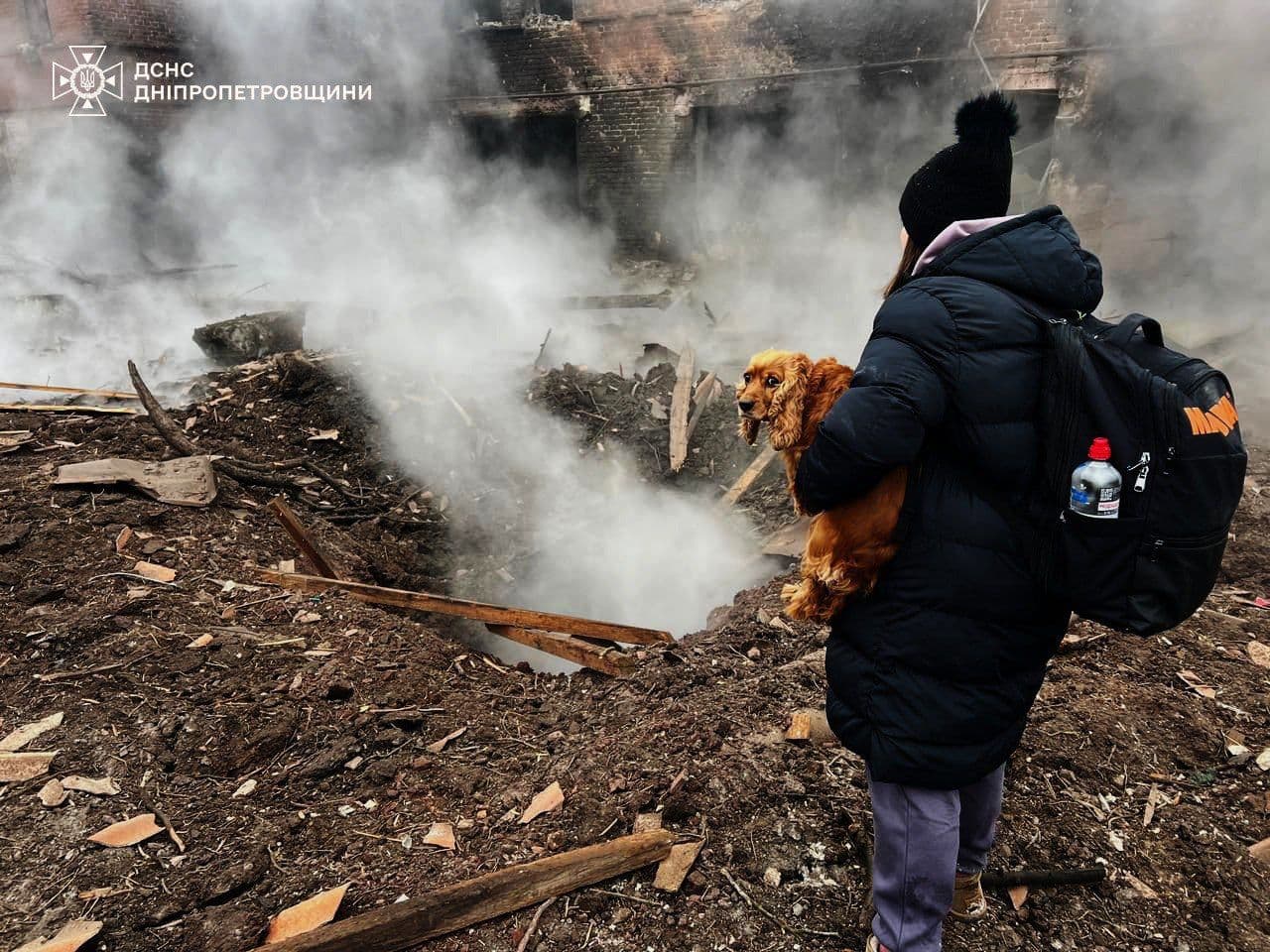
The aftermath of a Russian attack on Kryvyi Rih, Dnipropetrovsk Oblast, on Jan. 22, 2026. (State Emergency Service of Dnipropetrovsk Oblast)
They came in waves, just after dark.
Russia launched 101 drones against Ukraine overnight—Shaheds, Gerberas, and other types—lifting off from sites scattered across Russia and occupied territory: Kursk, Oryol, Smolensk, Rostov, Krasnodar Krai, and occupied Donetsk Oblast. Roughly 60 were Shahed-type, the familiar buzz returning again.
Ukraine fought back in the air. The Air Force reported 76 drones shot down. Nineteen still broke through, striking 12 locations.
They hit where people live.
Residential and civilian infrastructure were damaged across Chernihiv, Dnipropetrovsk, and Kharkiv oblasts. By day’s end, at least six people were dead and 45 wounded. In non-occupied Donetsk Oblast, Governor Vadym Filashkin reported four killed and six injured. Near the Zaporizhzhia front line, four strikes—including glide bombs—rocked Komyshuvakha, killing one and injuring ten.
Kherson Oblast reported one civilian killed and two wounded. In Kharkiv Oblast, five more were injured.
In Dnipropetrovsk Oblast, the night turned especially brutal. Russian drones and an Iskander-M ballistic missile struck Dnipro and Kryvyi Rih, wounding 19 people—five of them children.
The numbers told the story plainly. Air defenses worked. But enough weapons slipped through to leave craters, shattered homes, and another morning counted in dead and wounded.
Burning a Fortune to Freeze a City
The price tag came after the lights went out.
Ukrainian military intelligence calculated Russia spent more than 10.2 billion rubles—about $131 million—on the January 20 strike that ripped through Kyiv’s power and heating systems. The money bought darkness, broken substations, and apartments growing colder by the hour as temperatures stayed below freezing.
The arsenal was vast. Russia fired 372 long-range weapons, including Iskander ballistic missiles, X-101 cruise missiles, repurposed naval Zirkon missiles, and RM-48U dummy missiles once meant for training air defenses like the S-400. Iranian-designed Shahed-based drones filled the gaps, stretching Ukraine’s interceptors thin.
The damage spread fast. Energy infrastructure collapsed across multiple regions, leaving thousands without heat during the coldest stretch of winter Ukraine had faced since the full-scale invasion began. DTEK, the country’s largest private energy company, announced emergency outages in Odesa and Dnipropetrovsk oblasts. Rolling blackouts followed across Chernihiv, Zhytomyr, Sumy, Kharkiv, Kyiv, Kirovohrad, Poltava, and Cherkasy.
The cost didn’t stop at the blast sites. Ukrainian intelligence noted Moscow was paying for attacks like this by raising taxes, hiking excises, and cutting social spending and government investment at home—draining its own society to keep the war machine running.
Russia burned a fortune in a single night. What it bought was suffering, not surrender—cold apartments, dark cities, and another reminder that this war was being fought against civilians as much as armies.
What Ukraine Carried Home From Davos
The meeting ended with cautious optimism—and one urgent request still hanging in the air.
After speaking with President Trump at the World Economic Forum in Davos, Volodymyr Zelensky said the conversation was “above all” about the United States. At the center of it was air defense. Ukraine, he told reporters, was expecting positive results.
Specifically, Zelensky raised the need for PAC-3 missiles—the interceptors used by Patriot systems and the only weapons proven to stop Russian ballistic missiles like Kinzhals and Iskanders. “Nothing else works,” he said plainly. Without them, cities remained exposed.
Beyond missiles, the framework was already in place. Zelensky said the core treaty was ready to be signed, with technical annexes and supplementary documents to follow. What remained was logistics: a time and a place, to be set by Trump.
Talks between Kyiv and Washington had been underway for months. The expected agreement would include long-term security guarantees across land, sea, and air, and provisions for foreign military contingents. In parallel, a European “Coalition of the Willing,” led by the UK and France, continued meeting—but had yet to secure firm commitments for troops on the ground after the war.
Zelensky said the United States had offered security guarantees lasting 15 years. He hoped they would stretch longer.
Davos did not deliver everything Ukraine needed—but it clarified what mattered most, and where the next answers would have to come from.
A City Running Out of Warmth
Crews worked through the night, reconnecting 650 high-rise buildings across Kyiv. Even so, 1,940 apartment blocks—about 16 percent of the city’s housing—remained exposed to the cold. Nearly two weeks after major Russian strikes on January 9 and 20, blackouts and water cut-offs still rippled through neighborhoods as temperatures hovered near minus ten.
The damage was uneven. Most buildings without heat stood on the city’s left bank, east of the Dnipro—far from the historic center and government quarter on the right. For families there, heating was rationed or gone entirely, even in buildings technically still on the grid.
Mayor Vitali Klitschko stopped softening the message. He urged residents to leave Kyiv if they had anywhere else to go. “I am speaking honestly,” he said. “The situation is extremely difficult, and this may not be the most difficult moment yet.” He told people to stock food, medicine, and water. By official counts, about 600,000 had already left a city of roughly 3.6 million.
The crisis widened a political fracture. President Zelensky publicly faulted Klitschko for inadequate preparedness ahead of the attacks and the freeze. The dispute came at a sensitive moment, following corruption charges against senior Zelensky administration figures accused of stealing funds meant to protect power plants.
Kyiv endured the cold, the outages, and the uncertainty—but now also an open argument over who was responsible, even as winter tightened its grip.
The Deal That Wasn’t Ready Yet
The signatures never came.
Kyiv and Washington left Davos with a prosperity plan still unfinished. President Zelensky described it as a “bundle of documents,” unfinished but necessary, stressing the papers had to be “clear and transparent” because they would form the foundation of Ukraine’s recovery. Progress, he said, would come—but not yet.
Trump confirmed discussions about a US-Ukraine free trade area, a proposal Zelensky welcomed. Nothing was signed. US Special Envoy Steve Witkoff called the idea “a game-changer” while speaking at Ukraine House in Davos, even as the details remained behind closed doors.
What did emerge was scale. Official statements pointed to a 10-year framework involving Ukraine, the United States, the EU, and G7 partners—an effort to mobilize roughly $800 billion through public and private investment. Guarantees, risk-sharing, and blended financing would underpin the plan, targeting energy, infrastructure, industry, and human capital.
Politics quickly intruded.
Hungarian Prime Minister Viktor Orban claimed Ukraine was set to join the EU by 2027 and receive $1.6 trillion by 2040, citing a confidential document he said was presented at an EU summit. The European Commission refused to confirm his figures but acknowledged it was close to agreeing on a “single unified prosperity framework.”
Orban went further, insisting Ukraine’s support should remain voluntary for each country and declaring no Hungarian parliament would back Ukrainian EU accession “in the next 100 years.”
The vision of recovery remained vast. The consensus behind it did not.
The Army Europe Already Has
Zelensky didn’t speak in abstractions. He spoke in numbers and scars.
Ukraine’s army—nearly a million strong—should form the backbone of any future European joint force, he told journalists, renewing his call for a continental army of at least three million troops to meet the Russian threat. Europe, he argued, already had the core it needed. It was fighting right now.
Ukrainian forces had taken European and American weapons and used them with unprecedented effectiveness against Russia’s army. Meanwhile, Moscow had rebuilt its defense industry and amassed roughly 1.5 million soldiers and veterans hardened by combat in Ukraine. The comparison was no longer theoretical.
“This isn’t just about numbers,” Zelensky said. “It’s about capability and experience.” Without Ukraine’s million soldiers, he warned, Europe would not manage. They would be the backbone—trained under fire, tested in the hardest conditions modern war could produce.
The statement directly challenged Moscow’s demands. Russia wanted Ukraine’s postwar army capped at 600,000 troops—a condition Kyiv rejected outright. Ukraine had reportedly agreed only to a peacetime ceiling of 800,000, still far beyond what Russia would tolerate.
Zelensky’s appeal was not new. Nearly a year earlier, at the Munich Security Conference in February 2025, he first urged Europe to build a new joint force amid doubts about long-term US support. Since then, European leaders had debated—but not acted.
Ukraine, he implied, was no longer asking to be protected. It was offering to protect Europe—if Europe was ready to decide.
A Plane, a Courtroom, and a Question of Will
For nearly four years, the Antonov An-124 hasn’t moved.
A Russian-registered giant, once built in Kyiv, sits fused to the tarmac at Toronto Pearson Airport—its wheels locked in place by sanctions, paperwork, and winter ice. The parking bill has climbed past 1.5 million Canadian dollars, about $1.1 million US. It may be the most expensive parking ticket on earth.
But the aircraft has become something far more important than an accounting oddity.
As the European Union hesitated on using frozen Russian reserves, this stranded cargo plane turned into a test of Western resolve. Could a democracy go beyond freezing Russian property—and actually take it, legally, and redirect it to help Ukraine?
Canada decided to try.
The process began on June 8, 2023, when Ottawa formally took control of the aircraft. What followed was familiar to anyone who has chased Russian assets: a maze of shell companies and subsidiaries stretching from Ireland to the Netherlands. To make forfeiture stick, Canada issued a new legal order in mid-February, tightening the focus on the individuals and corporate network behind the plane.
On March 18, the Attorney General filed for forfeiture in Ontario Superior Court. Russia’s Volga-Dnepr Group responded with a $100-million lawsuit, denouncing the move as “pirate hijacking.”
The stakes were larger than one airplane. Under amendments to Canada’s Special Economic Measures Act in 2022, Ottawa became the first G7 government to move from freezing assets to pursuing permanent seizure—allowing proceeds to be used to rebuild Ukraine, compensate victims, or support international peace.
Foreign Affairs Minister Anita Anand framed it as something close to restoration. Russia destroyed Ukraine’s Antonov fleet at the start of the war, she noted. Taking this aircraft was, in a sense, giving one back.
There was one catch. After three brutal Canadian winters, no one knew if the plane could still fly.
What sat on the runway was either a $100-million liability—or a precedent waiting to be set.
A Shadow Fleet Runs Out of Steam
The tanker slowed, then slipped out of the lane.
Early on January 21, the LR2-class oil tanker Progress passed Algiers on its way toward the Suez Canal, carrying roughly 730,000 barrels of Russian Urals crude. Then it veered north, away from the shipping corridor, changed its status to “not under command,” and crawled forward at one knot. Tracking data showed it drifting east—adrift in more ways than one.
The signs pointed to trouble. Leaving the lane, losing speed, declaring loss of control—each suggested mechanical failure aboard an aging ship.
Progress was no ordinary tanker. At 19 years old, it sat under Western sanctions for transporting Russian oil. Since being designated, it had changed names twice, recently reflagged to Russia, and joined the Russian Maritime Register of Shipping in November—a familiar pattern for vessels trying to outrun scrutiny.
That scrutiny was tightening. Western governments were increasing pressure on Russia’s “shadow fleet,” a web of elderly tankers operating through opaque ownership and flag-hopping to evade sanctions. France, Germany, and Italy had recently moved against sanctioned Russian-linked vessels operating in or passing through their waters.
Now one of those ships was stuck.
With hundreds of thousands of barrels of crude aboard and no clear ability to proceed, Progress became a floating example of the system’s weakness—old steel pushed too far, running without margin. Sanctions didn’t have to sink the ship. Time, wear, and evasion were doing that already.
Russia’s shadow fleet was still moving oil. But in the Mediterranean, one tanker showed what happens when the shadows finally catch up.
The Day’s Meaning: When Ambiguity Met Reality
Day 1,429 exposed the war’s central tension with unusual clarity. Russian negotiators agreed to meet in Abu Dhabi even as Kremlin spokesmen insisted an alleged “Anchorage formula” made real diplomacy unnecessary. Ukrainian drones set fire to oil depots deep inside Russia while a Moscow court briefly admitted that Neptune missiles sank the Moskva—only for the truth to be erased hours later. Zelensky spoke of positive expectations on air defense after meeting Trump, even as nearly two thousand Kyiv apartment buildings remained without heat.
The Kremlin’s strategy relied on controlled fog. By keeping the Alaska summit opaque, Moscow created space to claim that decisive agreements already existed. Ambiguity became a weapon, allowing Russia to demand Ukrainian surrender while masking its own role in blocking negotiations. The “formula” asked the West to accept outcomes without process, concessions without consultation, and peace without sovereignty.
That weapon ran into a hard obstacle: reality. Trump’s diplomacy with Ukraine and Europe had produced tangible movement—wartime election law changes, a revised peace framework shaped by multilateral talks, and security guarantees nearing a signable form. Moscow wanted him to abandon that difficult progress for a mirage that required no European buy-in and no Russian compromise.
On the battlefield, clarity replaced illusion. Ukrainian strikes reached hundreds of kilometers into Russia. Mechanized assaults were broken with disproportionate losses. Russian units advanced without logistics, left wounded behind, patched shelters they could not repair, and reverted to horses when armor failed.
Beyond the front, the same contrast played out. A Russian aircraft sat stranded in Toronto as Canada tested whether frozen assets could finally be forfeited. A sanctioned tanker drifted powerless in the Mediterranean. A censored court ruling revealed how fragile narrative control had become.
The day offered no answers, only a choice. Information warfare versus lived outcomes. Phantom formulas versus negotiated reality. Day 1,429 showed which side dealt in ambiguity—and which one kept forcing facts onto the record.
Prayer For Ukraine
- For warmth, shelter, and endurance — Pray for families in Kyiv and across Ukraine living without reliable heat and power, especially the elderly, children, and the sick. Ask God to protect bodies from the cold, sustain spirits under exhaustion, and hasten restoration where infrastructure has been shattered.
- For wisdom and integrity in leadership — Pray for President Zelensky, Mayor Klitschko, and all national and local leaders facing impossible decisions under pressure. Ask for unity rather than division, clarity rather than accusation, and courage to act justly amid political strain and public fear.
- For protection and strength at the front — Pray for Ukrainian soldiers holding the line under constant attack, especially those repelling mechanized assaults and operating under drone warfare. Ask God to guard their lives, steady their hands, and frustrate plans meant to overwhelm them.
- For truth to prevail over deception — Pray that lies, manipulation, and information warfare would lose their power. Ask that truth—about aggression, responsibility, and reality on the ground—would continue to surface despite censorship, intimidation, and deliberate confusion.
- For resolve and moral courage among Ukraine’s partners — Pray for leaders in the United States, Europe, and allied nations as they weigh security guarantees, aid, and the use of frozen assets. Ask God to move them beyond hesitation, grant them moral clarity, and strengthen their commitment to a just and lasting peace for Ukraine.