
As Russian generals exaggerate advances to influence negotiations, drones strike trains, civilians are executed, and diplomacy unfolds against a battlefield reality even Kremlin loyalists no longer believe.
The Day’s Reckoning
Valery Gerasimov stood before his maps and spoke of victories that existed only on paper. Seventeen settlements seized. Five hundred square kilometers taken since January 1. A battlefield bending, at last, to Russian momentum. Outside that briefing room, Russian military bloggers did something almost unthinkable: they laughed. “Beautiful reports,” they called them — the bitter shorthand for claims so false they no longer bothered pretending otherwise.
On the ground, the numbers collapsed. Independent analysis showed roughly half the territory Gerasimov claimed. Kupyansk-Vuzlovyi, declared captured, remained firmly under Ukrainian control. Even loyalist commentators joked about a “hidden side of Kupyansk” where phantom victories must be happening, because they certainly were not happening anywhere real.
While those fabrications floated toward negotiating tables, reality struck steel and flesh. Near Barvinkove in Kharkiv Oblast, three Shahed drones hunted a moving civilian passenger train in the dark. One car burned. Five people died instantly. More than two hundred passengers watched the attack unfold, close enough to understand it was deliberate.
Farther north, in occupied Hrabovske near Sumy, two civilians tried to escape. An FPV drone killed the woman outright. Another strike finished the wounded man beside her body. The footage was clear. There was no ambiguity.
And in Abu Dhabi, behind secure doors, talks continued. Ukraine’s foreign minister confirmed a new Russian delegation — no lectures, no historical monologues, just “focused” conversations. Focused, according to reporting, on pressing Ukraine to surrender territory Russia has failed to seize by force.
Maps lied. Drones did not. Negotiations moved forward anyway.
By the end of the day, the contradiction was unmistakable: fabricated advances shaping diplomacy, real violence shaping lives. The war now lived in two realities at once — and only one of them was killing people.
Maps That Lied: Inside Gerasimov’s Imaginary Offensive
Valery Gerasimov listened as his commanders spoke and then delivered a battlefield that sounded triumphant. Russian forces, he said, were advancing in nearly every direction. Seventeen settlements taken. More than 500 square kilometers seized in less than a month. Kupyansk-Vuzlovyi captured. Ukrainian units encircled and destroyed along the Oskil River. The map, as Gerasimov described it, bent decisively toward victory.
Then reality checked in.
Independent analysts and Ukrainian commanders were watching a different war unfold. The Institute for the Study of War traced Russian movement not in sweeping arrows, but in thin, tentative lines—about 265 square kilometers since January 1, barely half of what Gerasimov claimed. Zaporizhzhia City remained farther away than advertised. Kupyansk-Vuzlovyi, declared taken, showed no Russian presence at all. Ukrainian forces never left.
The most telling detail came from Podoly. Russian units had slipped into the village briefly in early January. Days later, Ukrainian forces pushed them back out. By mid-month, even Kremlin-linked military bloggers acknowledged the expulsion. Yet Gerasimov was still counting Podoly—and places like it—as conquered ground weeks after Russian soldiers had vanished from them.
That was when the mockery began.
Pro-war Russian milbloggers stopped pretending. They called Gerasimov’s briefing a “beautiful report”—a phrase reserved for victories that exist only in PowerPoint. Others spoke openly of a “parallel reality” in the Kupyansk direction, joking darkly about a hidden version of the city where Russia kept winning battles no one else could see.
This was not dissent from the margins. It was the Kremlin’s own echo chamber breaking character.
And the reason mattered. These inflated claims were not just vanity. They were leverage—meant to convince diplomats that Russian momentum was unstoppable, that Ukraine should surrender territory before it was taken by force.
But the territory was not being taken. Not on real maps. Not on the ground.
The gap had grown too wide to ignore. Even Moscow’s most loyal voices could no longer bridge it.
Hamlets as Headlines: How Tiny Villages Became Proof of “Victory”
Gerasimov’s January 27 briefing rolled out like a victory tour. Names spilled across the map—Symynivka, Starytsya, Bondarne, Zakitne, Pryvillya, Novoyakovlivka—each one presented as evidence of a broad, unstoppable Russian advance. The geography sounded vast. The reality was not.
Look closer and the illusion thins fast. Most of the places Gerasimov celebrated were little more than dots on a rural road map—fields, tree lines, scattered houses. According to UN data, the largest of them, Drobysheve, covered just over eight square kilometers. Most were smaller than two. These were not cities. They were not logistics hubs. They were not the fortified prizes that decide wars.
But lists have power.
By stacking settlement names one after another, Russian commanders created the impression of momentum without the substance of breakthrough. The tactic depended on one thing: that no one would stop to measure what those names actually represented on the ground. No one would calculate how little territory they added up to. No one would ask why months of fighting were being sold as conquest of places barely visible on a satellite image.
The contrast became impossible to ignore when set against the real objectives. Pokrovsk alone—still resisting after nearly two years of assault—covers more ground than all of Gerasimov’s celebrated villages combined. Slavyansk, Kramatorsk, Kostyantynivka—the cities that actually determine control of Donetsk Oblast—remain far larger, far tougher, and far beyond what these rural gains suggest.
The battlefield told the truth numbers could not hide. Near Pokrovsk, Russian forces crawled forward at an average of seventy meters per day. Less than 1.5 percent of Ukrainian territory had changed hands since the start of 2024. The cost was enormous. The progress was not.
So the villages became headlines. Not because they mattered militarily—but because they filled space where victories should have been.
Three years into a war promised to last days, Russia was still advancing one hamlet at a time.
Surrender What Russia Cannot Take
The pressure arrived quietly, through briefings and back channels rather than ultimatums. As Gerasimov painted imaginary advances on his maps, the Financial Times reported that Washington was urging Kyiv to give up what Russia had failed to take—remaining Ukrainian-held territory in Donetsk Oblast—in exchange for U.S. security guarantees.
Pause on that logic. After more than a decade of fighting in Donbas, Russia still had not seized the region by force. Yet Ukraine was being asked to surrender it anyway.
According to eight sources familiar with the talks, U.S. officials told Kyiv that meaningful security guarantees would follow only after a peace deal with Moscow—one expected to include territorial concessions. The proposed guarantees, sources said, might resemble NATO’s Article 5 in theory, promising coordinated responses to future Russian attacks. In practice, even supporters worried they were “too vague” for Ukraine and “too broad” for Russia. Weapons for a post-war Ukrainian army were offered as further incentive. A senior Ukrainian official quietly questioned whether any of it would be binding.
Independent analysts were blunt. The Institute for the Study of War assessed that Russia was unlikely to seize the rest of Donetsk Oblast before August 2027, even if it sustained its late-2025 pace—a pace already slowing under winter conditions. For Ukraine to withdraw now would hand Russia better positions to regroup, rearm, and strike again.
Moscow made its intentions clear. Russian lawmakers rejected NATO troops outright and dismissed security guarantees as unacceptable. Others declared resistance “futile,” insisting Donbas would fall “sooner or later.”
This was cognitive warfare, not compromise—using exaggerated momentum to extract concessions Russia could not earn on the battlefield. Washington pressed Kyiv to surrender ground. Gerasimov supplied the fiction to justify it.
Between them stood the reality: territory Russia could not seize, and a peace built on pretending it already had.
The War That Doesn’t End at Donbas
Kirill Dmitriev called it “the path of peace.” Ukraine withdraws from Donbas, Russia stops fighting, the war winds down. On the same day, a Russian lawmaker said it more bluntly: there was only one solution, and it involved Ukraine leaving territory it still controlled.
But the words coming out of Moscow did not stop at Donbas.
Listen carefully and the map keeps expanding. Gerasimov spoke of “buffer zones” stretching into Kharkiv, Sumy, and Dnipropetrovsk oblasts—areas Russia claimed it needed to occupy to feel secure. On Russian state television, Alexei Zhuravlyov waved Donbas aside entirely. The real problem, he said, was NATO. And Ukraine itself.
This was familiar language. It echoed Russia’s pre-invasion demands from 2021 and 2022: no NATO expansion, a rollback of the alliance to its 1997 borders, and a Ukraine reshaped under a Kremlin-approved government. Territory was only the opening bid.
Ultranationalist outlets dropped the pretense altogether. Tsargrad asked why Moscow should stop at Donbas if the war’s logic demanded more. One prominent milblogger floated the terms openly: Ukraine withdraws, Russia agrees to a temporary ceasefire, and Kyiv can then “consider” denazification, demilitarization, and whatever else Moscow required.
These messages were not aimed at negotiators in Abu Dhabi. They were aimed at Russian audiences—and Western ones too. A steady drumbeat meant to normalize the idea that Russia’s demands were limitless, and resistance therefore pointless.
On the ground, Russian forces advanced near Pokrovsk at roughly seventy meters a day. On paper, Gerasimov announced sweeping gains. In the information space, Moscow insisted peace required surrender far beyond Donbas.
This was not a negotiation. It was pressure dressed up as inevitability. Russia was not asking for an end to the war—it was asking for permission to continue it, just without resistance.
Hunted on the Tracks: When Drones Found the Train
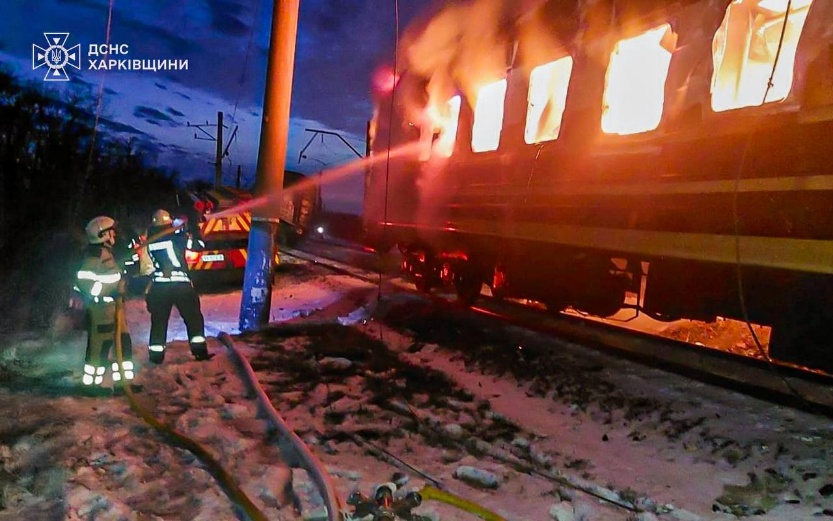
Russian drones struck a passenger train in Kharkiv Oblast, causing a fire inside a passenger car, Ukrainian officials said. The attack killed five people and injured two others. (Ukraine’s State Emergency Service/Telegram)
At 2:20 a.m., the train was moving steadily through darkness near Barvinkove. Most of its passengers were awake only in fragments—half-sleep, the soft rhythm of wheels, the belief that distance from the front still meant safety.
It did not.
Three Shahed drones picked up the train nearly fifty kilometers from the frontline. More than two hundred people were aboard. Eighteen sat in the car the drones chose. The first strike hit the front of the locomotive. Another slammed into a passenger car. Fire tore through steel and fabric. Five civilians were killed instantly. Two others were pulled from the wreckage and rushed to hospitals.
A Ukrainian soldier riding the train later described the attack: one drone struck cleanly, another crashed nearby, missing its mark. The pattern suggested adjustment—operators tracking the moving target in real time, refining their aim. This was not accidental. It was pursuit.
Ukrainian officials were unequivocal. Deputy Prime Minister Oleksiy Kuleba confirmed three Shaheds were used. President Volodymyr Zelensky called it terrorism. “There was no military target,” Kuleba said. “This was a direct act of Russian terror against civilians.”
Analysts saw something else as well. Russian forces were getting better at this. Cameras. Radio control. Artificial intelligence. Trains—once lifelines—were becoming moving targets. The use of multiple drones was not desperation. It was method.
International law offered its verdict on paper. It could not undo what happened inside that burning car.
Emergency crews evacuated 291 passengers. Buses replaced railcars. Hot drinks were handed out. Forms were filled. Ukraine’s machinery of survival moved with practiced efficiency—the kind learned only after years of repetition.
Three drones hunted a civilian train in the night while negotiators spoke of “focused” peace talks hundreds of kilometers away.
The distance did not protect them. The rails did not save them. And the war, once again, arrived where it was never supposed to be.
No Way Out: When Fleeing Meant Death
The drone footage appeared on January 27, precise and unmistakable. Two civilians were walking near Hrabovske, southeast of Sumy City, trying to leave occupied territory. They were not running. They were not armed. They were simply moving away.
The first FPV drone struck the woman without hesitation. She died instantly. Seconds later, a second strike hit the man as he lay wounded beside her body. The camera lingered just long enough to remove doubt. This was not crossfire. It was execution.
Ukraine’s 14th Army Corps confirmed what the video showed: Russian forces had deliberately killed two civilians attempting to escape. The drones moved with calm accuracy, the kind that comes from practice, not panic.
That practice had history. In mid-December, Russian forces crossed into Hrabovske during nighttime raids, forcibly deporting around fifty civilians. Russian sources credited the operation to elements of the 34th Motorized Rifle Brigade. Weeks later, the same brigade was still operating nearby. The pattern had not changed. It had hardened.
This was how occupation enforced itself. Not with checkpoints or fences, but with visibility. Kill those who try to leave. Make sure others see it. Turn fear into a boundary no one dares cross.
The footage was not an anomaly. It was doctrine in action. Deportations in December. Executions in January. Control achieved not through military necessity, but through terror directed at the unarmed.
Russian forces continued to commit war crimes in areas where they were pressing forward. These were not rogue acts. They were repeatable, documented behaviors tied to identifiable units operating in known locations.
Two civilians died in Sumy Oblast while Russian negotiators spoke of “focused” peace talks elsewhere. The footage existed. The deaths were recorded. The message was clear.
In occupied territory, escape was no longer a risk.
It was a death sentence.
The Price of Pretending Victory
The number landed with the weight of a verdict. According to the Center for Strategic and International Studies, Russia had suffered roughly 1.2 million military casualties since February 2022. About 325,000 of them were dead.
CSIS warned the total toll—Russian and Ukrainian combined—could approach two million by spring 2026. No major power, the analysts noted, had endured losses on this scale since World War II. The study asked a simple question at its core: had Moscow succeeded in achieving its objectives in Ukraine?
The answer was written in meters.
Near Pokrovsk, the most contested stretch of the frontline throughout 2025, Russian forces advanced an average of seventy meters per day. Slower than some of the bloodiest battles of the last century. Since the start of 2024, Russia had captured less than 1.5 percent of Ukraine’s territory. The land gained did not match the lives spent to take it.
CSIS widened the lens. Russia, the report said, now functioned as a second- or third-tier economic power—hampered by labor shortages, declining manufacturing, and shrinking capital. In emerging technologies, it lagged badly. Not a single Russian company ranked among the world’s top one hundred technology firms. Artificial intelligence, the engine of modern warfare and economies, remained an area of weakness.
The conclusion was blunt: Russia was “hardly winning,” and increasingly in decline.
Official statements told a different story. On January 27, Russian leaders spoke of momentum, industrial resilience, and steady progress. Those claims collided with the math. Three hundred twenty-five thousand dead. Over a million wounded. For gains that independent analysts measured in hundreds of square kilometers, not the sweeping advances advertised.
Ukraine’s losses were staggering too—up to 600,000 casualties, with as many as 140,000 killed. Civilian deaths passed fifteen thousand and kept rising.
The ledger was clear. The price soared. The progress slowed.
Only the stories grew larger.
A Night of Fire, Again
The drones came in waves just after midnight, their routes fanning out across Ukraine from nearly every direction. By morning, the count was clear: 165 attack drones launched between January 26 and 27, roughly a hundred of them Shaheds, some jet-powered, rising from launch points in Russia and occupied Crimea.

Rescuers clear out rubble from an apartment building after a Russian drone strike. (Mayor Serhiy Lysak / Telegram)
Air defense crews worked through the night. One hundred thirty-five drones were destroyed. Twenty-four were not. They struck fourteen locations. Debris fell in nine more.
In Odesa, the night turned violent at 2:20 a.m. More than fifty drones descended on the city, ripping into apartment blocks near the Black Sea. A preschool was damaged. A church was hit. Windows blew inward. Concrete folded. By dawn, emergency crews were still digging. Fourteen people were pulled from rubble, including a child. The injury count climbed from twenty-three to thirty-five. By mid-afternoon, three bodies had been recovered, with more feared trapped below.
The damage spread across the Prymorskiy neighborhood—forty-three buildings, 122 apartment units torn open in the heart of the city. Nearby ports were scarred. Energy provider DTEK confirmed its facilities were struck as well. “Destruction is colossal,” the company said. Repairs would take time Ukraine did not have.
Farther west, a drone hit an oil terminal in Lviv Oblast’s Zolochiv district, setting off fires tied to the Druzhba pipeline system. Smoke hung low. Residents were told to seal their windows. Schools in Brody closed. Emergency crews worked through the morning, measuring air quality and containing what they could.
This was not escalation. It was repetition.
The strikes carried familiar messages: no city is far enough away, sanctions have not emptied Russia’s arsenals, winter would again be used as a weapon. The numbers told the rest of the story. One hundred thirty-five drones stopped. Twenty-four slipped through. Fourteen places hit. Three dead in Odesa. Five more on a train near Barvinkove.
Another night where Ukraine’s defenses saved many—and still could not save everyone.
Quiet Rooms, Hard Edges
The tone changed first. Gone were the lectures, the history lessons, the long monologues meant to exhaust rather than persuade. When Ukraine’s foreign minister spoke on January 27, he described a Russian delegation that looked different, sounded different, and behaved differently.
Admiral Igor Kostyukov, head of Russian military intelligence, now led Moscow’s negotiators. Senior Defense Ministry officials sat beside him. Vladimir Medinsky—the Kremlin aide infamous for rambling historical digressions and open threats—was nowhere to be seen. “These are different people,” Andrii Sybiha said. “There were no more pseudo-historical lectures. The conversations were very focused.”
That absence mattered. Medinsky had fronted earlier talks in Istanbul in 2022 and later rounds in 2025, where he reportedly warned Ukraine that refusal meant endless war and expanding occupation. His removal signaled a tactical shift, not a change of heart.
Because the substance remained stuck.
Territory was still unresolved. Control of the Russian-occupied Zaporizhzhia Nuclear Power Plant remained unresolved. Sybiha said President Zelensky was prepared to meet directly with Vladimir Putin to address those issues, but Russia continued to block progress.
The talks—now in their third trilateral round with the United States—were set to continue in Abu Dhabi. Washington hoped to push them toward a conclusion. Yet reporting suggested U.S. pressure was falling hardest on Kyiv, urging territorial concessions Moscow showed no sign of reciprocating. Public denials clashed with private briefings. The gap between what was said and what was done widened.
Zelensky called the January meetings “constructive.” Kremlin spokesperson Dmitry Peskov was cooler. “Significant work” remained, he said. Friendliness was not expected.
The new format stripped away theatrics, not demands. Russia still sought control, rejected meaningful security guarantees, and insisted on a rollback of NATO’s presence—positions unchanged since before the invasion began.
The threats were quieter now. The pressure was not.
Focused conversations continued in closed rooms while Gerasimov inflated battlefield gains outside them. The tone had shifted. The stakes had not.
No Longer Neutral: Belarus Named an Accomplice
The language was no longer careful. On January 27, Ukraine’s foreign minister said plainly what Kyiv had treated as implicit for years: Belarus was not a bystander in this war. It was a participant.
Speaking to European Pravda, Andrii Sybiha confirmed Ukraine was preparing sanctions against Alexander Lukashenko himself. Not against faceless institutions. Against the man. “The Lukashenko regime, and Lukashenko personally, must bear responsibility for their complicity in Russian aggression,” he said.
This was not a rhetorical shift. It was a legal and moral one.
Belarus, Sybiha noted, had not been dragged unwillingly into the war. Lukashenko had ruled the country since 1994, dismantling democratic institutions until Belarus stood alone—Europe’s most authoritarian state outside Russia. Ukraine, like many European governments, did not recognize him as a legitimate president. In 2020, when Belarusians voted for change, the result was suppressed. Sviatlana Tsikhanouskaya, widely seen as the rightful winner, was forced into exile.
From that moment, the choice was clear.
Lukashenko opened Belarus to Russian forces. Missiles launched from its territory. Troops massed there before the invasion. Drones and aircraft crossed its airspace. At times, Belarus even appeared as a potential launch platform for Russia’s Oreshnik missile system—designed to carry nuclear warheads.
Ukraine’s position hardened accordingly. This was not neutrality violated under pressure. It was cooperation chosen. Sanctuary provided. Infrastructure offered. Borders opened.
Sybiha’s statement drew a line that had long hovered just below the surface: Belarus would be treated not as a coerced neighbor, but as a co-belligerent. And co-belligerence carried consequences—diplomatic isolation, legal accountability, and sanctions aimed squarely at the dictator who made those decisions.
Belarus was no longer hiding behind Russia’s shadow. It was standing in it.
Proof From Orbit: When the Damage Finally Shows
For three weeks, the claim hung in the air, unconfirmed and contested. Ukrainian drones had struck the 100th Arsenal near Neya in Kostroma Oblast, officials said. Ammunition storage was hit. Stocks were destroyed. Moscow denied it.
Then the satellite passed overhead.
On January 27, commercial imagery finally provided the view Ukrainian commanders had been waiting for. At least three storage buildings at the Russian Main Missile and Artillery Directorate’s arsenal were gone. Roofs collapsed. Structures erased. The strike from the night of January 5–6 had done what Ukraine said it did.
The delay was not doubt. It was physics.
Damage assessment in modern war moves at the speed of orbit. Ukrainian drones hit their target in early January. Initial reports followed immediately. Russian sources dismissed them just as quickly. Ukrainian forces held their position: the strike had degraded Russia’s ammunition reserves. Only weeks later—when weather cleared and satellites aligned—could independent verification catch up with the truth.
Three buildings destroyed meant more than scorched concrete. It meant lost shells. Lost rockets. Reserves that would take months to replace. Russian forces were already firing ammunition faster than it could be produced. What vanished at Neya could not be quietly replenished.
The arsenal mattered. Kostroma was not a frontline depot but a backbone—centralized storage feeding units across the theater. Each successful strike forced Russia to disperse what remained, stretch supply lines, and expose convoys to further attack. Logistics, once tidy, became fragile.
This was how pressure accumulated in modern war. Not in dramatic explosions alone, but in slow confirmation. One satellite pass. Three missing buildings. A supply chain bent a little further out of shape.
The January 27 imagery did not change the past. It confirmed it.
And it added three more empty structures to a growing list—evidence that Ukrainian strikes were landing, even if proof took time to arrive.
Accusations on Stage, Oil in the Wings
The summons came with cameras in mind. On January 27, Hungary called Ukraine’s ambassador into the Foreign Ministry in Budapest, and Foreign Minister Peter Szijjarto stepped forward to deliver the charge: election interference.
“We will not tolerate it,” he said, accusing Kyiv of trying to sway Hungary’s upcoming parliamentary vote in favor of the Tisza Party. The language was sharp, theatrical, and absolute. Hungary’s future, he declared, would be decided only by Hungarians—“not in Brussels and certainly not in Kyiv.”
The accusation did not stand alone. Days earlier, Prime Minister Viktor Orban had sounded the same alarm, claiming Ukraine had “gone on the offensive,” issuing threats and meddling openly in Hungary’s elections. Together, the statements formed a familiar script: sovereignty under siege, foreign enemies at the gate, Budapest as the last defender.
Ukraine largely refused the stage. Responding to earlier claims, Foreign Minister Andrii Sybiha urged Hungarian leaders not to fear Ukraine, but to listen to their own people. There was no escalation. No counter-summons. Just restraint.
The contrast mattered.
Because while Budapest protested imagined interference, its own actions continued uninterrupted. Hungarian territory remained a conduit for European energy infrastructure moving Russian oil. Budapest kept blocking European support packages for Ukraine’s defense. Orban continued presenting himself as a mediator between Kyiv and Moscow, despite the clear conflict between mediation and financing one side of the war.
The grievance was loud. The context was quieter—and more revealing.
Summoning an ambassador over unproven claims made for strong headlines. Allowing Russian oil to flow made for steady revenue. Accusing Ukraine of interference drew attention outward, away from Hungary’s own role in sustaining the war it publicly claimed to lament.
This was the choreography Budapest had perfected: denunciation in public, accommodation in practice.
On stage, Hungary defended its democracy. Behind the curtain, it helped keep Russia’s war machine running.
Victory on Paper, Despair in the Ranks
The complaints did not come from Ukrainian sources. They came from inside Russia’s own war chorus. On January 27, a Russian military blogger tied to the Northern Grouping of Forces began describing the conditions inside units that Moscow’s leadership had just declared victorious.
The picture was not triumphant.
One post described the recruitment of elderly contract soldiers into the 2nd Battalion of the 30th Motorized Rifle Regiment, operating north of Sumy City near Oleksiivka. These were not reinforcements chosen for strength or endurance. They were bodies filling gaps. The blogger’s frustration hinted at a force scraping the bottom of its manpower pool while commanders spoke publicly of momentum.
Another blogger reported plans to send elements of the 3rd Battalion of the 1st Motorized Rifle Regiment toward Starytsya near Kharkiv. The language was restrained but clear: morale inside the unit was collapsing. The deployment was unwanted, imposed, and deeply resented.
The most revealing account came from the Kupyansk direction—the very sector Gerasimov held up as proof of sweeping gains. A blogger writing about the 272nd Motorized Rifle Regiment said the unit was suffering acute drone shortages despite intensified operations. Soldiers were told to “donate” money for drones. In reality, those payments functioned as bribes—to avoid being sent on assaults so deadly that survival felt less likely than financial loss.
This was not rumor. It was admission.
On the same day, Ukrainian forces held or advanced positions near Kupyansk. Russian bloggers acknowledged Ukrainian counterattacks around Kupyansk and Radkivka. Footage showed Russian strikes in areas previously claimed as secured—evidence that the front was still contested, unstable, and dangerous.
Elderly recruits. Forced deployments. Drone shortages masked as extortion. Units paying to escape assault.
These were the forces behind the “beautiful reports.” These were the soldiers supposedly carving out 500 square kilometers of gains. And these were the cracks spreading beneath a narrative that insisted victory was only a matter of time.
Meters, Not Myths
Strip away the maps that lied and the claims that floated far ahead of reality, and what remains on January 27 is smaller, heavier, and harder to move.
Russian forces did advance—just not in the way Gerasimov described. Geolocated footage confirmed the seizure of Khromivka and movement in southeastern Nykyforivka, southeast of Slovyansk. Fighting there stretched across a broad front, with Russian units pressing near Lyman and probing multiple villages at once. The pressure was constant. The progress was narrow.
Near Kostyantynivka, footage showed Russian units edging southeast of Pryvillya and pushing into surrounding settlements. Combat reached the city itself. Inside Kostyantynivka, roughly two thousand civilians remained, living with the sound of incoming fire and the knowledge that the line was inching closer, not breaking.
Around Pokrovsk, the front told a familiar story of exhaustion and contest. Ukrainian artillery struck Russian forces in western parts of the city, hitting areas Russian units had infiltrated earlier—signs that control was partial and fragile. Ukrainian commanders reported holding sections of northern Pokrovsk and nearby Myrnohrad even as Russian forces tried to fold around them. Fiber-optic drones with ranges over twenty kilometers hovered above the fight, extending the battlefield but not resolving it.
Analysts assessed Pokrovsk and Myrnohrad would likely fall eventually, after a campaign already dragging past twenty-two months. But “eventually” was doing the work here. Russian airborne units—the 76th Airborne Division—had been pulled back from the Pokrovsk line, spent and worn down.
These were the real gains: meters at a time, paid for with depleted units, thinning morale, and equipment burned faster than it could be replaced. No sweeping breakthroughs. No collapsing fronts.
Just ground taken the hard way—while imaginary territory was claimed elsewhere to shape negotiations and sell inevitability.
The Day’s Meaning
January 27 pulled the war’s contradictions into the open and refused to let them hide. On paper, Valery Gerasimov traced sweeping advances across maps. In public, Russian military bloggers mocked those claims as “beautiful reports.” On the ground, five civilians burned to death in a train car nearly fifty kilometers from the frontline, and two more were executed by drones as they tried to flee occupation.
All of it happened at once.
The battlefield told one story. Russian forces did advance—meters at a time. Khromivka fell. Pressure tightened around Pokrovsk. Positions shifted through attrition, not collapse. The cost was enormous: exhausted airborne units pulled back, drone shortages masked as bribery schemes, morale thinning as elderly recruits filled the ranks.
The information space told another. Those modest gains were inflated into imaginary breakthroughs and fed into diplomacy. Washington, citing momentum that did not exist, pressed Kyiv to surrender Donbas—territory analysts said Russia could not seize before 2027. Moscow maintained maximalist demands it had held since before the invasion. Negotiations became “focused,” stripped of theatrics but no closer to agreement.
The numbers cut through both narratives. One point two million Russian casualties. More than three hundred thousand dead. For advances averaging seventy meters a day. For less than two percent of Ukraine’s territory since last year.
And still the violence reached outward. Shaheds hunted a moving train. FPV drones turned escape into execution. These were not accidents. They were choices, made alongside claims of moral authority and demands for capitulation.
No one could say who truly believed their own story—whether Gerasimov, Washington, or the Kremlin itself. But the facts were plain enough. The claims were false. The pressure was real. The civilians were dead.
January 27 revealed a war trapped between fabrication and fact, where negotiations floated above reality and terror filled the gap.
Prayer For Ukraine
• Pray for the families of the civilians killed on January 27 — those who died in the train near Barvinkove and those executed while trying to flee occupation — that they would not be forgotten, and that comfort, justice, and truth would surround those left behind.
• Pray for protection over civilians across Ukraine, especially those traveling, sheltering in cities under drone attack, or living trapped under occupation, that God would place limits on violence and preserve life where no human shield exists.
• Pray for Ukrainian soldiers holding ground under relentless pressure, particularly near Pokrovsk, Kupyansk, and Kostyantynivka, that they would be strengthened in body, clarity, and resolve amid exhaustion and loss.
• Pray for wisdom and moral clarity in negotiations — that leaders would not be deceived by fabricated victories or pressured into unjust concessions, and that truth would outweigh convenience in every decision made.
• Pray for an end to the machinery of terror — that drone strikes, executions, and deliberate attacks on civilians would be halted, that those responsible would be held accountable, and that a just peace rooted in reality, not illusion, would finally take shape.