
As Trump touts a temporary halt to Russian energy strikes, Starlink-guided drones hit Ukrainian highways and Belarus floods NATO skies with balloons, exposing the widening gap between diplomatic claims and battlefield reality.
The Day’s Reckoning
President Trump stood before cameras and described a promise he said he had secured personally: Vladimir Putin agreeing to halt strikes on Kyiv and Ukraine’s energy infrastructure for one week. A pause, he said, granted out of consideration for winter cold. Hours later, Russian military bloggers circulated what they claimed was the order behind the promise, asserting a nationwide energy moratorium running from January 29 through February 3. In the same breath, they scolded the Kremlin for surrendering what they called valuable leverage.
In Washington, Secretary of State Marco Rubio confirmed that the United States and Ukraine had finalized a framework for security guarantees. In Moscow, Foreign Minister Sergey Lavrov dismissed that framework outright, calling it protection for an “illegitimate” government and demanding Ukraine accept Russia’s 2022 Istanbul terms instead. Translation: limits on Ukrainian forces, Russian veto power over Ukraine’s future, and no meaningful protection at all.
Trump said Putin agreed. President Zelensky thanked Trump for efforts to stop energy strikes but stopped short of confirming any deal. The Kremlin refused to clarify. Lavrov reiterated that any ceasefire longer than a few weeks remained unacceptable because Ukraine might use the time to recover.
While the words echoed, the war kept moving.
Russian Molniya-2 drones, fitted with Starlink terminals, struck vehicles along the E-50 highway fifty kilometers behind the front line. In the Baltic region, forty-two balloons drifted into Lithuanian airspace from Belarus in a single night, forcing airport closures and police arrests. On the home front, Ukrainian families received the remains of one thousand fallen soldiers, exchanged for thirty-eight Russian bodies. Inside Russia, university students opened letters threatening expulsion unless they signed drone warfare contracts.
A promised pause. Drones hunting highways. Balloons probing NATO skies. Bodies crossing borders. The day revealed how diplomacy and escalation now advance side by side, never quite touching, never slowing the war beneath them.
Seven Days of Silence That Never Arrived
The announcement sounded decisive. President Trump told his cabinet he had personally asked Vladimir Putin to halt strikes on Kyiv and Ukraine’s cities for a week—and that Putin had agreed. No missiles on power plants. No drones over frozen neighborhoods. Just seven days of restraint. “Very nice,” Trump called it.
But the promise arrived without edges. No start time. No written terms. No confirmation of what, exactly, would stop.
In Kyiv, President Zelensky answered with care. He thanked Trump for trying to shield Ukrainian cities during winter’s hardest weeks. He spoke of electricity as life itself. He did not say a ceasefire existed.
In Moscow, the silence was louder. Kremlin spokesperson Dmitry Peskov refused to confirm anything. Foreign Minister Sergey Lavrov dismissed the idea of longer pauses outright, insisting any ceasefire beyond a few weeks was unacceptable because Ukraine might recover. Rest. Rearm. Survive.
Then Russian milbloggers filled the vacuum. They claimed an order had gone out on January 28: long-range strikes halted from 0700 through February 3. All of Kyiv. All energy infrastructure nationwide. Some hedged. Others bristled. One Kremlin-aligned voice accused Moscow of giving up “valuable leverage,” tying the pause to upcoming talks in Abu Dhabi. Relief followed criticism—the ceasefire was short enough, they said, to hurt Ukraine later.
The pattern was familiar. Moscow had offered pauses before, just long enough to appear reasonable, just vague enough to deny meaning. Short moratoriums cost Russia little. Missiles could be stockpiled. Drones queued. Pressure resumed on command.
What did the pause cover? Only Kyiv, or every city? Energy targets alone, or civilians too? Did it exist beyond Trump’s words and Telegram speculation?
Seven days. Maybe. For some targets. Perhaps.
The ambiguity wasn’t a flaw. It was the strategy.
The Sky Turned Hostile: How Starlink Followed the War Home
The announcement of an energy pause was still echoing when vehicles began burning on a highway far from the front.
Along the E-50 between Pokrovsk and Pavlohrad—fifty kilometers behind the fighting—Russian Molniya drones started appearing overhead, quiet and persistent. Ukrainian drivers never saw the operators. They felt the strike instead. One vehicle after another, hit deep in what had once been safe rear territory.
Serhiy “Flash” Beskrestnov, an advisor to Ukraine’s Ministry of Defense, confirmed what frontline units were already whispering: several Molniya fixed-wing FPV strikes per day, aimed not at trenches but at movement. Supply trucks. Passenger cars. Anything traveling the road. Ukrainian sources told Suspilne the campaign began weeks earlier, stretching from Troitske to Pavlohrad—up to seventy-eight kilometers from the line.
Molniyas weren’t new. Russia had used fixed-wing drones for months, sometimes as “motherships” ferrying smaller drones toward distant targets. Zaporizhzhia had seen them in October. What changed was what sat inside them now.
Starlink terminals.
By integrating satellite connectivity, Russia turned cheap loitering munitions into long-range precision weapons. The drones flew beyond Ukrainian electronic warfare coverage. They didn’t need line-of-sight. They didn’t lose signal. They hunted.
Footage released January 28 showed a Molniya strike in Preobrazhenivka, Kharkiv Oblast—ninety-seven kilometers behind the front—guided by a ZALA reconnaissance drone. A coordinated kill chain, stitched together by American satellites.
Ukraine’s Defense Minister announced emergency coordination with SpaceX. Calls made within hours. Fixes proposed. “Western technology must protect civilians,” he said, “not destroy peaceful cities.”
The paradox was brutal. Starlink kept Ukrainian units connected under fire. The same network now guided Russian strikes into Ukraine’s operational rear.
Molniyas cost thousands, not millions. And they were no longer just disrupting supply lines.
They were turning highways into frontlines.
The Night the Sky Was Tested
The first alerts came after dark. Radar operators in Lithuania watched unfamiliar returns drift in from the east—slow, numerous, unhurried. By morning, forty-two balloons had crossed into Lithuanian airspace from Belarus, the largest single incursion since the violations began months earlier.
Vilnius reacted in real time. Flights halted. Vilnius International Airport shut down once. Then again. Then a third time. Emergency services fanned out across the countryside. By dawn, authorities had recovered eight balloons carrying smuggled cargo, found fragments of others, and arrested four people tied to the operation. Each balloon was small. Together, they forced a nationwide response.
The disturbance didn’t stop at Lithuania’s border. Late the following night, Polish radar picked up similar objects entering from Belarus. Airspace over Podlaskie Voivodeship closed temporarily as Polish forces tracked the incursions. Another disruption. Another test.
Balloon violations had become familiar since October 2025. What changed on January 27–28 was scale. Forty-two at once. Enough to overwhelm routine monitoring and force repeated decisions: close the airport or risk it, scramble assets or watch, respond visibly or absorb the provocation.
ISW’s assessment gave the pattern a name: Phase Zero. The shaping stage before open confrontation. The balloons were not random contraband. They were probes—cheap, deniable, systematic—forcing NATO states to burn time, attention, and resources on platforms that cost almost nothing to deploy.
Each incursion trained responders. Each recovery mapped procedures. Each hesitation revealed limits.
Belarus announced new border outposts. A new training ground near Prybor. Russian forces continued operating from Belarusian territory. The picture sharpened: Lukashenko’s regime was not a bystander but a staging ground.
Forty-two balloons in one night wasn’t an accident.
It was rehearsal.
The Door Slams Shut in Moscow
The confirmation came from Washington first. Secretary of State Marco Rubio said the United States and Ukraine had finalized a framework of security guarantees—a structure meant to deter the next invasion, not just end the current one. For a moment, it sounded like forward motion.
Then Moscow answered.
In an interview with Turkish media, Foreign Minister Sergey Lavrov dismissed the guarantees outright, brushing them off as protection for what he called an “illegitimate” Ukrainian government. Instead, he returned to Russia’s familiar demand: the 2022 Istanbul framework. Translation: Ukraine disarmed and constrained, Russia unconstrained and empowered, Moscow holding veto power over any future response if Ukraine were attacked again.
Lavrov went further, restating the Kremlin’s commitment to the terms Vladimir Putin laid out in June 2024—terms that required not compromise, but capitulation. Ukraine, he claimed, remained a standing threat to Russia’s security. The logic was circular. The conclusion was fixed.
Inside Russia, the chorus hardened. Chechen leader Ramzan Kadyrov said negotiations were pointless and the war should continue. Members of the Federation Council and State Duma echoed the line, insisting Ukraine had no right to territories Russia had illegally annexed and should surrender to make talks easier.
The pattern was unmistakable. Every serious proposal offering Ukraine real security had been rejected. Not paused. Rejected. The refusal revealed Moscow’s enduring theory of victory: outlast Ukraine, exhaust the West, and force concessions without ever offering protection in return.
Rubio spoke of a “key role” for the United States and a general consensus around limited European troop deployments. Talks were still scheduled for February 1 in Abu Dhabi. Representatives might attend.
But the positions no longer overlapped.
Trump spoke of a week-long pause. Lavrov ruled out meaningful ceasefires. Kadyrov demanded more war.
Diplomacy remained on stage. The script, unchanged.
Three Days to Decide: When the Draft Came by Email
The letter didn’t arrive from the military. It came from the university.
Several Russian students opened official notices informing them they had failed their exams. Expulsion loomed. So did student debt. But there was a pause built in—three days. Three days to consider an “alternative.”
According to an investigation published January 28 by the science outlet T-Invariant, the alternative was service in Russia’s Unmanned Systems Forces. Students in Moscow and other cities said university officials told them expulsions would be delayed while they weighed a one-year military contract. The offer came dressed as opportunity. The pressure was unmistakable.
The Defense Ministry’s pitch was precise. One-year fixed contracts. Guaranteed placement only in drone units. No transfers to infantry. Release from service after twelve months if they declined to re-sign. Pay ranging from 5.2 to 5.5 million rubles a year—far beyond most graduate salaries. Deployment, they were told, would be twenty kilometers behind the front.
The campaign had begun quietly in December. It wasn’t working. Prestigious schools like the Higher School of Economics weren’t producing volunteers. So the tactics hardened.
A Russian lawyer later obtained a Defense Ministry guidebook instructing university military centers to expand recruitment, targeting both men and women. The promise of a single year came with a caveat: Russia’s 2022 partial mobilization order could override everything.
Opposition outlet Verstka described the contracts as “bait and switch.” Unit assignments weren’t guaranteed. Rear-area deployment wasn’t binding. Drone operators could become something else entirely.
The pattern was coercion masquerading as choice. Fail an exam—real or fabricated—and pick your future. Expulsion, or the war.
ISW assessed some recruits may never touch drones at all, instead filling depleted ground units. The desperation was visible. Russia needed technically skilled operators. It couldn’t persuade them.
So it pressured them.
The war had reached the lecture hall.
One Thousand Names Coming Home
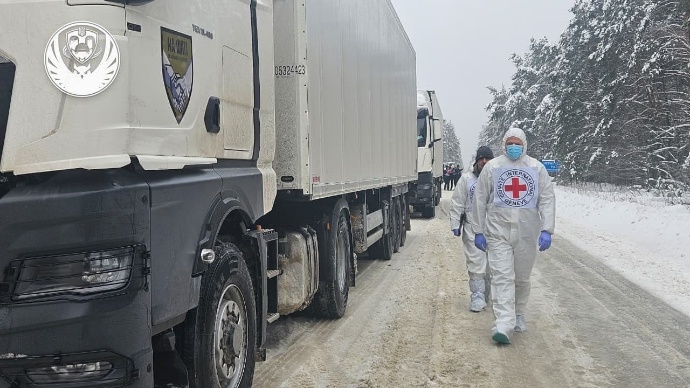
A photo published by the Coordination Headquarters for the Treatment of Prisoners of War, Two International Committee of the Red Cross workers walk on the road as the repatriation takes place. (Coordination Headquarters for the Treatment of Prisoners of War/Telegram)
The transfer happened without speeches.
On January 29, refrigerated trucks crossed borders carrying the remains of one thousand Ukrainian soldiers. In return, Ukraine handed over thirty-eight Russian bodies. It was the first repatriation of the new year, conducted with the same quiet efficiency that has marked these exchanges since the war settled into its fourth winter.
Russian presidential aide Vladimir Medinsky confirmed the number on Moscow’s side. Ukrainian officials confirmed theirs. The arithmetic was stark, but the meaning was layered.
Russia had lost enormous numbers of troops through attritional assaults. At the same time, Russian forces—on offense for much of the war—had recovered more Ukrainian bodies from contested ground. Moscow also inflated figures deliberately, sometimes delivering unlabeled remains that may have included Russian servicemembers, blurring the numbers to suggest Ukrainian losses were higher than reality. Even in death, the war continued to manipulate perception.
The exchange traced its roots to the Istanbul agreements of 2025, one of the few channels that continued to function between Kyiv and Moscow. The first bodies returned under that framework arrived the previous June. Thousands had followed since.
This time, the work began again.
Ukraine’s Coordination Headquarters for the Treatment of Prisoners of War thanked the International Committee of the Red Cross, law enforcement agencies, military units, and forensic teams. Investigators prepared for weeks of DNA testing. Paperwork. Notifications. The slow, careful work of matching remains to names.
One thousand families would receive a call.
One thousand identification processes would begin.
One thousand funerals would be planned.
While diplomats debated guarantees that did not materialize and spokesmen argued over pauses that might not exist, this machinery kept moving. Borders opened. Trucks rolled. Bodies changed hands.
The exchange did not signal progress toward peace.
It marked something colder: the war’s grim competence at returning its dead.
The Pause That Never Touched the Night
Air raid sirens rose again after midnight.
Despite talk of restraint, Russian launch crews sent wave after wave of drones into Ukrainian skies between January 28 and 29. The Ukrainian Air Force tracked 105 inbound systems—Shaheds, Gerberas, Italmas drones—lifting off from six directions: Bryansk and Oryol, Millerovo in Rostov Oblast, Primorsko-Akhtarsk on the Black Sea coast, occupied Crimea, and occupied Donetsk.
Radar screens filled. Interceptors went up. By morning, Ukrainian forces had destroyed 84 drones. Eighteen got through.
Seven locations were hit.
In Odesa and Zaporizhia oblasts, industrial and civilian sites burned as emergency crews moved in under fading night skies. The damage arrived quietly, in fragments and fires, not as a single spectacular strike—but it arrived all the same.
The timing was the point.
Only hours earlier, President Trump had said Vladimir Putin agreed to a week-long halt on energy infrastructure attacks. Russian milbloggers circulated what they claimed were internal orders enforcing the pause. Kremlin officials declined to confirm any of it.
Then came the launches.
Whether the strikes technically violated the moratorium depended on definitions no one could find. Did the pause cover all drones or only energy targets? Had it begun yet? Were industrial facilities military objectives or civilian infrastructure? The answers were never supplied.
That uncertainty worked in Russia’s favor. Moscow could point to restraint on paper while maintaining pressure in practice. The operational tempo never slowed. One hundred five drones in a single night was not a pause—it was continuity.
The pattern was familiar by now. Announcements at podiums. Silence from the Kremlin. Clarifications from Telegram channels. Explosions after midnight.
If the moratorium existed, it never reached the sky.
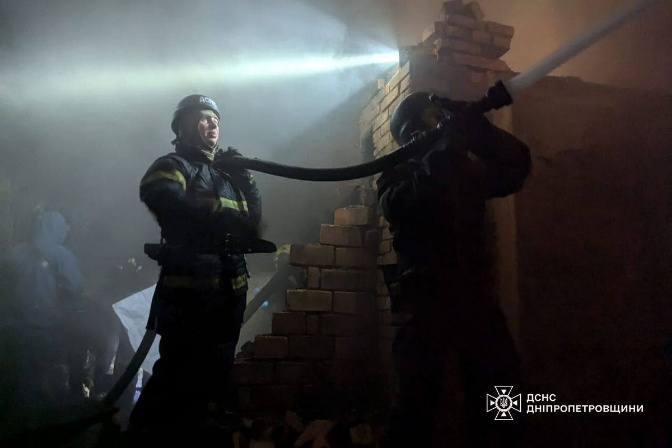
Firefighters extinguish a fire after a Russian strike on a residential building in Kryvyi Rih. The attack killed one person and injured three others. (Ukraine’s State Emergency Service / Telegram)
Meters, Not Miles: The War That Wouldn’t Move
Away from microphones and ceasefire talk, the front kept chewing forward—slowly, expensively, without spectacle.
In western Zaporizhia Oblast, Russian units edged northwest of Stepnohirsk. Geolocated footage published January 28 showed positions consolidating, not breaking through. Elsewhere along the Hulyaipole axis, attacks rolled toward Tsvitkove, Ternuvate, and Vozdvyzhivka. The lines bent. They did not break.
Even Russian voices urged caution. A Kremlin-aligned milblogger admitted Ukrainian small units were still operating between the Haichur and Yanchur rivers and warned it was premature to declare Ternuvate seized. Poor weather slowed Russian infiltration. Logistics lagged behind earlier claims of momentum.
Near Pokrovsk, Russian soldiers slipped forward in small groups, hugging windbreaks and tree lines. Geolocated footage showed movement without change—no shift in terrain control, no movement of the FEBA. Ukrainian units reported the tactic was familiar: exploit snow and low visibility to accumulate bodies in Myrnohrad, then try again.
Around Kupyansk, the pressure pulsed. Ukrainian spokesperson Trehubov said Russian assaults rose and fell as units regrouped, lacking the manpower edge to sustain intensity without constant rotation. Even here, Moscow’s own information space fractured. Kremlin-linked milbloggers rejected Chief of the General Staff Valery Gerasimov’s claims of clearing Kupyansk-Vuzlovyi, noting Ukrainian footage showed Russian forces at least ten kilometers away.
Observers reported redeployments—elements of Russia’s 47th Tank Division shifting toward Lyman Pershe—suggesting preparation for future attempts to stretch Ukrainian defenses from north and south along the Oskil River.
Across Slovyansk, Kostyantynivka-Druzhkivka, and Dobropillya, Russian units attacked repeatedly with no confirmed gains. Ukrainian officers described fireteam infiltrations, drones and UGVs hauling supplies, soldiers in thermal cloaks and snowsuits walking ten to fifteen kilometers to reach the line—often hungry, undersupplied, exhausted.
The pattern did not change. Men and munitions spent for meters. Ukrainian defenses held. Claims outran reality.
Diplomacy talked. The ground refused to listen.
The Day’s Meaning
Two wars unfolded at once, and neither acknowledged the other.
On one stage, President Trump announced a week-long pause in Russian energy strikes—no start date, no written terms, only reassurance. In another, Russian officials rejected the very idea of security guarantees, demanding Ukraine accept the 2022 Istanbul framework that would leave it disarmed and dependent. Russian milbloggers filled the gaps with claimed orders and open criticism, calling the pause a surrender of leverage even as they stressed it would end quickly.
Below the rhetoric, the war kept working.
Starlink-guided Molniya drones struck vehicles on the E-50 highway fifty kilometers behind the front, extending Russia’s battlefield air interdiction deep into Ukraine’s rear. Electronic warfare failed. The same satellite network keeping Ukrainian units connected now guided Russian strikes. Coordination with SpaceX began, but the paradox remained unresolved.
To the north, hybrid pressure spilled across borders. Forty-two balloons crossed from Belarus into Lithuanian airspace in a single night, forcing airport closures and emergency responses. Poland followed with its own airspace restrictions. ISW’s Phase Zero assessment fit cleanly: cheap platforms, plausible deniability, systematic testing of NATO reactions.
Inside Russia, the manpower strain showed through coercion. University students received letters claiming exam failure and offering three days to choose—expulsion or one-year drone warfare contracts promising high pay and rear-area service, with mobilization rules able to override everything.
And amid all of it, the dead moved quietly. One thousand Ukrainian bodies returned home. Thirty-eight Russian remains went back. Identification work began. Families were notified. The machinery functioned even as diplomacy stalled.
The contradictions did not resolve. A promised pause alongside a hundred-drone night. Security guarantees finalized and rejected. Balloons probing NATO skies while talks were scheduled. Innovation accelerating as restraint was announced.
If the moratorium existed, it changed nothing that mattered.
The war continued—adaptive, expansive, and indifferent to the language meant to contain it.
Prayer For Ukraine
• Pray for civilians across Ukraine who heard promises of a pause but endured another night of drones and explosions. Ask God to protect families in cities and towns where sirens still interrupt sleep and to grant strength to those living with constant uncertainty.
• Pray for Ukrainian soldiers, medics, and drivers moving along roads now targeted deep behind the front lines. Ask for protection over those traveling supply routes like the E-50, and for wisdom and courage as they adapt to new and deadly threats.
• Pray for leaders and decision-makers facing escalating hybrid warfare. Ask God to give clarity and unity to Ukraine’s partners and neighboring nations as they respond to airspace violations, technological escalation, and pressure meant to exhaust resolve.
• Pray for the families of the fallen as one thousand Ukrainian soldiers are returned home. Ask for comfort for grieving parents, spouses, and children, and for compassion and care for those tasked with identification, notification, and burial.
• Pray for truth and justice to overcome deception and coercion. Ask God to protect young people forced toward war through intimidation, to expose false promises, and to bring an end to violence disguised by diplomatic ambiguity.