
Trump announced a humanitarian pause after speaking with Putin—but hours later, 111 drones and a ballistic missile struck Ukraine, exposing the widening gap between diplomatic claims and battlefield reality.
The Day’s Reckoning
Donald Trump spoke from the White House as if the hardest part was over. He told his cabinet he had personally persuaded Vladimir Putin to stop bombing Kyiv for a week—a humanitarian pause, he said, to give civilians relief from the cold and open space for negotiations.
That same night, Ukrainian air defense screens filled with targets.
One hundred eleven drones of multiple types. One ballistic missile. Six civilians killed. Twenty wounded. A residential building torn open in Zaporizhzhia. Whatever pause had been announced in Washington did not exist in Ukrainian skies.
The Kremlin then shrank the claim without contradicting it outright. Dmitry Peskov confirmed Trump had made a request. Not an agreement. The request applied only to Kyiv, not cities and towns across Ukraine. It lasted until February 1, not a full week. Putin had been asked to refrain, not committed to stop. Each clarification narrowed the promise until it barely resembled what had been announced.
Volodymyr Zelensky responded with calibrated restraint. No ceasefire existed. No deal had been negotiated. But if Russia stopped striking energy infrastructure, Ukraine would respond in kind. Reciprocity without obligation. Flexibility without concession.
Behind the diplomatic ambiguity, pressure accumulated everywhere else. Ukrainian police handled more than 2,000 fake bomb threats in three hours while real FSB-directed bombing plots were disrupted in Odesa. Seven drone strikes hit rail infrastructure in a single day. Estonia called for permanently barring Russian combat veterans from Europe. The EU weighed choking off Russia’s oil logistics entirely. The U.S. Senate advanced new shadow-fleet sanctions.
Russia, meanwhile, halted prisoner exchanges altogether. More than 2,500 Ukrainians remained in captivity as peace frameworks multiplied on paper.
Day 1,437 revealed the contradiction plainly: diplomacy moved in language, while the war moved in force. And force kept winning the timetable.
A Ceasefire That Evaporated on Contact
Donald Trump spoke with the confidence of a deal already done. In a cabinet meeting, he told the world he had personally asked Vladimir Putin to stop bombing Kyiv—and Ukraine’s cities and towns—for a week. Putin had agreed, Trump said. A humanitarian pause. A diplomatic success delivered through personal persuasion.
Then Moscow began sanding down the claim.
Kremlin spokesman Dmitry Peskov confirmed the request—but only just. Trump had asked Putin to refrain from striking Kyiv alone, not cities across Ukraine. The pause ran until February 1, not a week. Putin had been asked, not committed. Each clarification shrank the promise until it barely resembled what had been announced in Washington.
The contradiction was stark. Trump described an agreement. Moscow described a request. Both could not be true.
Volodymyr Zelensky stepped into the gap with practiced precision. There was no direct dialogue with Russia, he said. No agreement. No ceasefire. But if Russia stopped striking Ukraine’s energy infrastructure, Ukraine would respond in kind. Reciprocity without obligation. An opportunity, not a deal.
The ambiguity deepened as the day wore on. Pro-Kremlin military bloggers claimed orders had gone out halting strikes on Kyiv and energy sites until February 3. Ukrainian bloggers reported mirror instructions not to hit Russian energy facilities. No official confirmation followed. The pause existed only in fragments and rumors.
Then night fell, and reality arrived.
One hundred eleven drones crossed Ukrainian airspace. One ballistic missile followed. Six civilians were killed. Twenty were wounded. A residential building in Zaporizhzhia was torn open. In Kharkiv Oblast, a missile damaged warehouses at a civilian industrial site.
Zelensky later noted that only one energy facility had been hit—perhaps the pause was starting, perhaps targeting had shifted, perhaps the entire framework lived only in diplomatic imagination.
The ceasefire that was announced but not agreed. The pause that might exist. The week that began two days before it ended.
Diplomacy, suspended between claim and consequence.
“Come to Moscow” — The Invitation Designed to Humiliate
The invitation arrived wrapped in diplomatic courtesy and sharpened with intent. Kremlin aide Yuri Ushakov suggested President Volodymyr Zelensky come to Moscow. Russia, he said, would guarantee his security. Working conditions would be arranged. Talks to end the war could continue—on Russian soil.
Zelensky’s response came fast and clean.
“I can just as well invite him to Kyiv,” he said. “Let him come. I’m openly inviting him, if he dares.”
The exchange stripped the theater bare. Russia invaded Ukraine. Russia seized territory. Russia leveled cities and power plants. Then Russia invited Ukraine’s president to the capital of the aggressor to negotiate surrender terms while missiles were still flying. The symbolism was the point.
Zelensky had already ruled out talks in Russia or Belarus. Moscow was the invader; Minsk its accomplice. Agreeing to meet in either would recast Ukraine not as a nation defending itself, but as a petitioner asking for mercy.
The two presidents had not met since before the invasion. Their last face-to-face encounter came in 2019 during Normandy-format talks, back when the war was still frozen. Since then, Moscow’s position had hardened into ritual: negotiations could happen anywhere—so long as Ukraine came to Russia.
That pattern held. When Zelensky proposed talks in Turkey last year, Putin refused and repeated the Moscow invitation. Zelensky declined again.
Ukraine’s position was simple. Real talks were possible. Any serious format would work. Translation: neutral ground only. No symbolic capitulation disguised as diplomacy.
For now, the venue remained Abu Dhabi, where U.S., Ukrainian, and Russian officials had met January 23–24 and planned to reconvene February 1. But even that was uncertain. Zelensky warned the schedule could shift as Washington’s attention drifted toward Iran.
Adding to the unease, Kremlin negotiator Kirill Dmitriev was set to meet Trump administration officials in Florida—alone, one day before the planned talks. Parallel diplomacy. Parallel risks.
Putin’s invitation to Moscow still stood. Zelensky’s invitation to Kyiv stood beside it, perfectly mirrored.
Neither would be accepted. And while diplomats debated venues, the war kept its own calendar.
“No Road From Bucha to Brussels” — Estonia Moves the Border Forward
Margus Tsahkna did not hedge his words. Sitting among Europe’s foreign ministers, Estonia’s foreign minister drew a straight line from massacre to security policy.
“There can be no path from Bucha to Brussels.”
The proposal was as blunt as the phrase. Russian soldiers who fought in Ukraine should never be allowed to enter the European Union—during the war or after it ended, however it ended. Combat service in Ukraine, Tsahkna argued, should permanently disqualify entry.
The reasoning was unsentimental. Russia had fielded close to one million combatants. Many were recruited from prisons and penal colonies. “They are mainly criminals,” Tsahkna said. “They are very dangerous people.” They had learned violence not on training grounds, but in occupied towns and fields. When the war ended, many would look outward. Europe, he warned, was not prepared for that migration.
Estonia had already acted on the logic. Tallinn imposed permanent entry bans on 261 identified Russian soldiers involved in the invasion. Now it wanted Europe to act together, not as isolated states. Fragmentation, Tsahkna argued, created gaps that violence could slip through.
Bucha was not invoked lightly. After Russian forces withdrew in March 2022, Ukrainian police found 422 civilian bodies. Bound hands. Execution-style gunshot wounds. Across the wider district, 1,190 bodies were recovered. Some residents never returned at all.
The proposal acknowledged an uncomfortable truth: many perpetrators would survive the war. Moscow had shown no interest in prosecuting its own. Some of those men would eventually try to cross into Europe, seeking work, anonymity, or escape from Russia’s postwar collapse.
EU foreign policy chief Kaja Kallas confirmed quiet support from several member states. The risk, she said, was real—and predictable. Better to prepare before a ceasefire scattered veterans across borders.
Implementation would be messy. Records, verification, legal challenges. But the principle was stark.
Europe did not owe entry to men shaped by systematic war crimes.
The road from Bucha to Brussels remained hypothetical. Estonia intended to keep it closed.
Three Orders, No Margin for Failure — Fedorov Takes the War’s Hardest File
President Volodymyr Zelensky didn’t speak in abstractions. On January 30, he numbered the problems and handed them to his new defense minister like a checklist written under fire.
“Number one: close the skies.”
Air defense came first because nothing else worked without it. Russian missiles and drones still cut through Ukrainian airspace, striking cities and infrastructure faster than systems could intercept them. The task was brutally simple to state and brutally difficult to solve: protect the country while fighting a technologically adaptive enemy with finite interceptors.
Then came number two. Busification.
The word had become shorthand for fear. Conscription-age men stopped on streets, loaded onto buses, delivered to enlistment offices. The practice filled ranks but hollowed trust. Zelensky told Fedorov to fix it—find manpower without turning daily life into a hunt.
Fedorov inherited numbers that explained the urgency. Nearly two million Ukrainians wanted for draft evasion. Another 200,000 listed as absent without leave. Recruitment had become as much a social crisis as a military one.
The third mandate cut through bureaucracy. Military contracts existed, Zelensky said. Now they had to work. Pay structures, service terms, conditions—all needed to function cleanly enough that service felt structured, predictable, and worth committing to. War could not be sustained on paperwork that failed soldiers once they signed.
Beyond the list hovered other pressures. Drones and artillery both mattered. The belief that drones could replace guns had died on the battlefield. Kill zones had widened; short-range artillery no longer reached far enough. Long-range firepower mattered again.
Fedorov, newly moved from digital reform to national defense, had promised audits of recruitment centers and overhaul of training. He had also stated the grim arithmetic aloud: Ukraine would need to inflict roughly 50,000 Russian casualties per month to make the war unsustainable. Moscow planned to replace only 32,000.
The mandates were not policy goals. They were survival conditions.
Choking the Lifeline — Europe and Washington Tighten the Oil Trap
The debate in Brussels had moved past prices. What Europe was now weighing was denial.
EU officials were considering scrapping the Russian oil price cap altogether and replacing it with something far more severe: a total ban on maritime services. No insurance. No shipping. No financing. Not cheaper oil—no European help moving it at all.
The proposal resurfaced quietly on January 29 as part of preparations for the EU’s 20th sanctions package, targeted for adoption on February 24, the fourth anniversary of Russia’s full-scale invasion. It had been drafted months earlier, then pulled back. Now it was back on the table.
The difference was structural. Under the current $60-per-barrel cap, European companies could still insure and ship Russian crude—as long as Moscow sold below the threshold. The system aimed to drain revenue without crashing global markets.
The new idea ended that compromise. Price would no longer matter. Russian oil could sell for $30 or $130 a barrel; European firms would be barred from touching it either way.
The stakes were enormous. Oil and gas provided roughly a third of Russia’s federal budget—the cash engine behind missile production and troop mobilization. A maritime ban would push nearly all exports onto Russia’s shadow fleet: aging tankers, thinly insured, flagged through shell companies and jurisdictions willing to look away.
Europe was already preparing to lower the cap dynamically to $44.10 on February 1. A services ban would make that irrelevant overnight. But unanimity was required. All 27 member states would have to agree.
Washington was moving in parallel. On January 29, the U.S. Senate Foreign Relations Committee advanced bipartisan shadow fleet legislation, targeting ship owners, insurers, operators, and financiers—along with Russia’s Yamal LNG and Arctic LNG 2 projects and the Nord Stream pipelines.
The timing was deliberate. Talks were scheduled to resume in Abu Dhabi on February 1. Pressure and diplomacy advancing together.
Enforcement remained the unanswered question. Shadow fleets exist to evade rules. Past sanctions forced adaptation, not surrender.
Still, the direction was unmistakable.
The lifeline was tightening—even if it hadn’t snapped yet.
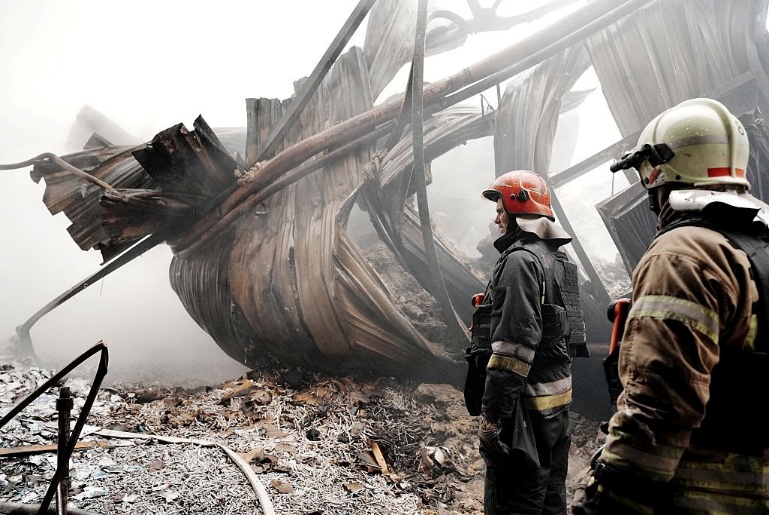
Rescue workers extinguish a fire at Philip Morris’s Kharkiv factory after a Russian strike. (Viktoriia Yakymenko / Suspilne Ukraine / Global Images Ukraine via Getty Images)
Two Thousand Alarms — How Fear Was Launched Without a Single Bomb
It began mid-morning and didn’t stop.
Between 9:30 a.m. and 12:10 p.m. on January 30, Ukrainian police were flooded with more than 2,000 bomb threat reports.
Government offices. Banks. Schools. Businesses. Messages arriving in waves, each claiming an explosive had been planted and would detonate. Each forcing the same response.
Evacuate. Check. Confirm.
Officers reached roughly a third of the locations within hours. Every single report was false. No bombs. No devices. No attackers on the ground.
That was the point.
The operation required no explosives, no smugglers, no infiltrators. Just keyboards. Coordinated digital messages sent from safety, forcing Ukrainian authorities to treat every threat as real—because ignoring even one genuine bomb would be unforgivable.
Every evacuation meant hours of lost work multiplied across thousands of employees. Every police unit dispatched to sweep a building was one less unit available for real emergencies. Every temporary closure rippled outward, stacking economic disruption nationwide in a matter of hours.
The damage went deeper than logistics. Parents hesitated before sending children to school. Business owners delayed decisions, knowing operations could be halted by another anonymous message. Over time, repeated false alarms risked something more dangerous: fatigue. Cynicism. The instinct to ignore warnings that might one day be real.
Ukraine had seen this before. Similar waves of threats hit schools in 2023. The pattern was familiar—systematic, synchronized, designed to exhaust rather than explode.
This was cyberwarfare in its purest form. Generating chaos was cheap. Responding to it was expensive. Two thousand messages cost almost nothing to send. Responding to two thousand possible bombs demanded mass mobilization and public disruption.
From Moscow’s perspective, the operation succeeded completely. The absence of explosives didn’t matter. Disruption was the weapon.
Two thousand threats. Two thousand forced reactions.
Fear, launched at scale—without a single bomb.
Bombs Meant for Families — The Attack That Was Stopped in Time
The arrests came quietly on January 30. Three men, pulled aside before anyone heard an explosion. Their profiles did not match a single pattern: a 36-year-old draft evader, a deserter, a member of a public-order NGO. Different lives, same recruiter. The FSB did not need loyalty. Only access.
Their targets were not bases or checkpoints. They were homes.
According to Ukraine’s Security Service, the men were recruited to hunt Ukrainian special-forces soldiers by aiming at what those soldiers could not protect—their families in Odesa. Cars. Apartment entrances. Places where children slept and neighbors passed without looking twice.
The plan was deliberate. Homemade bombs, remotely triggered. Not battlefield weapons, but instruments of fear. The goal was not just to kill. It was to make every soldier wonder whether service meant a death sentence for loved ones hundreds of kilometers from the front.
Surveillance came first. Tracking movements. Watching parking habits. Learning which stairwells led to which doors. The FSB supplied coordinates to a cache holding two explosive devices. Both were meant for a single apartment entrance shared by two servicemen.
The logic was cruel and efficient. If soldiers believed their families could be murdered at home, focus would fracture. Requests for rear assignments would rise. Recruitment would falter. The rear would become another front.
SBU officers moved before the final step. The suspects were detained en route. The bombs were seized along with phones used to coordinate with Russian handlers. No detonation. No warning blast in the night.
The three were charged with treason under martial law. Life imprisonment is possible.
The disruption saved lives. But it did not end the campaign.
This was not an isolated plot. It was a method. One cell stopped. Others likely watching.
Three men arrested. Two bombs neutralized. Families spared.
For now.
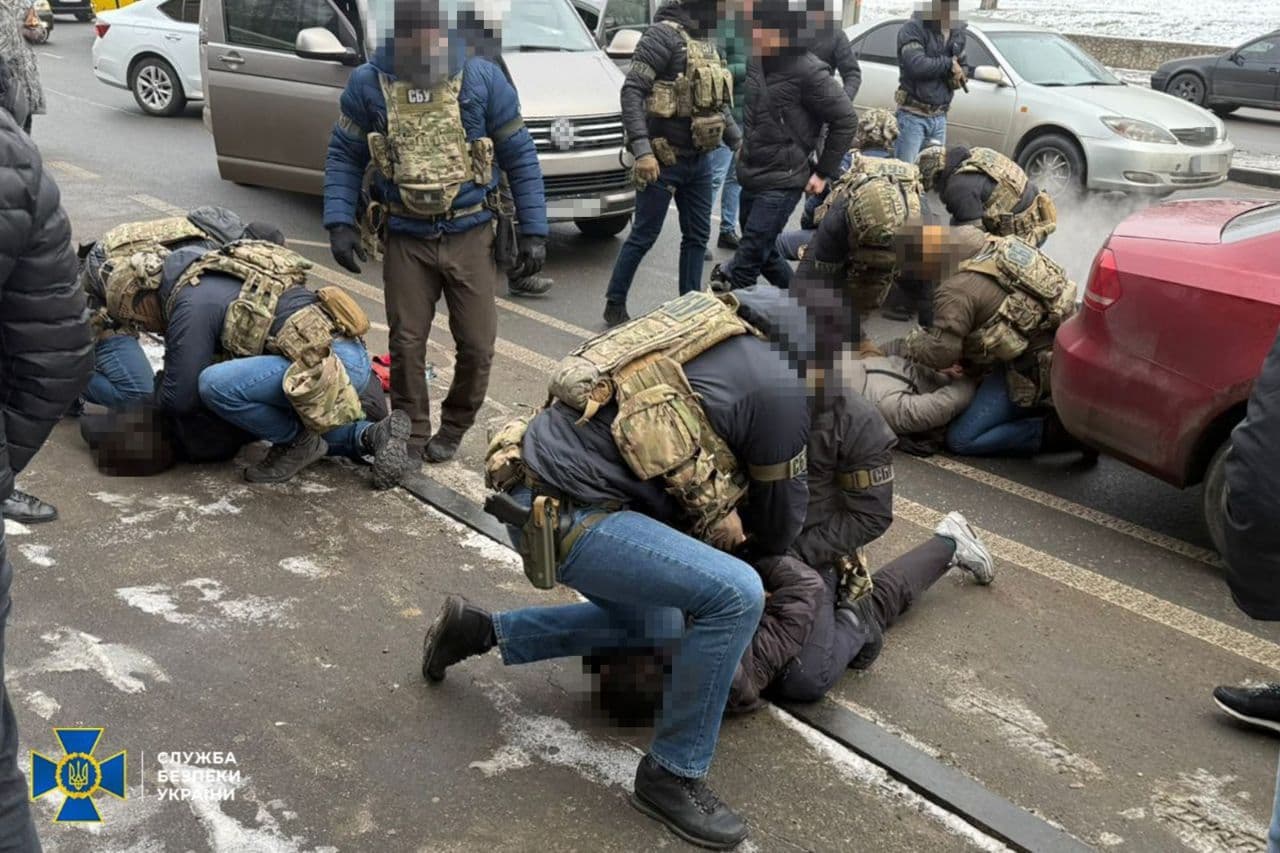
The SBU officers detaining suspects in Odesa, Ukraine, in a photo published. (The Security Service of Ukraine / Telegram).
Tracks Under Fire — When Rail Strikes Became a Strategy
By January 30, seven was no longer a statistic. It was a pattern.
Prime Minister Yulia Svyrydenko laid it out bluntly: seven Russian drone attacks on Ukraine’s railway system in just twenty-four hours. Not accidents. Not spillover. “Deliberate terror against people and civilian logistics,” she wrote.
The clearest signal came at Synelnykove station in Dnipropetrovsk region. Drones tore through passenger cars and locomotives. Rails twisted. Electrical systems went dark. Administrative buildings and production facilities were damaged in sequence, as if someone had mapped the station for maximum disruption rather than symbolic damage.
The consequences spread outward immediately. Ukrzaliznytsia restricted traffic between Dnipro and Zaporizhzhia. Trains that should have departed from Zaporizhzhia were rerouted to Dnipro instead. Evening passengers finished their journeys by bus, ferried by regional authorities through winter darkness.
The strikes came only days after a more visceral warning. In Kharkiv region, three Shahed drones hit a moving civilian passenger train. Five people were killed. Two more were injured. Fire raced through the carriages as 291 passengers were evacuated. Afterward, Ukraine’s rail operator quietly stopped publishing exact schedules and routes for some intercity trains.
Then came the detail that exposed the fiction of “pauses.” Russian negotiators reportedly apologized for the Kharkiv strike, telling Ukrainian counterparts it happened during a so-called gentleman’s agreement reached in Abu Dhabi on January 23–24. The explanation was simple and damning: not all Russian units had been informed.
Translation: agreements didn’t reach the operators launching drones.
Seven rail attacks in one day confirmed it. This was not miscommunication. It was method. Railways were being targeted to fracture logistics, disrupt movement, and remind civilians that even transit remained exposed.
Those strikes unfolded alongside a broader barrage: 111 drones and a ballistic missile hitting 22 locations across Ukraine. Six civilians killed. Twenty wounded.
Diplomats spoke of ceasefires. The war answered on steel and tracks.
Left Behind on Purpose — Russia Freezes the Prisoners
The confirmation came without ceremony. On January 30, President Volodymyr Zelensky said aloud what families had already feared: Russia had stopped prisoner exchanges altogether.
“They are not very interested,” he said. Not angry. Not rhetorical. Just flat. Exchanges, Moscow had decided, no longer served its needs.
The last swap took place on October 2, 2025—nearly four months earlier. That day, Ukraine brought home 185 soldiers and 20 civilians. Russia acknowledged exchanging 185 Ukrainian POWs for 185 of its own, noting separately that civilians were included. Then the process went silent.
More than 2,500 Ukrainian prisoners remained in Russian captivity as of September. Since the full-scale invasion began, Kyiv had managed to return over 7,000 people through painstaking negotiations. Now the mechanism had stopped working entirely.
Ukraine had long proposed an all-for-all exchange. Russia refused. Instead, it froze the system.
The timing sharpened the cruelty. Diplomats spoke of frameworks. Trump claimed breakthroughs. Talks convened in Abu Dhabi. Yet the most basic humanitarian act—sending prisoners home—ceased.
The logic was brutally transactional. POW exchanges benefited Ukraine more than Russia. Ukrainian society demanded the return of captured defenders. Every exchange proved the state fought for its people. Russia’s system did not reward that logic. Soldiers were replaceable. Losses were absorbed.
By halting swaps, Moscow denied Kyiv those moments of reunion—and preserved leverage. Prisoners became bargaining chips. Or pressure points. Or simply forgotten bodies behind wire.
“They believe it gives us something,” Zelensky said. And so they stopped.
The diplomatic calendar continued to move. Meetings scheduled. Envoys flying. Sanctions debated.
But the prisoners did not move.
Four months since the last exchange. No timeline. No signal. No humanitarian pause.
Frameworks advanced. Words multiplied. Bombs fell. And more than 2,500 Ukrainians remained where Russia decided they were most useful: out of sight, held in silence, waiting for a calculation that still hadn’t turned in their favor.
The Day’s Meaning
Two realities unfolded at once, and neither acknowledged the other. In Washington, a ceasefire was announced with confidence, framed as a humanitarian pause born of personal diplomacy. In Ukraine, air defense crews tracked drones, police evacuated buildings, rail workers rerouted trains, and families waited for news that never came.
The day revealed how fragile language becomes when it is not anchored to control.
Nothing that mattered was actually agreed. Moscow confirmed requests but avoided commitments. Kyiv offered reciprocity without obligation. Rumors of pauses circulated among bloggers while operators on the ground launched drones anyway. Even Russia’s own negotiators admitted that informal understandings failed to reach the units executing strikes. The gap between words and action was not a misunderstanding—it was structural.
What emerged was a pattern, not an accident. Russia continued to apply pressure everywhere that did not require formal escalation: rail infrastructure instead of frontlines, bomb threats instead of explosives, hostage leverage instead of prisoner exchanges. These were not signs of de-escalation. They were indicators of a strategy designed to exhaust, destabilize, and retain bargaining power while appearing open to talks.
Ukraine’s responses were equally telling. Zelensky avoided rejecting diplomacy outright but refused to validate illusions. His answers were conditional, precise, and deliberately nonbinding. Offer reciprocity, not trust. Keep channels open, but prepare for nothing to change. It was diplomacy shaped by experience rather than optimism.
The international response moved on a parallel track. Economic pressure tightened. Sanctions advanced. Proposals hardened. But these tools, too, remained future tense—pending votes, enforcement, alignment.
The question the day left unresolved was not whether talks would continue. They will. The question was whether any side possessed the ability—or the will—to translate declarations into restraint.
Until that gap closes, announcements will keep colliding with reality. And reality, as the day showed, is still written by drones, not statements.
Prayer For Ukraine
- For civilians caught between words and weapons
Pray for families who went to sleep under promises of a pause and woke to drones, evacuations, and shattered buildings. Ask God to protect those in homes, trains, schools, and workplaces who remain exposed while diplomacy offers no shelter. - For prisoners abandoned to leverage
Lift up the more than 2,500 Ukrainian POWs still held in Russian captivity and their families living in silence and uncertainty. Pray for endurance, dignity, and hope for those imprisoned, and for a breaking of the cold calculus that treats human lives as bargaining chips. - For Ukraine’s defenders under layered pressure
Pray for soldiers fighting at the front while fearing for their families at home—amid bomb plots, cyber threats, and rail strikes meant to spread terror. Ask for strength of mind, protection for loved ones, and resilience against psychological warfare. - For leaders navigating truth in a fog of claims
Pray for wisdom for Ukrainian leadership as they balance openness to diplomacy with the reality of continued attacks. Ask for clarity, courage, and restraint—and that false assurances and strategic ambiguity would not cost innocent lives. - For an end to war that moves beyond theater
Pray that international pressure, sanctions, and negotiations would move from future tense to real consequence. Ask God to restrain violence, expose deception, and hasten a peace grounded not in announcements, but in the actual silencing of weapons.