
A single software update darkened Russian battlefield communications across 1,000 kilometers on the same day Ukrainian soldiers captured since Mariupol finally returned home.
The Day’s Reckoning
Russian commanders opened their laptops and found nothing.
Not one terminal. Not one sector. From Kharkiv to Zaporizhzhia, Starlink connections went dark at the same time. Units that had coordinated assaults, guided drones, and shared targeting data online were suddenly offline. Paper maps came out. Couriers moved between positions with memory sticks. Command posts designed for 21st-century warfare reverted overnight to 20th-century methods.
Serhiy “Flash” Beskrestnov, Ukraine’s newly appointed Defense Ministry electronic warfare advisor, did not soften the assessment. The enemy, he said, did not have a problem. The enemy had a disaster.
The cause was bureaucratic, technical, and devastating. A whitelist system, jointly implemented by SpaceX engineers and Ukraine’s Defense Ministry, required every Starlink terminal in Ukrainian territory to be registered and verified. Within forty-eight hours, unauthorized terminals—many smuggled in by Russian forces through black markets—were shut down. Pro-Russian military bloggers confirmed what frontline units were already experiencing: connectivity lost, operations disrupted, no quick fix in sight.
Eight hundred kilometers away, a different kind of reconnection unfolded. In Abu Dhabi, mediators finalized the first prisoner exchange in five months. One hundred fifty-seven Ukrainians came home—soldiers captured at Mariupol, a guardsman seized at Chornobyl, men imprisoned for years under illegal Russian sentences. Families received calls they had waited for since 2022.
Far inside Russia, Ukrainian strikes told another story. January attacks on Kapustin Yar damaged facilities used to prepare ballistic missile launches. Personnel evacuated. Launch cycles disrupted.
And over all of it hung expiration. New START ended. Within hours, military backchannels reopened. No treaty. No guarantees. Just conversations resuming in the shadows.
In Kyiv, Polish Prime Minister Donald Tusk arrived as heating systems failed under Russian strikes, promising aid as temperatures dropped.
Day 1,443 showed how power now moves in parallel lanes—software updates, missile strikes, prisoner lists, diplomatic calls—each reshaping the war without ending it.
The Night the Screens Went Dark
The first sign was silence.
Across the frontline, Russian commanders refreshed screens that refused to load. Maps froze. Drone feeds vanished. From Kharkiv to Zaporizhzhia—more than a thousand kilometers—units that had fought this war online were suddenly offline. Paper maps came out. Runners moved between positions with memory sticks. Command posts built for 2026 snapped back to the last century.
Serhiy “Flash” Beskrestnov, Ukraine’s senior electronic warfare advisor, didn’t hedge. This wasn’t a glitch. It was a disaster.
Reports rippled in from both sides. Ukrainian sources tracked failures across entire sectors. Russia’s independent agency Astra confirmed army-operated Starlink terminals had gone dead force-wide. Pro-Russian Telegram channels described commanders abandoning digital systems for handwritten orders and couriers.
On the ground, the effects were uneven—and revealing. A Ukrainian marine officer near Myrnohrad said assaults continued, but slower. Azov Corps staff reported no immediate halt. Elsewhere, the picture darkened. An officer from Ukraine’s 3rd Army Corps said Russian units were “cut off completely,” forced to pause while scrambling for alternatives. Near Zaporizhzhia, a drone commander put it plainly: the blackout bought time—and little more.
Starlink had become the nervous system of modern combat: live maps, unit tracking, targeting, drone navigation. When it went dark, accuracy suffered. Tempo slipped. Coordination frayed.
The disruption cut both ways. Ukrainian volunteer units using gray-market terminals lost access too. Beskrestnov’s team moved fast, rolling out a registration process through the secure Delta network. Verified terminals came back online. Unauthorized ones stayed dark.
Russian milbloggers admitted the scope. The difference wasn’t total access versus none. It was organization. Ukraine restored connectivity systematically. Russia hunted for workarounds without infrastructure to scale them.
Within forty-eight hours, a software switch had reshaped the battlefield. Not forever. Long enough to matter.
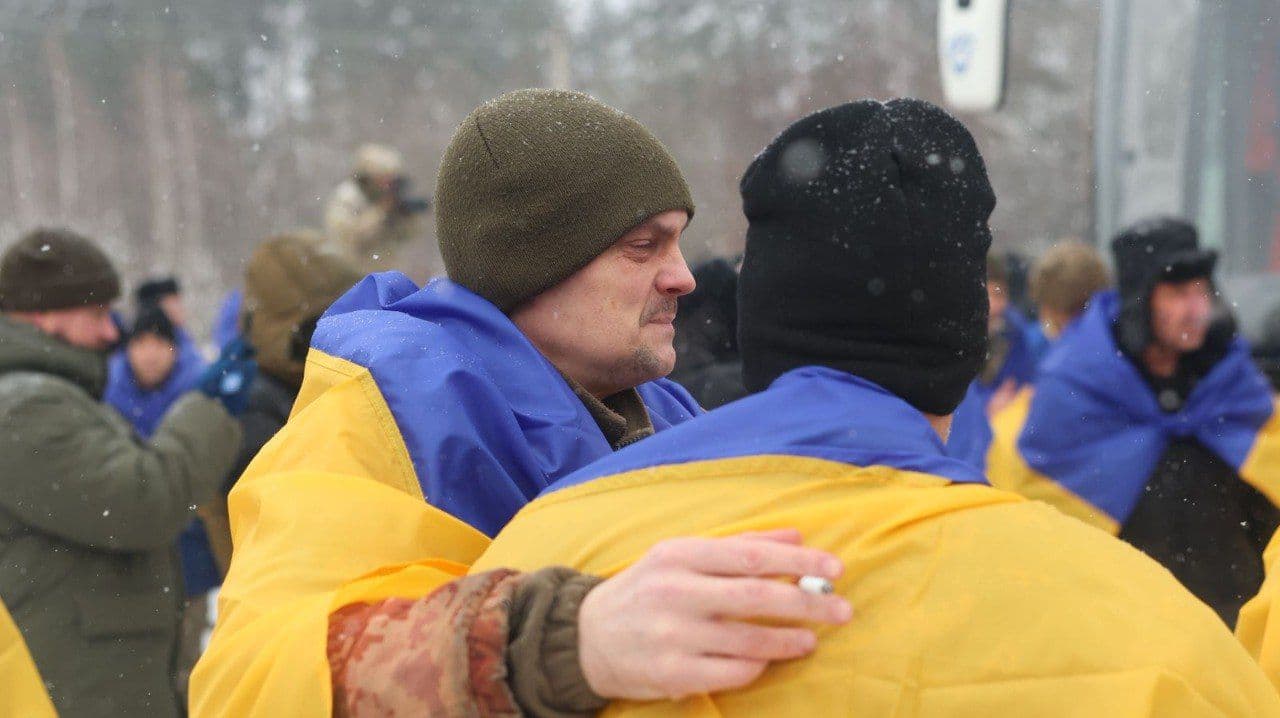
Ukrainians after their release from Russian captivity. (Coordination Headquarters for the Treatment of Prisoners of War)
The Call They Thought Might Never Come
“Ours are home—157 Ukrainians.”
President Volodymyr Zelensky didn’t elaborate. He didn’t need to. Across Ukraine, phones rang with words families had rehearsed in their heads for years.
The first prisoner exchange in five months broke Moscow’s blockade of the process. One hundred fifty soldiers. Seven civilians. Men taken in the opening chaos of 2022, now stepping back onto Ukrainian soil. The youngest was twenty-three—captured at nineteen during the defense of Mariupol, later sentenced to life by a Russian court. The oldest was sixty-three. Most had been gone since the war’s first year.
More than half had come from Mariupol, from Azovstal’s tunnels and the city Russia erased block by block. A National Guard serviceman seized at the Chornobyl Nuclear Power Plant returned. Eighteen others came back bearing the mark of illegal conviction—tried as criminals under Russian law instead of held as prisoners of war, a systematic violation Moscow never hid.
They had fought everywhere. Luhansk. Donetsk. Kharkiv. Zaporizhzhia. Kherson. Sumy. Kyiv. One hundred thirty-nine had endured captivity since 2022. Years measured in isolation, interrogation, and survival.
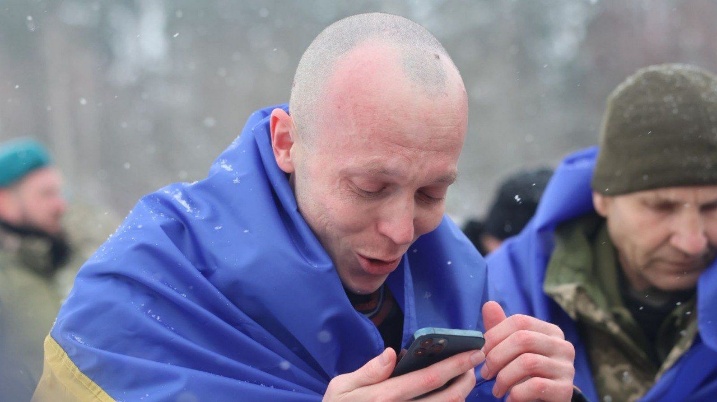
Ukrainians after their release from Russian captivity. (Coordination Headquarters for the Treatment of Prisoners of War)
Interior Minister Ihor Klymenko described what awaited them now: medical examinations, treatment, rehabilitation, psychological care. Recovery would take time. Coming home was only the first step.
The agreement emerged from Abu Dhabi. U.S., Ukrainian, and Russian delegations settled on symmetry—157 for 157. The United Arab Emirates helped broker it. American mediation delivered a rare, tangible result while larger negotiations remained stalled.
Ukraine’s ombudsman confirmed the details. Zelensky confirmed the resolve. Every name still missing remained a priority.
A Kyiv Post reporter captured one moment that carried them all: Olha answering a call from her husband Ruslan, captured in Mariupol nearly four years earlier.
One call. One voice. Proof he was alive.
The numbers mattered.
The names mattered more.
The Missiles That Never Launched
For weeks, the strikes went unanswered.
On February 5, Ukraine’s General Staff confirmed what Russian commanders at Kapustin Yar already knew: throughout January, Ukrainian forces had been hitting one of Moscow’s most sensitive missile sites again and again. Cruise missiles. Long-range drones. A steady rhythm, not a single headline strike.
Kapustin Yar sits deep inside Russia—about 430 kilometers from Ukraine’s border. A Soviet-era proving ground. A launch site for intercontinental and medium-range ballistic missiles. It was from here that Russia fired Oreshnik missiles toward Dnipro and Lviv. From here that Moscow signaled strategic reach.
Ukraine aimed not at runways or symbols, but preparation. Hangar-type buildings where missiles are assembled, fueled, and readied. The General Staff reported varying levels of damage. One hangar significantly hit. Personnel pulled back. Launch workflows interrupted.
The weapon doing the work carried its own message. FP-5 Flamingo—Ukraine-made, subsonic, designed for deep strikes. Advertised range: up to 3,000 kilometers. Warhead: one metric ton. Fire Point’s chief designer, Denys Shtilierman, released footage that appeared to show Flamingos lifting off toward Russian targets.
Special Operations Forces filled in the rest. Their Deep Strike units flew long-range drones into the complex, igniting fires and forcing evacuations. Intelligence support came from an unexpected direction: Chornaya Iskra, a Russian insurgent network tracking logistics shifts, command responses, and adaptation after each hit.
The logic was blunt. Hit the place where missiles are prepared, not the cities they later target. Every damaged hangar meant fewer ready launch positions. Every evacuation meant delays. Every disrupted cycle made Russia’s most advanced weapons slower, costlier, harder to use.
These were not symbolic raids. They were sustained operations, coordinated between Ukraine’s General Staff, its special forces, and its defense industry.
Kapustin Yar didn’t disappear.
But for weeks, missiles that should have launched didn’t.
When the Last Guardrail Fell
The treaty expired quietly.
Fifteen years of limits on the world’s largest nuclear arsenals ended on February 5, and with them the last formal restraint binding Washington and Moscow. New START was gone. No extension. No replacement. No legal ceiling left on how many warheads either side could deploy.
Within hours, something else resurfaced. U.S. European Command confirmed that American and Russian militaries had agreed to reopen high-level communication channels—shuttered since late 2021, before Russia’s full-scale invasion. The decision followed closed-door meetings in Abu Dhabi between Gen. Alexus Grynkewich and senior Russian and Ukrainian officials. The backchannel was alive again.
Publicly, the language was careful. Privately, the math was stark. Russia holds roughly 4,380 nuclear warheads. The United States, about 3,708. China, accelerating fast, has doubled its arsenal in five years. New START had capped deployed warheads at 1,550 and limited launchers. Its expiration erased those constraints overnight.
According to multiple sources, U.S. and Russian delegations discussed an informal six-month adherence to treaty terms while negotiating a successor—an arrangement without legal force, dependent entirely on political will. A White House official said President Trump would decide the U.S. position on his own timeline.
Moscow’s signals pointed elsewhere. Kremlin spokesman Dmitry Peskov said Vladimir Putin and Xi Jinping discussed the treaty’s “negative consequences” days earlier, reaffirming Beijing’s refusal to join arms control talks. Russia backed China’s stance—another trade in a war built on transactions.
The reopened channel carried risks of its own. Russia has used military-to-military lines before not just to prevent miscalculation, but to shape narratives and apply pressure. Informal dialogue can restrain. It can also obscure.
The alternative was worse: unbounded arsenals, rapid expansion, a return to Cold War dynamics without Cold War rules.
New START was gone. The phones were ringing again.
Whether the calls would limit the danger—or mask its growth—remained unanswered.
The Train Arrived in the Cold
Donald Tusk stepped off the train into a city running out of heat.
The Polish prime minister arrived in Kyiv on February 5 as Russian strikes continued tearing at Ukraine’s energy system. His message was blunt and timed to the moment: Ukraine would not be left alone.

Polish Prime Minister Donald Tusk arrived in Kyiv. (Poland’s government / X)
The capital was already rationing electricity. A state of emergency had been declared weeks earlier. That same morning, Mayor Vitaliy Klitschko warned that repairs to the Darnytsia Thermal Power Station would take at least two months—if no new strikes hit. Until then, parts of eastern Kyiv faced winter without heat. Before the attack, Darnytsia had warmed more than 1,100 apartment buildings. Now its turbines sat damaged and silent.
Poland moved where the system had failed. Volunteers raised 9.7 million zloty to buy generators for Kyiv. State-backed energy flows followed. As temperatures stayed brutal, Warsaw’s support became less symbolic and more existential.
At the station, Tusk was met by Foreign Minister Andriy Sybiha. Meetings with President Zelensky followed—talks about reconstruction, about a Ukraine recovery conference Poland would host in 2026, about keeping Europe engaged even as diplomatic gravity shifted elsewhere. Tusk framed Poland’s help not as charity, but as self-defense.
Energy dominated the agenda. Prime Minister Yulia Svyrydenko confirmed the arrival of the first U.S. LNG cargo earmarked for 2026, delivered through Polish-Ukrainian cooperation. Orlen’s agreement with Naftogaz—300 million cubic meters of gas—was already flowing. Nearly a third had reached Ukraine. More would be needed if the cold held.
Military aid followed the same logic. Armored equipment. MiG-29s. Technology sharing. Practical commitments, not speeches.
As U.S. mediators wrapped talks with Russia in Abu Dhabi, Europe sent a signal of its own. One train. One visit. A reminder that while negotiations drift, winter does not.
The Night Kyiv Didn’t Sleep
The first explosion came at two in the morning.
Windows rattled across Kyiv as residents lay awake in apartments already growing cold. Then another blast, just after 4:15 a.m. Air defenses thundered. Sirens cut through the dark. By dawn, at least two people were injured, and the capital was counting damage again.
Russian drones struck across multiple districts—Obolonskyi, Darnytskyi, Shevchenkivskyi, Solomianskyi. In Shevchenkivskyi, a four-story office building burned through the night. In Solomianskyi, a kindergarten took damage. In Obolonskyi, parked cars ignited. Windows shattered in at least four buildings. For a city already rationing heat, each strike carried added weight.
The timing was deliberate. As Russian, Ukrainian, and American delegations wrapped up a second round of talks in Abu Dhabi, Moscow chose the night to remind Kyiv how negotiations and violence coexist. Diplomacy in conference rooms. Drones over sleeping neighborhoods. The contradiction has become policy.
The scale of the assault stretched far beyond the capital. Russia launched two Iskander-M ballistic missiles from occupied Crimea and 183 drones—Shahed, Gerbera, and others—from launch sites across Russia and occupied territory. Ukrainian air defenses destroyed 156 strike drones. Still, one missile and 22 drones hit 16 locations. Wreckage fell in seven more by morning.
Civilian infrastructure took the brunt. Residential areas in Kyiv, Kharkiv, and Mykolaiv oblasts were struck. Energy and heating systems—already damaged by weeks of attacks—remained under pressure as temperatures stayed below freezing.
For Kyiv’s residents, the night blurred into routine: counting explosions, checking messages, waiting for daylight. Talks had concluded thousands of kilometers away. Here, the war kept its schedule.
The city survived the night.
It rarely sleeps through them anymore.
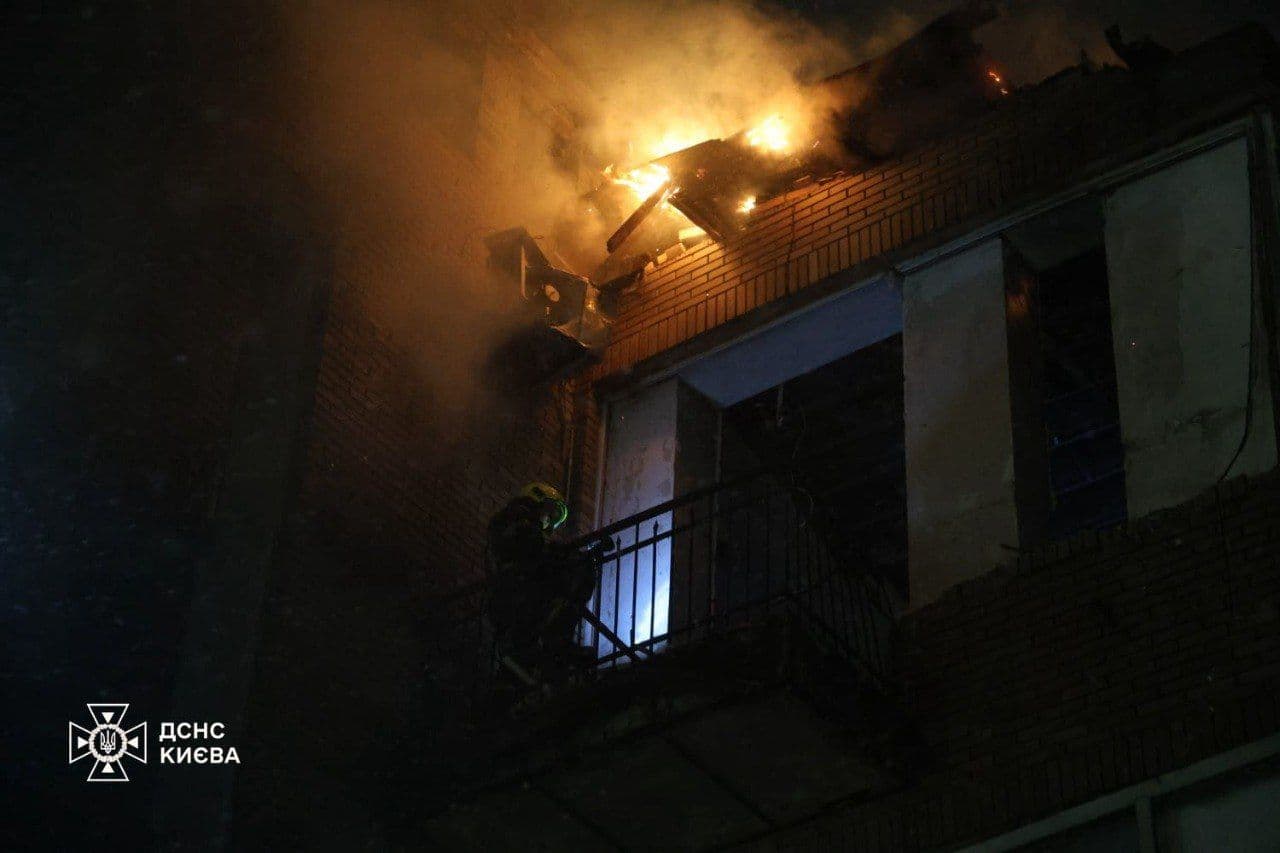
Firefighters work to extinguish a blaze at a building in Kyiv following a Russian drone attack on the capital. (Ukraine’s State Emergency Service/Telegram)
Unity, Announced Because It Was Slipping
The stage was immaculate. The timing was deliberate.
On February 5, Vladimir Putin formally opened 2026 as the “Year of the Unity of the Peoples of Russia,” presenting the country as a multiethnic, multireligious state bound together by shared values and a common war effort. The speech was less celebration than reinforcement.
Putin lingered on origins. Ethnic Russians, he said, emerged as a people through the unification of Slavic groups. Other cultures followed—distinct, remembered, but ultimately absorbed into a single historical project. Land. Family. Tradition. These were the pillars he named, insisting that Russian forces fighting in Ukraine remained united regardless of background.
The balance was careful. Ethnic primacy without exclusion. Diversity without autonomy. A message aimed simultaneously at ultranationalists demanding dominance and minority regions supplying disproportionate manpower to the front. Civic nationalism, closer to Soviet framing than religious fervor, offered a language broad enough to demand loyalty without igniting ethnic fracture.
The branding served a domestic purpose. Mobilization has strained regions unevenly. Economic pressure grows. Resistance and desertion simmer beneath official statistics. Declaring a “Year of Unity” provided a framework to recast dissent as disloyalty—not to the Kremlin, but to the nation itself.
The context sharpened the message. That same day, Ukrainian prisoners were coming home. Russian units were struggling with sudden digital disruptions at the front. The war was revealing fractures faster than slogans could seal them.
So unity was proclaimed—publicly, insistently—because it could no longer be taken for granted.
Where the Line Bent but Would Not Break
The front did not pause.
Even as Russian units struggled with digital disruptions, the ground war kept grinding forward on February 4–5, measured in meters, not breakthroughs. In the Kostyantynivka–Druzhkivka sector, both sides pushed into the same village. Ukrainian forces advanced in central Ivanopillya. Russian troops edged into the east. Drones hunted supply routes. Infiltration teams slipped through bad weather. Ukrainian units identified and hit them before they could hold ground. The assault tempo stayed high.
Around Kostyantynivka, attacks came from nearly every direction—Pryvillya, Minkivka, Pleshchiivka, Kleban-Byk, Illinivka, Yablunivka, Rusyn Yar. The map filled with arrows. None of them decisive.
Farther north, the Slovyansk direction turned into a night war. Russian groups crossed frozen stretches of the Siverskyi Donets, moving in small units, taking losses, failing to consolidate. Ukrainian unmanned forces tracked the attempts and struck them back. Cold helped movement. Cold also killed drones.
Near Pokrovsk, January’s air campaign told its own story. More than a thousand aerial bombs dropped in a single month—a sharp escalation. Russian infiltrators carried multiple radios to counter Ukrainian signals intelligence. Attacks fanned out toward Rodynske, Myrnohrad, Kotlyne, Udachne. The line held.
In Kharkiv Oblast, ice opened routes but froze machinery. Russian troops crossed water obstacles yet stalled after a kilometer or two. Ukrainian strikes hit a Tornado-S system, blunting firepower.
In Sumy Oblast, Russian military police hunted deserters. Some units refused to advance. Others pressed on under camouflage cloaks and anti-thermal gear.
Across Zaporizhia, Kupyansk, Borova, Novopavlivka, the pattern repeated: attacks without gains, assaults repelled, equipment lost.
The line bent. It did not break.
The cost rose anyway.
Fixing the Supply Line While the War Burns
The paperwork changed on February 5. The stakes were already enormous.
Defense Minister Mykhailo Fedorov appointed Taras Chmut to represent the Ministry of Defense on the supervisory board of the Ukrainian Defense Procurement Agency, inserting a familiar wartime figure into a system under growing strain. Chmut leads Come Back Alive, one of Ukraine’s most trusted military support foundations, built during the war on speed, accountability, and direct connection to frontline needs.
Fedorov met with Chmut the same day. The agenda was blunt: what soldiers actually need, how fast it can be delivered, and how to prevent corruption as procurement volumes surge. Quality control. Timelines. Flexibility. A system that can keep pace with a battlefield where innovation cycles are measured in weeks, not years.
The timing mattered. International funding is accelerating. The European Bank for Reconstruction and Development poured €2.9 billion into Ukraine in 2025 alone. The European Union approved a €90 billion support loan. With that scale of money comes risk—delays, inefficiencies, leakage. And with war still raging, failure isn’t abstract. It costs lives.
Come Back Alive built its reputation by bypassing bureaucracy without bypassing accountability—crowdfunding drones, optics, vehicles, and equipment directly for units that needed them yesterday. Chmut brings that muscle memory into a government system that must now operate at national scale.
The challenge is balancing speed with trust. Move too slowly, and soldiers wait. Move too fast without safeguards, and corruption follows. Fedorov’s signal was clear: wartime procurement must be both rapid and clean.
The fighting continues. So does the logistics war behind it.
This appointment was about making sure the supply line doesn’t become the weakest front.
The Day’s Meaning
February 5 revealed a war increasingly shaped by leverage rather than momentum.
Across the front, Russian units discovered how fragile modern warfare becomes when connectivity disappears. A software decision—not an offensive—disrupted command structures across a thousand kilometers. Assaults slowed in places, coordination frayed, and the limits of improvisation became visible. Not a knockout blow. A reminder that technological dependence cuts both ways.
At the same time, diplomacy produced something real. One hundred fifty-seven Ukrainians came home after years in captivity. The exchange did not resolve territorial disputes or security guarantees, but it proved that pressure can still force narrow agreements even when larger talks stall. Humanitarian outcomes remain possible—if only at the margins.
Far inside Russia, January’s strikes on Kapustin Yar exposed another pressure point. Ukraine did not chase spectacle. It targeted preparation—hangars, launch cycles, infrastructure that makes strategic weapons usable. The message was practical: delay the missiles before they fly. Strategic depth, long advertised by Moscow, proved less insulating than claimed.
Over all of it hung expiration. New START died quietly, removing the last legal guardrails on nuclear arsenals. Yet the phones rang again almost immediately. Backchannels reopened. Informal understandings surfaced. The world slipped into a more ambiguous, more dangerous space—where restraint depends on trust rather than treaty.
In Kyiv, winter tightened its grip. Heating failed. Drones returned. And as American-led talks concluded in Abu Dhabi, Europe arrived by train. Poland’s presence underscored a parallel reality: while negotiations drift, energy flows, generators, and gas deliveries decide whether cities endure the cold.
Put together, the day showed how this war now advances sideways. Software updates, prisoner lists, strike campaigns, aid shipments, and quiet phone calls all mattered more than captured villages.
Nothing ended. Nothing broke through.
But pressure accumulated—unevenly, quietly, in places that will matter later.
Prayer For Ukraine
- For those who came home from captivity — pray for physical healing, restoration of minds wounded by years of isolation, and gentle patience for families learning how to live together again after long absence.
- For those still held — pray that every remaining name is not forgotten, that negotiations continue to open doors, and that hope does not die in cells where time has stretched unbearably long.
- For civilians enduring winter under attack — pray for warmth where heating has failed, safety through the night as drones return, and strength for families carrying daily fear alongside ordinary life.
- For those defending the front — pray for protection, clarity, and endurance as the war grinds on without resolution, and for wisdom as technology, weather, and exhaustion shape every decision.
- For leaders and decision-makers — pray for courage rooted in truth, restraint where destruction tempts, and mercy that values human life above power, pride, or vengeance.