
As a GRU architect bleeds in Moscow, Lavrov hardens Russia’s demands, Europe tightens sanctions, and Ukraine endures one of the war’s largest drone-and-missile barrages—revealing how diplomacy and violence now move in lockstep.
The Day’s Reckoning
Three shots cracked the Moscow morning. Vladimir Alekseyev—the GRU’s First Deputy Head and one of the architects of the February 2022 invasion—collapsed near his apartment on Volokolamskoye Highway, bleeding as the shooter vanished into the city.
Within hours, the Kremlin blamed Kyiv. Before Ukraine spoke, Foreign Minister Sergei Lavrov framed the attack as a “provocation” and, in the same breath, declared Russia’s negotiating position unchanged: nothing short of the Istanbul Protocol. No Western security guarantees. No compromise. Capitulation, dressed as diplomacy.
While Moscow spoke, Russia struck.
Overnight, 328 drones and missiles surged toward Ukraine—two Kinzhals, five Kh-59/69s, and roughly 200 Shahed drones launched from multiple directions. Ukrainian air defenses downed 297 drones and intercepted every missile. Still, 22 drones hit 14 locations. Homes were damaged. Substations burned. Energy infrastructure in Kharkiv and Zaporizhzhia oblasts took the blows that slipped through.
In Brussels, the European Commission moved in parallel, proposing a 20th sanctions package: a maritime services ban on Russian crude, new shadow-fleet listings, banks targeted, companies sanctioned, and anti-circumvention tools activated for the first time.
In Kyiv, President Zelensky ordered immediate air defense restructuring. Personnel changes. New instructions. The acknowledgment was blunt: some regions performed better than others, and the gaps were costing Ukraine.
In Odesa, a remotely detonated bomb killed a 21-year-old border guard at dawn, leaving a young daughter without a father.
Across the front, attacks continued without breakthrough. Lines bent. They did not break.
A general bled. A child was orphaned. Sanctions were proposed. Drones fell. The war advanced another day—loud, unresolved, and unforgiving.
Blood on Volokolamskoye Highway
Three shots broke the quiet outside an apartment block in northwestern Moscow. Vladimir Alekseyev—the GRU’s First Deputy Head—staggered as bullets tore into his torso. The attacker vanished into the city. Russia’s Investigative Committee confirmed only the bare facts. Alekseyev was rushed to hospital, critically wounded.
His résumé had long read like a map of Russia’s shadow wars. Volunteer formations. Private military companies. Redut. The Russian Volunteer Corps. Former officer Igor Girkin claimed Alekseyev helped create Wagner itself. Inside the GRU, he was credited with shaping the opening phase of the February 2022 invasion.
Mariupol was where his name hardened into something darker. In spring 2022, Alekseyev sat at the table during the surrender of Ukrainian defenders at Azovstal. He spoke of humanitarian corridors. He promised Geneva Convention treatment.
Those words collapsed almost immediately. Prisoners taken from Azovstal were beaten, tortured, and abused. Denys Prokopenko—the Azovstal commander and now head of the 1st Azov Corps—documented the betrayal.
“Even if Alekseyev survives,” Prokopenko wrote after the shooting, “he will not sleep peacefully. One day, the matter will be finished.”
Alekseyev’s reach extended far beyond Ukraine. The United States sanctioned him in 2016 for malicious cyber operations tied to its presidential election. The Kremlin later awarded him the title Hero of the Russian Federation. British and EU authorities accused him of directing the 2018 Novichok attack in Salisbury. The intended targets survived. A British civilian did not.
In June 2023, Alekseyev reportedly sided with Yevgeny Prigozhin during Wagner’s mutiny—an extraordinary fracture inside Russian military intelligence.
After the shooting, Lavrov blamed Kyiv before Ukraine spoke. Russian strikes on Ukrainian energy infrastructure continued uninterrupted.
Whether Alekseyev would survive remained unclear. Whether he would ever rest again had already been answered.
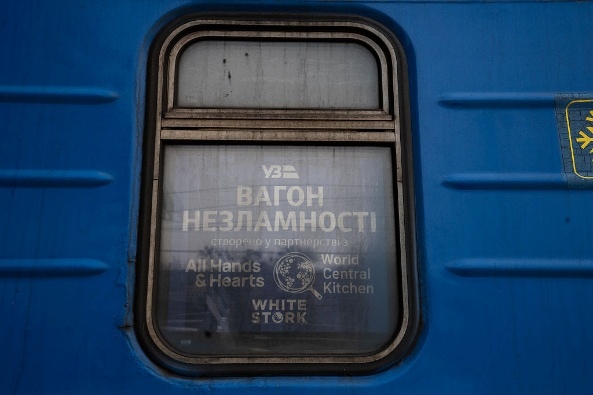
“Cars of resilience,” train cars serving as warming shelters, are seen at a railway station in Kharkiv, Ukraine. (Mia Kliushnykova / Gwara Media / Global Images Ukraine via Getty Images)
Peace on Paper, Surrender in Reality
Sergei Lavrov’s words landed with the dull weight of inevitability. No surprise. No flexibility. And that was the point.
Russia, Lavrov said, would not accept Western-backed security guarantees for Ukraine. Russia would not move beyond the framework agreed in Istanbul in April 2022. The position was delivered calmly, almost bureaucratically, as if three years of war had changed nothing.
The Istanbul Protocol had always been misnamed. It did not guarantee security; it engineered vulnerability. Under its terms, Ukraine would become “neutral,” stripped of meaningful military capacity. Russia—the invading force—would be recast as a neutral guarantor. Moscow and Beijing would hold veto power over any response to future aggression. Ukraine would be barred from alliances, barred from military aid, barred from protecting itself.
Translation: surrender, formalized.
Lavrov’s statement was not new policy. It was confirmation. Senior Kremlin officials had repeated the same demand for months. Vladimir Putin had rejected the U.S.-proposed 28-point peace framework. Any plan that required Russia to abandon even one original war aim was dismissed outright. Since April 2022, Moscow’s position had not evolved. It had hardened.
Either Ukraine accepts terms that allow Russia to restart the war at a moment of its choosing—or the war continues.
The timing stripped away any remaining ambiguity. Lavrov spoke the same day an assassin shot Vladimir Alekseyev in Moscow. The same night Russia launched 328 drones and missiles at Ukrainian cities. Diplomacy, violence, and intimidation moved together, not in sequence.
Negotiations, the Kremlin made clear, were not a search for compromise. They were a demand for capitulation.
Everything else—talks, proposals, pauses—was framed as delay. Ukrainian delay before an outcome Moscow still believed inevitable.
The message was consistent across every domain. Russia was not bargaining over peace. It was insisting on defeat—wrapped in legal language, delivered as diplomacy, enforced by force.
A Sky That Would Not Stop Coming
Shortly after midnight, Ukraine’s air-defense screens began to glow. One launch. Then another. Two Kh-47M2 Kinzhal aeroballistic missiles lifted from Russian airspace. Five Kh-59/69 guided missiles followed. Then the swarm arrived.
Three hundred twenty-eight drones surged in from every direction—Shaheds, Gerberas, Italmas types—nearly 200 Shaheds among them. They lifted from Oryol and Kursk, from Millerovo in Rostov Oblast, from Primorsko-Akhtarsk on the Black Sea coast, from occupied Donetsk. The map filled until there was no empty space left.
Ukrainian defenders fought the night in layers. Aviation. Helicopters. Interceptor drones. Anti-aircraft missile systems. By dawn, 297 drones had been destroyed. Every missile was intercepted. It was a defensive performance bordering on the extraordinary.
It was not enough.
Twenty-two drones punched through and struck 14 locations. Fragments fell elsewhere. Homes were hit. Electrical substations burned. Power grids and energy facilities in Kharkiv and Zaporizhzhia oblasts took damage. Ninety-one percent interception still meant 31 impacts. The arithmetic of saturation warfare allowed no clean victory.
The targets revealed intent. Russian drones struck railway infrastructure—Pivdenna railway in Trostyanets, junctions in Kropyvnytskyi. Rear logistics, not frontlines. Interdiction meant to slow reinforcements, disrupt resupply, and stretch Ukrainian response times as ground fighting continued elsewhere.
General Oleksandr Syrskyi later explained the limits plainly. In good weather, Ukrainian forces could destroy 70 percent—or more—of incoming threats. Missile systems remained the most effective tool. But good weather was never guaranteed. And against 328 simultaneous attacks, even success carried damage.
The strikes came despite Moscow’s alleged assurances to pause attacks on energy infrastructure. Diplomacy continued. The missiles did not stop.
Morning commuters crossed cities under air-raid sirens. Trains slowed. Lights flickered. The war did not wait for negotiations. It came anyway—loud, layered, and relentless.
Fixing the Shield While the Missiles Are Flying
The order came without ceremony. President Volodymyr Zelensky announced personnel changes inside the Air Force—units responsible for intercepting Russian drones, especially Shaheds, would be restructured immediately.
It followed an unusually blunt admission. Air defense in some regions, Zelensky said, had been “unsatisfactory.” The organization of the Air Force, he added, “should be different.” In wartime Ukraine, that language signaled urgency, not debate.
The problem was uneven performance. Some regions coordinated radar, missiles, aviation, and interceptor drones with precision. Others lagged. Those gaps translated into burning substations and darkened neighborhoods. Zelensky’s directive was simple: what worked in one direction had to work everywhere.
Defense Minister Mykhailo Fedorov was tasked with execution. The Air Force commander received additional orders. There was no grace period. Every day lost meant another night of impacts.
The context made delay impossible. Russian strikes in mid- and late January had ripped through Ukraine’s energy system, forcing emergency power cuts across multiple regions. Heating and water supplies failed as temperatures plunged below minus 20 degrees Celsius. In Kyiv and surrounding areas, some apartment blocks sat without heat for nearly three weeks.
Yurii Ihnat, the Air Force’s communications chief, described the reality without spin. Missile shortages meant some air-defense systems occasionally stood empty. During massive attacks, even advanced systems like NASAMS and IRIS-T could not reload fast enough.
The math was merciless. Shoot down 80 percent—and the remaining 20 percent still hit homes, grids, and substations.
Reorganization would not conjure new missiles. It could only squeeze more effectiveness from what remained: tighter coordination, faster decisions, smarter placement.
The night’s 328 incoming drones and missiles underscored the stakes. Ukraine intercepted 297. Thirty-one still struck 14 locations.
The shield held—barely. Fixing it could not wait.
Sanctions on the Table, Surrender Off the Menu
In Brussels, the language was measured—but the intent was sharp. The European Commission unveiled its proposed 20th sanctions package against Russia, widening the economic vise as the war ground on.
At the center sat energy. A full ban on maritime services for Russian crude oil—insurance, shipping, financing—regardless of price. Coordinated with G7 partners, the move aimed straight at the artery funding the war. Oil and gas still supplied roughly one-third of Russia’s federal budget. Cut the services, and exports choke.
The package widened outward. Forty-three more vessels from Russia’s shadow fleet were listed. Maintenance and services for LNG tankers and icebreakers were restricted, reinforcing earlier LNG bans and the RepowerEU framework. Twenty regional Russian banks were added, targeting crypto channels and third-country intermediaries used to dodge earlier sanctions.
Trade followed finance. Export bans expanded to include rubber, tractors, and cybersecurity tools. Import bans targeted metals, chemicals, and critical minerals. More than 40 companies—inside Russia and beyond—were named to disrupt production lines feeding Moscow’s war machine. For the first time, the EU activated its anti-circumvention tool against a single country, designed to block sensitive goods slipping through third states.
“This is about closing the gaps,” said EU foreign policy chief Kaja Kallas.
The timing was deliberate. The Commission aimed for adoption on February 24—the fourth anniversary of the invasion. Ursula von der Leyen called it a “powerful signal.”
But unanimity remained the hurdle. Every sanction required all member states to agree.
And Moscow did not flinch.
The same day, Sergei Lavrov repeated Russia’s position: only the Istanbul Protocol would be considered. No sanctions would alter the terms. Ukraine would accept capitulation—or the war would continue.
Brussels tightened the screws. Moscow dismissed the pressure. The distance between them did not narrow.
The War Reaches the Driveway
At 5 a.m., the street was still asleep. A Toyota sat parked near a residential building on Akademika Korolyova Street in Odesa. Then it exploded.
The blast killed a Ukrainian servicemember instantly. Investigators later confirmed a remotely detonated device. The Security Service of Ukraine classified it as a terrorist attack and sealed the area as forensic teams began working through twisted metal and shattered glass.
The man was 21 years old. A local. A canine handler with Ukraine’s border guard service. He left behind a young daughter.
The attack fit a pattern that had been spreading quietly across Ukrainian cities far from the front. Cars burned. Vehicles sabotaged. Over the past year, Russian intelligence services increasingly recruited teenagers with promises of fast cash to target military vehicles parked in residential neighborhoods. Most operations aimed at equipment, not people. Most failed to kill.
This one did not.
The objective was achieved. A soldier would not come home. A child would grow up without her father.
That same morning in Moscow, an assassin shot Vladimir Alekseyev near his apartment building. The contrast was stark. One attack would dominate headlines and intelligence briefings. The other would barely ripple beyond Odesa.
No analysts would debate this young man’s strategic importance. No cameras would follow his funeral. No diplomats would mention his name.
But his death belonged to the same war.
Russian operations now stretched across every domain—frontline assaults, long-range strikes on infrastructure, assassinations in Moscow, terrorist attacks inside Ukrainian cities. Service no longer guaranteed danger only at the front. It followed soldiers home, into parking lots, into sleeping neighborhoods.
The forensic team kept working as daylight spread across Odesa. The investigation continued.
The daughter would not see her father again.
Pressure Everywhere, Breakthrough Nowhere
The attacks came from all directions, in all sectors, all day. Russian units pushed, probed, infiltrated—and stopped.
Along the northern border in Sumy Oblast, Russian sources claimed a seizure of Popivka, southeast of Sumy City. If it happened at all, it was small and contained, a brief cross-border thrust rather than a breakthrough. Fighting rippled around Kindrativka, Yunakivka, Pokrovka, toward Krasnopillya. The line held.
In northern Kharkiv Oblast, assaults struck near Hrafske, Prylipka, Vovchansk, and Vovchanski Khutory. Ukrainian units kept fire control over Dehtyarne and the border crossings feeding the attacks. Movement without gain.
Kupyansk told a familiar story. Russian soldiers infiltrated central positions, even holding ground inside the city hospital for a time. The terrain did not change. Attacks followed toward Kindrashivka, Petropavlivka, Podoly, Kupyansk-Vuzlovyi. The map stayed the same.
Near Slovyansk, Russian infantry tested frozen crossings of the Siverskyi Donets in small groups—two, three men at a time—slipping out from the Siversk area. Ukrainian forces repelled them. Lyman held. So did the approaches to Svyatohirsk, Drobysheve, Yampil, and the surrounding villages.
Pokrovsk burned with activity. Russian drones saturated the sky—Mavics along the line, Supercams, Zalas, Orlans deeper in the rear, Molniya drones feeding logistics. Heavy equipment shifted into Myrnohrad as fighting churned on the outskirts. Still, no collapse.
In Hulyaipole, western Zaporizhzhia, and Kherson, attacks came and stalled. Counterattacks flared and faded.
Across the entire front, the pattern repeated. Russia applied pressure everywhere. Ukraine absorbed it.
No breakthroughs. No routs. Just a grinding day where the war moved—but did not change.
The Border Stops Protecting Russia
The footage appeared within hours. A strike inside Belgorod City. Then the lights went out.
Ukrainian forces continued their long-range campaign against Russian rear infrastructure, hitting targets once considered safely beyond the war. Russian opposition outlet Astra reported a strike on the Belgorod Combined Heat and Power Plant. Regional governor Vyacheslav Gladkov confirmed the damage—and the result. Power and heat outages spread through the city.
Bryansk Oblast followed. Governor Alexander Bogomaz claimed Ukrainian forces used HIMARS to strike energy infrastructure near Klintsy, southwest of Bryansk City. More outages. More disruption. More confirmation that Russian air defenses were not sealing the rear.
The targets were not incidental. Combined Heat and Power Plants sit at the junction of civilian life and military logistics, feeding both homes and operational systems. When they go dark, cities feel it—and so do the forces moving through them.
The message was unmistakable. Russian territory was no longer insulated from the war it launched. The border was no longer a shield. It was a line the war now crossed in both directions.
Eighteen Taken at the End of a Long Hunt
The village did not fall in a day. Or a week. Or a month.
In Zolotyi Kolodiaz near Dobropillia, the Azov International Battalion announced the capture of 18 Russian soldiers during final clearing operations—an entire platoon-sized element taken alive at the end of a campaign that began the previous summer. Russian forces had first slipped into the village in August, using deep infiltration tactics before their advance was halted.
Stopping them was only the beginning. Dozens of Russian troops remained dug in, concealed among ruined buildings and prepared positions. Ukraine redeployed several elite units to contain the pocket. What followed was not a dramatic assault but months of grinding, methodical clearing—house by house, trench by trench, position by position.
The final phase belonged to Azov’s foreign fighters. When it ended, Zolotyi Kolodiaz was cleared.
Eighteen prisoners marched out. Eighteen rifles silent. One more Russian platoon removed from the battlefield—not through collapse, but through patience and persistence.
The operation showed how this war is often decided now: not by sweeping advances, but by the slow work of eliminating entrenched forces who believed time and concealment would save them.
It did not.
Drones Where the War Is Not Supposed to Be
The war showed up where it officially does not exist.
In central Poland, a small commercial drone fell onto the grounds of the 1st Air Cavalry Battalion base in Lodz province. Military police moved quickly. The suspected operator—a 22-year-old Polish citizen—was identified, detained, and charged with violating aviation laws. Flying drones near a military facility carries a penalty of up to five years in prison.
Farther southeast, the pattern repeated. In Moldova, police discovered an unidentified drone in the village of Sofia, Drochia District, near the Ukrainian border. The area was sealed off. Explosives disposal teams were dispatched. Moldovan authorities said it was the third drone found in the country since the start of the year.
The Moldovan Foreign Ministry issued a sharp condemnation, warning that any violation of national airspace posed a direct threat to public safety.
None of the incidents involved missiles. None involved declared combat. That was the point.
Hybrid warfare does not announce itself with artillery fire. It probes. It tests. It lands drones where they are not meant to be, forcing governments to respond to incidents that fall below the threshold of war but inside the boundaries of security.
Poland. Moldova. NATO space. Neutral territory.
The geography mattered. The message did too. The battlefield was no longer contained by frontlines or borders—it was spreading outward, quietly, one drone at a time.
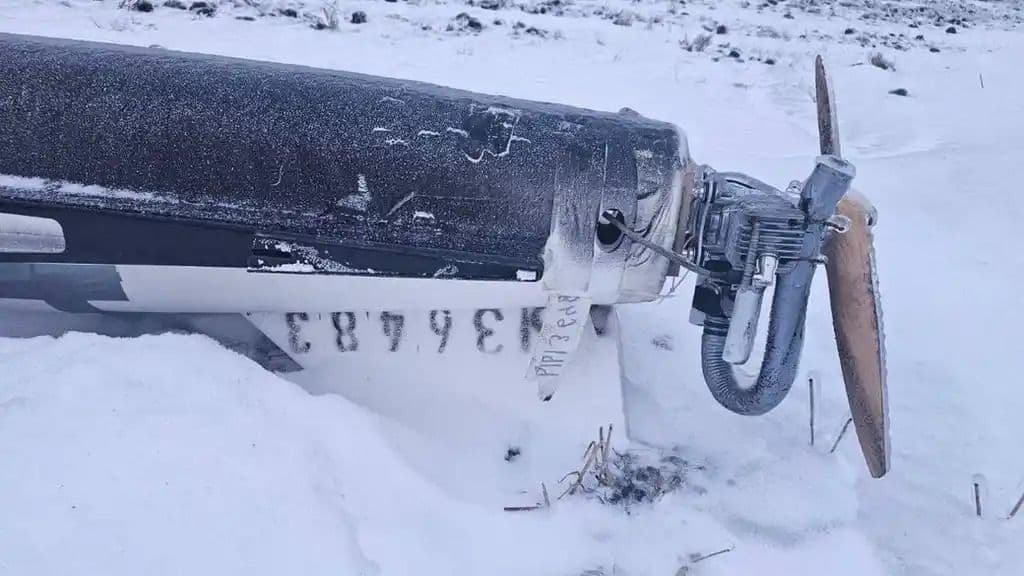
Pictured is the drone found in the village of Sofia, in the Drochia District of Moldova. (Moldova’s National Police/Telegram)
Keeping the Machines Alive
The approval came quietly, without ceremony. The U.S. State Department authorized a potential $185 million Foreign Military Sale to Ukraine—spare parts and logistical support for American-supplied vehicles and weapon systems already in the fight.
This was not about new firepower. It was about keeping what Ukraine had moving.
The package focused on Class IX spare parts—the unglamorous components that keep armored vehicles rolling and weapons systems operational. U.S. officials said the support would allow faster repairs, shorter downtime, and more resilient maintenance cycles as equipment wore down under constant use.
Washington framed the sale as defensive, tied to broader U.S. national security interests and European stability. Kyiv framed it more simply: broken equipment that cannot be repaired is equipment lost.
The timing mattered. Ukraine continued to press for additional military aid, even as the war settled into a phase where endurance mattered as much as escalation.
In a conflict measured by months and attrition, keeping machines alive can matter as much as delivering new ones.
The Day’s Meaning
February 6 exposed the war’s contradictions without disguise.
In Moscow, Sergei Lavrov declared the Istanbul Protocol non-negotiable while Vladimir Alekseyev—the GRU architect of the invasion—bled in a hospital bed. In Brussels, European officials unveiled another sanctions package. In Ukraine, air-raid sirens rose as 328 drones and missiles tore across the sky. Diplomacy spoke. Violence answered.
Russia’s position hardened into clarity. Lavrov’s insistence on the Istanbul framework confirmed Moscow’s belief that time remained its ally. Negotiations meant Ukrainian capitulation to terms that preserved Russia’s ability to strike again. Nothing less qualified as peace. No security guarantees. No compromise. Strategic defeat, dressed in legal language.
That rigidity was enforced in motion. The largest aerial assault of the night slammed Ukrainian cities despite supposed pauses on infrastructure strikes. A 21-year-old border guard was killed in a terrorist bombing in Odesa. Across the front, Russian forces attacked everywhere without breaking through—showing not momentum, but endurance.
The shooting of Alekseyev underscored the same logic. Whether Ukraine was responsible remained unconfirmed. Whether the general would survive was unknown. What was clear: architects of this war no longer moved without consequence.
Western response followed a familiar rhythm. Brussels proposed sweeping sanctions aimed at energy, banks, and industry. Adoption would take time. Impact would be gradual. Whether economic pressure could alter Russia’s calculations before battlefield realities shifted remained unanswered.
Kyiv moved faster where it could. Zelensky ordered immediate restructuring of air defense after uneven regional performance. Organization could improve. Missile shortages could not. Even near-perfect interception still meant damage when saturation attacks came.
Beyond Ukraine, the war widened quietly. Drones appeared in Poland and Moldova. Hybrid pressure probed European borders.
No side forced resolution. Russia pressed everywhere without victory. Ukraine held without breakthrough. Allies supported without escalation.
Time remained the argument—claimed by both sides, owned by none.
Prayer For Ukraine
- For protection over civilians — for families sleeping under sirens, commuters moving through damaged cities, and children growing up amid explosions, that God would guard lives and steady hearts when danger comes without warning.
- For those who serve on the front and behind it — soldiers holding the line, air-defense crews making split-second decisions, medics, engineers, and logistics teams, that strength, clarity, and endurance would be renewed day by day.
- For leaders facing impossible choices — in Kyiv, Brussels, Washington, and beyond, that wisdom would outweigh pride, truth would overcome illusion, and decisions would be shaped by justice rather than fatigue or fear.
- For families who have lost loved ones — especially children growing up without parents and parents grieving sons and daughters, that comfort would reach where words cannot and hope would not be extinguished by grief.
- For an end to violence and deception — that lies dressed as peace would be exposed, that aggression would be restrained, and that a just and lasting peace—one that protects the vulnerable and holds the guilty accountable—would finally take root.