
As Russian missiles forced reactor shutdowns and blackouts across western Ukraine, Washington pressed for rapid peace talks—only to find Moscow answering diplomacy with destruction.
The Day’s Reckoning
The missiles arrived before dawn. Four hundred forty-seven projectiles launched overnight—cruise missiles, anti-ship missiles repurposed for land attack, and waves of drones—aimed not at trenches or troop concentrations, but at the machinery that keeps a country alive.
Russian targeting locked onto Ukraine’s energy spine: 750 kV and 330 kV substations feeding the national grid, the high-voltage nodes that stabilize nuclear reactors, the Burshtyn and Dobrotvir thermal power plants that carry winter demand. This was infrastructure, not coincidence. Power first. Heat next. Stability last.
Ukrainian air defenses performed near the limits of possibility, downing 382 drones and 24 missiles. Still, thirteen missiles and twenty-one drones broke through. Nineteen locations were hit. Nuclear power plants cut output. One reactor shut down automatically. Six hundred thousand people in Lviv Oblast lost electricity. In Burshtyn, heating and water failed entirely.
It was the second Russian strike exceeding 400 projectiles in a single week. The scale was no longer episodic. It was a method.
While Ukraine rerouted power and emergency crews worked in blackout conditions, Washington moved on a different clock. U.S. officials, according to Reuters, pressed for a peace deal by March and a national referendum as early as May. One source described the United States as “in a hurry.”
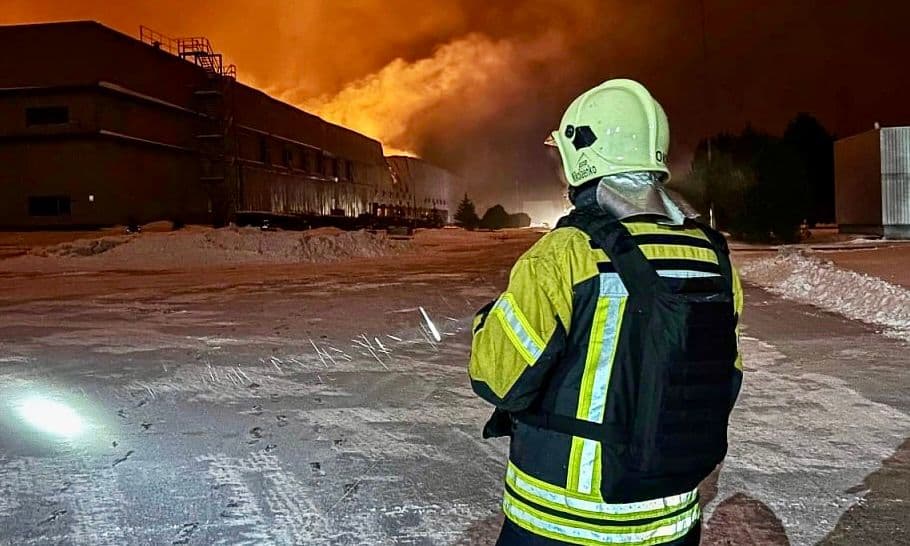
The aftermath of a Russian attack on a warehouse in Kyiv Oblast. (State Emergency Service of Ukraine)
Ukraine’s election authorities were not. They estimated six months would be required just to change legislation and organize a vote—under conditions that still assumed a ceasefire Russia refused to guarantee.
President Zelensky agreed to a proposed meeting in the United States. Moscow dismissed it outright.
By nightfall, Lieutenant General Vladimir Alekseyev had regained consciousness after surgery in Moscow. Two suspects were detained. The war moved everywhere at once.
Four hundred forty-seven projectiles answered diplomacy. Reactors throttled down. Homes went cold. And the distance between urgency and reality widened, measured in megawatts lost and minutes without heat.
When Missiles Speak Louder Than Diplomats
They counted them one by one, because counting was the only way to make sense of it. Twenty-one Kh-101 cruise missiles. Two Zirkon and Onyx anti-ship missiles bent inland. Sixteen Kalibrs. Four hundred eight drones—Shaheds first among them, dark shapes threading the night sky.
Four hundred forty-seven projectiles launched between February 6 and 7. The second time in one week Russia crossed the 400-strike threshold.
Ukrainian air defense crews worked until exhaustion, intercepting 382 drones and 24 missiles. Still, the rest got through. Thirteen missiles. Twenty-one drones. Nineteen locations hit. Debris fell in three more places, fragments of intercepted weapons crashing into neighborhoods already braced for impact.
The pattern was unmistakable. Russian strikes carved into the 750 kV and 330 kV substations holding Ukraine’s grid together. Power nodes feeding nuclear reactors. The Burshtyn and Dobrotvir thermal power plants—the systems meant to keep homes warm while winter still clung to the land.
As substations failed, nuclear facilities throttled down. One reactor shut itself off automatically. Six hundred thousand people in Lviv Oblast lost electricity. In Burshtyn, heating stopped. Water followed.
President Volodymyr Zelensky named it plainly: attacks on “facilities crucial to the operation of Ukraine’s nuclear power plants.” He called it a scale of violence “no terrorist in the world has ever dared.”
DTEK reported severe damage to its thermal plants—the 220th such strike since the invasion began. High-voltage substations failed. Nuclear units were forced to discharge. Electricity vanished by the megawatt.
In Kyiv, residents prepared for one or two hours of light per day.
Russian drones now carried mines and cluster munitions, tuned not for precision but for maximum civilian harm. The message was written in outages and cold apartments.
Four hundred forty-seven projectiles. A reactor shut down. Six hundred thousand in the dark.
This was Moscow’s reply to talk of peace.
Deadlines From Washington, Missiles From Moscow
In Washington, the calendar drove the conversation. Three sources told Reuters that U.S. and Ukrainian negotiators discussed a goal of reaching a peace deal by March 2026.
March. Less than a month away.
American officials, the sources said, urged Ukraine to prepare a national referendum on any agreement—possibly as early as May—paired with national elections held at the same time. One source put it bluntly: the United States was “in a hurry.”
In Kyiv, election officials looked at the clock differently. Under current law and wartime conditions, they estimated six months would be required just to change legislation and organize a vote. That estimate assumed something Russia refused to provide: a ceasefire long enough for ballots instead of missiles.
The timelines didn’t align. March peace deal. May referendum. Simultaneous national elections. All while Russia launched 447 projectiles at Ukraine’s nuclear-supporting infrastructure and rejected American proposals to meet.
President Volodymyr Zelensky said Ukraine agreed to a U.S.-proposed meeting in the United States, likely Miami, around February 12. Moscow dismissed it within hours.
“There was no talk about” such a meeting, Kremlin spokesman Dmitry Peskov said. Asked whether Russia would attend negotiations in America, he answered with a single word: “No.”
The refusals followed a familiar script. Russia rejected trilateral talks. Rejected leadership-level negotiations. Rejected venues suggested by Washington and Kyiv alike—while continuing to strike civilian infrastructure with growing intensity.
The contrast sharpened by nightfall. In western Ukraine, 600,000 people sat without power. Nuclear reactors throttled down. Heating failed in Ivano-Frankivsk Oblast.
American urgency pressed for speed. Russian intransigence enforced delay through violence. Ukrainian reality absorbed the impact.
The result was not momentum toward peace, but pressure—concentrated on the country already under attack.
He Survived. The Violence Didn’t.
In Moscow, surgeons brought Lieutenant General Vladimir Alekseyev back from the edge. State media reported he regained consciousness after surgery. The bullets fired near his apartment building failed to kill him. His injuries were no longer life-threatening.
Investigators moved quickly. A source told Kommersant that two suspects were detained, including the alleged shooter. The case advanced. The general lived.
Alekseyev’s survival carried weight beyond the hospital ward. First Deputy Head of the GRU. One of the architects of the February 2022 invasion. The officer who promised Azov defenders humane treatment—before systematic torture followed.
Denys Prokopenko had already framed the moment. “Even if Alekseyev survives this time,” he said, “he will not sleep peacefully. And one day the matter will be brought to an end.”
The timing mattered. The assassination attempt came the same day Russia launched 328 drones and missiles at Ukraine. Alekseyev regained consciousness on the day Russia escalated again—447 projectiles aimed at nuclear-supporting infrastructure.
Assassinations in Moscow. Missiles over Ukraine. Diplomacy rejected. Violence accelerating.
The general survived. The pattern did not.
Fuel for the Missiles Became a Target
The strike came quietly, far from the front. Overnight on February 6–7, Ukrainian drones reached into Russia’s rear, aiming not at barracks but at the machinery that keeps Russian missiles flying.
Sources in Ukraine’s Security Service told Suspilne that Ukrainian forces hit a research plant in Tver Oblast producing diesel fuel, aviation kerosene, and components used in Kh-55 and Kh-101 cruise missiles. Andriy Kovalenko of Ukraine’s Center for Countering Disinformation identified the target as the Redkinsky Research Plant. Geolocated footage showed fire and explosions tearing through the site.
Regional officials moved quickly to contain the narrative. Tver Oblast’s acting governor, Vitaly Korolev, acknowledged a drone strike and a resulting fire at the facility in Konakovo Raion—but insisted production capacity was unaffected.
The Ukrainian General Staff reported additional strikes the same night: a Russian force concentration near Dronovka in Belgorod Oblast, close to the Sumy border, and the Balashovo oil depot in Saratov Oblast.
The significance lay in the symmetry. Redkinsky produced components for the same Kh-101 missiles Russia had just launched at Ukraine’s nuclear-supporting infrastructure. Fuel and parts flowed one direction. Drones answered the other.
Russia claimed minimal damage. Ukraine demonstrated reach. Production continued. So did the strikes.
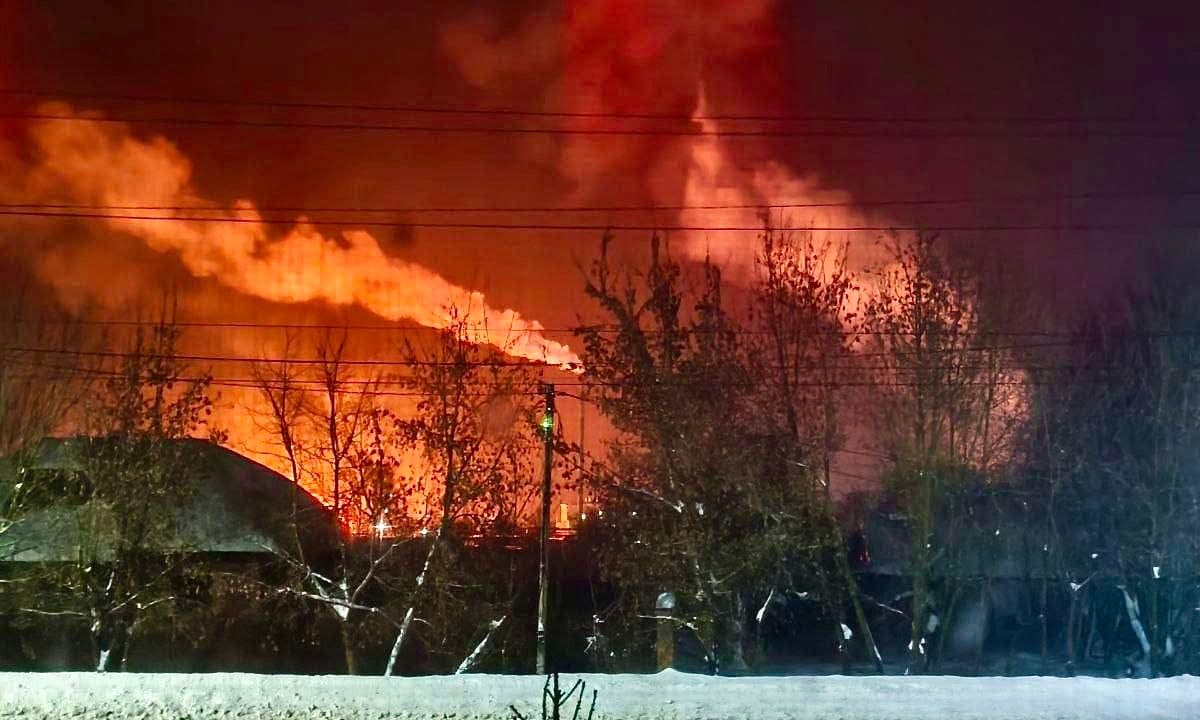
Fire broke out after Ukrainian drones struck Russia’s Redkino Experimental Plant in Tver Oblast. (Astra / Telegram)
Meters Taken, Lives Spent, No Line Broken
Along the front, the war moved in fragments—small pushes, brief infiltrations, ground gained and contested again before maps could catch up.
Near Velykyi Burluk, Russia’s Defense Ministry claimed its forces seized Chuhunivka. Units from the 83rd and 344th motorized rifle regiments were credited with the advance. The claim stood largely on Moscow’s word.
Elsewhere, the movement was quieter. In northwestern Kupyansk, geolocated footage showed Russian troops slipping into the city’s edge on what appeared to be an infiltration mission, not a shift in the forward line. The same pattern played out near Borova: Russian forces appeared in eastern Bohuslavka, while Ukrainian troops were simultaneously filmed holding central Borivska Andriivka—an area Russian sources had already declared taken.
South of Kostyantynivka, Russian units edged forward near Yablunivka and southwestern Stepanivka. The advances were measured in streets and treelines, not towns.
Near Chasiv Yar, a Ukrainian brigade spokesperson described a different reality. Russian assault troops arrived exhausted, demoralized, and increasingly willing to surrender during infiltration attempts. Many, the spokesperson said, were penal recruits or struggling with alcohol abuse. Some never made it back—FPV drones were used to kill Russian soldiers who tried to give up.
In Pokrovsk, Russian forces advanced slightly in the northwest. Near Hulyaipole, Ukrainian commander Oleksandr Syrskyi reported Russia had committed elements of four combined-arms armies. Cold weather worked against them, freezing condensation inside drones and grounding flights.
In Orikhiv, assaults remained limited—one or two per day.
Pressure persisted. Gains stayed small. Forces were spent without breakthrough.
The Day’s Meaning
February 7 exposed the war’s contradictions without subtlety. Russia spoke through force while diplomacy tried to keep pace.
Four hundred forty-seven projectiles tore toward Ukraine’s nuclear-supporting infrastructure just as Washington pressed for a March peace deal. Substations failed. Reactors reduced output. Six hundred thousand people lost power. In Burshtyn, heat and water disappeared entirely. The strikes arrived days after a supposed moratorium ended, making clear it had been used to stockpile weapons, not build trust.
Moscow’s diplomacy followed the same logic as its missiles. It rejected American meeting venues. Rejected trilateral talks. Rejected leadership-level negotiations. Violence carried the message that Russia’s negotiating position had not softened: only outcomes resembling victory were acceptable.
Washington moved on a different timeline. March peace deal. May referendum. Elections organized within six months—despite Ukrainian authorities explaining that six months was the minimum required just to prepare a vote, and despite Russia refusing to commit to ceasefires that would make voting possible. Urgency replaced realism.
Ukraine struck where it could. Drones reached fuel and missile-support facilities in Tver, Saratov, and Belgorod oblasts. The strikes showed reach, not prevention. They could not stop the barrage already in flight.
Elsewhere, the war pressed forward in fragments. Frontlines shifted by meters. Russian troops advanced in pockets, surrendered in others. Morale frayed. Assaults continued without breakthrough.
Even in Moscow, violence echoed. The GRU general Vladimir Alekseyev survived an assassination attempt as reactors shut down hundreds of kilometers away. Different theaters. Same war.
February 7 did not answer whether negotiations would come. It clarified something else: deadlines meant little when one side used infrastructure collapse as leverage and the other rushed diplomacy faster than reality could sustain.
The war continued—measured not in proposals, but in megawatts lost and nights without heat.
Prayer For Ukraine
• Pray for civilians facing darkness and cold tonight — for families without heat, water, or reliable power, and for protection over the elderly, children, and the sick as winter and war press in together.
• Pray for wisdom and endurance for Ukrainian leaders, engineers, and emergency crews working to stabilize reactors, repair substations, and keep the country functioning under relentless attack.
• Pray for restraint to overcome cruelty — that attacks on energy and nuclear infrastructure would cease, and that lives would be spared from decisions that treat civilian suffering as leverage.
• Pray for clarity and humility among international leaders — that diplomacy would be guided by truth, patience, and justice rather than artificial deadlines or pressure on the victim of aggression.
• Pray for peace rooted in accountability — not exhaustion or coercion — and for the day when missiles no longer answer proposals, and negotiations are shaped by repentance, security, and genuine commitment to life.