
As Moscow wages information warfare with claimed village seizures, its own milbloggers admit Russian units are fighting blind without Starlink—while Ukraine answers with missile strikes, drone innovation, and a historic shift from aid recipient to arms exporter.
The Day’s Reckoning
The Russian Ministry of Defense opened the day by claiming another border village. Sydorivka, northwest of Sumy City, was said to have fallen to the 80th Arctic Motorized Rifle Brigade. A buffer zone, Moscow called it. Another brick in the wall of inevitability.
There was just one problem. No evidence.
Satellite imagery showed nothing. No geolocated footage followed. Sydorivka sat beside Komarivka, a stretch of border that had been quiet until Moscow decided it was useful. If the seizure happened at all, it joined a familiar list: Komarivka, Bila Bereza, Popivka, a push into Sotnytskyi Kozachok. Tiny villages. No operational value. Maximum psychological return.
Russia had not prepared the ground for a real northern offensive. No sustained air interdiction. No logistics degradation. No pressure toward meaningful objectives. But Moscow needed the West to believe something else—that the front was cracking, that delay meant disaster.
At the same time, Russian milbloggers told a different story. Starlink was gone. Units across the front were struggling to communicate. Donations were requested. Radios begged for. One blogger called the block “extremely unfortunate.” Another admitted the truth outright: there was no equivalent. Everything was happening “on the ground.”
Two narratives collided. Official triumph. Unofficial panic.
Then came Ukraine’s answer. Zelensky announced military exports. Drone production in Germany. Joint lines already running in the United Kingdom. A defense industry no longer just surviving, but supplying.
Hours later, Kyiv confirmed missile strikes on Kapustin Yar. Flamingo cruise missiles. Assembly buildings damaged. Logistics hit. The launch site for Oreshnik.
Information warfare promised momentum. Technology exposed limits. Ukraine exported capability. Russia begged for radios.
The contrast defined the day.
Villages Claimed, Reality Absent
The announcement landed with practiced confidence. The Russian Ministry of Defense declared Sydorivka—an unremarkable border village northwest of Sumy City—had fallen. The 80th Arctic Motorized Rifle Brigade, milbloggers said. Another step toward a northern “buffer zone.”
Then the silence followed.
No footage. No satellite confirmation. Nothing on the ground to show a village changing hands. Sydorivka sat beside Komarivka, a stretch of border that had slept through most of the war until Moscow decided it needed waking. If Sydorivka was taken at all, it joined a growing list of names doing more work in headlines than on maps: Komarivka, Bila Bereza, Popivka, Sotnytskyi Kozachok.
Russian milbloggers filled in the imagined future. More than twenty assault groups forming. Units from the 2nd Motorized Rifle Regiment pushing south. Airborne troops and motorized rifle elements following to “consolidate.” Even specialist missile forces reportedly thrown into infantry roles. Plans layered on plans.
But preparation leaves fingerprints. And along the Sumy and Kharkiv borders, those signs were missing.
There were no sustained air interdiction campaigns. No grinding strikes against logistics. No shaping fires like those that preceded real offensives in Pokrovsk or Hulyaipole. No movement toward terrain that actually mattered. Just names repeated, villages declared, momentum implied.
The pattern was familiar. Small border settlements framed as proof of inevitability. Limited cross-border probes inflated into a looming northern offensive. The goal wasn’t territory—it was pressure.
Make the front look as if it’s collapsing. Make delay feel dangerous. Make capitulation sound reasonable.
Tiny villages. Zero operational value. Maximum psychological return.
This wasn’t an offensive. It was a message—information warfare standing in for the real thing.
When the Screens Went Dark
The truth surfaced where Moscow couldn’t control it. On Russian Telegram channels, milbloggers admitted what the Ministry of Defense would not say out loud: Starlink was gone, and Russian units were feeling it everywhere.
Messages described frontline formations struggling to talk to each other. Requests followed—radios, satellite phones, anything that could replace what had vanished. One milblogger called the shutdown “extremely unfortunate.” Another was blunter. Commanders, he said, had warned for years about relying on Starlink. Some had built alternatives. It didn’t matter. The loss still hurt. There was no substitute. Communications had dropped to what he called “on the ground.”
That phrase said everything.
Russian forces had not merely used Starlink; they had built around it. Stolen Ukrainian terminals powered command links across occupied territory. Drone teams coordinated in real time. Units spread across kilometers stayed connected. Tactical command and control assumed those screens would always light up.
Then SpaceX flipped a switch.
The network went silent. Coordination slowed. Drone operations degraded. Milbloggers began publicly fundraising for basic equipment—radios instead of satellites. The dependency was exposed in real time, not by analysts, but by soldiers trying to fight without the tools they had come to rely on.
ISW assessed the consequences quickly. Without Starlink, Russia would struggle to sustain the intense air interdiction campaigns it had previously relied on. Workarounds were supposed to exist. The admissions suggested they didn’t.
“No equivalent,” one milblogger wrote.
Yet Moscow kept talking as if nothing had changed. Border villages were claimed. Momentum was declared. Victories were announced.
On the ground, the screens stayed dark. And no amount of information warfare could turn radio donations into a replacement for a technology Russia never truly owned.
Ukraine Stops Asking—and Starts Supplying
The announcement marked a quiet turning point. President Volodymyr Zelensky said Ukraine would open military exports—ten export centers across Northern Europe and the Baltics by 2026. A country once dependent on emergency shipments was preparing to ship weapons of its own.
Details were deliberate but spare. Zelensky did not list systems. He didn’t need to. Ukrainian drones would begin joint production in Germany by mid-February. Production lines were already running with the United Kingdom. The signal mattered more than the catalog.
This shift did not happen overnight. Since 2023, Ukraine had chased a single goal: build a defense industry that could stand on its own. Western aid—money, equipment, know-how—made that possible. Factories moved underground. Supply chains fragmented and adapted. Engineers learned to design, test, and field systems while under fire.
Early last year, ISW assessed Ukraine would need years of external support before reaching anything close to self-sufficiency. Parts of the defense industrial base have now crossed that line.
The exchange is no longer one-way. Ukraine is offering something Western militaries lack: lived experience. Drone warfare evolving week by week. Electronic warfare adapting in real time. Manufacturing under missile threat. An offense-defense cycle measured in days, not procurement cycles.
What Western planners studied in classrooms, Ukraine learned in combat.
This is the deeper meaning of the announcement. Ukraine is not just exporting hardware. It is exporting lessons. Doctrine. Adaptation. A blueprint for fighting modern war when supply chains are targets and innovation is survival.
Ten export centers. Joint factories in Germany and the UK. Ukrainian drones rolling off Western production lines with Ukrainian expertise baked in.
The country once defined as an aid recipient has crossed a threshold. Ukraine is no longer only being defended. It is helping others prepare.
Hitting the Launch Pad
The confirmation came quietly, but its implications echoed far beyond Astrakhan Oblast. Ukraine’s General Staff acknowledged what had already unsettled Moscow: Ukrainian missiles had struck Russia’s Kapustin Yar launch site.
This wasn’t a symbolic target. Kapustin Yar is where Oreshnik begins.
Previous strikes had torn into the site’s backbone—technical facilities that service intermediate-range ballistic missiles, assembly buildings where weapons are prepared, logistics warehouses that keep the system moving. Ukrainian-produced FP-5 Flamingo cruise missiles reached deep into Russian territory to do it. Not once. Repeatedly.
Oreshnik is not just another missile. It is Russia’s newest intermediate-range system, the one Vladimir Putin threatened to deploy to Belarus, the one used to hit Ukrainian cities. Kapustin Yar is where those threats become hardware, where rhetoric turns into launch sequences.
Ukraine went after the process, not the platform.
Missile servicing facilities. Assembly lines. Storage hubs. Each strike targeted the machinery that allows Oreshnik to function at scale. Each hit forced repairs, workarounds, delays. The message wasn’t hidden: Ukraine could reach the source.
Kapustin Yar lies far from Ukrainian borders, shielded by Russian air defenses and central to Russia’s ballistic missile programs. Hitting it required more than intent—it required capability. Ukrainian-built Flamingo missiles delivered that proof.
The timing sharpened the contrast. On the same day President Zelensky announced Ukraine would open military exports, Ukraine confirmed it was already fielding long-range strike systems capable of degrading Russia’s strategic infrastructure.
This was not defense alone. It was demonstration.
Ukraine was showing partners what its industry could build, what its missiles could reach, and how its experience translated into real effects against high-value targets.
The country under fire wasn’t just surviving. It was striking at the launch point—and preparing to share the tools that made it possible.
Missiles on the Tail
The encounter ended in midair. A Ukrainian interceptor drone closed on a Shahed and destroyed it—only afterward did analysts see what the Russian drone had been carrying. R-60 air-to-air missiles. Mounted backward.
That detail mattered.
Earlier in the war, Russian forces armed Shaheds with forward-facing R-60s. The purpose was blunt: hunt Ukrainian helicopters and tactical aircraft tasked with shooting drones down. Those missiles turned cheap attack drones into flying traps. Ukrainian pilots learned quickly. Tactics changed. Engagement distances shifted. The threat was managed.
So Russia adjusted.
This Shahed wasn’t built to chase aircraft. It was built to survive them. The R-60s were pointed backward, not forward—designed to threaten pursuers, not targets ahead. If a Ukrainian aircraft or interceptor drone closed in from behind, the Shahed could defend itself, fire, and keep moving toward its original objective.
The priority had flipped.
Russian forces were no longer trying to turn Shaheds into aerial hunters. They were trying to keep them alive long enough to reach infrastructure targets. The missile placement reflected that calculation: survival over aggression, persistence over pursuit.
It was adaptation layered on adaptation. Ukrainian helicopters had forced Russia to arm drones. Ukrainian countermeasures had forced Russia to rethink how those weapons were used. Each side responded not in years, but in weeks—sometimes days.
Backward-facing missiles changed the geometry of interception. Ukrainian air defenders now had to assume drones could threaten them during pursuit. Interceptor drones faced new risks. Air defense crews had to adjust engagement profiles again.
This wasn’t a gimmick. It was the offense-defense cycle tightening in real time.
Interceptor drones versus armed Shaheds. Missiles meant for jets strapped to unmanned platforms. Weapons repurposed, repositioned, reimagined.
The sky over Ukraine had become a laboratory. Every encounter rewrote the rulebook. Every shootdown taught the next attacker how to survive longer.
And somewhere between forward-facing missiles and backward-mounted defenses, the war kept accelerating—one adaptation chasing the next.
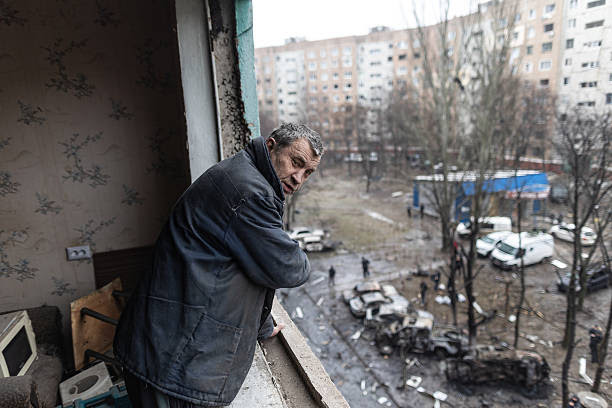
A man is photographed leaning over what use to be his window after a Russian air strike on Kramatorsk caused damage to residential buildings. (Diego Herrera Carcedo/Anadolu via Getty Images)
Foot Soldiers, No Breakthroughs
The pattern repeated itself along the line. Russian forces pushed. Ukrainian positions held. Infiltrations probed for weakness and found none.
Near Kupyansk, geolocated footage captured the moment clearly. A Russian servicemember moving through southeastern Kutkivka—an infiltration, not an advance—was struck by Ukrainian forces. The terrain didn’t change hands. It rarely does in these encounters. Moscow claimed the seizure of nearby Hlushkivka anyway.
On the ground, reality was harsher. Colonel Viktor Trehubov said fewer than fifty Russian soldiers remained encircled in the Kupyansk area, cut off from reliable logistics. Many were poorly trained contract soldiers or mercenaries. Assaults continued against the city’s northern outskirts, but they went nowhere. Ukrainian drone units reported almost daily attempts by small Russian groups slipping in from different directions, usually without armor.
South toward Slovyansk, the picture was similar. Russian strikes hit Ukrainian positions in central Nykyforivka—an area Russian sources had already declared theirs. Ukrainian troops were still there. Still fighting. Still holding.
Russian forces kept testing toward Lyman, sending small assault groups forward again and again. They had the manpower to sustain pressure, Trehubov warned, even if results remained elusive. Weather worked against them. Starlink disruptions degraded command and drone coordination. Yet the attempts continued, suggesting preparations for something larger once equipment accumulated.
Elsewhere, Ukraine gained ground. Near Hulyaipole, Ukrainian forces advanced around Ternuvate, Pryluky, and Prydorozhnie. In Pokrovsk, Russian assaults went forward on foot alone. Vehicles stayed hidden in tree lines. Supplies moved by unmanned ground vehicles instead.
Across sectors, the rhythm stayed the same. Russian forces infiltrated. Ukrainian defenses absorbed the blows. Advances stalled. In some places, Ukraine pushed back.
Grinding, exhausting, unglamorous—and decisive in its own way.
The Day’s Meaning
Two wars ran side by side. One existed in statements and maps. The other played out in broken networks, factory floors, and missile launch sites.
Russia leaned hard into information warfare. Claimed border villages became proof of momentum. Tiny places were elevated into symbols of collapse. The aim was psychological, not territorial—create urgency, suggest inevitability, push Western capitals toward compromise. It was a campaign built on perception.
But perception ran into physics.
At the same moment Moscow spoke of advances, its own milbloggers described units unable to communicate. Starlink was gone. Radios were scarce. Command and control had dropped to improvised, “on the ground” methods. The contradiction mattered. Information warfare can amplify strength, but it cannot manufacture capability when technology fails.
Ukraine moved in the opposite direction. While absorbing pressure along the front, it crossed a quieter threshold. Military exports. Joint production lines. A defense industry no longer defined only by need, but by output. The country under attack was beginning to supply others.
The strikes on Kapustin Yar sharpened that shift. Hitting the infrastructure behind Oreshnik launches was not symbolic retaliation. It was system-level disruption—aimed at assembly, logistics, and sustainment. Ukraine wasn’t just surviving Russia’s newest weapons. It was reaching back to where those weapons were made ready.
The tactical layer told the same story. Armed Shaheds adapted. Ukrainian interceptors adapted again. The offense-defense cycle compressed into weeks. Speed became its own advantage.
On the ground, nothing collapsed. Russian infiltrations failed. Ukrainian lines bent and held. Advances came slowly, if at all.
The unanswered question was no longer who spoke louder. It was who could adapt faster—information campaigns built on claims, or capabilities built under fire.
February 8 showed the difference. One side narrated momentum. The other built it.
Prayer For Ukraine
• Pray for truth to prevail over deception — that information warfare would not confuse leaders, fracture resolve, or distort moral clarity, and that decision-makers in the West would see reality on the ground rather than narratives crafted for fear.
• Pray for Ukrainian soldiers on every frontline — especially those holding under constant pressure, facing infiltrations, weather, and exhaustion — that they would be protected, alert, and strengthened in body, mind, and spirit.
• Pray for those affected by technological disruptions — for Ukrainian defenders adapting daily, and for civilians whose safety depends on communications, early warning, and coordinated defense.
• Pray for wisdom over Ukraine’s growing defense industry — that new capabilities, exports, and partnerships would be stewarded with integrity, restraint, and purpose, serving protection rather than escalation.
• Pray for lasting endurance — that Ukraine would not merely survive this war but emerge with justice, security, and peace rooted in truth, and that the human cost of this conflict would not be forgotten as strategies and technologies evolve.