
As Moscow doubles down on impossible peace terms, India’s oil pivot and U.S. enforcement expose the widening gap between Kremlin demands and what the war can still sustain.
The Day’s Reckoning
Sergei Lavrov sat for a February 9 interview and explained why peace talks had stalled. Not because Russia invaded Ukraine. Not because Moscow demanded Ukraine’s surrender and NATO’s dismantling. According to Russia’s foreign minister, negotiations failed because Washington “created artificial barriers” after the Alaska Summit had supposedly resolved everything.
The claim set the tone for Day 1,447. Moscow blamed the United States while restating demands that amounted to total capitulation. Lavrov accused Washington of betrayal—new sanctions, seized shadow-fleet tankers, secondary tariffs on Russian oil importers—after what he described as a moment of “broad and mutually beneficial collaboration” in Alaska. No documents were produced. None were needed. The absence itself became the argument.
Behind the rhetoric sat the familiar ultimatum. Russia would dictate Ukraine’s postwar government and military. Western weapons would be banned. “Demilitarization” would ensure Ukraine could not defend itself. “Denazification” would remove the current leadership and replace it with a compliant regime. Territorial claims stretched beyond the four annexed oblasts into the invented expanse of “Novorossiya.” NATO, Lavrov insisted, must reverse its post-1997 expansion.
Then the day widened.
Four thousand five hundred kilometers southeast, Indian refiners quietly stopped buying Russian oil for April delivery. Indian Oil, Bharat Petroleum, Reliance—orders halted. The shift followed through on earlier political signals and struck directly at Russia’s war finances.
At sea, U.S. forces boarded another shadow-fleet tanker. The Aquila II—dark for months, skirting detection—was taken out of circulation.
On the battlefield, Ukrainian strikes hit a Russian Airborne command post in Kursk Oblast. Near Rostov, containers holding roughly 6,000 FPV drones lay destroyed. In Zaporizhzhia, Russian milbloggers scrambled to invent Ukrainian “counteroffensives” to explain advances that never happened.
Lavrov demanded surrender. The world answered with pressure. And the distance between what the Kremlin wanted and what it could enforce kept growing.
The Ultimatum, Unmasked
Sergei Lavrov didn’t raise his voice in the February 9 TV BRICS interview. He didn’t need to. The ultimatum arrived calmly, line by line, each demand narrowing the future he claimed to offer.
Russia had “no doubt,” Lavrov said, that it would prevent the deployment of any weapons it considered threatening on Ukrainian soil. This was not about a missile here or a system there. It was about control—how many soldiers Ukraine could field, what they could carry, and whether they could defend themselves at all. The old Istanbul Protocols resurfaced as precedent. Translation: Ukraine would be left exposed, permanently.
Western weapons would be banned. Western support would end. The postwar Ukrainian army would exist in name only. Security, in Moscow’s telling, meant defenselessness.
Then came politics. Peace, Lavrov insisted, required the removal of Ukraine’s “Nazi roots”—Kremlin shorthand since 2022 for dismantling the current government and installing one that answered to Moscow. He spoke of protecting Russians and Russian-speakers across “Crimea, Donbas, and Novorossiya,” a place that exists more in imperial memory than on any map. The borders extended well past the four illegally annexed oblasts. The ambition did too.
NATO came next. Europe, Lavrov warned, was preparing to “unleash war” on Russia. The cure, he argued, was the alliance’s rollback—forces withdrawn, guarantees erased, members admitted after 1997 effectively unprotected. It was the same demand Moscow issued before the invasion. It had not softened with time or blood.
Negotiations, under this vision, would not include Ukraine. Europe would not be consulted. Washington would speak to Moscow alone.
State Duma official Svetlana Zhurova put the deadline on it: a peace deal by March—if everyone surrendered.
Three years of war had changed nothing. Lavrov’s message was the same as in 2021. Capitulate, or fight on.
When the Lifeline Quietly Shut Off
The shift didn’t begin with a speech or a press conference. It showed up on order books.
By early February, India’s biggest refiners had stopped taking calls for Russian crude slated for April delivery. Indian Oil. Bharat Petroleum. Reliance Industries. March cargoes were still on the water, but April was blank. Offers came in. No one said yes.
Trade and refining sources confirmed what the paperwork already showed: most Indian refiners had stepped away entirely. The lone exception, Russian-backed Nayara, was offline for maintenance and importing nothing. The tap wasn’t slowing. It was closing.
Officially, New Delhi called it “diversification.” An Indian Ministry of External Affairs spokesperson used careful language about broadening energy sources. Translation: Russian crude was no longer welcome unless the government explicitly said otherwise.
The timing wasn’t accidental. On February 2, Donald Trump said Prime Minister Narendra Modi had agreed to halt Russian oil purchases and expand imports of U.S.—and possibly Venezuelan—crude. Days later, the market moved. Indian refiners canceled future Russian orders. U.S. crude volumes began rising. The wartime energy partnership Moscow had relied on was unraveling in real time.
For Russia, the implications cut deep. India had been one of the largest buyers willing to absorb discounted Russian oil shunned by Western markets. Those purchases kept cash flowing into the Kremlin despite price caps and sanctions. Indian refineries turned unwanted barrels into usable revenue—hard currency that paid for war.
Now that stream was drying up.
Canceled orders. Rejected cargoes. Relationships that once helped Moscow dodge sanctions suddenly fragile under American pressure. The loss came at a bad moment: deficits widening, inflation biting, factories short of workers, weapons production straining to keep pace.
The lesson was larger than India. When enforcement sharpened, even longtime buyers recalculated. Access to U.S. markets, Western finance, and global systems mattered more than cheap Russian crude.
One country stepping back. One revenue artery narrowing. And a war economy discovering it had fewer friends than it thought.
Hunted in the Open Ocean
The Aquila II thought it was invisible.
For eleven months, the tanker moved without a digital shadow—no automatic identification signal, no electronic footprint, no easy way to be seen. Its last known ping had been near the Strait of Hormuz in March 2025. After that, silence. A sanctioned ship carrying sanctioned Russian crude, slipping through the world’s oceans by pretending not to exist.
On the night of February 8 to 9, that illusion ended.
U.S. naval forces operating under Indo-Pacific Command executed a right-of-visit boarding in international waters. The Aquila II—sailing under a Panamanian flag—was intercepted after violating a U.S. quarantine on sanctioned vessels originating in the Caribbean. Tracking data revealed the route American analysts had followed across oceans. When the ship briefly reappeared on AIS in the Indian Ocean on February 8, the hunt was over.
The tanker belonged to Sunne Co Limited, a company sanctioned in 2025 for moving Russian oil above the G7 price cap. Despite restrictions, it kept operating—cycling through flags of convenience, manipulating AIS signals, and running convoluted routes to keep crude flowing. Until it ran into a U.S. boarding team.
The seizure removed another shadow-fleet tanker from circulation. One ship doesn’t stop an industry. But the math was shifting. Each interdiction forced Russia to rely on older vessels, pay higher insurance, accept deeper discounts, or move less oil altogether.
This was the shadow fleet’s weakness laid bare. Hundreds of aging tankers, minimal insurance, poor maintenance, constant environmental risk—held together by the assumption that enforcement would be sporadic and hesitant. It wasn’t.
The Aquila II seizure showed how much effort Washington was willing to spend—tracking ships across hemispheres, coordinating commands, navigating flag-state law—to make sanctions real.
One vessel boarded. One revenue stream disrupted. And another reminder that Russia’s sanctions-proof system was anything but.
The Lie That Ate the Frontline
The story began online, not on the battlefield.
Russian milbloggers started posting maps and breathless updates claiming Ukrainian “counteroffensives” near Hulyaipole—fog, Starlink disruptions, armored columns pushing through villages with unfamiliar names. Sosnivka. Novooleksandrivka. Nechaivka. Ternuvate. The posts multiplied, each more confident than the last. Ukrainian forces, they said, were surging forward.
Except nothing had moved.
Colonel Vladyslav Voloshyn, spokesperson for Ukraine’s Southern Defense Forces, shut it down quickly. Ternuvate was still under Ukrainian control. The frontline sat ten to fifteen kilometers away. No breakthroughs. No armored thrusts. No counteroffensive at the Dnipropetrovsk-Zaporizhzhia border. What Ukrainian units were doing—routine reconnaissance and searches for Russian infiltration teams—had been inflated into fiction.
The reason mattered.
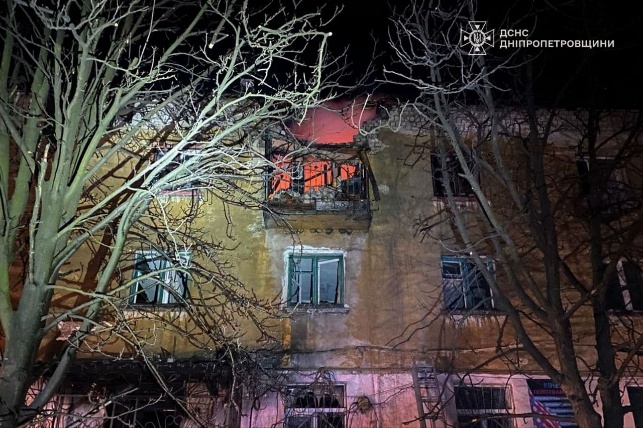
Aftermath of Russian attacks on Dnipropetrovsk Oblast, Ukraine, overnight. (Ukraine’s Emergency Service)
Russian commanders had already reported advances that never happened. Settlements captured on paper but not on the ground. Maps shaded red where Ukrainian troops still held their lines. When reality failed to match the reports sent upward, the lie needed cover.
So milbloggers invented Ukrainian attacks.
The narrative solved the problem neatly. Russian forces hadn’t exaggerated gains; they had been “pushed back.” Advances hadn’t stalled; they had been reversed by sudden counteroffensives. Commanders could quietly retreat to positions they had never left while blaming Ukrainian action for the correction.
The pattern was familiar—and corrosive.
Milbloggers themselves had complained for months about false reporting inside Russian units. Progress was demanded. Truth was punished. So officers lied, then lied again to protect the first lie. Each fabrication required another, until fiction became operational reality.
The damage went beyond propaganda. Senior commanders planned off bad data. Resources were shifted based on imaginary gains. Decisions were made against a battlefield that existed only on Telegram.
Near Hulyaipole, the deception collapsed quickly. But the system that produced it remained intact—feeding on its own falsehoods, and weakening itself in the process.
Striking the Nerve Centers
The strike came in the dark, close enough to the border to make Moscow uncomfortable.
On the night of February 8 to 9, Ukrainian forces hit a Russian Airborne command post in Sudzha, Kursk Oblast—just ten kilometers from Ukraine. The Ukrainian General Staff confirmed the target: a headquarters used by Russia’s VDV units. Screens went dark. Radios fell silent. Plans stopped mid-sentence.
It was not an isolated blow. It was part of a widening pattern.
Days earlier, Ukrainian missiles found their way to a storage site near Rostov-on-Don. Inside were containers packed with first-person-view drones and components—roughly 6,000 of them, according to Ukrainian confirmation. Months of production disappeared in a single strike. Reconnaissance tools. Precision weapons. Gone.
Together, the attacks traced a map of intent. Ukraine wasn’t chasing trenches. It was reaching for the systems that made those trenches work—command posts, drone depots, logistics hubs, ammunition sites. Places Russian planners assumed were safely out of reach.
The Sudzha strike cut especially deep. Command posts are not just buildings. They hold senior officers, planning staffs, communications gear—the nerve centers that keep units synchronized. Destroy one, and orders stall. Subordinate units wait. Confusion spreads until a new headquarters is improvised, farther back, farther from the fight.
The loss near Rostov carried a different weight. FPV drones had become central to Russian battlefield tactics. Losing 6,000 at once meant gaps—fewer eyes, fewer strikes, fewer options. Replacements would come, but not immediately, and not without pulling resources from elsewhere.
Each strike forced tradeoffs. More air defenses stretched thinner. Assets dispersed, efficiency lost. Production lines strained to refill emptied warehouses.
The damage wasn’t just what burned. It was what Russia now had to protect—and what it no longer could.
The “Breakthrough” That Was Already Old
The headlines moved fast. Russian glide bombs, newly extended, now flying two hundred kilometers. A fresh leap. A technological surprise.
Except the surprise had already happened—months ago.
By early February, Russian and Ukrainian sources were again circulating claims that Moscow had unlocked a new range for its guided glide bombs. The UMPB-5R, they said, could now reach targets two hundred kilometers away. A Russian milblogger flagged it on February 6. A Ukrainian OSINT account echoed it on February 8. The framing was familiar: another sudden Russian innovation changing the battlefield.
But the trail told a different story.
Back in October 2025, Ukrainian electronic warfare specialist Serhiy “Flash” Beskrestnov had already documented the UMPB-5R’s extended reach—one hundred to one hundred eighty kilometers. A month later, Ukraine’s military intelligence deputy chief, Major General Vadym Skibitskyi, publicly stated that Russia planned to produce five hundred of the longer-range variants in 2025, with maximum ranges approaching two hundred kilometers.
What was being billed as a breakthrough was, in reality, a rediscovery.
The pattern wasn’t accidental. Russian capabilities were often reintroduced as “new” long after they appeared, allowing old developments to be repackaged as momentum. Information warfare didn’t require invention—only timing.
That didn’t make the weapon insignificant. A two-hundred-kilometer glide bomb still mattered. It allowed Russian aircraft to launch from beyond Ukrainian air defense envelopes. It widened the list of reachable targets. It forced Ukrainian planners to adjust, again, to threats arriving from farther away.
But mislabeling the system as a sudden leap distorted the picture. It suggested rapid innovation where there was incremental adaptation. Surprise where there was continuity.
The danger wasn’t the bomb itself. It was the narrative—one that kept pretending Russia was sprinting forward, when it was often just circling back to what already existed.
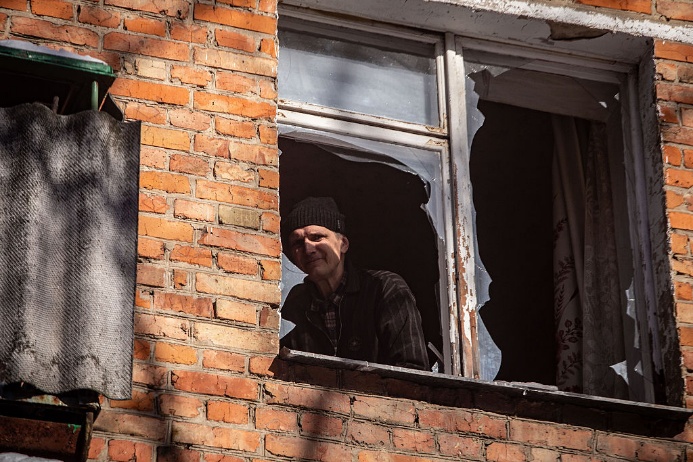
A resident is in his home in Sumy, Ukraine, with damaged windows after a Russian drone attack. (Photo by Francisco Richart Barbeira/NurPhoto via Getty Images)
Meters That Still Cost Blood
There were no sweeping arrows on the map—just movement measured in fields and tree lines.
Near Velykyi Burluk in Kharkiv Oblast, Ukrainian forces pushed forward, advancing in a sector that had remained largely static. The gains were limited but meaningful, showing Kyiv’s ability to apply pressure even where frontlines had hardened.
Russia advanced as well.
In northern Sumy Oblast, Russian units continued pressing along the international border, sustaining northern pressure. Additional advances were recorded near Velykyi Burluk, Kupyansk, Slovyansk, and within the Kostyantynivka–Druzhkivka tactical area. None produced a breakthrough. All reflected incremental, costly movement.
Velykyi Burluk became the clearest example of the day’s pattern. Both sides advanced in the same area, each attempting to improve tactical positioning. Control shifted slightly. Momentum did not.
This was frontline war stripped of illusion. No collapse. No surge. Just steady probing, localized gains, and constant risk of reversal. Ground was taken, but not transformed into operational advantage.
The lines moved. The balance did not.
Testing the Sky, One Balloon at a Time
The violation was quiet, almost easy to miss.
On the night of February 8 to 9, Polish radar screens picked up balloon-like objects drifting into national airspace. The Polish Armed Forces Operational Command confirmed the intrusion but did not specify the entry route. The pattern, however, was already familiar. Since January 27, similar balloons had crossed into Poland from Belarus five times.
These were not accidents.
The incursions fit what NATO analysts describe as Russia’s “Phase Zero”—psychological and informational pressure applied before open confrontation. With Belarus effectively absorbed into Moscow’s military posture, its airspace has become a launch point for low-risk provocations against NATO’s eastern edge.
Each balloon tested something different. Detection times. Air defense reactions. Political thresholds. Domestic tolerance inside Poland for repeated violations of sovereignty that fall short of missiles or aircraft.
The dilemma was deliberate. Respond, and NATO expends resources while escalating tensions over objects barely worth intercepting. Ignore them, and violations begin to feel routine—normalized signals that probing the alliance’s airspace carries little cost.
Lithuania. Poland. The eastern flank. The geography mattered less than the message.
Nothing exploded. No aircraft scrambled into combat. But the sky had been crossed again, quietly reminding NATO that pressure does not always arrive with engines or warheads.
Sometimes it floats.
What February 9 Revealed
Two wars unfolded at once.
In public, Sergei Lavrov blamed the United States for failed peace talks while repeating demands that required Ukraine’s surrender and NATO’s rollback. In practice, the foundations supporting Russia’s war effort were quietly weakening—oil buyers stepping away, tankers seized, and military claims unraveling under scrutiny.
The contrast was stark.
Lavrov’s position left no room for negotiation. Ukraine’s postwar military would be dictated by Moscow. Its government would be dismantled under the banner of “denazification.” Territorial claims stretched beyond the four annexed oblasts into the imagined expanse of “Novorossiya.” NATO would reverse decades of expansion or accept permanent confrontation. Peace, Russia insisted, meant capitulation—or nothing at all.
To sustain that position, the Kremlin leaned on narrative. It blamed Washington for blocking progress, pointed to the undocumented Alaska Summit as proof of American betrayal, and pushed for bilateral U.S.–Russian talks that would sideline Ukraine and Europe. Diplomacy became theater designed to mask immovable demands.
But elsewhere, pressure mounted.
India halted purchases of Russian oil, cutting into one of Moscow’s most important revenue streams. Major refiners stopped future orders. The United States removed another shadow-fleet tanker from circulation, boarding the Aquila II after months of operating dark. Sanctions enforcement was no longer abstract—it was operational.
On the battlefield and online, the strain showed. Russian commanders exaggerated advances. Milbloggers amplified the claims. When reality failed to cooperate, invented Ukrainian “counteroffensives” appeared to explain retreats that had never been advances. Institutional lying became a tactical liability.
Ukraine, meanwhile, struck where it mattered—command posts near Sudzha, drone stockpiles near Rostov—eroding Russian capabilities without chasing spectacle.
February 9 did not resolve the war. It clarified it.
The Kremlin demanded surrender. Its room to maneuver shrank. And no one yet knew which pressure—economic, military, or internal—would force the first real change.
Prayer For Ukraine
• For truth to outlast deception — Pray that lies, propaganda, and manufactured narratives would collapse under their own weight, and that truth would surface clearly for leaders, journalists, and ordinary people trying to discern what is real.
• For endurance amid economic pressure — Pray for Ukrainians as the war grinds on, that families, workers, and communities would have provision, stability, and resilience as global forces shape the conflict around them.
• For protection of defenders and civilians — Pray for those on the frontlines and those living under threat far from them, that lives would be spared, homes preserved, and courage sustained through long uncertainty.
• For wisdom among decision-makers — Pray that leaders in Ukraine, Europe, and the United States would act with clarity, restraint, and moral courage, resisting shortcuts that trade justice for false peace.
• For a just peace, not exhaustion — Pray that this war would not end through surrender, despair, or silence, but through an outcome that protects the vulnerable, restores sovereignty, and opens a real path toward healing and reconciliation.