
As Moscow demands Ukrainian capitulation, new data shows Russia bleeding faster than it can replace troops while Europe scrambles to offset America’s near-total withdrawal from military support.
The Day’s Reckoning
Lavrov sat beneath studio lights three days in a row, his tone steady, his script unchanged.
First to TV BRICS. Then to Russian state channel NTV. Then to a RuTube propaganda podcast aimed at young Russians. Different backdrops. Different interviewers. The same message.
Russia will not compromise.
Ukraine must surrender all of Luhansk, Donetsk, Zaporizhia, and Kherson—territory Moscow doesn’t even fully control. NATO must roll back to its 1997 footprint. Kyiv must repeal language protections and undo restrictions on the Moscow Patriarchate. Security, Lavrov said, “is non-negotiable.”
While he spoke, the numbers told another story.
Ukrainian General Staff data showed December 2025 as the first month Russian casualties exceeded recruitment. 33,200 killed and wounded. 27,400 new contract soldiers. A deficit of nearly 6,000 bodies. Roughly 30,000 dead in a single month—twice the Soviet Union’s decade-long losses in Afghanistan.
In Brussels, NATO ambassadors confirmed $4.5 billion in American weapons purchased through European wallets. HIMARS. Patriot batteries. Washington no longer gifted; it sold. The Kiel Institute reported U.S. military aid had fallen 99 percent in 2025. Europe had surged support by 67 percent just to keep Ukraine supplied.
In Kyiv, Zelensky accepted a U.S. proposal for talks in Miami on February 17–18. Moscow did not respond. Russia was “hesitating.”
In the Kremlin, Putin signed a decree placing Rosgvardia under General Valery Gerasimov’s command—300,000 internal security troops now answering to his most loyal general.
Maximalist demands. Mounting losses. Europe compensating for America’s retreat. Negotiations proposed, unanswered.
The war moved forward on parallel tracks—rhetoric hardening even as the math tightened around it.
The Echo Chamber of Capitulation: How Lavrov Conditioned a Nation for Endless War
On February 9, Sergei Lavrov faced the cameras at TV BRICS, speaking to governments Moscow courts as alternatives to the West.
On February 10, he sat beneath the lights of NTV, his words flowing across Russia, into Belarus, even into North America.
On February 11, he appeared on “Empathy Manuchi,” a RuTube platform designed for younger Russians scrolling on their phones.
Different studios. Different hosts. Different audiences.
The same script.
Lavrov invoked the alleged August 2025 Alaska Summit “understandings”—agreements the White House has never confirmed. He pointed back to Putin’s June 2024 speech as doctrine. Ukraine must surrender all of Luhansk, Donetsk, Zaporizhia, and Kherson—even land Russian forces do not control. NATO must stop expanding and withdraw from every member state admitted after 1997. Kyiv, he said, is “obligated” to repeal language protections and laws restricting the Moscow Patriarchate. Russia “will not change these positions.”
On “Empathy Manuchi,” the message sharpened. This was not diplomatic nuance. It was repetition of the 2021 ultimatums issued before the invasion. No expansion. No NATO presence eastward. No compromise.
The choreography mattered. International partners heard it. Western viewers heard it. Young Russians heard it.
The Kremlin was not preparing its public for concessions. It was rehearsing them for refusal.
Across three days, Lavrov embedded the same conclusion into every demographic Moscow considers strategic: compromise is betrayal, and total victory is the only acceptable outcome.
The repetition was the point.
Russia was not negotiating toward peace. It was conditioning its nation to reject anything less than capitulation.
The General He Trusts: Putin Tightens His Grip After Wagner’s Shadow
On February 11, Vladimir Putin signed a decree that quietly redrew the map of power inside Russia.
Rosgvardia—his 300,000-strong National Guard, created in 2016 to protect the regime from internal threats—would no longer answer directly to him. It would now fall under the General Staff, commanded by Army General Valery Gerasimov.
On paper, the language was bureaucratic: command and control in peacetime and wartime, force development plans, mobilization readiness, training, intelligence, communications systems. A reshuffle.
In reality, it was a verdict.
The question has lingered since June 2023, when Wagner columns rolled toward Moscow and Rosgvardia—the force built to stop exactly that scenario—barely engaged. The mutiny exposed not just cracks in military command, but a personal vulnerability for Putin. The men tasked with protecting him had hesitated.
Gerasimov had not.
Through battlefield setbacks and political infighting, he remained publicly loyal. He did not maneuver for advantage when Wagner faltered. He did not test the limits of Putin’s authority.
So Putin rewarded him.
Reports from early February suggested even more consolidation ahead: the possible abolition of the Ministry of Emergency Situations, merging its 50,000 rescue personnel into Rosgvardia, reinforcing the structure with sappers and specialists. Recruitment pipelines streamlined. Irregular forces centralized. Chains of command simplified.
But the core shift was psychological.
Putin placed the force designed to guard his regime under a man he trusts more than the institution itself.
The message to Russia’s security elite was unmistakable: loyalty in crisis outweighs mandate on paper.
Gerasimov passed. Rosgvardia did not.
Thirty Thousand in a Month: When Russia’s War Ledger Turned Red
The numbers arrived without emotion.
27,400 new contract soldiers signed in December 2025.
33,200 killed and wounded.
For the first time since the invasion began, Russia lost more men than it replaced. Nearly 6,000 bodies in deficit. Roughly 30,000 dead in a single month—double the Soviet Union’s decade-long losses in Afghanistan.
In previous months, the arithmetic had held. November: 31,000 losses, 33,300 recruits. October: 31,500 losses, 35,600 new contracts. September followed the same pattern. Brutal, but sustainable. Moscow could trade blood for ground and keep the ranks filled.
December broke the balance.
On the eastern front, the reason was visible. In the Pokrovsk direction, Russian units increasingly pushed forward soldiers facing disciplinary action—men treated as expendable. A Ukrainian brigade spokesperson reported that during one large assault on February 7–8, Russian forces suffered 127 casualties, 80 killed. Fifteen pieces of equipment destroyed.
The tactics persisted. Small infiltration groups moving under poor weather. Camouflage cloaks believed to render them invisible. First-person view drones controlling roads, forcing Ukrainian troops to move under constant aerial watch. Volume substituted for quality.
Meters gained. Blocks contested.
But every meter required bodies.
December’s math signaled something deeper than a bad month. It marked the shift from sustainable attrition to net degradation. Combat power was no longer being replenished at the rate it was consumed.
Still, the machine moved forward.
Russian commanders accepted catastrophic losses, gambling that Ukrainian fatigue—or Western political fracture—would come first. The numbers suggested an approaching inflection point.
Approaching was not collapsing.
The war ground on, ledger deepening in red.
Filling America’s Silence: Europe’s 67 Percent Gamble
The spreadsheet landed on desks in Kiel with a blunt conclusion: Europe had surged military aid to Ukraine by 67 percent in 2025.
The United States had cut its own by 99 percent.
The headline sounded dramatic. The math felt colder.
Even with Europe’s dramatic increase, total military support still fell 13 percent below the annual average of 2022–2024. Translation: fewer artillery shells in crates, fewer air defense interceptors in storage, fewer precision strikes planned.
Since January 2025, Washington allocated zero new packages under Presidential Drawdown Authority. No more rapid transfers from U.S. stockpiles. Instead, the White House shifted to sales. Allies could buy American weapons through the Prioritized Ukrainian Requirements List.
NATO Ambassador Matt Whitaker confirmed that 21 NATO members, plus Australia and New Zealand, had pooled $4.5 billion since summer 2025. Norway, the Netherlands, and Germany led the funding. HIMARS launchers and Patriot batteries moved east—not as gifts, but as purchases.
Germany and the United Kingdom now carried two-thirds of Western Europe’s military aid burden. Northern Europe followed. Eastern Europe’s share shrank from 17 percent in 2022 to just 2 percent in 2025. Southern Europe’s fell from 7 percent to 3 percent.
On February 11, the European Parliament approved a €90 billion Ukraine Support Loan—€30 billion for macro-financial support, €60 billion for defense procurement. The funds would be raised through common EU borrowing, debt serviced through future EU budgets. Ukraine would repay principal only after receiving reparations from Russia.
The loan covered two-thirds of Kyiv’s projected €135.7 billion needs through 2027. Roughly $37.4 billion remained unfunded.
Europe stepped forward. America stepped back.
Ukraine’s survival now rests increasingly on Berlin, London, and Brussels—and on whether European political will proves steadier than Washington’s.
A Line Europe Once Avoided: Training Soldiers Inside Ukraine
In Brussels on February 11, Kaja Kallas outlined a shift Europe once considered too risky.
Two sites inside Ukraine had been identified where European forces could train Ukrainian soldiers if a ceasefire takes hold. “On the table,” she wrote on X before EU defense ministers met, were plans to establish the facilities and mobilize additional private capital through the European Investment Bank.
Until now, training happened safely beyond Ukraine’s borders. More than 86,000 Ukrainian soldiers had rotated through EU programs by January 2026. Poland, Germany, and other member states hosted the drills. The war stayed at a distance.
This proposal changes that.
An EU official told AFP that preparatory work could begin even before fighting ends—despite Russia’s prior warning that any European troops in Ukraine would be treated as “legitimate targets.”
The risk is explicit.
Ukrainian Defense Minister Mykhailo Fedorov attended the Brussels meeting, where ministers discussed continued support and defense innovation. The session coincided with the European Parliament’s approval of the €90 billion Ukraine Support Loan.
Kallas stressed that Russia was not winning—citing mounting casualties and a strained wartime economy. Europe, she said, must both support Ukraine and learn from it, especially in defense innovation and rapid spending expansion.
Training on Ukrainian soil would shorten timelines and signal deeper commitment. It would also test Moscow’s tolerance for escalation.
Europe is weighing whether proximity is now part of deterrence.
No Date, No Signature: Zelensky Draws His Line in Europe
On February 11, Volodymyr Zelensky made the demand plain.
No “specific date” for EU accession—no peace agreement with his signature.
“Ukraine will do everything to be technically ready for accession by 2027,” he told reporters. “We will at least accomplish the main steps. Second, I want a specific date.” Without one, he warned, Russia would “do everything to block the process.”
A day earlier, a European Commission spokesperson had avoided timelines, calling accession part of the broader peace process but declining to speculate. Politico reported Brussels was drafting a pathway for Ukraine to join as early as 2027—though without full membership rights.
For Zelensky, that was not enough.
“This is about security guarantees,” he said. “Specific details, with a specific date.” Any 20-point peace framework, he added, must include it. His signature would guarantee Ukrainians more than words—it would guarantee a timetable.
He had already named 2027 in late January. The response was immediate. Hungarian Prime Minister Viktor Orban called the idea “an open declaration of war against Hungary.” German Chancellor Friedrich Merz said 2027 was “out of the question.”
Ukraine applied for EU membership days after Russia’s full-scale invasion in February 2022. It gained candidate status that same year. Formal accession talks opened in 2024. Yet negotiations on key accession clusters remain stalled, with Hungary wielding its veto.
Zelensky’s message was not procedural. It was strategic.
EU membership is not a diplomatic aspiration. It is, in his framing, a security guarantee.
And without a date, there is no deal.
Talks on the Calendar, Drones in the Sky: Russia’s Calculated Silence
On February 11, Zelensky confirmed what Washington had already proposed: another round of trilateral talks, possibly February 17–18 in Miami.
Ukraine said yes.
Russia did not answer.
“We were waiting for a response from the Russians,” Zelensky told journalists. “So far… Russia is hesitating.”
Hesitating is a polite word. Moscow was calculating.
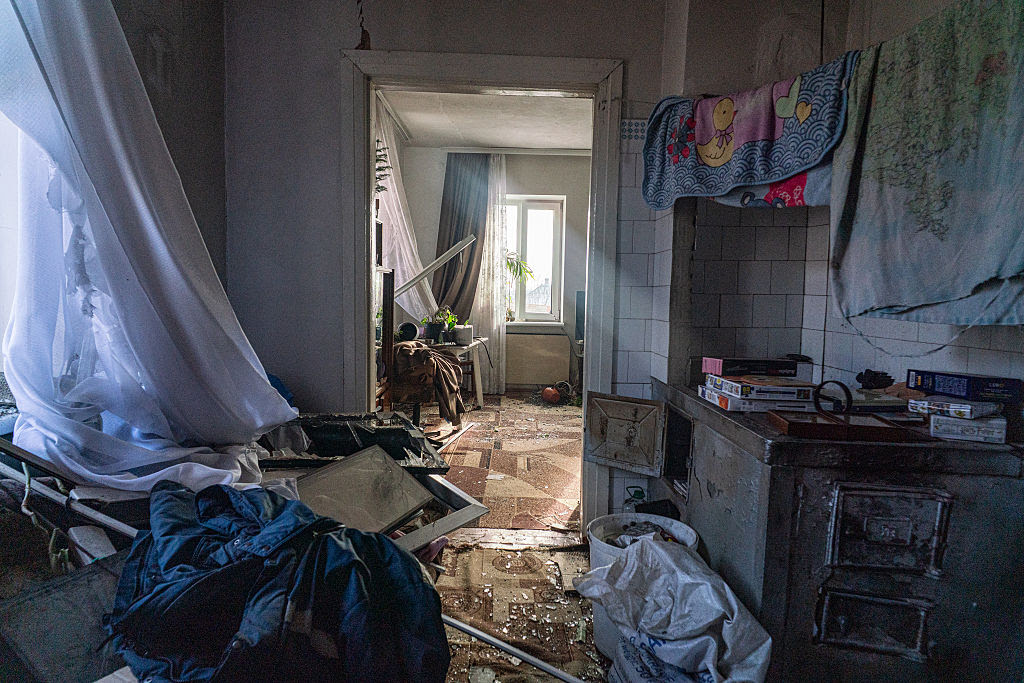
Damaged buildings and debris are seen after a drone attack in the city of Bohodukhiv, Kharkiv Oblast, that killed four people, including three children. (Carlo Bravo/Anadolu via Getty Images)
Lavrov’s statements that same day made the context clear. He dismissed the U.S.–Ukraine 20-point peace framework, claiming that ahead of the Alaska summit U.S. envoy Steve Witkoff had presented proposals “in line with realities on the ground.” According to Lavrov, earlier discussions had identified “real approaches” that could have formed a final agreement.
“All subsequent versions,” he said, were attempts by Zelensky and Europe to override the American initiative. The 20-point document, he insisted, had never been formally given to Moscow.
That framework—developed in late December 2025 as a revision of an earlier 28-point draft—had been delivered to Putin in early January through envoy Kirill Dmitriev. Witkoff and Jared Kushner later traveled to Moscow to discuss it directly.
For three straight days Lavrov escalated criticism: February 9, accusations Washington failed to honor alleged understandings; February 10, warnings against “enthusiastic perception” of progress; February 11, outright rejection.
Meanwhile, the night sky offered its own reply.
Russia launched 129 drones from Kursk, Oryol, Bryansk, Millerovo, Primorsko-Akhtarsk, and occupied Donetsk. Ukrainian air defenses intercepted 112. Fifteen struck eight locations across Sumy, Chernihiv, Kharkiv, and Zaporizhia oblasts—targeting energy, residential, railway, and civilian infrastructure.
Ukraine answered by striking the Volgograd oil refinery, igniting fires.
Zelensky said each strike “undermines trust” in diplomacy. Miami remains penciled in.
The drones did not wait for confirmation.
“We Don’t Use It”: The Lie That Sparked a Pro-War Revolt
On February 11, Dmitry Peskov stepped to the microphone and said he “cannot imagine” Russian forces using Telegram for frontline communications.
State Duma Defense Committee Chair Andrei Kartapolov reinforced the claim. Russian troops, he said, used the platform only “minimally” in combat.
The response was immediate—and furious.
Russian milbloggers, many with direct ties to frontline units, accused both men of ignorance or deception. Telegram, they insisted, was not optional. It was lifeblood: tactical coordination, unit updates, drone feeds, situational awareness. In Ukraine’s electronic warfare environment—where traditional military systems often falter—Telegram filled the gaps.
The controversy followed Roskomnadzor’s throttling of the platform on February 9–10. Milbloggers had warned the move would have “serious implications on Russian command and control.” The Kremlin’s denial appeared designed to calm the backlash.
It did the opposite.
Bloggers cited specific units that relied on Telegram to move, strike, and survive. Some questioned whether Kartapolov received “distorted” battlefield reports. Others accused officials of deliberately misleading the public.
Behind the clash sat a deeper tension. Moscow has long sought tighter control over Telegram, wary of a platform not fully under state authority. But censorship collides with battlefield necessity. Severely restricting Telegram would degrade combat effectiveness.
The Kremlin tried to thread the needle: limit the platform while claiming troops didn’t need it.
Pro-war commentators were unconvinced.
The episode exposed a familiar pattern. The state can impose censorship. It cannot easily convince those who know better.
Even loyal constituencies balk when the lie contradicts what soldiers experience in real time.
A Russian City Without Heat: Belgorod’s Winter Reckoning
On February 11, Belgorod Governor Vyacheslav Gladkov chose language that carried weight.
The region’s power and heating situation was “extremely difficult, critical, and prolonged.”
Two days earlier, he had called it “almost catastrophic.”
The crisis followed a month-long Ukrainian bombardment campaign targeting Belgorod Oblast’s energy infrastructure. Domestically developed kamikaze drones and long-range artillery repeatedly struck key facilities, including the Luch Thermal Power Plant—a 60 MW gas-turbine station central to the regional grid.
Satellite imagery after February 7–8 showed direct hits on both 30 MW turbines. The turbine hall appeared gutted. January repairs had briefly restored service after earlier strikes that cut electricity to 500,000 residents. February destroyed those gains.
The consequences spread across a city built for 320,000 people. Roughly 80,000 residents now live in buildings without reliable heat or electricity. Rolling blackouts affect nearly all homes and businesses. Unheated structures include 455 apartment blocks, 25 kindergartens, 17 schools, nine polyclinics, and four universities. Another 100,000 residents face water disruptions as pumps struggle to maintain pressure, forcing authorities to drain heating systems to prevent frozen pipes.
Officials urged families to evacuate children. Subzero temperatures made the crisis dangerous, not merely uncomfortable.
Strikes also hit the Belgorod Combined Heat and Power Plant and key substations. Repairs face added strain: GE equipment used in the facilities no longer receives parts or service after the company exited Russia in 2023.
Ukraine’s Unmanned Systems Forces credited long-range units with the campaign. Zelensky framed energy targets as legitimate, arguing Russia’s infrastructure fuels its war effort.
The scale remains asymmetric; Russian attacks across Ukraine dwarf the focused strikes on Belgorod. But the message is unmistakable.
One city, in winter, without heat.
Words on a Helmet, Erased in the Name of “Neutrality”
Days before the Milan-Cortina Games, Ukrainian short track skater Oleh Handei was told his helmet had failed inspection.
The violation: a “political slogan.”
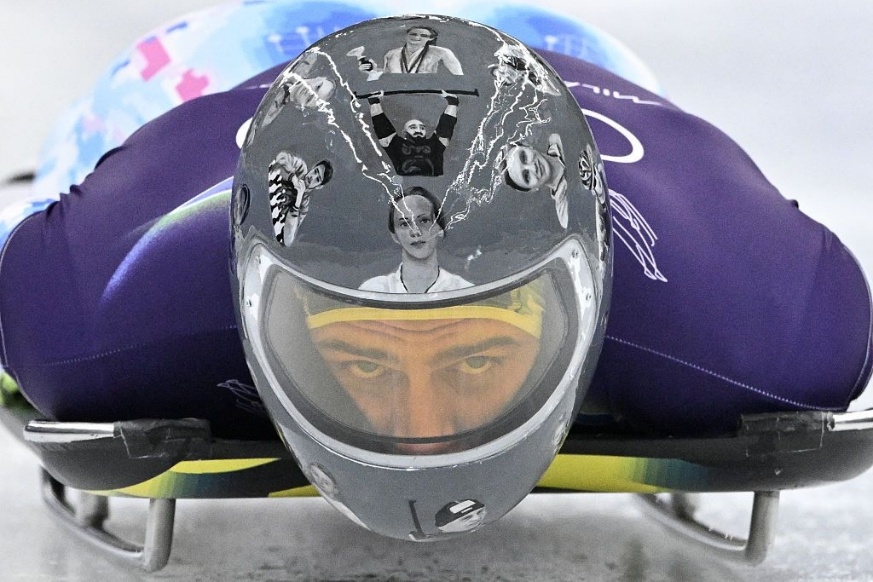
Ukraine’s Vladyslav Heraskevych wears his “memorial helmet” during the skeleton men’s training session the 2026 Winter Olympic Games in Cortina, Italy. (Tiziana Fabi / AFP via Getty Images)
Across the shell ran a single line of poetry by Lina Kostenko: “Where there is heroism, there is no final defeat.”
“They banned it,” Handei told Suspilne Sport. He translated the words for officials—line by line. Not a slogan, he insisted. Motivation. Memory. Strength.
The International Olympic Committee disagreed.
Handei became the third Ukrainian athlete barred from competing with a helmet deemed too political. Freestyle skier Kateryna Kotsar’s “Be Brave like Ukrainians” was rejected. Skeleton racer Vladyslav Heraskevych was prohibited from wearing portraits of Ukrainian athletes killed in Russia’s war.
The IOC cited the Olympic Charter’s ban on politicization.
Heraskevych pointed to a contradiction. Israeli skeleton racer Jared Firestone had worn a kippah honoring the 11 Israelis murdered at the 1972 Munich Olympics during the Opening Ceremony. “I honestly don’t understand how these two cases are fundamentally different,” Heraskevych wrote. The rules, he noted, apply equally to ceremonies and competition.
Meanwhile, Russian and Belarusian athletes competed under “neutral” status despite documented ties to the Kremlin or public support for the invasion.
More than 650 Ukrainian athletes and coaches have been killed since 2022. Hundreds of sports facilities lie in ruins.
Commander-in-Chief Oleksandr Syrskyi wrote simply: “Remembrance is not a violation.”
Heraskevych vowed to wear his memorial helmet in training and on race day. “I truly believe that we didn’t violate any rules.”
The IOC called it neutrality.
For Ukrainian athletes, it felt like memory itself had been ruled out of bounds.
Three Toddlers Among the Dead: A Day Measured in Small Coffins
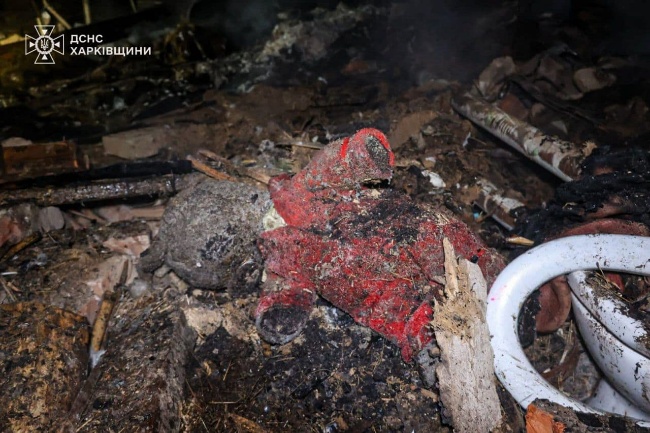
A child’s toy lies among the debris left after Russian attacks on Kharkiv Oblast, Ukraine, overnight. (Ukraine’s Emergency Service)
On February 11, the count settled at nine dead.
Three of them were toddlers.
In Bohodukhiv, Kharkiv Oblast, a Russian strike tore through a home and killed four people, including children aged one and two. A 35-year-old pregnant woman—their mother—was injured. Across the region, attacks wounded civilians in Odradne, Zolochiv, and Oskil. Five houses, a car, two petrol stations, and a cafe were damaged.
In Sloviansk, Donetsk Oblast, a glide bomb killed three more people, among them a mother and her 11-year-old child. Fourteen were injured. In Oleksiievo-Druzhkivka, two others were wounded.
In Sumy Oblast, a drone strike on the Seredyno-Budsk community killed a 72-year-old man. A 16-year-old girl and boy were injured, along with men aged 19 and 50 and a 48-year-old woman. Elsewhere in the oblast, one person was killed and three injured, including a 12-year-old girl.
In Vilniansk, Zaporizhzhia Oblast, five people were injured. In Kherson Oblast, Russian forces struck 33 settlements, wounding six.
Thirty-nine injured in total.
As the numbers came in, diplomatic discussions intensified. Another round of trilateral talks could resume as early as February 17–18.
Zelensky wrote that each strike “undermines trust” in diplomacy and proves that only strong pressure and clear security guarantees can stop the killings. “The Russian army is not preparing to stop—they are preparing to continue fighting.”
Nine dead.
The negotiations remain on the calendar.
The funerals do not wait for them.
Meter by Meter: A Frontline That Refuses to Break
While diplomats circled conference tables, the front moved in meters.
On February 11, geolocated footage showed Russian forces advancing north of Nova Sich in northern Sumy Oblast. Attacks pressed toward Korchakivka and near Popivka. The lines bent slightly, not dramatically.
Elsewhere, Ukraine clawed ground back. Near Velykyi Burluk, Ukrainian forces cleared Chuhunivka after Russian troops had briefly taken it days earlier. A company commander confirmed the town was secured. Fighting near Khatnie and Kolodyazne remained fluid—claims contested, control uncertain.
In the Borova direction, Russian troops edged into central Bohuslavka. Assaults continued near Borivska Andriivka and Novoyehorivka, while Russian sources alleged Ukrainian counterattacks near Oleksandrivka and Korovii Yar.
South of Lyman, footage showed Russian movement in Nykyforivka. Attacks radiated outward—toward Yarova, Drobysheve, Stavky, Zakitne, Dronivka, Zarichne, Dibrova, Ozerne. Ukrainian counterattacks reportedly struck near Yarova and Drobysheve.
In the Kostyantynivka-Druzhkivka area, Russian forces pressed without gaining ground. Ukrainian commanders described first-person view drones hovering over supply routes, camouflage cloaks in bad weather, and small infiltration teams struck by Ukrainian drones when concealment failed.
Near Pokrovsk, Russian assaults continued around Hryshyne, Rodynske, Kotlyne, Udachne, and Molodetske. A Ukrainian spokesperson said disciplinary troops were again sent forward in preliminary attacks, wounded often left behind.
Farther south, Ukrainian forces cleared Ternuvate, Tsvitkove, Staroukrainka, Zaliznychne, and advanced near Kosivtseve—limited clearing operations, not a major counteroffensive.
In western Zaporizhia, positions shifted near Stepnohirsk and Lukyanivske, marginal advances and withdrawals layered over each other.
No breakthrough.
Just trenches contested, drones overhead, and a war that grinds forward one field, one street, one tree line at a time.
The Day’s Meaning: When Narratives Collide with Arithmetic
February 11 exposed the war’s central contradiction.
Moscow repeated its maximalist script—no compromise, no retreat, no altered demands—while the numbers beneath the rhetoric shifted in the opposite direction. Russian casualties outpaced recruitment for the first time. Thirty thousand killed in a month is not a slogan. It is a trajectory.
At the same time, Ukraine struck deep: oil refineries, defense facilities, air defense systems, logistics hubs. The strategy was cumulative, not theatrical. Every refinery fire, every damaged plant, every destroyed launcher forced Russia to stretch its defenses thinner across a widening map.
Europe surged military aid by 67 percent, stepping into the vacuum left by America’s near-total withdrawal. But even that surge could not fully close the gap. The burden concentrated in Berlin and London. The €90 billion loan bought time—not certainty.
Diplomacy hovered in the background. Miami remained penciled in. Russia hesitated. Drones did not.
On the frontline, villages changed hands in meters. In Belgorod, civilians shivered without heat. In Milan, Ukrainian athletes were told memory itself was too political. Parallel realities unfolded: negotiation and bombardment, condemnation and hesitation, advance and attrition.
The Kremlin tried to condition audiences for capitulation. The battlefield imposed arithmetic instead.
The decisive question is not what leaders declare non-negotiable. It is which side’s resources, will, and alliances bend first under sustained pressure.
That tension—between narrative and math—now defines the war more than any single strike or speech.
Prayer For Ukraine
- For grieving families
Pray for the parents in Kharkiv and Sloviansk who buried children this week. Ask God to hold mothers, fathers, and grandparents in their grief, to bring comfort where words cannot reach, and to surround broken homes with His presence. - For those living without heat and light
Lift up the civilians in Belgorod and across Ukraine facing winter without reliable power, water, or warmth. Pray for protection from the cold, swift repairs where possible, and mercy for the elderly, the sick, and the very young. - For soldiers on the frontline
Pray for Ukrainian defenders holding trenches meter by meter under drone-filled skies. Ask for endurance, clarity in command decisions, protection from unseen threats, and strength for medics caring for the wounded. - For wisdom in diplomacy
As talks are proposed and delayed, pray that leaders act with integrity and courage. Ask that deception be exposed, that true justice—not empty theater—guide negotiations, and that lasting security be pursued rather than temporary optics. - For unity and steadfast support
Pray that international partners remain resolute, that political will does not fracture, and that truth overcomes propaganda. Ask God to sustain Ukraine with provision, allies, and hope until peace comes in righteousness.