
As Moscow calls for UN “external governance” in Kyiv, Ukrainian forces reverse Russian gains along the Yanchur and Haichur rivers—exposing the widening gap between Kremlin rhetoric and battlefield reality.
The Day’s Reckoning
In Moscow, Deputy Foreign Minister Mikhail Galuzin sat beneath studio lights and calmly suggested that the United Nations should administer Ukrainian elections. Not monitor them. Administer them. Temporary external governance, he called it—language that implied Ukraine required international supervision to choose its own leaders.
At the same time, the Kremlin offered a “one-day ceasefire” so Ukrainians could vote.
Eight hundred kilometers south, along the Yanchur and Haichur rivers in Zaporizhia Oblast, Ukrainian assault groups were moving through frozen fields and shattered treelines. Geolocated footage confirmed counterattacks that pushed Russian forces back nine to 9.5 kilometers in some sectors. Oleksiivka. Orestopil. Danylivka. Vyshneve. Yehorivka. Zlahoda. Rybne. Dobropillya. Settlements Russian troops had held for weeks slipped from their control.
The rivers changed hands.
In Munich, Volodymyr Zelensky answered Moscow’s proposal with blunt clarity: elections after at least two months of a genuine ceasefire. Not under ballistic strikes. Not during daily air raid sirens. Security first. Then ballots.
Meanwhile, Chief of the General Staff Valery Gerasimov announced that Russian forces had seized 12 settlements and 200 square kilometers in the first half of February—figures meant to project momentum as Ukrainian units reclaimed depth along two river lines.
Beyond the front, the war’s strain showed elsewhere. Former Energy Minister Herman Halushchenko was detained at the border in a corruption case. Ukrainian drones struck targets near Moscow, Bryansk, and Belgorod. Enlistment officers were hospitalized in Odesa after civilians attacked them with tear gas.
Diplomatic theater in Moscow. Tactical reversals in Zaporizhia. Statistics in one capital, river crossings in another.
February 15 unfolded as a study in contrast—claims of control colliding with proof that the battlefield remained anything but settled.
Ballots Under Fire: Moscow’s UN Takeover Proposal
Under studio lights in Moscow, Deputy Foreign Minister Mikhail Galuzin chose a phrase that landed like a hammer: “temporary external governance.”
Not observers. Not monitors. Administration.
In his TASS interview, Galuzin proposed that the United Nations run Ukrainian elections and establish a government with which Russia could sign “legitimate documents on future cooperation.” The framing assumed Ukraine’s current leadership lacked legitimacy and that its institutions were incapable of organizing democratic elections during wartime.
The mechanics exposed the design. Russia is a permanent member of the UN Security Council. Any resolution establishing such governance would require Moscow’s approval. In practice, elections would count only if they produced a government acceptable to the Kremlin.
UN Secretary General Antonio Guterres and White House National Security Council spokesperson James Hewitt had already rejected similar ideas. February 15 brought no new argument—only repetition.
Galuzin again claimed Volodymyr Zelensky is “illegitimate” because Ukraine has not held elections under martial law. Ukrainian law explicitly prohibits national elections during martial law—a condition triggered by Russia’s invasion. Zelensky has repeatedly said elections will occur once security conditions permit.
Moscow rejected that timeline. Instead, it offered a one-day ceasefire for voting—24 hours without missile strikes. Never mind that credible elections require months of preparation: verified voter rolls, international observers, secure infrastructure, and participation from soldiers on active front lines. Never mind that large territories remain under Russian occupation.
Galuzin suggested Ukraine would block “Ukrainians” living in Russia from voting—laying groundwork to delegitimize any result Moscow disliked. He did not mention Russia’s forced passportization in occupied territories, where hundreds of thousands were pressured into taking Russian citizenship.
The proposal’s logic was blunt: demand elections during war, retain veto power over the mechanism, and reserve the right to reject the outcome.
Democracy—on Moscow’s terms.
“Under Missiles, Not Ballots”: Zelensky Draws the Line in Munich
In Munich, Volodymyr Zelensky stepped to the microphone and stripped the debate of illusion.
He had met with US Secretary of State Marco Rubio. He had spoken by phone with Special Envoy Steve Witkoff and former Senior Advisor Jared Kushner. There were commitments. There were disagreements. And there was pressure—mounting calls for Ukraine to prove its democratic credentials with wartime elections.
Zelensky answered plainly.
“Give us two months of a ceasefire—and we will go to elections. That’s it. Ceasefire, security, infrastructure. We need time to prepare.”
“Our people are under missiles. This is not just a ground war. We are under ballistic attacks.”
The Civil War analogy—America voting in 1864—collapsed under modern realities. Ukraine’s cities, hundreds of kilometers from the front, face daily missile and drone strikes. Power grids fail. Sirens interrupt nights and mornings alike. Organizing credible national elections under those conditions would require secure infrastructure, verified voter rolls, international observers, and access for soldiers fighting in active combat zones.
Those soldiers must vote. It is both law and principle. But doing so safely demands guarantees Ukraine does not yet have.
Zelensky appealed directly to Donald Trump: “President Trump can do this. Put pressure on Vladimir Putin, get a ceasefire—and then our parliament will change the law and we will hold elections, if needed.”
If needed.
The United States proposed 15-year postwar security guarantees. Zelensky asked for at least 20. He insisted guarantees must come first—before territorial concessions, before withdrawals, before signatures. Russia has repeatedly rejected meaningful Western guarantees.
Munich clarified the lines. Elections after security. Guarantees before concessions. Moscow demanding ballots during bombardment.
Everyone now knows what each side wants.
No one knows if negotiation can deliver it.
When the Rivers Turned Back: Ukraine’s Counterpunch in Zaporizhia
For weeks, Russian units had edged forward in the Oleksandrivka and Hulyaipole directions. Then, according to Ukrainian military observer Kostyantyn Mashovets, the advance slowed.
Then it stopped.
Russian forces that had been pressing ahead suddenly found themselves digging in. Ukrainian tactical counterattacks pushed them back nine to 9.5 kilometers in some sectors, clawing territory along the Yanchur and Haichur rivers. Not a sweeping counteroffensive like Kharkiv in 2022—Mashovets stressed that. Smaller, precise blows. Calculated pressure at weak points.
Along the Yanchur River southeast of Oleksandrivka, Ukrainian troops forced Russian units out of Oleksiivka and Orestopil, advanced toward Berezove and Ternove, liberated Danylivka, Vyshneve, Yehorivka, Zlahoda, and Rybne, and began fighting for Pryvilne. River crossings that had served as Russian anchors shifted back under Ukrainian control, disrupting logistics and observation lines.
Northwest of Hulyaipole, along the Haichur River, the pattern repeated. Ternuvate and Kosivtseve fell back into Ukrainian hands. Dobropillya was liberated. Units pushed east of the town and crossed the river again after driving Russian forces from Pryluky and Olenokostyantynivka, beginning battles for Varvarivka.
These movements mattered beyond the map. Mashovets reported Russian forces had been preparing for a potential summer 2026 offensive toward Orikhiv and Zaporizhzhia City. Secure staging areas were essential. Ukrainian counterattacks disrupted those preparations, forcing Russian units to defend ground they had considered stable.
Timing may have helped. Russian milbloggers had complained of communications and command problems after losing Starlink access. Ukrainian forces struck as coordination faltered.
Even pro-Kremlin commentators acknowledged reverses. Exaggerated claims of Russian control—Chasiv Yar declared taken, Chervone secured—collided with fresh footage of ongoing Ukrainian attacks.
Not everywhere did the front move. But along two rivers, momentum shifted.
The Yanchur and Haichur ran Ukrainian again.
Twelve Villages and a Headline: Gerasimov’s Numbers Game
Chief of the General Staff Valery Gerasimov delivered the figures without hesitation: 12 settlements seized. Two hundred square kilometers captured in the first half of February 2026.
It sounded decisive.
Across the entire front, Russian forces had gained 203 square kilometers through steady, grinding advances—village by village, field by field. Some “settlements” were clusters of houses. Others were crossroads with a few structures. Each required manpower to take and more to hold.
The headline obscured the scale. Seizing scattered rural points is not the same as storming fortified cities like Slovyansk or Kramatorsk in Donetsk Oblast. Those remain unconquered, layered with defenses and years of preparation.
Gerasimov acknowledged Ukrainian counterattacks in the Hulyaipole direction but insisted the Russian Eastern Grouping was repelling them. Ukrainian reporting suggested more than resistance: multiple settlements liberated, Russian units pushed back across river lines.
He also highlighted seizures of Sydorivka and Popivka northwest of Sumy City, presenting cross-border actions as expanding “buffer zones” in Sumy and Kharkiv oblasts. The framing suggested collapsing Ukrainian defenses. The terrain suggested incremental shifts.
The broader trend undercut the narrative of momentum. Between January 25–31, Russian forces seized 141 square kilometers—their highest weekly total. From February 8–14, that fell to 74. In late November and early December, Ukrainian forces reclaimed 106 square kilometers across several directions. Late December saw the liberation of much of Kupyansk and surrounding areas—305 square kilometers slipping from Russian control.
The pattern was not linear advance. It was fluctuation.
Twelve villages seized. Rivers lost elsewhere. Statistics deployed for leverage.
On the ground, progress remained measured in meters—and vulnerable to reversal.
Cut Off from the Sky: Russia’s Scramble to Replace Starlink
On February 12, Russia’s Foundation for Advanced Research Projects announced the maiden flight of a new system: the Barrage-1 unmanned stratospheric platform. According to TASS, it could carry up to 100 kilograms and operate at 20 kilometers altitude, potentially hosting 5G Non-Terrestrial Network communications equipment.
The timing was not accidental.
Russian milbloggers immediately linked the test to a pressing problem: Russian forces had recently lost access to Starlink, the SpaceX satellite system that had quietly powered battlefield communications for months. The urgency betrayed the dependence. Moscow had been relying on technology it neither owned nor controlled.
A Kremlin-affiliated milblogger quickly punctured expectations. One aerostat at 20 kilometers cannot replace a constellation of thousands of low-orbit satellites. Barrage-1 might supplement layered communications. It would not restore what was lost.
Ukrainian Ministry of Defense advisor Serhiy “Flash” Beskrestnov responded bluntly, urging Ukrainian forces to use S-300 air defense systems to strike platforms like Barrage-1 at altitudes of 20 to 30 kilometers. If Russia sought a workaround, Ukraine signaled it would target that, too.
The loss of Starlink showed up where it mattered—at the front. Military observer Kostyantyn Mashovets reported Ukrainian counterattacks in the Oleksandrivka and Hulyaipole directions that coincided with Russian complaints of degraded command-and-control. Units that had advanced for weeks suddenly defended ground they once held securely.
Modern warfare runs on bandwidth as much as ammunition. Real-time targeting, rapid coordination, battlefield awareness—strip those away, and tempo falters.
Barrage-1 rose into the stratosphere. Along the Yanchur and Haichur rivers, Russian positions slipped.
Technology, once an advantage, had become a vulnerability.
Stopped at the Border: A Minister, a Train, and the Price of Accountability
Border guards boarded the train before it crossed out of Ukraine.
Herman Halushchenko was not fleeing the front. He was not escaping bombardment. He was attempting to leave the country while under investigation—and the National Anti-Corruption Bureau had been watching. Officers had alerted border authorities: if he tried to cross, detain him.
Halushchenko had served as Energy Minister from 2021 to 2025. In July 2025, he became Justice Minister. By November, prosecutors were playing audio recordings in court—conversations in which suspects allegedly discussed dividing kickbacks and referred to a figure called “Professor.” Investigators believed that figure was Halushchenko. Parliament accepted his resignation after President Volodymyr Zelensky publicly urged him to step down.
The Energoatom case became the largest anti-corruption investigation of Zelensky’s presidency. Eight suspects were formally charged. Properties were searched. Files compiled. The machinery moved forward.
Now it moved at the border.
NABU and the Specialized Anti-Corruption Prosecutor’s Office had coordinated with border services, ensuring that suspects under investigation could not quietly exit the country. Halushchenko was detained and transported to Kyiv for questioning.
The timing carried weight. Ukraine remains at war—missiles falling, front lines shifting—while Western partners demand measurable progress on anti-corruption reforms as a condition of sustained support. Wartime has not suspended legal accountability.
A former minister stopped before departure. An investigation continuing despite air raid sirens.
The battlefield is not the only front where Ukraine fights for credibility.
Tear Gas on the Street: Mobilization Boils Over in Odesa
The confrontation unfolded in broad daylight.
Enlistment officers were escorting a man described as a “violator of military registration” when a group of civilians intervened. Shouting turned to shoving. Then tear gas filled the air.
The Odesa Oblast Regional Recruitment Center later reported that civilians used physical force and deployed gas against servicemembers, causing chemical burns to the cornea, multiple injuries, and damage to a military vehicle and cameras. Several officers were hospitalized. What officials called “aggressive physical pressure” replaced compliance.
The clash exposed a pressure point inside Ukraine’s war effort.
Mobilization has become increasingly contentious. Draft offices face accusations—sometimes substantiated—of forced conscription without proper safeguards, mistreatment of recruits, and violations of procedural rights. Human Rights Ombudsman Dmytro Lubinets reported 6,127 complaints in 2025 concerning possible violations by enlistment officers—nearly double the 3,312 appeals in 2024, far above 514 in 2023 and just 18 in 2022.
As mobilization intensified, complaints rose. Frustration hardened. Confrontations grew more volatile.
Moscow has amplified such incidents through propaganda campaigns, portraying recruitment drives as coercive and chaotic, seeking to inflame distrust and weaken cohesion.
Personnel shortages persist despite reforms. Mobilization has slowed compared to the early months of the full-scale invasion, complicated by reluctance, resentment, and skepticism toward recruitment practices.
The Odesa attack was not a Russian strike. It was domestic tension erupting into violence.
A war fought at the front requires manpower. A democracy at war requires trust.
In Odesa, both were tested.
Fire Across the Border: Oil Tanks Burning, Cities Under Drones
Just after midnight, flames rose near Volna in Krasnodar Krai.
Ukrainian forces struck the Tamanneftegaz oil terminal on the night of February 14–15. Ukraine’s General Staff reported damage and fire. Krasnodar Governor Veniamin Kondratyev said an oil storage tank, warehouse, and terminals were hit, with falling drone debris igniting blazes.
Elsewhere, Russian officials described large-scale drone attacks targeting Moscow, Bryansk, and Belgorod oblasts. Moscow Mayor Sergey Sobyanin claimed air defenses downed 13 drones heading toward the capital. Bryansk Governor Alexander Bogomaz reported sustained UAV strikes since early morning—120 drones destroyed, but hits on energy infrastructure left five municipalities and parts of Bryansk City without heat and electricity. Russia’s Defense Ministry said it intercepted 102 Ukrainian drones between 9 a.m. and 1 p.m. Moscow time over Bryansk, Kaluga, and Tula. Belgorod reported apparent energy strikes, damage still being assessed.
The campaign is deliberate: oil terminals, refineries, weapons plants, ammunition depots, energy nodes. Ukraine forces Russia to defend thousands of kilometers of infrastructure, stretching air defenses thin.
Russia answered in kind.
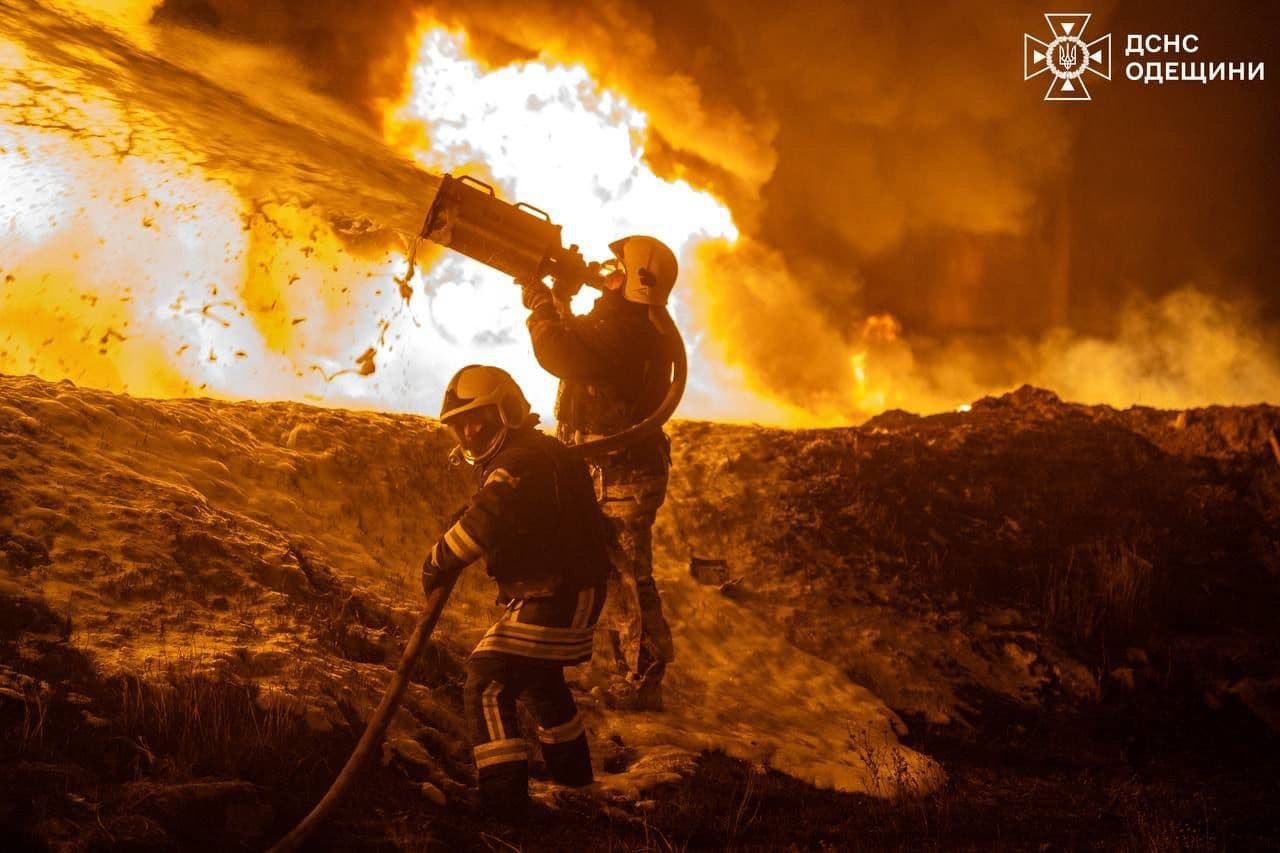
Firefighters of Ukraine’s State Emergency Service (DSNS) extinguish a large-scale fire following a Russian overnight attack on Odesa. (DSNS/Telegram)
Overnight February 14–15, Moscow launched 83 drones at Ukraine. Ukrainian air defenses shot down or suppressed 55; 25 reached targets across 12 locations. Energy, civilian, and railway infrastructure were hit in Odesa, Donetsk, Zaporizhia, Dnipropetrovsk, and Sumy oblasts.
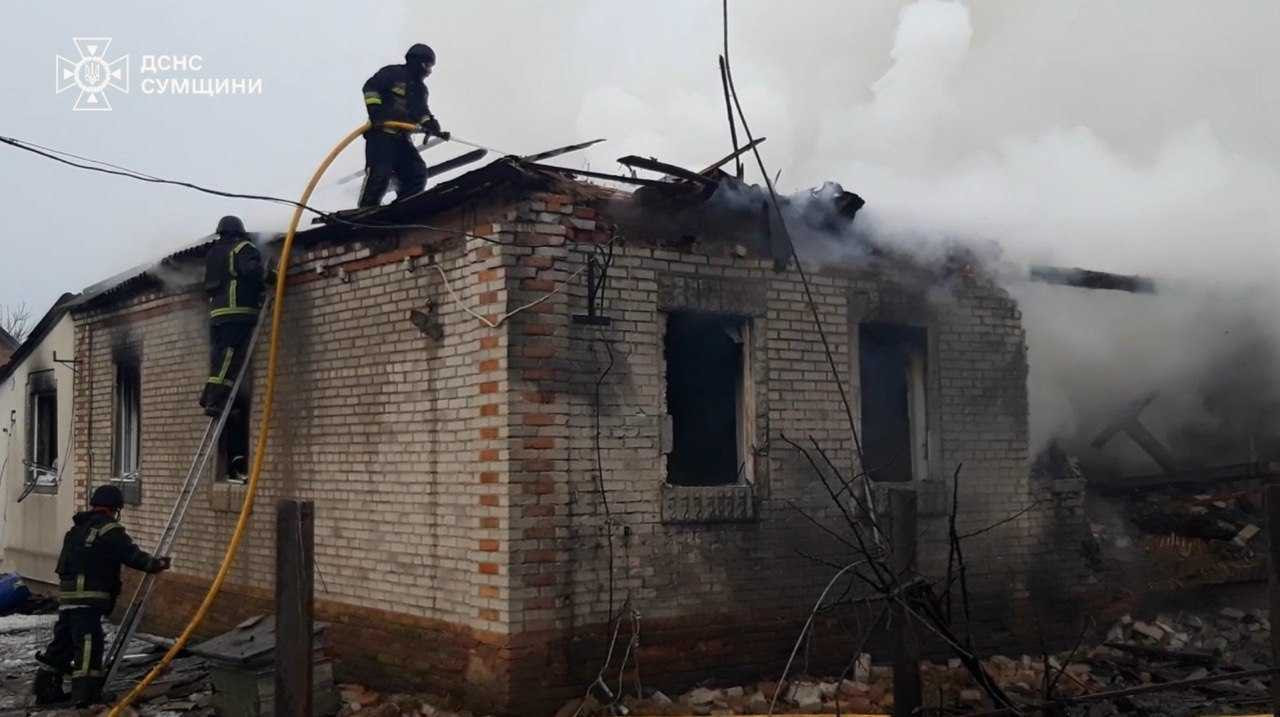
Firefighters extinguish a house fire after a Russia drone struck the home in the town of Okhtyrka in Sumy Oblast. (Ukraine’s State Emergency Service)
At least three people were killed and 15 injured in the past day. In Kherson Oblast, two died and five were wounded. In Zaporizhzhia Oblast, one was killed and seven injured as 658 strikes hit 33 settlements. In Odesa, railway infrastructure was damaged and a fuel tank caught fire.
President Zelensky said Russia launched roughly 1,300 drones, more than 1,200 glide bombs, and over 50 missiles—nearly all ballistic—against Ukraine in the previous week, deliberately targeting power generation and substations.
Oil tanks burn in Krasnodar. Power grids falter in Kherson.
Neither side can stop the other. Both keep striking.
Missiles Promised, Winter Pressing: Munich’s Test of Follow-Through
Late in the evening, Volodymyr Zelensky addressed the nation from Munich.
Behind the diplomatic choreography, he said, there were concrete results: new support packages, centered on air defense missiles to counter ballistic strikes. He had spoken with virtually every leader capable of helping. Agreements were reached with leaders of the Berlin Format for “specific packages of energy and military aid,” slated for delivery by February 24—the fourth anniversary of Russia’s full-scale invasion.
The clock matters.
Within the next week, Zelensky expects additional “energy packages” focused on recovery equipment and grid repair. Ukrainian cities, including Kyiv, are absorbing mass missile and drone attacks against power stations and substations while temperatures remain below freezing. The strikes have deepened a nationwide energy crisis already straining households and industry.
He warned that further large-scale attacks could come in the days ahead. Russia has used winter before. It will try again.
“Air defense is a daily necessity,” Zelensky said.
Missile interceptors are not symbolic. They are heat in apartments, light in hospitals, trains that run on time, factories that restart after impact. Every delay between commitment and delivery leaves a gap.
Munich produced promises. Timelines are now attached.
Winter does not wait for paperwork.
The Day’s Meaning
Two wars unfolded at once.
In Moscow, officials spoke of UN “external governance” and one-day ceasefires for elections. In Zaporizhia, Ukrainian troops crossed the Yanchur and Haichur rivers and pushed Russian units back kilometers from positions they had held for weeks. On paper, 12 settlements seized. On the ground, rivers changing hands.
The contrast revealed something fundamental.
Russia’s diplomatic strategy seeks leverage over Ukraine’s political future—elections during active war, UN administration subject to veto power, legitimacy defined on Kremlin terms. The offer of ballots under bombardment was less about democracy than about narrative positioning: create grounds to reject any outcome Moscow does not control.
Meanwhile, the battlefield refused to cooperate with the storyline of steady Russian momentum. Tactical counterattacks disrupted preparations for a possible summer offensive. Gains measured in square kilometers fluctuated sharply week to week. Communications disruptions after the loss of Starlink access exposed vulnerabilities that Ukrainian forces exploited.
The numbers still matter. But they no longer speak with certainty.
Technology gaps widened. Deep strikes burned oil tanks in Krasnodar while Ukrainian cities absorbed missile barrages. Neither side stopped the other. Both kept paying the price.
Inside Ukraine, strain surfaced in other ways: a former energy minister detained in a corruption probe; enlistment officers hospitalized after clashes in Odesa; mobilization complaints nearly doubling year over year. War pressures every institution it touches.
Munich clarified lines but solved nothing. Ukraine insists security guarantees must precede concessions. The United States offers timelines. Russia rejects meaningful guarantees while demanding elections mid-conflict.
Diplomacy seeks advantage. The battlefield rewrites assumptions.
Momentum, like a river, can shift direction.
Pray For Ukraine
1. For Wisdom Over Manipulation
Pray that truth would prevail over political theater. Ask God to grant discernment to Ukraine’s leaders and to expose any attempt to distort justice, elections, or sovereignty for strategic gain. May integrity guide every decision made in Kyiv and beyond.
2. For Protection Along the Front Lines
Lift up Ukrainian soldiers holding newly regained positions along the rivers and across contested sectors. Pray for clarity in command, resilience in exhaustion, and protection in every engagement. Ask God to guard them physically and spiritually.
3. For Civilians Under Drone and Missile Fire
Intercede for families in Kherson, Zaporizhzhia, Odesa, and other regions facing daily strikes. Pray for those grieving loved ones, for the injured recovering in hospitals, and for protection over power grids, homes, and critical infrastructure during the winter cold.
4. For Unity Amid Internal Strain
Pray for healing where tensions have risen—between citizens and enlistment officers, within institutions, and across communities. Ask God to strengthen trust, fairness, and accountability so that Ukraine’s defense remains rooted in justice and dignity.
5. For Enduring Hope and True Security
Pray that promised air defense systems and energy support arrive swiftly and effectively. Ask God to frustrate violence, restrain aggression, and open a path toward a just and lasting peace grounded in security—not illusion.