
As Zelensky’s team arrived for ceasefire talks, Russia launched hypersonic missiles, tightened the Pokrovsk pocket, and left Kyiv freezing in the dark.
The Day’s Reckoning
Zelensky’s delegation stepped onto the tarmac in Geneva as Russian planners finalized coordinates for the next wave of energy strikes. In Kyiv, Mayor Vitali Klitschko told the Financial Times the capital stood on “the brink of catastrophe” while utility crews in minus twenty degrees fought to restore heat to 1,200 apartment buildings still cold after the February 12 missile strike. Hours earlier, four Zircon hypersonic missiles had lifted from occupied Crimea and cut across the winter sky.
Two realities moved at once.
In Switzerland, Ukraine arrived ready to formalize an unconditional ceasefire it had already accepted. Russia arrived with Vladimir Medinsky, Mikhail Galuzin, and GRU First Deputy Head Lieutenant General Vladimir Kostyukov—military intelligence seated at a peace table. The framework guiding them was Putin’s June 2024 doctrine. Not compromise. Capitulation.
Three thousand kilometers east, Ukrainian assault brigades along the Haichur River consolidated gains won over the weekend. The 82nd and 95th Air Assault. The 33rd and 475th Assault Infantry. Villages retaken. Russian lines bent backward. Starlink disruptions had cracked Russian command and control, and Ukrainian units pushed through the opening before it closed.
Kyiv still shivered. Twelve hundred buildings without heat. Rolling blackouts. Intelligence warnings of new massive strikes forming.
In a Kyiv courtroom, former Energy Minister Herman Halushchenko faced money laundering charges. In Odesa, a 56-year-old disabled veteran lay wounded after a car bombing the SBU called terrorism. A Russian drone operator, Miroslav Simonov, surrendered rather than execute orders that had wounded a 20-year-old civilian woman.
Geneva opened. Missiles flew. The battlefield and the negotiating table refused to agree on what this war was becoming.
The Spy at the Peace Table
Dmitry Peskov read the names slowly, as if this were routine diplomacy.
Vladimir Medinsky—veteran of the failed 2022 Brest talks, the man who walked away and later insisted Russia’s war aims had not shifted an inch. Mikhail Galuzin—the deputy foreign minister who, just one day earlier, floated UN administration of Ukraine and a one-day ceasefire for elections. And then the third name: Lieutenant General Vladimir Kostyukov, First Deputy Head of the GRU.
A military intelligence chief at a peace conference.
The signal was unmistakable.
Deputy Foreign Minister Sergei Ryabkov removed any lingering doubt. The delegation, he said, would operate within the framework allegedly discussed by Putin and Trump at the August 2025 Alaska Summit—principles rooted in Putin’s June 2024 Foreign Ministry speech. That speech demanded Ukrainian capitulation and NATO’s rollback from Eastern Europe.
Peskov called the Geneva agenda “broader” than Abu Dhabi, with territorial issues explicitly included.
Translation: Moscow was prepared to discuss how much Ukraine would surrender, not whether it would surrender at all.
Kirill Dmitriev, head of the Russian Direct Investment Fund, arrived separately for a US-Russian economic working group. Economic normalization threaded carefully beside territorial negotiation. Business incentives dangled in one room. Borders redrawn in another.
Zelensky landed with a different message. Ukraine had accepted what he called “realistic US proposals”—an unconditional, long-term ceasefire. Russia had rejected it and continued front-line assaults while striking cities and power plants.
“Russia cannot resist the temptation of the last days of winter cold,” Zelensky said. “The more of this evil comes from Russia, the harder it will be for everyone to reach any agreements.”
He warned that every delayed air defense shipment magnified the next strike already forming.
Geneva could host talks.
But missiles were already en route.
The Ceasefire That Reloads the Missiles
Before Geneva’s delegations even sat down, the trap was already on the table.
Rustem Umerov confirmed Ukraine would again propose a temporary moratorium on energy strikes—pause attacks on power plants, protect civilians through the final stretch of winter, create space for negotiations.
It sounded humane.
Russia had run this play before. Twice.
During the March–April 2025 moratorium, Moscow used the pause to stockpile drones and missiles. During the January–February 2026 moratorium—the one that had just ended—it rebuilt strike packages again, agreeing only after inflicting severe damage on Ukraine’s national grid. Even during that ceasefire, shutdowns continued. Years of accumulated destruction could not be reversed in weeks.
Zelensky had already reported that Russian strikes damaged every power plant in Ukraine. The grid was so degraded that major power disruptions persisted even when Russia temporarily stopped striking.
Any new moratorium would begin from catastrophe, not stability. Russia would gain time to rearm. Ukrainian engineers would race winter temperatures and failing infrastructure. The physics of repair would not bend to diplomatic language.
The pattern was not hypothetical. It was documented.
Pause the strikes.
Reload the arsenal.
Geneva would call it de-escalation. Moscow had twice treated it as preparation.
A Capital in the Cold
When Vitali Klitschko spoke to the Financial Times, he did not soften it.
“Right now, the question of the future of our country—whether we will survive as an independent country or not—is still open.”
Behind him stood a city two months into relentless bombardment. Russia had systematically targeted Kyiv’s three main power plants. At the worst point this winter, roughly half of the capital’s 12,000 apartment buildings lost heating. Crews clawed much of it back. But 1,200 buildings remained dark and cold as temperatures fell below minus twenty degrees, pressing down on 3.5 million residents.
The February 12 strike on the Darnytsia Thermal Power Plant cut heat to 2,600 high-rise buildings in Dniprovskyi and Darnytskyi districts. By nightfall, workers had restored 2,500.
That left 1,100.
City spokesperson Kateryna Pop delivered the blunt truth: those buildings would not be reconnected this winter. Not delayed. Not under repair. Impossible until spring.
Rolling blackouts continued as authorities rationed electricity. About 1,500 “invincibility centers” offered warmth, food, and internet. European partners shipped generators. Emergency crews repaired systems that new strikes knocked out again.
Klitschko acknowledged renewed friction with Zelensky—accusations of insufficient winter preparation from the president, counterclaims of political interference from the mayor. The tension surfaced even as both insisted unity was essential.
“Right now unity inside the country is the key for our peace and freedom,” Klitschko said.
Outside, blackout schedules rotated. Entire buildings remained unheated. And Russian planners prepared the next wave.
Hypersonic Winter: The Night the Zircons Came
Just after midnight, the radar screens began to light up.
Four Zircon hypersonic cruise missiles lifted from occupied Crimea. An Iskander-M ballistic missile followed from Bryansk Oblast. A Kh-31P anti-radiation missile streaked in from occupied Zaporizhia Oblast. Behind them came the swarm—62 drones launched from Kursk, Bryansk, Millerovo, Shatalovo in Smolensk Oblast, Primorsko-Akhtarsk in Krasnodar Krai, and occupied Hvardiiske in Crimea. Shahed, Gerbera, Italmas—roughly 40 of them Shaheds.
The strike package was calibrated to punch through Ukrainian air defenses.
Two Zircons fell from the sky. Fifty-two drones were shot down. But one missile and nine drones slipped through, striking eight locations. Debris rained down on two more.
Residential blocks. Energy infrastructure. Medical facilities. Railway lines in Kharkiv and Sumy oblasts.
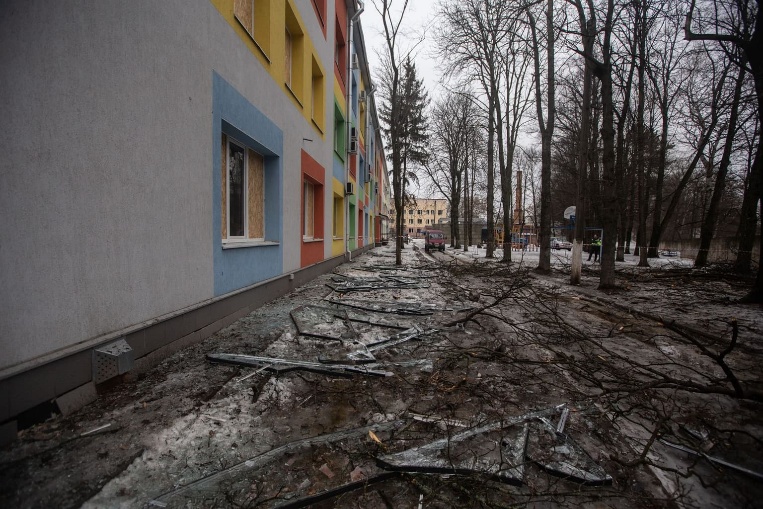
The aftermath of a Russian drone attack on a children’s hospital in Sumy, Ukraine, published. (Francisco Richart Barbeira/NurPhoto via Getty Images)
At least 13 people were injured. Six near Zaporizhzhia city. Three in Kharkiv Oblast, including a 15-year-old child in Tetianivka village. Two women in Sumy Oblast—ages 43 and 61—wounded by drone attacks. Two more injured in Kherson Oblast.
By morning, power outages spread across Donetsk, Dnipropetrovsk, Cherkasy, and Odesa oblasts. Ukrenergo reported a substantial number of consumers in Odesa remained without electricity after the overnight strikes.
The Zircon stood out. A hypersonic cruise missile designed for anti-ship warfare, now redirected at civilian infrastructure—launched from a peninsula Russia illegally annexed to strike a country it claimed lacked legitimacy.
The weapons were cutting-edge.
The targets were not.
The Window Opened on the Haichur
Along the Haichur River, the sound was not of retreat but of consolidation.
Ukrainian assault brigades spent the day tightening their grip on ground seized over the past week in Zaporizhia Oblast—gains Russian official channels denied even as pro-Kremlin milbloggers admitted the damage.
The 82nd and 95th Air Assault Brigades moved alongside the 33rd and 475th Assault Infantry Regiments across a 30-kilometer front near Hulyaipole. M1A1 Abrams tanks rolled forward. Swedish CV-90 infantry vehicles followed. Fortifications that had anchored Russian lines were cleared.
The 225th Assault Regiment confirmed fighting around two villages and reported 40 Russian troops killed in a single day near Hulyaipole.
The breakthrough hinged on silence—digital silence. Starlink disruptions crippled Russian data exchange. Units fell back on VHF radios, easily jammed. Russian unmanned ground vehicles went dark. Logistics troops switched to motorcycles and quad-cycles, exposed to drone strikes as they ferried supplies and evacuated casualties.
Ukrainian teams pressed into the vacuum.
Vidradne. Verbove. Prydorozhnie. Ternuvate. Recaptured. Fighting continued around Verbove. Smaller Ukrainian gains appeared near Mahdalynivka along the Zaporizhzhia-Vasylivka highway, near Sviatohirsk in Kharkiv sector, and near Chasiv Yar in Donetsk sector.
Konrad Muzyka of Rochan Consulting called it “a clear Ukrainian tactical success and a notable Russian setback,” noting Moscow failed to turn its earlier Haichur crossing into a durable foothold and failed to absorb the counterstroke that reversed more than a month of advances.
Russian state television correspondent Yevgeny Poddubny claimed all attacks were repelled.
Rybar’s Mikhail Zvinchuk wrote otherwise: “A difficult situation is developing… The enemy was able to enter the territory of Ternove, Kosivtseve and Pryluky, and also broke through to the outskirts of Olenokostiantynivka.”
Two narratives.
One battlefield.
Five Kilometers to Collapse
The 7th Rapid Reaction Corps did not dramatize it.
They measured it.
Five kilometers.
That was the narrowing distance between Russian-controlled ground pressing in from Kotlyne and Rodynske, tightening around the Pokrovsk-Myrnohrad agglomeration. From the northwest, small Russian assault groups slipped toward Hryshyne, eight kilometers from Pokrovsk, probing for seams in Ukrainian lines.
The pocket was shrinking.
Ukraine’s Eastern Operational Command confirmed its units still held northern Pokrovsk, where fighting continued street by street. In Myrnohrad, Russian forces reinforced the northern sector with heavy weaponry, preparing what commanders described as “an enveloping maneuver and subsequent assault.”
Ukrainian forces answered with eyes in the sky and steel in the ground. Aerial reconnaissance intensified. Likely assault routes were mined. On the night of February 15 to 16, Ukrainian strikes hit a Russian drone control point near Zatyshok and a communications hub near Novopavlivka—about seven kilometers from the frontline.
Geolocated footage showed Russian advances south of Hryshyne. Attacks fanned outward: near Pokrovsk itself; northwest toward Shevchenko and Novooleksandrivka; north near Rodynske and Bilytske; northeast near Zatyshok and Chervonyi Lyman; southwest near Kotlyne and Udachne; west toward Serhiivka.
Over the past day, Ukrainian forces reported 167 Russian troops killed and 19 wounded across the broader area, along with 13 vehicles, 43 drones, 15 shelters and ammunition depots, and a tank destroyed.
Pokrovsk has been a logistics lifeline for more than a year. Rail lines. Highways. Supply arteries.
If it falls, eastern Donetsk fractures.
For now, five kilometers remain.
The Factory of Flying Death
While infantry fought for meters, Moscow was building the next phase of the war in workshops and laboratories.
Dmitry Rogozin—former Roscosmos head and now a senator installed in occupied Zaporizhia—announced that the BARS-Sarmat Unmanned Systems Special Purpose Center was expanding. More roles. More combat units. New recruitment. BARS-Sarmat functions as Russia’s primary research and development hub for drone warfare, testing hardware and battlefield concepts before pushing successful designs across frontline units.
Its structure reads like an industrial blueprint for air war.
Strike detachments “Dnepr” and “Stalingrad” operate at depths of 30 to 35 kilometers. “Bagration” specializes in intercepting Ukrainian drones using unmanned systems. The “Ustinov Scientific and Technical Detachment” manufactures and upgrades equipment based on direct combat lessons.
A new specialty is emerging: the “soldier technologist.” Not merely a drone operator, but a translator between battlefield and lab—adapting technology in near real time.
Russia’s air interdiction campaign, which enabled advances through fall and winter 2025, is being institutionalized and scaled. Plans call for reorganizing BARS-Sarmat and at least five separate Unmanned Systems Forces regiments into six brigades to speed the spread of innovation across the military.
Ukraine adapts differently.
Denys Shtilierman, chief constructor at Fire Point, described the front: minus twenty degrees freezing cameras and wires, batteries draining in minutes, fibre-optic cable the only communication immune to jamming. High tech meets frostbite.
“We just put lard on them and it takes off. I’m laughing, but it’s how it is,” he said.
Same winter. Same sky.
Russia builds systems.
Ukraine improvises to survive them.
Arson for Hire: The GRU’s Shadow Returns to Europe
Western intelligence officials told the Financial Times that Russia’s military intelligence directorate has rebuilt its sabotage machine in Europe.
This time, it is using old Wagner bones.
Former Wagner recruiters—once tasked with finding Russians willing to fight in Ukraine—are now hunting for Europeans willing to set fires, vandalize property, or pose as Nazi propagandists across the continent. The GRU keeps distance: at least two layers between handlers and operatives. Plausible deniability built into the chain of command.
The target profile is deliberate. Europeans described as “economically vulnerable,” adrift, short on money or direction. The same demographic organized crime has long exploited—now recruited through a tighter, more centralized structure. The GRU replaces the criminal middlemen it once relied on with former Wagner networks under direct oversight.
The shift helps explain why sabotage activity appeared to taper in 2025. After waves of arrests and prosecutions across Europe, Moscow reassessed. Resources shifted toward the war in Ukraine. The European campaign was restructured rather than abandoned.
The new model trades scale for control. Fewer mass criminal networks. More individually recruited, financially motivated actors. Less noise. Lower exposure.
Former Wagner elements now serve intelligence needs instead of battlefield assaults, allowing the GRU to focus core resources on Ukraine while sustaining disruptive operations across Europe through a rebuilt, compartmentalized network.
The battlefield stretches beyond trenches.
And Europe remains inside it.
“Professor” in the Dock
Herman Halushchenko stood before Ukraine’s High Anti-Corruption Court one day after being detained while attempting to leave the country.
The former energy minister now faces charges of money laundering and organized crime.
NABU’s indictment traces the scheme back to February 2021. Investigators allege members of the criminal group created a fund in Anguilla designed to raise roughly $100 million in “investments,” listing Halushchenko’s family among its participants. The fund was reportedly led by a Seychelles and St. Kitts and Nevis citizen accused of providing laundering services.
The structure sprawled across jurisdictions.
Two shell companies in the Marshall Islands. A trust in St. Kitts and Nevis. Beneficiaries: Halushchenko’s ex-wife and four children. Over $112 million allegedly passed through former advisor Ihor Mironyuk during Halushchenko’s tenure as minister. More than $7.4 million transferred to accounts controlled by the family fund. An additional 1.3 million Swiss francs and 2.4 million euros withdrawn in cash and sent to Switzerland.
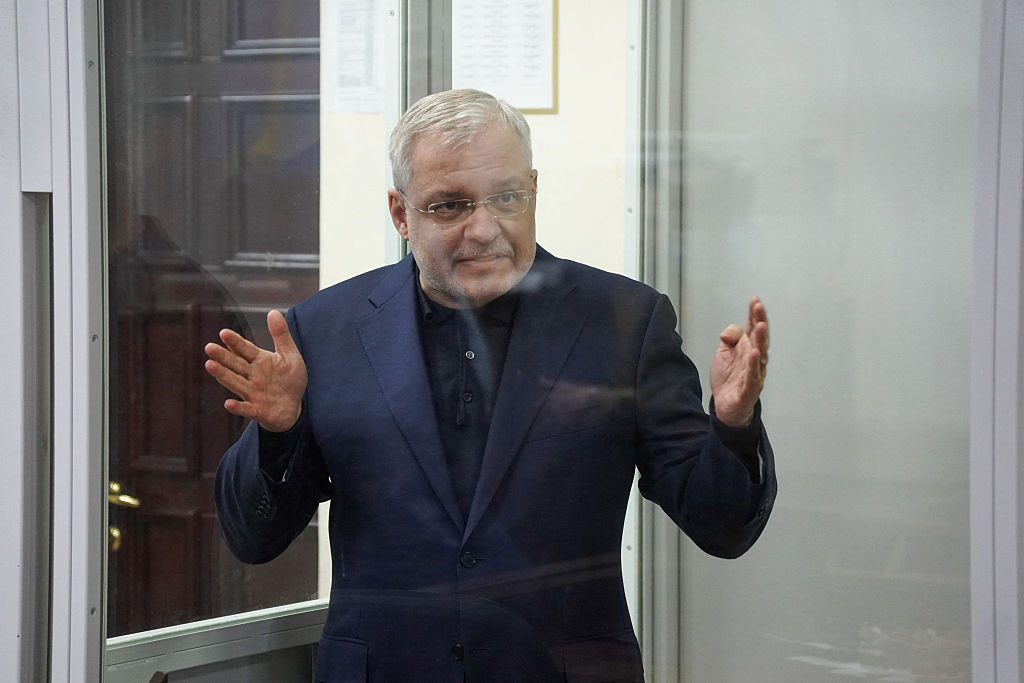
Former Energy Minister Herman Galushchenko attends a court hearing over his detention, in Kyiv, amid the Russian invasion of Ukraine. (Photo by Serhii Okunev / AFP via Getty Images)
Investigators say the money financed children’s education at elite Swiss institutions, personal accounts, and investment deposits. Audio recordings released by NABU reportedly captured suspects dividing kickbacks. In those conversations, Halushchenko appeared under code names: “Professor.” “Sigismund.”
The court partly upheld his lawyers’ claim that his detention was unlawful—but refused to release him. A preventive measure remains pending. If convicted, he faces up to 12 years in prison.
NABU is coordinating with authorities in 15 countries. Prosecutors describe it as the largest corruption case of Zelensky’s presidency, naming Timur Mindich—an associate of the president—as the alleged ringleader.
War on the front.
War in the courtroom.
The Drone Operator Who Walked Away
Miroslav Simonov did not flee the battlefield.
He crossed it.
A soldier in Russia’s elite Rubikon drone unit surrendered through Ukraine’s “I Want to Live” project, telling coordinators he could no longer execute the orders he was given.
He said he had been coerced into service under threat of criminal charges. Trained first as assault infantry. Then reassigned to UAV operations. Eventually transferred into Rubikon—a GRU-funded unit operating away from the immediate front with advanced drones and electronic warfare systems.
Inside the unit, Simonov described constant psychological pressure, verbal abuse, and threats of being sent to “meat” assault units for minor infractions.
The breaking point came during a strike gone wrong.
A Russian drone hit incorrect coordinates and seriously wounded a 20-year-old woman. Commanders approved the strike. In the group chat, members minimized the civilian harm. One operator told Simonov that frontline cities no longer contained civilians—only “Ukrainian soldiers or people working for them.”
“I saw support from the command for those who did it,” Simonov said. “That made me both angry and scared.”
He forged documents and tried to leave Russia for Kazakhstan. He was detained and sent back to the front as assault infantry. From there, he contacted the surrender project.
Ukrainian forces guided him safely to their positions.
Simonov says he wants to fight on Ukraine’s side.
“They destroyed not only my life, but the lives of many others. I want to defend your home.”
Fire Across the Border
The flames were on Russian soil this time.
Overnight, Ukrainian strikes hit energy infrastructure in multiple regions. In Belgorod Oblast, Governor Vyacheslav Gladkov acknowledged significant damage to energy facilities. Lieutenant Andriy Kovalenko posted images of fire near the Belgorod Combined Heat and Power Plant—orange light against a winter sky.
In Bryansk Oblast, footage showed an electrical substation burning near Vygonichi. Governor Alexander Bogomaz confirmed power and heating outages across five municipalities and part of Bryansk City.
The strikes went deeper than transformers.
Ukrainian military intelligence released footage from the elite Prymary—“Ghosts”—unit operating in occupied Crimea. Their targets: a Pantsir air defense system, a 55Zh6U Nebo-U long-range radar station valued at approximately $100 million, and a BK-16 landing craft. The SBU separately reported that its Alpha unit had destroyed half of Russia’s stockpile of Pantsir systems.
On February 15 and 16, Ukrainian forces also struck Russian military concentrations in occupied Donetsk, Zaporizhzhia, and Dnipropetrovsk oblasts, hitting troop assembly areas, a communications hub, and a drone control center in occupied eastern Donetsk Oblast.
One Ukrainian FP-5 Flamingo cruise missile previously reached Russia’s Kapustin Yar launch site in Astrakhan Oblast but failed to hit its intended target. New satellite imagery showed a six-meter crater near a preparation area fence. A Russian milblogger claimed four Flamingo missiles were launched in that strike package. Ukrainian production of the Flamingo—disrupted by an earlier Russian attack—has since relocated and partially resumed.
The war’s geography keeps expanding.
So do its targets.
No More Barrels for Moscow
Zagreb drew a line.
Croatia refused to transport Russian oil to Hungary and Slovakia, with Economy Minister Ante Susnjar declaring his government would not allow Central Europe’s fuel supply to become a channel for funding war.
The dispute centers on the Druzhba pipeline through Ukraine—halted since late January after relentless Russian strikes on Ukrainian energy infrastructure. Hungary and Slovakia asked Croatia to route Russian crude through the Adria pipeline instead. Budapest’s foreign minister blamed Kyiv, accusing Ukraine of stopping flows for “political reasons.”
Kyiv rejected that outright.
Ukrainian Foreign Minister Andrii Sybiha posted an image of the Druzhba pipeline burning after a rare Russian strike on it inside Ukrainian territory.
“Hungary made no protest to Russia about it. They could not even pronounce the word ‘Russia,’” Sybiha wrote. “The truth is that Moscow stopped being a reliable supplier the moment it launched its aggression against Ukraine.”
Croatia’s answer was blunt. A barrel of Russian oil might appear cheaper, Susnjar said, but it helps finance attacks on Ukrainian civilians. It is time to stop that war profiteering. No EU country, he argued, has any technical excuse left for dependence on Russian crude.
Druzhba remains a lifeline for Hungary and Slovakia—the only EU members still importing Russian oil through the system.
Now that lifeline runs into a political barricade.
“We Will Strike Deep”: The Baltic Warning to Moscow
On the sidelines of the Munich Security Conference, Estonia’s foreign minister did not hedge.
“We’ll bring the war to Russia and we’ll have very deep strikes very far into Russia,” Margus Tsahkna told The Telegraph. “We know exactly what to do.”
It was NATO’s bluntest public signal yet.
Across Europe, concern has been building as Russia probes alliance defenses—drone and fighter jet incursions near NATO airspace, troop buildups along Finland’s border, upgraded bases, restructured western military districts, and the steady militarization of Kaliningrad.
The Baltics are not waiting.
Estonia, Latvia, and Lithuania are planning defense budgets at 5 to 6 percent of GDP. Estonia has passed legislation requiring new buildings to include bunkers. Latvia has urged residents to convert basements into air raid shelters.
In Munich, Lithuanian Foreign Minister Kestutis Budrys sharpened the message further, dismissing talk of “Article 5-like” security guarantees for Ukraine as hollow.
“There can be nothing similar to Article 5,” Budrys said. “Because Article 5 means that if you are in trouble, I promise you that I will come and if it is needed, I will die for you.”
Real guarantees, he argued, mean forces that actually arrive.
NATO prepares for confrontation even as Russia sits at a negotiating table in Geneva. One track speaks of diplomacy. The other prepares for war.
Both move forward.
Bombs in Odesa, Pressure from Within
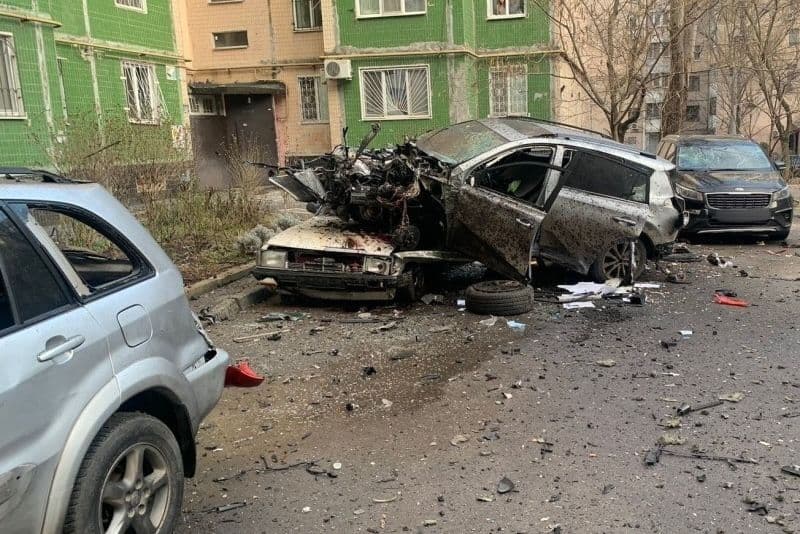
Vehicles damaged in an explosion in Odesa, Odesa Oblast, which also injured a Ukrainian veteran. (The National Police)
The explosion tore through a car in Odesa just after morning light.
Inside was a 56-year-old disabled Ukrainian veteran. He survived. He was hospitalized. The Security Service of Ukraine classified the blast as a terrorist attack and opened a criminal investigation.
It was the second car bombing in the city in ten days targeting current or former service members. Ten days earlier, a 21-year-old Ukrainian soldier was killed in a nearly identical vehicle explosion. That, too, was labeled terrorism.
The pattern is familiar.
Russian intelligence services continue subversive operations inside Ukrainian cities, recruiting Ukrainian citizens—including minors—to carry out attacks. Car bombs against military personnel are not random violence. They are pressure tactics, meant to fracture morale while conventional fighting grinds on at the front.
The war is not only trench lines and artillery arcs. It is also ignition switches.
Elsewhere, Ukraine’s Economic Security Bureau opened another front—this one against the shadow fuel market. It launched a Telegram bot, StopShadowBot, to crowdsource reports of illegal gasoline traders. Detectives seized fuel and equipment worth over 250 million hryvnias in the past year—three times more than in 2024. Seventy-six illegal gas stations were shut down in 2025, with 22 more closed in January alone. Legal fuel revenues rose by more than 23 billion hryvnias as enforcement tightened.
Bombs target veterans.
Investigators target corruption.
Both fights unfold behind the lines.
She Fled the War. It Followed Her.
Kateryna Tovmash was 21 years old when she was shot and killed in her home in Woodlake, North Carolina.
Beside her, her 28-year-old partner, Matthew Wade, was also killed.
Police say the suspect, 25-year-old Caleb Hayden Fosnaugh—her ex-boyfriend—traveled to the residence, entered unlawfully, and forced Kateryna’s six-year-old brother to show him where she was sleeping. Two school-age sisters were in the house at the time. All three children survived physically unharmed.
Kateryna was from Bila Tserkva. She fled Ukraine after Russia’s full-scale invasion and had been living in the United States for about two years.
Her brother Mykhailo wrote what the headlines could not hold: “A refugee who fled the war in Ukraine seeking safety in the United States was murdered in her own home.”
The suspect was arrested in Ohio later that same day.
It was the second killing of a Ukrainian refugee in North Carolina in less than a year. In the previous case, Iryna Zarutska was fatally stabbed on a Charlotte train in what authorities described as an unprovoked attack.
Kateryna escaped a country under missile fire.
She did not escape violence.
The Day’s Meaning: Diplomacy Under Missile Fire
Geneva’s conference rooms filled as Zircon missiles cut through Ukrainian skies.
Russia sent military intelligence to the negotiating table even as its weapons struck Kharkiv. Zelensky’s delegation arrived ready for an unconditional ceasefire Moscow had already rejected. In Kyiv, Mayor Klitschko warned the capital stood on the brink while utility crews, in minus-twenty cold, restored heat to 2,500 buildings in a single day—leaving 1,100 beyond repair this winter.
The contradiction was not subtle.
Geneva suggested words might end what weapons have sustained for 1,454 days. But Russia’s delegation—Medinsky, Galuzin, a GRU general—signaled a different intention: delay, consolidate, return to force. Ukraine’s proposed energy moratorium had twice allowed Russia to rearm and resume strikes. The pattern was known. The risk of repetition hung over the talks.
On the Haichur River, Ukrainian assault brigades reversed a month of Russian advances in five days. A Starlink disruption fractured Russian coordination; mechanized units exploited the opening. Russian state television denied the setback. Russian milbloggers admitted it. The battlefield decided.
Elsewhere, the war showed its other faces. A GRU drone operator surrendered rather than accept civilian casualties as routine. A former energy minister stood in a Kyiv courtroom facing corruption charges. A Ukrainian refugee who escaped invasion was murdered in North Carolina. Croatia refused to route Russian oil, calling it war profiteering.
Frontline and courtroom. Power plant and peace table. Frozen street and Swiss hotel lobby.
Geneva opened.
The strikes continued.
Another day added weight to questions still unanswered.
Prayer For Ukraine
- Pray for protection over Ukraine’s cities under renewed strike threats.
As missiles hit Kharkiv and energy facilities remain vulnerable, ask God to shield civilians, first responders, and infrastructure workers racing to keep heat and power flowing in the bitter cold. - Pray for wisdom and resolve in the Geneva negotiations.
With talks underway even as fighting continues, pray that truth prevails over deception, that delay tactics are exposed, and that any path toward peace protects Ukraine’s sovereignty and people. - Pray for strength for soldiers defending critical fronts.
Lift up Ukrainian forces holding Pokrovsk and consolidating gains along the Haichur River. Ask for protection, clarity in command, endurance in winter conditions, and courage in the face of relentless pressure. - Pray for justice and integrity within Ukraine.
As major corruption charges unfold in court and internal security threats surface in Odesa, pray that wrongdoing is exposed, institutions are strengthened, and unity deepens rather than fractures. - Pray for hearts affected by war beyond the battlefield.
Remember the surrendered Russian drone operator, the grieving family of Kateryna Tovmash, and refugees worldwide. Pray for repentance where evil has taken root, comfort for the mourning, and hope for those who fled seeking safety.