
Five European intelligence chiefs confirm Putin’s war aims go far beyond territory—while Lavrov demands annexation recognition and Russian Geran “mothership” drones push deeper into Ukraine’s rear.
The Day’s Reckoning
The Reuters call went out quietly. Five European intelligence chiefs, speaking anonymously, said what Moscow has hinted at for months: Vladimir Putin does not want a quick end to the war.
One of them put it plainly. The Kremlin’s goals have not changed—remove Volodymyr Zelensky. Impose Ukrainian neutrality. Force political submission, not just territorial concessions. Even if Kyiv surrendered the rest of Donetsk Oblast, the demand list would grow.
In Riyadh, Sergei Lavrov sharpened the message. On Saudi television, he invoked an alleged “Alaska understanding,” claiming Moscow and Washington had already discussed terms rooted in Russia’s long-stated demands. Recognition of the illegal annexations of Luhansk, Donetsk, Zaporizhia, and Kherson. Acceptance that Ukraine—not Russia—was the obstacle to peace. Rejection of Western security guarantees.
And one more condition: any future Ukrainian government must be “friendly” and “benevolent” toward Moscow.
Translation: elections alone would not be enough.
European intelligence assessments added another layer. Putin does not need peace immediately. The Russian economy, strained but functional, can absorb the pressure for now. The real financial reckoning may come in late 2026, when sanctions and borrowing costs bite harder. Better, from the Kremlin’s perspective, to force capitulation before that moment arrives.
While diplomats traded phrases, the war kept moving. Ukraine’s defense industry announced production had grown fiftyfold since 2022. Sweden pledged $1.4 billion in new military aid. Russian forces field-tested Geran-2 “mothership” drones over Sumy. Ukrainian troops edged forward in Kupyansk even as Russian units advanced near Nykyforivka. An oil depot burned in Pskov. Nine civilians were injured. Thirty-seven drones crossed the sky.
Intelligence warnings. Diplomatic ultimatums. Technological adaptation.
The gap between negotiation theater and battlefield reality did not narrow. It widened.
They Said It Plainly: This War Is About Control, Not Land
The message did not come from Kyiv. It came from inside Europe’s intelligence community.
Five senior European intelligence chiefs, speaking anonymously to Reuters, delivered the assessment in quiet, measured language: Vladimir Putin does not want this war to end quickly.
One of them distilled the Kremlin’s objective to its core. The goal remains unchanged—remove Volodymyr Zelensky. Impose Ukrainian neutrality. And even if Kyiv surrendered the remainder of Donetsk Oblast, it would not be enough. The demand list would expand. It always does.
This aligns with what Moscow has signaled for years. The war was never just about eastern territory. It was about reshaping NATO itself. Forcing Ukraine to abandon its membership aspirations. Crippling Ukraine’s military so it could not defend itself. Replacing its elected government with one loyal to the Kremlin.
Control, not compromise.
One intelligence chief identified what he called the “main issue”: Putin neither wants nor needs immediate peace. Russia’s economy is strained but not collapsing. That gives Moscow time. Another source warned of “very high” financial risks emerging in the second half of 2026, when sanctions and high borrowing costs may choke Russia’s access to capital markets.
For now, however, the Kremlin appears convinced it can endure.
The numbers tell part of the story. Military spending is unsustainably high. Labor shortages deepen. The sovereign wealth fund shrinks. Bloomberg reported Russian oil producers drilled 3.4 percent fewer production wells this year, as sanctions and a strong ruble squeezed revenue. Oil and gas income fell to a five-year low.
But Putin’s theory of victory rests on endurance—that Russia can outlast Ukraine’s defenses and Western resolve.
Which is why negotiations matter now.
Before the economic bill comes due.
“Friendly and Benevolent”: Lavrov’s Terms for Ukraine’s Future
Sergei Lavrov chose his audience carefully.
On Saudi Arabia’s state-owned Al-Arabiya television, Russia’s foreign minister delivered his latest message to the world—polished, deliberate, and aimed far beyond Moscow. It was one more stop in a series of interviews targeting international viewers.
He invoked what he called the “Alaska understanding.” According to Lavrov, Russian and U.S. delegations discussed it during the Geneva talks—an alleged framework rooted in agreements the Kremlin claims were reached at the August 2025 Alaska Summit. Those alleged understandings, he suggested, were built on Vladimir Putin’s public demands for Ukrainian and NATO capitulation.
Lavrov said the “root causes” of the war had to be addressed. Translation: Ukraine must abandon its NATO aspirations. Kyiv must answer for alleged discrimination against ethnic Russians and the Kremlin-backed Ukrainian Orthodox Church–Moscow Patriarchate.
He demanded formal recognition of Russia’s illegal annexation of Luhansk, Donetsk, Zaporizhia, and Kherson oblasts.
He insisted Ukraine had been the “main obstacle” to peace since 2014. He blamed the European Union for the collapse of the Minsk Agreements—without acknowledging Russia’s documented violations and obstruction of those accords. He denounced Western security guarantees for Ukraine as threats to Russia itself.
Then came the clearest condition.
Any future Ukrainian government, Lavrov said, must be “friendly” toward Russia. “Benevolent.”
The implication was unmistakable. Elections alone would not satisfy the Kremlin. A democratically elected Ukrainian government that resisted Moscow’s influence would remain unacceptable.
This was not simply a demand for territory.
It was a demand for political alignment.
The $14 Trillion Temptation: Moscow’s Parallel Negotiation
While diplomats discuss ending the war, another conversation runs alongside it.
Four European intelligence sources told Reuters that the Kremlin has spent the past year using talks with the United States to push for sanctions relief and bilateral business deals. Two of those sources said Moscow is deliberately trying to separate discussions about Ukraine from discussions about U.S.–Russian economic cooperation.
Split the tracks. Keep the war on one table. Put money on another.
Kirill Dmitriev, head of Russia’s Direct Investment Fund, argued U.S. sanctions have cost American businesses heavily and claimed lifting them would serve U.S. interests. Kremlin spokesperson Dmitry Peskov called the sanctions “illegal,” saying they hinder trade and economic cooperation. He urged both countries to “revive” relations for mutual benefit.
Lavrov confirmed that bilateral economic working groups are operating alongside ongoing trilateral U.S.–Ukrainian–Russian talks aimed at resolving the war.
Then came the number meant to turn heads.
Dmitriev claimed lifting sanctions could unlock joint U.S.–Russia projects worth more than $14 trillion, with a portfolio allegedly exceeding that figure.
Intelligence officials assess the approach as strategic: use economic carrots unrelated to the battlefield to push Washington toward concessions tied to Russia’s war demands.
In this negotiation, the promise of profit becomes leverage.
From Workshops to War Engine: Ukraine’s Defense Industry Surges Fiftyfold
Inside factories once built for peacetime contracts, production lines now run for survival.
Hanna Gvozdiar, advisor to Ukraine’s defense minister, reported that Ukraine’s defense industrial base has increased output fiftyfold since the full-scale invasion began. The total value now stands at an estimated $50 billion. More than half of the Ukrainian military’s needs are supplied domestically.
A country that once relied heavily on foreign deliveries is building its own arsenal.
Joint production facilities with European states are expanding. Ukraine is no longer only a recipient of weapons; it is becoming a manufacturer integrated into European defense networks.
Stockholm reinforced that shift. Sweden announced a new military aid package worth nearly 12.9 billion Swedish kronor—about $1.4 billion. The package includes short-range air defense systems such as the Tridon, ammunition, long-range drone cooperation projects, and unmanned surface vehicles.
The Tridon is a self-propelled, remotely controlled 40mm anti-aircraft artillery system. Designed to combat drones, cruise missiles, aircraft, and armored vehicles, it entered service in 2022.
The Swedish package also funds long-range artillery shells, additional 40mm air defense rounds, and 12cm grenade launcher ammunition.
Since 2023, Kyiv has pursued a long-term goal: self-sufficiency. Western financial and security assistance has accelerated that effort. Air defenses remain critical—not only to shield cities, but to protect the very factories producing the next wave of weapons.
Joint Ukrainian-European facilities outside Ukraine add another layer of resilience.
Production continues.
Even under fire.
The Drone That Carries Drones: Geran-2’s New Role Over Ukraine
The aircraft hums high above Sumy Oblast, steady and mechanical.
Then something drops.
A Russian milblogger posted footage showing a Geran-2 drone releasing a smaller first-person view drone mid-flight. The larger drone does not dive. It keeps moving, continuing toward its own target while the smaller FPV separates and speeds off independently.
Russian forces, according to the milblogger, are now using Geran drones as airborne “motherships”—carrying FPV drones deeper into Ukraine’s rear and acting as signal repeaters. The FPVs detach as they approach intended targets, extending range and control.
Another milblogger suggested the adaptation became especially important after Russian units lost access to Starlink terminals.
This is not the first iteration. Ukrainian Defense Ministry advisor Serhiy “Flash” Beskrestnov previously reported Russian forces experimented with Gerbera drones—the cheaper decoy version of Shahed/Geran—as motherships for strike or reconnaissance FPVs. Russian forces also used Molniya fixed-wing FPV drones in similar roles.
But Gerbera drones carry minimal or no explosive payloads. They crash or detonate in small blasts.
The Geran-2 is different.
It can release an FPV drone and still continue toward its own strike objective. If carrying reconnaissance FPVs, it can use them to confirm or adjust its primary attack.
One drone becomes two.
And the sky becomes more complicated.
Kill Zones and Burning Fuel: Kupyansk Shifts While Pskov Smolders
In central Kupyansk, the line moved.
Geolocated footage showed Ukrainian forces edging forward in the city’s central blocks. Colonel Viktor Trehubov, spokesperson for the Ukrainian Joint Forces Task Force, said only 30 to 40 Russian personnel remained there—too few to mount effective offensive operations, lacking the combat power to properly defend their positions.
An officer operating in the Kupyansk direction described a battlefield reshaped by technology and weather. Starlink blocking reduced Russian drone attacks. Warmer temperatures flooded Russian positions and made the Oskil River impassable.
Above and behind those lines, Ukrainian drones stretched the battlefield outward. A Ukrainian drone battalion commander said Russian forces had limited equipment left and were reluctant to deploy it because Ukrainian “kill zones”—areas of heightened drone strike risk—now extend several dozen kilometers into Russian rear areas. Reconnaissance assets map movements. Fiber-optic drones bypass Russian electronic warfare. Bomber drones strike shelters.
Yet the front is not static. Russian forces advanced in central Nykyforivka, southeast of Slovyansk, confirmed by geolocated footage.
And far from the front, Pskov burned.
Ukrainian intelligence sources told Suspilne that SBU units struck the Velikolukskaya oil depot overnight. Video showed flames rising from the site despite anti-drone netting placed around the facility. The Pskov Oblast governor acknowledged the strike set an oil tank on fire.
A marginal gain in Kupyansk. An advance in Nykyforivka. An oil depot aflame deep inside Russia.
The war stretches in both directions.
Fuel as Leverage: Hungary and Slovakia Close the Tap
In Budapest and Bratislava, the pressure shifted from the battlefield to the fuel line.
Hungary and Slovakia announced they were halting diesel exports to Ukraine, citing the suspension of Russian oil transit through the Druzhba pipeline. What had been a supply route became a bargaining point.
Hungarian Foreign Minister Peter Szijjarto accused Kyiv directly. “President Zelensky has decided not to restart oil transit for political reasons, deliberately putting Hungary’s energy supply at risk,” he said. He reminded listeners that Hungary plays a key role in supplying Ukraine with energy. “A large part of Ukraine’s gas, electricity and diesel imports arrives through or from Hungary.”
Slovak Prime Minister Robert Fico followed with action. Slovnaft, Slovakia’s oil refining company, would stop all fuel exports to Ukraine and redirect production to the domestic market.
The disruption traces back to late January, when transit through the Druzhba pipeline halted after Russian strikes hit Ukraine’s energy infrastructure. Ukrainian Foreign Minister Andriy Sybiha posted an image of the Druzhba line burning after a rare Russian strike on the pipeline on Ukrainian territory. Kyiv has also targeted sections of the pipeline inside Russia as part of its broader campaign against Russia’s energy sector.
The Druzhba system—capacity roughly 2 million barrels per day—remains one of the world’s largest oil pipelines. Hungary and Slovakia are the only EU countries still importing Russian crude through it.
Now diesel becomes leverage.
And energy becomes another front.
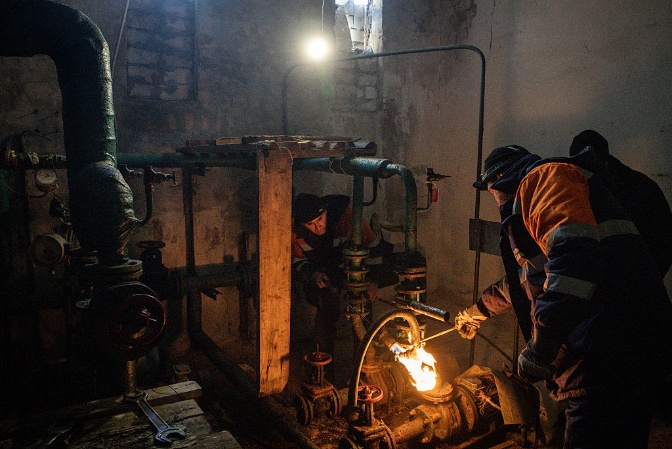
Mechanics use a blowtorch to thaw frozen pipes during emergency repairs after Russian strikes on critical power infrastructure cut electricity, leaving homes without heat in Kyiv, Ukraine. (Chris McGrath / Getty Images)
A Quieter Sky, But Not Peace
The drones came again.
Russia launched 37 overnight. Ukrainian air defenses intercepted or jammed 29. Four locations were struck.
At least nine civilians were injured.
In Chernihiv Oblast, a 49-year-old man was wounded by a ballistic missile. Two people were injured in Ray-Oleksandrivka, Donetsk Oblast. Five were hurt in Kherson Oblast as 22 municipalities fell under fire. In Zaporizhzhia Oblast, a six-year-old child was injured.
By recent standards, the night was quiet.
Sumy and Dnipropetrovsk oblasts—both battered in recent weeks—reported evenings that spared their civilian populations.
But even a quieter night still leaves wounds.
The Day’s Meaning
Five intelligence chiefs said it out loud: this war was never just about land.
The assessment from European services confirmed that Vladimir Putin’s objectives remain political and structural—remove Volodymyr Zelensky, impose Ukrainian neutrality, reshape NATO’s security architecture, and limit Ukraine’s military so it cannot defend itself. Even surrendering the remainder of Donetsk Oblast would not close the ledger. The demands would continue.
Sergei Lavrov’s words reinforced that conclusion. Recognition of illegal annexations. Ukraine cast as the “main obstacle.” A future government required to be “friendly” and “benevolent.” Translation: sovereignty conditioned on obedience.
Intelligence officials see no urgency in Moscow for peace. Russia’s economy is strained but functioning. The true pressure point may arrive in late 2026, when sanctions and borrowing costs intensify. That timeline explains the present push—secure capitulation before harder economic choices arrive.
Meanwhile, carrots accompany coercion. A proposed $14 trillion portfolio of joint U.S.–Russia projects. Claims that sanctions cost American businesses $300 billion. Parallel economic working groups running alongside war talks. Separate the profit from the battlefield.
On the ground, the trends are equally clear. Ukraine’s defense industry has multiplied production fiftyfold to $50 billion, now supplying over half its military’s needs, backed by Sweden’s $1.4 billion package and Tridon air defenses. Russia adapts Geran-2 drones into FPV-carrying platforms. Ukrainian forces extend “kill zones” deep into Russian rear areas. Hungary and Slovakia halt diesel exports as Druzhba remains suspended. Thirty-seven drones cross the sky; nine civilians are injured.
The pattern holds.
Strategic maximalism. Tactical adaptation. Economic maneuvering. Diplomatic theater.
The gap between declared objectives and negotiated language is not narrowing.
It is clarifying.
Prayer For Ukraine
1. For Sovereignty Without Submission
Lord, as intelligence chiefs warn that this war is about overthrow, not territory, we ask You to guard Ukraine’s freedom. Protect its leaders from coercion, its institutions from manipulation, and its future from being shaped by foreign demands disguised as negotiation. Let no pressure—military or diplomatic—steal what You have given this nation: the right to choose its own path.
2. For Wisdom in Diplomacy and Strength in Resolve
As ultimatums are spoken and “understandings” are invoked, grant Ukrainian negotiators clarity and courage. Expose deception. Strengthen allied unity. Let truth cut through propaganda, and let any talks be grounded in justice, not capitulation.
3. For Protection From Evolving Weapons
With Geran drones now carrying FPV weapons deeper into Ukraine’s rear, we pray for protection over cities, factories, and front lines. Shield soldiers in Kupyansk. Guard those who live far from the battlefield but still under threat. Confound systems designed to harm and preserve innocent life.
4. For Provision and Resilience
Thank You for the fiftyfold growth of Ukraine’s defense production and for Sweden’s new aid package. Sustain this momentum. Protect industrial sites from long-range strikes. Provide resources, ingenuity, and endurance so Ukraine can defend itself without exhaustion.
5. For Civilians Under Fire
For the nine injured this night—the 49-year-old man in Chernihiv, the wounded in Donetsk and Kherson, the six-year-old child in Zaporizhzhia—we ask for healing and comfort. Let quieter nights become normal, not rare. Shelter families in Sumy and Dnipropetrovsk who finally felt relief.