
On the war’s fourth anniversary, Putin prepared Russians for new sacrifice while Ukrainian drones set the Druzhba oil artery ablaze 1,200 kilometers inside Russia.
The Day’s Reckoning
February 23, 2026. Defender of the Fatherland Day.
In Moscow, Vladimir Putin stood beneath flags and spoke of duty. He honored soldiers. He also prepared the country to send more of them.
Inside the Kremlin, he met widows of men killed in Ukraine and promised the state would never forget their sacrifice. On another stage, Dmitry Medvedev appeared in a military uniform he has no rank to wear and urged troops to “take care of themselves.” The choreography was deliberate. Responsibility. Patriotism. Endurance. The language of tribute shading into the language of mobilization.
Far from the speeches, 1,200 kilometers east of Ukraine’s border, night shattered in Tatarstan. Six explosions tore through the Kaleykino oil pumping station, a key node feeding the Druzhba pipeline that carries Siberian crude toward Central Europe. Two massive tanks ignited. Smoke rose over Almetyevsk. Residents in Saratov and Engels reported blasts of their own. Russia’s rear no longer feels rear.
In southern Ukraine, another shift unfolded. Ukrainian forces announced the liberation of more than 400 square kilometers and eight settlements in the Oleksandrivka direction since late January. The figures vary depending on who counts and how “control” is defined. But the line is moving.
Across Europe, thousands marched in solidarity as the UN Secretary-General warned that the rule of force is spreading. Hungary blocked new EU sanctions. And in Lviv, Mykolaiv, and Dnipro, coordinated bombings targeted Ukrainian police, killing 23-year-old Viktoria Shpylka and wounding dozens.
Day 1,460 compressed four years of war into a single, unsettled frame.
The Word Before the Draft: Putin Primes Russia for the Next Call-Up
The word landed softly, then again, and again.
Responsibility.
On Defender of the Fatherland Day, Vladimir Putin stood beneath banners of the Red Army and returned to it with precision. Russian soldiers carry an “enormous responsibility” to the Motherland. Patriotism and responsibility unite all Russians, regardless of faith or nationality. The repetition was not accidental. It was scaffolding.
The Institute for the Study of War assessed the speech as preparation, not pageantry. Behind the ceremony lies groundwork for limited, rolling involuntary reserve callups — targeted conscription designed to avoid the shock of full mobilization while feeding the front. By invoking shared civic duty before announcing policy, the Kremlin is attempting to blunt anger before it surfaces.
Dmitry Medvedev reinforced the signal. He appeared beside troops in a military uniform he does not officially hold rank to wear. Russia “needs” victory, he said, but “the price of victory matters” — a rare public acknowledgment that losses are not abstract. He urged soldiers to care for themselves and their families, implying the state would not discard those summoned next.
Online censorship tightens. Space for criticism narrows. Benefits may shrink.
Putin met with widows and promised constant state attention. The Kremlin remembers Afghanistan. It remembers Chechnya. It remembers what organized grief can do.
The language of honor is being laid down before the language of mobilization.
Responsibility first. Then the draft.
The Night the Pipeline Burned: Ukraine Reaches 1,200 Kilometers Into Russia
At 2 a.m., Kaleykino was supposed to be quiet.
The pumping station in Tatarstan sits where Siberian crude converges before flowing into the Druzhba pipeline — the artery carrying Russian oil west into Central Europe. It is 1,200 kilometers from Ukraine. Deep rear. Industrial routine. Safe.
Then the first blast split the dark.
Then another. Then four more.
Ukraine’s Security Service confirmed to the Kyiv Independent that its drones struck the facility overnight, igniting a massive fire. Two storage tanks — each holding 50,000 cubic meters of crude — caught flame. Geolocated footage showed smoke rolling into the Tatarstan sky. Residents in nearby Almetyevsk reported explosions; local authorities acknowledged a blaze in an industrial zone. Saratov and Engels reported detonations as well.
The target was not random. Kaleykino is a critical buffer node feeding Druzhba — the same pipeline Slovakia and Hungary are leveraging in their dispute with Kyiv. By hitting the source, Ukraine signaled it can reach the artery’s Russian heart even as Budapest and Bratislava accuse Kyiv of choking supply downstream.
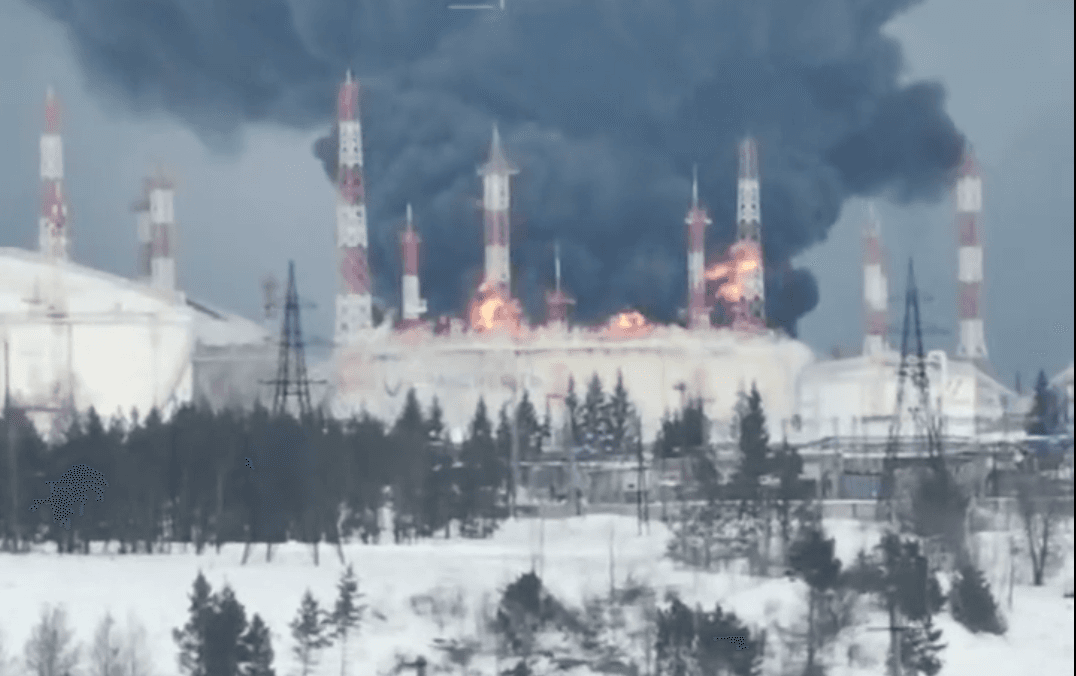
A screenshot of a video showing fire burning at an oil depot in Russia’s Tatarstan Oblast overnight. (Exilenova+/ Telegram)
The campaign extended beyond Tatarstan. In Belgorod Oblast, SBU strikes damaged energy infrastructure, plunging parts of the city into blackout and hitting apartment buildings, a social facility, and private homes. Satellite imagery indicated the February 18–19 strike on the Velikolukskaya oil depot in Pskov destroyed roughly half its tanks.
Russia’s Defense Ministry claimed it intercepted 152 Ukrainian drones overnight — 65 in Belgorod, 35 in Saratov, eight in Voronezh, three in Tatarstan.
If accurate, it was not a raid.
It was a map of a country under fire — from the Baltics to the Volga.
Meters, Maps, and Doubt: The Southern Advance No One Can Count the Same Way
General Oleksandr Syrskyi stood in the Southern Operational Zone and spoke a number that would have sounded like fantasy months ago.
Four hundred square kilometers.
Eight settlements recaptured since late January in the Oleksandrivka direction, where Zaporizhzhia, Donetsk, and Dnipropetrovsk oblasts meet. A wedge driven into territory long assumed static.
But numbers in this war rarely travel alone.
Days earlier, President Zelensky cited 300 square kilometers. The Airborne Assault Forces used the same figure, noting much of the gain cleared “gray zone” areas — zones where Russian reconnaissance and sabotage groups operated rather than firmly held positions. The Institute for the Study of War, applying stricter open-source standards, assessed 168.9 square kilometers of confirmed liberation since January 1. Real ground. Verified cautiously.
Military correspondent Diana Butsko voiced what many were thinking: “The president said 300 square kilometers in the south. This is the territory of four Khersons. I wonder who makes such calculations and how.”
Still, movement is undeniable. Geolocated footage shows Ukrainian advances east of Verbove and presence in northwestern Ternuvate. Colonel Vladyslav Voloshyn rejected Russian claims of holding Ternuvate, saying an infiltrating group that entered around February 9 was destroyed — though some isolated soldiers may remain. ISW assessed liberation of Andriivka, Ostapivske, Pishchane, Nechaivka, Radisne, and Nove Zaporizhzhia, with no confirmed Russian presence since at least February 8–9.
The push may be exploiting SpaceX’s February 1 block of Russian Starlink terminals, disrupting communications. Weather and logistics strikes also play roles.
The line here is porous. Positions intermingle. Syrskyi called it “complicated.”
Advance, yes.
Clarity, less so.
They Waited for the Sirens: Russia’s Bombers Turn Ukraine’s Police Into Targets
The first blast in Lviv’s Old Town sounded like vandalism.
A reported store break-in. Officers responded. Reinforcements followed.
Then the second explosion tore through the street.
Twenty-three-year-old police officer Viktoria Shpylka was killed. Twenty-five others were injured. The target was not a shop. It was the responders.
Investigators traced the mechanics quickly. A 33-year-old woman, later arrested near the Polish border, had planted three homemade explosive devices. Each was wired to mobile phones and detonated remotely. She filed a fake intrusion report to draw police in. A smartphone in her rented apartment streamed live video to her handler — a man known only as “Mark.” He waited until the maximum number of officers had gathered. Then he triggered the blasts.
She told investigators she was promised $1,000 per device. Debt drove her to agree. She claimed she did not know what the packages contained.
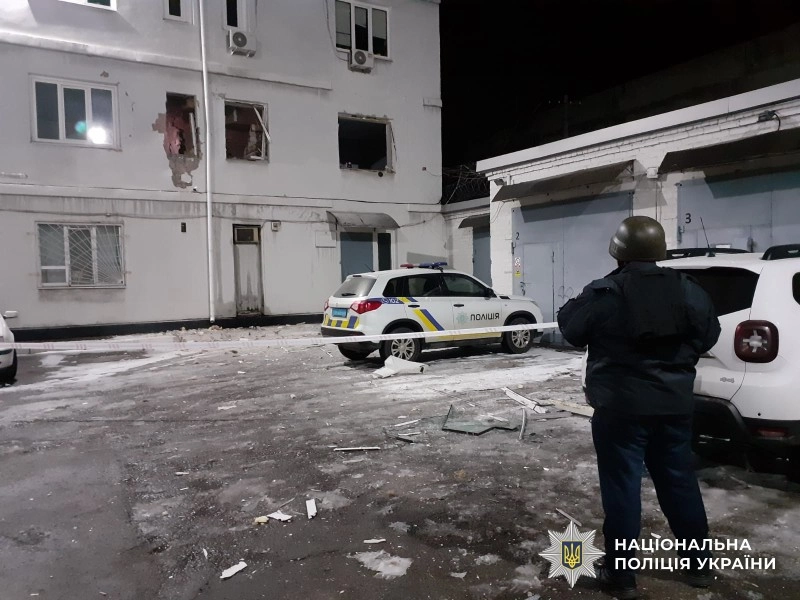
Aftermath of the explosion that struck a police station in central Ukraine’s Dnipro. (Photo by the National Police of Ukraine)
President Zelensky said the perpetrators were recruited via Telegram and that Russia organized the operation.
The pattern continued. In Mykolaiv, explosions ripped through a defunct gas station during a police shift change, injuring seven officers, two critically. Hours later, another blast struck a police administrative building in Dnipro
’s Amur-Nyzhniodniprovskyi district, damaging offices, equipment, and a vehicle outside.
National Police Chief Ivan Vyhivskyi called it “a deliberate attack on the rule of law.”
Lviv. Mykolaiv. Dnipro. Within 48 hours.
The method echoed similar 2025 attacks on recruitment centers — couriers lured, handlers waiting to detonate remotely.
This time the targets wore badges.
A new front had opened, not at the trenches, but in the streets.
Millimeters From Disaster: 126 Drones, One Missile, and a Night of Strain
The sirens began before midnight and did not stop.
From February 22 to 23, Russia launched one Iskander-M ballistic missile from Rostov Oblast and 126 drones — Shahed, Gerbera, and Italmas variants — from Bryansk, Kursk, and Oryol; from Primorsko-Akhtarsk in Krasnodar Krai; and from occupied Crimea. The pattern was familiar. The scale was not.
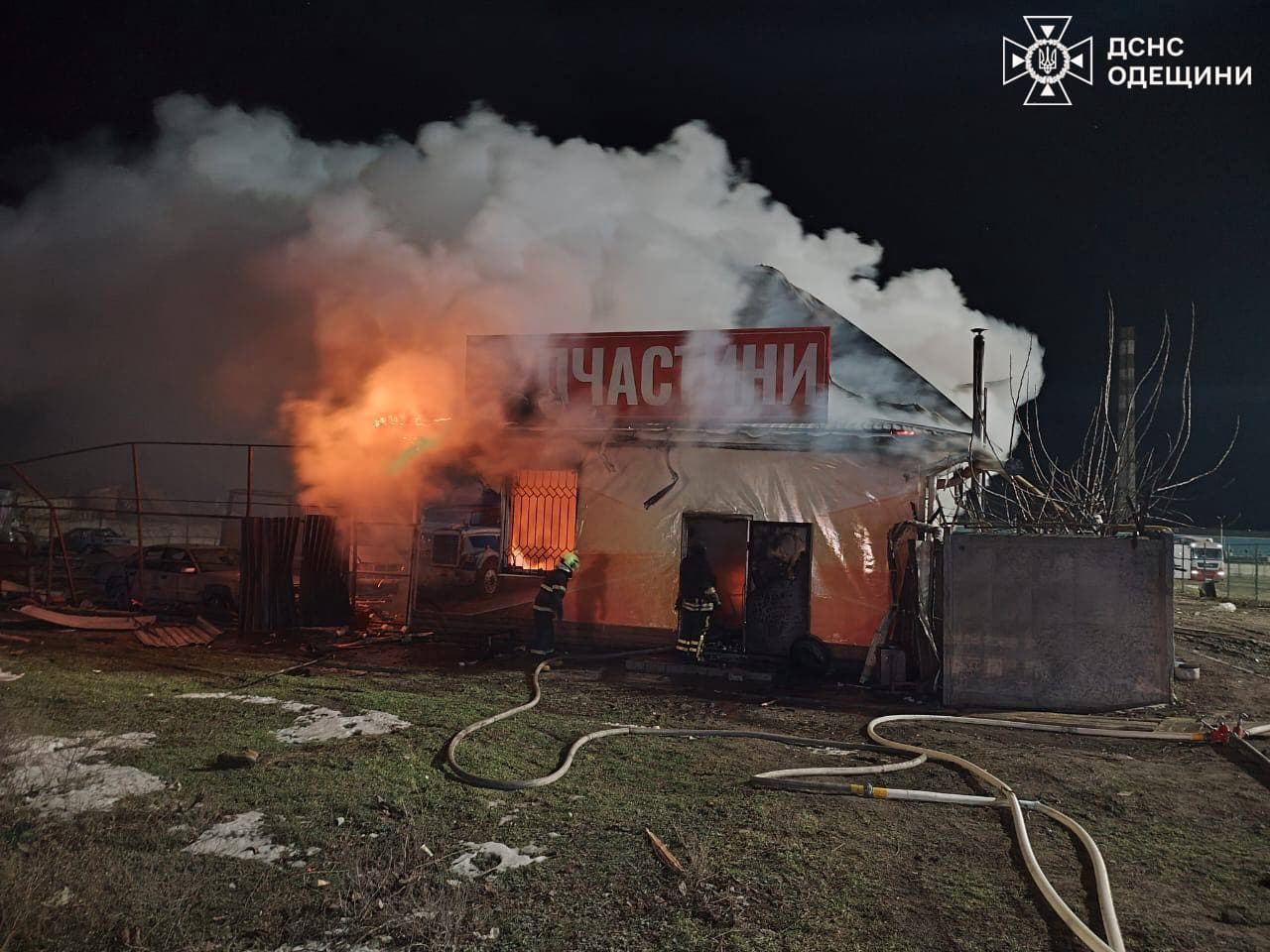
Aftermath of a Russian attack on Odesa Oblast, Ukraine. (Ukraine’s Emergency Service)
Ukrainian air defenses intercepted 105 drones. Twenty drones and the missile broke through, striking eleven locations. Civilian, transport, industrial, and energy infrastructure took the impact across Odesa and Zaporizhzhia oblasts.
By morning, regional authorities reported at least four people killed and 26 injured.
In Odesa Oblast, a 20-year-old woman and a 45-year-old man died. Three others were wounded. A drone tore into a high-rise apartment — and failed to detonate. In Zaporizhzhia Oblast, two people were killed and four injured as Russian forces carried out 754 strikes on 44 settlements in that region alone. Four more were injured in Druzhkivka. Civilians were wounded in Kherson, Kharkiv, Sumy, and Dnipropetrovsk oblasts.
Numbers fill reports. They do not capture the silence after impact.
One drone lodged in concrete above a sleeping family and did not explode. The difference between four dead and dozens more was measured in wiring, in timing, in millimeters of chance.
For Ukraine, this was not a new tactic.
It was the same war, concentrated.
Bridges Bombed, Deadlines Missed: The War Grinds East
On February 23, the map looked busy. The gains did not.
Russian forces attacked along a dozen axes — Kupyansk, Lyman, Slovyansk, Kostyantynivka-Druzhkivka, Pokrovsk, Novopavlivka, Hulyaipole, Orikhiv — and confirmed advances in only one. The arrows multiplied. The line barely moved.
Near Kostyantynivka-Druzhkivka, geolocated footage showed Russian troops edging into southern Virolyubivka. FAB-500 guided glide bombs fell on bridges near Kostyantynivka. Kh-38ML air-to-surface missiles followed. Another FAB-500 hit a bridge in Bohorodychne, north of Slovyansk — infrastructure stripped away piece by piece to isolate Ukrainian defenders. On the outskirts of Kostyantynivka, Russian units infiltrated without altering control, probing rather than seizing.
Inside Russian channels, frustration leaked. A milblogger tied to the Western Grouping of Forces reported that the 69th Motorized Rifle Division had missed its deadline to capture Lyman by the start of 2026. The division reportedly suffered the highest losses in the 25th Combined Arms Army’s sector. The attacks continue. Lyman remains out of reach.
In Kupyansk, Russian forces hold less than three percent of the city, according to Colonel Viktor Trehubov, and are “trying to survive.” Ukrainian forces advanced west of Holubivka. Elements of Russia’s 1st Guards Tank Army operate in Kupyansk-Vuzlovyi, southeast of the city.
Near Pokrovsk, Russian units attempt flanking maneuvers through Hryshyne and Rodynske while drone operators from the Rubikon Center work to sever supply lines.
In Zaporizhzhia, elite VDV paratroopers fight as regular infantry — manpower stretched thin. Airstrikes intensify. Mud slows vehicles. In Sumy Oblast near Ryzhivka, a Russian milblogger blasted commanders sending four-to-six-man assault teams into Ukrainian drone kill zones.
The offensive persists.
The breakthrough does not.
Sanctions Stalled: Hungary’s Veto Exposes Europe’s Fault Lines
It was meant to land with force.
The European Commission unveiled its 20th sanctions package on February 6, timing it for the fourth anniversary of Russia’s full-scale invasion. The measures would have banned maritime services for Russian crude, targeted 43 shadow fleet vessels, sanctioned 20 regional Russian banks, and tightened restrictions on cryptocurrencies used to evade penalties.
Hungary stopped it.
“This is a setback and a message we didn’t want to send today,” EU foreign policy chief Kaja Kallas said after the Foreign Affairs Council meeting. Budapest had warned it would block new sanctions until the Druzhba pipeline — offline since a Russian missile struck Ukraine’s Lviv region in late January — resumed delivering crude to Hungary and Slovakia. It also blocked a planned €90 billion EU loan to Ukraine.
Hungarian Foreign Minister Peter Szijjarto shifted blame to Kyiv, telling colleagues to “ask Ukrainians why they stopped the oil deliveries,” omitting that a Russian missile severed the flow.
Slovakia’s Prime Minister Robert Fico raised the stakes. Bratislava would halt emergency electricity assistance to Ukraine until oil transit resumed, he said, and reconsider support for Ukraine’s EU membership. Hungary and Slovakia had already suspended diesel exports to Ukraine on February 18.
Analysts described Fico’s electricity threat as political theater. Ukrenergo stated Ukraine is not dependent on Slovak emergency imports and can access them under different pricing terms.
Croatia declined a Hungarian and Slovak request to reroute Russian crude through the Adria pipeline, closing that alternative.
NGO sanctions campaigner Alexander Kirk called Hungary’s veto “effectively treason to European security.”
On an anniversary meant to signal unity, Europe showed its fractures.
$587 Billion and a Broken Roof: The Cost You Can Count — and the Cost You Can’t
On February 23, the World Bank put a number on four years of destruction.
$587.7 billion.
Reconstruction needs calculated through December 31, 2025 — nearly three times Ukraine’s annual GDP. Transport damage: $96 billion. Energy and housing: roughly $90 billion each. More than one in seven homes damaged or destroyed. Demining alone: $28 billion.
The figures describe a country.
They do not describe Karina.
On December 27, she was asleep in her Kyiv apartment near the Dorohozhychi metro station when a Russian drone struck the building — one meter from her room. She fled with a coat and nothing else. The apartment is now officially uninhabitable. Compensation: about $1,000. Roof repairs could take two years.
“I’m blessed that I am alive,” she said.
When asked if the war will end soon, she answered quietly: “I don’t.”
The numbers also fail the Glodan family.
On Orthodox Easter Eve 2022, a Russian missile hit Valeria and Yuriy Glodan’s apartment in Odesa while Yuriy was out shopping. Their three-month-old daughter Kira was killed. Valeria, 28, died. So did her mother, Lyudmyla, 54. Yuriy later joined the army. In September 2023, near Bakhmut, a drone chased him down during an assault on Andriivka. He was killed. His funeral took place February 24, 2024 — two years after the invasion began.
They are buried in Avangard cemetery: Kira, Valeria, and Lyudmyla on one side of a narrow path. Yuriy facing them from the other.
“We’re still living in April 2022,” Yuriy’s mother Nina said. “And we haven’t moved past it.”
More than 15,000 Ukrainian civilians are confirmed dead by the UN.
The real toll is higher.
Twenty-Two Operators for Six Reactors: The Quiet Risk at Zaporizhzhia
Inside Europe’s largest nuclear power plant, the control rooms are lit.
The chairs are not all filled.
Nearly four years after Russian forces seized the Zaporizhzhia nuclear power plant, it runs with what experts call a skeleton crew. Before March 2022, 159 licensed specialists were authorized to operate its six reactors. Since the occupation, more than half have fled, including 122 licensed operators. As of February 23, just 22 licensed specialists remain.
International standards require at least three licensed operators per reactor, per shift. Six units. Around the clock.
Viacheslav Huba, chief consultant to Energoatom’s leadership, told a Legal Action Worldwide briefing in Kyiv that the work demands roughly ten years of training. These are not positions replaced in weeks.
Russia has tried to restart the plant under Rosatom management and link it to the Russian grid. The IAEA has warned this poses serious nuclear risks, particularly after the destruction of the Kakhovka reservoir that once supplied the plant’s cooling system.
Those who refused to sign Rosatom contracts paid heavily. Some 2,500 employees — including 15 licensed operators — faced physical pressure or illegal detention. Ukrainian NGO Truth Hounds documented at least 78 detained workers subjected to torture, including electrocution and starvation. One was beaten to death in a police station. Ten have been sentenced in Russian courts to prison terms ranging from five to 25 years on espionage and sabotage charges.
On February 23, Legal Action Worldwide filed a complaint with the UN on behalf of ten detained employees, urging their release as peace talks continue.
Ukraine has rejected a U.S.-backed proposal for joint management with Russia. “Any discussions about joint management with Russia are inconceivable,” Huba said.
Twenty-two operators remain.
And the reactors still hum.
Negotiating the War, Arguing the Peace: Who Gets to Decide Ukraine’s Future
Another round of talks is forming before the last one has faded.
Kyrylo Budanov, head of Ukraine’s Presidential Office, confirmed that U.S.-mediated negotiations between Kyiv and Moscow could resume around February 26–27 — the fourth round since January. The previous session in Geneva produced no ceasefire, no territorial breakthrough, only carefully worded statements and silence on substance.
The Kremlin has not confirmed the dates. Spokesperson Dmitry Peskov offered only this: no agreement has been reached.
While diplomats circle the table, the debate inside Ukraine is sharpening.
Nearly 50 civil society organizations issued a joint statement rejecting any peace deal ratified through a referendum during martial law. Such a vote, they argued, would be unconstitutional and vulnerable to Russian interference. “The attempt to impose the legitimization of peace agreements on Ukrainians through a referendum is unlawful and unacceptable,” the statement read, warning of “unpredictable destructive consequences.” They urged President Zelensky and parliament to abandon the idea.
The warning came after Zelensky suggested a referendum might be necessary if a deal required Ukrainian forces to withdraw from Donbas — a concession that would redraw the war’s meaning.
Public opinion is divided but not paralyzed. A mid-January poll showed 55 percent of Ukrainians support holding such a referendum, while 32 percent oppose it.
For now, the talks remain stalled on territory. The battlefield and the ballot box hover over the same question: who decides what is surrendered — and how?
While Missiles Fell, the Investigators Moved: Ukraine’s War Within the War
As drones crossed the sky and explosions echoed across Ukraine, another operation unfolded quietly in Kyiv.
Officers from the National Anti-Corruption Bureau of Ukraine detained an employee of the Security Service of Ukraine, accusing him of accepting a $68,000 bribe. Prosecutors allege he removed two men from military enlistment wanted lists and arranged fake deferments, using falsified documents claiming each had three children — complete with fabricated foreign birth certificates.
It was not an isolated arrest. It was another chapter in a widening institutional clash.
The conflict between NABU and the SBU dates to July 2025, when SBU officers searched NABU premises and detained the head of a NABU detective unit on accusations of aiding Russia. Critics described it as retaliation. NABU had been investigating figures close to President Zelensky in the Energoatom corruption case — the largest probe of his presidency, with his associate Timur Mindich named as an alleged ringleader.
Since then, the confrontation has escalated: competing criminal charges, the discovery of surveillance devices, and the resignation of presidential chief of staff Andriy Yermak after NABU searched his premises. A presidential decree briefly curtailed NABU’s independence before wartime protests forced a partial restoration.
The bribe arrest lands inside that unresolved struggle.
Ukraine is fighting a conventional war at its borders. It is also fighting a quieter one inside its institutions — over whether accountability can survive emergency powers.
Missiles test air defenses.
Corruption tests democracy.
Both are active fronts.
Chocolate, Missiles, and the Companies That Stay
On February 21, a Russian missile struck the Mondelēz International factory in Trostianets, Sumy Oblast.
The plant had operated since 1994 — one of the oldest major American investments in Ukraine. It produced brands stacked on European shelves: Milka, Oreo, Korona, Barni. After heavy damage during Russia’s 2022 occupation of Sumy, it had just completed a two-year reconstruction.
The missile found it anyway.
Ukrainian Foreign Minister Andrii Sybiha said Russia was attacking “American business interests in Europe.” Investment did not shield the building.
Mondelēz still operates three factories inside Russia.
On the fourth anniversary of the invasion, Ukraine’s ambassador to Germany, Oleksii Makeiev, widened the argument. More than 100 German companies remain active in Russia, he said — including Metro, Ritter Sport, and Claas. Their continued presence generates tax revenue that helps finance missiles and bombs.
Makeiev invoked IG Farben, the chemical conglomerate that supplied Nazi Germany and whose executives were prosecuted after the war. The reference was deliberate — a warning about corporate complicity during conflict.
“There are enough people and companies in Germany who, after 12 years of war — or four years of full-scale invasion — continue to operate in Russia and generate revenue that, through taxation, helps finance missiles, bombs and Russia’s armed forces,” Makeiev said.
The strike in Trostianets damaged machinery.
The question it raised reaches far beyond the factory walls.
The Battlefield on a Phone Screen: Ukraine Trains Civilians to See Like Drone Pilots
A grainy field fills the screen. Somewhere in it, something is hidden.
Ukraine’s Unmanned Systems Forces have launched a web-based simulator called “Kill Zone,” built from real front-line imagery. Players search for concealed Russian equipment — tanks, missile launchers, supply vehicles — using the same reconnaissance cues drone operators rely on: track marks in dirt, unnatural ground shapes, faint thermal signatures.
The scenarios are drawn from dozens of Ukrainian units and randomized. Players can request help from avatars based on real commanders. At the end of each round, they receive a score, see how they compare to others, and learn which unit supplied the imagery.
It looks like a game. It trains a skill.
Drone warfare depends on sharp eyes. Ukraine’s answer is to widen the pool — to make pattern recognition something that can be practiced anywhere, even on a phone.
By January 2026, the kill zone near Kupyansk reportedly extended 20–25 kilometers for Russian vehicles and one kilometer for infantry, driven in part by drone density.
The front line is digital now.
So is the training.
“Why Should We Give It Up?”: A Soldier From Donetsk Refuses the Premise
Yehor Firsov is 37. He is from Donetsk.
His city has been under Russian occupation since 2014. He once served in parliament and held government posts. In 2022, he enlisted as an ordinary soldier. Today he is deputy commander of a drone regiment in one of Ukraine’s most effective UAV units — Muramasa.
At its peak, Muramasa destroyed roughly 40 pieces of Russian equipment per deployment. The unit pushed first-person-view drone strikes out to distances once considered unrealistic. Thirty kilometers became operational.
When asked about U.S. pressure to cede Donbas, Firsov does not hedge.
“What kind of discourse is this that we must give something up? Seriously? You must give up what is yours, and the only internal question you have is — why the hell should you do that?”
His argument is tactical before it is emotional. Donbas is not just symbolic ground. Its industrial terrain — concrete plants, factories, Soviet-era structures — forms natural defensive positions. Surrender the cities, he says, and Ukrainian forces fall back into open steppe, exposed. Russia does not possess enough missiles or Shaheds to level the remaining industrial sprawl.
He also rejects the narrative of a local uprising in 2014. Activists were bused across the Russian border, passports visible, payment lists circulating. “I did not know a single person from that rally,” he said. “There was not a single neighbor, classmate, or activist.”
He speaks of return as certainty.
“Even if today that belief takes your breath away — I still believe it.”
Candles and Warnings: Europe Marks Four Years of War
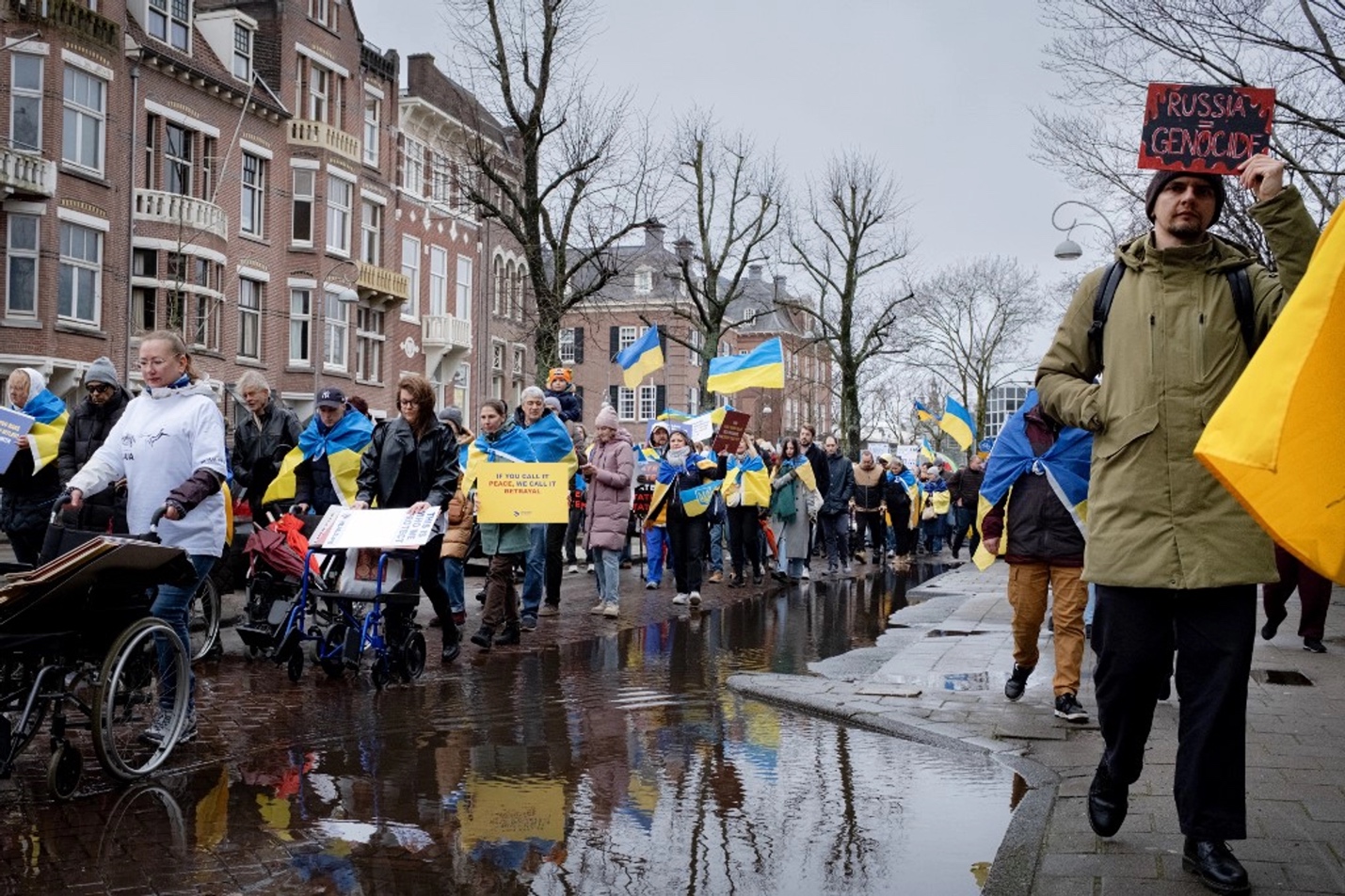
Participants in a solidarity march for Ukraine walk from Museumplein to Dam Square, where a commemoration ceremony was held to mark the fourth anniversary of Russia’s invasion of Ukraine, in Amsterdam. (Photo by Ramon van Flymen / ANP / AFP)
On the eve of the fourth anniversary, Europe filled its squares.
In Berlin, marchers moved from Lustgarten to the Brandenburg Gate beneath banners reading “For Europe’s Future.” In London, supporters gathered at Trafalgar Square outside Ukraine’s embassy. Thousands stood in Prague’s Old Town Square as President Petr Pavel warned that whatever peace emerges will shape Europe’s long-term stability. In Paris, roughly 2,000 called for continued aid and the confiscation of frozen Russian assets. Luxembourg, Budapest, and Milan held commemorations of their own.
In Washington, speakers reminded the crowd that Ukraine is “holding the line for democratic countries,” urging Americans not to surrender to fatigue.
Commentators across Europe measured the war’s scale. By mid-2026, one analysis noted, the conflict will have lasted longer than the First World War, with combined casualties approaching two million. A Portuguese column argued that an imperfect peace could test the EU more than the war itself, since ceasefire decisions become permanent borders. A Russian political scientist speculated online about Chinese combat humanoid robots one day appearing on the front. An Austrian publication observed that the war is “no longer exclusively male” — Ukrainian women fight, fly drones, treat the wounded, and sustain families at home.
In Geneva, UN Secretary-General António Guterres told the Human Rights Council that “human rights are under a full-scale attack around the world,” citing more than 15,000 confirmed Ukrainian civilian deaths. Volker Türk warned of “domination and supremacy” returning at a rate unseen in 80 years.
That same night in Moscow, an explosive device killed a traffic police officer near Savyolovsky railway station.
Anniversaries gather crowds.
They do not end wars.
From Crimea to Orbit: The War Expands Beyond the Horizon
In occupied Crimea, Ukrainian forces struck a concentration of Russia’s 15th Separate Coastal Missile Brigade.
The target: Bastion coastal missile systems — the launchers that fire Onyx anti-ship missiles with 200-kilogram warheads and a 300-kilometer reach, weapons repeatedly used against civilian and critical infrastructure across southern Ukraine.
The strikes did not stop there.
Ukraine hit an ammunition depot of Russia’s Southern Grouping of Forces near occupied Nyzhnya Krynka, about 50 kilometers from the front. A logistics warehouse near Velyka Novosilka was struck. Two Russian Tor anti-aircraft systems northwest of occupied Mariupol were targeted. So was a Russian drone control point near occupied Pokrovka on the Kinburn Spit — the only part of Mykolaiv Oblast still under Russian occupation.
President Zelensky confirmed assessments that Russian forces are using Belarusian telecommunications infrastructure to support drone operations against Ukraine and incursions into NATO airspace — active operational backing, not passive geography.
Above the battlefield, another layer unfolds.
The Financial Times, citing European security officials, reported that Russian space vehicles Luch-1 and Luch-2 have intercepted communications from at least a dozen European government and military satellites. The craft have shadowed targets for weeks. Since its 2023 launch, Luch-2 has approached European satellites 17 times. Intelligence officials believe Russia is positioning them within narrow data-beam cones between ground stations and older satellites lacking advanced encryption — learning how to jam or manipulate them.
ISW assessed the activity as “Phase Zero” preparation for a possible confrontation with NATO.
The war is no longer confined to trenches and coastlines.
It now hums in orbit.
The Day’s Meaning — Four Years In, No Illusions Left
Four years ago, the Kremlin expected Kyiv to fall in 72 hours.
Day 1,460 tells the story of what that miscalculation became.
Russia is preparing its public for more conscription even as Ukrainian drones strike 1,200 kilometers inside Russian territory. Ukraine has retaken hundreds of square kilometers in the south while absorbing relentless pressure in the east. Europe’s sanctions regime sits exposed, stalled by governments still importing Russian crude. The Zaporizhzhia nuclear plant operates with just 22 licensed specialists. Reconstruction costs stand at nearly $588 billion. In orbit above Europe, Russian satellites shadow and intercept signals never meant for them.
The war is no longer a single front. It is military, economic, political, nuclear, digital.
Putin marked Defender of the Fatherland Day speaking of “responsibility.” In Lviv’s Old Town, 23-year-old police officer Viktoria Shpylka died responding to a staged explosion. Yehor Firsov, from occupied Donetsk, spoke of returning home and refused the premise that Ukraine should surrender what is hers. In Tatarstan, Russian oil infrastructure burned in the night.
No decisive breakthrough came. No peace framework moved forward. The front lines shift in meters, the strategic picture shifts in inches.
What February 23 revealed is endurance — and stalemate. Neither side can impose a conclusion. Both are preparing for a longer war.
On the fourth anniversary, the costs are visible in graves, in empty apartments, in budget ledgers, in strained alliances, and in satellites circling silently overhead.
The invasion meant to end Ukraine instead hardened it.
But hardening is not the same as ending.
Prayer For Ukraine
1. For Those Under Fire
Lord, remember the cities that marked another anniversary under sirens. Comfort the families of Viktoria Shpylka and every civilian killed in these days of grinding war. Protect police officers, rescue workers, and soldiers who run toward danger while others flee. Shield the homes still standing and guard those sleeping beneath uncertain roofs.
2. For the Front Lines and the Freed Villages
Strengthen Ukrainian forces holding ground in the east and advancing in the south. Give wisdom to commanders, endurance to drone operators, and courage to those fighting for towns like Donetsk and the villages newly reclaimed. May justice prevail over aggression, and may every kilometer regained signal hope, not exhaustion.
3. For Leaders and the Struggle for Integrity
Grant clarity and courage to Ukraine’s leaders as peace talks loom and hard decisions press. Protect the institutions fighting corruption even in wartime. Let accountability, not power, define Ukraine’s future, and keep the nation’s moral compass steady under pressure.
4. For Nuclear Safety and Global Responsibility
Guard the Zaporizhzhia nuclear plant and the specialists who remain at their posts. Prevent catastrophe born of negligence or coercion. Restrain reckless ambition in every capital — on land, at sea, and in orbit — and turn hearts away from escalation.
5. For Endurance — and an End to War
Sustain Ukraine through this fourth year. Provide resources for rebuilding what has been shattered. Unite Europe and the wider world in principled support. And Lord, bring a just and lasting peace — one that protects the vulnerable, restores the displaced, and ends the bloodshed without surrendering truth.
Amen.