
As U.S.-backed peace talks convened in Geneva, Russia unleashed one of the war’s largest drone and missile barrages on Kyiv—while insiders admitted the negotiations are meant to stall Western weapons, not end the war.
The Day’s Reckoning
At 4:00 a.m., the explosions began in Kyiv.
While Rustem Umerov and Davyd Arakhamia sat across from Steve Witkoff and Jared Kushner in a Geneva conference room, outlining pathways toward a possible summit, 420 Russian drones and 39 missiles were already airborne over Ukraine.
Diplomacy in Switzerland. Ballistic trajectories over Europe.
Four years and two days after Vladimir Putin launched the full-scale invasion, February 26 unfolded in parallel realities. Two rounds of peace talks. One of the largest coordinated air assaults of the year. An $8.1 billion IMF approval in Washington. And leaks from inside the Kremlin confirming that Moscow views negotiations not as an exit—but as a lever.
In Kyiv’s Pecherskyi district, a Shahed drone tore through a kitchen ceiling and set a house ablaze. Volodymyr and his wife were trapped inside. Their grandson, Maksym Leshchenko, sprinted across the neighborhood and smashed through the door. “I had seen warnings,” he said later. “But never imagined it could hit my grandparents’ house.” Across eight oblasts, one person was killed and at least 33 were injured, including two children in Kharkiv. In Odesa, 32,000 homes lost power. In Poltava, gas infrastructure burned.
At the same time, Ukrainian HIMARS rockets hit Belgorod. Explosions lit up an oil depot in occupied Luhansk. Ukrainian forces edged forward near Bilytske. In Washington, IMF board members approved funding that will keep the Ukrainian state solvent into 2026.
And in occupied cities, Russian officials signed papers transferring Ukrainian apartments to loyalists and inducted children into Kremlin youth movements.
Day 1,464.
Peace talks underway. Missiles in the air. The war continuing—on every front at once.
Peace Under Chandeliers, War in the Sky
Rustem Umerov steps into a quiet conference room in Geneva, the kind lined with polished wood and filtered light. Across the table sit Steve Witkoff and Jared Kushner, President Trump’s envoys, papers stacked neatly, translators poised. Outside, Lake Geneva is still.
Above Ukraine, nothing is still.
The mandate in the room is precise: align positions before trilateral talks with Russia and clear a path toward a leaders’ summit. The day before, Zelensky and Trump spoke for 30 minutes. Witkoff and Kushner were on the line. Washington signaled urgency. The war, Trump said, must end quickly.
Umerov frames the objective carefully—to make the next meeting with the United States and Russia “as substantive as possible.” The agenda sprawls: security guarantees, prisoner exchanges, economic recovery, and the long-debated $800 billion U.S. prosperity package for Ukraine. By the session’s end, Zelensky signals the next round may convene in Abu Dhabi in early March.
But Moscow is not negotiating in the same register.
Sergei Lavrov, asked about deadlines, answers with visible impatience: “Have you heard anything from us about deadlines? We have no deadlines, we have tasks. We are getting them done.” Dmitry Peskov sharpens the message. Predicting stages of peace would be a “big mistake.” Putin will not meet Zelensky until the final moment—and only to sign what others have already settled.
In Geneva, they discuss sequencing and parameters.
In Moscow, they discuss tasks.
Between those two postures lies the war itself.
Negotiations as Weapon: Moscow’s War Plan in Plain Sight
The clearest signal of Moscow’s intentions did not come from the front lines.
It came from inside the Kremlin.
A source close to Russia’s Foreign Ministry told opposition outlet Verstka that Russia’s negotiating position “has not changed at all.” The goal remains unchanged. Russia “must achieve” its war objectives.
Inside the Kremlin’s domestic policy bloc, another source was blunt: Ukraine’s legal recognition of Russia’s annexed territories “cannot be resolved.” Not debated. Not bargained. Cannot.
Then came the admission that reframes Geneva entirely.
Negotiations are a “tool,” the source said—not to end the war, but to contain escalation. A mechanism to manage optics while buying time.
A concrete example followed. Ukraine has not received Tomahawk missiles from the United States. Why? Because Russia remains at the negotiating table. As long as talks continue, certain Western weapons remain undelivered. Diplomacy becomes restraint.
And Moscow is planning for endurance.
Two United Russia political strategists confirmed the party is already building its “military agenda” for the September 2026 State Duma elections—because no one inside the system “seriously expects” the war to end before then.
These are not outside observers speculating.
They are insiders describing a Kremlin that has folded the war into its political future.
When 420 Drones Filled the Sky
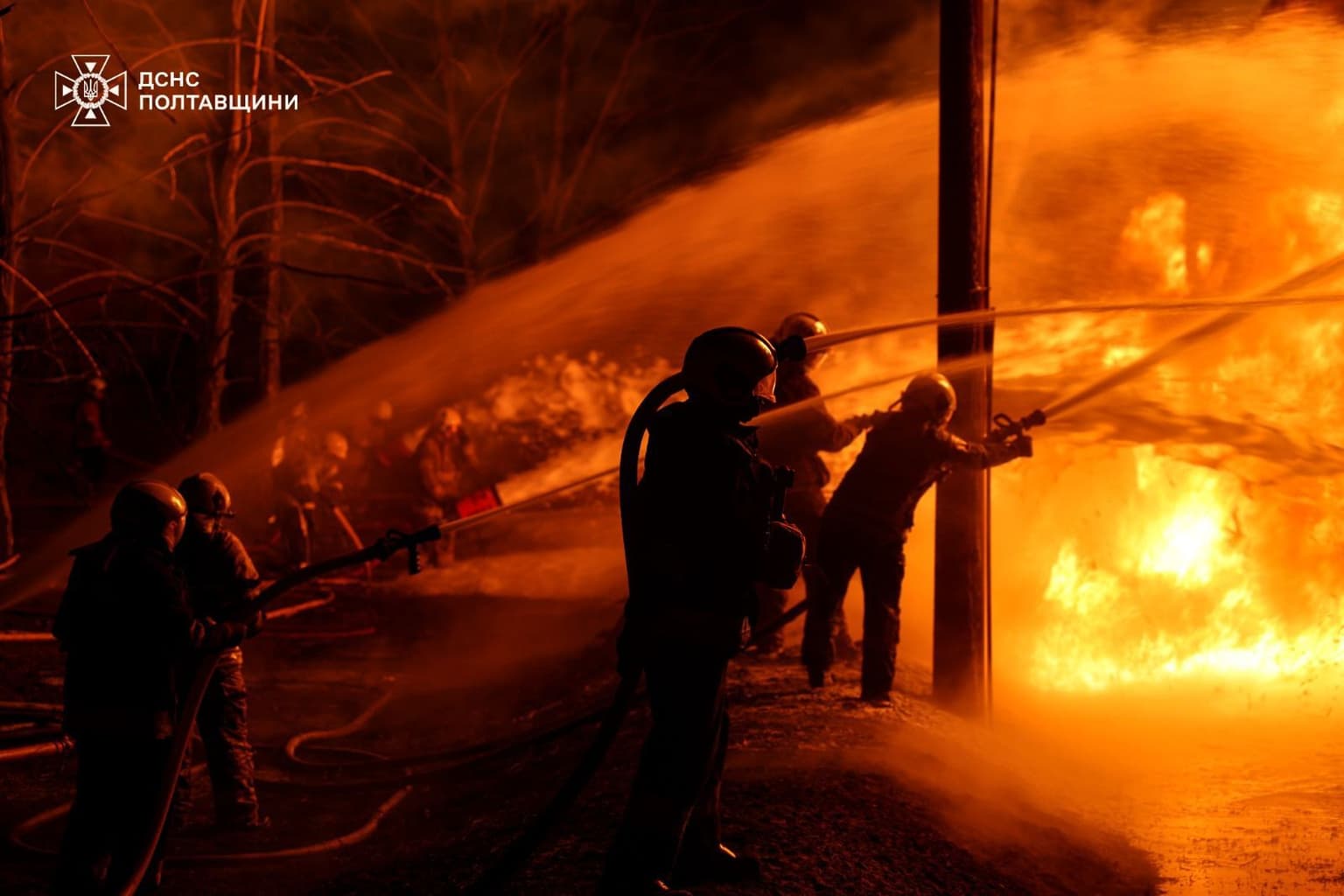
Firefighters extinguish a fire following an overnight Russian attack in Poltava Oblast, Ukraine, on Feb. 26, 2026. (State Emergency Service of Ukraine/DSNS)
At 4:00 a.m., Kyiv shook.
Air defenses lit up the darkness as 420 drones and 39 missiles surged toward Ukraine. The Air Force counted them precisely: Shahed, Gerbera, Italmas drones. Eleven Iskander-M ballistic missiles. Twenty-four Kh-101 cruise missiles. Two Zirkon hypersonic missiles. Two Kh-69 cruise missiles.
Ukrainian forces intercepted 374 drones and 32 missiles.
Five ballistic missiles and 46 drones broke through, striking 32 locations. Debris fell in 15 more.
In Kyiv’s Pecherskyi district, Volodymyr and his wife were asleep when their kitchen exploded. “The doors flew off. We went into the kitchen and saw a fire. The roof was blown off,” he said. Unable to escape quickly, they waited while their grandson forced his way inside to reach them.
Across eight oblasts, the toll mounted: one dead, at least 33 injured. In Kharkiv, 16 people were hurt, including two children, after 17 drones and two missiles hit four districts and a children’s railway. Zaporizhzhia counted 10 injured, including an eight-year-old boy. In Kryvyi Rih, an 89-year-old man and an 82-year-old woman were wounded. In Odesa, a substation strike left 32,000 homes without power. In Poltava, gas infrastructure burned, cutting electricity to 18,209 residential and 1,781 commercial consumers.
A Russian drone violated Romanian airspace, triggering F-16 scrambles. Polish and allied aircraft patrolled overhead.
Zelensky was blunt: air defense missiles are needed “every single day.”
Russia has shifted tactics. Mykolaiv Governor Vitaliy Kim warned Shaheds are now launched in daylight, increasing risks to civilians. In the previous two days, roughly 60 drones struck Naftogaz storage and production sites in Kharkiv and Chernihiv regions. A February 24 strike halted a Kharkiv facility. Since 2022, Russia has attacked Naftogaz facilities 401 times—tripling in 2025 alone the strikes of the previous three years combined. Three hundred and twelve Naftogaz employees have been killed.
Fire Across the Border: Belgorod Burns and the Flamingo Flies
While Kyiv counted its craters, Belgorod went dark.
Overnight on February 26–27, Ukrainian HIMARS rockets streaked across the border and struck the Belgorod Thermal Power Plant, just 34 kilometers from Ukraine. The impact rippled outward—power outages, water disruptions, heating failures across the regional center and surrounding towns.
The same night, flames rose over an oil depot in occupied Luhansk. Residents reported multiple explosions before the blaze swallowed the facility.
This was not an isolated reply. Earlier in the week, Ukrainian forces hit the PJSC Dorogobuzh chemical plant in Smolensk Oblast, a producer of components used in Russian defense industrial explosives. In Tatarstan, drone strikes forced Transneft to cut crude intake by roughly 250,000 barrels per day after two 50,000-metric-ton storage tanks ignited at the Kaleykino Oil Pumping Station.
Then came the revelation.
Zelensky confirmed that Ukraine’s domestically produced FP-5 Flamingo cruise missiles had struck targets 1,400 kilometers inside Russia. One strike, on February 20–21, reached roughly 1,700 kilometers to hit the Votkinsk Machine Building Plant in Udmurtia. Ukrainian Air Force sources told the BBC the missile struck a galvanic and stamping shop directly; debris sparked a fire and damaged a neighboring workshop.
Russian air defenses intercepted some Flamingos. Others missed precise impact points.
But all reached their target areas.
Production has resumed despite earlier Russian strikes on the missile’s manufacturing line. Ukraine plans to scale output—if funding and components hold.
The message is no longer symbolic.
Distance is shrinking.
Cash in Washington, Blockades in Budapest
In Washington, the vote was clinical.
In Kyiv, it was existential.
The IMF executive board approved an $8.1 billion loan that could determine whether Ukraine remains financially afloat through 2026. The first $1.5 billion clears immediately. The rest will arrive in tranches through 2029. The terms are softer than those negotiated in November 2025—Kyiv secured a delay of unpopular tax measures affecting online retail, imported parcels, and VAT rules for self-employed entrepreneurs.
Without IMF financing, Ukraine would run out of cash by mid-2026.
But the approval landed against European crosswinds.
On February 24—the invasion’s anniversary—Hungary blocked both the EU’s proposed 90 billion euro loan to Ukraine and the bloc’s 20th sanctions package. Budapest demanded restoration of Russia’s Druzhba oil pipeline before it would cooperate. Slovakia suspended emergency electricity supplies at the same time.
The pipeline dispute traces back to a late-January Russian missile strike that damaged the Ukrainian section of Druzhba. Hungary and Slovakia accused Kyiv of delaying repairs for political leverage. Ukrainian Foreign Minister Andrii Sybiha answered sharply: “Hungary has not expressed a single protest to Russia over this. They could not even bring themselves to say the word ‘Russia.’ Double standards in their purest form.”
On February 26, Viktor Orbán escalated further, publishing an open letter accusing Zelensky of pursuing an “anti-Hungarian policy” and alleging coordination between Kyiv, Brussels, and Hungary’s opposition to install a “pro-Ukraine government” in Budapest—claims offered without evidence.
European Commission President Ursula von der Leyen insisted the 90 billion euro package will move forward “one way or another.”
The IMF’s decision suggests confidence that Europe’s internal blockade will not hold.
Twenty-One Months for Ruins: Pokrovsk and the Myth of Momentum
For nearly two years, Pokrovsk was invoked as destiny.
Now it is a fact.
The Institute for the Study of War reports no Ukrainian forces operating inside the city since January 28 and assesses that Russian forces likely completed their capture in recent weeks. What the battlefield already showed has been quietly confirmed.
The timeline tells its own story.
Russia began pushing toward Pokrovsk in February 2024 after taking Avdiivka. Frontal assaults started in March. Most of the city did not fall until December 2025—21 months of grinding advances, repeated assaults, and heavy casualties. Myrnohrad, just east of Pokrovsk, fell around the same time. Moscow declared victory in early December. Gerasimov called it “crucial.” Putin said it “opened up multiple directions of advance.”
Those directions remain closed.
Since December 2025, Russian forces have not significantly advanced northwest or west. Hryshyne—two kilometers from Pokrovsk’s city limits—remains unconquered. The so-called “fortress belt” of Kramatorsk and Slovyansk still stands.
Ukrainian military analyst Kostyantyn Mashovets estimates Russian forces may have two to three months in spring 2026 to seize Kostyantynivka and Druzhkivka and prepare a summer offensive toward Slovyansk and Kramatorsk. Yet one and a half months of fighting has only secured positions on Kostyantynivka’s southeastern outskirts.
Twenty-one months for one city.
The next objectives are larger, more fortified, and closer to Ukraine’s defensive core.
Pokrovsk was supposed to unlock the Donbas.
Instead, it exposed the cost of every meter.
Factories, Missiles, and a Drone Near a Nuclear Carrier
While diplomats debated language, factories shifted into motion.
Ukraine’s Council of Defense Industry announced joint production agreements worth up to 800 million euros with Finnish, Latvian, and Danish companies to manufacture UAVs and unmanned ground vehicles. In London, Ambassador Valerii Zaluzhnyi confirmed that a Ukrainian company has opened its first drone production facility on British soil. Ukraine’s defense platform Brave1 signed a joint grant letter with France’s Defense Innovation Agency to back Ukrainian and French defense startups.
Weapons are no longer just shipments.
They are supply chains.
Lithuania transferred 30 RBS-70 MANPADS missiles. Canada pledged $1.4 billion in military assistance for 2026–2027, including 66 LAV 6 armored personnel carriers and 383 Senator armored cars. Estonia added $13 million for air defense and ammunition.
Then came a warning from London.
A Royal United Services Institute report assessed that Russia’s expanding missile defenses could intercept British and French nuclear strikes within 10 years. If accurate, Europe’s deterrence model may erode at the very moment European leaders debate whether to anchor Ukraine’s security with their own forces.
And in Malmö, the war brushed NATO steel.
Swedish Armed Forces jammed a suspected Russian drone as it approached France’s nuclear-powered aircraft carrier Charles de Gaulle, docked for NATO’s Orion-26 exercises. Launched from a nearby Russian vessel, the drone closed in before electronic countermeasures neutralized it. It vanished.
A Russian vessel. An unmanned aircraft. A nuclear-capable carrier. A NATO exercise.
The testing is no longer subtle.
The Ledger of the Missing
The numbers arrived without ceremony.
More than 90,000 Ukrainians are officially registered as missing, the Commissioner for Missing Persons reported—soldiers, civilians, children—each name entered into the Unified Register of Persons Missing Under Special Circumstances.
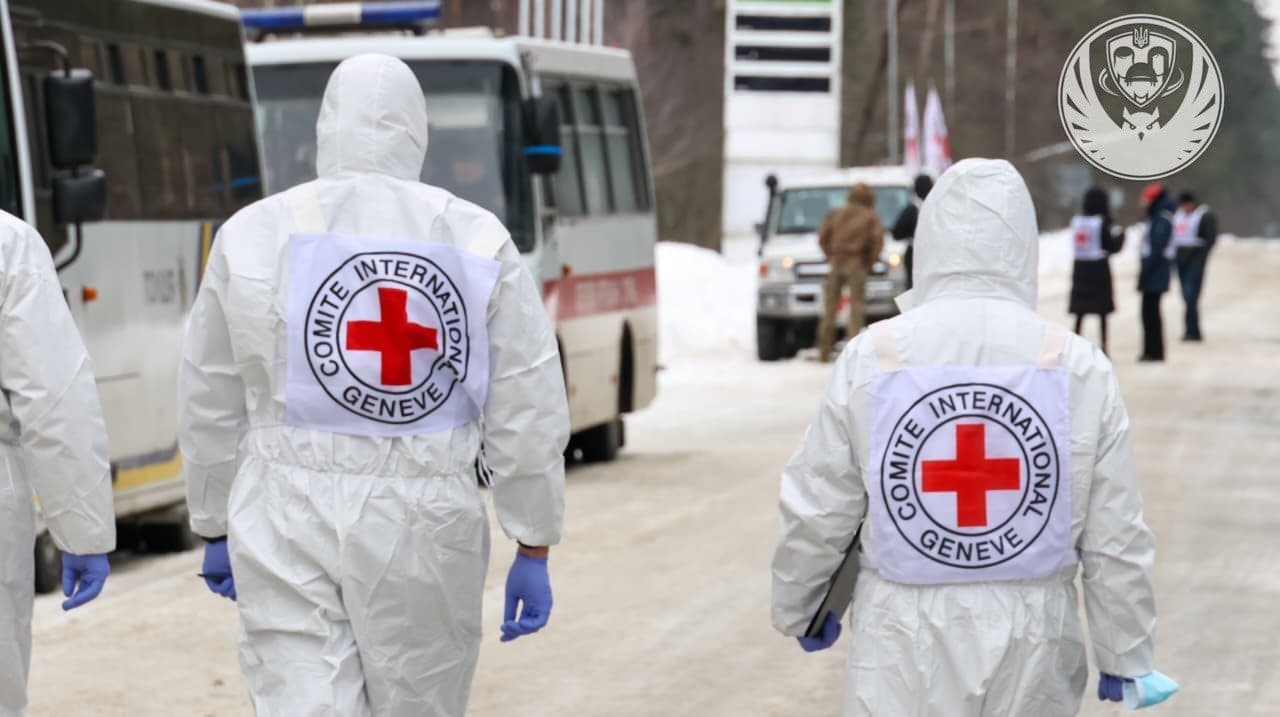
Ukraine returned the bodies of 1,000 fallen service members during the latest repatriation. (Ukraine’s Coordination Headquarters for the Treatment of Prisoners of War)
The same day, 1,000 bodies of fallen Ukrainian soldiers returned home from Russia, the third major repatriation since the Istanbul Agreements last summer. Since 2022, approximately 18,000 bodies have been returned. Russia confirmed receiving 35 in exchange.
The imbalance is stark. Russian forces, as the primary offensive army, hold far more Ukrainian dead.
Across the border, statistics tell another story.
Russia reported 916,000 deaths in the first half of 2025 alone. Mortality among those aged 15 to 59—working-age and combat-age men—is rising faster than among older groups. Deaths categorized as “other causes,” widely understood to include military casualties, climbed to 102,000 in the first half of 2025, up from 67,000 a year earlier.
The funeral business is expanding accordingly. Turnover rose 7.7% in 2024 and another 12.7% through April 2025. New funeral companies increased by 16% in the first half of 2024. Russia now has 38 crematoriums, with dozens more planned. Cremation—once rare outside Moscow and St. Petersburg—is spreading nationwide.
Cardboard coffins, priced between €13 and €44 and marketed as “environmentally friendly,” sell around 1,000 units per month. “Often, the body is cremated in another city where it’s cheaper,” one funeral organizer said.
The war counts territory in kilometers.
It counts people in silence.
He Memorized His Wife’s Number Before the Darkness
Oleksii says he is not hiding.
He enlisted one day after the full-scale invasion began, joining the 13th National Guard Brigade, trained in Western tactics and built for maneuver. When Russia launched its 2024 Kharkiv offensive, his unit moved north. “A normal day at war is like a dangerous amusement ride,” he said. “One where you can die only once.”
One afternoon, a Russian FPV drone slammed into his trench and landed centimeters away. It did not explode. He picked it up, threw it out, and kept fighting.
Days before his capture, he did something unusual. For the first time in years of war, he memorized his wife’s phone number. “I don’t believe in mysticism,” he said. “But for some reason, right before that deployment, I learned her number by heart.” Later, it would anchor him.
On June 8, 2024, after his ammunition ran dry and Russian forces overran his position, he was taken prisoner.
What followed, he says, was systematic erasure. No names. No ranks. Only numbers and insults. Windows sealed with metal sheets. Guards told them their wives had left, their country had forgotten them. In nearly two years, he saw sunlight once. He lost 15 kilograms. He watched a prisoner’s back burned with a gas torch.
Twice, they staged mock executions. “Every time, you say goodbye to life. You really believe that this is the end.”
Blindfolded during transfer, he assumed he was being moved deeper into Russia. When the aircraft door opened, someone said, “Guys, breathe out—you are in Belarus.” He did not believe it until he heard the word: exchange.
His daughter was born while he was captive.
“I would give everything so she would never know that word—war,” he said. “But now my task is to make sure she grows up free.”
Erasing Ownership, Rewriting Reality
While officials spoke of peace abroad, occupation authorities were redrawing life on the ground—quietly, deliberately, on paper and in law.
In occupied Luhansk Oblast, Leonid Pasechnik announced that roughly 16,000 apartments labeled “abandoned” would be transferred to municipal control. In Mariupol, authorities published a list of 400 newly seized apartments, to be reassigned as “compensatory housing” for loyal Russian officials, teachers, and doctors.
The standard for “ownerless” is elastic. Weeds near a doorway. An unpaid utility bill. Silence during war.
To reclaim property, Ukrainians must appear in person inside occupied territory—and present a Russian passport. Many who try never reach the office. The Ukrainian Resistance Center reports checkpoint officers stopping returnees, scrolling through phones, interrogating them for hours, then sending them back across the line.
Homes become paperwork. Paperwork becomes ownership.
At the Zaporizhzhia Nuclear Power Plant, the same logic is unfolding at industrial scale. Russia’s Rostekhnadzor agency issued a 10-year operating license for Unit 2, formally threading the facility into Russia’s legal system. Rosatom intends to file applications for the remaining four units by the end of 2026.
This is not the language of temporary control.
It is cadastral maps and operating permits. Apartment registries and nuclear licenses. Bureaucracy replacing memory.
Occupation, here, is not only tanks and checkpoints.
It is a system designed to make absence permanent.
Marching in Miniature Uniforms
The bus left occupied Donetsk carrying 50 Ukrainian children.
They were sent to a sanatorium in Kislovodsk, Stavropol Krai—officially for rest, for health, for recovery from cold apartments and broken heating in Khartsyzk. There, they were introduced to Russian military veterans as part of what authorities called a “military-patriotic campaign.” The Yale Humanitarian Research Lab has identified such sanatoria as sites where deported Ukrainian children are exposed to structured militarization programs.
In occupied Zaporizhzhia Oblast, officials announced the creation of a new Cossack district, with plans for a broader Zaporizhia Cossack army. In occupied Luhansk, Cossack groups now operate across more than half the region, embedding cadet corps and Cossack classes into local schools. These organizations place civil life under Kremlin-aligned supervision.
On Defenders of the Fatherland Day, kindergarteners in occupied Mariupol marched in uniform and posed with Russian soldiers. Schools hosted Rosgvardia induction ceremonies. Children pledged allegiance to Yunarmia, Russia’s Young Army Cadets National Movement.
In occupied Luhansk, officials organized a drone racing championship to select competitors for a national Russian contest. In occupied Crimea, 47 students completed a drone control training course. A school “Drone League” was launched—the first of its kind in occupied Ukraine or Russia.
Uniforms. Oaths. Competitions. Sanatoria.
These are not scattered episodes.
They form a coordinated effort to reshape childhood itself—so that a generation raised under occupation remembers drills and ceremonies, but not the country that came before.
Stone Taken, Roads Rebuilt Elsewhere
In occupied Donetsk Oblast, the Telmanovsky Quarry is expanding.
Jointly owned by a Donetsk-based company and a Moscow entrepreneur, and outfitted with Chinese equipment purchased in 2023, the quarry plans to grow its workforce from 290 to 400. Granite and crushed stone will be exported to Russia’s Belgorod, Kursk, and Rostov oblasts, as well as Stavropol and Krasnodar krais, for road reconstruction projects.
It is one site in a broader pattern.
Across occupied Ukrainian territory, Russian entities are extracting grain, liquefied natural gas, coal, rare metals, and now construction materials. Resources are redirected into Russia’s economy, folded into domestic supply chains.
This is not administration.
It is systematic extraction—land turned into output, occupation turned into infrastructure.
Preparing the Silence Before the Draft
Inside Russia, the tightening is administrative—but purposeful.
A Duma official warned that the FSB may move within two to three months to label Telegram a “terrorist accomplice” if it fails to comply with Russian law. Telegram founder Pavel Durov confirmed that Russian authorities have opened a criminal case against him for allegedly aiding terrorism. State media, citing FSB materials, reported the investigation.
A Russian court also fined Google more than 22 million rubles (about $288,000) for distributing VPN services through the Google Play store. The decision fits a broader campaign to restrict VPN access without banning it outright. Moscow has already outlawed VPN advertising and made VPN use an aggravating circumstance in criminal cases.
The Institute for the Study of War assesses that these censorship measures aim to strengthen information control ahead of rolling, involuntary reserve call-ups—steps likely to generate domestic backlash.
Before more men are summoned, the space for dissent is being narrowed.
Russia is preparing its information environment for a war it has already decided will continue.
Faith on Trial, Corruption in the Shadows
In occupied Crimea, a courtroom delivered a sentence built on silence.
Jehovah’s Witness Vitaliy Buryk was sentenced to six years in a Russian penal colony for “organizing” religious activities. The case relied on the written testimony of two secret witnesses—both of whom stated they had not seen him since 2017. Russia banned Jehovah’s Witnesses in April 2017 and has applied the designation systematically across occupied Ukraine. As of September 2025, 157 members were imprisoned for their beliefs. The pattern extends beyond one denomination: the Orthodox Church of Ukraine, Muslim Crimean Tatars, and other communities outside the Kremlin-aligned Russian Orthodox Church face sustained pressure.
Inside Ukraine, a different struggle unfolded.
The National Anti-Corruption Bureau reported that several law enforcement bodies—including the SBU, State Investigation Bureau, Prosecutor General’s Office, and National Police—accessed NABU warrants in the Midas corruption case without authorization and passed that information to suspects. NABU Chief Semen Kryvonos said officials tracked NABU vehicles through Kyiv’s municipal camera system. An unspecified agency installed a surveillance device in the home of a NABU unit chief investigating defense industry corruption.
The conflict between anti-corruption institutions and agencies aligned with the President’s Office began in July 2025 and remains unresolved.
War presses from outside.
Accountability strains from within.
Keeping the Lights On at Minus Twenty
When the temperature dropped to –20C and Russian strikes cut the power, Denys Biletsky’s building stayed lit.
The 42-year-old manages a 25-story apartment block in Kyiv. Months earlier, he persuaded neighbors to pool 700,000 hryvnias ($16,200) for rooftop solar panels and batteries. On the morning of the latest attack, he stood on the roof brushing fresh snow from the panels with a wooden broom, making sure the system could breathe.
The batteries kept the elevators running. Water pumps still pushed heat upward. On the 20th floor, Tetyana Taran praised the inverter that automatically switches to stored power when the grid fails.
Not everyone paid in. Biletsky said 20–30% of residents contributed nothing—lower-floor apartments were among the least willing. When those same residents complained about dark stairwells, sympathy was limited.
Across Kyiv, more than 1,000 of the city’s 12,000 high-rise buildings have been without heating for a month after a heating station was destroyed. In another block, 47-year-old Tetyana Kolisnichenko fills plastic bottles with hot water to warm her rooms. Burst pipes forced her to remove radiators entirely.
“Fortunately,” she said, “our entrance is not as close-knit.”
Some buildings patch resilience together panel by panel.
Others wait in the cold.
Fault Lines Beyond the Front
The war’s map does not stop at Ukraine’s borders.
In Tbilisi, Georgian parliament speaker Shalva Papuashvili accused Zelensky of ingratitude, invoking reports that Trump had urged Kyiv to show more thanks. He referenced Ukraine’s recall of its ambassador from Georgia and criticized Kyiv for questioning why Georgians were not “sent to fight and die there.” Georgia continues backing pro-Ukraine UN resolutions while declining to impose bilateral sanctions on Russia—a neutrality that has deepened friction with Kyiv.
In Warsaw, Polish Foreign Minister Radoslaw Sikorski stood before parliament and framed the conflict in civilizational terms. The war, he said, will decide whether Europe or Russia becomes the “third pillar” of a reshaped global order alongside the United States and China. “The international order is shaking to its foundations.”
Farther south, the consequences surfaced in South Africa. Foreign Minister Ronald Lamola confirmed that two South African nationals had died fighting for Russia. They were among 17 men allegedly lured to Russia for what they believed was “bodyguard training,” in a scheme linked to Duduzile Zuma-Sambudla, daughter of former President Jacob Zuma. Fifteen returned home. Two remain hospitalized in Russia. Two are dead.
Ukrainian officials estimate more than 1,400 individuals from 36 African countries have been recruited to fight for Russia, often under false pretenses.
The battlefield stretches outward—through parliaments, recruitment schemes, and quiet diplomatic rifts.
No Deadlines. Only Tasks.
Four years after the invasion, Russia is speaking in two voices.
A demographer told the opposition outlet The Insider that exhaustion is spreading. “Millions are waiting for the war to end and live in fear of tomorrow. Prices are rising, opportunities are becoming more limited, independent media are being shut down, the internet is being blocked. I hear the phrase ‘We are weary’ more and more often. People want predictability.”
In the pro-Kremlin newspaper Izvestia, the tone was triumphant. Russia, it declared, has achieved “genuine sovereignty,” becoming “a kind of ark in which traditional spiritual and moral values are preserved.”
Foreign observers see something else. Sweden’s Svenska Dagbladet wrote that the war is “the only vision of the future on which the Putin regime bases its legitimacy.” Luxembourg’s Tageblatt drew a historical parallel: just as Reagan pushed the Soviet Union into an unsustainable arms race, expanded European military support could strain today’s Russia—whose war spending climbs even as oil revenues fall.
On the Ukrainian side, National Guard Commander Oleksandr Pivnenko was blunt about 2022. “We were not ready. That is why we lost a lot at the beginning.” But he added a calculation for the years ahead: if Ukraine strengthens drone production and stabilizes its defense, “If active defense works and the enemy achieves no victories, they will begin to question whether they need such a war.”
Moscow says it has no deadlines.
Only tasks.
The Day’s Meaning — February 26
Watch Geneva’s polished table reflect ceiling lights while diplomats align language for a possible summit.
Watch, at the same hour, 420 drones and 39 missiles arc toward Ukrainian cities.
An IMF board approves $8.1 billion. Hungary blocks a 90-billion-euro EU package. Kremlin insiders quietly confirm negotiations are serving another function: delay the weapons that could change the battlefield. Lavrov says it without disguise: “We have no deadlines, we have tasks.”
An 84-year-old man and a 17-year-old girl are injured in the same overnight strike in Chernihiv Oblast. Oleksii recalls two years of captivity, mock executions, and the moment a voice said, “You are in Belarus.” Kyiv residents brush snow off rooftop solar panels in minus-20C darkness so elevators still run when the grid fails.
Day 1,464 stripped the war to its central tension.
Diplomacy exists. Deterrence does not.
Russia negotiates to slow the very support that might halt its advance. Meanwhile, occupied territories are reshaped into permanence: children drilled into loyalty, apartments reassigned to Russian officials, a nuclear plant folded into Moscow’s legal system.
Ukraine adapts—through loans, joint production, domestic missiles, and civic improvisation—but adaptation is not resolution.
The contradiction is no longer subtle. Talks continue. Tasks continue. Western patience is tested in both arenas.
The drones keep flying.
Prayer For Ukraine
1. Protection from the Skies
Lord, shield Ukraine from the drones and missiles that filled the night sky. Protect families in Chernihiv, Kyiv, and every targeted city. Guard the elderly, the children, and those who run toward danger to rescue others. Strengthen air defenses and preserve lives.
2. Endurance for the Captive and the Missing
Comfort the more than 90,000 families waiting for word of the missing. Heal those recently returned from captivity, like Oleksii, who carry invisible wounds. Bring justice where there has been torture, and restore dignity where it has been stripped away.
3. Wisdom in Diplomacy and Resolve in Support
Grant clarity and courage to leaders in Geneva, Brussels, Washington, and across Europe. Expose delay tactics. Strengthen unity among Ukraine’s partners. Provide what is needed for defense without hesitation or fatigue.
4. Protection for Children Under Occupation
Guard the hearts and minds of Ukrainian children being pressured into militarized programs. Preserve their identity, their language, and their future. Break systems designed to erase memory and replace truth.
5. Integrity Within Ukraine
Strengthen Ukraine not only on the battlefield but within its institutions. Protect anti-corruption efforts. Give courage to those pursuing accountability. Let transparency and justice fortify the nation from the inside out.
Lord, sustain Ukraine through this long war. Preserve her people, steady her allies, and bring an end to violence. Let freedom endure.