
Ukraine’s battlefield survival is turning into global influence. As Kyiv quietly liberates hundreds of kilometers in the south, Ukrainian drone specialists are now being sent abroad to teach Gulf states how to defeat the same Iranian Shahed drones that have terrorized Ukrainian cities for four years. Meanwhile, Russian forces are redeploying elite units to plug unexpected gaps, revealing new pressure points along the front.
The Day’s Reckoning
Picture a Ukrainian soldier standing in the predawn darkness near Kyiv’s airport, checking his equipment one final time. Not preparing for another night of defending Ukrainian skies. Preparing to board a flight to the Middle East.
President Zelensky announced that Ukrainian specialists who spent four years learning how to defeat Iran’s Shahed drones would depart to train Gulf states facing the same threat. The United Arab Emirates, Qatar, and Kuwait were not just seeking advice—they were interested in purchasing Ukrainian interceptor drones, weapons born from Ukraine’s nightly struggle to survive the world’s largest drone war.
At the same moment Ukraine was exporting that hard-won knowledge, Zelensky revealed another quiet development on the battlefield: Ukrainian forces had reclaimed roughly 400–435 kilometers of territory in the south over the past six weeks. While Russia continued grinding forward in Donetsk at enormous cost, Ukrainian counterpressure was slowly reclaiming ground elsewhere.
The gains were significant enough to force Russian adjustments. Near Hulyaipole, troops from Russia’s Pacific Fleet—naval infantry normally stationed thousands of kilometers away—launched a mechanized assault after being redeployed from other sectors to stabilize the front. Ukrainian forces repelled the attack, but the redeployment itself revealed the strain.
Beyond the battlefield, the geopolitical picture was shifting just as quickly. In Tehran, Iran’s Assembly of Experts elevated Mojtaba Khamenei to succeed his father as Supreme Leader following recent U.S.–Israeli strikes. In Brussels, Slovak Prime Minister Robert Fico threatened to continue blocking a €90-billion EU support package for Ukraine if Hungary’s veto disappeared after upcoming elections.
Day 1,375 showed the war expanding far beyond its frontlines. Ukraine’s battlefield experience was becoming an export. Russian forces were shifting units to contain unexpected pressure. And political decisions in Tehran and Brussels were shaping the battlefield almost as much as artillery or drones.
The Knowledge Forged Under Drone Fire Now Leaves Ukraine
The soldiers leaving Ukraine carried no crates of weapons and no cargo of equipment. What they carried could not be packed into aircraft holds. They carried memory—four years of nights spent under the rising whine of incoming Shahed drones, four years of learning how to survive them.
Ukraine did not study Iranian drone warfare in classrooms or simulation labs. It learned beneath exploding skies. Every successful interception sharpened a tactic. Every drone that slipped through defenses exposed a weakness engineers rushed to close before the next attack. Night after night, Ukraine’s military built something no academy could teach: a living doctrine for defeating mass drone warfare.
President Zelensky announced that Ukrainian specialists would soon travel to the Middle East to share that knowledge. The United Arab Emirates, Qatar, and Kuwait were not seeking theory. They wanted the hard lessons Ukraine had carved out of survival—how to destroy drones, cruise missiles, and the aerial threats that now define modern war.
They also wanted the weapons born from that struggle. Ukrainian manufacturer SkyFall estimated it could produce up to 50,000 interceptor drones each month, exporting between 5,000 and 10,000 while still supplying Ukraine’s own defenses. But machines alone were not enough. Training operators to fight drone swarms required months, making Ukrainian instructors as valuable as the drones themselves.
The calculation was simple and brutal. Ukraine had been forced to become the world’s laboratory for counter-drone warfare. What began as improvisation under attack had matured into doctrine, technology, and training systems.
Now that knowledge was leaving Ukraine’s borders—earned the only way such expertise can ever truly be earned: through survival.
The Quiet Counteroffensive Rewriting the Map
The number arrived almost casually during a briefing in Kyiv, but it carried the weight of an entire front shifting.
Ukraine had restored control over roughly 400 to 435 kilometers of territory in the south.
Not meters. Kilometers.
While attention remained fixed on Russia’s grinding assaults in Donetsk, Ukrainian forces had been pushing forward elsewhere—village by village, field by field. The operations unfolding across Zaporizhia and nearby regions had often been described as limited probing attacks. In reality, they were slowly redrawing the battlefield.
President Zelensky acknowledged the war remained difficult. Nothing about the front had suddenly become easy. But the mood among Ukrainian commanders was noticeably different from the grim closing months of 2025. Momentum, even in small increments, changes the atmosphere of a war.
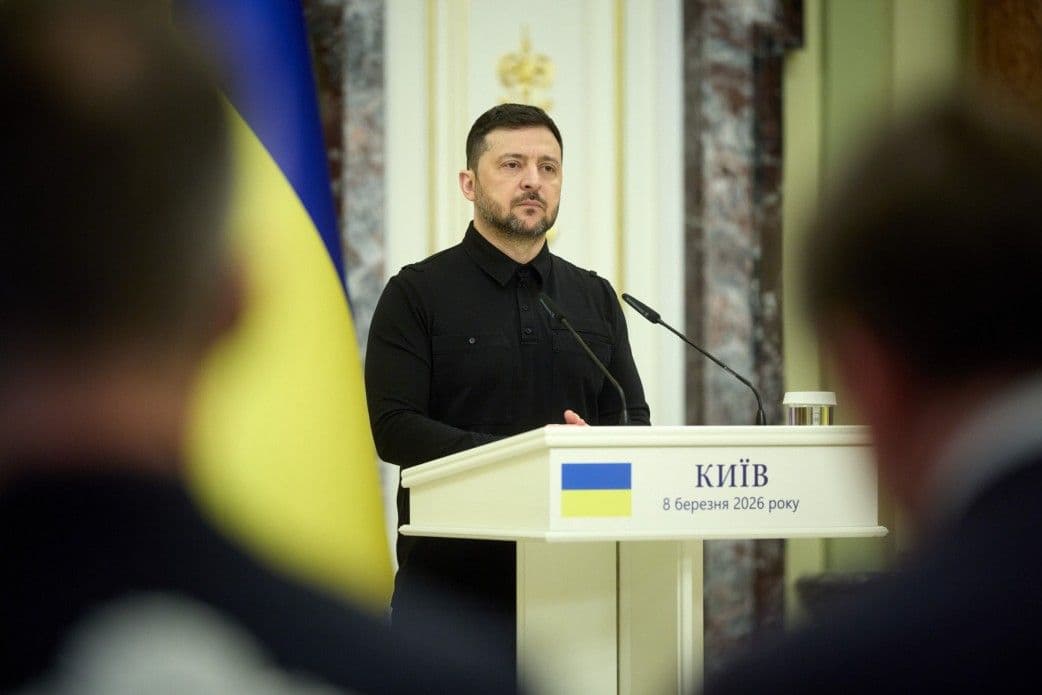
President Volodymyr Zelensky speaks to journalists at a joint briefing with Dutch Prime Minister Rob Jetten. (Presidential Office)
Those gains forced Russian commanders to react. Units once pressing offensives in the east were shifted south to stabilize the front. Among them was the 40th Naval Infantry Brigade, redeployed from the Pokrovsk sector toward Hulyaipole—one more brigade no longer available for assaults in Donetsk.
Meanwhile the pace of Russia’s advance had slowed. Open-source project Deep State recorded 126 square kilometers of Ukrainian territory lost in February, the smallest monthly loss since summer 2024. Russian forces continued attacking relentlessly, still paying enormous casualty costs for every kilometer gained, but the breakthrough Moscow hoped for had not arrived.
Russia’s goals remain unchanged: complete control of Donetsk and Luhansk. But the timetable is slipping.
Across the battlefield, a quieter equation is emerging—Russia inching forward in the east while Ukraine reclaims ground in the south.
A counteroffensive many believed had stalled is quietly rewriting the map.
Pacific Fleet Marines Thrown Into Ukraine’s Southern Fight
The 40th Separate Naval Infantry Brigade was supposed to guard Russia’s far eastern frontier. Its home waters stretch from Vladivostok to the Kuril Islands, thousands of kilometers from Ukraine’s southern steppe.
Yet Ukrainian drones and battlefield reports began telling a different story. Russian Pacific Fleet marines were now fighting near Hulyaipole, defending ground northwest of the town around Olenokostyantynivka. The same brigade had recently been operating near Pokrovsk and in the Dobropillya sector before being pulled south again.
The redeployment told its own story. Russian commanders had not moved elite naval infantry across the battlefield for convenience. They moved them because Ukrainian counteroffensives near Oleksandrivka and Hulyaipole were forcing difficult choices—defend the south or keep pushing in the east.
The pressure became visible during a mechanized attack east of Hulyaipole along the Malynivka–Zelenyi Hai corridor. Russian troops advanced with a tank, an armored vehicle, and two ATVs—barely the strength of a reduced platoon. Ukrainian defenders stopped the assault.
Even so, the attack revealed an adjustment. Russian forces in recent months had relied heavily on small infantry infiltration groups. The appearance of armored vehicles signaled a limited return to mechanized tactics, though on a cautious scale.
Ukrainian commanders watching the sector warned against complacency. Some Russian infantry units remained well trained, adapting their movements to terrain and weather. Surprise assaults and close-range engagements remained a constant threat.
But the larger calculation was unavoidable. Every brigade Russia shifted to defend Ukrainian gains in Zaporizhia meant one fewer formation available for its grinding offensives in Donetsk.
Pacific Fleet marines were never meant to defend Hulyaipole. Ukrainian pressure had rewritten their orders.
The Fire That Is Unraveling Russia’s Drone War
The smoke rising over northwestern Donetsk was not the result of a random strike. It was another step in a campaign unfolding piece by piece.
Geolocated footage showed massive explosions near the Tochmash Plant southwest of Donetsk City Airport. Secondary blasts rippled through the complex—the kind that follow when ammunition stores ignite. The location was no coincidence. Ukrainian forces had struck a Shahed drone launch site near the airport the day before.
That earlier attack used ATACMS and SCALP-EG missiles. Ukrainian officials confirmed the strike, and video soon verified the impact. Less than a day later, nearby storage facilities were erupting.
The pattern revealed deliberate targeting. Ukrainian forces were working through the infrastructure that sustained Russia’s nightly drone assaults.
Launch sites. Storage depots. Production facilities. Logistics nodes.
Each strike removed another piece of the network that allowed Shahed drones to reach Ukrainian cities.
The campaign also cut deeper into command structures. Ukrainian forces destroyed a drone control point and command observation post near Selydove, about sixteen kilometers from the front. Another control point near Hulyaipole was eliminated, disrupting the coordination behind drone operations.
For Russian planners in Donetsk, every strike created new problems. Launch sites had to be moved. Command links had to be rebuilt. Logistics chains had to be reorganized under constant threat of the next explosion.
Ukraine had spent years learning how to survive the Shahed war.
Now it was dismantling the machinery that made those attacks possible.
The Heir of the Ayatollah Steps Into a War
The decision in Tehran came quickly, but its consequences will echo far beyond Iran.
The Assembly of Experts elevated Mojtaba Khamenei to the position once held by his father, the late Ayatollah Ali Khamenei. The 56-year-old cleric had never held formal government office, yet his influence inside Iran’s power structure—especially through ties to the Islamic Revolutionary Guard Corps—had long made him a central figure behind the scenes.
To observers who followed Iran’s internal politics, the choice signaled continuity rather than change. The revolution that once rejected monarchy had now produced something resembling dynastic succession. The new leader was expected to preserve the same hardline direction that defined his father’s rule.
The response from Washington was immediate. President Trump dismissed the selection as unacceptable and suggested the United States should have a say in who governs Iran. The remarks went further than standard diplomatic criticism, implying that Iran’s leadership itself required American approval.
Israel’s position was equally blunt. Israeli officials warned that any successor to the slain ayatollah would remain a target, placing the new supreme leader under the same shadow that had ended his father’s rule.
For Ukraine, the development was more than a Middle Eastern political drama. Iran remains one of Russia’s most important military partners, supplying the drone technology that fuels nightly attacks against Ukrainian cities. A hardline succession suggested that cooperation would continue without pause.
The cycle tightened. Airstrikes killed one supreme leader. Another rose in his place. Threats followed immediately.
And the weapons flowing from Iranian factories toward the Ukrainian battlefield showed no sign of stopping.
Questions Washington Won’t Answer About the Russia–Iran Intelligence Link
When questions surfaced about Russian intelligence helping Iran target U.S. forces, the response from Washington was less clarification than deflection.
President Trump was asked about reports that Moscow had been providing targeting information to Iran. His answer did not confirm the claim or deny it. Instead, he dismissed the impact. Even if Russia were sharing intelligence, he argued, it did not appear to be helping Iran very much given recent events.
Pressed further, Trump shifted the argument. Countries share intelligence against adversaries all the time, he suggested. Russia might accuse the United States of doing the same by supporting Ukrainian strikes against Russian targets.
The comparison carried its own implication: intelligence cooperation between rival powers was simply part of modern conflict, not something that necessarily demanded retaliation.
Trump also insisted that Iran’s drone production had collapsed following American strikes, claiming output had fallen to roughly nine percent of its previous level. The destruction of manufacturing facilities, he argued, had crippled Iran’s ability to sustain the program.
But events on the battlefield told a different story. Russian forces launched 117 drones against Ukraine in a single night, including about seventy Shahed drones—the same Iranian-designed weapons that have struck Ukrainian cities for years.
The attacks continued night after night.
For Ukrainian officials, the contrast between Washington’s claims and operational reality raised troubling questions. If Russian intelligence assistance to Iran was considered normal when directed at American forces, what priority would the United States place on stopping the cooperation that fueled Russia’s drone war against Ukraine?
The drones kept coming regardless of political explanations.
The Russian Chip Inside the Drone That Hit a British Base
When investigators sifted through the wreckage of the drone that struck a British air base in Akrotiri, Cyprus, they were not just examining debris. They were tracing the fingerprints of a partnership.
British intelligence sent fragments of the kamikaze drone to laboratories for analysis. Inside the damaged electronics they found a Russian-made Kometa-B navigation system. The discovery confirmed that the drone—launched by an Iranian-aligned group from Lebanon—carried Russian technology.
The finding gave physical proof to what battlefield observers had long suspected. Russia and Iran were not simply exchanging weapons. They were integrating their technology.
According to U.K. Defense Staff Chief Sir Richard Knighton, the drone that struck the British base had been launched by an Iranian-aligned force. The attack came the same day Britain agreed to allow U.S. forces to use British bases for strikes against Iranian missile storage sites and launch facilities.
The sequence looked less like coincidence and more like retaliation.
Western forces struck Iranian targets. Iranian-aligned groups responded with drones. Those drones carried Russian navigation systems that helped guide them to their targets.
The pattern revealed how deeply the two countries’ military efforts had intertwined. Iranian drone designs had already fueled Russia’s nightly attacks against Ukrainian cities. Now Russian navigation technology was appearing in drones used against Western bases.
For Ukraine, the discovery was not surprising. Four years of war had already exposed the scale of the cooperation.
The same partnership that helps Iranian-aligned forces strike Cyprus also helps Russia launch waves of drones toward Ukraine’s cities night after night.
The Global Supply Chain Inside Russia’s Cruise Missiles
When Ukrainian intelligence specialists dismantled a captured Kh-69 cruise missile, they were not just studying Russian engineering. They were tracing how the global economy had found its way into a weapon aimed at Ukrainian cities.
The missile itself came from Russia’s Zvezda design bureau, part of the Tactical Missiles Corporation. Its structure resembled other Russian cruise missiles such as the Kh-35U and Kh-101. But the most revealing details were hidden inside its navigation system.
Investigators found components produced far beyond Russia’s borders.
Parts manufactured in China, the United States, Switzerland, and the Netherlands had all been integrated into the missile’s satellite guidance system. A weapon launched toward Ukrainian cities depended on technology built across multiple continents.
The discovery exposed the stubborn reality behind sanctions. Despite sweeping restrictions, Russia continues to obtain commercial electronics through complex procurement networks reaching into global markets.
Ukrainian intelligence tracks those discoveries through the War & Sanctions platform, a database documenting thousands of foreign components recovered from Russian weapons. Each entry identifies companies connected to the supply chain, creating a map of how civilian technology ends up inside military systems.
The information serves two purposes. It helps Western governments close sanctions loopholes. It also creates pressure on manufacturers whose products—sometimes unknowingly—appear in weapons used against civilians.
For Ukrainian investigators, the Kh-69 confirmed a lesson repeated throughout the war.
Russia’s missile arsenal is not built in isolation. Every missile launched toward Ukraine carries fragments of the global economy inside it.
The Fuel War Burning Behind the Front Lines
The fire in Krasnodar Krai was not just another explosion behind Russian lines. It was part of a quieter war aimed at the fuel that keeps armies moving.
Ukrainian drones struck an oil depot in Armavir, igniting fires across the facility. Local authorities confirmed the strike as geolocated footage showed explosions near the Armavir production and control station, a Transneft hub responsible for receiving, storing, and shipping fuel by rail. Satellite sensors soon detected heat signatures consistent with burning petroleum.
The target was deliberate. Oil depots and rail-linked fuel terminals sustain Russian operations across the front. Every damaged facility forces fuel to travel farther, stretching supply routes and complicating logistics.
The strikes also reached closer to the border. Ukrainian forces destroyed a Russian drone control point in Dunayka, Belgorod Oblast, about six kilometers from Ukraine. The site had coordinated drone operations targeting Ukrainian positions along the front.
Russia continued its own infrastructure campaign in response. Rail lines in western Ukraine were struck again, though Ukrainian Railways reported most damaged sections repaired by morning. Officials warned that attacks on logistics networks had intensified as the spring fighting season approached.
The result is a parallel battlefield far from the trenches.
Each burning fuel depot in Russia weakens supply flows to the front. Each repaired railway in Ukraine keeps its defenses moving.
Neither side has broken the other’s logistical network. But the war over fuel, railways, and supply routes continues to raise the cost of fighting for both.
When the Night Sky Filled With Drones and Missiles
Air raid screens across Ukraine lit up with a familiar pattern: incoming threats spreading across the map.
Air defense crews tracked 119 aerial attacks moving toward the country—two Iskander-M ballistic missiles and 117 drones. The missiles launched from Rostov and Voronezh. The drones approached from six directions: Bryansk, Kursk, and Oryol, Primorsko-Akhtarsk in Krasnodar Krai, Millerovo in Rostov Oblast, and occupied Crimea.
The multi-axis approach forced Ukrainian defenders to track targets across hundreds of kilometers at once.
Ukrainian air defenses destroyed 98 drones. The number showed both their growing skill and the harsh arithmetic of modern air defense. Even after shooting down most of the attack, nineteen drones and two ballistic missiles still broke through. Eleven locations were hit.
Energy sites and civilian infrastructure in Chernihiv and Kharkiv oblasts suffered damage as the strikes followed a familiar pattern—pressure on Ukraine’s power networks without crossing thresholds that might provoke stronger Western intervention.
In Velyka Babka in Kharkiv Oblast, rescuers encountered a tactic that has become increasingly common. After firefighters arrived to contain the first strike, another attack followed. The “double-tap” strike targeted the responders themselves.
Morning brought another threat. A Lancet drone struck a passenger train traveling between Sumy and Kyiv carrying about 200 passengers. The train was halted and diverted while railway crews inspected the damage.
Across the past week, Russia had launched nearly 1,750 drones, 1,530 glide bombs, and 39 missiles against Ukraine.
One hundred nineteen threats in a single night. Ninety-eight destroyed. The rest slipping through.
Another night where Ukrainian air defenders saved dozens of targets while knowing they could never save them all.
The Quiet Arithmetic of Loss
The numbers from the past day arrived quickly and without ceremony.
Three people killed. Twenty wounded. Among them, a child.
Behind each number was a place.
In Donetsk Oblast, Governor Vadym Filashkin reported one civilian killed and ten injured. The figures reflected only territory under Ukrainian control. Beyond the front line, in Russian-occupied areas, the full toll often goes unreported.
In Kharkiv Oblast, Russian drones and glide bombs killed two civilians and injured seven others, including a child. The region remains one of the war’s most exposed frontiers—close enough to the border for frequent strikes and large enough that attacks often reach populated neighborhoods.
Further south, Kherson continued absorbing the slow damage of daily bombardment. Authorities reported artillery and air strikes damaging seven apartment buildings and eighteen private homes. Five civilians were injured. Even when people survive the blasts, the destruction steadily erodes the places where they live.
The numbers look simple on a report.
Three dead. Twenty injured.
Seven apartment buildings damaged. Eighteen homes destroyed.
After years of war, this accounting has become routine. Yet each number marks a family leaving a shattered home, neighbors gathering for another burial, and communities bracing for the next night of sirens.
How the Battlefield Turned Ukraine Into a Weapons Laboratory
The message from Kyiv’s military innovation briefing was blunt: war had given Ukraine something most armies cannot buy—experience.
Colonel Vitalii Dobriansky, who leads the Armed Forces’ innovation directorate, explained that many militaries prepare for future wars through exercises and simulations. Ukraine had been forced to test its ideas in real combat.
Every night of drone attacks, every battlefield improvisation, every emergency repair had become part of a living laboratory.
At the briefing, senior officers described how Ukraine was turning that experience into a new defense ecosystem. Foreign partners brought industrial capacity and advanced technology. Ukrainian units tested those systems under real combat conditions—something few countries could replicate.
Major Andrii Kovalyov summarized the partnership in simple terms: the West provides industry, Ukraine provides ideas and battlefield experience.
More than 110 joint projects are now under discussion with partners across NATO, the European Union, and allied militaries. Britain is working with Ukraine to expand production of Octopus 100 interceptor drones, aiming for roughly 1,000 units each month. Additional projects focus on training, education, and new battlefield technologies.
Other collaborations stretch even further. NATO innovation programs are testing counter-drone defenses. Canada is developing urban systems to defeat aerial threats. Sweden is supporting projects in autonomous systems and electronic warfare.
U.S. cooperation includes testing synthetic-aperture radar on Ukraine’s Raybird-3 drone, allowing surveillance even in bad weather when traditional sensors fail.
The pattern is clear. Ukraine identifies the problem on the battlefield. Partners supply technology and production. Ukrainian forces test the solution under fire.
Four years of war have created knowledge no training exercise could reproduce.
Ukraine is now turning that hard-earned experience into technological advantage.
From Ukrainian Trenches to the Pentagon’s Arsenal
The drone that caught the Pentagon’s attention did not begin in a laboratory. It was born on the battlefield.
Ukraine’s SkyFall company, working with Britain’s Skycutter, saw its Shrike Fiber drone take first place in the Pentagon’s Drone Dominance competition. The fiber-optic First Person View drone scored 99.3 out of 100 in the program’s first “Gauntlet,” outperforming other systems competing for U.S. military orders.
Skycutter also topped long-range performance tests and ranked second in urban strike trials. When the Pentagon released its list of the first eleven systems selected for procurement, the Ukrainian-linked design stood at the top. Another Ukrainian manufacturer, Ukrainian Defense Drones, also secured a place among the chosen suppliers.
The victory was not the result of theoretical engineering.
The Shrike Fiber had been shaped in combat. Ukrainian drone teams refined the design through thousands of missions against Russian forces, adjusting tactics and hardware after every encounter. Each battlefield lesson became part of the drone’s evolution.
The key feature lay in its control system. Instead of relying on radio signals easily disrupted by electronic warfare, the drone used a fiber-optic cable to transmit commands. The physical link allowed operators to guide the aircraft even in heavily jammed environments where conventional drones would lose control.
That solution emerged from necessity. Russian electronic warfare forced Ukrainian engineers to rethink how drones communicate in combat.
Now the Pentagon is preparing to deploy that same solution.
For Ukraine’s defense industry, the result was more than a contract. It was recognition that ideas forged under fire had matured into technology capable of shaping Western military procurement.
Battlefield improvisation had become exportable innovation.
The Quiet Before the Next Assault Near Kharkiv
Along the Kharkiv front, something unusual had happened. The constant pressure eased.
Colonel Viktor Trehubov, spokesperson for Ukraine’s Joint Forces Task Force, confirmed what soldiers along the line had already noticed: Russian attacks in the sector had slowed. But he warned that the quiet was not victory. It was preparation.
Russian forces had lost satellite connectivity after Ukrainian actions blocked Starlink terminals used by their units. Without those links, coordinating attacks across multiple axes and directing artillery became far more difficult.
The pause gave Russian commanders time to rebuild their communications.
Ukrainian units reported seeing improvised solutions appear across the battlefield. Russian forces began establishing Wi-Fi relay bridges to replace the lost satellite connections. The networks were weaker but still capable of guiding drones. Other units experimented with tethered balloons rising a hundred to two hundred meters above the ground, extending signal range across the front.
The fighting never disappeared completely. Russian forces continued probing attacks northeast of Kharkiv near Hrafske, Vilcha, Vovchansk, and nearby villages, while other units pressed north of the city toward Vesele. Russian military bloggers also reported Ukrainian counterattacks near Izbytske and Vovchanski Khutory.
Drone operators from Russia’s 11th Tank Regiment remained active in the sector, evidence that Moscow had not abandoned the fight.
For Ukrainian defenders, the slowdown offered rare breathing room. Positions could be reinforced. Units could rotate. Supplies could move forward.
But commanders along the front understood the pattern.
The quiet meant Russian forces were rebuilding the tools needed for larger attacks. Communications were being restored, tactics adjusted, and units reorganized.
The pause near Kharkiv was not an ending.
It was the silence before the next assault.
A Frontline That Never Sleeps
Across Ukraine’s eastern and southern fronts, the maps barely changed. The fighting never stopped.
Russian forces pressed along the northern border of Sumy Oblast, striking near Sopych and Pokrovka while probing villages further north. Reports of small advances circulated on Russian channels, but Ukrainian sources saw no confirmed changes to the line.
To the east, attacks continued along the Kupyansk axis. Russian units struck positions inside the city and nearby villages including Kucherivka, Pishchane, Podoly, and Kivsharivka. Further south, assaults reached toward Borova, where fighting flared around Serednie and Novyi Myr without shifting the front.
In the forests and river valleys around Lyman and Slovyansk, Russian forces attempted infiltration south of Riznykivka. Ukrainian strikes hit the exposed positions, leaving the forward edge of the battle unchanged. Fighting also continued near Yarova, Stavky, and Dronivka as both sides probed for openings.
Further south, the pressure spread across the Donetsk front. Russian units attacked near Kostyantynivka, Druzhkivka, Toretsk, and Chasiv Yar. The assaults continued toward Pokrovsk—once the focal point of Moscow’s offensive—but none produced confirmed breakthroughs.
Ukrainian forces responded with their own strikes. Drone operators destroyed a North Korean–supplied Koksan artillery system while command posts near Volnovakha and Novopetrykivka were hit behind the lines.
The fighting stretched further south through the Vremivka and Kurakhove sectors, while Russian units also pressed toward Orikhiv in Zaporizhia. In Kherson, small assaults probed Ukrainian defenses near the Antonivskyi Bridge.
Even Crimea was not quiet. Ukrainian strikes hit a Pantsir air defense system and a landing vessel near Novoozerne while another drone control point was destroyed.
The result was a battlefield in constant motion but little movement.
Russian forces attacked across dozens of sectors. Ukrainian defenders held the line.
Another day ended with the map almost unchanged.
Europe’s Financial Weapon: The Druzhba Pipeline Hostage Crisis
Slovak Prime Minister Robert Fico warned that Slovakia would “take up the baton from Hungary” and block European Union funding for Ukraine if Hungarian Prime Minister Viktor Orbán loses upcoming elections.
The threat targets a €90-billion EU loan package—€30 billion for Ukraine’s budget and €60 billion for military needs. Without it, Kyiv risks severe financial strain by mid-2026. Hungary is already blocking the loan amid a dispute over the Druzhba pipeline, which stopped transiting Russian oil through Ukraine in January.
Slovakia and Hungary—the only EU states still importing Russian crude through the system—have escalated pressure on Kyiv since the shutdown.
Fico plans to raise the issue with European Commission President Ursula von der Leyen in Paris. His message is simple: why should the EU prioritize Ukraine’s interests over those of its own member states?
Bratislava wants the Commission to pressure President Volodymyr Zelensky to allow inspection of the pipeline. Fico claims Slovakia has satellite imagery showing Druzhba remains operational—contradicting Ukrainian statements that Russian strikes damaged infrastructure and halted flows.
The timing reflects Hungarian politics. Orbán’s Fidesz Party currently trails the opposition Tisza Party in polls. If Orbán loses power, Hungary’s veto over EU support for Ukraine could disappear. Fico is signaling that Slovakia would replace Hungarian obstruction.
Both Slovakia and Hungary have already halted diesel exports to Ukraine in retaliation. Budapest previously declared it would block EU support until Russian oil flows through Druzhba resume.
For Kyiv, the dispute exposes a vulnerability Russian offensives cannot exploit. Moscow advances slowly at enormous cost. But if European allies withhold €90 billion over a pipeline dispute, Ukraine could face financial collapse long before military defeat.
Culture Wars: Russia Returns to Venice While Ukrainian Artists Remain Dead
Ukraine condemned Russia’s impending return to the Venice Biennale on March 8, calling it “a dangerous signal of support for aggression, tolerance of Russian war crimes, and the normalization of the Russian occupiers’ genocidal policy.”
The Art Biennale—one of the world’s largest cultural events—opens May 9. Russia will participate for the first time since 2022, when its pavilion was effectively shut down after invited artists withdrew in protest of the full-scale invasion of Ukraine.
A joint statement from Ukraine’s Culture and Foreign Ministries highlighted the scale of destruction inflicted on Ukrainian culture since Russia’s war began. According to Ukrainian officials, 346 artists and 123 Ukrainian and foreign media professionals have been killed since 2022. Russian attacks have also damaged or destroyed 1,707 cultural heritage sites and 2,503 cultural infrastructure facilities.
The ministries also referenced Russia’s centuries-long campaign of Russification against Ukrainian culture. In that context, they argued, admitting Russian representatives to major international art events was unacceptable.
The Russian pavilion will be overseen by commissioner Anastasia Karneeva, appointed by Russia’s Culture Ministry in 2021 for an eight-year term. Reports indicate Karneeva has ties to Russia’s military-industrial complex, raising concerns that cultural diplomacy may also support sanction-evasion networks or intelligence activity.
For Ukrainian artists and cultural workers, the decision reflects a troubling shift in Western cultural memory.
Russian forces have destroyed museums, bombed theaters, and killed hundreds of artists and journalists. Yet the global art world is once again opening its doors to Russian participation less than three years after the invasion.
While Ukrainian cultural sites remain in ruins and many Ukrainian artists remain dead, Russia is returning to one of the world’s most prestigious cultural stages.
The Day’s Meaning: The War Expands While the Front Holds
Watch Ukrainian drone specialists boarding flights to the Middle East while Russian naval infantry redeployed to stabilize the Hulyaipole sector. Listen to President Zelensky announce 400 kilometers liberated in the south while Slovak leaders threatened to block €90 billion in European aid. See the Pentagon selecting Ukrainian-designed drones while Russian forces attacked across the front without achieving breakthrough.
Day 1,375 revealed a war expanding outward even as the battlefield itself remained largely unchanged.
Ukraine’s battlefield experience—earned defending against nightly Shahed attacks—has become strategic currency. Gulf states are seeking Ukrainian instructors and interceptor technology. American procurement competitions are selecting Ukrainian-designed drones over Western alternatives. Innovations forged through survival are now spreading to allied militaries.
Yet those same successes expose new vulnerabilities. Slovakia and Hungary are threatening to weaponize European financial support over pipeline disputes. Russia is returning to major cultural events while Ukrainian artists and journalists remain among the war’s dead. Iranian hardliners are consolidating power in Tehran while cooperation with Russia on drone warfare continues.
On the battlefield, Russian deployments reveal strain. Units have shifted from offensive sectors to defensive stabilization, and February territorial losses were the lowest since mid-2024. Russian attacks continue across multiple sectors but have failed to produce confirmed breakthroughs.
At the same time, the scale of Russian strikes remains relentless. Drones, glide bombs, and missiles continue arriving nightly. Ukrainian defenses intercept most threats, but not all.
The war’s infrastructure dimension continues as well: Ukrainian strikes on Russian oil depots and drone facilities, Russian strikes on Ukrainian railways and energy systems, foreign components flowing into Russian missiles, and Russian technology appearing in Iranian drones.
The front line holds. The war spreads outward.
Ukraine’s knowledge, alliances, and innovation are expanding. So are the pressures surrounding the war.
The outcome remains uncertain.
Prayer For Ukraine
- Protection from Drone and Missile Strikes
Lord, we pray for the people of Ukraine who again faced waves of drones and missiles. Protect the cities and villages struck in this latest assault, and guard the air defense crews who stand watch through the night. Shield families, firefighters, and first responders from the “double tap” attacks meant to increase suffering. Preserve lives and give strength to those defending the skies.
- Comfort for the Bereaved and the Wounded
Father, we lift before You the families of those killed and the twenty people wounded in the latest attacks, including the injured child. Bring comfort to grieving families, healing to the wounded, and peace to communities that continue to endure loss after so many days of war.
- Wisdom for Leaders Facing Critical Decisions
God, grant wisdom to Ukraine’s leaders and to those across Europe making decisions about aid and support. As disputes over pipelines and financial assistance threaten Ukraine’s stability, guide leaders toward choices that uphold justice, unity, and the defense of freedom.
- Justice Amid Global Complicity in War
Lord, we pray for restraint and accountability among nations whose technology, weapons, and partnerships fuel this conflict. Expose the networks that enable destruction and turn the hearts of those who profit from war so that truth and justice prevail.
- Endurance for the Ukrainian People
Strengthen Ukraine’s soldiers holding the line across the front, the engineers repairing damaged infrastructure, the innovators building defenses against drones, and the cultural leaders preserving their nation’s identity. Give the Ukrainian people courage, unity, and perseverance for the days ahead.
Lord, defend Ukraine, comfort the suffering, guide the nations toward justice, and bring this war to a just and lasting end. Amen.