
In Krasnodar Krai, fuel tanks blazed at the pipeline feeding Russia’s Black Sea exports. In Riyadh, Aramco executives negotiated to buy the drone technology Ukraine built while surviving Russian attacks. In Moscow, the Kremlin cut its own citizens’ internet for the second straight day.
The Day’s Reckoning
Fuel tanks burning at Tikhoretsk. The only pipeline feeding petroleum products to Russia’s Black Sea export terminal at Novorossiysk — on fire.
Six thousand kilometers southeast, Saudi Aramco executives sat across the table from Ukrainian drone manufacturers, trying to buy interceptor technology faster than their own government could approve it. The world’s largest oil producer wanted the defenses Ukraine built while surviving four years of Russian Shahed attacks. The U.S.-Israeli war against Iran had made those defenses everyone’s problem.
In Moscow, the Kremlin cut internet inside the State Duma for the second straight day. Telegram faced throttling. VPNs were next.
Along the front line, Russia’s 51st Combined Arms Army — bled white taking Myrnohrad — slowed to sporadic attacks. Russian forces seized Hryshyne and the Pokrovska mine, but the army that was supposed to encircle Pokrovsk could barely sustain offensive operations. Ukrainian counterattacks exploited the Starlink blackout crippling Russian communications.
Five civilians killed. Over a hundred wounded. A 15-year-old girl dead in Chernihiv Oblast.
Day 1,478. The day Ukraine’s war started selling.
Russia’s Oil Lifeline to the Black Sea Goes Up in Flames
The SBU source didn’t mince words: Tikhoretsk is the only supply branch delivering petroleum products to Novorossiysk.
One sentence. The entire strategic logic of the operation.
Novorossiysk is Russia’s largest oil export terminal on the Black Sea. Every barrel passing through it flows first through Tikhoretsk — the pumping station, the depot, the terminal where Russian fuel gets handled and routed south. Hit Tikhoretsk and you choke the revenue pipeline feeding Moscow’s war machine.
The SBU’s Alfa Special Operations Center hit it. Videos showed multiple fires — fuel storage tanks, given the intensity and spread. Satellite imagery confirmed at least one tank ablaze.
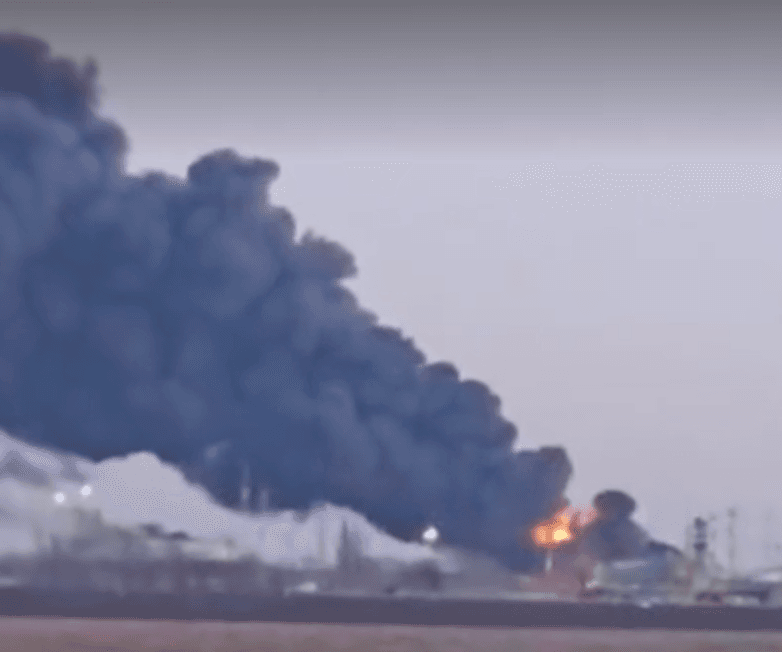
Russian authorities scrambled 26 pieces of firefighting equipment. Tikhoretsky Raion Head Anatoly Perepelin acknowledged the strike.
This wasn’t the first. Ukraine struck Novorossiysk oil infrastructure earlier in March. The pattern was deliberate: disrupt supply chains, complicate fuel transport, force Moscow to reroute logistics it can’t afford to reroute.
Then the irony. Even as Ukrainian drones burned Russian oil infrastructure, the war in Iran was roiling global energy markets in ways that could rescue Moscow’s finances. January and February had been bleak for Russia — low oil prices, a looming glut, compounding sanctions squeezing revenue. The Iran war threatened to reverse all of it, spiking demand for precisely the Russian barrels Ukraine was trying to stop.
The SBU kept striking anyway. The flames burned into the morning.
Aramco Wants Ukraine’s Drones — and They Want Them Now
The Wall Street Journal broke it on March 12. Saudi Aramco — the world’s largest oil producer, a tenth of global supply — was in urgent talks with Ukrainian drone manufacturers SkyFall and Wild Hornets to buy interceptor drones that destroy hostile UAVs by ramming them or detonating nearby.
Aramco wanted them fast. Faster than its own government. Faster than regional competitors like Qatar.
Four years of surviving Russian Shahed swarms had given Ukraine something no other country possessed: battle-tested counter-drone systems refined through thousands of real interceptions. The U.S.-Israeli war against Iran, launched February 28, had turned those same Iranian drones into the Middle East’s most urgent threat. Suddenly, Ukraine’s painful expertise was the hottest commodity in the Gulf.
Zelensky was already moving. Three groups of Ukrainian specialists — experts, military personnel, engineers — had departed for the Middle East. National Security and Defense Secretary Umerov arrived in the UAE. Ukrainian interceptor drones and a team of experts were already protecting U.S. military bases in Jordan.
Then came the bigger play. Zelensky revealed Ukraine had proposed a major agreement with the United States on drone production and integrated air defense technologies seven months ago. Washington dismissed it.
Now Washington was reconsidering.
“I hope that maybe American friends will be closer to this decision now,” Zelensky said, “especially after such challenges as we see in the Middle East.”
Seven months ago, nobody wanted to buy. Now everyone was calling.
Moscow Goes Dark — By Its Own Hand
Mobile data across Moscow, restricted since March 5. Internet inside the State Duma building, cut for the second consecutive day. State Duma Speaker Vyacheslav Volodin’s explanation: “state security.”
Translation: the Kremlin was blinding its own capital.
Spokesman Dmitry Peskov warned Telegram to comply with Russian laws or face a full block. Deputy Chairperson Andrey Svintsov of the Duma’s Information Policy Committee went further — claiming Roskomnadzor could throttle Telegram even through VPNs, and would start doing so. His justification: “uncontrolled communications” enable terrorism.
The real calculus was different. September 2026 brings Duma elections. Rolling reserve call-ups loom. The Kremlin was building a controlled information environment before announcing things its citizens wouldn’t welcome.
Russians noticed. A political Telegram channel declared the consensus blunt: the censorship was “madness.” The crackdown had shattered a “narrative of unity” between government and people that would be hard to rebuild before voters went to the polls.
The Kremlin’s response: force Russians onto state-controlled apps like the Max messenger. Imprison dissidents. Restrict foreign internet access.
A regime confident in its grip doesn’t systematically cut its own population’s communications. This one was cutting fast.
Pokrovsk’s Spearhead Bleeds Out
The biggest frontline story on March 12 wasn’t a breakthrough. It was an army grinding to a halt.
Ukrainian military observer Kostyantyn Mashovets reported that Russia’s 51st Combined Arms Army — the spearhead of the Pokrovsk offensive — had suffered such heavy losses taking Myrnohrad that it was reduced to sporadic attacks in the Rodynske-Shevchenko and Sukhetske-Bilytske directions. The formation that was supposed to encircle Pokrovsk from the north could barely sustain operations.
Russian forces still seized Hryshyne northwest of Pokrovsk and the Pokrovska mine north of Udachne. The 2nd Combined Arms Army pushed through Hryshyne toward Novooleksandrivka. The offensive continued — with one of its two main armies functionally broken.
The math was punishing. Mashovets noted that any push toward Dobropillya would force Russia to divert resources from the Slovyansk-Kramatorsk direction and heavily reinforce both the 51st and 2nd CAAs. Pokrovsk was consuming combat power faster than Moscow could replace it.
A Kremlin-affiliated milblogger confirmed the cost from the other side: constant Ukrainian drone strikes were forcing Russian soldiers to hold positions in basements for months. No supplies. No rotation.
Months. In basements.
The encirclement Russian planners envisioned was becoming a fantasy sustained by orders, not capability.
The Starlink Blackout Russia Didn’t Plan For
When Starlink went dark for Russian forces on February 1, Moscow’s commanders likely assumed they’d adapt. Six weeks later, Ukrainian infantry was walking through the gaps their silence created.
A Ukrainian brigade spokesperson in the Oleksandrivka direction described what the disruption actually did to Russian operations: command and control shattered, FPV and reconnaissance drone networks went blind, and the door swung open for counterattacks that hadn’t been possible in months. Russian engineers scrambled to replace Starlink with WiFi bridges — primitive systems that needed an amplifier antenna every kilometer to function. Lose a single antenna and the whole network collapsed.
Ukrainian forces read the battlefield and moved. Infantry groups advanced on foot and mounted on armored fighting vehicles near Andriivka, Novooleksandrivka, Vovche, and Sosnivka, while mechanized counterattacks struck north of Ivanivka. Heavy drones played a dual role — hammering Russian positions and resupplying the advancing Ukrainian troops behind them.
The ripple effects reached the Slovyansk direction, where Russian forces were reduced to controlling unmanned ground vehicles with handheld remote controls instead of networked systems. The UGVs that once ran logistics sat useless. Russian troops turned to Mavic FPV drones to drop supplies to forward positions — but Ukrainian air defenses intercepted roughly 90 percent of those deliveries before they reached anyone.
The technology that had powered Russia’s drone-centric way of war was gone, and every substitute Moscow tried was proving worse than the last.
145 Kilometers Behind the Lines, a Fuel Train Burns
While infantry traded meters along the front, Ukraine’s deep strike campaign was methodically tearing apart the infrastructure that kept Russian forces fighting.
On the night of March 11 to 12, Ukrainian Unmanned Systems Forces Commander Major Robert “Magyar” Brovdi reported three FP-2 drone strikes that mapped the depth of Ukraine’s reach: an S-300V air defense launcher near Borovenky, 45 kilometers from the front. A warehouse and ammunition depot near Dubivskyi, 110 kilometers back. And a fuel train near Dovzhansk, 145 kilometers behind the lines. Geolocated footage confirmed fires at all three targets. Luhansk People’s Republic head Leonid Pasechnik acknowledged the train strike himself, posting images of the burning wreckage.
The damage went deeper. In occupied Donetsk Oblast, a March 11 strike against a field artillery depot near Shyroka Balka — 112 kilometers from the frontline — destroyed over 6,000 rounds of ammunition. Satellite imagery from March 8 showed that cruise missile strikes against occupied Donetsk City Airport on March 7 had wrecked several hangars storing Russian strike drones and a likely warhead depot. Russian forces responded by removing eight hangars and building four concrete bunkers — harder to hit, but proof Ukraine was forcing expensive adaptations.
In occupied Crimea, the picture was even more alarming for Moscow. GUR drone operators had struck Sopka-2, Podlyot, P-18 Terek, and Kasta radar stations, a Shahed drone ground repeater, a precision approach radar, and a jamming station throughout February. A Russian milblogger warned bluntly that continued strikes would either gut Crimea’s air defense umbrella within a year or force Russia to strip radar systems from other theaters.
The Unmanned Systems Forces also hit four assets of the Rubikon Center for Advanced Unmanned Technologies in Zaporizhia Oblast since March 1 — a position, warehouses, and a drone workshop. Ukraine was hunting the drone operators themselves.
A Girl in Mena, a House That No Longer Exists
Ninety-four drones launched overnight from five directions — Kursk, Oryol, Millerovo, Primorsko-Akhtarsk, occupied Hvardiiske. About 60 were Shaheds. Ukrainian air defenses downed 77. Sixteen struck home across 11 locations. Debris from the intercepted ones hit another.
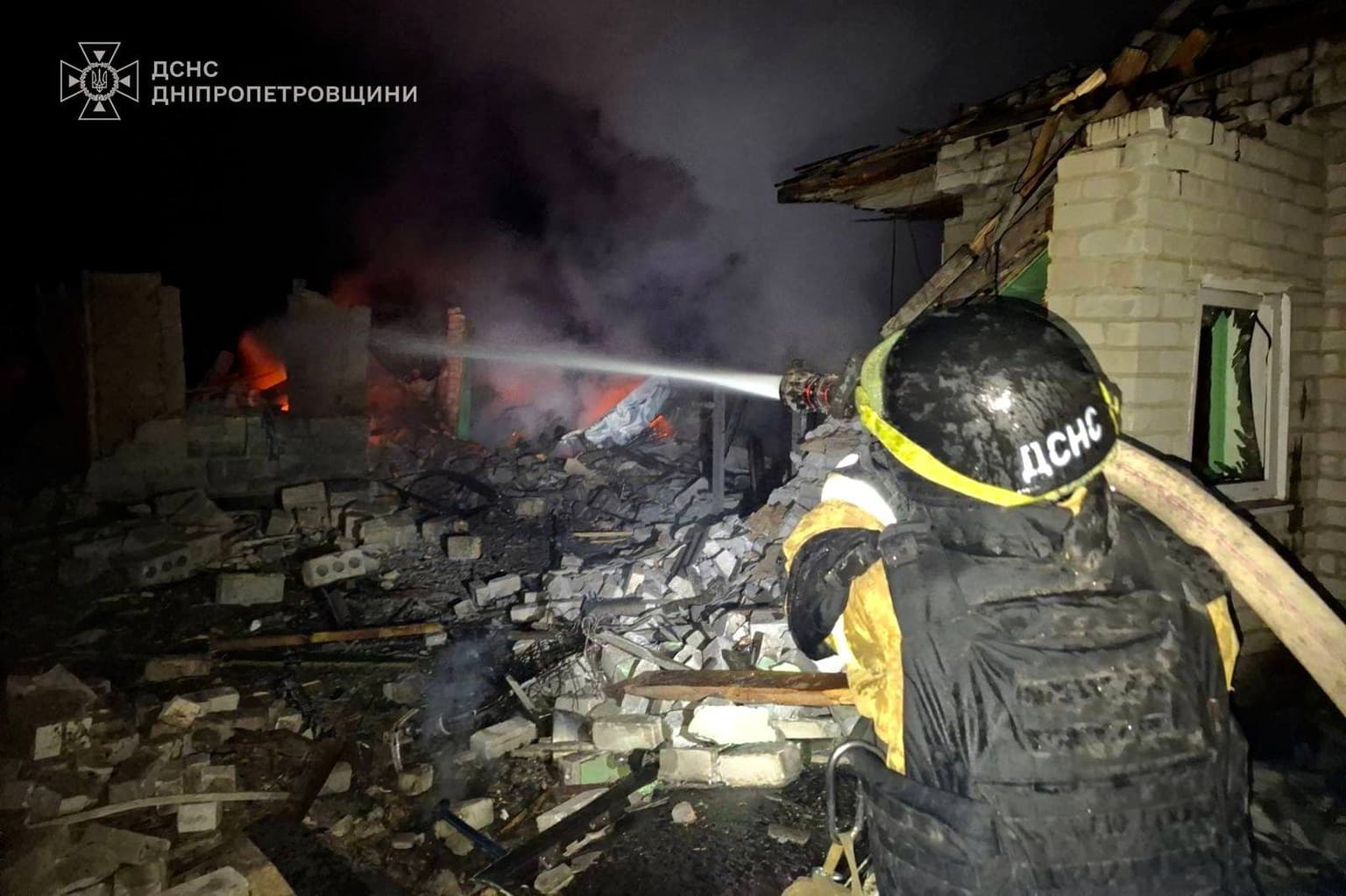
Firefighters tackle a blaze in Dnipropetrovsk Oblast after a Russian attack overnight. (DSNS/Telegram)
In Mena, Chernihiv Oblast, one of those drones found a family’s house. A 15-year-old girl died. Her parents survived, injured, and remained under medical supervision. The house didn’t survive at all.
Kharkiv took the heaviest combined blow — three killed, 16 injured, including a child. Russian forces hit the Shevchenkivskyi and Kyivskyi districts with a mix of eight guided aerial bombs, 13 Geran-2 drones, four Molniya drones, six FPV drones, and 15 others of unspecified type. In Kherson Oblast, one person was killed and 23 wounded, including a child, as air strikes and artillery hit critical, transport, and social infrastructure. A 66-year-old man died from injuries sustained the day before — the war catching up a day late.
Zaporizhzhia Oblast absorbed 780 strikes across 42 settlements. KAB glide bombs hit a residential area of Zaporizhzhia City, injuring 15. In Sumy Oblast, a drone struck a police administrative building in the Shostka community, wounding more than 40 officers in a single hit. Two more civilians were injured in the Boromlia community. In Dnipropetrovsk Oblast, two wounded. In Donetsk Oblast, one.
Five dead. Over a hundred wounded. Another night where the math of interception — 77 out of 94 — still left families buried in rubble.
A Relay Cabinet Near Stary Oskol
Somewhere near Stary Oskol in Belgorod Oblast, Atesh partisan agents found a railway relay cabinet that controlled rail traffic supporting Russian operations toward Kupyansk. They disabled it.
The target wasn’t random. An urgent ammunition delivery was rolling toward the Russian 122nd Motorized Rifle Regiment and 27th Motorized Rifle Brigade. It never arrived. Both units launched their next assaults short on ammunition.
The result was predictable: high casualties from attacks that went in without adequate supply.
No drone strike. No cruise missile. Just agents operating inside Russian-controlled territory, choosing which piece of infrastructure would hurt most — and breaking it. The Atesh network was turning Russia’s rear areas into another front, one relay cabinet at a time.
Choking on a Narrow Corridor South of Vovchansk
The Russian advance in northern Kharkiv Oblast hadn’t been stopped by a single decisive battle. It was being strangled by geometry.
Military observer Mashovets reported that Russia’s 44th Army Corps and 6th Combined Arms Army kept pushing south along the east bank of the Siverskyi Donets River toward Hrafske and Symynivka. But Ukrainian counterattacks near Prylipka had squeezed their supply route down to a single narrow corridor — and Ukrainian forces held fire control over it. Every truck, every ammunition carrier, every reinforcement column had to run a gauntlet to reach the advancing troops.
Ukrainian forces held the southeastern outskirts of Vovchansk, blocking any Russian push toward Bilyi Kolodyaz northeast of Kharkiv City. Russian attacks near Vovchanski Khutory, Prylipka, Symynivka, Zybyne, and Vesele produced nothing.
In Sumy Oblast, Russian forces had infiltrated one to two kilometers across the international border near Pokrovka, Popivka, Vysoke, and Hrabovske, with elements of the 83rd Separate Airborne Brigade operating near Yablunivka. They were trying to seize Pokrovka and push toward Ryasne.
The Russian objective — a buffer zone that would bring tube artillery within range of Kharkiv City — remained out of reach. The border bent. It didn’t break.
A Tank Division Thrown at Kupyansk — and Nothing Moved
Russia’s Western Grouping of Forces made its bet on the Oskil River line: redirect the main effort east of Kupyansk and throw the 47th Tank Division at it — the 153rd Tank Regiment and two motorized rifle regiments committed to breaking through.
Mashovets reported the result: unsuccessful. Russian forces attacked toward Kupyansk itself, southeast toward Podoly and Hlushkivka. Nothing moved. Ukrainian forces held Kurylivka southeast of Kupyansk. Russian infiltrations toward northeastern Kupyansk and eastern Kivsharivka changed nothing on the forward edge of the battle area.
South in the Borova direction, Russian forces hit Novoplatonivka and Cherneshchyna. Same outcome.
A tank division committed. A front line unchanged. The Oskil River remained a barrier Russia could not cross in force.
Chasiv Yar Is Filling with Tanks
Russian forces fought across an arc from Lyman to Fedorivka, striking near more than a dozen settlements. Ukrainian forces counterattacked near Lyman and Illinivka, and in the Kostyantynivka tactical area actually advanced on the city’s southern outskirts — a rare gain amid months of defensive grind.
The real story was what Ukrainian commanders saw building behind the front.
Lieutenant Colonel Dmytro Zaporozhets, spokesperson for Ukraine’s 11th Army Corps, reported that Russian forces were accumulating infantry, drone operators, and armored vehicles — including tanks — inside occupied Chasiv Yar. A spring offensive was taking shape. Russian airstrikes in the corps’ sector had already intensified from an average of three to five daily, enabled by clearer weather and longer daylight hours.
Further north, a Ukrainian NCO in the Lyman direction saw the same pattern: Russian forces preparing to intensify assaults in spring, using drones to establish fire control over settlements that would open the road toward the Slovyansk-Kramatorsk agglomeration.
Zaporozhets put the daily drone war in scale: Ukrainian forces were eliminating or suppressing 100 to 150 Russian drones every day. An industrial-scale air war fought above the trenches, invisible to anyone not standing in it.
Spring was coming. Chasiv Yar was filling up.
Higher, Faster, Deadlier: The Skies Over Zaporizhia
The drone war over Zaporizhia Oblast was evolving faster than either side could keep up with.
Russian forces had dropped their Molniya fixed-wing drones to lower altitudes to evade Ukrainian detection. Ukrainian forces adapted — and were now intercepting them at altitudes exceeding one kilometer. A Ukrainian brigade spokesperson in the Orikhiv direction confirmed the shift. The countermeasure had already been countered.
From the Russian side, a milblogger complained that Ukrainian forces had started fielding E-300 long-range fixed-wing drones against frontline targets in Zaporizhia Oblast, and Russian forces couldn’t stop them. Every innovation by one side forced the other into a scramble that might take days or weeks to solve — and by then, the threat had changed again.
On the ground, Ukrainian forces advanced southeast of Novodanylivka. Russian attacks near Stepnohirsk, Novodanylivka, and Stepove went nowhere. Across the Hulyaipole arc — from Olenokostyantynivka to Myrne — Russian forces pushed without gaining ground.
A Russian milblogger claimed a strike on a Ukrainian bridge near Zaporizhzhia City disrupted logistics — a reminder that holding the front line didn’t make the rear areas safe. Further south near Kherson, Russian forces continued limited assaults near Bilohrudyi Island, the southern flank’s quiet pressure point that never quite went away.
Russian Drones Keep Crashing in Romania. Now Bucharest Is Building Its Own.
Russian attack drones had been crashing in Romanian territory during strikes on Ukraine. Bucharest decided to stop watching and start building.
In the Romanian capital, Zelensky and President Nicusor Dan signed a strategic partnership declaration that included joint drone production — turning a neighbor’s irritation into a manufacturing alliance. Romania wasn’t just condemning the drone threat anymore. It was joining the supply chain to counter it.
The energy agreements ran equally deep. Two new power supply lines connecting Romania to Ukrainian border regions, particularly Chernivtsi Oblast, were under construction. The two sides discussed importing American LNG into Ukraine and jointly developing Ukrainian gas fields.
“This is something that will allow Romania to become stronger in terms of ensuring energy security in our part of Europe,” Zelensky said.
Drones and power lines. Defense and energy. Another bilateral relationship hardened by war into something practical and immediate.
Budapest Sends a Delegation to Kyiv. Kyiv Didn’t Invite Them.
Orbán announced it like a diplomatic triumph: a Hungarian expert team led by State Secretary Gabor Czepek had arrived in Kyiv to assess the Druzhba oil pipeline, whose Ukrainian section went offline in late January after a Russian attack in western Ukraine.
Ukraine’s Foreign Ministry responded with the diplomatic equivalent of a blank stare. The visit hadn’t been coordinated. The team had no official status. No meetings were scheduled. In an online call with Czepek, Orbán instructed him to “try to get in touch with the government bodies responsible for energy” — effectively admitting his delegation had arrived in a foreign capital without a single appointment.
The backdrop made it worse. Budapest and Bratislava had accused Ukraine of lies and blackmail over the pipeline, and were blocking the EU’s 20th sanctions package against Russia and the €90 billion EU loan to Kyiv in retaliation.
Zelensky didn’t bother with diplomacy. “He’s standing on the side of the Russian leader,” he told Politico. “He’s doing the same, blocking everything for Ukraine.” He urged European partners to build a “Plan B” if Hungary’s veto held.
A pipeline broken by Russian missiles. A NATO member using that damage as leverage against Ukraine. An uninvited delegation wandering Kyiv with no one to meet. The logic was perfectly circular.
“What Will Be After You? And What Will Be After Me?”
In Miami, U.S. Special Envoy Steve Witkoff, Jared Kushner, and Trump peace board advisor Josh Gruenbaum sat down with Russia’s lead negotiator Kirill Dmitriev. They discussed “a variety of topics.” They agreed to continue contacts. Neither side released a readout.
Translation: nothing concrete happened, but both sides wanted it known they were talking.
In Kyiv, Zelensky used his Politico interview to say what the diplomatic language wouldn’t. “We need negotiations. We support them. We don’t trust Russia, but I think, and I trust that Americans really want to finish with this war. I hope that they will help us, but we need more pressure on Russia, not on me.”
The unresolved core: security guarantees. Zelensky said Ukraine still had no clarity on what the United States would actually commit to. He recounted Trump asking whether American guarantees could be stronger than NATO’s.
His answer cut to the heart of it: “Yes, it depends on you for today. It depends on you, Mr. President. God bless if we will have stronger security guarantees than NATO. But what will be after you? And what will be after me?”
Any guarantees, he insisted, would need congressional and parliamentary approval to outlast the men who signed them.
On the war’s timeline: “If the United States and Europe are strong, if they don’t buy Russian oil and gas, if pressure on Russia is strong and clear — the war will end as quickly as possible.”
Then the line that landed hardest: “Russia doesn’t have enough power to occupy us. It simply doesn’t.”
€200 Million, No Fanfare, Drones Keep Flying
German Bundestag President Julia Klöckner stood before the Ukrainian Verkhovna Rada and delivered what mattered most: money. An additional €200 million — roughly $230 million — for air defenses, reconnaissance drones, and civil defense.
No dramatic announcement. No front-page headlines. Just the kind of steady commitment that keeps interception systems loaded and drone operators in the air for another month.
€44 Billion for Poland’s Defense. Its Own President Might Kill It.
Five hundred kilometers from an active front line, Poland was fighting over whether to accept €44 billion in European defense loans.
The country had already pushed defense spending to 4.8 percent of GDP — among NATO’s highest. The government had secured nearly a third of the €150 billion Security Action For Europe fund. Parliament passed it.
Then nationalist President Karol Nawrocki threatened to veto. His argument: SAFE would let Brussels pressure Warsaw and burden Poland with debt “for generations.” His alternative, “SAFE 0%,” proposed revaluing central bank gold and foreign currency reserves instead.
The government called it fantasy — the central bank had been running losses for years. Tusk dismissed Nawrocki’s plan as “yet another body, a council, bureaucracy, and dozens of unnecessary regulations” that provided no actual money.
Analysts weren’t fooled. Wojciech Przybylski of the Visegrad Insight think tank told AFP the real objective was to “bring down the Tusk government and prepare for a change of power” in 2027. Former PiS chairman Kaczyński framed SAFE as placing Poland “under the German boot.” The nationalist opposition argued it would scare off American arms companies.
Polish voters disagreed: 52 percent backed SAFE, 35 percent opposed.
Gazeta Wyborcza landed the sharpest line: “Poland is the only country along NATO’s Eastern flank where there is a debate on whether to accept the funds offered under the European programme.”
A frontline state arguing over whether to take defense money. While the front line burned.
A Thousand Fights Nobody Will Remember
Near Dobropillya, Russian milbloggers claimed the offensive continued. Mashovets told a different story: attacks toward Kucheriv Yar and in multiple directions had dropped to a minimum. Elements of the newly formed 55th Naval Infantry Division were operating in the area — another fresh unit feeding into a grinder that consumed them all at the same rate.
Northeast of Novopavlivka, Russian forces hit Muravka and Novomykolaivka and gained nothing. Ukrainian forces counterattacked near Novopavlivka itself.
From Lyman to Nykyforivka, Russian forces attacked near more than a dozen settlements in the Slovyansk direction. Ukrainian forces counterattacked. Neither side broke through.
The front line moved in millimeters. The cost was measured in lives and equipment burned through at industrial scale. None of these engagements would make history books on their own. Together, they were the war’s truest face — not the deep strikes or the diplomatic summits, but the brutal daily arithmetic that ground both armies down.
What Day 1,478 Revealed
Something shifted. The war that had been reshaping Ukraine for four years started reshaping everyone else.
Aramco racing to buy Ukrainian interceptor drones wasn’t a footnote — it was a turning point. Four years of absorbing the world’s most intensive drone campaign had produced technology no one else possessed. Washington dismissed Ukraine’s drone defense proposal seven months ago. Now Iranian drones were falling across the Middle East, and suddenly everyone was calling Kyiv.
On the ground, the pattern was familiar but the cracks were widening. The 51st Combined Arms Army bled out at Myrnohrad and couldn’t sustain the Pokrovsk encirclement. Ukrainian forces exploited the Starlink blackout to counterattack where Russian communications collapsed. FP-2 drones burned logistics 145 kilometers behind the lines. Russia seized villages but couldn’t stop the systematic gutting of its rear-area infrastructure.
In Moscow, the internet crackdown told its own story. A regime throttling Telegram, cutting Duma internet, and herding citizens onto state-controlled apps isn’t preparing for victory. It’s preparing for something its population won’t accept — reserve call-ups, election management, or both.
The diplomacy matched the dysfunction. Miami produced handshakes and no readout. Budapest sent a delegation nobody invited. Warsaw’s president held €44 billion in defense funds hostage while the front line burned 500 kilometers east. Zelensky asked the question no one could answer: what happens to security guarantees after the men who sign them leave office?
Five dead. A hundred wounded. A 15-year-old girl in Chernihiv Oblast who won’t see Day 1,479.
The war’s consequences had crossed borders. They were selling in Riyadh, burning in Krasnodar, and stalling in Miami. Ukraine built these tools to survive. The world was lining up to buy them.
Prayer For Ukraine
1. Shield Over the Soldiers in Basements and Trenches Lord, we lift up the Ukrainian soldiers holding the line from Pokrovsk to Vovchansk — those enduring months in positions under relentless drone attack, those counterattacking through gaps left by the Starlink blackout, those defending the narrow corridors that keep supply lines alive. Protect the men and women of the 11th Army Corps as they face a spring offensive building in Chasiv Yar. Guard the defenders who suppress 150 drones a day and never make the headlines. Keep them strong when the grinding arithmetic of attrition says they should have broken long ago.
2. Comfort for a Family in Mena Father, we pray for the parents in Chernihiv Oblast who survived a drone strike that took their 15-year-old daughter and destroyed their home. We pray for the children wounded in Kharkiv and Kherson, for the 40 police officers hit in Shostka, for the 66-year-old man in Kherson who survived one day’s attack only to die from the next. Hold the families of the five killed and the hundred wounded. Meet them in their grief with a presence no words can carry.
3. Wisdom for Leaders Navigating Impossible Choices God, grant wisdom to President Zelensky as he asks the question no one can answer — what security guarantees will outlast the leaders who sign them. Guide the negotiations unfolding in Miami and the partnerships being forged in Bucharest. Give European leaders the courage to build a “Plan B” when allies obstruct, and give those in Warsaw and Budapest the clarity to see that defense funds and unity serve their own people as much as Ukraine’s.
4. Justice Against Those Who Blind Their Own People Righteous God, we ask for justice against a regime that throttles its citizens’ communications, imprisons dissidents, and builds an information prison ahead of decisions its own people would reject. We pray for the innocent Russians being herded onto state-controlled platforms and cut off from truth — that they would find ways to see clearly despite the darkness their government imposes. Let the crackdown that destroyed the “narrative of unity” become the seed of accountability.
5. Endurance for a Nation Whose Innovation Now Defends Others Lord, sustain Ukraine — a nation that turned four years of suffering into technology the world now needs. As Ukrainian experts protect bases in Jordan and advise allies across the Middle East, as SkyFall and Wild Hornets negotiate with the world’s largest oil producer, remind Ukraine that what was forged in pain carries purpose beyond its borders. Strengthen the hands that build interceptor drones and the hearts that keep believing peace is possible. Bring justice. Bring an end to this war. And until that day comes, do not let Ukraine stand alone.