
In the fog west of Pokrovsk, Russian armor rolled toward Ukrainian lines and died in sleeper drone ambushes. In the Mediterranean, French commandos boarded a sanctions-busting tanker hauling Russian crude under its third fake flag. In Brussels, Hungary froze €90 billion in aid while Moscow’s state television cheered. Day 1,487—when the spring offensive announced itself and Europe couldn’t agree on how to answer.
The Day’s Reckoning
Fog on the E-50 highway west of Pokrovsk. A column of Russian armor—T-80 tanks, motorized infantry, motorcycles, quad bikes—pushing toward Ukrainian lines. Not a probing squad. A reinforced company.
Ukrainian drone operators were waiting. Sleeper ambushes triggered in the mist. Remote mines detonated under wheels and treads. Seven quad bikes, four motorcycles, three cars—destroyed. A hundred and twenty Russian soldiers killed before the column reached its objective.
March 20, 2026. The assault wasn’t isolated.
Since March 17, ISW tracked mechanized probes surging across the front: company-sized pushes toward Novopavlivka, platoon-sized armor near Kupyansk and Myrnohrad, a reinforced company at Shandryholove. Dams struck to flood Ukrainian positions. Artillery hammering supply lines along the Fortress Belt. The ground phase of Russia’s spring-summer offensive was no longer approaching. It was announcing itself.
Six kilometers from the frontline, a fiber-optic FPV drone—small enough to hold in two hands—found a Ka-52 attack helicopter and knocked it from the sky. Third time in the war a drone downed a helicopter mid-flight.
In the Mediterranean, French commandos boarded a Mozambique-flagged tanker hauling Russian crude under its third fake flag. In Brussels, Viktor Orbán froze €90 billion in EU aid while Russian state television called him Europe’s last sovereign leader. Over Moscow, nearly thirty Ukrainian drones streaked through the darkness. In occupied Luhansk, students who failed exams were told: join the army or face expulsion.
Day 1,487. Armor and drones. Diplomacy and sabotage. A continent arguing about money while the spring offensive wrote its opening chapter in fog and fire.
The Offensive You Can Hear Coming
Late February. Shells started falling on settlements near Kramatorsk—places that hadn’t been targeted in months. Russian glide bombs hammered Ukrainian supply roads along the Fortress Belt’s southern tip. Dams near Kostyantynivka exploded, floodwater pouring toward Ukrainian positions and logistics routes.
The preparation phase. Textbook.
Then came the armor. A reduced company-sized formation rolled toward Novopavlivka on March 17. Platoon-sized mechanized probes hit Kupyansk and Myrnohrad the next day. By March 19, a reinforced company was pushing near Shandryholove, northwest of Lyman. ISW tracked each one. Reconnaissance-in-force—probing, mapping, finding the seams in Ukrainian defenses before the real blow lands.
Forget the massed tank columns of twentieth-century doctrine. This frontline is saturated with drones. Russian armor reserves are thinning. The spring-summer offensive would pulse—limited armor committed at multiple points simultaneously, enough to stretch Ukrainian defenders, never enough to present a fat target for drone operators.
Along the E-50 highway west of Pokrovsk, Russian commanders sent infantry, light vehicles, and motorcycles forward through morning fog. They thought weather would blind Ukrainian reconnaissance.
It didn’t.
Drone operators tracked the column from the moment it moved. Sleeper ambushes—drones pre-positioned and dormant until activation—triggered in the mist. Remote mines detonated under wheels and treads. A Ukrainian brigade tallied the wreckage over two days: seven quad bikes, four motorcycles, three cars burning. A hundred and twenty Russian soldiers dead. Six wounded.
Russia was spending men and machines to map Ukrainian kill zones. The probes would continue. The armor would keep rolling forward in small, expendable packets, testing, dying, feeding data back to commanders planning the main assault.
The question hanging over every Ukrainian position along the Fortress Belt: when the real blow falls, will these defenses hold?
$16 Million Helicopter vs. $500 Drone: The Ka-52 That Never Came Home
Twelve tons. Twin engines. Guided missiles, cannons, rocket pods. The Ka-52 Alligator costs roughly $16 million and is one of Russia’s most advanced attack helicopters.
The fiber-optic FPV drone that killed it weighs less than a house cat and costs a few hundred dollars.
Six kilometers from the frontline northeast of Novopavlivka, the drone found the Ka-52 in mid-flight. It struck the helicopter’s S-8 unguided rocket pod. The Alligator dropped. Ukrainian drones then hit the surviving crew on the ground. Geolocated footage confirmed the wreckage northwest of Nadiivka.
Unmanned Systems Forces Commander Major Robert “Magyar” Brovdi announced the kill. Only the third time in the entire war an FPV drone had downed a helicopter mid-air—after an Mi-28 over Kursk Oblast in August 2024 and an Mi-8 near Kotlyarivka in September 2025.
A Russian milblogger affiliated with the Aerospace Forces acknowledged the loss—then quietly edited his posts to delete claims the crew survived.
Then came something rarer than the kill itself: Russians turned on their own command. Why was a $16 million helicopter flying within FPV range carrying S-8 unguided rockets? Those rockets hit massed troops in open terrain. This war is fought by small groups in ruined basements. One Kremlin-affiliated milblogger called it a waste of irreplaceable equipment. Others pointed out that cheap FPV drones could strike the same targets without risking a helicopter and its crew.
The deeper problem for Russian aviation: fiber-optic cable connected that drone to its operator. No radio signal to jam. No electronic countermeasure to deploy. The electronic warfare systems protecting Russian helicopters were useless against it.
Every Ka-52 mission near the frontline now carries a new calculation. The math favors the drone.
Three Flags, One Tanker: Catching Russia’s Oil Runner in the Mediterranean
Morning, March 20. French commandos climbed aboard the Deyna in the Mediterranean. Not coast guard officers. Commandos. President Macron announced the seizure personally—making shadow fleet interdiction a matter of presidential attention.
The Deyna’s trail read like a spy novel with bad aliases. Ship-tracking data from Starboard Maritime Intelligence traced the route: Tonga flag, Singapore to Murmansk, December 2025. The vessel vanished. Late February 2026, it reappeared near Murmansk flying a Mozambique flag—destination Port Said, Egypt. A Western military source confirmed what was in the hold: Russian crude oil. The tanker was already under U.S. sanctions.
Three flags. Two oceans. One cargo Russia needed to keep moving.
France ran the operation jointly with Britain—their third interception in recent months, after boarding actions in September 2025 and January 2026. Belgium joined the campaign in early March, detaining another sanctioned tanker flying a Guinean flag. Each seizure peeled back another layer of the network: shell companies registering vessels in countries that barely had coastlines, deceptive flags swapped between voyages, destinations falsified on tracking systems.
“These vessels, which evade international sanctions and violate the law of the sea, are profiteers of war,” Macron declared. “They line their pockets while helping finance Russia’s war effort.” He added that the war involving Iran would not deflect France from supporting Ukraine.
The shadow fleet was how Russia kept oil revenue flowing despite Western sanctions—hundreds of aging tankers operating through webs of phantom ownership. Every boarding made the next voyage more expensive to insure, harder to flag, riskier to crew.
The Deyna sat under armed guard in a Mediterranean port. Its cargo wasn’t going anywhere.
One Man, Twenty-Six Hostages: Orbán Freezes Europe’s Lifeline to Ukraine
Brussels, March 20. Donald Tusk stood at the podium after the European Council meeting and said what diplomatic language usually obscures: Viktor Orbán was holding €90 billion hostage to win an election.
Hungary’s April 12 parliamentary vote—the toughest challenge to Orbán’s rule in years—had turned Ukraine’s survival into a campaign prop. The EU assistance loan required unanimity. Twenty-six countries said yes. One said no. Foreign Minister Péter Szijjártó added that Hungary would also block the EU’s 20th sanctions package against Moscow until Druzhba pipeline transit issues were resolved.
Aid and sanctions. Both frozen. By one country.
“There is no ‘plan B,'” Tusk admitted. His “political intuition” told him the money wouldn’t move before April 12. European Commission President von der Leyen vowed the loan would arrive “one way or the other.” Council President Costa called Hungary’s stance “unacceptable”—”no one can blackmail the European Council.” German Chancellor Merz went furthest, calling the veto an unprecedented “act of serious disloyalty.”
Three thousand kilometers east, Moscow watched with unconcealed delight.
Russian state media praised Orbán as a “tough leader” defending sovereignty. RIA Novosti called efforts to bypass Hungary “illegal.” Solovyov Live—the Kremlin’s flagship propaganda channel—described the standoff as a “special operation by Brussels” targeting “the only leader” unwilling to let his people “freeze for Zelensky.” Foreign Ministry spokesperson Zakharova accused Brussels of “terrorizing” Hungary. Russian analysts warned darkly of “color revolution” plots against Orbán.
The choreography was seamless. Budapest blocked. Moscow applauded. State television amplified. And on the frontline, Ukrainian soldiers fighting with dwindling ammunition supplies waited for €90 billion that one man’s election campaign had frozen solid.
Moscow’s Offer: We’ll Stop Helping Iran Kill Americans If You Stop Helping Ukraine
Miami, March 11. Kirill Dmitriev—CEO of Russia’s Direct Investment Fund and one of the Kremlin’s key back-channel negotiators—sat across from Jared Kushner and U.S. Special Envoy Steve Witkoff and laid out the deal: Russia stops sharing intelligence with Iran. America stops sharing intelligence with Ukraine.
Two wars. One trade.
The U.S. delegation rejected it. Politico reported Moscow had floated other Iran proposals too—including moving Iran’s enriched uranium to Russian soil. All rejected. But the offer itself revealed the strategy: link every conflict into a single bargaining framework where Ukraine’s survival becomes a chip on a larger table.
The context made the gambit darker than it sounded. CIA Director John Ratcliffe told Congress on March 18 that Iran was actively seeking Russian intelligence on American military assets in the Middle East. The Wall Street Journal reported Russia was already providing Iran satellite imagery and drone technology supporting strikes against Israeli and U.S. forces.
American soldiers were in the crosshairs of Russian-supplied intelligence. And Moscow wanted Washington to accept that as leverage.
Trump downplayed it on March 7, claiming the intelligence sharing was “not doing much.” A European official told Politico that France now provides “two-thirds” of Ukraine’s military intelligence—as if that made the trade less dangerous.
Reading between the lines: the Kremlin was testing whether Washington valued its Iran problem enough to sacrifice Ukraine’s battlefield awareness. The rejection was immediate. But the proposal remained on the table—a standing offer that could resurface whenever the next round of negotiations began, whenever American frustration with the war’s cost created an opening Moscow could exploit.
The price of ending Russian intelligence to Tehran: Ukrainian soldiers fighting blind.
Lukashenko’s $3 Billion Pitch: Selling Independence He Doesn’t Have
Lukashenko sat for the cameras and performed. His meeting the previous day with U.S. Special Envoy John Coale had gone well, he told Belarusian state media. A “big deal” was coming. Multiple “major deals,” in fact. Perhaps the sale of a mine—for at least $3 billion.
He described Russia and China not as allies but as states “close” to Belarus. He applauded Washington for never trying to drive a wedge between Minsk and Moscow. When pressed about alleged Iranian requests for Belarusian missiles, he acknowledged discussing “many things” with Tehran on defense matters—but claimed missiles never came up.
Translation: I’m an independent leader running a sovereign country, open for business.
Now the reality. Russian Oreshnik ballistic missiles sat on Belarusian soil. Belarusian territory hosted repeaters that helped Russia adjust Shahed-type drone strikes against Ukrainian cities. The two countries’ defense industries were so intertwined that the Kremlin used Belarus as a primary sanctions evasion channel—funneling components to Russian weapons factories through Minsk. Iran and Belarus had surged high-level military cooperation since spring 2024.
The man pitching Washington a mining deal was running a country that helped guide Russian drones into Ukrainian apartment buildings.
ISW’s assessment stripped away the performance entirely: Russia had de facto annexed Belarus. Any American money flowing into the Belarusian economy would likely flow directly into Russia’s war effort.
Lukashenko wanted $3 billion for a mine. The question was whether Washington understood what it would actually be buying.
Crimea Goes Dark, Shell Factories Burn: Ukraine’s Overnight Strike Campaign
Overnight. Drones fanning out across Russian-held territory on multiple axes, each one aimed at something Russia needed to keep its offensive running.
In Krasnodar Krai, a strike ignited the 500 kV Taman electrical substation near Starotitarovskaya—a key node feeding power to occupied Crimea. NASA satellite data confirmed heat anomalies at the site. Every watt denied to Crimea complicated logistics for the entire southern front.
In occupied Luhansk Oblast, at least four drones hit the Alchevsk Metallurgical Plant, 65 kilometers behind the frontline. This wasn’t a random target. The plant manufactures artillery shell casings and produces armored steel for Russian vehicles. Reports indicated the blast furnace and oxygen converter may have been damaged. Strike the furnace, and you strike every shell it would have produced for months.
The General Staff also released battle damage assessments from earlier strikes. The March 17 hit on the 123rd Aircraft Repair Plant in Staraya Russa, Novgorod Oblast, had damaged an A-50 airborne early warning aircraft under repair. Russia’s A-50 fleet is small. Each one lost or sidelined is irreplaceable on any realistic timeline. Satellite imagery confirmed the March 14 strikes on Khanskaya Airfield at Maykop Airbase damaged the control tower. Near occupied Dovzhansk, strikes on a Russian air defense missile depot destroyed at least one building.
Further south, Ukrainian drones hit the Vostochnyi training ground near occupied Novopetrivka in Zaporizhzhia Oblast—99 kilometers from the frontline, where Russian forces prepare before deploying forward.
And over Moscow, nearly thirty drones were intercepted through the afternoon and evening—continuing a surge that saw over sixty drones hit the capital in a single day the previous week.
Power stations. Shell factories. Radar planes. Training grounds. The capital itself. All in one cycle.
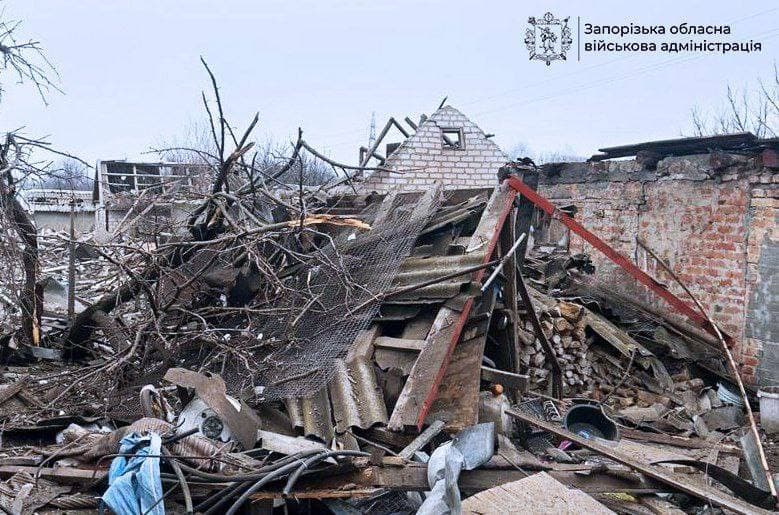
Damage following a Russian strike in the Zaporizhzhia district. (Zaporizhzhia Oblast Military Administration)
The Trap With No Exit: Russia Demands Elections It Won’t Let Happen
The logic was elegant and vicious. Demand Ukraine hold elections as a precondition for peace. Refuse the ceasefire necessary to hold them. Call Ukraine illegitimate for not holding them.
Repeat.
Ukraine’s official working group had been trying to solve the puzzle. The Times reported they hadn’t resolved fundamental questions. Serhiy Dubovyk, deputy head of the Central Election Commission, laid out what “everyone”—parliament included—agreed on: active hostilities must end, a clear demarcation line must exist, and six months must pass before any vote. The working group ruled out elections while fighting continued. The reasons were concrete—Russian strikes on polling stations, martial law restrictions on speech and movement that would cripple any campaign period.
Some opposition officials rejected digital voting outright: vulnerable to manipulation, impossible to monitor internationally. Dubovyk noted elections were legally possible by amending martial law and election legislation—no constitutional change required. But only after the guns stopped.
The guns weren’t stopping. And Moscow made sure everyone knew why that didn’t matter.
Dmitry Medvedev declared on March 19 that Russia would never recognize Zelensky as a legal negotiating partner. The Kremlin had called his government “illegitimate” since Ukraine skipped 2024 elections—elections Ukrainian law explicitly prohibits during martial law. A law enacted because Russia invaded.
The circle closed perfectly. Russia causes the war. The war prevents elections. The absence of elections makes Ukraine’s government “illegitimate.” The “illegitimate” government can’t sign peace agreements. Any agreement it does sign, Moscow can discard whenever convenient.
Not a diplomatic position. A trap designed so that every exit leads back inside.
5.9% Inflation? Russian Grocers Would Like a Word
Seventh rate cut since June 2025. The Russian Central Bank dropped its key rate from 15.5 to 15 percent and announced inflation stood at 5.9 percent. Forecast for year’s end: 4.5 to 5.5 percent.
Numbers from a parallel universe.
U.S. Treasury Secretary Scott Bessent estimated actual Russian inflation at over 20 percent back in October 2025. ISW tracked rising prices for essentials—food, services, basic goods—throughout 2025 and into early 2026 that made the official figures look like fiction. Russians standing in grocery stores already knew what the Central Bank wouldn’t say.
The rate cut wasn’t about controlling inflation. It was about feeding the war machine. Cheaper capital meant more money flowing to defense factories, more weapons rolling off production lines, more contracts signed with arms manufacturers. The Central Bank had become a wartime instrument—monetary policy bent to keep the defense industrial base humming regardless of what happened to consumer prices.
The Kremlin’s fiscal policy guaranteed the inflation would continue. Record military spending. Enlistment bonuses. Social payments to soldiers’ families. Defense industrial investment. Deficit spending climbing. None of it showed signs of slowing.
Translation: the rate cut told Russia’s war economy that cheap money would keep flowing. Ordinary Russians would pay the difference at the checkout counter—where the real inflation rate lived, uncounted and unacknowledged.
Blood for Meters: The Frontline Beneath the Headlines
Beneath the downed helicopters and seized tankers, the grinding daily reality continued. Assault. Repulse. A tree line gained. A basement lost.
Ukrainian forces pushed forward in three confirmed areas. Geolocated footage showed advances in southern Yampil, southeast of Lyman. In the Kostyantynivka-Druzhkivka area, Ukrainian troops pushed into southeastern Kostyantynivka and central Minkivka. Near Hulyaipole, advances in central Hirke, western Zaliznychne, and eastern Myrne contradicted prior Russian claims of control.
A Kremlin-affiliated milblogger made a quieter concession: Ukrainian forces likely controlled Shevchenko Microraion in southwestern Chasiv Yar—meaning Russian envelopment of Kostyantynivka wasn’t happening.
Near Kupyansk, the story was humiliation. Russian milbloggers acknowledged Ukrainian forces had almost entirely cleared the city and turned on their own command. A former Storm-Z instructor pointed to the source: Chief of the General Staff Gerasimov had falsely claimed Russian forces seized Kupyansk on November 20, 2025. Four months of fiction. The milblogger argued that fabricated victory reports prevented mobile strike assets from redeploying where needed—leaving Russian forces exposed when Ukrainian counterattacks came.
Lies at headquarters. Bodies at the front.
Russian offensive operations continued across Sumy Oblast, northern Kharkiv, Borova, Pokrovsk, Dobropillya, Oleksandrivka, western Zaporizhzhia, and near the Antonivskyi bridge northeast of Kherson. Confirmed advances in none of them. Near Hulyaipole, a Ukrainian drone commander reported massed Russian infantry assaults every three to five days—motorcycles and light vehicles thrown forward in waves.
The manpower cost was becoming visible. In the Lyman direction, a Ukrainian brigade spokesperson reported elements of the 20th Combined Arms Army arriving with “barely a week” of training. Down from a month in mid-2025. The spring offensive fueled by bodies as much as armor.
One bright spot near Kherson: drone interdiction had cut Russian logistics to Oleshky and the Dnipro islands—positions that saw unimpeded rotations just a year earlier.
The Buses Leave Slovyansk
Vadym Filashkin, head of the Donetsk Oblast Military Administration, ordered mandatory evacuation of children from the most shelling-vulnerable areas of Slovyansk. A city that has served as a center of Ukrainian military administration since 2014—now close enough to the frontline that its children had to leave.
No parent packs a bag for a mandatory evacuation without understanding what it means. The shelling isn’t stopping. It’s getting closer.
Diesel Generators Between Kharkiv and a Nuclear Incident
The night of March 11–12. A Russian strike hit an electrical substation near the Kharkiv Institute of Physics and Technology. The grid connection to the institute’s subcritical Neutron Source Installation severed. Emergency diesel generators kicked in—the only thing keeping a nuclear research facility from going completely dark.
Power wasn’t restored until March 13. Two days on backup generators.
IAEA Director General Rafael Grossi disclosed the incident with a warning that applied far beyond one facility: “These episodes underscore how grid instability and the vulnerability of off-site power is affecting nuclear safety and security.” The IAEA reported similar disruptions at Chornobyl in recent weeks.
This wasn’t the first time. Russian strikes hit the Kharkiv facility’s buildings in June 2022. Radiation levels stayed normal then. They stayed normal this time. But each strike on Ukraine’s energy grid rolls the same dice again—nuclear facilities dependent on external power losing that power because a missile found a substation.
The slow-burning danger nobody talks about while the frontline dominates headlines. One substation. One severed connection. Diesel generators humming in the dark.
156 Drones, Seven Dead, and a Grain Ship Burning in Odesa
From seven directions they came. Oryol, Kursk, Bryansk, Smolensk, Rostov, Krasnodar, Crimea. Over 90 Shahed-type drones among 156 launched overnight. Ukrainian air defenses caught 133. Nineteen got through, striking thirteen locations.
Seven people didn’t survive the night. Thirty-two more were wounded.
In Sumy Oblast, three civilians died and thirteen were injured across multiple communities. Two men—aged 37 and 33—killed in the Khutir-Mykhailivskyi community. A 62-year-old man dead in Velyka Pysarivka. In Zaporizhzhia, three killed and four wounded, including a child. In Kherson Oblast, Russian forces targeted more than thirty settlements, injuring five. In Donetsk Oblast, four wounded across Kramatorsk, Dobropillya, and Kostiantynivka.
In Odesa, drone strikes hit two civilian grain vessels docked in port—one flying a Palau flag, the other Barbados. Both loaded with grain. Two people injured. The ships stayed afloat, but strikes against grain vessels carry a specific echo: Russia’s 2023 campaign to choke Ukraine’s Black Sea exports.
The cruelest strike of the day hit a humanitarian evacuation vehicle in Oleksiyevo-Druzhkivka. A Russian FPV drone found the Proliska mission vehicle—an organization that evacuates civilians from frontline areas. Two civilians killed. Two wounded. People trying to leave the war, struck by the war while leaving.
In Dnipropetrovsk Oblast, two men and a woman injured in the Synelnykove and Nikopol districts. In Kharkiv Oblast, a woman wounded by shelling in Hrachivka.
One night. Seven launch directions. Seven dead. Grain ships hit in port. An evacuation vehicle burning on a road.
Someone Burned a Drone Factory. The Drones Were Headed to Ukraine.
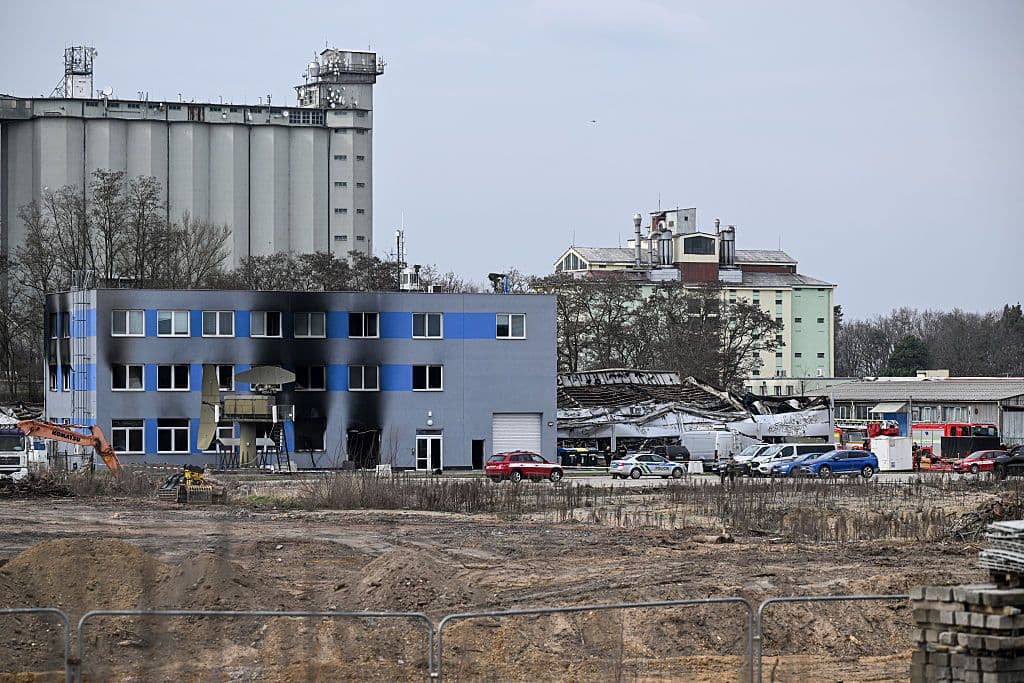
Overnight. A fire erupted in a storage hall at an industrial complex in Pardubice, 120 kilometers east of Prague. It spread to a second building. The facility belonged to LPP Holding—a Czech defense firm manufacturing AI-powered drones combat-tested on the Ukrainian frontline, including the MTS40: 12-kilogram warhead, 600-kilometer range, autonomous targeting in heavy electronic warfare environments.
No injuries. But Prime Minister Babis called it what investigators suspected: “being investigated as a terrorist act.” Interior Minister Metnar went further—”probable connection to a terrorist attack.”
A group protesting Israeli weapons claimed responsibility.
One problem. LPP Holding doesn’t make drones for Israel. The company said previously announced plans to partner with Israeli firm Elbit Systems were never implemented. “No Israeli drones have ever been manufactured at our facility.”
The pattern was familiar. In June 2025, activists in Belgium destroyed military equipment in a warehouse to protest Israeli weapons. The equipment was destined for Ukraine. Wrong target. Same result—Ukrainian defense capacity damaged by people who thought they were striking at someone else.
Whether the Pardubice fire was misdirected activism, something else entirely, or convenient cover for sabotage, the strategic effect was identical: a facility supplying Ukraine’s drone war went up in flames.
The drones LPP Holding builds fly autonomously where Russian electronic warfare blinds conventional operators. Every one that doesn’t get built is a gap in Ukraine’s frontline capability.
Both Sides of the Line: A Political Prisoner Beaten, a Commander Exposed, and Students Conscripted at Gunpoint
Volodymyr Balukh survived Russian occupation in Crimea. He survived detention in December 2016 on fabricated weapons charges. He survived nearly four years in a Russian penal colony before a prisoner exchange brought him home in 2019.
He didn’t survive a trip to a Kyiv recruitment center without bruises.
Balukh, who has a disability, said men in military uniforms pushed him into a van, took him to the center, and left him with bruising across his chest and shoulder. Members of parliament called it politically motivated. The recruitment center denied wrongdoing. Police opened an investigation.
Separately, a Kyiv court suspended 43rd Brigade Commander Yaroslav Lysenko after investigators found he’d ordered at least seven soldiers to leave their units—not for combat, but to renovate apartments belonging to his daughter, former wife, and sister. False reports concealed the arrangement. Soldiers kept drawing pay while laying tile. Lysenko faces up to ten years.
On the other side of the frontline, the coercion ran deeper.
In occupied Luhansk Oblast, students who failed exams were being told: join the Russian army or lose your academic spot. A lawyer from the Donbas SOS NGO explained the mechanism—the failures were engineered. “A certain number of students must be failed so that they can later be offered the opportunity to join the military.” Accept, and you get academic leave. Refuse, and you face expulsion and infantry conscription.
Russia’s army had swelled to 2,391,770 personnel under a March 4 decree, with year-round conscription replacing seasonal drafts in 2026. The Kremlin avoided politically toxic mass mobilization by finding manpower wherever coercion was cheaper than consent.
Occupied classrooms included.
28,300 Lives Saved: The Kharkiv Rescue Operation Hollywood Noticed
More than 28,300 animals rescued since February 2022. Over 110 staff members working through shelling, power cuts, and supply shortages in a city that Russia hits almost daily. Animal Rescue Kharkiv has operated for three years in conditions most organizations would have fled.
Now someone with a global audience noticed.
Oscar-winning director Chloe Zhao—best picture and best director for Nomadland, multiple nominations for Hamnet in 2026—announced a fundraiser in partnership with Charitybuzz to benefit the NGO. Contributors could enter for a virtual cup of tea with the director.
“In a region devastated by war, animals are too often the forgotten victims,” the organization said. Forgotten, but not by the staff still pulling animals from rubble in the war’s fifth year.
What Day 1,487 Revealed
A war entering a new phase without resolving the contradictions of the old one.
Russia’s spring offensive was announcing itself—armor probing, dams flooded, supply lines hammered—but the forces assembling were arriving with a week’s training, and their chief of staff was being caught fabricating victories that left real units exposed. Ukrainian drones downed a $16 million helicopter with a $500 device, but the country’s largest ally was debating whether to trade Kyiv’s intelligence access to settle a different war with Tehran.
Europe was simultaneously fierce and fractured. France boarded tankers. Britain cooperated. Germany called Hungary’s veto an act of disloyalty. Hungary blocked everything—€90 billion in aid and the 20th sanctions package—while Moscow’s state television applauded.
The contradictions ran deeper than the headlines.
The Kremlin demanded elections it refused to let happen and called illegitimate the government it refused to let hold them. Its Central Bank published inflation at 5.9 percent while groceries told Russians the real number was four times higher. Its milbloggers turned on commanders who wasted irreplaceable helicopters in drone-saturated skies. Its negotiators offered to stop helping Iran kill Americans—if America stopped helping Ukraine survive.
On the frontline, Ukrainian forces advanced near Kupyansk, Kostyantynivka, and Hulyaipole. Russian forces threw bodies forward every three to five days. Students in occupied Luhansk were coerced into uniform. Children left Slovyansk on evacuation buses. A nuclear facility ran on diesel. Grain ships burned in Odesa.
Nobody knew whether the offensive would achieve what two years of grinding hadn’t. Nobody knew whether drone innovation would keep outpacing adaptation. Nobody knew whether Europe’s politics would fracture faster than its aid could arrive.
Day 1,487. The armor rolled. The drones hunted. The war ground forward toward a conclusion neither side could force and neither side would accept.
Prayer For Ukraine
- Protection for the Defenders Facing the Spring Offensive
Lord, as Russian armor rolls toward Ukrainian lines and the spring offensive takes shape, we ask Your protection over the soldiers holding the Fortress Belt. Guard the drone operators who waited in the fog along the E-50 highway. Shield the brigades near Kupyansk, Kostyantynivka, and Hulyaipole who advance against overwhelming numbers. Give strength to those facing massed infantry assaults every three to five days and steady the hands of those who stand between the offensive and the people behind them.
- Comfort for the Wounded, the Grieving, and the Displaced
Father, we lift up the seven killed and thirty-two wounded overnight across Sumy, Zaporizhzhia, Kherson, and Donetsk. We pray for the civilians struck in the Proliska evacuation vehicle—people trying to flee the war, hit by the war while leaving. Comfort the families of the two men killed in Khutir-Mykhailivskyi, the father who died in Velyka Pysarivka, and the child wounded in Zaporizhzhia. Be with the children of Slovyansk boarding evacuation buses, and with every parent watching them go.
- Wisdom for Leaders Navigating Fractured Alliances
God of wisdom, guide the leaders in Brussels struggling to deliver €90 billion in aid past one nation’s veto. Grant discernment to those seeking alternative paths when unanimity fails. Give clarity to American officials weighing Moscow’s proposal to trade Ukraine’s intelligence for Iran’s—that they would see the trap within the bargain. And grant Ukraine’s leaders patience and resolve as they navigate the impossible demands placed upon them.
- Justice for the Coerced and the Oppressed
Righteous Judge, we bring before You the students in occupied Luhansk being failed on purpose and forced into Russian uniform. We pray for Volodymyr Balukh—a man who survived Russian imprisonment only to be beaten at a recruitment center in his own capital. Bring accountability where commanders exploit their soldiers for personal gain. Expose coercion on both sides of the line, and let justice reach even where the frontline prevents it.
- Endurance for Those Who Keep Going
Lord, we pray for endurance. For the 110 staff members of Animal Rescue Kharkiv pulling animals from rubble in the war’s fifth year. For the engineers at the Kharkiv nuclear facility keeping generators running when the grid goes dark. For the French and British sailors intercepting shadow fleet tankers one vessel at a time. For every Ukrainian who woke up on Day 1,487 and went to work, went to school, went to the frontline—and kept going. Sustain Ukraine, bring justice to the oppressed, and bring this war to an end. Amen.