
In Crimea, freshly mobilized Russian soldiers count their last days before April 1 deployment. In Bryansk, $70 million in air defense systems burn after Ukrainian drone strikes. In Miami, Kushner and Witkoff tell Ukraine’s negotiators they see “progress” — while Washington quietly eases Russian oil sanctions. Day 1,488: spring arrived, and both sides bet everything on attrition the other can’t sustain.
The Day’s Reckoning
Picture a barracks in occupied Crimea. Freshly mobilized Russian soldiers checking calendars. April 1—nine days away. Not a joke. A deadline. Every one of them headed for combat, plugging holes in an 810th Naval Infantry Brigade bleeding out faster than it can fight.
Now shift eight hundred kilometers east. Smoke rising over Ufa. Ukrainian drones found three Bashneft refineries clustered in the northern industrial zone like a gift. In Bryansk Oblast, two Buk air defense systems—$70 million combined—burned to wreckage, killed by the same unmanned forces whose commander just told The Economist his crews are destroying Russian soldiers faster than Moscow can replace them.
In a Miami conference room, Kushner and Witkoff sat across from Budanov and Umerov. Words like “progress” and “constructive.” Signals that prisoner exchanges might resume—the first real diplomatic pulse since Geneva in February. But Zelensky named the elephant: Washington’s eyes were on Iran. Ukraine couldn’t afford to become background noise.
On the front, spring had hardened the mud and Russian commanders seized the moment. More assaults. More sectors. More pressure. The result: 8,000 Russian soldiers killed or seriously wounded in seven days. One thousand one hundred per day. For negligible ground.
In St. Petersburg, residents opened their phones and found only Kremlin-approved websites loading. The whitelist that swallowed Moscow had spread to Russia’s second city. No drone alerts to justify it.
And on the Odesa railway, in the dark chaos of a drone-threat evacuation, an oncoming train struck 19-year-old conductor Ilona Vovk. Fresh from an internship in Germany. Her first full trip.
Day 1,488. Mobilized troops counting down. Air defenses burning. Diplomats negotiating. A teenager dead on a darkened rail line. Spring had arrived. So had its price.
Nine Days and Counting: Russia’s Cannon Fodder Pipeline
Somewhere in Crimea, men who weeks ago were civilians are learning to field-strip rifles. They have nine days left.
Colonel Vladyslav Voloshyn laid it out cold: every mobilized Russian soldier staged on the peninsula enters combat April 1. Destination—the 810th Separate Naval Infantry Brigade, a unit so chewed up its elements are split between the Kursk direction and the “Crimea” operational-tactical group, bleeding personnel from both ends.
The volunteers ran out. That’s the part Moscow won’t say aloud. Russia is now feeding mobilized conscripts—less trained, less motivated, less likely to survive—into frontline formations because the recruitment pipeline can’t keep pace with the body count. The 810th itself is being reorganized into a full naval infantry division. The tenth new maneuver division since 2022. The 155th Brigade became the 55th Division. The 336th became the 120th.
Paper divisions. Built on the bones of depleted brigades.
But here’s where Russia’s manpower crisis metastasizes. Those freshly minted 55th and 120th divisions? Already being transferred to the 29th Combined Arms Army in the Oleksandrivka and northern Hulyaipole directions—rushed south to contain Ukrainian counterattacks that shredded Russian plans. Elite VDV and naval infantry yanked from Donetsk Oblast. Operational reserves burned just holding current lines.
This is exactly what Kyiv wanted. Every unit scrambling south is one fewer unit available for the Spring-Summer 2026 offensive against the Fortress Belt. Russia has never managed simultaneous offensives across multiple sectors. These forced redeployments suggest that won’t change.
The mobilized men in Crimea don’t know any of this. They know April 1. They know they’re replacements. They don’t know what they’re replacing.
“I Kill Him or He Kills Me”: The Man Who Turned Drones Into a Death Factory
The numbers landed like a detonation. Robert “Madyar” Brovdi, commander of Ukraine’s Unmanned Systems Forces, opened his books for The Economist and the arithmetic was brutal: since winter began, his drone crews had killed or incapacitated 8,776 more Russian soldiers than Moscow managed to replace.
Read that again. Not total losses. The surplus. The gap between killing and recruiting that December made permanent—the first month verified drone casualties outpaced Russian recruitment. At peak intensity, 400 troops per day. An assault battalion erased every twenty-four hours.
Brovdi’s units are a fraction of Ukraine’s armed forces. They account for over a third of all Russian casualties. His own brigade claims one-sixth. The targeting is deliberate—at least 30 percent of strikes go after personnel, not equipment. Drain the manpower. Force Moscow to backfill infantry battalions with desk officers who’ve never held a position under fire.
“If a battalion has no infantry left, the Russians don’t disband it but throw desk officers to the front,” Brovdi said. “They are the easiest targets, because they can’t fight.”
Behind every kill sits what Brovdi calls an “ecosystem”—surveillance, electronic warfare, strike capability, all recorded, all analyzed, all feeding the next mission. Industrial efficiency. Zero sentiment. When asked about moral reservations over publishing strike footage, he didn’t pause: “I don’t experience any moral reservations at all. None. A man with a rifle in his hand on my land is coming to kill me.”
But Brovdi isn’t delusional. Russia keeps replenishing. The trajectory stays uncertain.
“I have no rose-tinted fantasies that this war is about to end.”
The killing machine keeps running. Whether its target collapses first—that’s the only question that matters.
The Hunters Become the Hunted: $70 Million in Russian Air Defense Burns
Drone operators from the 413th Raid Unmanned Systems Regiment locked onto their targets in Bryansk Oblast. A Buk-M3 surface-to-air missile system—$45 million, capable of tracking 36 targets at once. Then a Buk-M2 transporter-loader. Another $25 million.
Seventy million dollars. Burning.
The irony cuts deep. Buk systems gained worldwide infamy in 2014 when Russian proxy forces used one to shoot down Malaysia Airlines Flight MH17 over eastern Ukraine, killing 298 civilians. Now those same systems were being hunted from the sky by Ukrainian drones that cost a fraction of their price.
The March 22 strikes weren’t isolated kills. That same day, operators from the 1st Separate Center destroyed an S-400 Triumf radar in occupied Donetsk Oblast—one of Russia’s most advanced air defense systems, blinded by a drone. The night before, a Buk-M1 near Pervoye Maya in Bryansk Oblast. Another Buk-M2 in occupied Zaporizhzhia Oblast.
The monthly scoreboard: 26 pieces of Russian air defense equipment destroyed at operational depth since March 1. The running total since the Unmanned Systems Forces stood up: 7,073 Russian personnel and 25,612 military assets hit or destroyed.
Follow the logic of what’s happening. Every radar destroyed is a hole in Russia’s detection net. Every Buk system burning is fewer interceptors defending logistics hubs, fewer missiles tracking incoming Ukrainian drones, fewer barriers between Ukraine’s strike platforms and targets deeper inside Russian-held territory.
Ukraine isn’t just destroying air defenses. It’s systematically dismantling the shield that protects everything else Russia needs to fight.
The hunt creates the conditions for the next hunt. And the one after that.
Smoke Over Bashkortostan: Ukraine Reaches Deep Into Russia’s Interior
Residents of Ufa woke to smoke. Not from the front—the front was over a thousand kilometers away. From their own northern industrial zone, where Rosneft’s Bashneft operates three oil refineries in a tight cluster. Russian opposition outlet Astra geolocated eyewitness photographs to the site. Ukrainian drones had come calling.
The same night, a command post near Smorodino in Belgorod Oblast took a hit—five kilometers from the international border. A logistics hub and troop concentration near occupied Velyka Novosilka. A drone control point near Rivnopil. A command post near Uspenivka. Troop concentrations near Berdyansk and Hulyaipole in Zaporizhzhia Oblast.
Close your eyes and picture the map. Strikes at the frontline. Strikes fifty kilometers behind it. Strikes deep inside Russia proper. All on the same night.
Now picture the Russian commander staring at that map. Every air defense battery shifted to protect a Bashkortostan refinery is one fewer battery covering troops advancing in Donetsk. Every radar redeployed to shield oil infrastructure is a gap Ukrainian strike drones will find tomorrow.
Defend the rear or protect the front. There is no option that does both.
The Elephant in the Miami Room: Iran Overshadows Ukraine’s Peace Talks
Second day. Same Miami conference room. Witkoff and Kushner on one side. Umerov, Budanov, Kyslytsia, and Arakhamia on the other. Senior advisors Gruenbaum and Curran filling the American bench.
The words afterward were warmer than Geneva. Umerov spoke of “progress in aligning positions and further narrowing the circle of unresolved issues.” Witkoff called it “substantive” and “encouraging.” The focus: security guarantees and the humanitarian track—especially prisoner exchanges.
Reading between the diplomatic language: prisoner swaps were the one thing both sides might actually deliver. Zelensky, briefed by phone, said he’d received signals that exchanges could resume. The first real diplomatic pulse since the Geneva meeting on February 17–18. A follow-up planned for March 5 in Abu Dhabi never happened—U.S.-Israeli strikes on Iran blew up Washington’s calendar.
And there it was. The thing everyone in the room knew but only Zelensky named out loud: “It’s clear that the American side’s attention at this time is primarily focused on the situation around Iran.”
Translation: Ukraine was competing for American bandwidth with a shooting war in the Middle East. EU foreign policy chief Kaja Kallas had already said it plainly—”competition for the same assets.” Air defense systems earmarked for Ukraine could face delays as Washington fed its Iran campaign first.
The window stayed open. Barely. Prisoner exchanges offered something concrete. Everything else—security guarantees, territorial questions, the architecture of any peace—remained unresolved.
Russia’s willingness to negotiate “honestly and with dignity,” as Zelensky framed it, was still the question nobody in Miami could answer.
Putin’s Payday: How Washington Eased Sanctions While Ukraine Burned
Scott Bessent sat under studio lights on NBC’s Meet the Press and made the case with a straight face: easing restrictions on Russian oil exports would actually hurt Moscow’s bottom line.
The math, as Bessent presented it, was simple. Let Japan and South Korea buy Russian crude. Broaden supply beyond China. Keep prices below $100 a barrel. “Does Russia get more money if oil goes to $150 and they get 70% of that,” he asked, “or if oil stays below $100?” Maximum extra revenue for Russia: $2 billion. One day of the federal budget.
Democratic Senators Warren, Shaheen, and Schumer had different math. Their estimate: $150 million per day flowing to the Kremlin. Every day. Money that buys Shahed drones. Money that fuels the strikes hitting Ukrainian cities every night.
Zelensky didn’t mince words—any additional revenue would go straight into drone production aimed at Ukrainian civilians.
But the real story wasn’t the arithmetic. It was what the March 12 temporary license—permitting sale of Russian oil stranded at sea—revealed about Washington’s shifting calculus. Sanctions relief had been leverage. A bargaining chip held back to extract Russian concessions at the negotiating table.
Now it was being spent as market management. No Russian concessions required. No peace deal attached. The chip cashed before the game was over.
In Miami, American diplomats talked about “progress” with Ukraine. On Meet the Press, the Treasury Secretary explained why easing pressure on Russia made financial sense.
Both things happened on the same day.
Blood for Mud: 8,000 Russian Casualties Buy Almost Nothing
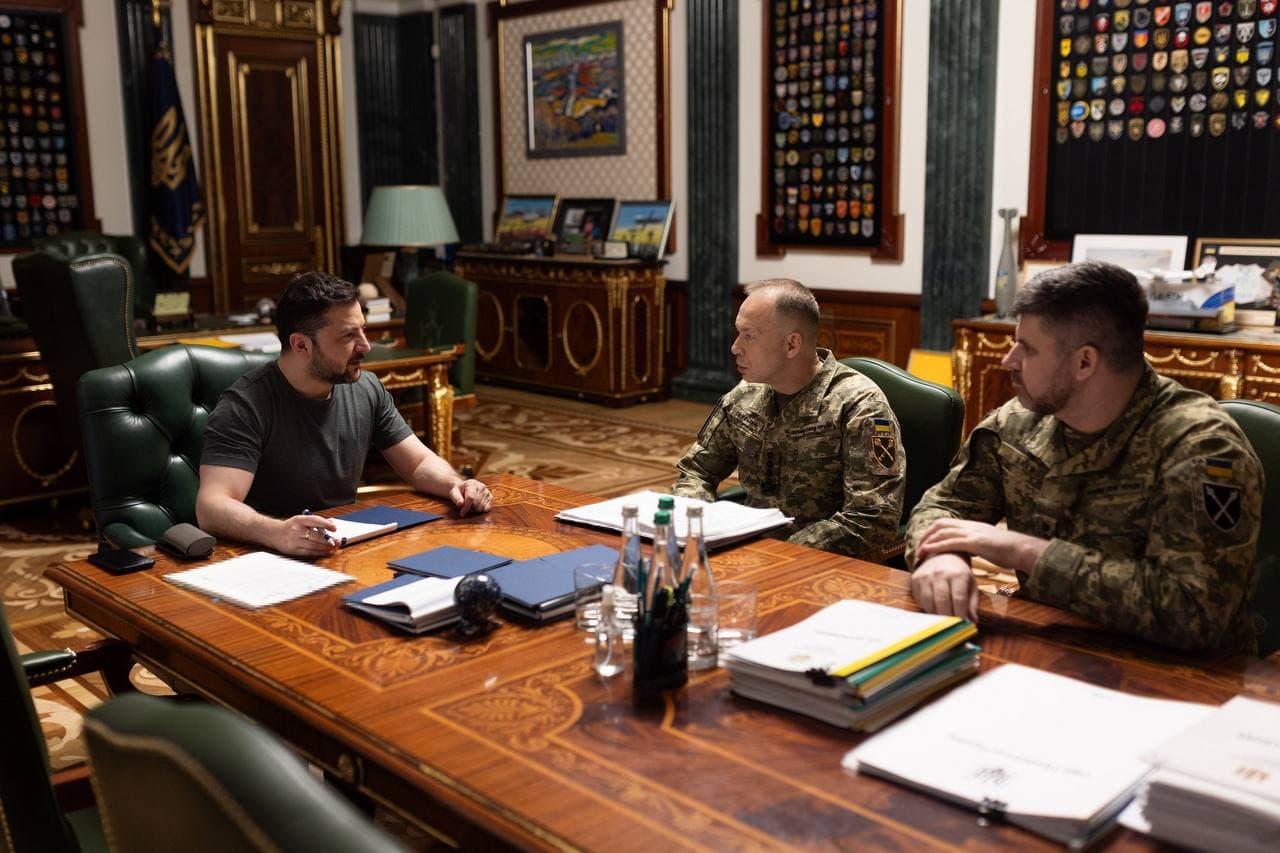
Zelensky walked out of his briefing with Commander-in-Chief Syrskyi and General Staff Chief Hnatov and put a number on spring’s opening week.
Eight thousand. Killed or seriously wounded. Seven days.
The ground had hardened. The mud had dried. Russian commanders saw their window and threw everything at it—intensified assaults across Kharkiv, Sumy, and Donetsk oblasts. More men. More vehicles. More pressure on more sectors simultaneously.
The result: 1,100 casualties per day. And positions in Donetsk Oblast essentially unchanged.
Spring made offensive operations possible. It didn’t make them successful. Ukrainian forces repelled advance after advance along the border regions. The thaw that was supposed to unlock Russian momentum produced body bags, not breakthroughs.
Zelensky signaled Ukraine wouldn’t just absorb the punishment. He confirmed approving “a series of new operations” against Russia—language that suggested Kyiv intended to dictate the spring campaign’s shape, not merely endure it. Syrskyi’s earlier report reinforced the framing: Ukraine captured more territory in February 2026 than Russia managed to occupy in the same period.
Though measuring control grows harder by the week. The “grey zone” between Ukrainian and Russian positions keeps widening, making clean territorial accounting almost impossible.
The numbers cut through the ambiguity. Russia opened its spring offensive not with the breakthrough it needed but with a casualty rate it cannot indefinitely sustain. Eight thousand men in seven days. For mud that looks exactly the same on the map as it did a week ago.
A Thousand Kilometers of Bleeding: The Front Holds Everywhere
One thousand kilometers of frontline. Russian attacks in every direction. Confirmed breakthroughs in none.
Near Slovyansk, another mechanized assault rolled forward—heavy armor, military vehicles, ATVs. It followed a battalion-sized push on March 19 that signaled the Spring-Summer 2026 offensive had opened against the Fortress Belt’s northern flank. Ukrainian forces hit back near Kryva Luka, Kalenyky, Nykyforivka, and Fedorivka Druha. The assault gained nothing.
The day’s sharpest irony came from the opposite direction. While Russia attacked everywhere, Ukraine advanced somewhere. Geolocated footage confirmed Ukrainian forces pushed forward along the T-0504 Pokrovsk-Kostyantynivka highway in eastern Kostyantynivka—a tactical gain in a sector Russia had been grinding at for months.
Around Kupyansk, the cracks were showing from the inside. Russian milbloggers publicly contradicted their own command’s claim that the city had been seized, calling it a contested grey zone. A Ukrainian brigade spokesperson described Russian soldiers driven forward by barrier troops—hungry, under-supplied, advancing because the alternative was a bullet from behind. Pokrovsk, Novopavlivka, Dobropillya, Borova—attacks everywhere, advances nowhere.
In the south, the same. Hulyaipole and Oleksandrivka saw sustained Russian offensive operations without gains. Intelligence indicated Moscow was planning to transfer additional brigades to Oleksandrivka. A Spetsnaz unit had already arrived. Russian forces ran infiltration missions between Ukrainian positions—but Ukrainian troops counterattacked on motorcycles and ATVs toward Herasymivka and Zarichne.
Western Zaporizhzhia. Kherson. Same pattern. Attacks. No advances.
The front bent along its entire length. It did not break at any point.
Five Balloons in a Polish Field: Russia’s Quiet Rehearsal for What Comes Next
A farmer in Podlaskie Voivodeship walks his eastern field on March 21 and finds something that shouldn’t be there. Five balloons. Ten foil-wrapped packages. Scattered across Polish soil, just over the Belarusian border.
Nobody officially says where they came from. Nobody needs to.
Belarusian balloons have been violating Polish airspace since October 2025. Five times since January 27 alone. Each incursion small enough to deny. Persistent enough to establish a pattern. Analysts have a name for it: “Phase Zero”—the psychological condition-setting phase before a potential conflict.
Probe. Test. Normalize. Measure the response. Calibrate the next one.
Belarus isn’t acting alone—it hasn’t acted alone in years. Its airspace, military infrastructure, and diplomatic posture all function as extensions of Moscow’s apparatus. In practical terms, Russia annexed Belarus without firing a shot. These balloons aren’t Belarusian provocations. They’re Russian ones, launched with just enough deniability to avoid triggering Article 5.
That’s the precision of the game. Stay below the threshold. Always. But keep pushing the boundary between peacetime and something nobody has a word for yet.
Five balloons in a Polish field. Not a crisis. Not an accident either.
Ilona Vovk Was Nineteen: The Night Russia’s Drones Killed Across Seven Oblasts
One hundred thirty-nine drones. Seven launch directions. The swarm hit Ukrainian airspace overnight, and air defense crews started killing them. They got 127. Eight got through to seven locations. Debris from the intercepts rained down on seven more.
Six civilians died. Twenty-nine were wounded. Here’s who paid:
Dnipropetrovsk Oblast—two dead, six wounded. One of them a child. Zaporizhzhia Oblast—two killed, eight injured, across a day that saw 700 Russian strikes on 39 settlements. Donetsk Oblast—one dead, six injured. Kherson Oblast—one killed, three wounded.
In Sumy, rescue workers rushed to the scene of a Russian strike. Then came the second strike. The double-tap—Russia’s tactic for killing the people who save lives. A fire engine took the hit. The crews survived.
Not everyone did.
On the Odesa railway, in the dark confusion of a drone-threat evacuation, a train heading to its own evacuation stop struck 19-year-old conductor Ilona Vovk. She had just finished an internship in Germany. She was conducting her first full trips for Ukrzaliznytsia. The kind of job you take when you’re young and the country still needs trains to run during a war.
Ukrzaliznytsia CEO Oleksandr Pertsovskyi named her publicly. Ilona Vovk. Nineteen years old.
In a war that counts its dead in daily aggregates, someone made sure she wasn’t just a number.
Strangling the Lifeline: Russia’s War on Ukraine’s Black Sea Ports
The port workers in Odesa and Chornomorsk didn’t need a government minister to tell them the strikes were getting worse. They lived it every shift. But on March 22, Minister Oleksiy Kuleba put numbers to what their bodies already knew.
One hundred fifty strikes on port infrastructure across all of 2025. Over 180 in the first three months of 2026 alone.
Three months surpassed twelve. Russia was methodically strangling Ukraine’s Black Sea lifeline—the ports that move grain out and supplies in, the infrastructure that connects a wartime economy to the world.
Ukrainian air defenses were getting better. Kuleba reported shoot-down rates up 25 to 35 percent. But do the math: better interception against heavier bombardment still means more warheads reaching the docks. When the attacker can sustain volume, improved defense only slows the bleeding.
Zelensky’s weekly tally drove the point home: nearly 1,550 drones, over 1,260 guided glide bombs, and two missiles launched at Ukraine between March 15 and 21. One week. That’s the incoming rate port defenders are absorbing.
The grain still moves. The ports still function. But the margin gets thinner with every strike that finds its target.
The Grid That Winter Broke: Kyiv Goes Dark Without a Single Russian Strike
No missile. No drone. No incoming alert. The lights just went out.
Parts of Kyiv’s eastern bank lost power on March 22 because a facility that Russian strikes had already savaged finally gave way on its own. DTEK confirmed residents across the Dniprovskyi and Darnytskyi districts and parts of Brovary went dark. Not from a new attack. From accumulated damage that couldn’t hold anymore.
This is what Russia’s winter campaign left behind. Over three months: 14,670 guided aerial bombs. 738 missiles. Nearly 19,000 attack drones. All aimed at the systems that keep a modern city alive. At the worst point, Kyiv hit minus 25 Celsius. Heating failed for days. Thousands sat in freezing apartments. Hundreds of high-rises lost heating systems designed to run through March 31.
Engineers patched what they could. Emergency repairs. Improvisation. Duct tape and determination holding together infrastructure that had absorbed strike after strike.
On March 22, one of those patches stopped holding.
Spring brought warmer temperatures. It didn’t bring recovery. Every repaired facility carries the memory of every hit it absorbed—stress fractures invisible until the moment they become blackouts. Russia doesn’t need to launch another missile to keep breaking Kyiv’s grid. The damage already delivered keeps working on its own.
$25 for a $300 Problem: The Fuel Subsidy That Angered Everyone
Picture a Ukrainian driver at a gas station, watching the pump tick past Hr.69 per liter of 95-octane. Two weeks ago it was Hr.60. The Strait of Hormuz is blocked. Iran struck Persian Gulf energy infrastructure. Spring planting is driving diesel even higher. And the government’s answer just landed in his account: $25.
The fuel cashback program launched March 20—15 percent back on diesel, 10 percent on gasoline, 5 percent on automotive gas. Monthly cap: Hr.1,000. Roughly $25 against fuel bills that run $300 a month for anyone commuting.
Understand what fuel means in wartime Ukraine. Airspace closed. Rail lines hit by Russian strikes. Power outages killing urban transit. Cars aren’t convenience—they’re the primary mode of transport for people and goods. During blackouts, they become heaters and phone chargers. Generators swallowing diesel now account for 20 percent of total fuel consumption.
The backlash hit from every direction. Soldier and blogger Serhii Marchenko asked why the state subsidized drivers instead of pensioners. Lawmaker Yaroslav Zheleznyak was blunter—grandmothers and soldiers footing the bill so some BMW X5 owner gets a slightly fuller tank. Economists warned that subsidizing consumption of an almost entirely imported product would hammer the hryvnia and feed inflation that punishes the poor hardest. Opposition lawmakers pointed out businesses were excluded—meaning no relief on logistics costs or grocery prices.
Even drivers shrugged. $25 against $300 is noise.
The debate cut to something deeper than fuel policy. In wartime, every hryvnia carries the weight of justification. Every policy creates visible winners funded by invisible losers. The cashback helped some. It satisfied almost no one.
Russia’s Internet Cage Reaches St. Petersburg: Only Kremlin-Approved Sites Load
Open your phone in central St. Petersburg on March 22. Tap a bookmark. Watch it fail. Try another. Nothing. Try a Kremlin-approved news site. It loads instantly.
Welcome to the whitelist.
One week after Moscow’s mobile internet collapsed into a curated list of government-sanctioned websites, the same restrictions hit Russia’s second city. Residents across several central districts reported identical symptoms—only state-approved content accessible. No drone alerts had been issued. No military justification offered. The pretext wasn’t even trying anymore.
The path here was incremental. June 2025: Putin signed a law building a national digital platform around the state-developed Max messenger. That summer: Roskomnadzor killed voice calls on Telegram and WhatsApp. By December 2025: Russia led the world in internet shutdowns—37,166 hours of total outage, 146 million people affected.
Each step small enough to absorb. Each one making the next one easier.
The whitelist was the logical destination all along. Not a blackout—something more sophisticated. A curated reality where the internet still works, still loads pages, still feels functional. It just only shows you what the Kremlin wants you to see.
The stated reason—protecting against Ukrainian drone attacks—dissolved the moment residents checked for alerts and found none. The real reason was sitting on their screens: a digital border as impenetrable as any physical one.
Moscow built a parallel economy. Now it built a parallel internet to match. Five million St. Petersburg residents were inside it.
One Launch Pad, One Cargo Ship, One Fragile Comeback
The Progress MS-33 lifted off from Site 31 at Baikonur on March 22. Unmanned. Cargo only. Bound for the International Space Station. Roscosmos called it a success.
It was the first launch from that pad since November 2025, when a servicing cabin collapsed during the Soyuz MS-28 liftoff and left Russia unable to conduct crewed missions from its only operational ISS launch site. The first such disruption since 1961. Repairs finished in early March—just enough to get an unmanned freighter off the ground.
The space program tells the wider story in miniature. Sanctions hollowed it out. Russia’s first lunar mission in 50 years crashed in 2023. Roscosmos CEO Yury Borisov was dismissed in February 2025. The infrastructure decays faster than it can be repaired.
Space remains one of the few threads of U.S.-Russia cooperation still intact, warmed slightly by Trump’s inauguration. Russian officials have floated collaboration with SpaceX. But floating ideas and launching rockets are different things.
Baikonur got one unmanned cargo ship into orbit. Not a crew. Not a lunar probe. A supply run—from a pad held together by four months of emergency repairs.
Less a recovery than a pulse. Faint, but present.
What March 22 Revealed
Two bets. One war. Neither side able to prove the other wrong.
Russia bet on volume. More bodies—mobilized men counting down to April 1. More assaults—8,000 casualties in a week for ground that barely moved on the map. More divisions built from depleted brigades. Spetsnaz rushed to contested sectors. Barrier troops forcing hungry soldiers forward. The logic: overwhelm the Fortress Belt through sheer mass, and accept the cost.
Ukraine bet on efficiency. Drone ecosystems where every kill fed data into the next strike. Air defense hunting campaigns that systematically stripped Russia’s ability to protect its own rear. Counterattacks in the south that forced redeployments away from the main offensive. An advance along the Kostyantynivka highway on a day Russia attacked in a dozen directions and gained nothing.
The costs mounted with asymmetric visibility. Moscow hid its losses behind internet blackouts spreading city by city. Kyiv announced them from the presidential podium. Ilona Vovk’s name was read aloud. Russia’s dead went uncounted on screens that only loaded Kremlin-approved websites.
Every thread from March 22 pulled toward the same unanswerable question. Bessent easing sanctions while diplomats in Miami talked “progress.” Zelensky warning that Iran was absorbing American attention. Balloons in Polish fields. A fuel subsidy that satisfied no one. Ports absorbing more strikes in three months than all of last year.
Which side’s resources exhaust first?
April 1 approached. The mobilized troops would arrive. The drones would keep hunting. The diplomats would keep meeting. The front would keep grinding.
Day 1,488. Spring had arrived.
So had the bills.
Prayer For Ukraine
- Protection for the Defenders Holding the Line
Lord, across a thousand kilometers of frontline, Ukrainian soldiers are absorbing the full weight of Russia’s spring offensive—8,000 enemy casualties in seven days, yet still the attacks keep coming. Protect the men and women holding positions in Slovyansk, Kupyansk, Pokrovsk, and the southern sectors. Give strength to those fighting with motorcycles and ATVs in counterattacks near Herasymivka and Zarichne. Shield the drone operators of the 413th Regiment and the Unmanned Systems Forces who hunt the enemy’s air defenses at enormous personal risk. Keep them steady. Keep them alive.
- Comfort for Ilona Vovk’s Family and All Who Grieve
Father, a 19-year-old railway conductor named Ilona Vovk died in the darkness of a drone-threat evacuation on the Odesa line—her very first full trip, fresh from an internship in Germany. We lift her family to You. We pray for the child wounded in Dnipropetrovsk Oblast, for the six dead and twenty-nine injured across seven oblasts overnight, for the rescue workers in Sumy targeted by a deliberate double-tap strike. Comfort those who mourn. Heal those who suffer. Let none of them be forgotten.
- Wisdom for Those Negotiating in Miami and Beyond
God of wisdom, as Witkoff, Kushner, Umerov, and Budanov sit across from each other searching for a path toward peace, grant them clarity and courage. With Washington’s attention pulled toward Iran, with sanctions being eased while the war grinds on, we ask that Ukraine not become an afterthought. Guide President Zelensky and all who advocate for a just peace. Let prisoner exchanges resume. Let diplomacy produce more than careful words.
- Justice for Those Trapped Inside Russia’s Lies
Lord of justice, the people of St. Petersburg opened their phones and found only Kremlin-approved reality loading. Mobilized Russian men in Crimea count down nine days to a frontline their government won’t describe honestly. Barrier troops force starving soldiers forward. We pray for the innocent Russian civilians trapped inside a system built on deception and coercion. Open eyes. Break chains. Hold accountable those who send the unwilling to die for conquest while hiding the truth from their own people.
- Endurance for a Nation That Refuses to Break
Almighty God, Ukraine enters spring carrying the accumulated damage of its worst winter—14,670 aerial bombs, 738 missiles, nearly 19,000 drones. Kyiv’s grid fails under its own fragility. Ports absorb more strikes in three months than in all of last year. Fuel prices climb while families argue over $25 in cashback. And still the trains run. Still the grain ships sail. Still the frontline holds. Sustain this endurance, Lord. Strengthen the hands that repair what Russia destroys. Bring justice to those who wage this war of aggression. And bring it, we pray, to an end.