
On the same day Ukrainian strikes halted crude oil exports from Russia’s largest Baltic Sea terminal, the Kremlin’s most popular war commentators began publicly warning their millions of followers that Russia cannot win the 2026 campaign — risking 15 years in prison to say what they can no longer pretend not to see.
The Day’s Reckoning
You are sitting in a Moscow apartment, Telegram open, watching a man with 2.8 million followers say something that could land him in prison for 15 years. Yuri Podolyaka — once Russia’s most confident voice of inevitable victory — is telling his audience that the 2026 spring campaign is already broken. “It’s absolutely clear there will be big losses,” he says. He is not alone. Across Russia’s private information channels tonight, the Kremlin’s own most-watched war commentators are doing the unthinkable: telling the truth.
While that reckoning unfolds inside Russia’s borders, Ukrainian drones are working the night shift along the Baltic coast. The Transneft terminal at Primorsk — Russia’s single largest crude oil export port — is burning. So are oil tanks at Kirishi and loading arms at Ust-Luga. A week-long campaign has now disrupted a significant portion of the oil revenue that pays for every Russian shell, every Russian soldier, every Russian drone that crosses into Ukraine each night. Far to the southeast, the same night’s strikes hit the Atlant Aero drone factory in Taganrog — the plant that builds the weapons Russia uses against Ukraine — and the KuibyshevAzot chemical plant in Tolyatti, struck for the fourth time in three weeks.
At the diplomatic table, Zelensky offered Russia an Easter ceasefire. Russia’s Federation Council dismissed it before the words finished echoing.
On the front lines, Russia’s spring offensive stalled everywhere it was tested — Kharkiv, Kupyansk, Pokrovsk — with no confirmed advances. Ukrainian forces pushed forward near Slovyansk. In the Oleksandrivka direction, nine settlements have been liberated. And Ukraine’s drone interceptor crews destroyed 55 percent more targets in March than February — over 2,300 aerial kills in a single month.
The oil burns. The bloggers confess. The line holds.
When the True Believers Stop Believing: Russia’s War Bloggers Confess
Picture Yuri Podolyaka at his desk, recording the video that could end his freedom. For four years, he has been the voice millions of Russians turned to for reassurance — 2.8 million Telegram followers, 2.7 million on YouTube, all tuning in for the same reliable message: Russia is winning, Ukraine is collapsing, the red arrows keep moving west. He built that audience one confident broadcast at a time.
Now listen to what he says instead.
“Little by little, the advantage is going to our enemies. Very experienced guys are working there. They know how things work, and they are working to take advantage of the technical superiority that they have. Unfortunately, they are succeeding.” He keeps going. “We have no way to protect those areas effectively. We don’t have enough jamming equipment.” And then the sentence that would have been unthinkable a year ago: “It’s absolutely clear there will be big losses.”
He is not the only one breaking ranks. A separate ultranationalist commentator tells his followers Russia is “doomed to defeat” and already quietly working toward a “shameful peace.” Ilya Remeslo — once a proud advocate of Russian expansion — posts a five-point manifesto to 90,000 followers: “A completely dead-end war, enormous losses… The war is being waged solely to satisfy Putin’s insecurities.” He calls Putin illegitimate and demands his resignation and war crimes trial. Journalist Maxim Kalashnikov declares Putin “a toxic figure” the ruling class wants gone. War correspondent Andrey Filatov describes an army with “a brain that can’t handle a modern war.”
Every one of these men faces up to 15 years in prison under Article 207.3 of Russia’s penal code for saying exactly this.
They said it anyway.
The Oil Stops Flowing: Ukraine Hits Russia Where It Hurts Most
Follow the money. Every Russian missile fired at a Ukrainian power station, every drone launched into the night, every soldier’s salary paid on time — it all traces back to the same source: oil revenue pouring out of Baltic Sea terminals and into the Kremlin’s war chest. Stop the oil, and you don’t just hurt the economy. You start starving the machine.
Ukraine spent the past week trying to do exactly that.
Beginning around March 23, Ukrainian drones began working their way systematically up Russia’s Baltic export infrastructure. The Transneft terminal at Primorsk — Russia’s single largest crude oil export port on the Baltic — struck on the nights of March 21 to 22 and March 22 to 23. The Novatek Ust-Luga terminal hit on March 23 to 24, then hit again on March 28 to 29. Two large oil tanks at the Kinef refinery in Kirishi destroyed on March 25 to 26. Each strike chosen, each target chosen deliberately — not random harassment, but a week-long campaign to shut down the arteries that keep Russia’s war funded.
Then, on the night of March 24 to 25, a drone found something different at the Vyborg Shipyard: a Purga-class patrol icebreaker — a warship, not an oil asset. Ukraine wasn’t just targeting revenue. It was hunting anything that moved in that theater.
The Ukrainian MoD confirmed the campaign has halted a significant portion of Russian oil exports. Even a prominent Russian ultranationalist blogger conceded the strikes are generating “tangible impacts on the Russian economy.”
Russia’s Black Sea Fleet was neutered by Ukrainian naval drones. Now the Baltic is bleeding too. There is no safe harbor left.
Hunting the Weapons Makers: Ukraine Hits the Factories Building Russia’s Drones
Imagine you work the night shift at the Atlant Aero plant in Taganrog. Your factory builds the Molniya strike drones that fly into Ukraine every night — the same drones that knock out power stations, kill civilians, keep an entire nation sleeping in basements. You have probably never thought of yourself as a target.
Tonight, you are.
Ukrainian drones found the Atlant Aero production workshops on the night of March 29 to 30, damaging two facilities where those strike drones are built and where components for Russia’s Orion reconnaissance system are assembled. The same strike package hit the Beriev Aircraft Plant next door — the facility responsible for modernizing Russia’s Tu-95 strategic bombers and A-50 airborne warning aircraft. Both the Rostov Oblast Governor and the Taganrog Mayor confirmed the damage. That confirmation matters: Russian officials almost never acknowledge Ukrainian strikes worked.
Hundreds of kilometers northeast, in Tolyatti, the KuibyshevAzot chemical plant was on fire again. Not for the first time. Not for the second or third. This was the fourth Ukrainian strike on that facility since early March — March 10 to 11, March 13 to 14, March 20 to 21, and now March 29 to 30. Ukrainian drones also hit other chemical plants in Tolyatti the previous night.
This is not improvisation. This is a strategy with a logic you can feel in the repetition: hit the same target until the repair crews can’t keep up, until Russian commanders must choose between fixing what’s broken and defending what remains. Weapons factories. Chemical plants. Strategic bombers. Deep inside Russia, the factories that feed the front are learning they are not safe.
The Ceasefire That Was Dead Before It Was Born
Zelensky steps to the microphone and makes the offer he already knows will be rejected.
“We are ready for a ceasefire for the Easter holidays,” he says. “Normal people who respect life talk about a ceasefire and an end to the war for life, not for a few days. But we are ready for any compromises, except for compromises with our dignity and sovereignty.” He means it. The words are genuine. And somewhere in Moscow, Grigory Karasin — Chairperson of the Federation Council’s Foreign Affairs Committee — is already composing his response before Zelensky finishes speaking.
Zelensky’s statements, Karasin announces, should not be taken seriously.
You have watched this scene before. Putin declared a unilateral Easter ceasefire in April 2025 — both sides accused the other of violating it within hours. A Russian Christmas ceasefire in 2023: broken before the candles burned down. A 30-day energy truce in March 2025: dead on arrival. A Victory Day ceasefire in May 2025: fighters on both sides reported no pause whatsoever. Analysts have documented the pattern with grim precision — Russia uses short ceasefires to stockpile missiles, then maximizes damage in the strike packages that follow once they expire. A ceasefire, in Russian strategic doctrine, is reloading time.
On the broader peace process, Zelensky chooses his words carefully. The US-mediated talks have not collapsed, he insists — they are “merely postponed” while Washington fights its war with Iran. The last trilateral meeting was February 16. Two reschedules followed. Now no date exists. Russia wants Turkey or Switzerland. Washington’s team isn’t moving. “The ball is in the court of both the United States and Russia,” Zelensky says.
Then, quietly, he adds: “We’re much stronger today than we’ve been over the past six months.”
Russia’s Spring Offensive Hits a Wall: Attacks Everywhere, Gains Nowhere
The mud has dried. The days are longer. The drones fly cleaner in warmer air. Russia’s generals planned their 2026 spring offensive for exactly these conditions — the moment when the ground hardens and momentum becomes possible. They attacked on every axis they had.
They gained nothing.
From Vovchansk to Zaporizhzhia, Russian forces hit every sector of the front on March 30 — Kupyansk, Borova, Lyman, Slovyansk, Kostyantynivka, Dobropillya, Pokrovsk, Novopavlivka, Oleksandrivka, Hulyaipole — and made confirmed advances in precisely none of them.
In Kupyansk, Moscow’s Ministry of Defense declared victory, announcing Russian forces had seized the village of Kivsharivka. Then came the footage: four soldiers of Russia’s 153rd Tank Regiment, captured by Ukrainian forces while literally trying to plant a flag in the settlement their commanders had already announced as taken. A Russian milblogger quietly confirmed what the footage showed — Russian forces are “far” from seizing it. At the Kupyansk hospital, Ukrainian spokesperson Colonel Viktor Trehubov revealed something stranger still: Russian soldiers Moscow had declared dead were alive, recovering in beds. Russia may have announced their deaths, Trehubov suggested, either to bury the story of Kupyansk’s failure — or to give itself justification for striking the hospital.
Near Slovyansk, Ukrainian forces advanced in southern Yampil. In the Oleksandrivka direction, nine settlements have been liberated — seven in Dnipropetrovsk Oblast, two in Zaporizhzhia. A Ukrainian battalion commander described the dynamic: Ukraine’s speed disoriented Russian reserves so completely that by the time Russia brought reinforcements forward, Ukrainian drones were already hunting them in small groups before they could organize.
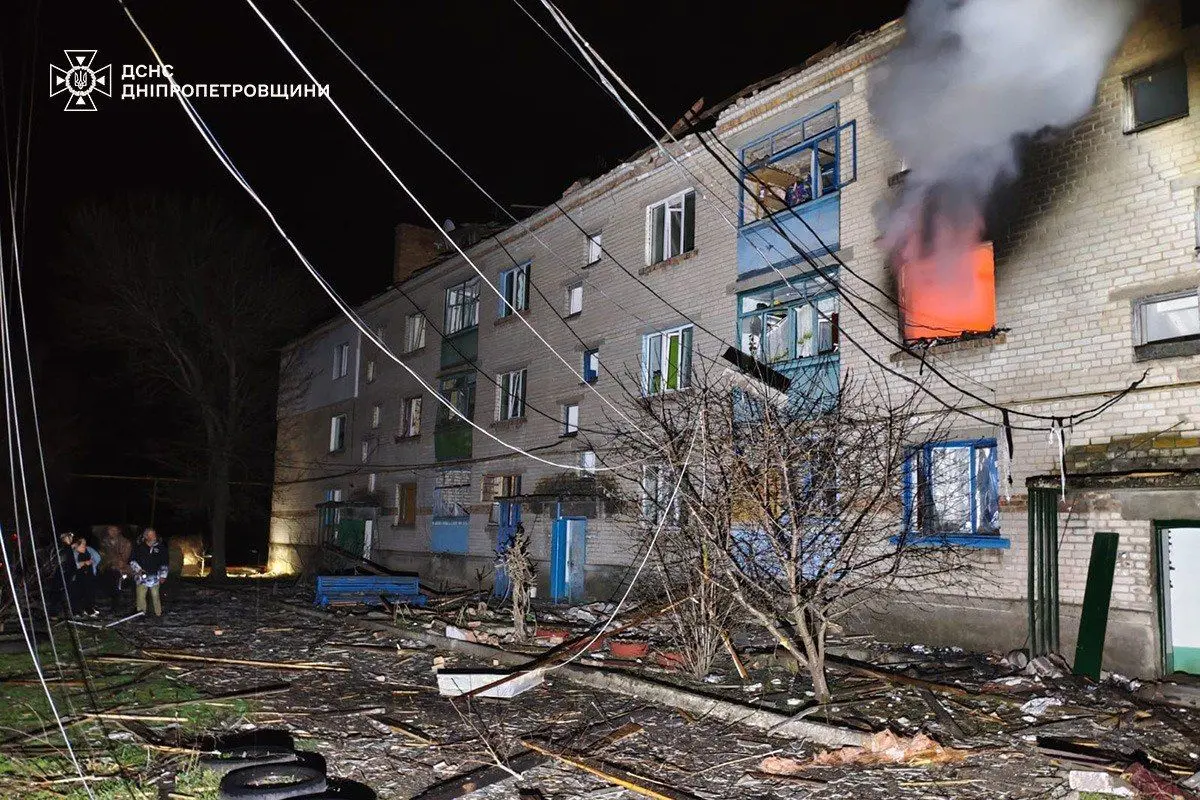
Aftermath of a Russian strike on Dnipropetrovsk Oblast. (Ukraine’s Emergency Service)
At Pokrovsk, Russian infantry assault Hryshyne daily — on foot, on ATVs, on motorcycles — unable to bypass it, unable to take it, buying their own civilian radios because the Starlink cutoff and Telegram throttling have left them unable to talk to each other.
In Kostyantynivka, 70 guided glide bombs fell on a single day. Russian soldiers hide their artillery under wood and nets, stationing infantry nearby with one purpose: shoot down the Ukrainian drones before they find the guns.
The offensive is pushing. The line is not moving.
The Drones That Hunt the Hunters: Russia Turns Shaheds Into Radar Killers
One hundred and sixty-four drones lifted off across six launch points on the night of March 29 to 30 — Shaheds, Gerberas, Italmas, and others — plus one Iskander-M ballistic missile fired from occupied Crimea. Ukrainian air defenses worked through the night and killed 150 of them. The missile and 12 drones got through, striking seven locations across the country.
Seven oblasts woke without power. Odesa, Zaporizhzhia, Dnipropetrovsk, Khmelnytskyi, Kharkiv, Chernihiv, Sumy — Ukrenergo urging everyone to cut electricity use between six and ten in the evening while repair crews raced the darkness. Four people were killed and 36 wounded. Three dead in Donetsk Oblast, 21 wounded. One dead in Kherson, four hurt — and then a second strike, this one hitting a civilian minibus. Three injured in Kharkiv. Three in Sumy. Four in Nikopol. A 23-year-old woman wounded in Synelnykove.
Then analysts looked more closely at one of the drones that didn’t make it through — and found something that changed the nature of the threat entirely.
Inside the wreckage: a passive radar homing head. A component that allows the drone to autonomously detect and home in on sources of radio radiation — radar signals, targeting emissions, the electronic signatures that Ukrainian air defense systems must produce to function. Russia has taken a cheap mass-produced drone and turned it into something that hunts the systems designed to stop it. Kill the radar, blind the defense, let the next wave through unopposed.
Ukraine is already adapting. General Syrskyi reported drone interceptor crews destroyed 55 percent more targets in March than February — over 2,300 aerial kills since March 1. Ukrainian helicopters alone downed 379 strike drones in the same period. Ukraine restructured its entire drone air defense command in March, creating the Direct Air Cover Forces Command inside the Air Force.
The drones are getting smarter. So is the defense.
From Kyiv to New Hampshire: Ukraine Becomes the World’s School of War
Somewhere in New Hampshire, a factory floor is about to change languages.
General Cherry — founded in September 2023, two years into a full-scale invasion, by Ukrainians who had no choice but to learn fast — has signed a deal with American military producer Wilcox Industries to build drones in the United States. The Bullet interceptor drone, born in wartime and battle-tested against the same Russian swarms that darken Ukrainian skies every night, will now be manufactured in New England. “We are pleased to have the unique opportunity to build production together,” said co-founder Yaroslav Hryshyn. What he didn’t need to add: we learned everything we know the hard way.
That hard-earned knowledge is suddenly the most valuable military commodity on earth.
Iran closed the Strait of Hormuz after US-Israeli strikes — and the Gulf states watching 20 percent of the world’s oil supply sit behind an Iranian blockade discovered they needed exactly what Ukraine had spent four years perfecting: cheap, effective drone interception at scale. Zelensky announced 10-year defense agreements with Gulf nations covering naval drones, electronic warfare, and software. Ukraine will share its Black Sea corridor expertise to help reopen Hormuz. In return: energy supplies, diesel, critical materials Ukraine needs now. National Security Secretary Rustem Umerov stayed in the Middle East to continue talks with Bahrain and Oman. “Ukraine has never had such agreements with this region before,” Zelensky said.
Back home, Defense Minister Fedorov announced the first confirmed kill by a private-sector air defense unit — a company’s own team shooting down Russian Shahed and Zala drones over Kharkiv Oblast. Thirteen other private entities are now authorized to form similar groups. “Private air defense is already working,” Fedorov wrote. “We are opening up the air defense market.”
A country that four years ago begged for weapons is now selling the future of warfare.
Europe’s Quiet Commitment: The Billions That Keep Arriving While Russia Waits for the West to Quit
Russia’s strategy has always included a second front: patience. Wait for Western resolve to fracture. Wait for the money to stop. Wait for the political will to exhaust itself. Watch what happened instead.
The European Commission approved €1.5 billion under the European Defense Industry Programme — €260 million of it dedicated specifically to rebuilding Ukraine’s defense industrial base through joint production projects, another €35.3 million for the BraveTech initiative accelerating military innovation. Commissioner Andrius Kubilius framed it plainly: Ukraine and European industries should “seize funding opportunities to strengthen defense cooperation and ramp up production.” This is not emergency aid. This is industrial integration — Europe and Ukraine building the same weapons, in the same factories, on the same timeline.
In Kyiv, Zelensky signed a 10-year security agreement with Bulgarian Acting Prime Minister Andrey Gyurov. Bulgaria joins NATO’s Prioritized Ukraine Requirements List, co-produces drones under the EU’s SAFE program, and cooperates on Black Sea demining. Read the calendar: Bulgaria holds parliamentary elections on April 19, and the frontrunner is former president Rumen Radev — a man who has spent years opposing military support for Ukraine. Zelensky and Gyurov signed anyway, locking the commitments in before Sofia’s political winds can shift.
Spain will send five Patriot PAC-2 interceptor missiles, worth $3-4 million each, pulled from its own active air defense units — this despite Spain’s own upgraded Patriot batteries being pushed back to 2031 due to production backlogs. Total Spanish military aid to Ukraine since 2022 now stands at approximately €4 billion. Latvia added €6.8 million for Ukraine’s energy grid, shelters, and drone capabilities.
Each commitment arrives quietly. No fanfare. No dramatic announcements. Just the machinery of European support turning — steadily, week after week — while Russia waits for it to stop.
Viktor Orbán’s Veto: How One Man Is Leaving Ukraine in the Cold
April 1 was circled on Ukrainian planners’ calendars months ago. Not as a deadline — as a starting gun. The day large-scale construction begins to harden Ukraine’s power infrastructure before Russia’s winter strike campaign turns the lights off again across an entire nation. Generators. Shelters. Air defense coverage for energy facilities. A $5.1 billion program, already designed, already approved, waiting only for the money to arrive.
The money has not arrived.
“We must start building from April 1,” Zelensky said on March 30. “But this is not happening on a large scale because there is no funding.” The €90 billion EU loan — specifically its first €45 billion tranche — sits frozen inside a procedural dispute that has one return address: Budapest.
Viktor Orbán is holding the release. Hungary has linked its approval to the restoration of Russian oil supplies through the Druzhba pipeline, damaged in a Russian attack earlier this year. Read that slowly: Hungary is demanding that Ukraine find a way to restore the flow of Russian oil revenue — money that funds the Russian military — as the price for unlocking funds Ukraine needs to protect its civilians from that same military this winter.
EU officials face a choice with no clean exits. Push ahead and trigger a public veto confrontation with Orbán — a spectacle that fractures European unity at the worst possible moment. Or wait, and watch Ukraine head into another winter with its power grid unprotected, its construction season lost, its people bracing for the blackouts that Russian planners are already scheduling.
Every week the loan stays frozen is a week of construction that will never happen before November.
The calendar doesn’t negotiate.
‘That’s How I Got Caught’: Ukraine Builds a New Army From the Unwilling
He was walking back from the store when they took him.
That’s how a 26-year-old who goes by Sailor ended up here — deep in a Ukrainian forest, running an obstacle course while loudspeakers blast battle sounds directly into his nervous system. Screams. Groans. Gunfire. An instructor barking one word on repeat: “Faster.” He expected the training to be awful. He found it, surprisingly, “calm.” The hardest part, he said, was the first couple of days “before I came to terms with it.”
He did not volunteer. Almost nobody here did.
Ukraine mobilizes 30,000 to 35,000 people a month, and the era of men flooding recruitment offices ended years ago. What replaced it is this: conscription, resistance, and more than 230,000 criminal cases opened for soldiers going AWOL in the war’s first three and a half years. The military has looked at those numbers and reached an uncomfortable conclusion — you cannot build a fighting force out of people who feel trapped. You have to give them a reason.
The training period has been extended from 30 to 51 days. The 3rd Army Corps and Khartia Corps are pushing reforms across the entire army. “Join us — let’s build a new army together,” says Khartia Corps commander Igor Obolensky. Instructor Buk puts it with quiet urgency: “If we don’t have development, work on mistakes, analysis of combat experience, it will lead to destruction.” Defense Minister Fedorov has promised better pay, better contracts, key changes to mobilization.
Off camera, instructors admit standards still vary wildly. Some centers are plagued by mass desertions. “A lot still must be done,” one says, anonymously.
But Sailor finished his obstacle course. He came to terms with it.
That, for now, is where Ukraine starts.
From Egypt to Italy, Russia’s Desperate Recruitment Spans 135 Countries
Somewhere in Yemen, a man with no prospects gets an offer. The money sounds real. The details are vague. He signs a contract he may not fully understand with a country he has never visited, to fight in a war whose origins he could not explain, against a people who never threatened him.
One week later, a Ukrainian drone finds him in a trench.
Ukraine’s Coordination Headquarters for the Treatment of Prisoners of War has now identified 27,407 foreign nationals fighting for Russia — up from 18,000 just four months ago in November. The list of source countries reads like a map of the world’s most desperate places: Egypt, Yemen, Somalia, Iraq, Algeria, Syria, Morocco, Jordan. The headquarters notes that list is “far from complete.” Nearly half came from Asia. Some came from EU member states. One came from Italy.
Each week, Ukrainian forces capture one to three foreign fighters. Hundreds are already in Ukrainian captivity, and the number grows. Many are identified through Ukraine’s “I Want to Live” program — a surrender hotline for combatants who have realized, too late, what they signed up for.
Russia began building this global recruitment network in 2023, when battlefield losses made the arithmetic of its own population impossible to ignore. The numbers of foreigners signing contracts climbed from hundreds to thousands per month. The Kremlin found them in the Arab world, across Asia, in the margins of Europe — people for whom a Russian military contract represented, however grimly, an economic option.
This is not what a confident military looks like. Confident militaries turn away volunteers. They don’t scour 135 countries for men willing to die in someone else’s war for someone else’s imperial ambitions.
Russia is running out of Russians who will fight.
Rockets Destroyed in Crimea, a Diplomat Expelled from Moscow: The War Beyond the Trenches
In occupied Crimea, three Russian multiple launch rocket systems are no longer a threat to anyone.
Ukraine’s Unmanned Systems Forces confirmed destroying three BM-30 Smerch or Tornado-S launchers — systems capable of hurling cluster munitions 90 kilometers, blanketing entire grid squares with submunitions designed to kill everything inside them. Gone. The Ukrainian General Staff also struck a Russian S-400 air defense launcher near occupied Hvardiiske — removing another layer of the air defense network that Russia depends on to protect Crimea from the strikes that keep finding it anyway. Every S-400 launcher destroyed is one less system defending the peninsula, and one more gap that forces Russia to stretch its remaining assets across ground they cannot fully cover.
In Moscow, the FSB announced something that would have seemed extraordinary in another era and now barely registers as news: a British diplomat — the Second Secretary at the UK Embassy — has been stripped of accreditation and ordered out of the country within two weeks, accused of “espionage and subversive activities.” The FSB also warned ordinary Russian citizens not to meet with British diplomats without prior Foreign Ministry approval, a directive that, if enforced, turns casual contact with a British embassy employee into a potential criminal act.
The UK Foreign Ministry called the accusations “baseless” and “completely unacceptable,” noting Russia has pursued “an increasingly aggressive and coordinated campaign of harassment against British diplomats.”
This expulsion follows a near-identical incident a year ago. Britain expelled a Russian diplomat in response then. It will likely do so again now.
The rockets are destroyed. The diplomat is packing. The war continues on every front it has found.
Men of God, Crimes Against Children: Two Moscow-Linked Monks Arrested in Kharkiv
They used the trappings of faith as a weapon.
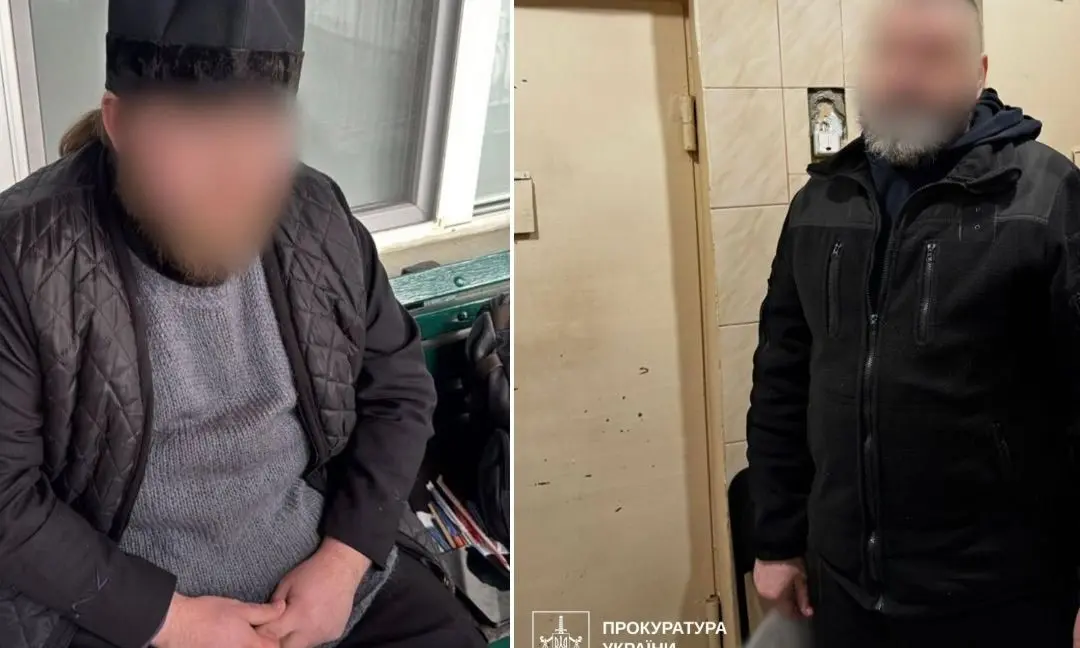
A 52-year-old novice monk at a Ukrainian Orthodox Church of the Moscow Patriarchate offered girls sweets to lure them to his home. Once there, he forced them to undress and photographed them. A 14-year-old victim told investigators he gave her alcohol so she could not resist. He is now charged with producing and possessing child pornography. Prosecutors say the full legal classification of his crimes is still being determined as the investigation continues.
A 24-year-old hieromonk from the same church led a 14-year-old girl into a monastery basement while intoxicated and committed sexual acts against her. He faces five to eight years in prison. Prosecutors are appealing the bail conditions for both men, seeking pretrial detention.
The case lands inside a context that makes it impossible to separate from the larger war. The Ukrainian Orthodox Church of the Moscow Patriarchate has operated under deep suspicion since Russia’s full-scale invasion — multiple clergy members have faced accusations of collaborating with Russian forces, passing information, providing spiritual cover for occupation. The church declared it severed ties with the Russian Orthodox Church after February 2022. Critics have
argued that declaration was made without legal or practical effect — that the institutional connection remains, whatever the paperwork says.
Ukraine has two Orthodox denominations. The autocephalous Orthodox Church of Ukraine received full canonical independence from the Ecumenical Patriarch in Constantinople in 2019. The Moscow-linked church has spent the years since trying to prove it is something other than what its name suggests.
Two monks in Kharkiv have made that argument harder to make.
What March 30 Revealed
Somewhere in Russia tonight, a man with two million followers is staring at a blank screen, deciding whether to tell the truth.
He knows what the truth costs. Article 207.3. Fifteen years. He types anyway.
That is what this day revealed — not just on the battlefield, not just in the diplomatic cables, but inside Russia’s own information space, where the people who built careers on inevitable Russian victory are now publicly calculating inevitable Russian defeat. Not because Western analysts told them. Because they can see it themselves and can no longer pretend otherwise.
Watch what happened on March 30 and feel the weight of it. Ukraine’s drones shut down Russia’s largest Baltic oil export terminal and hit the Taganrog drone factory and struck the Tolyatti chemical plant for the fourth time in three weeks. Russia’s 153rd Tank Regiment soldiers were captured trying to plant a flag in a village Moscow had already announced as seized. Twenty-seven thousand foreign fighters recruited from 135 countries stand as testament to a military that has exhausted the willingness of its own people to die for it.
Zelensky offered an Easter ceasefire. Russia dismissed it before the echo faded — as it has dismissed every ceasefire before it, using each pause to reload. The Washington talks remain frozen while America fights its war with Iran. Hungary holds the winter heating money hostage in Budapest. The construction season is slipping away one unfunded week at a time.
The drones keep flying in both directions. The oil terminals burn. The bloggers confess.
March 30 was not a decisive day. No single day in this war has been. But it was a day when the gap between what Russia claims and what Russia’s own voices admit grew wide enough that almost anyone could see through it.
Almost anyone is now looking.
Prayer For Ukraine
- Courage for the Men Buying Their Own Radios
Lord, we lift up the Ukrainian soldiers holding the line at Pokrovsk and Hryshyne — the men absorbing daily infantry assaults from forces attacking on foot, on ATVs, on motorcycles, probing for any gap that will give. We pray especially for the defenders whose enemies have lost their communications and come anyway — and for the Ukrainians who intercept 20 Russian reconnaissance drones every single day, each one worth $100,000, each one hunting them. Sustain their vigilance, Father. Let their technology outlast Russia’s ambition, and let their lines hold until the offensive exhausts itself against their courage.
- Justice for the Dead and the Wounded
Heavenly Father, four people did not survive March 30. Thirty-six others carry the wounds of a night that targeted power stations and civilian minibuses alike. We name them before You — the three killed in Donetsk Oblast, the one killed in Kherson, the woman on the minibus who never saw it coming. You know each name. Hold the grieving families. Sit with the wounded in their hospital beds. And remind a watching world that behind every casualty statistic is a person You made, and loved, and have not forgotten.
3. Wisdom for Zelensky at the Diplomatic Table
God of wisdom, Zelensky offered an Easter ceasefire and watched it dismissed before the words finished traveling. He is negotiating with Washington distracted by Iran, with Budapest holding winter heating money hostage, with a peace process that has produced no peace. Grant him clarity to know which concessions preserve Ukraine and which ones slowly surrender it. Give him patience that does not become passivity, and resolve that does not become rigidity. Where human wisdom runs out, let Yours begin.
4. Protection Over the Civilians of Seven Oblasts
Father, seven oblasts woke without power on March 30. Odesa, Zaporizhzhia, Dnipropetrovsk, Khmelnytskyi, Kharkiv, Chernihiv, Sumy — families setting alarms for the rationing windows, hospitals running on generators, repair crews working through the night to restore what one missile and twelve drones took away. We pray for the engineers and the linemen and the civil defense workers who restore normalcy in the dark. Protect the infrastructure that keeps people warm and alive. And frustrate every future strike package before it launches.
5. Endurance for a Nation Turning Its Wounds Into Weapons
Lord, on the same day Russia’s drones hunted Ukrainian radar systems with new homing heads, Ukrainian engineers were preparing to build interceptor drones in New Hampshire. On the same day conscripts were grabbed off the street and dragged to training camps, instructors were learning to treat them with dignity and turn them into soldiers worth following. On the same day Hungary blocked the winter heating money, Spain was pulling Patriot missiles from its own active units to send them east. This is the shape of this war in its fifth year — destruction and resilience arriving together, inseparable. Sustain that resilience, Father. Restore what has been taken. Protect what remains. And bring this war — with justice, with truth, and with Ukraine’s sovereignty intact — to its end.
Amen.