
Ukraine Daily Briefing | May 13, 2026 | Day 1,540 of the Full-Scale Invasion
Russia launched 139 drones overnight May 12–13, then 753 more during daylight hours on May 13 — 892 total, one of the longest and largest combined attacks of the war. Ukrainian air defenses downed 821. The 71 that got through killed at least 14 people and injured over 80 across nearly every region, including the first-ever strike on Uzhhorod in Zakarpattia. Then, overnight into May 14, Russia escalated to missiles: MiG-31 bombers launched ballistic missiles, a residential building in Kyiv’s Darnytskyi district partially collapsed, 11 people were rescued from rubble, one killed, 29 injured in Kyiv, 18 apartments destroyed. Zelensky said the timing “was clearly not accidental” — calculated to overshadow Trump’s visit to Beijing. Meanwhile, Ukraine struck the Taman oil terminal, the Yaroslavl refinery’s AVT unit, the Astrakhan gas processing plant, and the Nurlino pumping station in Ufa (1,500 km from the border) — at least 27 long-range strikes on Russian territory since May 1. The Kremlin doubled down on its Donbas withdrawal demand. Russia’s State Duma passed a bill authorizing military operations abroad to “protect Russian citizens.” The U.S. House Ukraine Support Act discharge petition got its 218th signature, forcing a floor vote. Hungary summoned Russia’s ambassador after Zakarpattia was struck. Russia banned all publication of drone strike aftermath in Moscow without official permission. Rusagro nationalized. Cash demand in Russia hit a record $2.84 billion over Victory Day weekend.
The Day’s Reckoning
The drones began overnight. One hundred thirty-nine flew into Ukraine between 6 p.m. on May 12 and 8 a.m. on May 13 — Ukrainian forces downed 111 of them — but they were only the prelude. At 11 a.m., the next wave started. Then another. Then another. By 6:30 p.m., Russia had launched 753 drones in daylight — in dense formations flying five to ten kilometers along the Belarus-Ukraine border, not entering Belarusian airspace, in a saturating corridor designed to exhaust Ukraine’s electronic warfare systems and push deep into the west. Eight hundred ninety-two drones in total. One of the largest single-day drone campaigns of the war.
The drones flew into regions that had rarely if ever been targeted: Zakarpattia, Lviv, Volyn, Ivano-Frankivsk, Rivne, Chernivtsi, Khmelnytskyi, Vinnytsia. Uzhhorod — in the far west near the borders of Slovakia and Hungary, 1,200 kilometers from the front line — was struck for the first time since the start of the full-scale invasion. Three people were killed in Rivne. Gas infrastructure in Kharkiv was hit. Eight killed and eleven wounded in Dnipropetrovsk Oblast. One killed and three injured in Kharkiv Oblast. An industrial zone struck in Odesa. Bridges, depots, locomotives, substations hit across the rail network — 23 strikes on railway infrastructure; three locomotives, seven commuter cars, eight freight wagons, five traction substations, two bridges destroyed. Two off-duty railway workers killed in Zdolbuniv.
Zelensky said at 5:45 p.m.: “Russia is clearly trying to spoil the broader political atmosphere and draw attention to its evil — at the expense of Ukrainian lives and infrastructure.” The reference was direct. Trump was in Beijing meeting Xi Jinping. ISW had assessed, and Ukrainian intelligence confirmed, that Russia planned the scale of the attack to project dominance at the moment of the superpower summit, to force the war back to the top of the bilateral agenda on Russia’s terms.
Then, after the drones, the missiles. Shortly before 1 a.m. on May 14, Ukraine’s Air Force issued a nationwide alert: MiG-31 bombers airborne, ballistic missiles inbound. In Kyiv’s Darnytskyi district, structural components of a residential building collapsed. Eleven people were pulled from rubble. One was killed. Twenty-nine were injured in the capital. Eighteen apartments destroyed. Water supply disrupted on Kyiv’s left bank. The attack continued until 3:44 a.m.
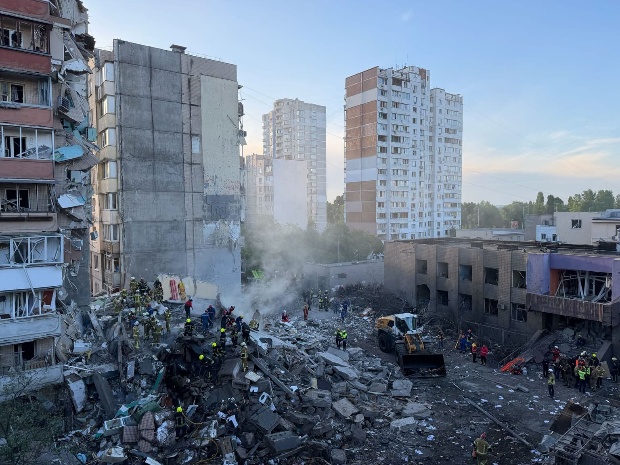
First responders search for victims trapped under the rubble of a residential building that partially collapsed as a result of a Russian drone and missile attack on Kyiv overnight. (Nick Allard/The Kyiv Independent)
892 Drones, 14 Killed, 80+ Injured: Region by Region
Daytime attack totals: at least 14 civilians killed and over 80 injured. In Rivne Oblast, a drone struck a residential building, killing three people and injuring six. In Volyn Oblast, Russian forces struck Lutsk and Kovel — a non-residential building in Lutsk, a residential building near critical infrastructure in Kovel, at least five injured. In Ivano-Frankivsk Oblast, a drone struck a residential building, injuring at least 10 including two teenagers; four hospitalized. In Zakarpattia Oblast, Uzhhorod was struck for the first time since February 24, 2022 — the most massive attack against the region since the invasion began; critical infrastructure in several districts struck; regional governor Biletskyi described it as the largest attack the region had ever experienced. In Khmelnytskyi Oblast, three people injured and hospitalized in moderate condition; drone debris fell on a nine-story residential building. In Vinnytsia Oblast, attacks reported across the region. In Chernivtsi Oblast, attacks reported. In Lviv Oblast, Zhovkva’s critical infrastructure was struck; the city lost power. In Cherkasy Oblast, three men injured in Smila.
In Kharkiv Oblast, one person killed and three injured; gas infrastructure damaged. In Dnipropetrovsk Oblast, eight killed and eleven wounded; a gas pipeline in Kryvyi Rih damaged; teenagers among the injured. In Kherson Oblast, one killed and 27 injured; a bus struck in Kherson City; a minibus struck in Bilozerka injuring passengers; first responders were struck in a double-tap attack. In Zaporizhzhia Oblast, three injured. In Odesa Oblast, an industrial zone fire, two men injured. In Kyiv Oblast, drone debris fell in Obolon; Fastiv area also impacted. In Poltava Oblast, a drone struck an electrical substation leaving 6,500 people without power; residential buildings damaged.
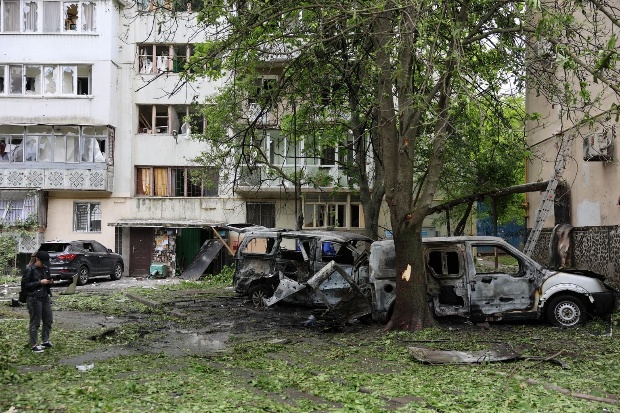
A woman stands next to destroyed cars in the courtyard of a damaged residential building following a drone attack in Odesa, amid the Russian invasion in Ukraine. (Oleksandr Gimanov / AFP via Getty Images)
Ukraine’s Air Force confirmed drones entered Ukrainian airspace from both the Belarus border direction (along the Chornobyl corridor toward northwest Ukraine) and from the Black Sea (heading toward Odesa, Mykolaiv, Kirovohrad, Vinnytsia). Ukraine’s HUR assessed that the daytime drone waves were designed to exhaust air defense ammunition and monitoring systems before Russia launched missiles later that night. Russia’s new tactic of launching drones in dense formations for extended periods — in this case from 11 a.m. through 6:30 p.m. continuously — allows Russia to sustain threats across more regions for longer and disproportionately affect civilian areas. Poland scrambled military aircraft and raised air defense readiness during the attack. Moldova’s Defense Ministry confirmed a drone entered Moldovan airspace from Ukraine’s Vinnytsia region, flew over Balti, and was tracked through Hincesti district; Moldova temporarily closed its northern airspace.
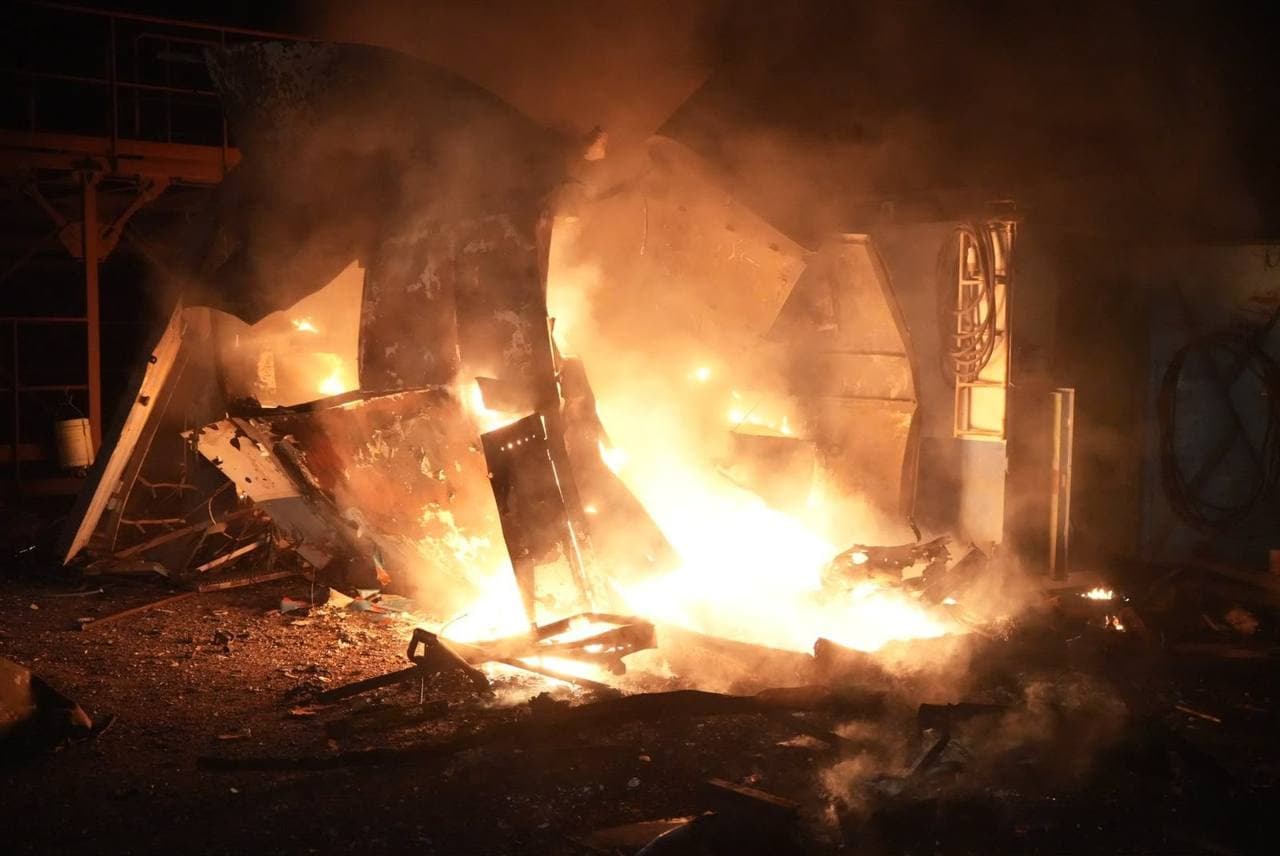
Aftermath of a Russian attack on an industrial site in the city of Odesa, Odesa Oblast, overnight. (Odesa Oblast Governor Oleh Kiper / Telegram)
Overnight Missile Strike on Kyiv: Building Collapses, 11 Rescued, One Killed
Shortly before 1 a.m. on May 14, Ukraine’s Air Force issued a nationwide ballistic missile alert, warning that Russian MiG-31 bombers were airborne. Multiple rounds of explosions were heard in Kyiv between 3:08 a.m. and 3:44 a.m. In the Darnytskyi district, structural components of a residential building collapsed, trapping people under rubble. Rescue operations extracted 11 people. One person was killed; 29 were injured in Kyiv City. Seven more were injured in Kyiv Oblast including a child. Eighteen apartments were destroyed. Water supply was disrupted on Kyiv’s left bank. Debris from intercepted drones sparked a fire on the roof of a five-story building in Dniprovskyi district, fell on a road in Holosiivskyi, set a car ablaze in Solomyanskyi, hit an office building and parking structure and sparked a fire at a 12-story building in Obolonskyi, and struck an unfinished 25-story building.
Zelensky had explicitly warned of the missile follow-up based on HUR intelligence during the daytime drone attack: “Russia plans to follow the drone waves with a significant number of air- and sea-launched cruise missiles, as well as ballistic missiles.” HUR had assessed that targets would include energy facilities, defense industry enterprises, and government buildings in major cities. Air raid alerts remained active across Ukraine as of 8:30 a.m. on May 14.
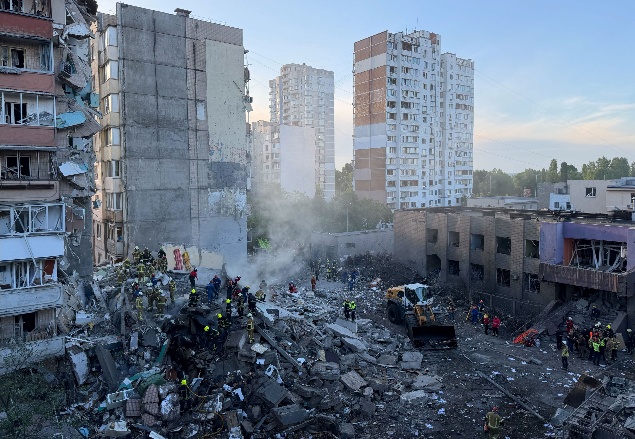
First responders search for victims trapped under the rubble of a residential building that partially collapsed as a result of a Russian drone and missile attack on Kyiv overnight. (Nick Allard/The Kyiv Independent)
Ukraine’s Long-Range Strike Campaign: Taman, Yaroslavl, Astrakhan, Ufa
The Ukrainian General Staff confirmed on May 13 that Ukrainian forces struck the Tamanneftgaz oil terminal at Volna, Krasnodar Krai, causing fires at both the loading pier and the port of Taman. NASA FIRMS thermal data confirmed the fire. The SSO noted the terminal is one of the key Russian oil export facilities on the Black Sea coast, also handling LNG, coal, and sulfur exports. Ukrainian forces also struck the AVT primary oil processing unit at the Slavneft-YANOS Yaroslavl Oil Refinery in Yaroslavl City (approximately 750 km from the border), confirmed by the General Staff; fires broke out at the facility. Yaroslavl Governor Evraev acknowledged a drone struck an industrial facility in the city. Ukrainian forces struck the Astrakhansky gas processing plant in Astrakhan Oblast (approximately 645 km from the border), also confirmed by the General Staff; fires broke out. Astrakhan Governor Babushkin acknowledged the strike, claiming air defenses neutralized the attack; the Kyiv Independent assessed this as inconsistent with the confirmed fire.
Ukrainian Sanctions Commissioner Vlasyuk confirmed — supported by geolocated footage — that Ukrainian forces struck the Nurlino Linear Dispatch and Pumping Station in Ufa, Bashkortostan Republic, approximately 1,500 kilometers from the Ukrainian border. Vlasyuk stated the station processes 30 million tons of oil annually, pumping crude from Siberia, Orenburg Oblast, and Kazakhstan. A Reuters report citing two industry sources confirmed that the May 7 Ukrainian strikes against the Lukoil Perm refinery forced the facility to completely halt production; repairs could take weeks. ISW documented at least 27 Ukrainian long-range strikes against targets on Russian territory since May 1, covering an area from Moscow City (455 km) to Chelyabinsk (1,600 km), Yekaterinburg (1,600 km), Leningrad Oblast (860–930 km), and Krasnodar Krai (110–235 km).
Kremlin Demands Full Donbas Withdrawal; Lavrov Says “Nothing Is Happening” in Talks
Kremlin spokesman Peskov stated on May 13 that Ukrainian forces must cease fire and withdraw from all four Russian-claimed oblasts — Donetsk, Luhansk, Zaporizhzhia, and Kherson — as a precondition for negotiations to resume. Anonymous sources familiar with the matter told the Financial Times that Putin plans to impose additional territorial demands in any future ceasefire agreement. Two sources in contact with Putin told the FT that his ambitions remain to control all Ukrainian territory between Russia and the Dnipro River, and possibly including Kyiv City and Odesa. Russian Foreign Minister Lavrov stated on May 13 that despite recent dialogue with the U.S., “nothing is happening” in negotiations.
ISW’s assessment: Russian forces have advanced only 349.89 square kilometers in Donetsk Oblast in all of 2026 — an average of 2.63 square kilometers per day. Russian forces first infiltrated Kostyantynivka in October 2025 and made no significant gains over six months. ISW is no longer prepared to forecast when or whether Russian forces can seize Donetsk’s Fortress Belt given the slowing advance rate and the challenging human and physical terrain. Senior Russian commanders reportedly convinced Putin that all of Donetsk and Luhansk could be seized by Fall 2026; ISW assesses this is disconnected from battlefield reality. Trump confirmed again on May 13 that he has no understanding with Putin that Russia should receive all of Donbas.
Russia’s Duma Passes Bill Authorizing Foreign Military Operations to “Protect Russian Citizens”
Russia’s State Duma unanimously passed a bill on May 13 allowing Putin to order military forces to conduct operations abroad to protect Russian citizens facing arrest, detention, criminal prosecution, or other legal proceedings in foreign courts. Duma Speaker Volodin stated: “Western justice has turned into a repressive machine.” Defense Committee chair Kartapolov invoked “countering rampant Russophobia abroad.” Putin has 14 days to sign the bill. ISW assessed: the Kremlin has repeatedly claimed that foreign states oppress Russian speakers in Moldova, the Baltic states, and Ukraine to justify military interventions — this bill sets informational and legal conditions to justify future such activity under a domestic legal pretext. The measure was introduced to the Duma on March 10.
Ukraine Support Act Gets 218th Signature; House Vote Now Mandatory
The U.S. House Ukraine Support Act discharge petition received its 218th and final required signature on May 13, forcing the bill to the House floor for a vote regardless of Republican leadership opposition. The bill — sponsored by Democratic Rep. George Meeks and bipartisan — affirms U.S. support for Ukraine, imposes sweeping new sanctions on Russia’s oil and mining industries, provides Kyiv with additional military aid, funds postwar reconstruction, establishes measures to counter Russian disinformation, and prevents the president from terminating sanctions without cause. The petition had been stuck at 217 signatures since February. The decisive 218th signature came from Independent Rep. Kevin Kiley, formerly Republican. Kiley: “Recent Ukrainian gains have created an opportunity for peace, but the collapse of the recent ceasefire shows that leverage is needed for diplomacy to succeed.” Speaker Johnson had previously declined to consider the bill.
Hungary Summons Russian Ambassador; Zelensky Calls It a “Significant Message”
Hungarian Prime Minister Peter Magyar announced on May 13 that Foreign Minister Anita Orbán summoned Russia’s ambassador to Hungary following the mass attack, which included the first-ever strike on Uzhhorod in Zakarpattia Oblast — home to Ukraine’s Hungarian minority. Orbán will personally condemn the attacks during a meeting with the ambassador on May 14 and call for an end to the full-scale invasion. Magyar stated Hungary has offered assistance and is in contact with the Hungarian Consul General in Uzhhorod. Zelensky: “This sends a significant message” and shows that Moscow is a shared threat not only to Ukraine but to neighboring countries and Europe. The summoning marks a decisive break from Orbán-era policy, under which Hungary blocked numerous EU Ukraine support measures and refused to condemn Russian strikes.
Zelensky in Bucharest: B9 Summit Joint Statement, Lithuania Drone Deal
President Zelensky attended the B9 and Nordic Allies summit in Bucharest, Romania on May 13. The joint statement called for increased pressure on Russia to engage meaningfully in peace negotiations: “Pressure on Russia to end its illegal war of aggression and engage meaningfully in peace negotiations must be increased.” Leaders reaffirmed support for Ukraine’s sovereignty, commitment to a just and lasting peace grounded in international law and credible security guarantees, continued military assistance via NATO’s PURL list, and noted Russia poses “a significant and direct long-term threat” requiring a stronger NATO forward defense posture. Some allies are already meeting or nearing 5 percent of GDP on defense. The statement also addressed NATO airspace violations, drone threats, critical infrastructure protection, maritime routes, and expanded NATO-EU cooperation including on Moldova.
Separately, Zelensky met Lithuanian President Gitanas Nausėda on May 13 and signed a bilateral defense cooperation agreement under the “Drone Deal” framework. Ukraine will deploy military experts to Lithuania to develop counter-drone capabilities; both countries will pursue joint production, technology transfer, drone manufacturing including possible Lithuanian localization of long-range strike and interception systems. Zelensky also called for opening all six EU accession negotiation clusters for Ukraine and praised Lithuania’s consistent defense support.
Moscow Bans Drone Strike Publication Without Official Approval
The Moscow city government announced on May 13 that it is banning the publication of information about the consequences of drone strikes and other attacks without prior appearance in official sources. The ban applies to authorities, state institutions, media outlets, emergency services, organizations, and residents, prohibiting text, photo, or video showing strike aftermath. Only content first published through Russia’s Defense Ministry, Moscow mayor’s office, city government, or Sobyanin’s social media may subsequently be shared. Fines: 3,000–5,000 rubles for individuals; 50,000 for officials; 200,000 for organizations. The measure follows internet shutdowns that Raiffeisenbank-Russia chief economist Murashov linked directly to the record $2.84 billion cash withdrawal surge over Victory Day weekend — the largest since Bank of Russia began collecting data in 2011 and five times the 2025 figure for the same period. Russians increasingly use cash to avoid card transaction disruptions during blackouts and to evade rising taxes.
Rusagro Nationalized; Kremlin Sets Conditions for Mass Asset Seizure
Russia’s Prosecutor General nationalized Rusagro — Russia’s largest agricultural holding and the most valuable asset of billionaire Vadim Moshkovich — on May 5, Meduza reported on May 12. Moshkovich was arrested on fraud charges in March 2025. The stated legal grounds: Moshkovich allegedly managed the company while serving as a senator in the Federation Council despite having formally stepped down from executive roles. The Bell co-founder Pyotr Mironenko assessed that the Rusagro case establishes precedents to nationalize assets of five of Russia’s 30 richest individuals, all of whom currently hold or previously held government positions or parliamentary seats. The Prosecutor General has been filing anti-corruption cases creating nationalization grounds for a series of such individuals. Crucially, the court did not release Moshkovich in exchange for the company — differing from previous cases. ISW connected the pattern to Putin’s closed March 26 meeting at which he pressured Russia’s top businessmen to contribute to the federal budget.
Frontline: Ukrainian Advances in Oleksandrivka and Hulyaipole; Lukoil Perm Halted
Ukrainian forces recently advanced in the Oleksandrivka direction, facilitated by the BAI campaign against Russian rear logistics near Velyka Novosilka. Russian milbloggers claimed Ukrainian forces are advancing toward Piddubne and Komar northeast of Oleksandrivka and near Oleksandrohrad east of Oleksandrivka, indicating Ukrainian forces advanced south of Andriivka-Klevtsove, into western Voskresenka, and into Oleksandrohrad; Russian forces appear to have infiltrated Piddubne rather than seized it. In the Hulyaipole direction, geolocated footage published May 12 shows Ukrainian forces advanced south of Pryluky and north of Olenokostyantynivka northwest of Hulyaipole; ISW now assesses these as part of a sustained counterattack series along the Haichur River fortification belt. In the Slovyansk direction, Ukrainian forces maintained positions in southern Nykyforivka; geolocated footage shows Russian forces shelling there, confirming no Russian positions in that area. In the Kostyantynivka area, geolocated footage confirms no Russian contiguous positions in southern or eastern Kostyantynivka despite Russian infiltration claims.
A source reporting on the Russian Western Grouping confirmed the 122nd Motorized Rifle Regiment (68th MRD, 6th CAA, Leningrad MD) is holding approximately 30 positions on the east bank of the Oskil River with under 100 servicemembers, under constant Ukrainian drone pressure. Russian forces continued limited attacks in Borova, Dobropillya, Pokrovsk, Novopavlivka, Oleksandrivka, Hulyaipole, western Zaporizhzhia, and Kherson directions without confirmed advances. A Ukrainian artillery battalion commander reported Russian forces in northern Sumy Oblast have largely replaced Lancet loitering munitions with FPV and fiber-optic drones for strikes against Ukrainian artillery. A new Russian Order of Battle: the Knyaz Veshchy Oleg reconnaissance drone operators of the Russian 8th Separate Unmanned Systems Battalion (2nd CAA, CMD) are operating in the Dnipropetrovsk direction — the first ISW evidence of this unit’s existence. In the Pokrovsk direction, Russian forces are using new Gerbera and Molniya drone modifications in support of nighttime small-group infiltration attempts.
Russian Decapitation Order Near Hulyaipole; Beheading War Crime Documented
Ukraine’s General Staff reported on May 13 that a Russian military commander ordered his troops to decapitate the bodies of two Ukrainian soldiers killed near Hulyaipole and display them “in a conspicuous spot at the edge of the field.” Radio intercepts captured the direct order and a subordinate’s confirmation of willingness to comply. The ambush occurred on May 12, when a Russian unit attacked soldiers of Ukraine’s 225th Separate Assault Regiment on the front line near Hulyaipole. The commanding unit has been preliminarily identified. The same commander is believed to have previously ordered troops to abuse Ukrainian prisoners of war. The General Staff: “By desecrating the bodies of fallen soldiers, the occupiers have once again demonstrated their sadistic nature. This is a gross, deliberate violation of the rules and customs of war — a war crime with no statute of limitations.”
EU Russian LNG Imports Hit Record; Refugee Temporary Protection Review; Labour Shortages
EU imports of Russian liquefied natural gas in Q1 2026 reached their highest level since 2022, driven by energy scramble following the Middle East war, the Institute for Energy Economics and Financial Analysis reported. The EU imported 6.9 billion cubic meters of Russian gas in Q1 2026 — a 16 percent increase year-on-year, with the trend continuing in April at 17 percent above 2025. Russia remains the EU’s second-largest LNG supplier at approximately 14 percent of total imports. France, Spain, and Belgium lead EU Russian LNG purchases. EU nations have simultaneously tripled U.S. LNG imports between 2021 and 2025; the U.S. is expected to become the EU’s largest gas supplier in 2026. The EU has pledged to end all Russian gas and oil imports by end of 2027. EU ministers are set to meet June 4–5 to discuss transitioning from the Temporary Protection Directive for Ukrainian refugees — currently covering 4.3 million people across the EU — to a more permanent legal framework before the directive expires in March 2027. The Council of Europe human rights commissioner warned against a “protection gap.”
Ukraine’s labour market faces severe structural shortages: at the start of 2026, 78 percent of EBA member companies reported a skilled worker shortage. An estimated 5.7 million refugees remain abroad; hundreds of thousands of men are mobilized, killed, or wounded. Official unemployment is not published, but Info Sapiens estimated a 15.5 percent jobless rate as of March 2026 — a paradox of simultaneous shortages and unemployment, explained by a skill mismatch. Female workforce participation has hit record levels, including in previously male-only industries. Women now constitute approximately half the workforce at manufacturing companies like Biosphere in Dnipro. Zelensky has announced plans for partial demobilization, with no details yet published.
Lavrov on U.S. Sanctions; Lukashenko Announces Rotational Mobilization
Russian Foreign Minister Lavrov accused the U.S. on May 13 of using sanctions to push Russian companies including Lukoil and Rosneft out of African and Balkan markets, and claimed Washington is seeking control of the Russia-to-Europe gas transit pipeline through Ukraine. The U.S. sanctioned Rosneft and Lukoil on October 22, freezing all U.S.-based assets. Kremlin economic envoy Kirill Dmitriev has repeatedly promoted a $14 trillion joint U.S.-Russia economic cooperation framework as an alternative framework, which Zelensky’s intelligence assessed at approximately $12 trillion in February.
Belarusian President Lukashenko announced on May 12–13 that Belarus will conduct “rotational mobilization” — calling up individual military units in turns for intensive combat training “to prepare them for war” and maintain readiness for a possible “ground operation.” Lukashenko: “God willing, it will be possible to avoid it. We are all preparing for war.” The announcement followed combat-readiness inspections revealing shortcomings. Belarus had already in April issued a decree calling up reserve officers and in March launched conscription for men aged 18–27. Zelensky noted in April that Russia sought to draw Belarus into the war and that roads and artillery positions near the border had been prepared.
Fire at Moscow Tourist Complex; ISW on Russia’s Territorial Disconnect
A large fire broke out overnight May 13 at the Izmailovo Kremlin complex in eastern Moscow — a cultural and entertainment complex that mimics the architectural style of the Kremlin. The blaze reportedly exceeded 3,000 square meters; an escape room building collapsed having been fully engulfed. No casualties were reported and no immediate attribution to Ukrainian military operations was made. The fire arose amid already heightened concern in Moscow about Ukrainian drone strikes following the May 4 strike on the Mosfilm Tower.
ISW’s broader strategic assessment on May 13: Russia’s spring-summer 2026 offensive has failed. Russia’s monthly advance rate in Donetsk has fallen to 2.63 square kilometers per day. Ukrainian counterattacks recaptured much of Kupyansk from November 2025, liberated over 400 square kilometers in southern Ukraine, and most recently cleared Russian positions from western Zaporizhzhia Oblast. Russia suffered a net territorial loss in April 2026. Russia’s recruitment rate fell below replacement rate in January 2026. Putin’s orders to the military appear disconnected from battlefield capability — he is reportedly being told his forces can seize all of Donetsk and Luhansk by Fall 2026 while ISW cannot even forecast if they are capable of doing so at all.
The Weight of May 13
892 drones in a single day. Then missiles. Eleven people were pulled from rubble in Kyiv after a building partially collapsed at 3 a.m. Three people were killed in Rivne. One was killed in Kharkiv Oblast. Eight died in Dnipropetrovsk Oblast. One was killed in Kherson Oblast. Uzhhorod was struck for the first time in the war.
Zelensky said the timing was not accidental. Russia launched its largest single-day drone attack while Trump was in Beijing meeting Xi. Putin wanted to be the subject of that meeting. Ukrainian civilians paid the price for that calculation.
Russia’s Duma passed a law authorizing military operations abroad to ‘protect’ Russian citizens. Russia nationalized Rusagro. Russia’s cash demand hit a record $2.84 billion over Victory Day. Moscow banned publication of drone strike aftermath without official permission. These are the instruments of a government preparing for something longer and harder than a parade.
Ukraine struck the Taman terminal, Yaroslavl, Astrakhan, Ufa — 1,500 kilometers from the border. The Perm refinery is shut down for weeks. At least 27 long-range strikes since May 1. The House Ukraine Support Act will now go to a vote. Hungary summoned the Russian ambassador. The B9 called for more pressure on Russia.
A Russian commander ordered his troops to cut the heads off two Ukrainian soldiers and display them at the edge of a field. Radio intercepts confirmed it. The unit has been identified.
A Prayer for Ukraine
1. For the Fourteen Killed and the Eighty Injured on May 13
Lord, three died in Rivne when a drone struck a residential building. Eight died in Dnipropetrovsk Oblast, including in Kryvyi Rih where a gas pipeline was also hit. One was killed in Kharkiv Oblast. One in Kherson Oblast. Others across the network of regions that Russia struck for hours on a Tuesday, from Zakarpattia to Kherson, from Lviv to Dnipro. Receive each of the dead. Hold the 80-plus who are injured — the teenagers in Ivano-Frankivsk, the passengers on the bus in Kherson, the two emergency workers struck in the double-tap. And hold Uzhhorod, which was struck for the first time — a city near the EU border that woke up to sirens it had never heard before as an actual threat.
2. For the People Pulled from Rubble in Kyiv
Father, eleven people were pulled from beneath collapsed structural components of a building in Darnytskyi district in the early hours of May 14. One person died. Twenty-nine were injured in Kyiv. Eighteen apartments were destroyed. Running water was cut on the left bank. A city that has survived more than four years of war went to bed during a ceasefire week and woke up with part of a residential building on the ground. Hold those eleven people who were found under the rubble. Hold the one who was not. Hold the emergency workers who have done this hundreds of times and must find the will to do it again.
3. For the Two Railway Workers in Zdolbuniv
God of labor, two off-duty railway workers were killed in Zdolbuniv in western Ukraine when Russia struck the city on May 13. They were not on their way to work. They were off duty. The train monitoring teams stopped and evacuated passengers in time to prevent casualties among travelers. The workers who were not on shift were not protected by that protocol. They died on the same day that Ukraine’s railway system absorbed 23 strikes and kept running. We pray for them. And we pray for every railway worker across Ukraine who rides the trains that Russia targets daily, knowing that the network must keep moving.
4. For the Dead Near Hulyaipole
Lord, two Ukrainian soldiers were killed in an ambush near Hulyaipole on May 12. Then a Russian commander ordered their bodies decapitated and displayed. Radio intercepts confirmed it. The unit has been identified. We do not pray for vengeance. We pray that the documentation exists, that the identification holds, that what was done to those two soldiers is recorded in a way that survives the war and reaches a court. And we pray for the families of those soldiers, who did not need to know this, but now do.
5. For Ukraine in the Longest Day
God of endurance, Russia launched 892 drones in one day. Ukraine shot down 821. The 71 that got through killed 14 people, collapsed a building in Kyiv, and struck Uzhhorod for the first time in history. Zelensky said it was calculated for Beijing. Putin wanted to be the story during the Trump-Xi summit. He used Ukrainian lives to make his point. We pray for Ukraine’s air defense crews who worked for more than 30 consecutive hours to intercept wave after wave of drones. For the pilots who scrambled. For the operators monitoring screens as target after target appeared and disappeared. For the people in the shelters who stayed underground for hours. Let the endurance that Ukraine has demonstrated — not just on May 13, but on every day of the 1,540 that preceded it — be answered by something more durable than the next ceasefire. Bring this war to its end. In Your mercy, in Your justice, in Your time.
Given the scale of the drone attacks mentioned in the article, especially the new tactics of using dense formations to exhaust electronic warfare systems, how effective are the current Western air defense supplies proving to be against such sustained saturation campaigns, and what specific types of counter-drone technologies are most urgently needed now?
Western air-defense supplies are still highly effective, but they are not enough by themselves for this new phase of the war. Systems like Patriot, NASAMS, IRIS-T, Gepard, and other Western-supplied layers have saved many lives, especially against missiles and higher-value aerial threats. But Russia’s drone campaign is designed to create a cost and volume problem: cheap Shahed-type drones and decoys are being launched in numbers large enough to exhaust missiles, radar attention, mobile teams, and electronic-warfare capacity. In April 2026, Russia launched more than 6,500 Shahed-type and related drones at Ukraine, showing the scale of the saturation problem.
So the answer is not simply “more Patriots,” though Ukraine still needs high-end air defense for ballistic and cruise missiles. Against mass drone waves, the urgent need is a cheaper, layered counter-drone shield: interceptor drones, mobile fire teams, short-range radar, acoustic and optical detection, stronger electronic warfare, anti-jam capability, and rapid command-and-control systems that can assign targets before the swarm overwhelms defenses.
Interceptor drones are especially important because they reduce the need to spend expensive missiles on cheap drones. Ukraine says these systems are already proving effective; in one April attack, interceptor drones reportedly accounted for half of the Russian UAVs shot down. Ukraine has also sharply increased interceptor-drone production, with more than 20 companies working in the field and reported mission success above 60%.
In short: Western air defense is working, but saturation attacks are exposing the limits of relying on expensive systems against cheap mass-produced drones. The most urgent need now is scale: thousands of low-cost interceptors, better detection networks, mobile short-range defenses, and electronic-warfare systems that can keep functioning even when Russia sends dense formations meant to overwhelm them.