
Ukraine Daily Briefing | May 17, 2026 | Day 1,544 of the Full-Scale Invasion
Prepared by Dayana Bozhyk
Overnight May 16–17, Ukraine struck the Angstrem semiconductor plant in Zelenograd — which produces microelectronics for Russian precision weapons — the Moscow Oil Refinery, two fuel pumping stations in Moscow Oblast, and the Belbek military airfield in Crimea. Russia’s banking system has crossed the IMF’s 10% non-performing asset threshold for a systemic banking crisis for the third consecutive month, according to Ukraine’s foreign intelligence service citing Russia’s own government-linked analysts.
The Day’s Reckoning
The strikes arrived after 3 a.m. local time and lit up the Moscow region in a way that required official acknowledgment. Zelenograd — northwest of the capital, built in the Soviet era as Russia’s Silicon Valley — was struck at the Elma Technopark, where the Angstrem-T plant produces microelectronics and semiconductors used in Russian high-precision weapons systems. Geolocated footage confirmed smoke rising from the facility. The Moscow Oil Refinery in Kapotnya district was struck; Mayor Sobyanin acknowledged the hit but claimed it only damaged a checkpoint. The Solnechnogorsk fuel loading station in Moscow Oblast — which stores and ships gasoline and diesel — caught fire. The Volodarsk pumping station southeast of Moscow was also struck. Russian Telegram channel Supernova+ reported that the Raduga Machine-Building Design Bureau in Dubna, Moscow Oblast — which manufactures cruise missiles and missile systems — was also targeted during the attack.
The disruption was measurable. A fire broke out on the runway at Sheremetyevo International Airport after drone wreckage struck it. The Russian Transportation Ministry announced temporary airspace restrictions and the diversion of 51 flights; two-thirds of departures from Moscow airports were delayed by more than two hours. Approximately 200 flights were delayed or canceled at Sheremetyevo, nearly 100 at Vnukovo. The Russian Defense Ministry claimed its air defenses intercepted 1,054 Ukrainian drones, eight guided aerial bombs, and two missiles — including what it described as a Flamingo long-range cruise missile and a Neptune-MD guided missile. Ukraine did not confirm use of the missiles. Moscow Oblast Governor Vorobyov confirmed at least three people were killed — two in the village of Pogorelki and one in Khimki — and others injured as drones struck residential buildings. Sobyanin said 12 people were injured near the refinery, most of them construction workers at the checkpoint.
Zelensky confirmed the operation: “This time, Ukrainian long-range capabilities reached the Moscow region. We clearly tell the Russians: their state must end its war.” He described the targets as more than 500 kilometers from Ukraine’s border — inside the most heavily defended air defense perimeter in Russia. The milblogger response was, as it was after the May 13 attack, one of anger at Russian air defenses for failing to protect even the capital, with calls for Russia to establish a multi-echeloned drone interdiction network. State television devoted approximately one minute to the strike. Peskov said Russia cannot be threatened “as a nuclear power,” issued no specific response, and separately said Moscow is open to restarting dialogue with Europe.
The Angstrem Plant and What It Makes
The Ukrainian General Staff and SBU confirmed on May 17 that Ukrainian forces struck the Angstrem semiconductor plant at the Elma Technopark in Zelenograd, northwest of Moscow City. Angstrem-T is a sanctioned entity that produces microelectronics and semiconductor components for Russian high-precision weapons systems, including components used in drones, missiles, and guided munitions. The Elma Technopark also hosts companies working in radio electronics, optical systems, robotics, and information technology. Geolocated footage published on May 17 confirmed a smoke plume at the plant. Russian opposition outlet Astra published footage of a fire at the Technopark following the strike. The General Staff confirmed that the RS-1, FP-1, and BARS-SM Ukrainian-developed drone systems were used in the Moscow Oblast strike series. Supernova+ additionally reported that the Raduga Machine-Building Design Bureau in Dubna — a manufacturer of cruise missiles and missile systems — was also targeted; this claim has not been independently verified.
Moscow Refinery, Two Fuel Stations, Sheremetyevo Runway Fire
The SBU confirmed strikes on four additional energy and fuel targets in Moscow Oblast overnight: the Moscow Oil Refinery in Kapotnya Raion (Moscow City), which produces fuels for Russian armed forces; the Solnechnogorsk fuel loading station northwest of Moscow City, which stores and ships gasoline and diesel; and the Volodarsk oil pumping station southeast of Moscow City. Sobyanin acknowledged the refinery hit but claimed only the checkpoint was struck and refinery operations were unaffected — the standard Russian gubernatorial response, consistent with similar claims after previous refinery strikes. Vorobyov acknowledged that drone strikes and debris damaged residential areas in multiple Moscow Oblast districts.
A fire broke out on the runway at Sheremetyevo International Airport after airport authorities reported drone wreckage striking the runway. The Russian Transportation Ministry confirmed temporary airspace restrictions. Approximately 200 flights were delayed or canceled at Sheremetyevo and nearly 100 at Vnukovo; the Ministry stated two-thirds of Moscow flights were delayed more than two hours, with 51 flights diverted. Explosions were reported in Khimki, Klin, Zelenograd, and central Moscow. Sobyanin claimed more than 120 drones were downed over Moscow City across May 16 and 17 combined.
Belbek Airfield, Caspian Patrol Boat, Crimea Communications
Ukraine’s SBU confirmed on May 17 that Ukrainian forces struck multiple targets at the Belbek military airfield in occupied Sevastopol, Crimea (approximately 325 km from the frontline): a Pantsir-S2 air defense system; a hangar housing the radar for an S-400 system; an Orion drone control system; a Forpost ground-based UAV control system; a ground-to-air data transmission system; and a control tower and hangar. Sevastopol occupation governor Razvozhaev acknowledged Ukrainian strikes on Sevastopol. NASA FIRMS data shows a heat anomaly near Belbek on May 17. The Ukrainian USF also struck a communications node of the Russian Black Sea Fleet near occupied Myrne, Crimea (approximately 200 km from the frontline), confirmed by geolocated footage. Brovdi reported that Ukrainian forces launched eight unguided air-launched rockets with 60-kilogram warheads from long-range drones at a range of up to 500 kilometers during the Myrne strike — a new operational capability. Separately, Brovdi confirmed Ukrainian forces struck a Project 10410 Svetlyak-class FSB border guard patrol ship docked at Kaspiysk Naval Base in Dagestan (approximately 1,000 km from the frontline).
287 Drones Overnight: Two Killed, 41 Injured Across Ukraine
Russian forces launched 287 Shahed, Gerbera, Italmas, and Parodiya drones overnight May 16–17 from Oryol, Kursk, and Bryansk cities; Millerovo, Rostov Oblast; Shatalovo, Smolensk Oblast; and Primorsko-Akhtarsk, Krasnodar Krai. Ukrainian forces downed 279; eight struck seven locations. Russian forces struck enterprises and residential buildings in Dnipro City; residential infrastructure in Kharkiv City; and an educational institution in Kutsurub Hromada, Mykolaiv Oblast.
Casualties on May 17: one person killed and 15 injured including a child in Kherson Oblast; one person killed in Donetsk Oblast; eight injured in Dnipropetrovsk Oblast after 30+ drone and artillery attacks on four districts — a 70-year-old woman hospitalized in critical condition after a drone struck her home in Dnipro; four more injured in the Kryvyi Rih, Lozuvatka, and Zelenodolsk communities; damage in Nikopol district (business, infrastructure, residential buildings). Seven injured in Zaporizhzhia Oblast; Russian forces struck 960 times across 49 settlements. Seven injured in Kharkiv Oblast across 14 settlements. Three injured in Sumy Oblast after nearly 80 attacks on 30 settlements. Two men aged 45 and 47 were killed in Sumy Oblast’s Putyvl community when they attempted to handle a downed drone and the explosive submunition inside detonated as they loaded it into a car. In Kherson Oblast’s Zelenivka, an afternoon drone strike injured a 43-year-old man and two others in the residential sector.
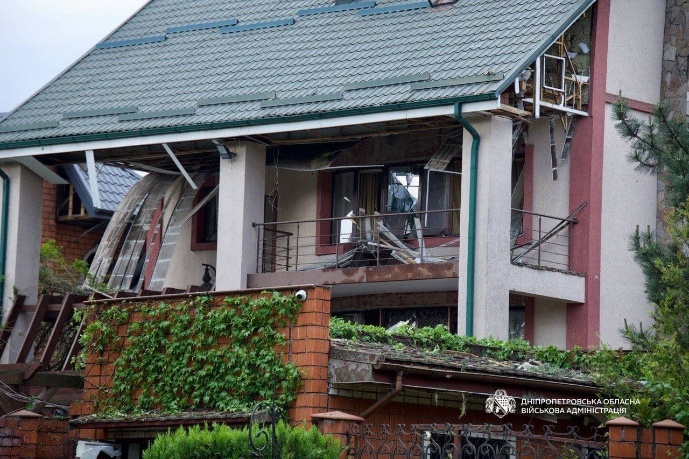
House damaged following a Russian attack on Dnipropetrovsk Oblast, Ukraine. (Local authorities/Telegram)
Zelensky confirmed that over the week spanning roughly May 10–17, Russia launched more than 3,170 long-range strike drones, 74 missiles, and over 1,300 guided aerial bombs against Ukraine, killing 52 people and injuring 346 including 22 children. He stated that Ukrainian forces conducted more “active operations” than Russian forces over the May 16–17 24-hour period.
Russia’s Banking System in IMF-Defined Systemic Crisis
Ukraine’s Foreign Intelligence Service (SZRU) released an assessment on May 17 based on an internal report by Russia’s government-linked Center for Macroeconomic Analysis and Short-Term Forecasting (CMACP), confirming that the share of non-performing and toxic assets in Russia’s banking system has exceeded 10 percent of total holdings for the third consecutive month — the IMF threshold that defines a systemic banking crisis. The CMACP acknowledged the crisis has a “latent character”: because Russia’s banking sector is dominated by state-backed institutions such as Sberbank and VTB, regulators have been able to conceal the structural decay by aggressively masking defaults and forcing artificial restructuring of non-performing corporate loans. This prevents retail panics but transfers the liability directly to the federal budget, which is already running at 150 percent of its planned 2026 deficit.
Nearly 50 percent of all registered Russian enterprises cited severe payment delays from corporate partners as their single greatest existential threat heading into mid-2026, per the same CMACP report. The chain reaction of unpaid invoices between contractors has created a massive backlog of default risks that local banks are absorbing only through state intervention. The Kremlin has been attempting in peace negotiations to secure access to SWIFT’s global banking network as part of any ceasefire deal, which Zelensky has repeatedly warned would provide Moscow with the liquidity to stabilize its internal defaults and extend the war.
Peskov: Open to Dialogue with Europe; Milbloggers Demand Air Defense Reform
Kremlin spokesperson Peskov stated on May 17, in the immediate aftermath of the Moscow strike, that Russia is open to restarting dialogue with European capitals over the war. “The active discussion of this topic — the shift toward understanding that at some point they will have to speak with the Russians — is good,” Peskov said. He simultaneously dismissed EU foreign policy chief Kaja Kallas as unsuitable for any negotiations, citing Putin’s condition that mediators not have “said too many bad things” about Russia. Estonian FM Tsakhna, speaking at a security conference in Tallinn on May 16, had warned allies not to engage in negotiations with Moscow, arguing Russia would use talks to buy time.
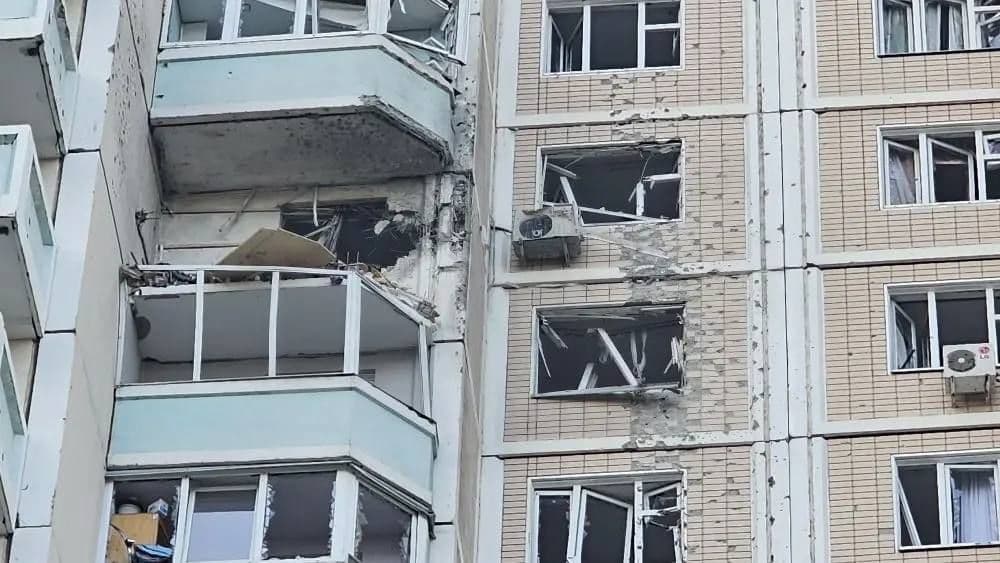
Imagery released by Russian authorities that purports to show damage following a drone attack in the Moscow region overnight. (Andrey Vorobyov/Telegram)
Russian ultranationalist milbloggers responded to the Moscow strike by cataloguing specific air defense failures in Moscow Oblast, calling for Russia to establish a multi-echeloned and unified drone interdiction network around the capital with an early-warning layer, noting Ukraine’s expanding long-range strike capability and the inability of existing systems to counter it. Some milbloggers called for retaliatory strikes including tactical nuclear weapons. State television devoted approximately one minute to the strike, mentioning only the civilian impact and describing unnamed “retaliatory strikes” against Ukraine with no specifics. Peskov’s nuclear reference — “Russia still cannot be threatened as a nuclear power” — was assessed by ISW as an attempt to manage public expectations rather than signal an actual nuclear posture change.
Belarus Relay Points Used for May 13–14 Kyiv Strike; Beschastnov Warning
Ukrainian MoD defense technology advisor Beskrestnov reported on May 17 that Russian forces may have used Belarus to deploy Shahed drone radio control relay points during the May 13–14 large-scale strike packages against Kyiv. The relays extended the operational range and guidance accuracy of drones transiting Belarusian airspace corridors. Beskrestnov noted that Ukrainian countermeasures had prevented this specific Belarusian relay tactic at the end of Winter 2025–2026, and that Russia appears to have adapted around those countermeasures. The development confirms that Belarusian territory is being used not only as passive airspace transit but as an active electronic support infrastructure for Russian strikes on Ukrainian cities.
Frontline: Russian Advance Near Hulyaipole; Velykyi Burluk Direction Consolidated
Russian forces recently advanced west of Myrne southwest of Hulyaipole, confirmed by geolocated footage published on May 16. Russian forces continued offensive operations in the Hulyaipole direction on May 17. Ukrainian Joint Forces Spokesperson Trehubov reported on May 17 that Russian forces in the Velykyi Burluk direction have been withdrawing in some areas and do not hold much ground in the area, following the Ukrainian liberation of Odradne (22 square kilometers seized in the direction by Ukrainian forces per the Ukrainian 16th Army Corps).
In the Kupyansk direction, Russian forces continued limited attacks without confirmed advances; Trehubov noted that Russian forces’ own false claims of seizing Kupyansk are now forcing their commanders to keep attacking toward the city for informational effect rather than strategic necessity. In the Slovyansk direction, a Ukrainian brigade officer reported that Russian forces began intensifying ground assaults around May 16, using Molniya-2 drones (which carry smaller FPV drones), guided glide bombs, fiber-optic drones, and ambush drones at different ranges. The Rubikon Center for Advanced Unmanned Systems personnel are operating in the direction. Russian forces conducted infiltration missions northeast of Slovyansk at Rai-Oleksandrivka. In the Pokrovsk direction, the Russian 83rd Separate VDV Brigade was identified from footage published by the Russian MoD as operating in the direction — likely redeployed from northern Sumy Oblast where it was last observed April 23.
Ukrainian mid-range and short-range strikes on May 16–17: command post of the 103rd Motorized Rifle Regiment (150th MRD, 8th CAA) near occupied Buhne, Donetsk Oblast (67 km); a fuel and lubricants supply train in occupied Fedorivka, Donetsk Oblast (138 km); commanders of the 2nd Sapper-Engineer Battalion (91st Engineer-Sapper Regiment, Northern Grouping) at a meeting in occupied Shakhtarsk (104 km); command post of the 9th Separate Motorized Rifle Brigade (51st CAA) in Pokrovsk; a drone control point near Dvorichna (on the frontline, Kupyansk direction); a Tor-M2 air defense system southeast of occupied Zakhidne, Luhansk Oblast (103 km); telecommunications towers and port cranes at Berdyansk (97 km); a missile and drone storage point near occupied Shchaslyvtseve, Kherson Oblast (190 km); a manpower concentration near Krasnohirske, Oleksandrivka direction; a personnel concentration near Volfinsky, Kursk Oblast. Order of Battle: the Russian 1st Guards Engineer Brigade (Northern Grouping of Forces) was observed in Kursk Oblast for the first time.
Cuba Seeking Russian Drones; Discussing Attacks on U.S. Guantanamo and Key West
Axios reported on May 17, citing unnamed U.S. officials, that Cuba has sought to acquire drones and other military equipment from Russia within the past month and is discussing plans to attack the U.S. military base at Guantanamo Bay, targets in Key West, and U.S. military vessels. Cuban officials have also been studying how Iran resisted U.S. military pressure. Cuba has already purchased over 300 Russian and Iranian drones of varying capabilities, stored across the country. Cuba has contributed approximately 5,000 soldiers to Russia’s war against Ukraine. CIA Director Ratcliffe visited Cuba on May 14 and warned Havana against serving as a platform for adversaries and against military escalation. A CIA official: “Director Ratcliffe made clear that Cuba can no longer serve as a platform for adversaries to advance hostile agendas in our hemisphere.” The U.S. is not currently assessed to view Cuba as a serious conventional military threat — “No one’s worried about fighter jets from Cuba” — but the intelligence may be used as a pretext for military action against Cuba given the presence of Iranian military advisors in Havana. The DOJ is expected to unseal an indictment against Raul Castro over the 1996 downing of civilian planes.
POW Exchange Next Phases Underway; Zelensky Weekly War Summary
Zelensky confirmed on May 16 that Ukrainian inter-agency working groups are preparing subsequent verification lists for the next phases of the 1,000-for-1,000 prisoner exchange, following the first phase return of 205 POWs on May 15. The Coordination Headquarters confirmed that a significant majority of the 205 returned personnel require immediate long-term psychological and physical therapy; many showed severe muscle atrophy, untreated shrapnel wounds from the siege of Mariupol, and indicators of systemic malnutrition. All 205 had ICRC validation prior to the exchange. Ukraine has conducted 74 formal prisoner exchanges since February 24, 2022, per Ombudsman Lubinets.
The Weight of May 17
Ukrainian drones struck inside Moscow’s most heavily defended perimeter: the semiconductor plant that makes chips for Russian missiles, the oil refinery that fuels Russian forces, two fuel pumping stations, and a fire on the runway of Sheremetyevo. The Kremlin’s state television covered it for one minute. Peskov said Russia cannot be threatened as a nuclear power. Milbloggers said Russia’s air defenses are failing.
Two men in Sumy Oblast found a downed drone in a field, loaded it into their car, and were killed when its submunition detonated. A 70-year-old woman in Dnipro is in critical condition. Russia launched 287 drones. Ukraine shot down 279. Russia’s banking system has been in IMF-defined crisis for three months.
Zelensky said Ukraine’s long-range strikes will expand in distance and frequency. Peskov said Russia is open to dialogue with Europe. Russia’s own analysts say its banking system is in latent systemic crisis. Putin leaves for Beijing in two days.
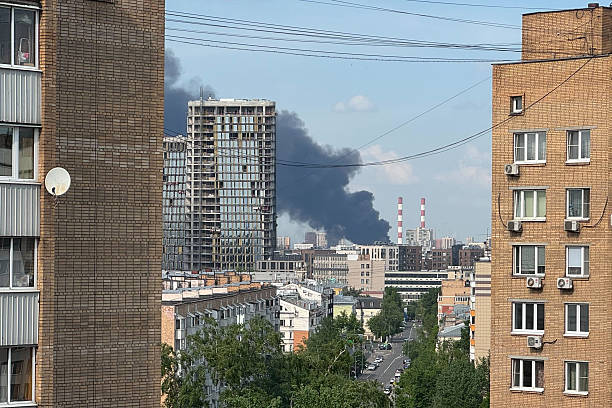
A major fire is seen emanating from what appears to be the Moscow Oil Refinery following a Ukrainian strike on the Russian capital by Ukrainian drones. (André Ballin/picture alliance via Getty Images)
A Prayer for Ukraine
1. For the Two Men in Sumy Oblast
Lord, two men aged 45 and 47 found the wreckage of a downed Russian drone in a rural area on Sunday morning. They did not know what it contained. They loaded it into their car. The submunition inside detonated and killed them both instantly. They were not soldiers. They were men in a field on a Sunday. Receive them. Hold their families. And let their deaths be the last time a Ukrainian civilian does not know that a downed drone is still a weapon.
2. For the 70-Year-Old Woman in Dnipro
Father, a drone struck a residential neighborhood in the city of Dnipro on Saturday night and fire consumed a single-family home. A 70-year-old woman was pulled from the burning wreckage. She is in an intensive care unit in critical condition. We pray for her by the fact of her age and her survival and the people who went in to find her. And we pray for the emergency workers in Dnipropetrovsk Oblast who responded to 30-plus strikes across four districts in a single night.
3. For the 52 Killed in One Week
God of the dead, Zelensky confirmed 52 civilians killed in the seven days between May 10 and 17. Three hundred and forty-six injured. Twenty-two children among the wounded. Most of the strikes hit residential buildings and other civilian infrastructure. Fifty-two people in one week. Receive each of them. And hold the 346 who survived with wounds they will carry forward.
4. For the 205 Returning Home
Lord, the 205 POWs who crossed the border on May 15 are now in medical centers. Most have been in Russian custody for four years. Many have muscle atrophy. Many have untreated shrapnel wounds from Mariupol. Many have signs of systemic malnutrition. They survived the detention, the crossing, the diagnostic process. Now they must survive the return. Give their doctors clarity, their families patience, and each of those 205 people the mercy of a night of sleep in a safe room. And let the next phases of the exchange proceed.
5. For the City Under Its Own Defenses
God of justice, Ukrainian drones struck a semiconductor plant 500 kilometers inside Russia’s most defended territory. State television covered it for one minute. Peskov reached for the nuclear card. Milbloggers demanded that Russia fix its air defenses. Moscow’s runway burned at 3 a.m. We do not pray for anyone’s destruction. We pray that the cost Russia is paying — in oil revenue, in refinery capacity, in chips for precision weapons, in chips for drones, in fuel for its armies — accumulates to a number that changes a calculation in the Kremlin. That the long-range sanctions work. That the war ends before 52 more civilians die in the next week. In Your mercy, in Your justice, in Your time.