
Ukraine Daily Briefing | May 19, 2026 | Day 1,546 of the Full-Scale Invasion
Prepared by Dayana Bozhyk
Russia announced surprise strategic nuclear exercises involving 64,000 personnel, 200+ missile launchers, 8 ballistic missile submarines, and every leg of its nuclear triad — the largest such exercise since the Cold War — which ISW assessed as a cognitive warfare effort to mask mounting battlefield failures. A Romanian NATO jet shot down a suspected Ukrainian drone over Estonia for the first time, Ukraine apologized, and Russia’s SVR threatened to strike Latvian government buildings. Ukraine killed five civilians including a 15-year-old in Pryluky, Chernihiv Oblast.

A funeral service for sisters Liubava and Vira Yakovlev, who were killed in a Russian missile strike on Kyiv that resulted in the deaths of 24 people, takes place at St. Michael’s Golden-Domed Monastery in Kyiv, Ukraine. Their father, Ukrainian serviceman Yevhen Yakovlev, was killed in action in 2023. (Maxym Marusenko/NurPhoto via Getty Images)
The Day’s Reckoning
The Russian Defense Ministry announced at 9 a.m. on May 19 that Russia had launched massive strategic nuclear exercises — without prior warning, weeks earlier than its annual Grom exercises, and on the same day Putin arrived in Beijing. Sixty-four thousand personnel. Over 200 missile launchers. Thirteen submarines including eight strategic ballistic missile submarines. Long-range aviation, the Northern and Pacific fleets, the Strategic Missile Forces, and elements of the Leningrad and Central Military Districts. Every leg of the nuclear triad. The stated purpose: practicing “preparation and use of nuclear force in response to a threat of aggression.”
ISW’s assessment was unambiguous: the timing is designed to project strength at exactly the moment that Ukraine’s expanding long-range strike campaign has demonstrated Russia cannot defend its own capital, its refineries, or its semiconductor plants. Russian forces have failed to make meaningful gains in their spring-summer 2026 offensive. Ukraine has contested the tactical initiative in multiple sectors. The Russian deep rear is burning. The nuclear exercises are a performance staged for Western audiences, timed to coincide with the Beijing summit, and designed to divide Ukraine from its European partners.
While Russia was practicing nuclear launches, Ukraine was conducting real strikes. The Lukoil-Nizhegorodnefteorgsintez refinery in Kstovo, Nizhny Novgorod Oblast — one of Russia’s largest, 17 million tons per year — was confirmed struck overnight May 18–19. The Yaroslavl-3 oil pumping station near Semibratovo was struck and confirmed by satellite heat data. Naftogaz’s gas infrastructure in Chernihiv Oblast was struck for the third consecutive day. And satellite imagery confirmed the May 17 strike on the Solnechnogorsk pumping station destroyed four RVS-5000 tanks, while the May 15 strike on the Ryazan refinery damaged more than half of its oil refining facilities.
Russia answered with a ballistic missile strike on Pryluky, Chernihiv Oblast at 10 a.m. — hitting near a shopping center in the city center and killing three people, including a 15-year-old boy who died in hospital from his injuries. Drones killed two men in Hlukhiv, Sumy Oblast. By day’s end, five civilians were dead, 33 injured. And over Estonia, for the first time in history, a NATO fighter jet — a Romanian F-16 on Baltic Air Policing duty — shot down a suspected Ukrainian drone that had been diverted from Russian airspace by Russian electronic warfare. Ukraine apologized. Russia’s intelligence service used the incident to threaten to strike Latvia’s capital.
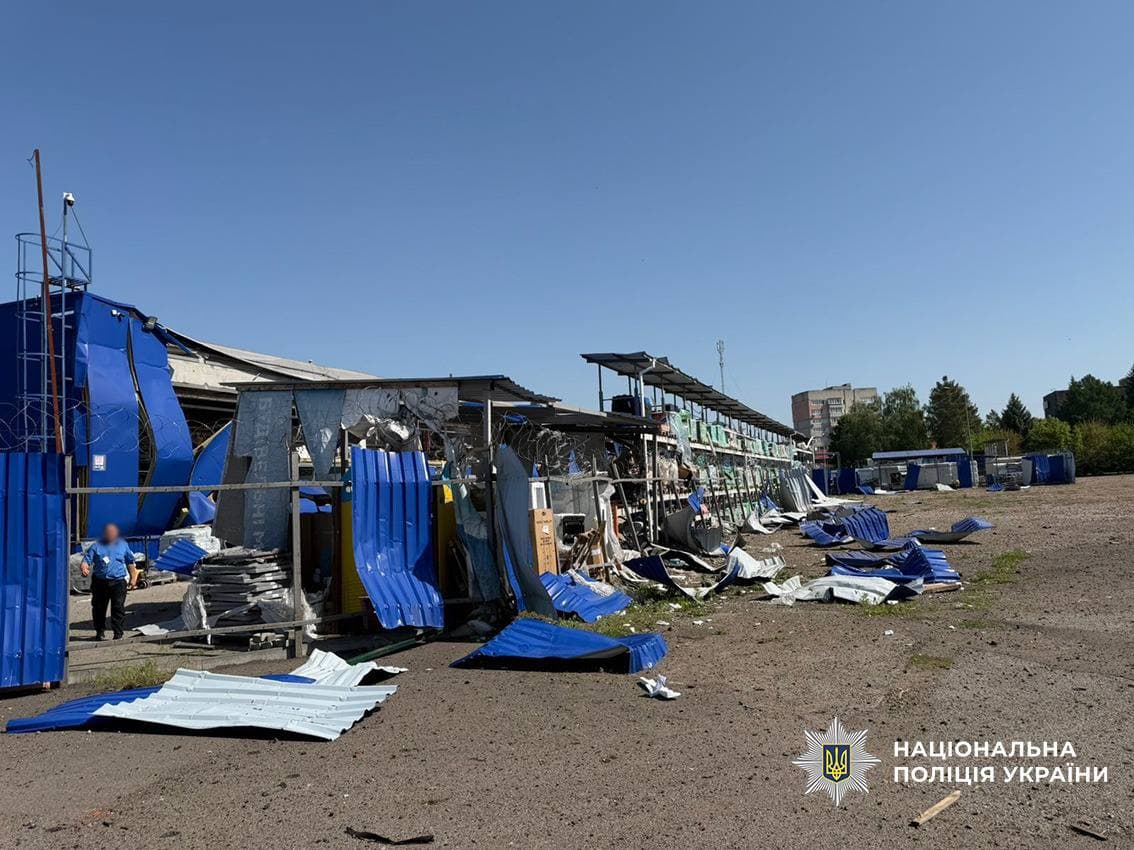
A commercial site damaged by a Russian ballistic missile strike in Pryluky, Chernihiv Oblast. (National Police of Ukraine)
Russia’s Strategic Nuclear Exercise: Scale, Timing, and ISW’s Assessment
The Russian Ministry of Defense announced on May 19 that Strategic Missile Forces, the Northern and Pacific Fleets, Long Range Aviation Command, and elements of the Leningrad and Central Military Districts are conducting a strategic nuclear exercise from May 19 to 21. The exercise involves over 64,000 personnel, over 7,800 pieces of military equipment, more than 200 missile launchers, more than 140 aircraft, 73 surface ships, and 13 submarines including 8 strategic missile submarines. Exercises include launches of ballistic and cruise missiles at ranges within Russia and joint Russian-Belarusian operations with Russian nuclear weapons deployed in Belarus. BBC Russia’s Service, citing the Bulletin of Atomic Scientists, assessed the exercise will likely involve the majority of Russia’s estimated 320 nuclear-capable ICBM launchers.
Russia did not announce the exercise in advance — a marked departure from standard practice. Russia typically conducts its annual Grom nuclear exercises in October; this exercise launched six months early. Russian forces last conducted surprise nuclear exercises in Summer 2024, focused on tactical nuclear weapons, at a moment when Western governments were debating whether to provide long-range weapons to Ukraine. ISW assessed that the exercise is designed to posture strength against NATO decision-making and to distract from: Russia’s failure to make meaningful gains in its spring-summer 2026 offensive; Ukraine’s successful demonstration that even Moscow’s air defenses can be penetrated; and Russia’s inability to defend its own industrial rear. Russian Deputy FM Ryabkov amplified the message: Russia and NATO are “increasingly likely” to have a direct clash with “catastrophic consequences.” NATO’s Supreme Commander in Europe Grynkewich: “They know that we are not a threat to Russia. If they thought we were a threat to Russia, they wouldn’t have emptied the Leningrad Military District to go and invade Ukraine.”
SVR Threatens Latvia; Estonia NATO First: The Baltic Airspace Crisis Deepens
Russia’s Foreign Intelligence Service (SVR) published a statement on May 19 making unfounded accusations that Ukrainian drone operators have deployed to Latvian military bases to launch strikes against Russia, and then issued an explicit threat: “It would be useful to remind that the coordinates of decision-making centers on Latvian territory are well known.” The SVR added: “Latvia’s membership in NATO will not protect terrorist accomplices from fair retribution.” Latvian FM Braze: “Latvia does NOT provide airspace for attacks on Russia. That has been explained several times to Russian representatives.” Ukrainian MFA Spokesperson Tykhyi: “Russian lies are merely an extension of its broader propaganda campaign aimed at destabilizing public opinion in Latvia and the wider Baltics.” ISW assessed the SVR’s claim is a continuation of Russian efforts to set informational conditions to justify potential military operations against Baltic or Finnish territory.
On the same day, Estonia’s Defense Ministry confirmed that for the first time in history, a NATO Baltic Air Policing fighter jet — a Romanian F-16 participating in the Baltic Air Policing mission — shot down a suspected Ukrainian drone over southern Estonia (Lake Võrtsjärv). The drone was likely of Ukrainian origin and appeared to be heading toward targets in Russia. Estonia issued an EE-ALARM national alert across six southern counties. NATO Baltic Air Policing jets were scrambled. Latvia simultaneously issued a drone alert covering multiple eastern municipalities. The drone was downed before crashing in a field with no casualties. Ukrainian FM Spokesperson Tykhyi apologized directly: “We apologize to Estonia and all of our Baltic friends for such unintended incidents.” Ukrainian FM Spokesperson also confirmed Russia continues to redirect Ukrainian drones into NATO airspace using electronic warfare systems. Estonian Defense Minister Pevkur confirmed he spoke directly with Ukrainian Defense Minister Fedorov, who “apologized that such an incident had happened.”
Romania scrambled two F-16 jets from the 86th Air Base in Fetesti overnight after Russian drones struck Ukrainian infrastructure in Izmail near the Romanian border, with radar tracking the attack. No Romanian airspace violation was detected but the jets remained on patrol. Latvia suspended rail traffic in affected regions during its alert. ISW previously observed reports of Ukrainian drones crashing in Baltic and Finnish territory as a result of Russian EW — and assessed Russia is deliberately engineering these incidents to create the political conditions to justify future action against Baltic states. European Commission spokesperson Regnier called the incidents an argument for the EU’s proposed drone defense initiative and air shield.
Five Killed in Pryluky and Hlukhiv; 209 Drones Overnight
At approximately 10 a.m. on May 19, a Russian Iskander-M ballistic missile struck near a business in the center of Pryluky, Chernihiv Oblast. Three people were confirmed killed, including a 15-year-old boy who died in hospital. At least 29 were injured. Shopping centers, shops, pharmacies, educational facilities, apartment buildings, private homes, and more than 30 vehicles were damaged. A fire broke out in a warehouse; firefighters extinguished it. Separately, Russian forces struck the Hlukhiv community in Sumy Oblast with two drones at approximately 10 a.m., killing two men aged 52 and 58 and injuring four others, including two women. Administrative buildings and apartment blocks in Hlukhiv city were damaged.
Overnight May 18–19, Russia launched 209 Shahed, Gerbera, Italmas, and Parodiya drones from Oryol, Kursk, Bryansk, Millerovo, Shatalovo, Primorsko-Akhtarsk, occupied Hvardiiske, and occupied Donetsk City. Ukrainian forces downed 180 drones; 27 struck 15 locations; debris fell on 5 more. Strikes hit port, residential, and energy infrastructure in Chernihiv, Dnipropetrovsk, Kharkiv, Odesa, and Sumy oblasts. Overall May 19 casualties: two killed and 14 injured in Kherson Oblast; two killed and 12 injured including a child in Kharkiv Oblast; two killed in Donetsk Oblast (Kramatorsk and Druzhkivka) and three injured; one injured in Dnipropetrovsk Oblast; two injured in Sumy Oblast across nearly 110 attacks on 45 settlements; three injured including an 84-year-old woman in Chernihiv Oblast; 858 strikes across 47 settlements in Zaporizhzhia Oblast (no casualties). Russia struck a Naftogaz gas infrastructure facility in Chernihiv Oblast for the third consecutive day, damaging “critically important equipment” and forcing personnel evacuation.
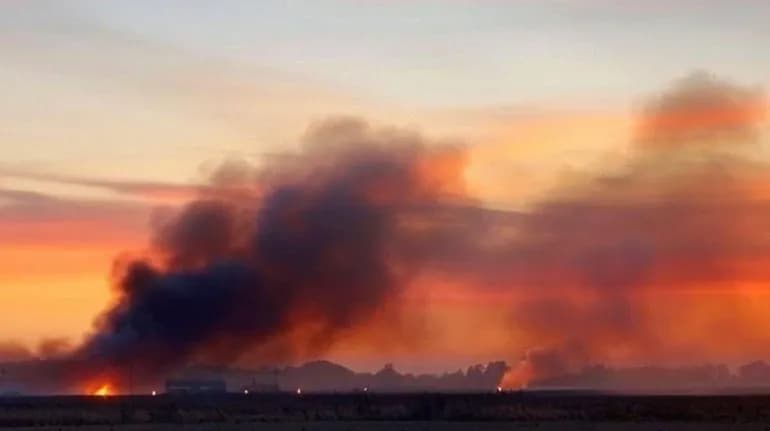
Smoke rises from a fire following a Russian drone strike on gas infrastructure facilities in Chernihiv Oblast. (Naftogaz)
Overnight, a Russian drone struck a multi-story residential building in Konotop, Sumy Oblast, partially collapsing the structure. Mayor Artem Semenikhin confirmed the strike and said: “Behind me is a multi-story building. Part of it is gone. And there are people there.” At least six people were injured; emergency crews conducted search-and-rescue operations for residents feared trapped in debris. Due to a shortage of ambulances, the injured were transported in civilian vehicles. The district hospital suffered blown-out windows. Administrative buildings, private homes, and apartments across the city were damaged. The mayor confirmed the city’s local museum was completely destroyed by the strike.
Ukraine Strikes Yaroslavl, Nizhny Novgorod, and Confirms Solnechnogorsk BDA
The Ukrainian General Staff confirmed on May 19 that Ukrainian forces struck the Yaroslavl-3 oil pumping station near Semibratovo, Yaroslavl Oblast, overnight. NASA FIRMS satellite heat data confirmed a fire near the Yaroslavl oil refinery; footage published May 19 shows smoke from the facility. Yaroslavl Governor Evrayev acknowledged the strike; State Duma Defense Committee member Kolesnik confirmed it. The General Staff also confirmed that Ukrainian forces struck the Lukoil-Nizhegorodnefteorgsintez refinery in Kstovo, Nizhny Novgorod Oblast, overnight May 18–19, causing a fire. The refinery processes approximately 17 million tons of crude annually, producing gasoline, diesel, and aviation fuel for Russian armed forces.
Satellite imagery captured May 18 provided updated BDA for previous strikes: the May 17 strike on the Solnechnogorsk pumping station in Moscow Oblast destroyed four RVS-5000 oil storage tanks. Satellite imagery of the Ryazan oil refinery confirmed that the May 15 Ukrainian strike damaged several ELOU-AVT-3, ELOU-AVT-6, and AVT-1 technological overpasses and one oil storage tank — assessed by a Ukrainian OSINT analyst as damage to over half the refinery’s oil refining facilities. Reuters reported on May 19 that the Moscow Oil Refinery temporarily halted processing operations following the May 17 strike, with two industry sources confirming Gazpromneft halted production to mitigate risk. The refinery processed 11.6 million metric tons of crude in 2024. Ukrainian Sanctions Commissioner Vlasyuk had already estimated damage from the Solnechnogorsk May 17 strike alone at $30 million.
China Secretly Trained 200 Russian Military Personnel in 2025; PLA-Russia Agreement
Reuters reported on May 19, citing three European intelligence agencies and internal documents, that the Chinese People’s Liberation Army secretly trained approximately 200 Russian military personnel at facilities in Beijing, Nanjing, Shijiazhuang, and Zhengzhou in late 2025 under a bilateral agreement signed on July 2, 2025. Training courses covered drone operations including FPV, mortar fire with drone reconnaissance support, counter-drone electronic warfare, army aviation, armored infantry tactics, explosive handling, demining, and counter-drone net-launching systems. Multiple trained Russian personnel had ranks sufficient to disseminate lessons down the chain of command. At least a handful of those trained in China have since deployed to operations in occupied Crimea and Zaporizhzhia Oblast, per one European intelligence agency. The agreement also included several hundred PLA personnel training in Russia. Both sides agreed not to inform third parties.
China’s Foreign Ministry denied the report: “China’s position on the Ukraine crisis is very clear. We support all efforts for peace.” One intelligence official told Reuters the agreement shows Beijing is more directly involved in the Ukraine war than it publicly admits. The report arrived on the day of Putin’s state visit to Beijing. China has been Russia’s primary economic lifeline since 2022, supplying dual-use goods and purchasing sanctioned Russian oil. Chinese firms have continued contributing to Russia’s long-range drone production, per ISW and Bloomberg. Xi Jinping told Trump during the May 13–15 Beijing summit that Putin may ultimately “regret” launching the war, according to the Financial Times — a remark Xi had not made in previous conversations with Biden. The Trump-Xi talks also reportedly included a controversial U.S. proposal for the U.S., China, and Russia to align against the ICC, which the White House declined to confirm or deny.
Putin in Beijing; Russia’s Contract Recruitment Falls Below Monthly Quota
Putin arrived in Beijing on May 19 for a two-day state visit at Xi Jinping’s invitation, immediately following Trump’s May 13–15 summit in the Chinese capital. The visit marks the 25th anniversary of the 2001 Sino-Russian Treaty. Putin’s delegation includes senior ministers and top business executives; talks will focus on bilateral ties, energy, and global issues. Putin will push the long-stalled Power of Siberia 2 pipeline, though Beijing holds the leverage as Russia faces Western sanctions and shrinking markets. Xi’s Trump meeting had underscored that Beijing is managing ties with both Washington and Moscow, and Putin’s key agenda item is gauging how much Russia’s relationship with China survived the Trump-Xi summit intact. The visit is the backdrop against which Russia simultaneously launched its nuclear exercise and Ukraine struck two more Russian oil facilities.
Ukraine’s Foreign Intelligence Service reported that Russian MoD concluded only 70,500 military service contracts in the entire first quarter of 2026 — below its own monthly quota of 33,500–34,600 contracts. Average daily recruitment: 800–930 servicemembers, compared to 1,200 per day in Q1 2025. More than 40 Russian federal subjects are raising enlistment bonuses by 30–500 percent compared to end of 2025. Russia’s prison population has fallen from 465,000 at end of 2021 to 282,000 in May 2026 as Russia recruits through the federal penitentiary system. A Russian Communist Party State Duma deputy, Renat Suleimanov, made what Agentstvo described as likely the first such public statement by a sitting Duma member: “The economy will not withstand a prolonged continuation of the special military operation.” He cited 40 percent of the federal budget going to defense and security. Russian military hospitals are overflowing with wounded; civilian hospitals, maternity wards, and a cystic fibrosis clinic in Moscow have been repurposed for military use. Novaya Gazeta Europe: “They don’t talk much about the SMO patients because there are so many of them.”
Syrsky: Ukraine Conducts More Assaults Than Russia for First Time; Two-Month Rotation
Commander-in-Chief Syrsky stated in a Militarnyi interview published May 19 that Ukraine has, for the first time, conducted more daily assault operations than Russian forces — signaling a shift in battlefield initiative. He confirmed Ukraine has the capacity for a two-month troop rotation in three shifts and set the 15th of each month as the internal monitoring deadline. Syrsky said demobilization is likely to be introduced when the war ends, not during it. “After 12 and a half years of war, there is nothing to motivate such numbers of people to volunteer — mobilization remains unavoidable,” Syrsky said, echoing Budanov’s May 15 interview. Ukraine’s Presidential Office stated it believes Moscow may announce nationwide mobilization after upcoming State Duma elections. Syrsky also warned of a major Russian grouping near Pokrovsk and a possible northern offensive from Belarus.
UK Issues Russian LNG and Refined Oil Licenses; G7 Reaffirms Sanctions
The United Kingdom quietly issued two new licenses on May 19: one permitting imports of diesel and jet fuel processed from Russian oil in third countries (effective May 20, indefinite); and a second permitting maritime transport of Russian LNG from Sakhalin-2 and Yamal terminals (expires January 1, 2027). The move came one day after the U.S. renewed its own Russian oil waiver for the third time. John Foreman, former UK defense attaché to both Kyiv and Moscow: “It is hard to pose as the leader of the ‘coalition of the willing’ when doing dirty deals.” Sanctions campaigner Alexander Kirk: “Celebrations will be happening in the Kremlin today.” UK’s energy ministry cited the Strait of Hormuz closure and fuel price stabilization.
The G7 finance ministers’ communiqué, published the same day, reaffirmed commitment to pressure on Russia including energy sector sanctions and “actions against entities in third countries that materially support Russia’s war effort.” Ukrainian Finance Minister Marchenko, speaking at the G7 finance meeting in Paris, called for $43 billion in external financing for 2027 and $95 billion total for 2026–27, and asked partners to establish a mechanism to use frozen Russian assets for Ukraine’s energy sector. The G7 communiqué was published the same day the UK issued licenses for Russian oil — a contradiction that Urgewald’s Kirk described as “the political message of weakness that Moscow will read.”
Ukraine’s Economy Improved in April; Czech Refugees Review; Hungary Reset
Ukrainian Prime Minister Svyrydenko reported that GDP contracted only 0.2 percent in the first four months of 2026 — significantly better than projected — with recovery beginning in March. Domestic trade, manufacturing, food industry, and the defense industry are driving growth, some rising more than 10 percent. The NBU’s growth forecast remains 1.3 percent for 2026; ICU forecasts 0.8 percent; IMF forecasts 2 percent. Inflation rose to 8.6 percent in April driven by fuel and logistics costs. The Czech Interior Ministry proposed legal changes on May 18 that would restrict temporary protection benefits for Ukrainian refugees, including a requirement to remain economically active and not leave Schengen for more than 30 days. The Council of Europe Human Rights Commissioner warned against a “protection gap.”
Zelensky stated after a meeting with FM Sybiha that Ukraine sees prospects for a “constructive reset” in relations with Hungary under PM Magyar. Ukrainian officials are preparing bilateral consultations with Budapest as Kyiv pushes to open all six EU accession clusters by May 26. Hungary’s new FM Anita Orbán confirmed Budapest’s conditions for the relationship: resolution of Hungarian minority rights in Zakarpattia, conditions on EU accession path, no weapons to Ukraine. NABU and SAPO widened the Supreme Court bribery investigation on May 19, adding three sitting judges and one retired judge allegedly paid to issue a favorable ruling in a corporate dispute involving oligarch Kostyantyn Zhevago (Finance and Credit Bank, Ferrexpo). U.S. Vice President Vance clarified that Russia taking possession of Iran’s enriched uranium is “not currently our plan” but refused to rule it out.
Frontline: Ukrainian Advances in Hulyaipole and Kupyansk; Vovchansk Positions Confirmed
Ukrainian forces recently advanced in northern Zelene northwest of Hulyaipole, confirmed by geolocated footage published May 18. In the Kupyansk direction, geolocated footage published May 18 shows Ukrainian forces striking a Russian position in central Kurylivka after an ISW-assessed Russian infiltration mission. Ukrainian forces maintain positions in southern Synelnykove and western Lyman northeast of Kharkiv City and south of Vovchansk, confirmed by geolocated footage from May 19 — indicating Russian forces infiltrated around rather than through those positions. Russian forces conducted a flag-raising in southern Volokhivka northeast of Kharkiv; ISW assessed this as part of Russia’s cognitive warfare flag-raising campaign, not a confirmed settlement seizure. In the Borova direction, a Kremlin-affiliated milblogger acknowledged on May 19 that May 18 footage purporting to show Russian forces in Borova was fake — the second such admission in consecutive days.
In the Kostyantynivka-Druzhkivka area, geolocated footage published May 18 confirmed Russian forces struck Ukrainian positions in northeastern and southern Molocharka (north of Kostyantynivka) after an assessed Russian infiltration mission. A Ukrainian brigade reported Russian forces are accumulating assault groups and conducting nighttime logistics near Chasiv Yar, setting conditions for future offensive operations northeast of Kostyantynivka. A FAB-300 strike was confirmed against a dam near Kostyantynivka. Russian forces continued offensive operations in Slovyansk, Dobropillya, Pokrovsk, Novopavlivka, and Oleksandrivka directions without confirmed advances. In the Lyman direction, a Ukrainian battalion commander reported Russian forces are intensifying Molniya drone ambushes to complicate Ukrainian logistics; a brigade spokesperson described the mix of Russian forces: well-trained infantry for special tasks, former convicts with minimal equipment, and mules for cargo. In western Zaporizhzhia Oblast, Russian forces continued limited assaults. Drone control point strikes May 18–19: near Oleksandrivka, Kherson Oblast (115 km); near Kamyanske, Zaporizhzhia Oblast (3 km); Bilovody, Kupyansk direction (4.5 km from front); command and observation post near Tetkino, Kursk Oblast.
Rubikon Center update: Radio Free Europe’s Pahulych reported that Rubikon operators are equipping FPV drones with both daytime and thermal imaging cameras to increase nighttime strike effectiveness; using sleeper drones alongside strike FPVs to target Ukrainian servicemembers who emerge after an initial strike; posting FPV drone strikes on Ukrainian radio communications deep in the Ukrainian rear; using FPV drones for airstrike target acquisition as Ukrainian drone interceptors prevent Russian reconnaissance drones from fulfilling this role; and beginning to intercept Ukrainian long-range strike drones — a development that may constrain Ukraine’s deep strike campaign if it scales.
April 2026: UN Counts 238 Civilian Deaths — Deadliest Month Since July 2025
The UN Human Rights Monitoring Mission in Ukraine reported that at least 238 civilians were killed and 1,404 injured in Ukraine in April 2026 — the deadliest month for civilians since July 2025 and an 18 percent increase from April 2025. The primary driver: Russian long-range drone and missile attacks, which accounted for 43 percent of casualties with victims concentrated in cities far from the front. Short-range drones alone killed 80 civilians and injured 481 — the highest monthly toll from this weapon system since the invasion began. Artillery, rocket attacks, and aerial bombardments near the front accounted for 54 percent of victims. The cities with the highest counts in April: Kherson, Dnipro, Nikopol, and Odesa. The report was presented at a UN Security Council session on May 19. UN officials stated that 15,855 civilians have been confirmed killed including 791 children since February 2022; 44,809 injured including 2,752 children; actual toll is likely significantly higher.
The Weight of May 19
Russia announced the largest nuclear exercises since the Cold War. ISW said it was a performance. Ukraine struck two more refineries. A 15-year-old boy died in Pryluky from a ballistic missile that hit a shopping area at 10 a.m. A NATO jet shot down a Ukrainian drone over Estonia. Russia threatened to bomb Latvia’s government buildings.
China secretly trained 200 Russian soldiers in Beijing, Nanjing, Shijiazhuang, and Zhengzhou in late 2025. Some of them are now fighting in Ukraine. Russia’s contract recruitment fell below its own monthly quota for the entire first quarter. A Duma deputy said the economy will not survive a prolonged war. Maternity wards are being converted into military hospitals.
Ukraine conducted more daily assaults than Russia for the first time. The UK issued licenses for Russian oil and LNG on the same day the G7 reaffirmed energy sanctions. The UN counted 238 Ukrainian civilians killed in April — the deadliest month in almost a year.
A Prayer for Ukraine
1. For the 15-Year-Old in Pryluky
Lord, a Russian missile struck near a shopping area in Pryluky, Chernihiv Oblast, at 10 a.m. on a Monday in May. A 15-year-old boy was taken to hospital with injuries he did not survive. Two other people died at the scene. Twenty-nine were injured. There is nothing additional to say about a missile that kills a 15-year-old on a Monday morning in a city that was going about its day. Receive him. Hold his family. Hold the 29 who are injured. And hold the city of Pryluky, which will carry this particular Monday for a long time.
2. For the Two Men in Hlukhiv
Father, two men aged 52 and 58 were killed in drone strikes on Hlukhiv, Sumy Oblast, at approximately the same hour as the missile hit Pryluky. Four others were injured including two women. Hlukhiv is a city of 30,000 people near the Russian border; it has been struck many times. These two men were not its first dead, and they will not be its last. Receive them. Hold the four who are injured. And hold the city that is struck so frequently that its name no longer registers as a headline anywhere except in the homes of those who live there.
3. For the 238 Who Died in April
God of the counted, the United Nations has confirmed 238 Ukrainian civilians killed in April alone. It is the deadliest month for civilians since July 2025. Short-range drones — small, cheap, deliberately aimed at civilian vehicles and bodies — killed 80 people in April by themselves, more than any prior month from that weapon. The cities with the highest counts: Kherson, Dnipro, Nikopol, Odesa. These are not frontline cities. They are cities where people live. Receive the 238. And let the UN Security Council that received this report on May 19 treat it as the document it is: a record of systematic, deliberate, and continuing mass murder.
4. For Estonia and the Countries Watching Their Airspace
Lord, a Romanian F-16 shot down a drone over Estonian Lake Võrtsjärv today. It was the first time. Estonia issued a national alert. Latvia issued an alert. Sweden scrambled jets. The drone was likely Ukrainian, diverted by Russian electronic warfare. Ukraine apologized. Russia’s intelligence service responded by threatening to bomb Latvia’s government buildings. We pray for the defense ministers and air defense commanders of Estonia, Latvia, Lithuania, Finland, Poland, and Romania, who are spending their nights watching radars that show objects that may be Ukrainian drones or Russian cruise missiles or something they have not yet categorized. Give them the systems they need. Give NATO the coherence to respond to Russia’s systematic effort to use Ukraine’s own weapons against the alliance.
5. For the Decision That Faces the West
God of justice, Russia launched nuclear exercises involving 200 missile launchers and 8 ballistic missile submarines today. ISW said it is designed to scare NATO into abandoning Ukraine. The UK issued Russian oil licenses on the same day the G7 reaffirmed energy sanctions. The U.S. renewed its Russian oil waiver for the third time. China trained 200 Russian soldiers in secret and claimed neutrality. Ukraine struck two more refineries and the G7 said it would act against those supporting Russia’s war effort. All of these things are true simultaneously. We pray for the decision-makers in Washington, London, Brussels, Paris, and Berlin who must decide whether the pressure they are applying is enough — or whether the fear Russia is performing with its nuclear exercises is succeeding in making Western governments flinch at the moment Ukraine is winning ground. Let the decision be made from clarity. In Your mercy, in Your justice, in Your time.