
Ukraine Daily Briefing · Day 1,549 · May 22, 2026
Ukraine struck one of Russia’s five largest oil refineries for the fourth time in a single month while Russian drones killed five Ukrainians and wounded 52 more across a single night, including infants struck in Dnipro. U.S. Secretary of State Marco Rubio publicly declared peace talks “not fruitful” and effectively suspended, even as Zelensky reported that Ukraine has reclaimed 590 square kilometers of territory since January — and internal Russian sources leaked that mid-level Kremlin officials now privately describe their own system as having “no future.”
The Day’s Reckoning
Picture the Slavneft-YANOS refinery outside Yaroslavl — one of the five largest in Russia, processing 15 million tons of crude oil per year — lit up for the fourth time this month. May 8. May 13. May 19. And now May 22, in the small hours of the morning, another flash recorded on video from Frunze Avenue, seven kilometers away. The governor claimed air defenses held. Temporary road restrictions told a different story.
Seven hundred kilometers to the southwest, in the residential neighborhoods of Dnipro, a Russian drone arrived at five in the afternoon — rush hour, families returning home. Twenty people were injured in that single strike: a 9-month-old girl, a 6-year-old boy, a 13-year-old hospitalized in moderate condition. Russia launched 124 drones that night. Ukrainian air defenses intercepted 115. The nine that got through were enough.
In Geneva and Helsingborg and Washington, the architecture of diplomacy was quietly collapsing. Marco Rubio stood before reporters and acknowledged what many had suspected: the peace talks “were not fruitful.” There are no negotiations currently underway. Zelensky, speaking with Macron, Starmer, and Merz, was simultaneously noting that Ukraine had retaken 590 square kilometers of territory this year and angling to ensure European voices have a seat at any future table.
And in Moscow, somewhere in the bureaucratic maze of the presidential administration, a mid-level official told an independent journalist: “The fact that the system has no future is obvious to everyone, and everyone discusses it among themselves. But nobody goes beyond stating the fact.”
Day 1,549. Refineries burning. Babies wounded. Diplomacy paused. A war machine cracking under its own weight — but still killing, still grinding forward, still not yet broken.
“Entirely Fair”: Ukraine Strikes Yaroslavl Refinery for the Fourth Time in May
The Slavneft-YANOS refinery in Yaroslavl has now been struck four times in a single month. May 8. May 13. May 19. May 22. Ukrainian drones found the facility again overnight, and geolocated footage from Russian independent outlet Astra placed the flash on Frunze Avenue in Yaroslavl city — about seven kilometers from the refinery’s perimeter. The facility processes approximately 15 million tons of crude oil annually, making it one of Russia’s five largest refineries and the primary asset of the PJSC NK Slavneft oil company.
Yaroslavl Oblast Governor Mikhail Evraev claimed Russian air defenses had repelled the attack. The temporary road restrictions his office quietly imposed during the strike suggested otherwise.
President Zelensky confirmed the strike publicly on X, making no effort to obscure Ukrainian involvement. “We are bringing the war home to Russia, and this is entirely fair,” he wrote, adding that the target lay roughly 700 kilometers from Ukrainian-controlled territory — a figure that underscores both the range of Ukraine’s strike campaign and the depth of its reach into Russia’s economic heartland.
The Yaroslavl strike was not an isolated event. A day earlier, Zelensky confirmed Ukrainian forces had hit Rosneft’s Syzran Oil Refinery. The day before that, drones struck the Lukoil-Nizhegorodnefteorgsintez facility in Kstovo, Nizhny Novgorod Oblast, forcing it to partially halt operations and close a primary refining unit. Reuters reported that nearly all major oil refineries in central Russia had been forced to halt or scale back production in recent days. Since the start of the full-scale war, Ukraine has struck at least 24 of Russia’s 33 large refineries — 158 documented strikes in total, with 32 recorded in the first five months of 2026 alone, nearly matching all of 2024.
Kyiv frames oil refineries as legitimate military targets: they produce the fuel powering Russian tanks and the revenue funding Russian shells. The pattern of four strikes on a single facility in one month is not accident. It is doctrine.
124 Drones, Five Dead: Russia’s Overnight Campaign Across Ukraine
The scale of Russian drone operations has become a kind of gruesome routine. On the night of May 21 to 22, Russia launched 124 Shahed-type, Gerbera-type, Italmas-type, and Parodiya decoy drones from multiple directions — Kursk, Oryol, Bryansk, Rostov, Smolensk, Krasnodar Krai, and occupied Crimea. Ukrainian air defenses intercepted 115. Seven struck five locations. Debris from the remainder fell across five additional sites.
The worst strike hit Dnipro at five in the afternoon, when a Russian drone found a residential neighborhood during the day’s busiest hour. Twenty people were injured in that single attack. Among them: a 9-month-old girl and a 6-year-old boy, both treated on-site. A 13-year-old boy was hospitalized in moderate condition. Seven more injured from the Dnipro strike remained hospitalized the following morning.
Donetsk Oblast suffered the day’s deadliest toll: four killed and 11 injured in Russian attacks, even as evacuation operations continued. In the past 24 hours, 272 people — including 19 children — were evacuated from front-line communities as Russian forces conducted 44 separate attacks across the oblast. In Sumy Oblast, 12 civilians were injured, including a 13-year-old boy. In Kherson Oblast, six more civilians were wounded as Russian forces struck dozens of settlements, hitting apartment buildings, homes, vehicles, garages, construction equipment, and a mobile communications tower. In Kharkiv Oblast, a 40-year-old man was killed and a 37-year-old injured, with Russian strikes targeting Kharkiv city itself and 17 surrounding settlements.
Across Ukraine, Russian strikes on energy infrastructure caused power outages in Sumy, Kharkiv, Dnipropetrovsk, Zaporizhzhia, and Kherson oblasts, according to state energy operator Ukrenergo. The totals for the day: five dead, 52 injured. Ordinary numbers in an extraordinary attrition.
The Starobilsk Dispute: Ukraine Strikes Rubikon HQ; Russia Claims Children Were Killed
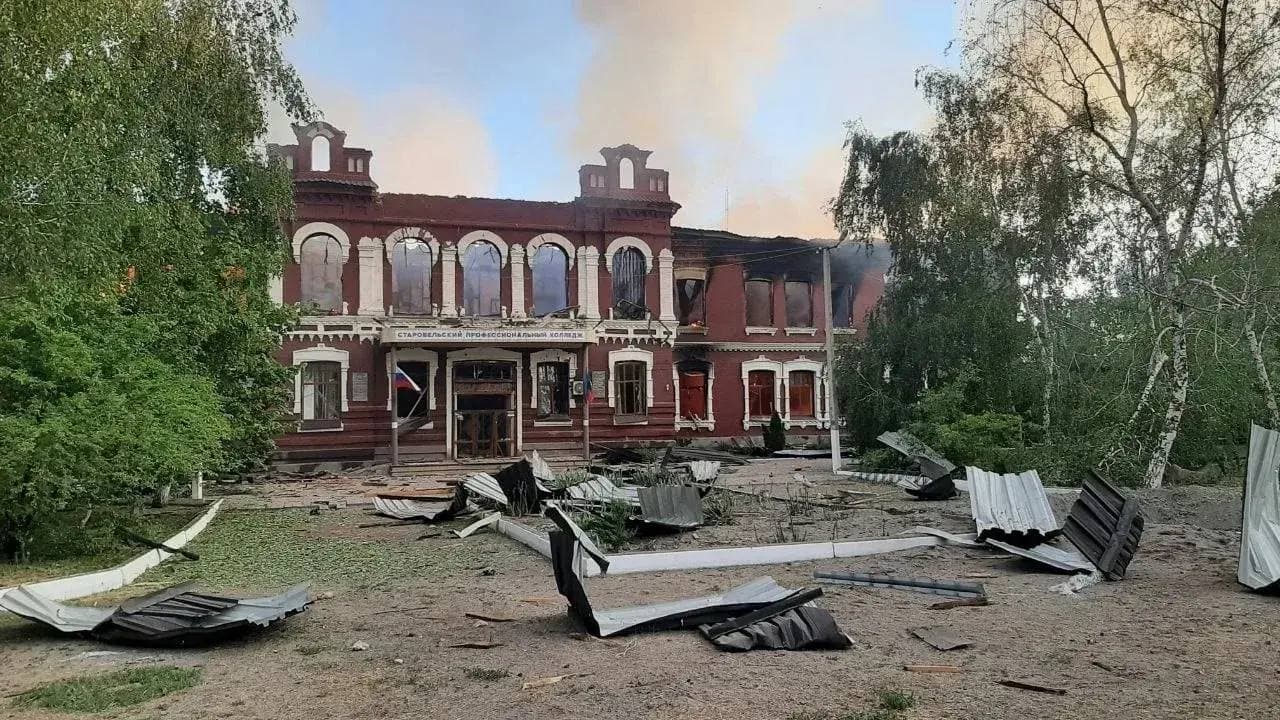
Shortly after midnight on May 22, Ukrainian drones struck the city of Starobilsk in occupied Luhansk Oblast. What happened next became a study in the information warfare that has come to define this conflict.
Russia’s Human Rights Commissioner Yana Lantratova claimed Ukrainian drones had struck a dormitory of the Luhansk Pedagogical University’s college in three separate waves, killing six people and injuring 35 children. The head of Russian occupation authorities in Luhansk Oblast claimed 84 children aged 14 to 18 had been inside the building at the time. Vladimir Putin condemned the strike publicly. Moscow called for an emergency session of the United Nations Security Council.
Ukraine’s General Staff did not deny striking Starobilsk. It said it had hit a headquarters of the Rubikon Center for Advanced Unmanned Technologies — Russia’s elite drone warfare unit, which the General Staff described as a “military special unit” whose operators “regularly carry out attacks on the civilian population and civilian facilities on the territory of Ukraine.” The General Staff called Russian claims “misleading information” and stated it strictly adheres to international humanitarian law, targeting only military infrastructure.
The Institute for the Study of War noted that Russian officials used the Starobilsk strike to advance longstanding information operations portraying Ukrainian forces as suffering setbacks across the theater — a framing contradicted by available battlefield evidence. ISW said it was unable to independently verify casualty claims from either side. The Kyiv Independent likewise noted that Russia’s information blackout over occupied territories makes independent verification impossible.
The episode is not isolated. Russia has repeatedly used civilian facilities — schools, hospitals, dormitories — as military bases throughout the war, a practice prohibited under international humanitarian law. The same day, Russia’s Sports Minister announced drone operation would be added to the national physical fitness curriculum for schoolchildren. The contradiction — claiming to protect student dormitories while formally militarizing student education — appeared to register with no one in Moscow.
“Not Fruitful”: Rubio Suspends Peace Efforts as Zelensky Courts Europe
The pretense held for as long as it could. On May 22, U.S. Secretary of State Marco Rubio stood before reporters at a NATO foreign ministers’ meeting in Helsingborg, Sweden, and said what the situation had long implied: the U.S.-brokered peace talks between Ukraine and Russia have produced nothing and are effectively paused.
“They were not fruitful, unfortunately, that’s the point,” Rubio said. He stressed that Washington had entered the process because it was seen as the only party both Kyiv and Moscow would engage with, and that it remains ready to re-engage — but only if talks have genuine prospects. “We’re also not interested in getting involved in an endless cycle of meetings that lead to nothing,” he said. “There are no such talks occurring at this time.”
Rubio maintained that a negotiated settlement is the only viable path to ending the war, pushing back against any notion of outright military victory. He also rejected reports of American pressure on Ukraine’s negotiating positions, calling such accounts untrue.
The talks that stalled had a brief history. A first round took place in Abu Dhabi in January, followed by sessions in February and Geneva. Progress collapsed amid the U.S.-Iran conflict and persistent disagreement over the status of Donetsk and Luhansk. On May 7, Ukraine’s National Security Council Secretary Rustem Umerov met with Trump envoys Steve Witkoff and Jared Kushner to discuss humanitarian issues and diplomatic revival — but nothing has materialized since.
Zelensky, speaking the same evening after a call with French President Macron, U.K. Prime Minister Starmer, and German Chancellor Merz, projected a different tone. Ukraine has liberated 590 square kilometers of territory since January, he said. The trend is not in the occupier’s favor. He shared Ukrainian intelligence on Russia’s political and military plans with the E3 leaders and reiterated his goal of securing Europe a seat at any future negotiating table. Kyiv is awaiting feedback from Washington on possible formats and a meeting schedule — but the initiative, for now, appears to be shifting toward European architecture.
“The System Has No Future”: Inside the Kremlin’s Growing Anxiety
The war is doing something to Russia’s political class that Russian state television cannot quite conceal. Independent Russian outlet Verstka published accounts from mid-level Kremlin officials and presidential administration employees describing a growing mood of private despair — officials who speak freely among themselves about systemic crisis but never act on it.
“The fact that the system has no future is obvious to everyone, and everyone discusses it among themselves,” one mid-level presidential administration employee told Verstka. “But nobody goes beyond stating the fact.” Another official put the fear more starkly: “If Putin’s power collapses, there is no future for us.”
The anxiety is traceable. Putin’s approval rating has fallen to 65.6 percent — its lowest point since before the February 2022 invasion. The Kremlin’s crackdown on the internet, which blocked Telegram, YouTube, and Facebook in an effort to create a state-controlled information environment, has generated resentment rather than compliance. Russia’s economy posted its first quarterly contraction in three years. Bloomberg reported on May 22 that some senior Kremlin officials privately believe the war has reached a “dead end” — though Putin himself reportedly still insists on seizing all of Donetsk and Luhansk by the end of 2026.
Russia’s Victory Day parade on May 9 was the starkest symbolic indicator of the pressure. No military hardware was displayed — the first time in nearly two decades — due to fears of Ukrainian drone attack. The parade that once announced Russian power to the world became an exercise in managing its absence.
None of this constitutes imminent collapse. Analysts note that discontent without a trigger event and an organized opposition amounts to widespread frustration with no outlet. “A crisis requires two factors: a trigger and a leader,” political scientist Konstantin Kalachev told AFP. “There has not yet been a trigger.” But the conversations happening inside the Kremlin’s corridors — the ones about finding younger replacements for aging leaders, about sending children abroad, about a system with no future — these are not the conversations of a regime at ease.
The Front Holds — and Bends: Ukrainian Advances Amid Russian Pressure
The battlefield picture on May 22 was one of attritional pressure absorbed and, in places, reversed. Ukraine’s DIA assessment, NATO Secretary General Mark Rutte’s public remarks, and Zelensky’s own accounting all converged on the same conclusion: Ukrainian forces have stabilized the front and, since Russia lost access to Starlink feeds in early February, have been incrementally retaking ground.
Near Sumy, Ukrainian forces advanced southeast of Varachyne, northeast of the city, while Russian forces continued pressure from multiple directions. The Ryasne area southeast of Sumy City was described as the most active in the direction. Ukrainian forces also struck a Russian command and observation post in Tetkino, Kursk Oblast, and Russian personnel concentrations in Troyebortne, Bryansk Oblast overnight.
In the Kharkiv direction, Russian forces pressed attacks near Vovchansk as Ukrainian forces counterattacked. Near Borova, Ukrainian forces recently advanced in western Ridkodub, southeast of the town. In the broader Donetsk theater, Ukrainian forces advanced northwest of Kotlyne in the Pokrovsk direction and southeast of Kryva Luka in the Slovyansk direction. In Zaporizhzhia Oblast, Ukrainian forces advanced southwest of Novodanylivka, and a Kremlin-affiliated milblogger acknowledged Ukrainian control of Mala Tokmachka following recent counterattacks.
On the southern axis, Ukraine’s mid-range strike campaign continued to disrupt Russian supply lines. Occupation head Vladimir Saldo signed a decree restricting freight movement on the M-14 Mariupol-Berdyansk-Melitopol-Henichesk highway — a primary route connecting Russia and occupied Crimea — citing the danger from Ukrainian strikes. The Kremlin’s own milbloggers criticized the move as counterproductive. Ukrainian forces struck Russian river crossings over the Oskil and Bakhmutivka rivers. Drone command posts, ammunition depots, and troop concentrations across Donetsk, Zaporizhzhia, and Luhansk oblasts were all hit in the overnight campaign.
Russia launched 880 personnel casualties in the past 24 hours, according to the Ukrainian General Staff — bringing total Russian losses to approximately 1,353,860 troops killed, wounded, or captured since February 24, 2022. Western analysts continue to assess Russian casualties at roughly 2 to 2.5 times Ukraine’s losses.
Perfidy on the Front: Russia Sends Soldiers Disguised as Civilians
Near Slovyansk, a Ukrainian brigade commander reported on May 22 that Russian forces were conducting infiltration missions disguised as civilians — moving through contested territory in civilian dress before attacking Ukrainian positions. Under the Geneva Convention, this constitutes perfidy: an act of treachery that exploits the protections of civilian status to gain military advantage. It is a war crime.
The report is consistent with a broader pattern of Russian tactical behavior that has drawn increasing documentation from Ukrainian units. On the same day, ISW assessed that Russian forces had conducted similar infiltration missions in the Hulyaipole direction in Zaporizhzhia Oblast — the telltale flag-raising footage used for Russian propaganda claims of territorial seizure accompanied what analysts described as infiltration operations rather than genuine control.
Russia’s information war and its battlefield conduct increasingly blur together: soldiers dressed as civilians, drone operators embedded in university buildings, casualty claims designed for UN Security Council consumption. The United Nations Human Rights Monitoring Mission, meanwhile, recorded April as the deadliest month for Ukrainian civilians since July 2025 — at least 238 killed. The numbers accumulate. The accountability remains distant.
Russia Strikes UNHCR Warehouse in Dnipro: $1 Million in Aid Destroyed
On May 20, Russian forces struck a United Nations High Commissioner for Refugees warehouse in Dnipro City. The UNHCR reported the strike on May 22: at least two people killed, an unspecified number injured, and at least $1 million in damages — basic aid supplies and shelter materials intended for frontline regions. Gone before they reached the people who needed them.
The strike on a clearly marked humanitarian facility is not an anomaly. Russia has targeted hospitals, schools, grain storage, and humanitarian logistics throughout the war. The UNHCR warehouse attack joins a long catalog of documented strikes on civilian and aid infrastructure — each one producing a UN statement, a diplomatic protest, and no apparent consequence for Russian targeting decisions.
School Credit for Killing: Russia Adds Drone Operation to University Entrance Exams
Russia’s Sports Minister Mikhail Degtyarev announced on May 22 that Russian school students who pass a drone operation test will be eligible for additional points on university entrance exams starting in 2027. Drone piloting with 75-millimeter propellers will be introduced in 2026 on a trial basis through the “Ready for Labor and Defense” program — the GTO — a Soviet-era physical fitness standard that now runs from age six to 70 and older.
The GTO already earns students two to five bonus points on state exams. Drone operation joins the program alongside running times and pull-up counts. Russia’s authorities were careful not to formally link this initiative to their drone unit recruitment campaign targeting university students — but the pipeline is not difficult to trace. Russia is formalizing the militarization of its educational system, making drone warfare a credentialed skill, a path to better university admission, a measure of civic fitness.
On the same day Russian officials claimed Ukrainian drones had wounded children in a Starobilsk dormitory, Moscow announced it would teach those children’s counterparts how to fly the weapons themselves.
Fire Point’s Danish Factory: Still Active Despite Corruption Scandal
Ukraine’s Fire Point — the drone and missile manufacturer at the center of the so-called “Mindich-gate” corruption scandal — confirmed that its Danish production facility remains operational, contradicting claims made by the company’s own co-owner. Fire Point co-owner and chief designer Denys Shtilierman told the Financial Times earlier this month that the Danish contract had been “put on ice” amid controversy surrounding the company. The Danish Ministry of Industry, Business and Financial Affairs told the Kyiv Independent the opposite: “The Danish authorities have not put the work on hold, neither at present nor in the past.”
The scandal centers on Timur Mindich, a Ukrainian-Israeli entrepreneur and close business associate of President Zelensky. Leaked recordings published by Ukrainska Pravda appear to show Mindich speaking about Fire Point as his company; the company denies any connection. Mindich fled Ukraine before Ukraine’s National Anti-Corruption Bureau raided his home in November. He has not been charged, and the pre-trial investigation is ongoing.
The controversy has not halted Fire Point’s operational importance. The company produces the FP-1 long-range drone — a mainstay of Ukraine’s deep strike campaign into Russia — as well as the shorter-range FP-2 central to Ukraine’s mid-range interdiction effort. It is also developing the Flamingo cruise missile, the FP-7 and FP-9 ballistic missiles, and the Freya anti-ballistic missile air defense system. Ukraine’s weapons pipeline runs through contested corporate territory. The war does not pause for audits.
$108 Million in HAWK Support: The U.S. Keeps Ukraine’s Air Defenses Alive
The U.S. State Department approved a $108.1 million sale of equipment to Ukraine on May 21 to sustain the HAWK air defense missile system. The package — maintenance and modification support, spare parts, repair services, logistics assistance, and technical support for FrankenSAM HAWK systems — is being conducted through the Foreign Military Sales program with Colorado-based Sierra Nevada Corporation as primary contractor.
The HAWK — Homing All the Way Killer — is a U.S.-designed system capable of intercepting aircraft, drones, and cruise missiles at ranges of 40 to 50 kilometers. Ukraine received its first HAWK systems at the end of 2022. In 2025, Washington authorized a $172 million support package for the Phase III variant. The latest sale continues that sustainment pattern: not new weapons, but keeping existing systems operational against the ongoing Russian aerial campaign.
The sale was approved without fanfare, a bureaucratic line item in a long logistics chain. But sustainment matters. The 115 drones intercepted over Ukraine on the night of May 21 to 22 did not intercept themselves.
Belarus Builds, Lukashenko Reassures, and Ukraine Watches the North
Satellite imagery captured May 14 and 17 shows construction underway at the site of the former Military Camp No. 25 “Pavlivka” in Belarus — roughly 185 kilometers from the Ukrainian border — with new fortifications, hangars, and foundations for further construction. The facility is expanding.
Belarusian President Alexander Lukashenko, speaking after joint Russian-Belarusian military exercises held May 19 to 21, said Belarus has no intention of attacking its Western neighbors. He also reiterated that Belarus would respond with “every weapon at its disposal” if threatened. Both things were said without apparent irony.
Ukrainian Foreign Minister Andrii Sybiha dismissed recent Lukashenko overtures — including a claimed willingness to meet with Zelensky — noting there have been no diplomatic contacts with Belarus recently. Sybiha said Belarusian opposition leader Sviatlana Tsikhanouskaya could visit Ukraine instead. Meanwhile, Zelensky has stated that Ukrainian intelligence has evidence Russia is attempting to draw Belarus directly into the war, including operational plans for forces to advance from Belarusian territory toward the Chernihiv-Kyiv sector. Ukraine has bolstered security along its northern border accordingly.
“We Were in the Bunker Almost Every Night”: Brink on the Aid Freeze
Former U.S. Ambassador to Ukraine Bridget Brink told Reuters on May 21 that the Trump administration’s decision to halt military aid and intelligence sharing with Ukraine in March 2025 had directly endangered the 1,000 civilian staff at the U.S. Embassy in Kyiv. The halt came without warning and cut off ammunition deliveries for air defense systems that were protecting embassy personnel from Russian drone and missile attacks.
“When we tried to find out why it was stopped, we got no answer,” Brink said. Embassy officials contacted the Pentagon, the State Department, and the White House. “We’re seven hours ahead and in the bunker almost every night,” she said, adding that the alternative — being told to “just call people” during active Russian attacks — was no solution at all.
Brink, who resigned in April 2025 citing what she described as Trump’s policy of appeasement toward Russia, said the freeze followed the now-infamous February 28, 2025 clash between Trump and Zelensky in the White House. Her account — diplomatic personnel sheltering underground while their government withheld the air defense ammunition protecting them — is a rare first-person view from inside the rupture.
The Song Will Be Among Us: Remembering Volodymyr Ivasyuk, Forty-Seven Years On
On May 22, 1979, thousands gathered in Lviv to bury Volodymyr Ivasyuk — composer, poet, one of the most gifted Ukrainian artists of the 20th century — found dead in a forest weeks after he disappeared. Soviet authorities declared it a suicide. For Ukrainians, the word has always meant something else.
Ivasyuk wrote more than a hundred songs before he turned 30. His most famous, Chervona Ruta — the Red Rue, a mythological flower — has spontaneously united Ukrainian crowds at protests, football matches, and celebrations for half a century. His funeral, attended by thousands in open defiance of Soviet pressure, was one of the rare public acts of resistance the regime could not fully suppress.
His story is told today in a personal essay by Tanya Sova, a Ukrainian musician who first spoke Ivasyuk’s name in an international publication — The New York Times, in 2022, during the first days of the full-scale invasion, from a basement in Kyiv while Russian missiles fell on the city. “We began singing Ukrainian songs together,” she writes. Ivasyuk’s “Pisnya Bude Pomizh Nas” — The Song Will Be Among Us — became her personal anthem.
The essay connects Ivasyuk’s silencing to the present war: the same logic that killed a composer in 1979 targets artists, medics, and poets in 2024 and 2025. Iryna “Cheka” Tsybukh, combat medic and cultural activist, killed near Kharkiv Oblast on May 29, 2024, three days before her 26th birthday. Maksym Kryvtsov, poet and soldier, killed January 7, 2024. Volodymyr Vakulenko, poet, abducted and killed during the Russian occupation of Izium. Writer Viktoriia Amelina, killed by a Russian strike in Kramatorsk in July 2023. “When they ask me what war is, I’ll answer without hesitation: it’s names,” Kryvtsov wrote before he died.
Ukraine will use its national public alert system to announce the daily minute of silence at 9 a.m. — a practice formalized by parliament in February, signed into law in March, and now extended to all public transport and city loudspeakers in Kyiv. On May 30, Cheka Fest 2.0 will take place in Lviv — a festival honoring Iryna Tsybukh’s memory. Ivasyuk’s music will be there too. The song will be among them.
Closing
The refinery outside Yaroslavl went dark sometime before dawn, and the governor said the air defenses had held. In Dnipro, families were still learning who among them had been taken to hospital. In Starobilsk, two claims about the same building stood unreconciled — a drone unit headquarters, a student dormitory, one or both, in a city where no neutral observer can go.
Peace talks paused. Territory reclaimed. A system that everyone inside it privately believes has no future, still running, still killing, still finding the fuel it needs — until, perhaps, it cannot.
A Prayer for Ukraine
1. For the Nine-Month-Old in Dnipro
Lord, she has been in this world less than a year. She did not come to Ukraine’s war — the war came to her, at five in the afternoon in a residential neighborhood, in the form of a drone that should never have found that street. We do not know her name. We know she was treated on-site, that she will continue care as an outpatient, that the word “outpatient” in this context means she survived. Hold her. Hold her parents. Let her grow up in a country where the afternoon is safe.
2. For the Artists Russia Has Silenced
God of memory, today we remember Volodymyr Ivasyuk, buried forty-seven years ago while thousands sang in defiance of the state that killed him. We remember Iryna Tsybukh, killed at 25. Maksym Kryvtsov, killed at 33. Viktoriia Amelina, killed in Kramatorsk. Volodymyr Vakulenko, taken from his garden and never returned. Each one held something irreplaceable — a song, a poem, a record of what happened here. What Ukraine has lost in artists alone could fill volumes. Guard what remains. Let the songs survive.
3. For the Defenders and the Drone Operators
Father, the men and women who flew toward Yaroslavl in the dark — who found the refinery a fourth time, who struck the Rubikon headquarters, who hit the crossing over the Oskil River — did not do it for glory. They did it because the alternative is worse. And the soldiers on the ground near Slovyansk, near Vovchansk, near Borova, who hold the line day after day against an enemy that disguises itself as civilians and advances one infiltration at a time: be with them. Give them what they need. Bring them home.
4. For Those Carrying the Weight of Impossible Choices
God of justice, Zelensky spoke with three European leaders tonight and shared intelligence about what Russia plans to do next. Rubio stood before cameras and admitted the talks have failed. Somewhere inside the Kremlin, officials are privately saying the system has no future while publicly saying nothing at all. None of these people carry their weight lightly — not even those carrying it in service of an unjust cause, who must live with what they know. Guide the ones who seek a just peace. And let their choices, in the end, reflect what Ukraine has endured.
5. For the Long Arc
Lord, the warehouses full of aid have been burned. The refineries have been struck four times and will be struck again. The minute of silence sounds at nine every morning across Ukraine — in the metro, on the buses, through loudspeakers in the streets — because the list of names is too long to hold in private grief alone. The war is in its fourth year. The diplomacy has stalled. The territory comes back slowly, at enormous cost. We do not ask for a quick answer. We ask for justice that is real, for an ending that is worthy.
In Your mercy, in Your justice, in Your time — bring this war to its end, and let the ending be worthy of what Ukraine has endured.