
Ukraine Daily Briefing | May 31, 2026 | Day 1,558 of the Full-Scale Invasion
Prepared by Dayana Bozhyk
Ukraine’s 3rd Army Corps declared drone fire control over Luhansk City, Starobilsk, Alchevsk, Bryanka, and Kadiivka, with strikes reaching the Izvaryne border checkpoint 205 kilometers into occupied territory, while the Saratov refinery and the Lazarevo pipeline station 1,200 kilometers from Ukraine’s border burned overnight. Romania’s Defense Ministry formally confirmed the Galati apartment strike was caused by a Russian Geran-2 drone, directly refuting Putin’s denial, while Zelensky told CBS News a window for negotiations exists until winter 2026 — after which Russia’s energy strikes are expected to resume. Russia launched 229 drones overnight, destroying Nova Poshta’s Dnipro branch, wounding a seven-year-old and his mother in Slovyansk, and killing a driver in Koriukivka — the week’s toll: 2,300 drones, 1,560 guided bombs, 108 missiles.
THE DAY’S RECKONING
The last day of May produced two disclosures that together describe the month’s strategic arc. The first: Brigadier General Biletsky announced that Ukrainian drones have achieved fire control over Luhansk City, Starobilsk, Alchevsk, Bryanka, and Kadiivka — cities 50 to 90 kilometers from the frontline — and that the 3rd Army Corps has struck the Izvaryne border checkpoint, 205 kilometers deep inside occupied territory on the Russian border. Russia’s Defense Ministry claimed in April that Luhansk Oblast had been fully captured. Biletsky’s response: “In response to the enemy’s statements about the complete capture of the Luhansk region, we announce an operation to control logistical routes in the Luhansk region.” Fire control, in practical terms, means Russian convoys, vehicles, and personnel concentrations in those cities are now targetable. Every supply run is a gamble.
The second disclosure: Zelensky told CBS News that Ukraine has a window for negotiations — and it closes before winter. Since December 2025, when Russia began losing the battlefield initiative, Ukraine has been accumulating leverage month by month. That leverage has a shelf life. When winter arrives, Russia will resume its energy infrastructure strikes. Civilian heating, electricity, water supply — the pressure tools that have nothing to do with the frontline — will return. The negotiations, if they are to happen, must produce something before that pressure is applied again. Zelensky told his American partners in January. The U.S. shifted focus to the Middle East. He told them again on May 31. He said he hoped to host Witkoff and Kushner in Kyiv within two weeks.
The rest of the day: Saratov refinery — Rosneft, 7 million tons per year, on the Volga River near Kazakhstan’s border — was struck and set ablaze. The Lazarevo station in Kirov, 1,200 kilometers from Ukraine, was also struck, threatening the Surgut-Gorky-Polotsk pipeline system connecting two of the largest pipeline networks in European Russia. Nova Poshta’s Dnipro branch was completely destroyed. A 58-year-old man was killed in a parking lot in Koriukivka when Russian drones struck commercial vehicles in Chernihiv. By the end of the week, Zelensky had counted 2,300 drones, 1,560 guided bombs, and 108 missiles launched at Ukraine’s civilian infrastructure. He said: “All these strikes are simply at ordinary civilian infrastructure.”
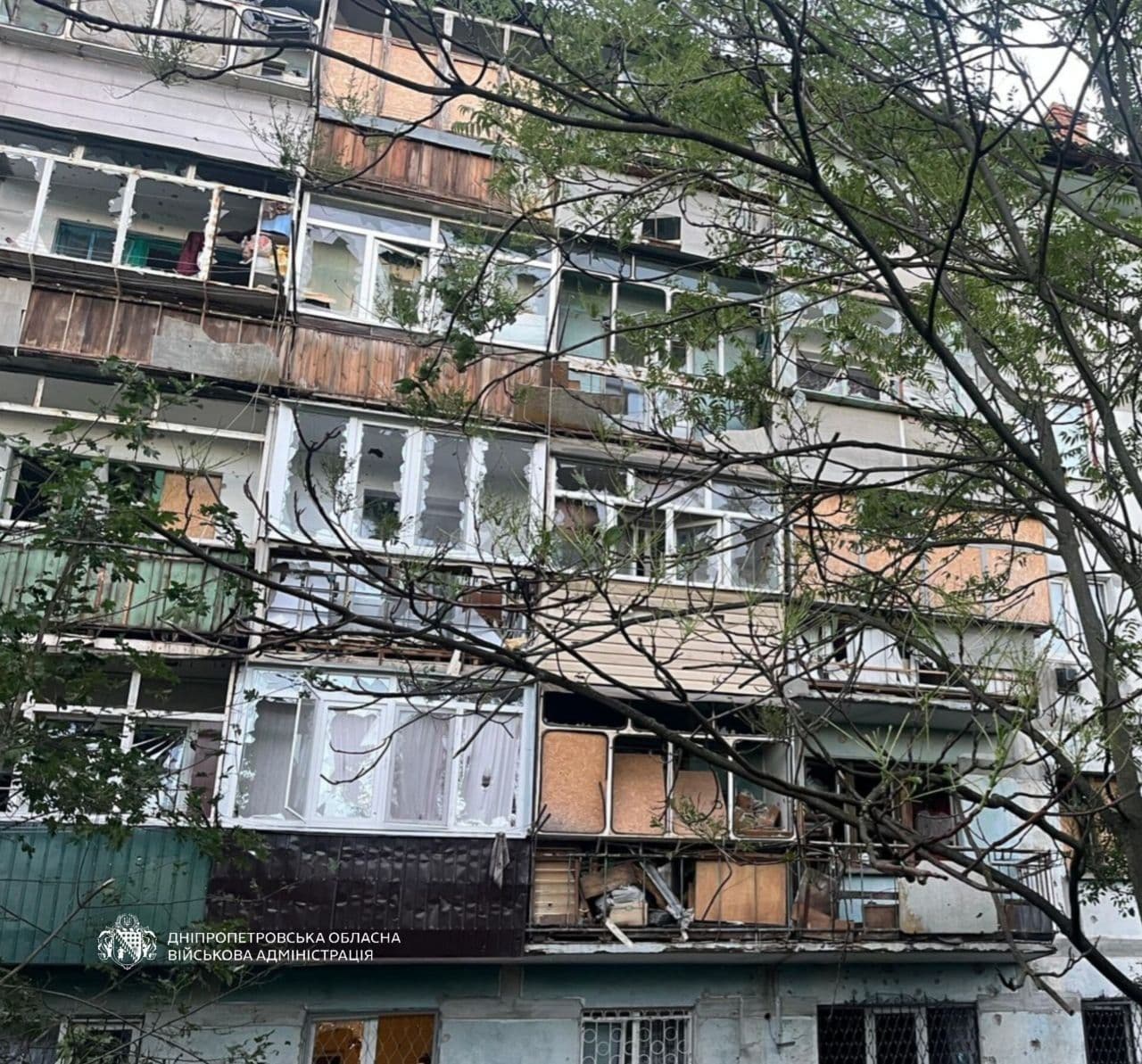
Aftermath of Russian strikes on Dnipropetrovsk Oblast, Ukraine, overnight. (Dnipropetrovsk Oblast Military Administration/Telegram)
SARATOV REFINERY STRUCK; LAZAREVO PIPELINE STATION HIT 1,200 KM FROM UKRAINE’S BORDER
The Ukrainian General Staff and USF’s 1st Separate Center confirmed strikes overnight May 30 to 31 against three Russian energy targets. The Saratov Oil Refinery in Saratov City — a Rosneft facility processing 7 million tons of crude oil annually, producing gasoline, diesel, and other fuels for Russian military logistics — was struck in a large fire confirmed at the ELOU-AVT-6 processing unit, with two tanks also damaged. Saratov Oblast Governor Busargin acknowledged the strike. The operation was carried out by the 1st Separate Center of the Unmanned Systems Forces in coordination with Ukraine’s Special Operations Forces and military intelligence.
The Lazarevo Linear Production and Dispatch Station in Kirov Oblast — 1,200 kilometers from Ukraine’s border — was simultaneously struck, setting fires confirmed by geolocated footage and acknowledged by Kirov Oblast Governor Sokolov. Ukraine’s Special Operations Forces clarified that Lazarevo links the Surgut-Gorky-Polotsk main pipeline to the Druzhba pipeline system, enabling the rapid transfer of oil between two of the largest pipeline networks in European Russia. A third strike hit the Agroproduct oil depot in Matveyev Kurgan, Rostov Oblast, a fuel storage facility with road and rail loading terminals and a pumping station. This brings Ukraine’s confirmed strike count on Russian oil refineries to at least 159 since the start of the full-scale war, with 17 facilities struck in May alone.
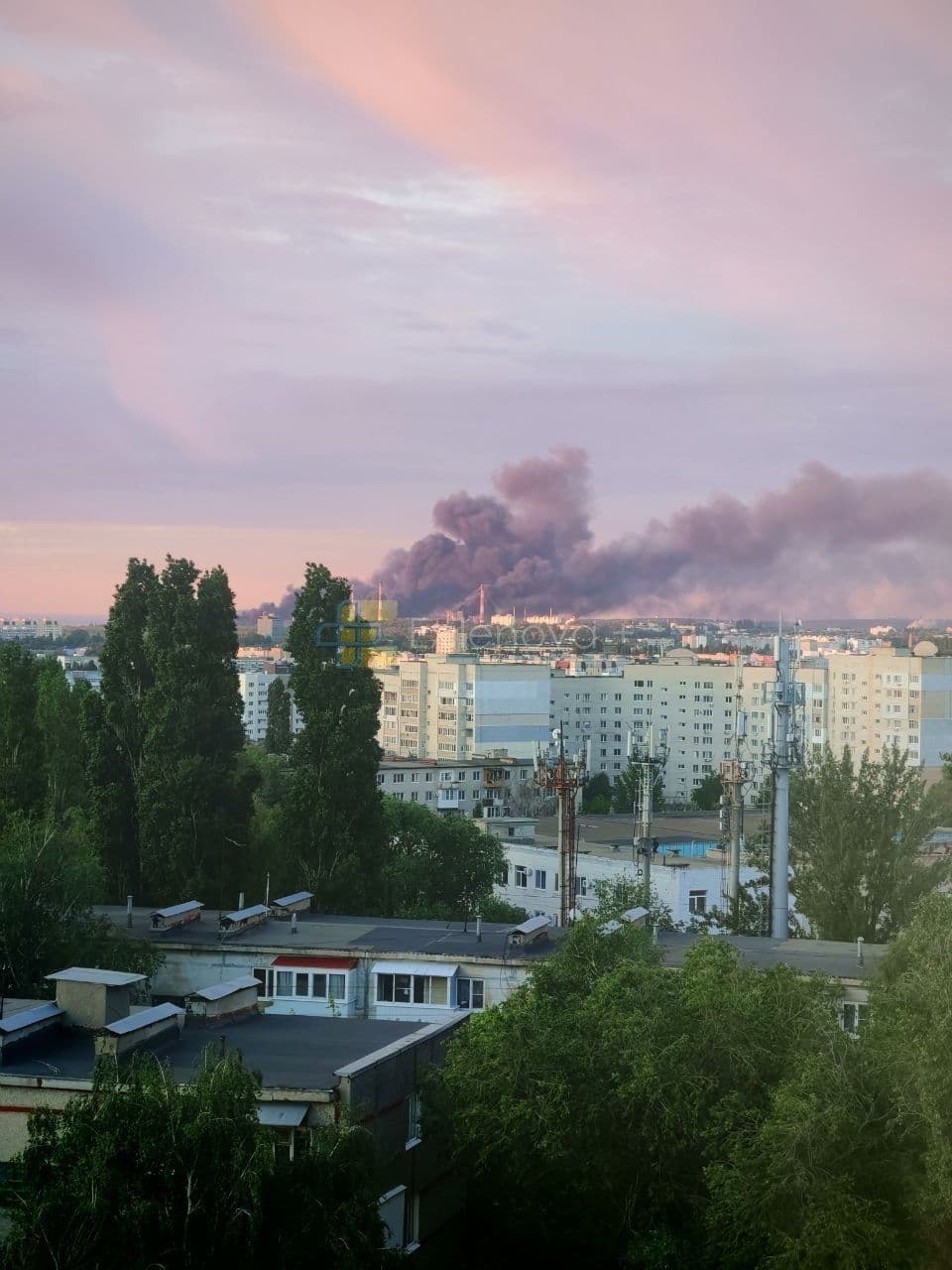
Smoke is purportedly seen rising from Saratov Oil Refinery in Russia late following a Ukrainian drone attack. (Exilenova_plus/Telegram)
3RD ARMY CORPS DECLARES DRONE FIRE CONTROL OVER LUHANSK CITY AND THE RUSSIAN BORDER
Brigadier General Biletsky announced on May 31 the launch of an operation in Luhansk Oblast and in Eastern Sloboda Ukraine — the Ukrainian ethnic territories historically located in Russia’s Kursk, Voronezh, and Belgorod regions. The 3rd Army Corps reported achieved drone-enabled fire control over Luhansk City, Starobilsk, Alchevsk, Bryanka, and Kadiivka — all between 50 and 90 kilometers from the frontline. Ukrainian forces have been regularly striking GLOCs, armor, and ammunition depots throughout the area. In one operation, drones reached the Izvaryne border checkpoint on the international border between occupied Luhansk and Russia’s Rostov Oblast — over 205 kilometers from the drone operators’ positions. Izvaryne serves as a primary transit point for heavy armor, ammunition, and personnel flowing from Russia to the Donbas frontlines.
The operation was planned and led by a strike UAV platoon commander with the callsign Skhid — a native of Luhansk Oblast who participated in the helicopter air insertion into encircled Mariupol in spring 2022, evaded Russian capture after the siege, crossed the frontline on foot, and was awarded the Hero of Ukraine decoration. He is now applying his localized knowledge of his native region to systematically interdict Russian logistics. Russian milbloggers confirmed on May 31 that Ukrainian drones are penetrating Russian air defenses throughout occupied Luhansk Oblast and reaching the Rostov Oblast border. A separate Russian milblogger acknowledged that Ukrainian mid-range strikes are causing significant fuel shortages and severely hampering Russian personnel rotations and ammunition supplies throughout occupied Donetsk and Luhansk oblasts.
UKRAINE’S DRONE STRATEGY REVEALED: DECOYS, DISTRIBUTED CONTROL, LAPTOPS
HUR Deep Strike commander Vector gave a CNN interview published May 31 detailing the operational mechanics of Ukraine’s long-range drone campaign. The core principle: a strike package contains both armed drones and specialized decoy drones designed to mimic the radar signatures of cruise or ballistic missiles. “These are decoys,” Vector explained. “We have sent hundreds of them. Some are empty, some carry a combat load. The combat payload is small, but it is enough to destroy air defense systems.” When Russian crews fire expensive interceptor missiles at what their radar indicates are high-priority threats, they reveal the coordinates of their radar and missile batteries, which the armed drones then strike.
Command and control is entirely decentralized across dozens of locations managed through standard laptops. “Laptops are our biggest advantage and the reason why it is so difficult for Russia to destroy this program, because we are scattered,” Vector stated. “We don’t have single centers, and we use dozens of locations. Furthermore, this software gives us the opportunity to work with thousands of UAVs.” The custom software coordinates trajectories, flight times, and electronic warfare countermeasures of thousands of drones simultaneously, converging them from multiple vectors to overwhelm Russian tracking radars. Russia has added a fourth Pantsir system onto a Moscow rooftop in response — the Nordstar Tower, adjacent to residential high-rises and a municipal school.
ZELENSKY: ‘WE HAVE A WINDOW FOR NEGOTIATIONS UNTIL WINTER’
Zelensky told CBS News in an interview published May 31 that Ukraine regained the battlefield initiative in December 2025, and that this has created a window for negotiations that will remain open until winter 2026. “It began in December 2025, Russia began to lose initiative on the battlefield. And from this point of view, I shared this information with our American partners. I said to them in January, I think that we have window for the negotiations, because each month they will lose more and more people. So now we have this period of time before the winter.”
Zelensky stated Russia is losing up to 35,000 soldiers per month and is on the path to a crisis that will push it toward dialogue, but that Putin will need additional external pressure to engage. He acknowledged that the United States has shifted its diplomatic focus to the Middle East: “United States moved and shift their focus on the Middle East, and because of this, I think Middle East is a priority. That’s why we have some pauses in our diplomatic negotiations.” He said he would like to host Witkoff and Kushner in Kyiv within two weeks, and that the humanitarian track — including children — is essential. On the abducted children: Russia offered to exchange them for POWs. “Can you imagine, how we can exchange our children?” Zelensky said. The last round of formal Ukraine-Russia negotiations took place in Geneva in February 2026.
ROMANIA FORMALLY CONFIRMS: THE GALATI DRONE WAS A RUSSIAN GERAN-2
Romania’s Defense Ministry published a formal statement on May 31 confirming that debris forensic analysis of the weapon that struck the Galati apartment building on May 29 is “structurally and functionally identical” to components recovered in previous incidents involving Geran-2 type drones. The target was first detected at 1:46 a.m. in Ukrainian airspace approximately 19 kilometers from Romania’s border, and struck at approximately 2:00 a.m. The confirmation directly contradicts Putin’s May 29 claim that “nobody can know the origin of the drone” and Russian Foreign Ministry Spokeswoman Zakharova’s statement that there is “not a single fact, material, piece of evidence” against Russia. Romania had previously closed Russia’s consulate in Constanta and expelled its consul. Article 4 consultations remain under discussion.
OVERNIGHT STRIKE: 229 DRONES, 212 DOWNED; NOVA POSHTA BRANCHES DESTROYED; ONE KILLED IN CHERNIHIV
Russian forces launched 229 Shahed, Gerbera, Italmas, and Parodiya drones overnight May 30 to 31 from Kursk, Oryol, Bryansk, Millerovo, Shatalovo, and occupied Hvardiyske in Crimea. Ukrainian air defenses downed 212 drones. Fourteen struck eleven locations; debris fell on five more. Russian strikes hit residential, industrial, and energy infrastructure across Chernihiv, Dnipropetrovsk, Sumy, Zaporizhzhia, and Rivne oblasts. A Russian drone struck a commercial enterprise parking lot in Koriukivka district, Chernihiv Oblast, triggering a large fire that completely destroyed seven cargo trucks. Emergency crews found the body of a 58-year-old driver.
Russian drones struck two Nova Poshta branches on May 31 — Branch No. 1 in Dnipro city and a branch in Slovyansk, Donetsk Oblast. The Dnipro facility was completely razed to the ground by fire; no employees were injured. Nova Poshta confirmed: “Backup schemes have been introduced, and logistics have been restructured. No delivery delays are expected.” The Slovyansk branch also sustained damage, alongside a commercial gas station and five private homes, after a combination of FPV drones, Molniya-2 loitering munitions, and Geran-2 drones struck the municipality six times within 24 hours. Two civilians were injured — a seven-year-old boy and his mother.
WEEK’S TOLL: 2,300 DRONES, 1,560 GUIDED BOMBS, 108 MISSILES; ONE NEW IRIS-T RECEIVED
Zelensky published a comprehensive accounting of the week’s Russian strikes: more than 2,300 attack drones, nearly 1,560 guided aerial bombs, and 108 missiles of various types, all directed at ordinary civilian infrastructure — residential buildings and energy facilities. Against this onslaught, Ukraine received one new IRIS-T air defense launcher from Germany on May 30. “Thousands and thousands of lives have been saved thanks to such strong support. But we also need missiles for air defense systems to have sufficient capabilities to repel Russian attacks,” Zelensky stated. He confirmed new agreements with Sweden on Gripen C/D fighter delivery and contributions to the PURL initiative, and reiterated that anti-ballistic defense remains the single highest-priority defensive need.
RUSSIA’S FALSE FLAG AT ZNPP; MEDVEDEV THREATENS ‘NEW CHORNOBYL’
Russian-controlled ZNPP occupation officials claimed on May 30 and 31 that Ukraine conducted two separate drone strikes against the plant — first against the Unit 6 turbine hall, then against a transport shop. Ukraine’s Southern Defense Forces and Foreign Ministry categorically denied both. The Ukrainian MFA noted that Russia routinely launches such accusations ahead of each IAEA meeting. The AFU clarified that it does not possess fiber-optic-guided drones with the range needed to reach the ZNPP; does not operate drones with the 5-6 kg shaped-charge warheads needed to create the claimed penetration hole; and that Russian forces have deployed a smoke screen entirely surrounding the plant that makes external aerial entry undetectable. The IAEA confirmed on May 31 that its on-site representatives observed damage consistent with a drone strike in the turbine hall but could not attribute it to Ukrainian or Russian origin.
Medvedev used the unverified claim to threaten “symmetrical” Russian strikes against Ukrainian or NATO nuclear power plants if Ukraine destroyed a reactor at the ZNPP. Russia has itself systematically militarized the facility since seizing it in March 2022: storing military equipment adjacent to reactors, stationing armed personnel in exclusion zones, and launching drones from the grounds. ISW assessed that Russia may use purported ZNPP strikes to justify a new massive long-range strike campaign against Ukraine, which Zelensky had already warned of on May 29 and 30.
LUKASHENKO’S THREAT EXCHANGE WITH UKRAINE’S DRONE COMMANDER
Lukashenko responded directly on May 31 to USF Commander Brovdi’s earlier public warning that Ukraine had identified 500 targets in Belarus. “They may have identified 500 targets — thank you, we have 500 targets for them too — but we have one very serious target, with exact coordinates, and it is entirely close to Belarus.” He declined to specify the target. Lukashenko simultaneously dismissed Ukrainian forces as “cannon fodder” — “people who were caught on the streets, poor Ukrainians, and the military of the so-called territorial defense — yesterday’s workers, machine operators, collective farmers.” He claimed Ukraine would not attack Belarus because it does not want a thousand-kilometer additional front, and claimed no Belarusian servicemembers are currently in Ukraine and none will be deployed.
Tsikhanouskaya adviser Viachorka told Kyiv Post at the Black Sea Security Forum that Russia and the Lukashenko regime are rebuilding Soviet military infrastructure, constructing communications networks and military bases along all of Belarus’s borders — Ukrainian, Polish, Lithuanian — and have deployed the Oreshnik system and nuclear weapons. “They are preparing for escalation. Drone and helicopter provocations are testing the capabilities of Western countries around the perimeter.” However, Viachorka stated Putin currently lacks the resources to open a new front, and that very few Belarusian military personnel are willing to participate in combat against neighboring countries.
FRONTLINE: KUPYANSK STALLED, BOROVA PRESSURE, ZAPORIZHZHIA FUEL COLLAPSE, CHURCH DESTROYED
Military observer Mashovets reported on May 31 that Russian forces continue attacks on Kupyansk from north and east to split Ukraine’s bridgehead but are achieving limited tactical results. Only isolated Russian groups remain in Kupyansk at the Lyceum No. 7 and canning plant without stable control. Russian forces have been unable to seize Kupyansk-Vuzlovyi, Kurylivka, or Kivsharivka. In the Borova direction, Russian forces are attempting to advance on a broad front toward the Oskil River, but Mashovets assessed the military command will not allocate sufficient operational reserves as it prioritizes the Kupyansk and Lyman directions. Russian advances to the P-79 highway between Novoplatonivka and Bohuslavka have complicated Ukrainian logistics near Zahryzove and Bohuslavka.
In Vovchansk northeast of Kharkiv City, Ukrainian forces struck a Russian-occupied building after an infiltration mission. Russian forces also attempted to establish a pontoon crossing in the Vovchansk direction, using an improvised truck-trailer float; Ukrainian forces struck and destroyed it. The kill zone in the Kharkiv direction has doubled or tripled in the past year and now extends into Russian territory. In western Zaporizhzhia, Russian forces continued infiltration missions near Vozdvyzhivka and west of Charivne but made no confirmed advances; Crimea occupation officials acknowledged that fuel shortages are worsening, with gas stations empty and overnight queues forming. A Ukrainian brigade reported on May 31 that Russian forces destroyed the Church of the Nativity of the Blessed Virgin Mary in Zaktine, east of Slovyansk, by dropping an incendiary device from a drone. ISW assessed this as part of Russia’s deliberate, systematic targeting of religious infrastructure in occupied and contested Ukraine.
DONETSK OBLAST LOGISTICS DEPOTS STRUCK; M-14 TANKER HIT; POLICE CARS TARGETED IN KHERSON
The 413th Regiment of Ukraine’s USF struck two military logistics depots near Novoselivka and Dokuchayevsk in occupied Donetsk Oblast on May 31, along with a temporary deployment site and multiple logistics depots near Olenivka — targeting key nodes at railway and road junctions where Russia concentrates personnel and resources. The General Staff reported strikes on a drone control point near Kalynove, a drone workshop, and a manpower concentration in Donetsk City. Geolocated footage confirmed a Ukrainian drone strike on a Russian fuel tanker on the M-14 highway northeast of Novoazovsk, roughly 140 kilometers from the frontline. The USF also struck a mobile fire group west of Mariupol.
The Kherson Oblast National Police reported on May 31 that Russian forces conducted a drone strike against a patrol police car in Kherson City, damaging the vehicle and injuring three police officers. This follows documented Russian drone strikes against police cars near Kharkiv City on May 21 and in Bilopillya, Sumy Oblast on May 3. ISW assessed this as an expansion of Russia’s “human safari” tactic — deliberately targeting first responders and law enforcement — across multiple frontline sectors.
CASUALTIES ACROSS UKRAINE: 5 KILLED, 37 INJURED; SEVEN-YEAR-OLD AND MOTHER WOUNDED IN SLOVYANSK
Russian attacks across Ukraine over the past day killed at least five people and injured 37 others. In Dnipropetrovsk Oblast, twelve people were injured — eleven in the Nikopol district across the Dnipro River from occupied Enerhodar, one in the Kryvyi Rih district. In Zaporizhzhia Oblast, two people were killed and seven injured. In Donetsk Oblast, two people were killed and four injured. In Chernihiv Oblast, a driver was killed in Koriukivka. In Kharkiv Oblast, eleven people were injured across the regional capital and fifteen other settlements. In Sumy Oblast, two men were injured in drone attacks. In Kherson Oblast, one person was injured across 36 targeted settlements.
The Saratov refinery burned 600 kilometers from the border. Ukrainian drones achieved fire control over Luhansk City and reached the Russian frontier. Zelensky said the window for negotiations closes before winter. Romania’s forensics confirmed: the Galati drone was Russian. Medvedev threatened NATO’s nuclear plants. Lukashenko threatened Ukraine’s unnamed “serious target.”
2,300 drones. 1,560 guided bombs. 108 missiles. One week. All at civilian infrastructure. Nova Poshta’s Dnipro branch burned to the ground. A seven-year-old and his mother were wounded in Slovyansk. A church was burned in Zaktine. A 58-year-old driver was found dead in a Koriukivka parking lot.
Day 1,558. The last day of May. The window is open. The clock is running.
A PRAYER FOR UKRAINE
1. For the Driver in Koriukivka
Lord, a 58-year-old man drove a cargo truck in Chernihiv Oblast on the night of May 30. He parked it at a commercial facility in Koriukivka district. Russian drones struck the parking lot, starting a fire that destroyed seven large trucks. Emergency crews who arrived to fight the fire found him dead. We know almost nothing about him except his age and what he was doing when he died. He was working. He was delivering something someone needed. He was part of the enormous civilian logistics infrastructure that keeps Ukraine functioning while one-third of European military personnel combined is trying to stop a war. Receive him. Hold the colleagues who found him. And let whoever in the Russian military’s targeting chain decided that Koriukivka’s parking lot was a legitimate objective understand one day what they chose to destroy.
2. For the Seven-Year-Old and His Mother in Slovyansk
Father, on May 31, Russian forces struck Slovyansk six times within 24 hours using FPV drones, Molniya-2 loitering munitions, and Geran-2 drones. A seven-year-old boy and his mother were wounded. The strikes also hit a Nova Poshta branch, a gas station, and five private homes. Slovyansk is a frontline city that has been under consistent Russian attack since 2022 and that Russia has repeatedly attempted to capture. Its residents have chosen to stay or have had no realistic means to leave. That seven-year-old has grown up with air raid sirens as a normal feature of life. He was wounded on the last day of May in what was, for Russian forces, one of six separate strikes on his city in a single day. Be with him and his mother. Let their injuries heal. And let the world that is sometimes distracted by the scale of this war pause to remember that behind each strike statistic is a child who was trying to live an ordinary day.
3. For ‘Skhid’ and the Pilots Flying Over Luhansk City
God of homecoming, the drone platoon commander who led the operation over Luhansk Oblast on May 31 is a native of Luhansk Oblast who has not been home since the occupation began. He flew into Mariupol during the siege. He survived the fall of Azovstal and walked out through occupied territory alone. He was decorated with the Hero of Ukraine title. And now he is using his knowledge of his hometown’s streets, roads, and checkpoints to guide Ukrainian drones over the places he grew up. The operation reached Izvaryne, 205 kilometers deep, on the Russian border itself. We pray for Skhid and for every pilot in the 3rd Army Corps’ strike battalion. For the knowledge they carry — of places they have not seen in years — and for the day when they can return to them not as targeteers but as people who have come home. Let that day come.
4. For the Negotiating Window
Lord, Zelensky told CBS News on May 31 that there is a window for negotiations before winter. He has been holding this window open through the most intense period of aerial attack Ukraine has experienced since April 2022. Two thousand three hundred drones in a week. One hundred eight missiles. A residential building in a NATO country struck. The Oreshnik deployed against Kyiv’s oblast. And he is saying: there is time, if the pressure on Putin increases, if American partners re-engage, if the battlefield leverage Ukraine has built translates into diplomatic currency before the cold returns and Russia hammers the grid again. We pray for the window. For the diplomats and officials who are preparing the meetings he mentioned but would not name. For the American envoys he wants to host in Kyiv within two weeks. And for the moral clarity in every capital that has the power to push this war toward an ending that is worthy of what Ukraine has paid — not a surrender dressed as a deal, but a peace that holds.
5. For the Congregation of the Destroyed Church in Zaktine
God of worship and of ruined places, Russian forces burned the Church of the Nativity of the Blessed Virgin Mary in Zaktine, east of Slovyansk, on May 30 by dropping an incendiary device from a drone onto its roof. The church burned. ISW assessed this as part of Russia’s deliberate, systematic targeting of religious infrastructure in occupied and contested Ukraine — aimed at eradicating religious organizations the Kremlin deems undesirable. We do not know how long that congregation has worshipped in that building, or what was kept inside it, or whether they had already evacuated it. We know it is gone. We pray for the congregation’s priest, for its members wherever they are, for the religious community that gathered in that place across generations. Let what was held in that building — the prayers, the liturgies, the baptisms and funerals, the ordinary holiness of a local church — survive the loss of the walls that contained them. And let the systematic targeting of holy sites be named for what it is: an attempt to destroy not just buildings but the spiritual identity of a people. It will not succeed.