
Ukraine Daily Briefing | June 1, 2026 | Day 1,559 of the Full-Scale Invasion
Prepared by Dayana Bozhyk
May 2026 ended with Russia’s net territorial gains turning negative for the first time since the 2023 counteroffensive — Ukraine liberated more ground than Russia occupied, as DeepState confirmed Russian forces gained only 7.87 percent as much territory as they did in the same period last year. The French Navy intercepted and boarded the sanctioned shadow fleet tanker Tagor in the Atlantic, Macron announced it personally, and Zelensky confirmed that 40 percent of Russian primary refining capacity is now offline with Moscow having already banned jet fuel exports. Budanov told the Architecture of Security Forum that ending the active war before winter is a direct presidential directive — and confirmed that U.S. envoys Witkoff and Kushner plan to visit both Kyiv and Moscow in the near future.
THE DAY’S RECKONING
The numbers arrived late in the day, and they were unusual. DeepState, the Ukrainian monitoring group that tracks territorial changes with a deliberate security delay, confirmed that May 2026 was the first month since the 2023 counteroffensive in which Russian net territorial gains turned negative — more ground was liberated by Ukrainian forces than was occupied by Russian forces. Russia launched 37.5 percent more assaults in May than in April. It gained 14 square kilometers of terrain on DeepState’s public map — and lost more than that. The spring offensive, historically Russia’s most productive period when ground hardens and infantry can move, produced a net subtraction.
ISW’s calculation is slightly different in methodology but consistent in direction: Russian forces gained control of or infiltrated only 40.64 square kilometers from December 2025 through May 2026, while losing 281.1 square kilometers in the same period. In the corresponding period one year earlier, Russia had seized or infiltrated 515.84 square kilometers. Russia gained 7.87 percent as much territory in 2026 as in 2025. The seasonal pattern that has historically boosted Russian advances in late spring — when ground dries after rasputitsa — has not materialized. ISW assessed this reflects structural shifts: Ukrainian counterattacks, the mid-range strike campaign, the Starlink cutoff for Russian forces in February, and the Kremlin’s throttling of Telegram degrading Russian tactical coordination.
At the Architecture of Security Forum in Kyiv, Presidential Office Head Budanov made the diplomatic calendar explicit. End the active war before winter. That is the presidential directive. “The president has tasked us with trying to end this war as quickly as possible. Preferably before winter.” Budanov said there are already real signs that conditions exist for halting hostilities, and that he had received confirmation that U.S. envoys Witkoff and Kushner plan to visit both Kyiv and Moscow in the near future. He also denied media reports of a Russian Trinity Sunday ceasefire offer — and cited 229 drones launched the night before as evidence of what ceasefire gestures from Moscow actually look like in practice.
Meanwhile, in the Atlantic Ocean, the French Navy intercepted the sanctioned Russian shadow fleet tanker Tagor. Macron announced it himself. “It is unacceptable for ships to circumvent international sanctions, violate the law of the sea, and fund the war that Russia has been waging against Ukraine for more than four years.” The Kremlin called it piracy. That is what every legal action against sanctions evasion looks like to the party being held accountable.
MAY’S BATTLEFIELD VERDICT: RUSSIA’S NET GAINS TURN NEGATIVE FOR THE FIRST TIME SINCE 2023
DeepState reported on June 1 that Russia’s territorial gains in May 2026 turned net negative for the first time since Ukraine’s failed 2023 counteroffensive — the first such month recorded. DeepState’s public map showed a Russian advance of only 14 square kilometers, while noting that Ukrainian advances are published with a security delay. The group’s overall assessment: when accounting for delayed Ukrainian gains, Russia’s net May balance was negative. Russia launched 37.5 percent more assault actions in May than in April — and achieved less.
ISW’s methodology produced a compatible but distinct calculation. From December 2025 to May 2026, Russian forces gained control of or infiltrated 40.64 square kilometers, while losing 281.1 square kilometers of previously held territory. Comparing to the same six-month period one year earlier: Russian forces had advanced into 515.84 square kilometers in December 2024 through May 2025. The 2026 figure represents 7.87 percent of 2025’s pace. Bloomberg reported in February that Russia was sustaining 9,000 more casualties per month than it could replace through recruitment. Ukraine’s defense minister stated Russia’s cost per square kilometer of advance rose from 67 soldiers in October 2025 to 179 soldiers in April 2026. Ukraine’s mid-range strike campaign, the February Starlink cutoff for Russian forces, and Ukrainian counterattacks in the Oleksandrivka and western Zaporizhzhia directions each contributed to the shift.
ISW cautioned that the calculation about Russian losing 281 square kilometers does not inherently mean Ukraine liberated that amount of territory — much of it reflects ISW recoding areas from the Russian advances layer to the infiltration layer as new evidence allows reassessment. The overall trend is nonetheless consistent with multiple independent sources: Russia’s spring 2026 offensive, historically its most productive season, has underperformed all prior years of the full-scale war.
PUTIN RESISTS DEFENSE SPENDING CUTS DESPITE FINANCE MINISTRY WARNINGS
Bloomberg reported on June 1, citing senior Russian Finance Ministry and Central Bank officials and documents Bloomberg viewed, that Putin has been told by his economic officials that Russia’s current level of war spending is on an unaffordable trajectory and risks dangerously widening the budget deficit. The Finance Ministry and Central Bank have proposed cuts to defense spending. The Russian Ministry of Defense is resisting, arguing that reduced military spending would damage the businesses dependent on military-related contracts. The MoD is reportedly demanding additional funding, not cuts.
The reported figures contextualize the pressure: Russia’s 2026 defense and security budget is 16.84 trillion rubles ($238 billion) — nearly 40 percent of total federal spending. The budget deficit reached 4.58 trillion rubles in the first three months of 2026, already exceeding the planned annual deficit of 3.79 trillion rubles. Bloomberg’s sources say Russian officials drafted the 2026 budget assuming the war might end mid-year, which would allow defense spending to fall. They now project a possible additional 1.2 to 1.5 trillion ruble deficit in the second half of 2026 if the war continues. Sustained oil prices above $100 per barrel would help, but sources said this would not resolve Russia’s structural problems with inflation, economic growth, and the banking sector.
ISW’s assessment of Putin’s reluctance: he likely believes he can win in the near to medium term based on heavily exaggerated battlefield reports from his military command — the same false maps ISW documented in its May 28 assessment. A leader who believes his forces are winning will not cut the spending that sustains them, regardless of what economists tell him. Reduced war spending would also put frontline positions at risk against Ukrainian counterattacks and mid-range strikes, creating a feedback loop that makes the false maps strategically necessary: admitting the real situation would require policy changes the system is not prepared to make.
BUDANOV: ‘END THE WAR BEFORE WINTER’; WITKOFF AND KUSHNER TO VISIT KYIV AND MOSCOW
Presidential Office Head Kyrylo Budanov stated at the Architecture of Security Forum on June 1 that ending the active phase of the war before winter 2026 is a direct directive from President Zelensky. “This is the president’s instruction — to try to end this war as quickly as possible. Preferably before winter.” Budanov described the objective as “absolutely correct, timely, and well considered” and said there are already “real signs” that conditions exist for halting hostilities. He confirmed that U.S. envoys Witkoff and Kushner have confirmed plans to visit both Kyiv and Moscow “in the near future” — the first direct confirmation from Ukraine’s side that the visits are scheduled.
Budanov explicitly denied media reports that Moscow had proposed a Trinity Sunday ceasefire and that anticipated large-scale strikes were postponed as a result. “I have not received any information regarding a ceasefire for Trinity Sunday. Moreover, you can look at how much was struck by the Russian Federation yesterday, and how many casualties there were.” Russian forces launched 229 drones on May 31. Ukrainian military intelligence spokesperson Yusov characterized Moscow’s public threats as a deliberate combination of military and psychological pressure: “It is clear that this is the enemy’s tactic — combining military pressure with psychological pressure on Ukrainians, who have been living under the stress of war for more than four years.”
Russia’s territorial demands remain the central obstacle to any settlement. Ukraine maintains that freezing the current frontline is the realistic basis for a ceasefire. Russia continues to insist that Ukrainian forces withdraw from parts of Donbas as a precondition — a demand Kyiv has rejected. The last trilateral Ukraine-Russia-U.S. talks took place in Geneva in mid-February 2026. A follow-up scheduled for late February was canceled when U.S.-Israeli strikes on Iran shifted Washington’s diplomatic focus to the Middle East. U.S. Secretary of State Rubio acknowledged talks have stalled.
FRENCH NAVY INTERCEPTS SHADOW FLEET TANKER TAGOR IN ATLANTIC; KREMLIN: ‘PIRACY’
French President Macron announced on June 1 that the French Navy, with allied support, intercepted and boarded the Russian shadow fleet tanker Tagor in the Atlantic Ocean on May 31. The Tagor is sanctioned by the EU, the United Kingdom, and Ukraine; Ukraine’s military intelligence database identifies it as a shadow fleet vessel transporting Russian crude oil and petroleum products. Macron: “It is unacceptable for ships to circumvent international sanctions, violate the law of the sea, and fund the war that Russia has been waging against Ukraine for more than four years.” The interception is the fourth such action by France against Russian shadow fleet vessels since September 2025, following boardings in January and March 2026.
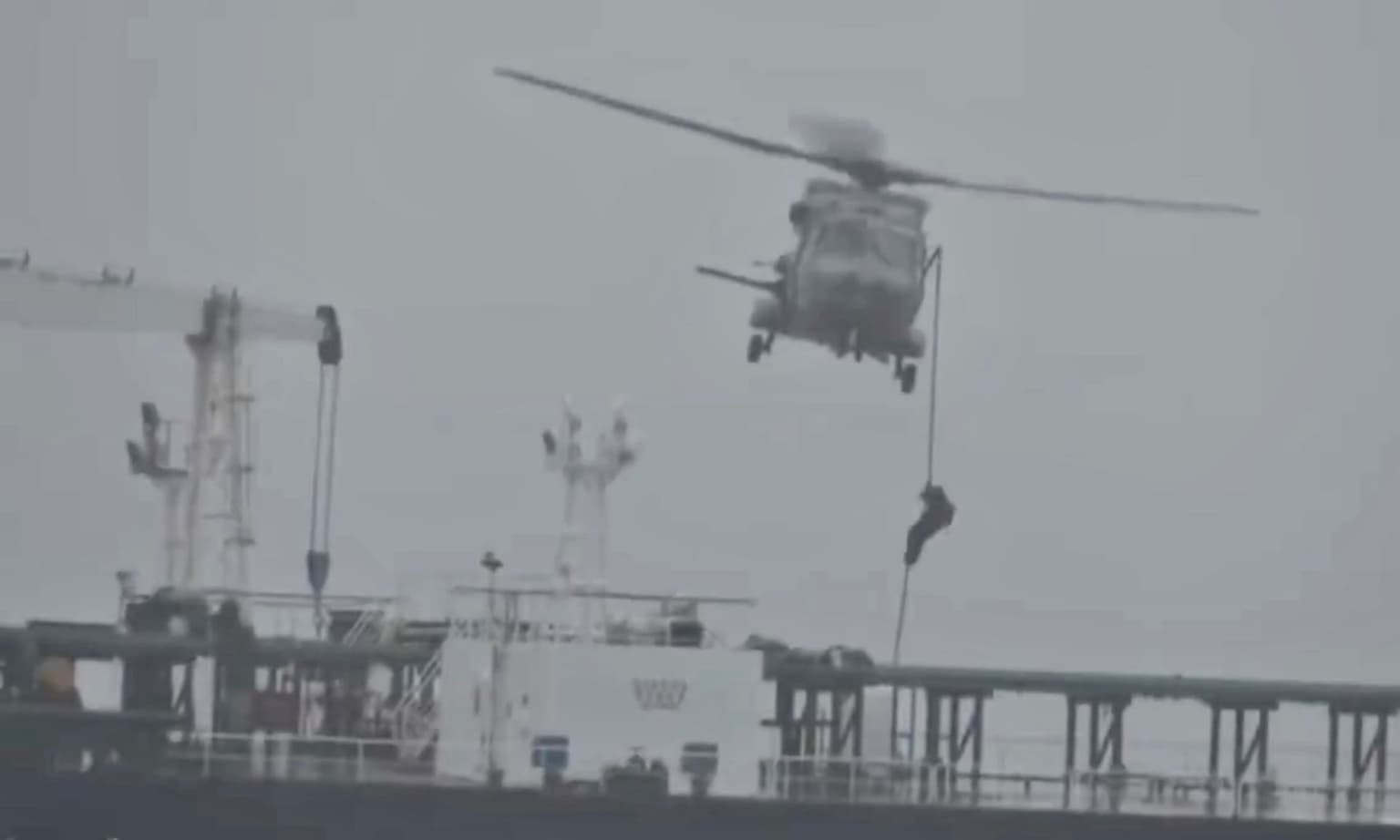
The French Navy intercepted a Russian shadow fleet tanker the Tagor. (Emmanuel Macron / X)
The Kremlin responded through spokesman Peskov, who called the boarding “illegal” and accused France of “international piracy.” Macron noted the tanker had departed from Russia. Zelensky welcomed the action. Under international maritime law, states may board vessels suspected of sanctions violations on the high seas under certain conditions; France has asserted a legal basis for each of its previous boardings. Ukraine has repeatedly urged European allies to update legislation enabling seizure of shadow fleet vessels and the repurposing of their cargo for European security.
40% OF RUSSIAN REFINING OFFLINE; JET FUEL EXPORT BAN; MOSCOW’S SUBURBS RATIONING FUEL
Zelensky confirmed in his June 1 evening address that nearly 40 percent of Russia’s primary oil refining capacity is offline as a result of Ukrainian drone strikes between January and May 2026. Fifteen refineries were struck in that period. Russia has already imposed a temporary ban on jet fuel exports effective June 1 through November 30, and is considering a diesel export ban. A country once described as a gas station is now rationing fuel to keep its military and domestic market supplied simultaneously. “For a country that, until quite recently, was called a gas station, losing even this is a major development, a major loss,” Zelensky said.
Fuel rationing has spread beyond occupied territory and Crimea to metropolitan Moscow. The Moscow Times reported that gas stations in Novaya Moskva — territory incorporated into Moscow city limits in 2012 — began displaying notices limiting gasoline sales to 60 liters per customer and diesel to 100 liters. Prices are rising: diesel in Moscow rose 56 kopecks per liter in a single week to 78.49 rubles; A-92 gasoline increased 24 kopecks to 64.67 rubles; A-95 rose 35 kopecks to 71.46 rubles. The private fuel company NeftMagistral led the increases, raising A-92 by 3 rubles and A-95 and diesel each by 5 rubles. Russian authorities said the jet fuel ban is aimed at maintaining domestic market stability, but Bloomberg calculated that Russia set a wartime record in May by striking refineries 16 times in a single month — more than 10 additional strikes hit pipelines, storage depots, and export ports.
Satellite imagery published on June 1 showed further confirmed damage: the Balakhonikhinskaya oil pumping station in Nizhny Novgorod Oblast sustained damage from a Ukrainian drone strike on an unspecified recent date; separate imagery from May 31 confirmed that the May 29-30 strike on the Armavir oil depot in Krasnodar Krai damaged at least one fuel tank, with a second tank damaged in March still inoperable. Russia’s CREA-calculated oil revenues averaged €734 million per day in April 2026, their highest in two and a half years — but export volumes continue to decline, and ISW estimated the combination of rising repair costs and state subsidies to energy companies cost the Kremlin approximately $4.7 billion in April alone.
ZELENSKY: UKRAINIAN FORCES CAN REACH ALL RUSSIAN LOGISTICS ACROSS OCCUPIED TERRITORY
Zelensky stated in his June 1 evening address: “Our warriors now have the capability to reach Russian military logistics across virtually the entire depth of the temporarily occupied territory. There are practically no safe roads left for the occupier in the south and east of our state.” He cited fuel shortages in occupied Crimea and across occupied eastern Ukraine as the visible evidence. The 3rd Army Corps’ May 31 announcement of drone fire control over Luhansk City, Starobilsk, Alchevsk, Bryanka, and Kadiivka — and strikes reaching the Izvaryne border checkpoint 205 kilometers deep — operationalizes that claim.
Ukrainian drone units are now reaching the Rostov Oblast border from positions in Luhansk Oblast. The 413th Regiment of the Unmanned Systems Forces struck a Russian dry cargo ship twice in occupied Berdyansk, likely on May 31, with the ship assessed to have been carrying ammunition at the time of the strike. A Ukrainian brigade published footage confirming ongoing strikes on Russian logistics on the approaches to occupied Donetsk City. Geolocated footage published June 1 showed damage to a Russian fuel truck near occupied Vuhlehirsk, roughly 40 kilometers from the frontline, and destroyed Russian trucks at a Rostov-Donetsk Oblast border crossing northeast of Novoazovsk, roughly 145 kilometers from the frontline.
UKRAINE INTEGRATES UNGUIDED ROCKETS INTO LONG-RANGE DRONES; GUIDED BOMBS ENTER PRODUCTION
Denys Shtilerman, co-founder of Ukrainian arms manufacturer Fire Point, confirmed in an interview published June 1 that his company has integrated Soviet-era S-5 unguided rockets into the FP-1 and FP-2 long and mid-range drones, with each drone now capable of carrying up to eight 55mm S-5 rockets. “We have developed a solution for existing rockets. We have a bunch of S-5 rockets left over from Soviet times and they are practically not used at the front. So why shouldn’t we use them.” Shtilerman noted the integration allows a drone to strike multiple targets in a single sortie rather than sacrificing itself in a kamikaze attack: “If we see a train with a bunch of tanks, we can blow up not one tank or locomotive, as before, but four tanks and a locomotive.” The FP-series drones fly up to 1,300 kilometers autonomously and roughly 500 kilometers under Starlink control.
Separately, BlueBird Tech confirmed on June 1 that it is entering early engineering stages for serial production of Ukrainian-developed guided aerial bombs, partnering with a leading Ukrainian design bureau. The company: “Every day, Russia uses hundreds of guided bombs. Ukraine must respond just as effectively.” Ukraine’s Brave1 defense tech cluster had previously completed development of the country’s first domestically produced guided bomb after a 17-month cycle; the Defense Ministry has already procured an initial experimental batch for pilot testing under combat conditions. USF footage published in mid-May showed drones launching S-5 rockets mid-flight near occupied Crimea, with the Air Force describing an operational depth of up to 500 kilometers and a 60-kilogram strike warhead per drone.
OVERNIGHT STRIKE: 265 DRONES, KALIBR MISSILES FROM CASPIAN; KYIV, ODESA, AND EIGHT OBLASTS HIT
Russian forces launched 265 Shahed, Gerbera, Italmas, and Parodiya drones overnight May 31 to June 1, alongside Kalibr cruise missiles launched from the Caspian Sea. Ukrainian air defenses downed 228 drones. Twenty-seven drones struck 18 locations; debris fell on 12 more. Russian strikes hit residential, industrial, and energy infrastructure in Chernihiv, Kharkiv, and Odesa oblasts. Ukrenergo reported power outages in Dnipropetrovsk, Zhytomyr, Zaporizhzhia, Odesa, Sumy, Kherson, Kharkiv, and Chernihiv oblasts.
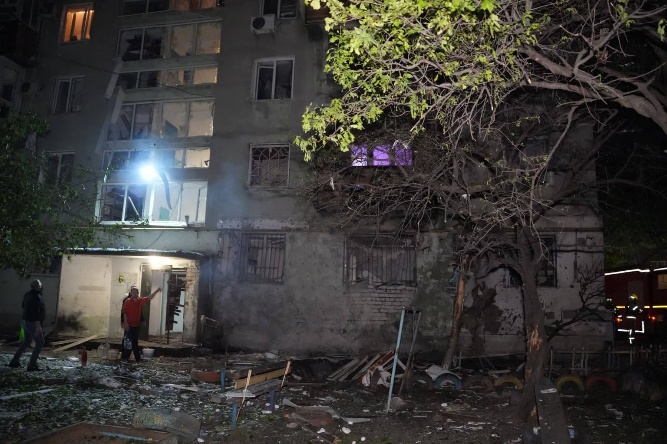
Aftermath of a Russian drone attack on Odesa, Odesa Oblast, overnight. (Odesa Oblast Governor Oleh Kiper/Telegram)
In Kyiv, a nine-story residential building in Podilskyi district was struck again — causing a partial structural collapse, with people reported possibly trapped. A missile likely hit a 24-story residential building in Shevchenkivskyi district, igniting a fire on the fourth and fifth floors. The upper floors of a 15-story residential building in Solomianskyi district were damaged. Drone debris fell near a kindergarten in Obolonskyi district. Non-residential buildings, vehicles, and a gas station also caught fire. Power outages were reported in Podilskyi, Obolonskyi, and Sviatoshynskyi districts. Two people were hospitalized, with one later confirmed dead from injuries.
In Odesa, two overnight drone attacks struck residential areas and industrial infrastructure. A drone hit a high-rise apartment building, destroying units on floors one through four; seven people were injured. In Donetsk Oblast, one person was killed in Druzhkivka and eight were injured across the region. In Kherson Oblast, one person was killed in Shyroka Balka; six people were injured across 39 targeted settlements. In Dnipropetrovsk Oblast, one person was killed and 13 injured, with the heaviest strikes in the Nikopol district opposite occupied Enerhodar. In Sumy Oblast, ten people were injured across five communities. In Kharkiv Oblast, eight people were injured including four in the city itself. In Chernihiv Oblast, eight people were injured including three children.
FRONTLINE: UKRAINIAN ADVANCES NEAR POKROVSK; NOVOPLATONIVKA CLEARED; VOVCHANSK HELD
Geolocated footage published on June 1 indicates Ukrainian forces recently advanced or maintained positions northeast of Rodynske north of Pokrovsk. A second geolocated video shows Ukrainian forces striking a Russian servicemember south of Hyrshyne northwest of Pokrovsk during what ISW assessed was a Russian infiltration mission. The Ukrainian 7th Rapid Reaction Corps reported that Ukrainian drone strikes in the Pokrovsk direction in May 2026 impeded Russian forces’ ability to accumulate personnel and weapons in the town and destroyed over 105 Russian artillery systems — twice as many as in April. A Kremlin-affiliated milblogger confirmed Ukrainian drone activity is preventing Russian forces from rotating personnel to frontline infiltration groups.
A Ukrainian brigade reported on June 1 that Ukrainian forces recently cleared Novoplatonivka north of Borova of Russian infiltrators. In the Kupyansk direction, geolocated footage confirmed Ukrainian forces striking Russian positions west of Fyholivka northeast of Kupyansk and in western Kurylivka southeast of Kupyansk. A Ukrainian non-commissioned officer reported that Ukrainian forces still hold positions on the outskirts of Vovchansk — directly contradicting Russian claims of complete seizure. Russian forces also attempted to build a pontoon crossing in the Vovchansk direction using an improvised truck-and-trailer float; Ukrainian forces struck and destroyed it before it could be used.
In the Kostyantynivka direction, Russian forces continued infiltrations within the city and near Dovha Balka but made no confirmed advances. In the Slovyansk direction, a Ukrainian drone company commander confirmed that Russian forces mostly infiltrate at night and under foliage cover during the day, accumulating near Ukrainian positions. Russian forces also struck the Church of the Nativity of the Blessed Virgin Mary in Zaktine east of Slovyansk, confirmed by geolocated footage. In western Zaporizhzhia, Russian forces continued infiltration missions near Vozdvyzhivka and west of Charivne without confirmed advances. The Ukrainian 412th USF regiment confirmed a strike on a Russian dry cargo ship twice in occupied Berdyansk, likely carrying ammunition.
RUSSIA’S RAILWAY CAMPAIGN AND EU REFUGEE DEBATE
Ukrzaliznytsia reported on June 1 that Russian forces struck railway infrastructure and rolling stock 541 times in the first quarter of 2026, damaging 1,718 railway facilities, causing $178 million in losses, and reducing freight transportation volumes by 6.4 percent. ISW assessed that Russian forces have substantially improved their ability to strike moving targets with precision through drone adaptations and improved reconnaissance, targeting Ukrainian rail logistics to obstruct Western aid deliveries and frontline supply movement.
EU capitals are separately debating whether to restrict Temporary Protection Directive access for Ukrainian men of conscription age under a possible extension of the framework, which currently covers 4.33 million Ukrainians and runs through March 2027. An internal EU Council document seen by Euractiv identified one option as excluding military-age men or irregular arrivals from a renewed scheme. Poland backed the proposed revision. Germany hosts the largest share of Ukrainian TPD beneficiaries at 1.27 million, followed by Poland at 961,405. EU justice and home affairs ministers are expected to address the issue this week. Any formal change requires a European Commission proposal; existing beneficiaries would remain unprotected under most formulations of the change.
DENMARK’S FAYARD SHIPYARD AND RUSSIAN ARCTIC LNG; REPOWER FOUNDATION’S MEDIC RECOVERY PROGRAM
NGO Urgewald published analysis on June 1 warning that Denmark’s Fayard shipyard — the last EU facility still servicing Russian Arctic LNG tankers — could repair up to six Arc7 ice-class vessels before the EU’s maritime services ban for Russian LNG takes effect in 2027. The six identified vessels have collectively carried Russian LNG worth an estimated 32 billion euros ($37 billion) since the full-scale invasion. Urgewald campaigner Kirk: “Every Arc7 tanker serviced in Denmark could help prolong Russian Arctic LNG exports for years and send millions more back to the Kremlin.” The EU’s 2027 ban on maritime services for Russian LNG projects is part of the broader strategy to phase out Russian gas imports beginning next year.
The Repower Foundation completed its second Carpathians psychological recovery program for Ukrainian military medics and doctors, bringing nearly 100 frontline healthcare personnel to the mountains for a 10-day program combining psychological support, neurogymnastics, creative workshops, and time in nature. Since 2022, Repower has organized recovery programs for nearly 2,000 military medics in Ukraine, Sweden, Denmark, and Spain. The foundation is developing a permanent psychological recovery center in Ukraine targeting more than 3,500 servicemembers annually. “After three or four days, you see people opening up again,” said Repower co-founder Sebastian Lindstrom. “You hear them laughing again.”
CASUALTIES ON JUNE 1: THREE KILLED, MORE THAN 60 INJURED ACROSS EIGHT OBLASTS
Russian attacks across Ukraine on June 1 killed at least three people and injured more than 60 others. In Kherson Oblast, one person was killed in Shyroka Balka in a morning drone strike; six people were injured across 39 targeted settlements. In Dnipropetrovsk Oblast, one person was killed — a 50-year-old woman in the Nikopol district — and 13 others were injured. In Donetsk Oblast, one person was killed in Druzhkivka and eight were injured. In Sumy Oblast, ten people were injured across five communities in nearly 90 Russian attacks. In Kharkiv Oblast, eight people were injured. In Chernihiv Oblast, eight people were injured including three children. In Zaporizhzhia, a 73-year-old woman was injured in a morning attack on the regional center. In Odesa, seven people were injured in residential drone strikes.
May ended with Russia’s net territorial gains turning negative for the first time since 2023. Forty percent of Russian refining capacity is offline. The French Navy seized a shadow fleet tanker in the Atlantic. Budanov said: end the war before winter. Putin’s generals are asking for more money for a war they’re falsely reporting as going well.
Gas stations in Moscow’s suburbs are limiting fuel to 60 liters per customer. Witkoff and Kushner are planning to visit Kyiv. Ukrainian drones can reach the Rostov Oblast border from Luhansk. Three people were killed and more than 60 injured across eight oblasts on a Sunday. Military medics hiked in the Carpathians and heard someone laugh for the first time in a while.
Day 1,559. The spring offensive ended in a loss. The window is open. The clock is running.
A PRAYER FOR UKRAINE
1. For the 50-Year-Old Woman in Nikopol
Lord, a 50-year-old woman was killed in Nikopol on June 1 in a Russian strike. Nikopol sits across the Dnipro from occupied Enerhodar and has been struck hundreds of times since 2022. We do not have her name — only her age and the district where she died. Receive her. Hold whoever is grieving her today. And let the sustained bombardment of a civilian district that continued through every ceasefire rumor and diplomatic overture eventually find its accounting.
2. For the Military Medics in the Carpathians
God of healing, nearly 100 frontline military medics completed a mountain recovery program this week — hiking, rafting, reading poetry aloud around campfires. A body therapist said many arrived unable to sleep because their nervous systems were still in survival mode. “After three or four days, you see people opening up again. You hear them laughing again.” They deserve laughter. They deserve sleep without bracing for the next explosion. When they return to the front — as they will — let them carry something restored.
3. For the Three Children Injured in Chernihiv
Father, Russian drone strikes injured eight people in Chernihiv Oblast, three of them children, on a Sunday in the northernmost oblast of Ukraine. They do not live near the frontline in any conventional sense. They live in a region that has been struck so many times its population treats the alerts as routine. That normalization is itself an injury. Protect these three children. Heal them. And let the scale of this war not obscure the fact that each of these numbers was a person on an ordinary Sunday.
4. For Budanov and the Diplomats Preparing What Comes Next
Lord, Budanov said the goal is to end this before winter — before Russia resumes the energy strikes that have destroyed heating systems and left hospitals on generators through four consecutive winters. We do not know if Putin will move toward a table that reflects reality rather than his generals’ false maps. We know Ukraine’s position is stronger than at any point in 2025. Give wisdom to the envoys and commanders preparing what comes next. Let the window be used. Let the winter not come with missiles.
5. For the Ships and Those Who Stopped Them
God of accountability, France boarded the shadow tanker Tagor in the Atlantic and Macron announced it himself. The Kremlin called it piracy. It was the fourth such interception since September 2025. Every ship stopped is money that does not buy drones. Every drone not bought is a strike that does not happen. We give thanks for the political will to enforce what the law permits. And we pray that Europe finds more of it — because the ships and the strikes are not separate stories. In Your mercy, in Your justice, in Your time — bring this war to its end, and let the ending be worthy of what Ukraine has endured.