
Ukraine Daily Briefing | June 2, 2026 | Day 1,560 of the Full-Scale Invasion
Prepared by Dayana Bozhyk
Russia’s largest aerial assault of the full-scale war killed at least 22 civilians — including two children — and injured 130 others, deploying 73 missiles including 8 Zircon hypersonic cruise missiles and 33 Iskander-M ballistic missiles alongside 656 drones, with Kyiv, Dnipro, and Kharkiv bearing the heaviest damage. In Dnipro, Russian forces used cluster munitions against civilians and conducted a deliberate double-tap strike that killed Major Anton Yarmolenko, a rescue worker who arrived at the first blast site to pull survivors from the rubble. Ukraine struck the Ilsky oil refinery for the 16th time and continued strikes across Crimea and occupied Donetsk, while Belarusian fuel imports to Russia hit 26 times their year-ago level as Ukraine’s refinery campaign drives Russia’s domestic fuel market toward collapse.
THE DAY’S RECKONING
Picture a rescue major in Dnipro arriving at the first blast site before dawn, flashlight in hand, calling into the rubble. He is looking for the people trapped in a four-story apartment building that Russia’s missiles partly collapsed. His name is Anton Yarmolenko. He is 40-something. He is a deputy chief of the resource provision unit, a man whose job is to keep other people alive. Then Russia sends the second wave.
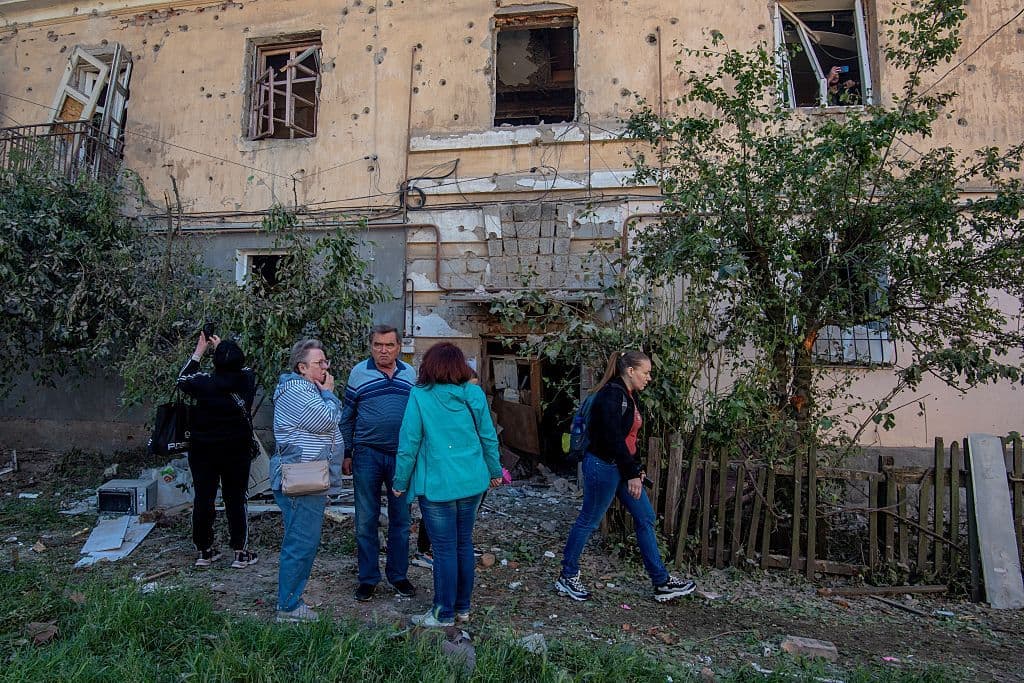
Local residents stand in the courtyard of a damaged residential building following an air attack in Dnipro, amid the Russian invasion of Ukraine. (Mykola Synelnykov / AFP via Getty Images)
The double-tap is deliberate. ISW has documented 401 cases of Russian repeat strikes against rescue workers since February 2022. Forty-three first responders killed. Two hundred fifty-eight injured. The strategy is simple and illegal: strike a civilian target, wait for rescue crews to arrive, strike again. The goal is to kill the people trying to save other people. Yarmolenko was killed this way on June 2 in Dnipro, while at least 16 civilians around him also died — including a three-year-old and an eight-year-old pulled from the same building. Russia also used cluster munitions in Dnipro, which scatter submunitions over a wide area and are banned under international humanitarian law. Dnipro Mayor Filatov described the use as deliberate.
In Kyiv, seven people died. A nine-story building in Podilskyi district — struck once already — partially collapsed again. A 24-story building in Shevchenkivskyi caught fire on the fourth and fifth floors. A medical clinic in Holosiivskyi district had its second and third floors partially collapse. Debris from intercepted missiles fell on a kindergarten in Obolonskyi. Eighty-one thousand citizens sheltered in metro stations overnight, hearing the city shake around them.
This was the largest single aerial assault of the full-scale war: 73 missiles, 656 drones, 729 total air attack means tracked by Ukrainian radar. Russia justified it as retaliation for the May 22 Ukrainian strike on a Rubikon drone headquarters in Starobilsk. ISW’s assessment is direct: the justification is false. Russia had prepared this package for weeks, threatened systematic strikes on Kyiv since May 25, and would have launched it regardless. The strike package is not retaliation. It is intimidation deployed with maximum civilian effect.
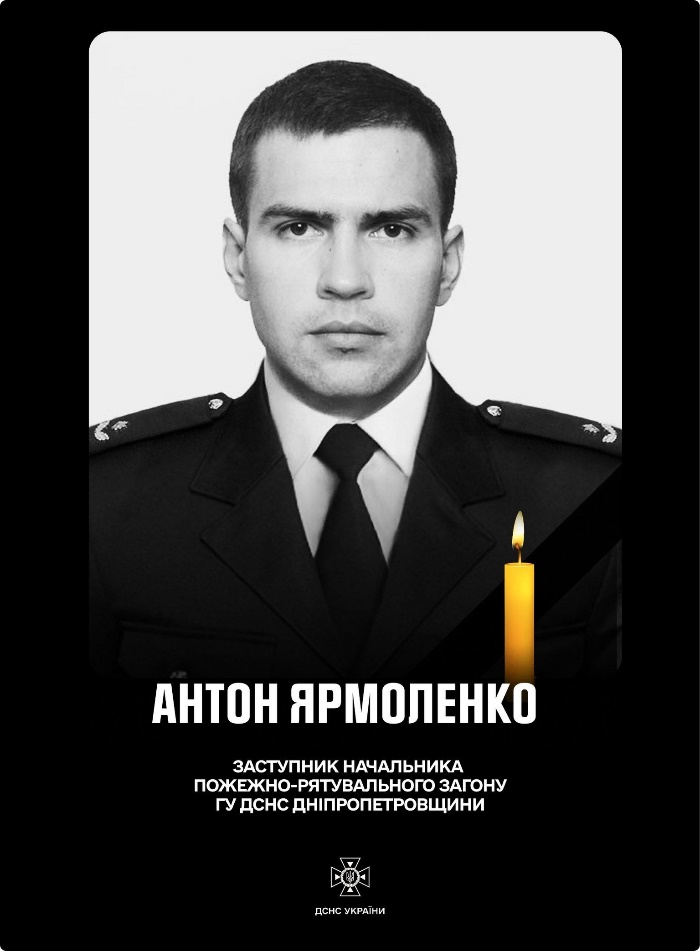
A photo of late Anton Yarmolenko, deputy chief of the resource provision unit of the 8th State Fire and Rescue Detachment in the regional State Emergency Service, published by the State Emergency Service. (State Emergency Service / Telegram)
THE STRIKE PACKAGE: 8 ZIRCONS, 33 ISKANDERS, CLUSTER MUNITIONS IN DNIPRO
Ukraine’s Air Force reported the composition of the June 1–2 strike package: eight 3M22 Zircon anti-ship hypersonic cruise missiles launched from occupied Crimea and Kursk Oblast, in two waves of four; 33 Iskander-M ballistic missiles from Bryansk, Kursk, Rostov, and occupied Crimea; 27 Kh-101 cruise missiles from Vologda Oblast; five Kalibr cruise missiles from the Caspian Sea; and 656 Shahed, Gerbera, Italmas, Banderol, and Parodiya drones from multiple directions. Russian forces continued the attack on June 2 with approximately 100 additional drones.
Ukrainian air defenses downed 11 Iskander-Ms, 26 Kh-101s, three Kalibrs, and 602 drones — 642 targets suppressed or destroyed in total. Thirty ballistic missiles, three cruise missiles, and 33 drones broke through, striking 38 locations; debris fell on 15 more. The Iskander-M and Zircon penetration rate reflects the central problem Zelensky has been raising for weeks: Ukraine’s Patriot interceptor stock is nearly exhausted. “If Ukraine is not protected from ballistic and other missile strikes, these strikes will continue,” Zelensky said. He added that the five Kalibr missiles in this package contained 145 imported components; 33 Iskanders contained 1,122 foreign parts; 650 drones relied on more than 17,000 components. “These are large-scale schemes designed to bypass sanctions. And this is absolutely real complicity in the killings.”
Zelensky announced he had been briefed by Defense Intelligence head Ivashchenko on Russian missile production, including production facilities, quantities, supply routes for critical components, and the foreign individuals and companies helping Russia bypass sanctions. “We are preparing updates to our countermeasures,” he said. He also disclosed that military intelligence has obtained new Russian internal documents on political planning concerning Ukraine’s relations with Moldova, the South Caucasus, and the Middle East — revealing that one of Russia’s key political tasks is to restrict Ukraine’s security and economic ties with those regions.
MAJOR ANTON YARMOLENKO: KILLED BY THE SECOND STRIKE WHILE SAVING OTHERS
The State Emergency Service named the rescue worker killed in Dnipro on June 2: Major Anton Yarmolenko, deputy chief of the resource provision unit of the 8th State Fire and Rescue Detachment of the Dnipropetrovsk regional DSNS. He responded to the first missile strike on the four-story apartment building that was partially destroyed by the attack. He was at the site, working to save survivors, when Russia launched a follow-up strike against the same location. He sustained fatal injuries and died. The agency’s head Danyk described him as “a reliable friend, a true professional, and a man with a big heart.” Interior Minister Klymenko confirmed: “At the time of the impact, he was on his way to respond to a call.”
The double-tap tactic is not random. Human rights organization Truth Hounds documented 401 cases of Russian repeat attacks against first responders from February 2022 through October 2025, resulting in 43 first responder deaths and 258 injuries. “The evidence suggests a sustained pattern, not a series of isolated accidents,” the organization concluded. Under international humanitarian law, deliberate strikes targeting rescue workers are prohibited. The Dnipro attack followed the same pattern as documented double-taps in Zaporizhzhia on May 30, where a second drone wave struck while emergency crews extracted a critically injured worker — and in dozens of other cities across Ukraine over four years.
KYIV: SEVEN KILLED, 90 WOUNDED, A CLINIC COLLAPSED, DEBRIS NEAR A KINDERGARTEN
Kyiv’s air raid alert lasted more than three hours. Residents heard the first explosion at 1:30 a.m.; subsequent waves came at 2:15 a.m., 4 a.m., and 7:20 a.m. More than 81,000 people sheltered in metro stations overnight. Klitschko confirmed seven killed and 90 wounded in the capital, including two children; three children aged 3, 11, and 17 were among the injured.
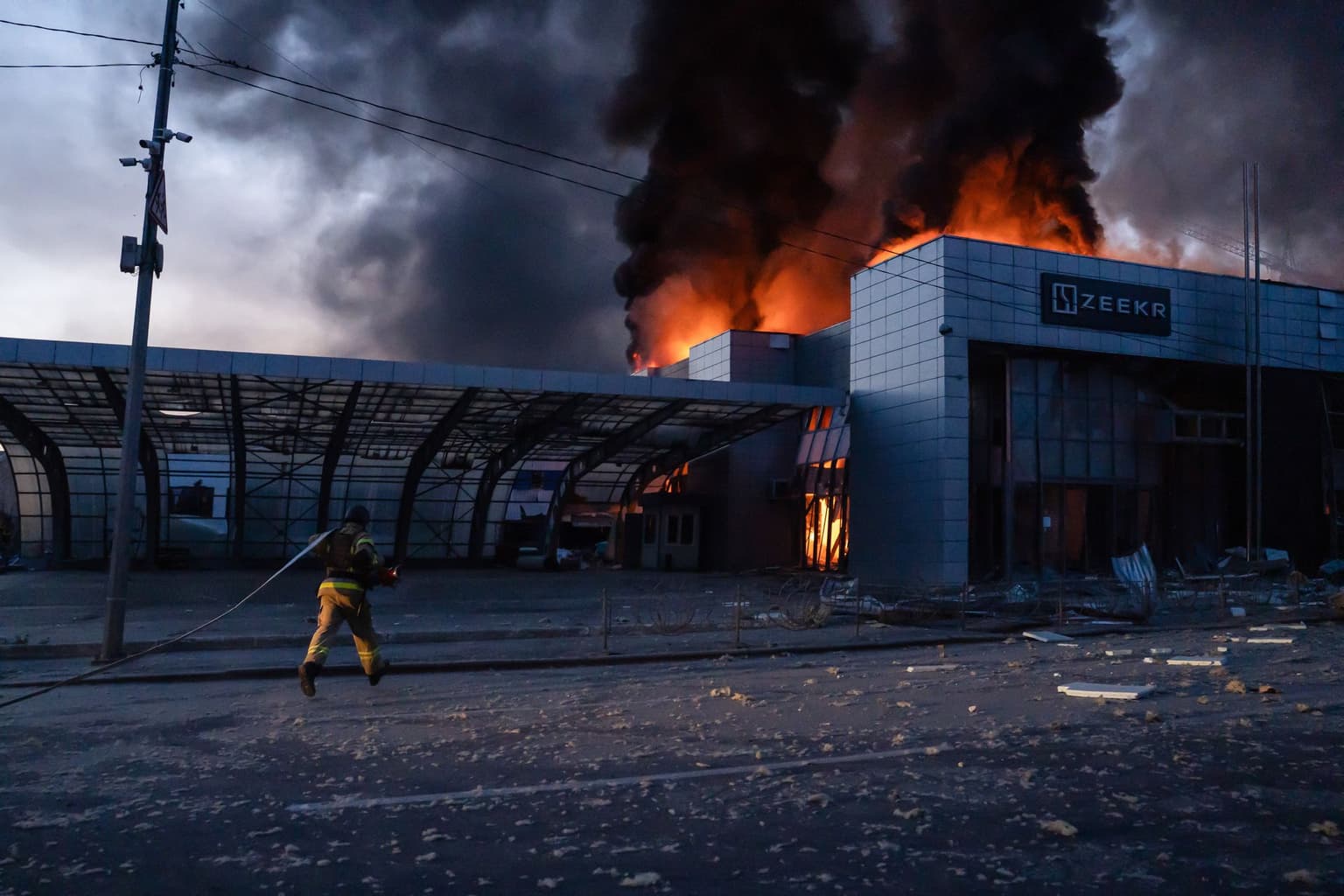
Ukrainian firefighter runs to extinguish a burning building damaged during a large-scale Russian missile and drone attack in Kyiv, Ukraine. (Patryk Jaracz/SOPA Images/LightRocket via Getty Images)
In Podilskyi district, a nine-story Soviet-era apartment block — struck previously in the May 24 attack — was hit again, causing a partial structural collapse. People were reported trapped. In Shevchenkivskyi district, a missile struck the 24th floor of a 24-story building, igniting a fire on the fourth and fifth floors. In Solomianskyi district, the upper floors of a 15-story building were damaged, with another fire on the seventh and eighth floors of a separate 24-story building. In Holosiivskyi district, a medical family clinic serving 20,000 people had its second and third floors partially collapse; ten doctors and nurses were working there. In Obolonskyi district, drone debris fell near a kindergarten and sparked a fire at a construction site. Power outages were reported in Podilskyi, Obolonskyi, and Sviatoshynskyi districts. Interior Minister Klymenko confirmed damage to a car dealership, a gas station, a municipal enterprise, an academy, utility facilities, and a Ministry of Internal Affairs service center.
DNIPRO: 16 DEAD INCLUDING TWO CHILDREN; FOUR-STORY BUILDING PARTIALLY DESTROYED
In Dnipro, Russian forces partially destroyed a four-story residential building and damaged more than 50 others, shattering over 2,000 windows. The death toll climbed through the day: four confirmed by morning, six by 9 a.m., seven by 9:35 a.m. when an eight-year-old boy’s body was recovered from the rubble, nine confirmed by Zelensky including a child — and reaching 16 by 5 p.m. as rescue operations continued. Thirty-seven people were injured, with 22 hospitalized; among the injured were a 16-year-old boy and a 13-year-old girl, both in moderate condition, and a 22-year-old man and a 71-year-old woman in serious condition. One child pulled from the rubble was born in 2023.
Mayor Filatov confirmed Russian forces used cluster munitions in Dnipro — specifically to maximize casualties among civilians, police, rescue workers, and utility crews responding to the first strikes. In the city of Kamianske, an administrative building and several apartment blocks were damaged; three people were injured. Poland scrambled its Air Force and allied aircraft to protect Polish airspace during the overnight assault.
KREMLIN’S FALSE JUSTIFICATION; ISW’S ASSESSMENT
Putin held a meeting on June 1, ahead of the overnight strikes, intended to reiterate claims that the May 22 Ukrainian strike in Starobilsk hit a civilian dormitory. Kremlin spokesman Peskov stated Putin issued military orders following the meeting. The Russian MoD published a list of military and defense industrial targets it claimed to have struck. The list does not match the footage: residential buildings, a medical clinic, a kindergarten’s surroundings, an eight-year-old boy’s apartment building.
ISW’s assessment is explicit: Russia would have conducted this strike regardless of the Starobilsk justification. The strike package takes weeks to assemble. Russia had threatened systematic strikes on Kyiv since May 25. The escalatory pattern — after the May 9–11 ceasefire embarrassed Putin by revealing he could not secure his own capital from Ukrainian drones — reflects a deliberate campaign to break Ukrainian morale and distract from battlefield setbacks. Russian ultranationalist milbloggers had been demanding a significant response for weeks. The Kremlin provided one — against apartment buildings, clinics, and rescue workers.
UKRAINE STRIKES ILSKY REFINERY FOR 16TH TIME; ILSKY, VOLGOGRAD, NOVOSHAKHTINSKY BDA CONFIRMED
Ukrainian forces struck the Ilsky oil refinery in Krasnodar Krai overnight June 1–2, causing a major fire confirmed by local witnesses and the Krasnodar Krai operational headquarters. Located roughly 500 kilometers from Ukrainian-controlled territory, Ilsky produces approximately 6.6 million tons of fuel annually. This was its 16th strike since February 2022, with the two most recent prior strikes both in February 2026. Russia’s Defense Ministry said its air defenses intercepted 148 drones overnight over eight Russian regions.
Updated battle damage assessments confirmed the full toll of recent Ukrainian strikes. A May 31 Neptune missile strike on the Novoshakhtinsky refinery in Rostov Oblast damaged both AVT-1 and AVT-2 primary refining units and caused a fire. The May 31 Lazarevo station strike in Kirov Oblast damaged two RVS-50,000 M3 tanks and main pumping station buildings. The May 31 Saratov Oil Refinery strike damaged the AVT-6 primary processing unit. Satellite imagery from June 1 confirmed a destroyed storage tank at the Yaroslavl-3 pumping station. Reuters confirmed the Volgograd Oil Refinery halted its CDU-1 unit — 40 percent of the plant’s total capacity — along with CDU-5 and CDU-6 following the May 29 strikes.
BELARUSIAN FUEL IMPORTS TO RUSSIA HIT 26 TIMES YEAR-AGO LEVEL; CRIMEA FULLY RATIONED
Russian state newswire TASS confirmed on June 2 that sales of Belarusian gasoline on the St. Petersburg International Mercantile Exchange are running 26 times higher than at the same point last year. Belarusian diesel sales are running three times higher. Russian business outlet RBK reported that Russian authorities are considering increasing the import damper for Belarusian fuel to incentivize more imports. Russian Interfax confirmed gasoline and diesel prices are rising in Moscow. Rosneft gas stations in Belgorod and Kursk oblasts imposed temporary restrictions on gasoline sales.
In occupied Crimea, Sevastopol governor Razvozhaev announced on June 2 that no AN-92 or AN-95 gasoline would be on sale at all except to ration ticket holders, promising deliveries “in the course of today.” Public response was skeptical. About 80 percent of Crimean fuel stations had empty reservoirs. Queues stretched one to three kilometers outside those still operating. Black market prices for higher-octane fuel reached the equivalent of $2.78 to $4.17 per liter, compared to under $1 per liter at mainland Russian retail prices. Tourists from mainland Russia, arriving for summer holidays, expressed surprise at the fuel shortages. Ukrainian strikes also closed the Dzhankoi railway station in northern Crimea after drones struck the switching yard, canceling the flagship Simferopol-St. Petersburg train service.
MID-RANGE STRIKE CAMPAIGN: PANTSIR DESTROYED, COMMAND POST HIT, NEVA RADAR STRUCK
USF Commander Brovdi reported that drones from the newly created Deep Strike Center struck two Pantsir air defense systems and a tugboat in occupied Crimea overnight June 1–2, along with the command post of the 5th Separate Command Battalion of the Russian 3rd Army Corps near occupied Shyrokyne in Donetsk Oblast — destroying at least 18 command staff and cargo vehicles and damaging four more. Ukrainian forces also struck a tank battalion deployment point of the 110th Motorized Rifle Brigade near occupied Zhelanne, a drone workshop of the 589th Motorized Rifle Regiment in occupied Donetsk City, and Neva-B and Neva-B2M coastal radar systems near occupied Mariupol. A Ukrainian drone regiment struck a Pantsir-S1 near occupied Vydne in Crimea, roughly 159 kilometers from the frontline, and a demagnetization vessel and Dnepr Flotilla command post near occupied Mizhovodne in Crimea.
On the M-14 highway, geolocated footage confirmed a Russian fuel truck on fire near occupied Prymorsk, roughly 94 kilometers from the frontline. Additional footage confirmed drone strikes against a fuel truck near occupied Yelyseivka and a transport truck near occupied Sofiivka, both roughly 65–72 kilometers from the frontline along the H-30 highway. Ukrainian forces struck a drone control point near occupied Luhove southwest of Orikhiv. A geolocated video published June 1 shows a Ukrainian cruise missile striking a garrison of the Russian 126th Coastal Defense Brigade near occupied Perevalne in Crimea, roughly 237 kilometers from the frontline.
FRONTLINE: NO CONFIRMED ADVANCES; COUNTERATTACKS AT BOROVA AND SLOVYANSK; SUMMER FOLIAGE
Neither Russian nor Ukrainian forces made confirmed advances on June 2. Russian forces continued offensive operations in the Kharkiv, Kupyansk, Borova, Slovyansk, Kostyantynivka, Dobropillya, Pokrovsk, Novopavlivka, Oleksandrivka, and Hulyaipole directions but did not advance. Ukrainian forces counterattacked south of Borova and southeast of Slovyansk. In the Sumy Oblast border area, geolocated footage confirmed Ukrainian forces striking a Russian position northeast of Bachivsk after a Russian infiltration mission.
A Ukrainian artillery battery deputy commander operating in Oleksandrivka reported that warmer weather and summer vegetation are changing the battlefield in both directions: Russian forces are conducting infiltration missions under foliage concealment, making them harder for drone operators to detect; but warmer weather also extends drone battery life, growing the “kill zone” as drones can operate longer before needing to return. Russian forces are fielding fewer heavy artillery systems because they are vulnerable to drone strikes, but are still deploying mortars heavily. A Ukrainian observer released footage of a May 19-20 strike against a command post of the Russian 1st Volki Volunteer Reconnaissance-Assault Brigade in occupied Soledar, killing 14 personnel and injuring at least one other. Ukrainian forces also struck a BM-21 Grad multiple rocket launcher near Sribne in occupied Donetsk Oblast.
RUSSIA’S DUMA MEMBER PREDICTS FALL MOBILIZATION; BUDANOV ON KREMLIN’S REAL FEAR
State Duma deputy and former Defense Committee member Andrei Gurulev wrote on Telegram on June 2 that “behind the scenes and in high offices, there is active discussion about the need for a new large-scale mobilization,” stating that “a fundamental decision on this matter has already been made” and that it will occur in fall 2026. He described Russia’s winter-spring campaign as having failed to produce expected results. “The advance has essentially stalled. The Special Military Operation has finally turned into a brutal stalemate.” Gurulev warned that mobilization without addressing the drone problem will simply increase casualties: “We will simply see a multiple increase in casualties.” He also noted that Crimea is “a frontline region” and that Russia must “hold those responsible for failures on the Novorossiya highway accountable.”
Presidential Office Head Budanov, speaking June 1 at the Architecture of Security Forum, stated that the Kremlin’s deepest fear is not economic decline but the destabilization of Putin’s political system. “This is what they fear. Everything else, economic decline and similar problems, they will survive.” He described Ukrainian deep strikes as producing social pressure inside Russia that economic data cannot capture. Budanov also warned that European governments must have a unified position before engaging Moscow in diplomacy: “An alliance cannot be serious if every decision must be adopted unanimously by many countries at the same time.” He assessed Putin will not voluntarily leave power: “After building a stable system for 27 years, why would he?” He said some “half-prospects” for future diplomatic movement have now appeared.
RUSSIA DEMANDS ROLE IN ITS OWN DRONE STRIKE INVESTIGATION; ROMANIA SUMMONS UN SESSION
Russia’s UN Ambassador Nebenzya requested, at an emergency UN Security Council session called by Romania on June 2, that Russia be allowed to participate in the investigation of its own drone strike on the Galati apartment building. He stated Russia “is ready to participate in such an investigation, but, of course, only if we are provided with objective data and the drone debris for analysis.” He simultaneously suggested the incident may have been a Ukrainian “provocation.” Romanian President Dan, in a BBC interview, confirmed Russia bears full responsibility while acknowledging the drone “strayed” after being hit by Ukrainian air defenses. Ukraine’s forensic confirmation on May 31 that the debris was structurally identical to a Russian Geran-2 was not disputed by any government at the Security Council session.
ZELENSKY TO ATTEND G7 IN EVIAN; HUNGARY LIFTS TWO-YEAR ARMS REIMBURSEMENT VETO
Politico reported on June 2 that Zelensky will attend the G7 summit in Evian-les-Bains, France, on June 15–17, to discuss diplomatic efforts to end the war and Ukraine’s critical need for additional anti-ballistic missile systems. French officials had earlier suggested Zelensky was not invited; the plans represent a shift. France holds the G7 presidency in 2026 and has designated addressing geopolitical crises — including Ukraine — as a central priority.
Hungary formally lifted its two-year veto on EU arms reimbursements to Ukraine on June 2, unlocking €6.6 billion under the European Peace Facility. The move, under new Hungarian Prime Minister Magyar’s government, ends a blockade that had lasted since 2024 and eases tensions within the EU over delayed military support. It also opens the path for further funding discussions and removes a key obstacle to Ukraine’s EU accession progress.
ARMENIA’S JUNE 7 ELECTION: RUSSIA’S PLAYBOOK FAILING, STRUCTURAL DEPENDENCIES REMAIN
Armenia holds parliamentary elections on June 7 in a contest that analysts describe as a referendum on the country’s geopolitical alignment. Prime Minister Pashinyan’s Civil Contract party is expected to win, with his 2026 electoral platform focused on European integration and a peace deal with Azerbaijan. Trump endorsed Pashinyan on May 27. Putin threatened an “Ukrainian scenario” for Armenia and pulled Russia’s ambassador from Yerevan. Russia imposed export bans on Armenian mineral water, cut flowers, vegetables, and strawberries, and threatened to cancel duty-free energy agreements.
Analysts assessed Russia’s interference as “an old playbook which by now is looking rather obsolete.” Armenia’s public support for Russia has fallen from over 80 percent before the lost Karabakh war to approximately 35 percent now. However, structural dependencies remain: Russian Railways manages Armenia’s rail network under a 2008 concession Moscow refuses to transfer; up to 40 percent of Armenia’s electricity comes from a nuclear plant co-owned with Russia; and Russia supplies all its gas. If Pashinyan wins a constitutional majority, a peace deal with Azerbaijan could open alternative trade routes that reduce these dependencies. The U.S.-Armenia TRIPP corridor framework, signed May 26, provides a transport alternative bypassing Russia entirely.
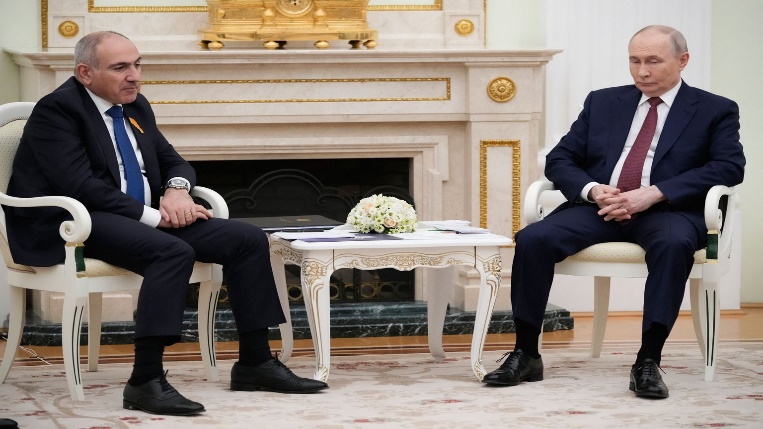
Russian President Vladimir Putin (R) speaks with Armenian Prime Minister Nikol Pashinyan (L) during their meeting at the Kremlin in Moscow, Russia. (Pavel Bednyakov / Pool / AFP / Getty Images)
Russia killed 22 civilians. Two of them were children. One was an eight-year-old boy pulled from the rubble of his apartment building. One was born in 2023. Anton Yarmolenko arrived to save people and was killed by the second strike. Cluster munitions were used in a residential neighborhood. Eight Zircon hypersonic missiles flew toward a city that has already absorbed months of bombardment.
Belarusian fuel imports to Russia are running 26 times higher than a year ago. Crimea has no gasoline. A State Duma member says fall mobilization has already been decided. Putin’s generals tell him they are winning. His maps say otherwise.
Day 1,560. The largest strike package of the full-scale war. The dead include a man who ran toward the blast.
A PRAYER FOR UKRAINE
1. For Anton Yarmolenko
Lord, Major Anton Yarmolenko ran toward the burning apartment building in Dnipro. He was a deputy chief of rescue, a man whose work was saving others. Russia sent a second wave of missiles while he was still there. He sustained fatal injuries and died. He was a reliable friend, a true professional, and a man with a big heart — in the words of his own service. Receive him. Sustain his colleagues who will continue doing this work knowing what it costs. And let his name be remembered not as a statistic but as a man who ran toward the blast.
2. For the Child Born in 2023
Father, a child born in 2023 was pulled from the rubble of a four-story apartment building in Dnipro. That child was two or three years old. We have no name. We have only the year of birth and the image of rescuers finding a body that small under collapsed concrete. This child never lived a day without war. Receive them. And let every leader with the power to change this situation feel the weight of a child born in 2023 dying in the rubble of their home on June 2.
3. For the 81,000 in Kyiv’s Metro
God of the sheltered, 81,000 people went underground in Kyiv’s metro stations on the night of June 1–2. They brought children and blankets and phones and waited for the city above them to stop shaking. Four years of this. Four years of metro platforms as shelters, of learning which exits to use, of children who know how to respond to sirens. Sustain them. Give them the air defense systems their president is asking for. Let the night come when nobody has to shelter underground while their city burns above.
4. For the Clinic in Holosiivskyi
Lord, the family outpatient clinic in Kyiv’s Holosiivskyi district had its second and third floors partially collapse. It serves 20,000 people. Ten doctors and ten nurses work there. Its director stood outside looking at the rubble of her office — “just bricks inside” — and said their task now is to organize themselves and keep providing care from another location. We pray for every medical worker rebuilding a practice from the street. And for the 20,000 patients who will find their clinic gone on Monday morning.
5. For the Long Arc of Accountability
God of justice, Russia used cluster munitions against civilians and first responders in Dnipro. It conducted deliberate double-tap strikes. It deployed hypersonic missiles at residential blocks. Zelensky confirmed that every drone and missile in this assault contained foreign components sourced through sanctions-evasion schemes. The complicity is documented. The deaths are documented. Let the chain of accountability — from the foreign component suppliers to the commanders who ordered the double-tap — eventually hold. In Your mercy, in Your justice, in Your time — bring this war to its end, and let the ending be worthy of what Ukraine has endured.