
Ukraine Daily Briefing | June 3, 2026 | Day 1,561 of the Full-Scale Invasion
Prepared by Dayana Bozhyk
As Putin’s flagship economic forum opened in St. Petersburg, Ukrainian drones set fire to the city’s oil terminal and the missile corvette Boikyi at Kronstadt Naval Base — 1,100 kilometers from Ukraine’s border — while striking the Michurinsk missile-guidance plant in Tambov Oblast overnight. NATO Secretary General Rutte arrived in Kyiv, chaired the first-ever NATO-Ukraine Council meeting on Ukrainian soil, and gave a direct address to potential Russian conscripts: “There is a very high chance you’ll die or be wounded — and odds are you will be left to suffer in the mud.” Russia’s Lyman encirclement attempt is collapsing, white phosphorus hit Kostyantynivka, another rescue worker died in a double-tap strike, and Hungary cleared the path for Ukraine’s first EU accession cluster.
THE DAY’S RECKONING
The Kremlin had spent weeks preparing the optics of the St. Petersburg International Economic Forum — its annual gathering of global investors, its platform for projecting economic resilience, its answer to Davos. On the morning of June 3, as the first delegates were arriving at the Expoforum convention center, black smoke was rising over the harbor. Ukrainian drones had struck the St. Petersburg Oil Terminal, 17 kilometers from the venue. The fire was large enough to be photographed from the city center. Pulkovo Airport activated its emergency procedure; more than 30 flights were delayed or diverted.
Simultaneously, Ukrainian USF drones reached Kronstadt Naval Base, west of St. Petersburg, and set fire to the Boikyi — a Project 20380 Steregushchy-class corvette armed with guided missiles. The ship had escorted Russia’s shadow oil fleet through the English Channel in 2025. It was in dry dock for scheduled repairs. Now it was burning. The Ukrainian General Staff confirmed: ships and port infrastructure at Kronstadt were hit. Brovdi: “The USF birds hunted and set fire to the corvette Boikyi, a carrier of guided missile weapons.”
In Tambov Oblast, overnight, Ukrainian forces struck the Progress Plant in Michurinsk — a facility that produces gyroscopic stabilization devices, autopilots, and navigation equipment for Russian Kh-101 and Kh-59 cruise missiles. This was its fourth reported strike. Fire Point’s Shtilerman posted on social media: “We really wanted to organize an excursion for guests to the cruiser Moskva. We had to sink two other ships right at the event site.”
Putin’s response, through Peskov: Russia’s strikes on Ukraine are “already systemic.” The smoke over St. Petersburg would not change the forum’s agenda. The forum’s agenda, however, was being conducted under the smoke of a country that, on June 2, had killed 22 Ukrainian civilians and was now watching its own naval base and oil terminal burn on live television.
THE ST. PETERSBURG STRIKE: OIL TERMINAL, KRONSTADT, TAMBOV — 1,100 KILOMETERS DEEP
Ukrainian forces struck three targets overnight June 2 to 3 in a coordinated deep-strike operation conducted by the USF, SBU, Special Operations Forces, Defense Intelligence, and State Border Guard Service. The St. Petersburg Oil Terminal, located on the Gulf of Finland at the city’s Great Port, receives and ships petroleum products by river, rail, and motor transit and handles 10 million tons per year — one of the largest oil transfer complexes on the Baltic Sea. The strike caused a confirmed large fire. Geolocated footage showed smoke rising over the facility from multiple points. Brovdi noted this was the 20th Ukrainian strike against oil infrastructure in St. Petersburg since May 1, 2026.
At Kronstadt Naval Base, west of the city, USF drones tracked and struck the Boikyi — a Project 20380 Steregushchy-class corvette that entered service in 2013, designed for multi-role operations including surface, airborne targets, and coastal strike support. The ship had been undergoing scheduled repairs since February. Brovdi confirmed a large-scale fire on board; the General Staff confirmed the vessel was hit and damage was being assessed. Leningrad Oblast Governor Drozdenko said 50 drones were shot down over the region, without commenting on the fires at the port.
At Michurinsk in Tambov Oblast, roughly 600 kilometers from Ukraine’s border, Ukrainian forces struck the Progress Plant. The General Staff stated the plant produces parts for control systems for Russian aviation and missile technology, including gyroscopic stabilization devices, autopilots, and navigation equipment for Kh-101 and Kh-59 cruise missiles. Tambov Oblast Governor Pervyshov acknowledged Ukrainian strikes on Tambov Oblast. This was the plant’s fourth recorded strike, following attacks in December 2024, June 2025, and February 2026.
BATTLE DAMAGE ASSESSMENTS: ILSKY CONFIRMED; ZENZEVATKA STATION HALTED; VOLGOGRAD UPDATED
The Ukrainian General Staff released updated battle damage assessments on June 3. The June 2 strike on Ilsky Oil Refinery in Krasnodar Krai — its 16th strike since 2022 — damaged the technological overpass, the AVT primary oil processing unit, and two RVS-5000 storage tanks. The June 2 strike on the Zenzevatka oil pumping station in Volgograd Oblast forced the station to stop pumping entirely. This adds to the cumulative picture of Russia’s refining and logistics network: Volgograd’s CDU-1 unit halted; Syzran fully shut; Novoshakhtinsky AVT-1 and AVT-2 damaged; Lazarevo station’s main pumping buildings damaged; Yaroslavl-3 storage tank destroyed. Nearly 40 percent of Russia’s primary refining capacity remains offline.
RUBIO: ‘STRATEGIC DISASTER’; RUTTE IN KYIV; FIRST NATO-UKRAINE COUNCIL MEETING ON UKRAINIAN SOIL
NATO Secretary General Rutte arrived in Kyiv on an unannounced visit on June 3, one day after Russia’s mass strike killed 22 civilians. He and Zelensky chaired the first-ever meeting of the NATO-Ukraine Council on Ukrainian soil, attended by representatives of all 32 alliance members. Rutte: “As Ukraine continues to stand strong, to innovate and to make battlefield gains, Russia is increasingly desperate.” He and Zelensky confirmed NATO and Ukraine have not abandoned the goal of Ukrainian membership. Six countries announced PURL contributions at the meeting. Rutte also addressed potential Russian recruits directly: “You are being sold a raw deal. Men like you who join the fight, you won’t be trained. There is a very high chance you’ll die or be wounded while you’re out there. And odds are that if you are wounded, you will be left to suffer in the mud and die.” He cited NATO estimates of more than 30,000 Russian casualties per month, noting this exceeds Soviet losses across the entire decade-long Afghanistan war in a single month.
U.S. Secretary of State Rubio, speaking at SPIEF, called Russia’s invasion a “strategic disaster” and said Moscow would not achieve its original war aims. EU foreign policy chief Kallas told AFP that Ukraine’s deep strikes are causing “panic” in the Kremlin, forcing Moscow to intensify strikes on Ukrainian civilians. Zelensky characterized ballistic missiles as Russia’s “final argument,” described Russian losses at 30,000–35,000 troops per month, and said May was the first month in which Russia achieved “almost no significant results on the battlefield.” He confirmed six countries contributed to PURL in May and will contribute in June, and discussed with Rutte additional long-term financial security guarantees to be pursued at the G7 and NATO Ankara summits.
ZELENSKY’S PATRIOT ULTIMATUM: ONE WEEK OR PERSONNEL CONSEQUENCES
Zelensky convened a meeting on June 3 with defense, foreign policy, and security officials on additional Patriot air defense procurement, then issued a public ultimatum. “We already have an agreement at the highest political level on the purchase of Patriot systems, and that agreement is now awaiting implementation on the financial, legal, and technical levels. The process has dragged on for too long.” He set a one-week deadline for all preparatory steps: “I expect a report on Friday — either there is clarity on implementing our Patriot agreement, or there will be serious personnel decisions.” He later confirmed Ukraine had reached agreement with the U.S. and other allies to acquire Patriot systems, but that the waiting line is measured in years — beginning circa 2030 — unless Ukraine can take over another country’s queue position, which requires paying for the contract.
The underlying problem: Ukraine reached an agreement with U.S. defense manufacturers in 2025 on new Patriot systems, but delivery would not begin until 2030. The EU loan disbursement delay prevented Ukraine from pre-paying to secure an earlier queue position. Zelensky: “Iran is issue number one for the United States of America. Unfortunately, we are in the queue for these wars.” He appealed to Rutte and the NATO framework as an alternative supply path and raised the possibility of licensing PAC-3 production in Ukraine if direct sales remain blocked. Japan’s Councillor Matsuzawa separately called on Japan’s Defense Minister Koizumi to export Mitsubishi-produced PAC-3 missiles to Ukraine; Koizumi responded that Japan “is not currently considering weapons transfers to Ukraine.”
FIRE POINT TESTS FP-7.X INTERCEPTOR MISSILE FOR FREYJA ANTI-BALLISTIC SYSTEM
Ukrainian arms manufacturer Fire Point released footage on June 3 showing a successful test flight of its FP-7.X missile, the platform intended for the company’s FREYJA anti-ballistic defense system. Chief Technology Officer Terekh described the test as “a fully controlled maneuvering flight conducted just days ago.” The FP-7.X is designed to fly at speeds of 1,500–2,000 meters per second and measures 7.25 meters in length. Fire Point targets delivery of a ballistic missile defense capability by 2027, with interceptors expected to cost under $1 million each — compared to several million dollars per Patriot PAC-3 interceptor. Fire Point first announced FREYJA in April; the June 3 footage is the first public evidence of a controlled test flight.
LYMAN ENCIRCLEMENT FAILING: 20TH AND 25TH ARMIES BOGGED DOWN; RUSSIAN SPRING OFFENSIVE STALLS
Military observer Mashovets published a comprehensive assessment on June 3 documenting the failure of Russia’s spring-summer 2026 offensive in the Lyman-Slovyansk direction. The 20th Combined Arms Army failed to seize Drobysheve and Novoosynove and advance toward Oleksandrivka; Ukrainian forces cleared Russian infiltrators from Yarova. The 25th CAA failed to recapture positions near Ozerne and Yampil and holds only isolated positions near Dibrova. Russian forces hold positions along the T-05-13 Lyman-Zakitne road but face intense flanking pressure. Russian reports of positions in northern and northeastern Lyman are false — only a small isolated section in the southeast was infiltrated.
Mashovets assessed that the Russian military command has reinforced the 20th and 25th CAAs with 1st Guards Tank Army assets but cannot overcome the structural problem: the 20th CAA is tasked with advancing toward Svyatohirsk, Oleksandrivka, Lyman’s outskirts, Borova, and Oskil simultaneously, without sufficient forces for any of them. The 25th CAA similarly lacks forces for its assigned role. The operational situation is worse than summer 2022 — when Russian forces held Izyum to the northwest and ultimately lost both Izyum and Lyman in Ukraine’s fall counteroffensive. The failure of the Lyman encirclement attempt is impeding the broader Russian advance toward Slovyansk and Kramatorsk and is forcing the Southern Grouping to plan a direct frontal assault on Slovyansk from the east instead. Ukrainian forces meanwhile maintain or have recently advanced in Sosnove, Pryshyb, Novoselivka, Yarova, Drobysheve, Svyatohirsk, Staryi Karavan, and Brusivka.
WHITE PHOSPHORUS IN KOSTYANTYNIVKA; DOUBLE-TAP KILLS RESCUE WORKER IN ZAPORIZHZHIA; FAB-250 ON KRAMATORSK
Russian forces struck northwestern Kostyantynivka with a white phosphorus munition on June 3, confirmed by geolocated footage and a Ukrainian brigade operating in the direction. Protocol III of the Convention on Conventional Weapons prohibits the use of incendiary weapons against civilian targets or in areas with concentrations of civilians. Russian forces have previously used white phosphorus in Ukraine in likely violation of international law. Separately, Russian forces struck a clearly marked humanitarian evacuation vehicle in the Druzhkivka direction with an FPV drone, reported by the Proliska humanitarian mission head Kaplin.
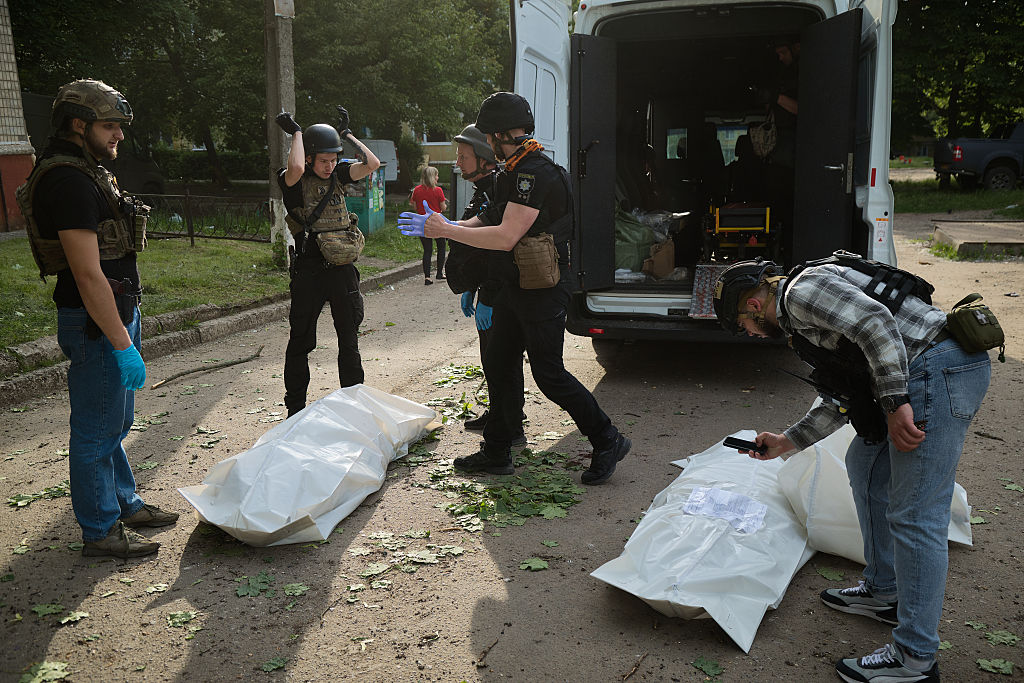
Police officers evacuate body bags containing the remains of residents following an aerial strike on a residential area by Russian troops, in Kramatorsk, Donetsk Oblast. (Pierre Crom/Getty Images)
In Zaporizhzhia Oblast, Russian forces conducted a double-tap missile strike against a fire station, killing a rescue worker who was responding to the aftermath of an earlier strike. This follows the June 2 double-tap in Dnipro that killed Major Anton Yarmolenko and is the latest documented instance in Truth Hounds’ confirmed pattern of 401 repeat strikes against first responders since February 2022. In Kramatorsk, Russian forces struck the city with a FAB-250 glide bomb, killing three people and injuring four.
OVERNIGHT DRONES: 198 LAUNCHED, 189 DOWNED; FIVE KILLED ACROSS UKRAINE
Russian forces launched 198 Shahed, Gerbera, Italmas, and Parodiya drones overnight June 2 to 3 from Bryansk, Kursk, Oryol, Millerovo, Primorsko-Akhtarsk, and occupied Hvardiyske in Crimea. Ukrainian air defenses downed 189. Eight drones struck seven locations; debris fell on seven more. Russian attacks killed at least five people and injured 60 across Ukraine.
In Sumy Oblast, a targeted drone strike on a residential building in Mykolaivska community killed a 64-year-old man and injured his 84-year-old mother. A second Sumy attack killed a 72-year-old man and injured 15 people, including three children, across 33 targeted settlements. In Kharkiv Oblast, overnight strikes injured 11 people, including four in Kharkiv city; morning strikes killed two men — a 29-year-old and a 65-year-old — in Rokytne and killed one person and injured four in Kharkiv itself. In Zaporizhzhia, one person was killed and three injured across 41 targeted settlements. In Kherson Oblast, 19 people were injured, including a child, across 38 targeted settlements. In Donetsk Oblast, two people were injured in Druzhkivka and Dobropillia. In Odesa, two men aged 20 and 36 were injured when a drone struck a parking lot.
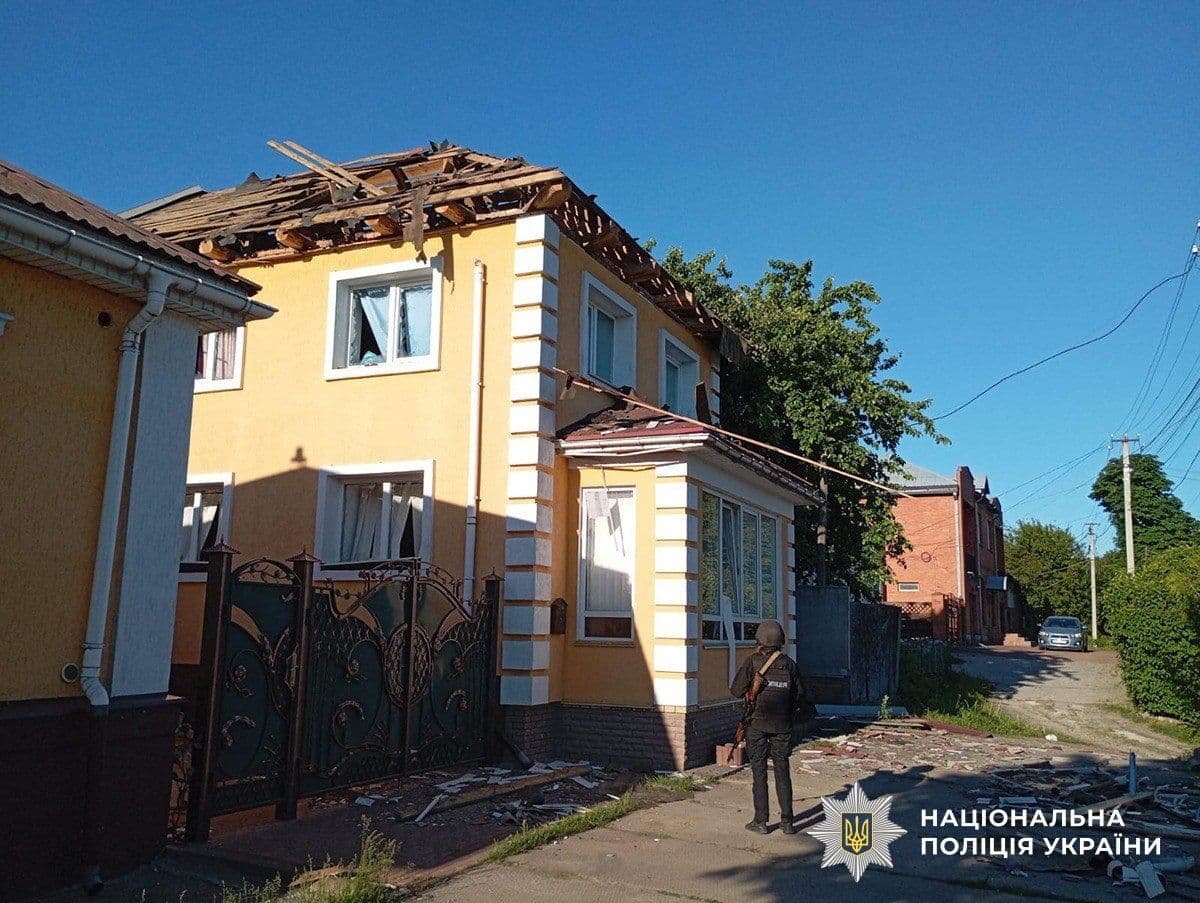
One of the houses which were hit or damaged in Russian attacks in Sumy Oblast. (The National Police of Ukraine / Telegram)
RUSSIA FABRICATES JUSTIFICATION: OCCUPIED BUS STRIKE IN YENAKIIEVE
Donetsk People’s Republic Head Pushilin claimed on June 3 that Ukrainian forces struck a civilian bus on the Moscow-Simferopol route in occupied Yenakiieve, killing eight civilians and injuring 11. Geolocated footage confirmed a drone strike on the bus. Russian officials threatened retaliatory military response. Ukrainian officials did not comment; ISW cannot verify the Russian account. ISW’s assessment: Russia has intensified a pattern of weaponizing alleged Ukrainian civilian strikes — real or fabricated — to justify massive strike packages against Ukraine that Russia intended to conduct regardless. The Yenakiieve claim came one day after Russia launched the largest aerial assault of the full-scale war and killed 22 civilians. The claim is designed to shroud those strikes in a fabricated veneer of legitimacy.
MID-RANGE STRIKES: BERDYANSK DRY CARGO SHIP, SAKI NAVIGATION SYSTEM, CRIMEAN LOGISTICS
Ukraine’s Southern Operational Command reported that a Ukrainian regiment struck the Russian dry cargo vessel Leonid Pestryakov in the port of occupied Berdyansk, roughly 105 kilometers from the frontline. The General Staff reported a strike against a Russian RBSN-4N short-range navigation radio system at Saki airfield near occupied Novofedorivka in Crimea, roughly 185 kilometers from the frontline. Geolocated footage confirmed a drone strike on a Russian fuel truck on the M-14 highway near occupied Prymorsk, roughly 90 kilometers from the frontline. The General Staff confirmed a May 30 strike on the Primorskyi Posad training ground in occupied Zaporizhzhia Oblast inflicted at least 30 personnel losses and destroyed personnel shelters, with elements of the 64th Separate Motorized Rifle Brigade among those training there. Ukrainian forces also struck a fuel and lubricants depot near occupied Bilolutsk in Luhansk Oblast, roughly 83 kilometers from the frontline.
U.S. HOUSE ADVANCES $8 BILLION UKRAINE SUPPORT ACT OVER REPUBLICAN LEADERSHIP OPPOSITION
The U.S. House of Representatives advanced the Ukraine Support Act on June 3 by a 218–204 procedural vote, clearing the way for a final vote the following day. Six Republicans crossed party lines to support the measure, introduced by Rep. Gregory Meeks. The bill provides $8 billion in military financing for Ukraine, extends the Ukraine Security Assistance Initiative through 2027, and imposes additional sanctions on Russia. House Speaker Johnson had declined to consider the measure; its advancement reflected the first significant Ukraine aid momentum in Congress since Trump’s return to the White House. U.S. military aid to Ukraine dropped 99 percent in Trump’s first year back in office.
HUNGARY CLEARS EU ACCESSION CLUSTER; MINORITY RIGHTS DEAL CONFIRMED; FIRST OPENING TARGETED JUNE 15
Hungarian Prime Minister Magyar announced on June 3 that Hungary and Ukraine have reached an agreement on the rights of the Hungarian-speaking minority in Transcarpathia, clearing the last bilateral obstacle to opening Ukraine’s first EU accession cluster. EU Enlargement Commissioner Kos confirmed the announcement “opens the way for progress on the EU accession path of Ukraine.” The first cluster opening is targeted for June 15 in Luxembourg on the sidelines of an EU foreign ministers meeting, with June 16 as a backup. Clusters two and three may also open; clusters four and five — covering agriculture and transport — are unlikely to open due to Polish concerns about Ukrainian competition. Magyar noted that if Ukraine closes all 33 chapters, Hungary would hold a referendum on the issue — a timeline of “10 or 15 years.”
Hungary also confirmed Druzhba pipeline flows to Hungary and Slovakia returned to normal in May — the first full month of deliveries since April resumption. An investigation by Hungarian outlet Telex published June 3 found that the March seizure of a Ukrainian bank convoy carrying $82 million in cash and gold was ordered by then-Prime Minister Orban as retaliation for the Druzhba disruption, through Hungarian intelligence services, without lawful basis. New PM Magyar called on Orban to “take responsibility.”
UKRZALIZNYTSIA IN DEFAULT; CAPITAL FLIGHT SCHEME EXPOSED; RUSSIAN ULTRANATIONALISTS AT SPIEF
Ukrzaliznytsia CEO Pertsovskyi told Reuters on June 3 that the railway needs at least a 45 percent freight tariff increase to survive, describing it as “a compromise solution that allows us at least to hold out.” The company suspended coupon payments on over $1 billion in bonds in 2026, entering default. Russian attacks have targeted locomotives, depots, power substations, and bridges; 541 strikes damaged 1,718 railway facilities in the first quarter of 2026. The 45 percent increase would cover about half of the projected $587 million cash shortfall. Debt restructuring talks are targeted for a new proposal to lenders in July.
Ukraine’s State Tax Service disclosed a scheme involving 2,300 companies that executed $4.5 billion in foreign trade transactions before vanishing — signs of capital flight disguised as trade. Seven individuals each controlled more than 500 companies; over 7,000 entities are under their combined control. Investigators found shared IP addresses, shared physical registrations, and matching reporting patterns. At SPIEF in St. Petersburg, Kremlin-affiliated oligarch Malofeev and ultranationalist ideologue Dugin presented “future scenarios” for Russia through 2050 at the General Staff Academy. Their “good” scenario included Russian occupation of Kyiv, Odesa, and Kharkiv and the collapse of the EU by 2036. Their “continuing” scenario speculated Russia would use nuclear weapons if the battlefield situation remained unchanged. ISW assessed the scenarios were designed to make Kremlin rhetoric appear moderate by comparison.
GREECE FILES DIPLOMATIC PROTEST OVER UKRAINIAN DRONE FOUND IN ITS WATERS
Greece’s Foreign Ministry confirmed on June 3 that it filed formal diplomatic demarches with Ukraine on May 28 and 29 after fishermen found an explosives-laden naval drone on the shores of Lefkada on May 7. Foreign Minister Gerapetritis briefed EU foreign policy chief Kallas and NATO Secretary General Rutte on the investigation’s findings. Athens argued the drone “seriously endangered maritime traffic” and warned that extending military operations to the Mediterranean “could undermine Greece’s national security and harm its economy.” Ukraine’s Foreign Ministry stated there is no evidence the vessel was connected to Ukrainian naval drone operations.
Ukraine struck Putin’s showcase forum city on its opening morning. The St. Petersburg Oil Terminal burned. The Boikyi’s fire was visible from the harbor. A Kremlin-aligned oligarch’s “good scenario” for Russia included the occupation of Kyiv. Russia’s real scenario included a stalled encirclement of Lyman, white phosphorus in Kostyantynivka, and another rescue worker killed in a double-tap strike.
NATO met in Kyiv for the first time. Zelensky gave his officials one week to close the Patriot contract or face consequences. Fire Point tested its first domestic anti-ballistic interceptor. The U.S. House advanced $8 billion in Ukraine aid over its own leadership’s opposition. Hungary cleared Ukraine’s EU accession path.
Day 1,561. Black smoke over St. Petersburg. The forum opened on schedule.
A PRAYER FOR UKRAINE
1. For the Rescue Worker in Zaporizhzhia
Lord, a rescue worker in Zaporizhzhia Oblast responded to a Russian strike on June 3 and was killed by the follow-up. Another double-tap. Another professional who ran toward danger and was killed by the second wave. This has happened 43 confirmed times since February 2022. Each time is a person with a name and colleagues and a family. Receive this one. Hold everyone who still does this work knowing what it costs. And let the pattern — documented, deliberate, illegal — reach its accounting.
2. For the 64-Year-Old Man in Mykolaivska
Father, a drone struck a residential building in Mykolaivska community in Sumy Oblast and killed a 64-year-old man. His 84-year-old mother was injured. Two people, in their home, at the end of a day. We do not have their names. We have their ages and the name of their community. Receive him. Heal her. And hold the community of Mykolaivska, which has 33 Russian attacks on its settlements to endure today in addition to the death of one of its residents.
3. For the Ukrainian Engineers at Fire Point
God of ingenuity, Fire Point’s engineers tested an interceptor missile on June 3 that could become Ukraine’s first domestically produced anti-ballistic defense system. They are trying to build something that normally takes states decades and billions of dollars, in the middle of a war, under the sustained targeting of the facilities that would manufacture it. Chief Technology Officer Terekh: “No matter how unrealistic and ambitious this goal may sound today, we are exerting all possible and impossible efforts.” Sustain those efforts. Give them time, resources, and the protection their factory needs to reach 2027.
4. For the Six PURL Countries
Lord, six countries announced contributions to the Prioritized Ukraine Requirements List at the first NATO-Ukraine Council meeting held on Ukrainian soil. Their names were not disclosed. Their decision was made in Kyiv, one day after Russia killed 22 civilians. We give thanks for them. We pray they hold to these commitments through the summits at G7 and NATO Ankara, through the diplomatic exhaustion that comes after the initial solidarity fades. Let the six become more. Let the “six or seven allies doing the heavy lifting” become twenty.
5. For Ukraine’s Path to Europe
God of history, Hungary cleared the last obstacle to Ukraine’s first EU accession cluster on June 3. The opening is targeted for June 15. A process that Viktor Orban blocked for a year — the same man who ordered the seizure of a Ukrainian bank convoy as political retaliation — has been unblocked by his successor. The road ahead is ten to fifteen years, thirty-three chapters, a referendum. It is not short. But the door was opened today, and that matters. In Your mercy, in Your justice, in Your time — bring this war to its end, and let the ending be worthy of what Ukraine has endured.