
Ukraine Daily Briefing | June 4, 2026 | Day 1,562 of the Full-Scale Invasion
Prepared by Dayana Bozhyk
Zelensky published an open letter to Putin on June 4 proposing an immediate ceasefire along the current frontline, an “all-for-all” POW exchange, and a face-to-face meeting in a neutral country — Putin responded that if Zelensky wants to meet, he can come to Moscow. The U.S. House passed the $8 billion Ukraine Support Act 226–195, with 19 Republicans crossing party lines, the first significant Ukraine aid vote since Trump returned to the White House. Ukraine struck a gunpowder plant in Ryazan Oblast, a Svetlyak-class patrol vessel in the Sea of Azov, the Donetsk Airport drone base, and the Zaporizhzhia Thermal Power Plant switchyard came under attack, triggering the ZNPP’s 17th blackout of the full-scale war.
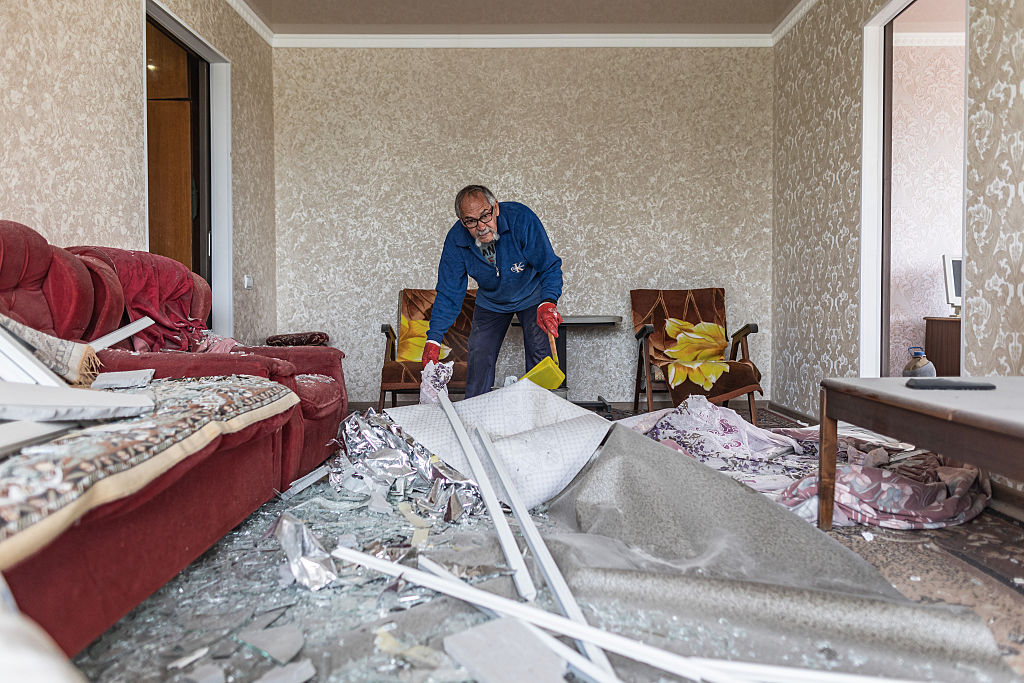
A man clears rubble from his home, which was damaged following a Russian air strike in Kramatorsk, Donetsk Oblast. (Diego Herrera Carcedo/Anadolu via Getty Images)
THE DAY’S RECKONING
The letter was 1,800 words long, addressed to Vladimir Putin, and published on the presidential website in the hours after Ukrainian drones had set his showcase city’s oil terminal and naval base on fire. Zelensky did not pretend to be negotiating from weakness. He listed Russia’s failures with precision: the Kyiv offensive that collapsed in three weeks, the Bucha massacre that mobilized the world, the drone campaign that has reached St. Petersburg, the 30,000 soldiers killed or seriously wounded in May alone, the fuel shortages that have spread from Crimea to Moscow’s suburbs, the second wave of mobilization that Putin is preparing but Russians do not want. “Enough of the war,” Zelensky wrote. “Ukraine offers to end this war.”
He proposed meeting in Switzerland, Turkey, or an Arab country. He proposed a ceasefire for the duration of negotiations, monitored by the United States. He proposed starting with an all-for-all prisoner exchange. He noted that the frontline — not Russia’s maximalist territorial demands — is the line from which diplomacy must begin. He ended with a warning that he framed not as a threat but as a historical fact: when Russia gets tired of war, changes happen.
Putin’s response, delivered through Peskov: “If Zelensky wants to meet with Putin, he can come to Moscow.” At a separate press conference, Putin said Russia is ready to end the war on the terms discussed at the Anchorage summit with Trump — which Kyiv understood to mean Ukrainian withdrawal from remaining Donbas territory. He also revealed, casually and without apparent awareness of the legal implications, that Russia struck Bila Tserkva with the Oreshnik on May 24 specifically because it was “convenient to observe the results.” Not a military target. A testing ground. With MIRV submunitions. Over a city.
Across the Atlantic, the U.S. House of Representatives passed the Ukraine Support Act 226–195. Nineteen Republicans crossed party lines. The discharge petition that forced the vote had been one signature short for months; an Independent former Republican provided the final signature. The bill provides $8 billion in military financing, extends the Ukraine Security Assistance Initiative through 2027, and imposes additional sanctions on Russia. It must pass the Senate and survive a probable White House veto to become law. But the vote happened. That is new.
ZELENSKY’S OPEN LETTER TO PUTIN: FULL TERMS, FULL ARGUMENT
The letter opens by noting that when Putin took power 26 years ago, many Ukrainians viewed him positively. “That was the case. That is already in the past.” It continues: “Almost half of your 26 years of power in Russia you have spent in the war against Ukraine. Whatever you say about NATO, geopolitics and the Russian language, this war is your personal choice — a war without a real reason. This is how history will remember it.”
Zelensky catalogued Russia’s vulnerabilities: 30,000+ soldiers killed or seriously wounded in May, with 63 percent killed and only 37 percent wounded — “in the 21st century, armies cannot afford such a balance”; the budget deficit already approaching $80 billion in five months; fuel shortages reaching Moscow’s suburbs; public fatigue with bans, price rises, and the prospect of mobilization. He noted that Russia had to turn to North Korea for help and is now “completely dependent on China — also for the first time in Russian history.” He stated plainly: “your resources are significantly reduced. You will not have enough money and political power to continue buying the loyalty of the Russians.”
The terms: a ceasefire along the current frontline as the starting point for negotiations; U.S. monitoring of the ceasefire; an all-for-all prisoner exchange as prologue to peace talks; return of deported civilians and children; and a bilateral summit in a neutral country — Switzerland, Turkey, or an Arab state — with the U.S. and Europe as security guarantors. “The front line now is the line from which diplomacy should begin.” The letter ends: “If you personally do not agree that it is time to end this war, Ukraine will continue to fight for its existence. But you will also have to fight much more for your existence — not Russia’s, but your own.”
Trump’s response: “I think it would be great if they met. They should get it done.” Putin’s response at his SPIEF press conference was to invoke Anchorage and to say Russia is “in no hurry.” He added: “Even if you put nine pregnant women together, nine women cannot give birth to a child in one month.” ISW assessed Putin’s reference to Anchorage terms as requiring Ukrainian withdrawal from remaining Donbas territory — a condition Ukraine has rejected and will not accept.
PUTIN REVEALS ORESHNIK STRIKE ON BILA TSERKVA WAS AN OBSERVATION TEST
Putin stated at a June 4 press conference at SPIEF: “I’ll reveal a major military state secret. We simply struck where it was convenient to observe the results.” He confirmed that the May 24 Oreshnik strike on Bila Tserkva was not aimed at a military target but was conducted to assess how the MIRV submunitions deployed. “We haven’t had a single combat use of the Oreshnik missile in the true sense of the word on Ukrainian territory,” Putin said. “Our drones flew in, into the barn they hit, and simply observed how the expanding blocks were placed. They calculated everything down to the millimeter. It was important for making a decision on the future on the full-format use of the Oreshnik on designated targets, including those in populated areas.”
Bila Tserkva has a population of approximately 200,000. Intentionally targeting civilian areas with a nuclear-capable intermediate-range ballistic missile for observational purposes, and stating that intent publicly, constitutes an admission of war crimes under the Geneva Conventions. EU High Representative Kallas called it “reckless nuclear brinkmanship” when the strike occurred. Putin’s confirmation of its purpose changes the legal characterization: this was not targeting error. It was a deliberate test in a populated area.
U.S. HOUSE PASSES $8 BILLION UKRAINE SUPPORT ACT 226–195
The U.S. House of Representatives passed the Ukraine Support Act on June 4 by a vote of 226–195, with 9 abstentions and 19 Republicans joining Democrats. The bill provides $8 billion in military financing for Ukraine, extends the Ukraine Security Assistance Initiative through 2027, imposes additional sanctions on Russia including against its oil and mining sectors, allocates funds for postwar reconstruction, establishes measures to counter Russian disinformation, and includes a mechanism to override presidential termination of existing sanctions without cause.
The vote was achieved through a discharge petition — a rarely used parliamentary tool that bypasses leadership to force a floor vote. Only one discharge petition has succeeded in the House from 2011 to 2022. This petition was one signature short for months; Independent Rep. Kiley, a former Republican, provided the final signature. Rep. Meeks: “Vladimir Putin is an authoritarian thug who ordered the invasion of Ukraine for his own imperialistic ambitions. He has ordered the kidnapping of Ukrainian children and the murder of innocent civilians.” The bill faces an uphill path in the Republican-controlled Senate and is unlikely to be signed by Trump without significant political pressure.
UKRAINE STRIKES RYAZAN GUNPOWDER PLANT AND SEA OF AZOV PATROL VESSEL
The Ukrainian General Staff confirmed overnight strikes on June 3 to 4. At the Elastik propellant powder plant of Gefest-M in Ryazan Oblast, Ukrainian forces struck the facility, causing a fire of over 400 square meters. Ryazan Oblast Governor Pervyshov acknowledged strikes on Ryazan Oblast. The plant produces propellant powder components used in Russian artillery rounds and missile propulsion systems. The strike is the first confirmed hit against a propellant manufacturing facility in Ryazan, roughly 180 kilometers southeast of Moscow.
USF Commander Brovdi confirmed a strike against a Project 10410 Svetlyak-class patrol boat near occupied Yurkyne on the Kerch Peninsula in the Sea of Azov, roughly 250 kilometers from the frontline. The 49-meter vessel is armed with 16 Igla MANPADS launchers, an AK-176 naval gun, machine-gun mounts, and six-barrel anti-aircraft autocannons, crewed by 28 personnel; it is responsible for port protection, air defense, and anti-submarine activity. The extent of damage is being assessed. Brovdi also confirmed strikes on Russian locomotives near occupied Vladyslavivka and Rozdolne in Crimea, and a Pantsir-S1 system near occupied Strilkove, and a fuel and lubricants warehouse in occupied Simferopol.
UKRAINE SYSTEMATICALLY DISMANTLES DONETSK AIRPORT DRONE BASE
The USF’s 14th Regiment published details on June 4 of an ongoing systematic strike campaign against the Russian-occupied Donetsk Airport, which Russian forces converted into a launch platform for Shahed-type drones operated by the elite Rubikon unit and a logistics hub for military supplies. Commander Hordiienko: “A decision was made to carry out systematic preemptive strikes that will disrupt enemy launches and reduce the number of enemy drones that will once again fly to attack kindergartens, high-rise buildings, and hospitals.” The campaign has destroyed launch pads, transport vehicles, fuel stations, logistics hubs, ammunition depots, and Shahed launch areas. Drone operator crews have been targeted on runways. Mobile fire groups and Russian air defense units in the area are being hunted to force flight cancelations. Hordiienko described it as “the first such operation of systematic asymmetric influence in modern history.” Ukraine previously struck the airport with Storm Shadow and ATACMS in March 2026.
ZNPP 17TH BLACKOUT; ZAPORIZHZHIA THERMAL PLANT UNDER ATTACK
The Zaporizhzhia Thermal Power Plant, whose switchyard supplies the last remaining power line to the Zaporizhzhia Nuclear Power Plant, came under heavy attack on the morning of June 4. The IAEA confirmed its on-site team observed smoke rising from the thermal power plant and heard military activity. The ZNPP experienced its 17th blackout of the full-scale war on June 3 — its fifth in 2026 — caused by a drone strike on the Nikopolska substation on the Ukrainian-controlled bank of the Dnipro River. IAEA Director General Grossi called for an immediate end to attacks, warning that the facility’s reliance on a single power line — repeatedly severed in recent weeks — poses a serious risk of an extended loss-of-power incident at Europe’s largest nuclear plant. Staff remained in shelters as of the morning of June 4.
RUSSIA’S SPIEF FACADE: STABLE ECONOMY CLAIMS VS. VTB’S RECESSION FORECAST
At SPIEF on June 4, Kremlin economic officials presented a coordinated picture of Russian strength. Presidential Administration Deputy Oreshkin: Russia’s economy grew 10 percent over three years while Europe grew only 3 percent; unemployment is the lowest in the world; there are no failures. Finance Minister Siluanov: Russia will soon repay its external debt; real incomes grew more than 24 percent in three years. Deputy PM Novak: the domestic fuel market is “stable” and gas station prices are rising in line with inflation.
The same day, VTB CEO Kostin told Reuters that Russia’s economic growth could stagnate in 2026 as high borrowing costs choke capital investment — and that VTB does not expect the 0.5 percent growth forecast by Russian officials to materialize. External context: the budget deficit reached 4.58 trillion rubles in the first quarter alone, already exceeding the planned annual deficit of 3.79 trillion rubles. Gasoline sales were restricted in Belgorod, Kursk, Moscow, and Leningrad oblasts in June. Crimea’s major gas companies suspended fuel coupon sales. Sevastopol distributed fuel only to emergency services. The Kremlin’s SPIEF narrative is designed for foreign investors and domestic consumption. VTB’s CEO said the quiet part aloud.
RUSSIA’S NEW BATTLE MANAGEMENT SYSTEM; CENTER-2026 EXERCISE IN SEPTEMBER
Russia’s Defense Ministry announced at the CSTO Defense Ministers meeting in Moscow on June 3 that it is testing a new battle management information system in Ukraine. Rostec presented the system, which integrates command and control from platoon to formation level in a single network. Defense Minister Belousov stated the Central Grouping of Forces is completing combat testing and the system will be deployed across all groupings by September 2026. ISW assessed Russia will likely debut the system at its Center-2026 strategic command-and-staff exercise, scheduled September 28 to October 3, which will include over 10 foreign military units from CSTO countries. The exercise would allow Russia to share battlefield management experience from Ukraine with CSTO partners and operationalize foreign military contingents under Russian command.
OCCUPIED UKRAINE’S CHILDREN: 24 PLACED FOR ADOPTION IN RUSSIA IN 2026; SUMMER CAMPS; YUNARMIA
The Luhansk Oblast occupation Commissioner for Children’s Rights Shvenk confirmed in a May 27 interview that 24 children from occupied Luhansk Oblast have been placed with Russian families in other Russian regions in 2026 alone, and 30 were placed in 2025. This directly contradicts the Russian federal Commissioner’s recent claim that Russia “does not have a program for adopting children from occupied areas.” ISW notes the contradiction constitutes evidence that Russia continues to adopt Ukrainian children into Russian families in violation of international law. The Luhansk oblast is not yet connected to the federal adoption database but maintains its own functional database.
Rostov Oblast will host 5,625 children from occupied Donetsk, Luhansk, Kherson, and Zaporizhzhia oblasts at summer camps in 2026, with 9,000 total from across Russia and occupied Ukraine. The regional budget allocated $19 million for children’s recreation including vouchers, food, and camp staff. Yunarmia — Russia’s paramilitary youth movement — has grown to 7,000 members in occupied Donetsk Oblast, up from 5,500 a year ago. The Zarnitsa 2.0 military-patriotic competition reached its regional stage in occupied Luhansk Oblast, with 300 students competing in drone operation, firearms handling, and political instruction. Ukraine’s Human Rights Commissioner Lubinets confirmed on June 4 that at least 707 Ukrainian children have been killed and 2,548 injured since February 2022, with 2,318 still missing. The youngest confirmed victim was a two-day-old baby.
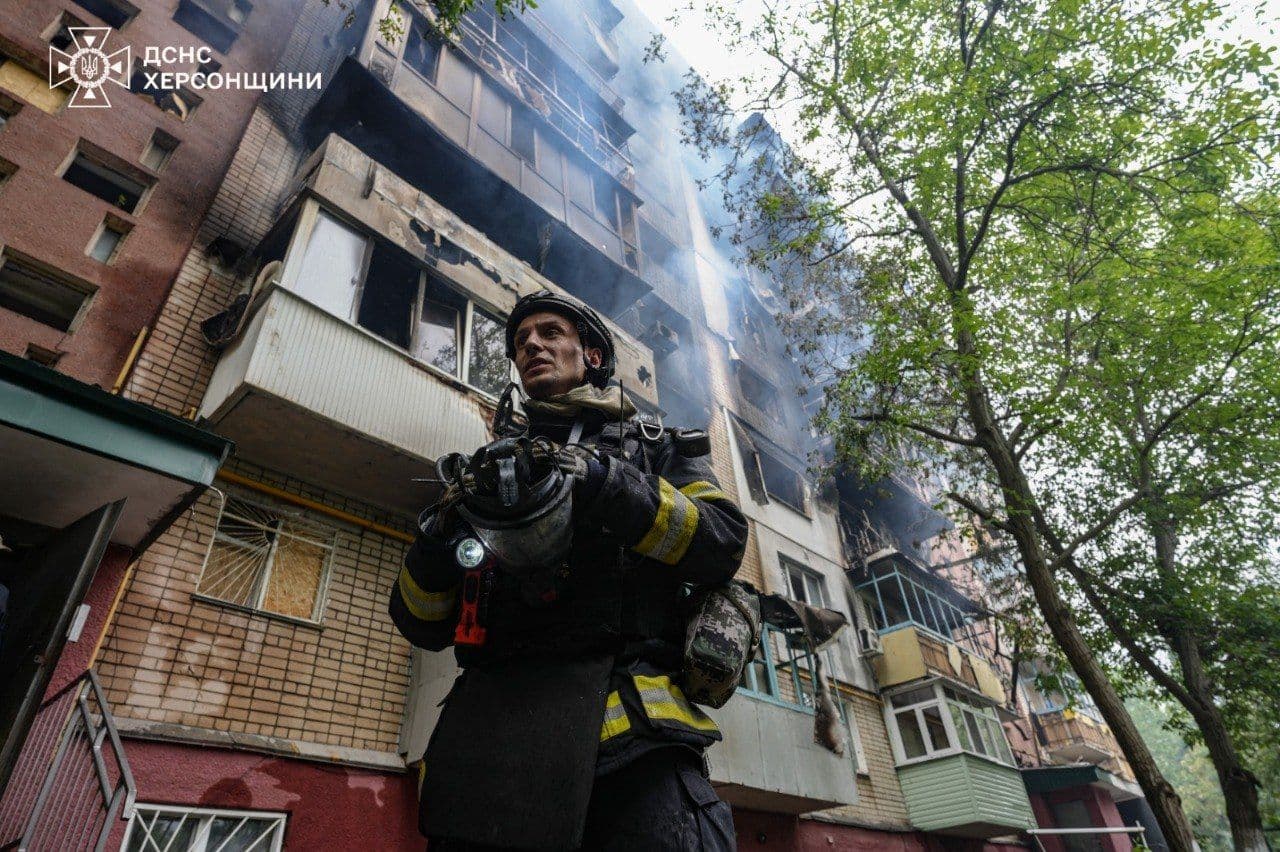
A firefighter extinguishes a blaze in a multi-story residential building in Kherson, Kherson Oblast, following a Russian attack. (Ukraine’s Emergency Service)
OVERNIGHT DRONES: 293 LAUNCHED, 264 DOWNED; 16 KILLED ACROSS SIX OBLASTS
Russian forces launched one Iskander-M from Voronezh Oblast and 293 Shahed, Gerbera, Italmas, Banderol, and Parodiya drones overnight June 3 to 4. Ukrainian air defenses downed 264 drones. The missile and 24 drones struck 11 locations; debris fell on 12 more. Russian attacks killed at least 16 people and injured 86 across Ukraine.
In Kherson Oblast, six people were killed and 26 injured, including a child, across 53 targeted settlements — the highest regional toll of the day. In Donetsk Oblast, five people were killed in Kramatorsk and Druzhkivka; 11 others were injured. In Kharkiv Oblast, four people were killed — including one woman in Kharkiv city — and 21 others were injured across 17 settlements. In Sumy Oblast, one person was killed and 10 injured. In Zaporizhzhia, one killed and four injured. In Dnipropetrovsk, 14 injured, with the heaviest concentration in Pavlohrad.
FRONTLINE: NO CONFIRMED ADVANCES; DONETSK AIRPORT CAMPAIGN; HULYAIPILSKE FLAG PROPAGANDA
Neither Russian nor Ukrainian forces made confirmed advances on June 4. Russian forces conducted infiltration missions in the Borova, Kostyantynivka-Druzhkivka, Pokrovsk, Oleksandrivka, and Hulyaipole directions but did not advance. Ukrainian forces counterattacked in the Kharkiv Oblast direction. In the Lyman direction, Ukrainian forces hold positions in eastern Kryva Luka and eastern Rai-Oleksandrivka where Russian sources had previously claimed Russian presence. A Ukrainian brigade reported striking Russian logistics near Horlivka, a key Russian supply artery to Kostyantynivka. A Ukrainian drone company reported concentrations of Russian troops and equipment building in the Vovchansk direction in preparation for an intensified summer offensive, using June to probe Ukrainian defenses.
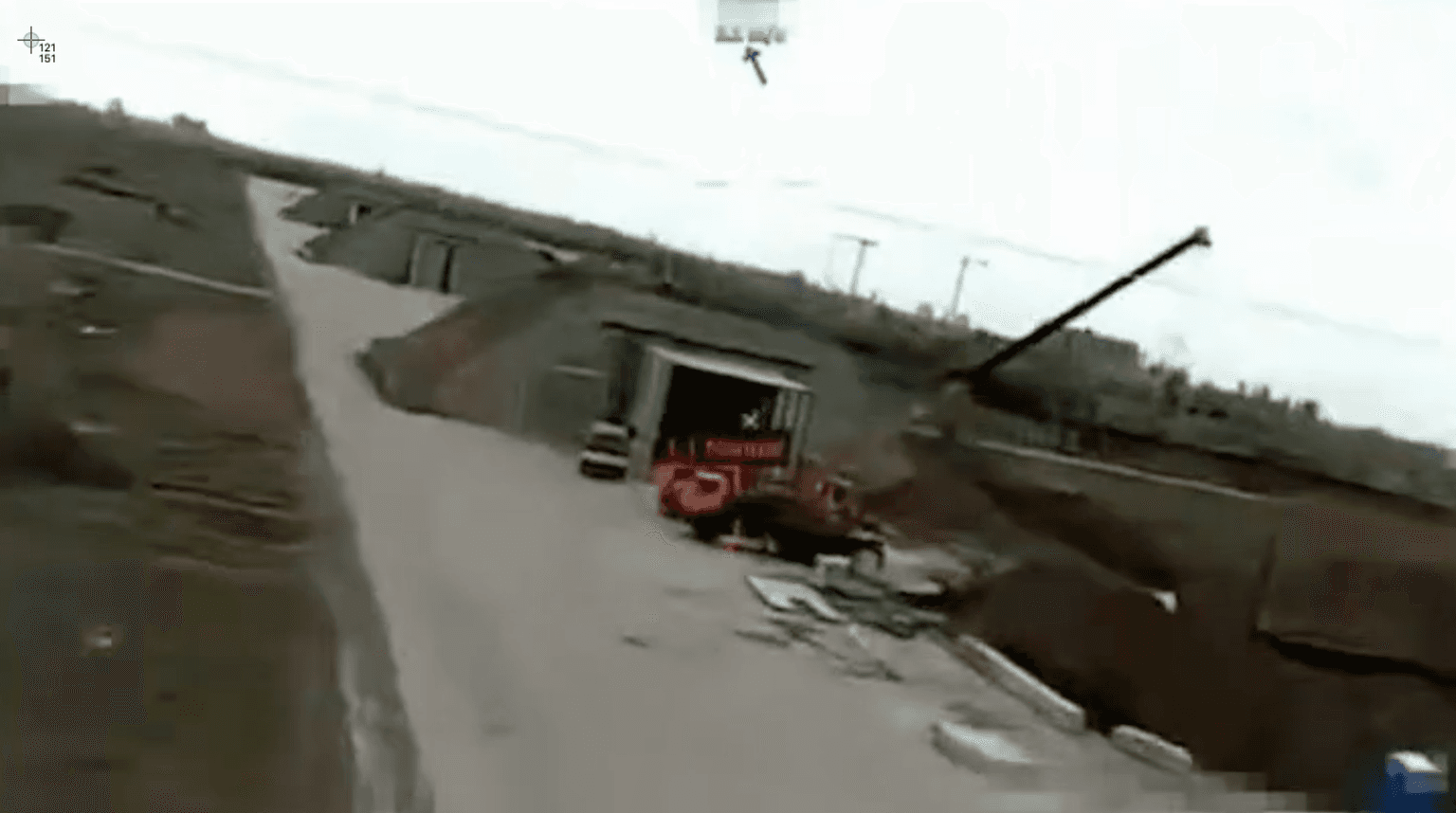
Screenshot from a video released by the Ukrainian military, depicting an ongoing operation to degrade Russia’s military facilities at the occupied Donetsk Airport. (Screenshot / Unmanned Systems Forces 14th Regiment / Telegram)
The 114th Motorized Rifle Regiment raised flags in Hulyaipilske near Hulyaipole and Russia’s MoD claimed seizure. Southern Defense Forces Spokesperson Voloshyn: Russian forces produced staged videos of a demonstrative nature and have not seized the village. ISW confirmed this is part of Russia’s cognitive warfare campaign to portray Ukrainian lines as collapsing. Russia has increased drone and artillery strikes in the Hulyaipole direction under deadlines from military command. The General Staff confirmed strikes on a Russian weapons concentration point near Novoyehorivka northeast of Kupyansk and on logistics depots near Makiivka, Bulavinske, and Vuhlehirsk, and on transformers in the Donetsk rear.
SWEDEN SEIZES CAFFA; DONETSK LOOTING DOCUMENTED; BALTIC SECURITY CENTER LAUNCHED
A Swedish court ordered the seizure of the cargo vessel Caffa on June 4 following Ukraine’s request for international legal assistance. The vessel had made repeated voyages from Russian-occupied Ukrainian ports to third countries, using false Guinean registration to disguise its origins. Ukrainian Prosecutor General Kravchenko: “No manipulation of flags, routes, or registration records will help avoid accountability.” FM Sybiha confirmed the decision sets an important legal precedent. Ukraine estimates over 1.7 million metric tons of agricultural products worth $450 million have been illegally removed from occupied territories since 2022.
The Baltic International Security Center — the first pan-Baltic think tank — launched in Brussels on June 3. Founder Lucas called out Western media and analysts who he said “echo Kremlin talking points” by portraying Baltic countries as inevitably vulnerable and Narva as Putin’s “next target.” The BISC aims to present Baltic solutions rather than Baltic problems, including an analysis of Kaliningrad as a Russian burden rather than a bastion. Estonian and Lithuanian EU ambassadors both welcomed the launch. EU member states are also discussing visa restrictions for Russian tourists: 11 EU countries formally requested the European Commission halt Schengen tourist visas for Russians; approximately 477,000 such visas were issued in 2025.
SYRSKYI STRIPS EIGHT UNITS OF TRAINING AUTHORITY; USF’S FIRST-YEAR REPORT: 100,000 RUSSIAN PERSONNEL
Commander-in-Chief Syrskyi reported on June 4 that inspections of 72 military units in May found eight units have had their authority to independently conduct basic training revoked. Separate brigades were instructed to review training conditions and curriculum. “There are no untouchables.” The updated basic training program includes practical group exercises in detecting and destroying small drones, including FPV copters. Ukraine previously extended its basic combat course to 51 days and moved training underground following Russian strikes on training grounds.
USF Commander Brovdi published a first-year combat report on June 4: the USF has carried out approximately 1.6 million combat missions in its first year, averaging 5,000 sorties per day, and has eliminated 100,082 Russian military personnel with confirmed irrecoverable losses recorded in the Delta battlefield awareness system. Total verified targets destroyed or damaged: 350,000 — including 248 air defense systems, 817 tanks, 4,890 artillery systems, 26,430 logistics vehicles, 29,903 reconnaissance drones, and 7,633 Shahed and Gerbera-type drones. Brovdi: “Kyiv in three days will never happen again.” HUR separately confirmed Russia can launch up to 100 Iskander-M ballistic missiles per month while maintaining stable stockpiles, and is increasing RM-48U missile production from 200 in 2025 to over 480 in 2026.
UKRAINE REQUESTS GERMAN PATRIOT STOCKPILE TRANSFER; NABU CASE CLOSED
Ukraine asked Germany to provide dozens of Patriot interceptor missiles from its existing stockpiles in a proposed swap arrangement under which Berlin would transfer missiles immediately and receive replacements from future production, Bloomberg reported. Germany has not approved the request; a decision could come before or at the NATO Ankara summit in July. Germany remains the only EU member capable of making a significant near-term contribution to Ukraine’s Patriot inventory. PAC-3 interceptors — the only Patriot variant capable of reliably destroying ballistic missiles — are produced solely by Raytheon in the U.S. and Mitsubishi in Japan. Germany’s approved €4 billion aid package finances local production of PAC-2 missiles, with deliveries targeted for 2027–29 — too late for Ukraine’s current shortage. Ukraine has also requested U.S. production licenses for PAC-3 interceptors.
Kyiv’s Shevchenkivskyi District Court closed the criminal case against NABU detective Viktor Husarov on June 4 after Prosecutor General Kravchenko dropped high treason charges. Husarov admitted guilt on an unauthorized information use charge, but the statute of limitations had expired. Anti-corruption committee head Radina: “What the heads of those agencies presented to the public as the ‘exposure of Russian influence within the NABU’ did not merely collapse in court — prosecutors ultimately had nothing to bring before the court in the first place.” The NABU stated the case “was part of a broader campaign aimed at undermining NABU’s independence.” The broader conflict between NABU and the Prosecutor General’s Office, which critics link to the Energoatom corruption investigation targeting Zelensky allies, continues.
Zelensky offered Putin a meeting in a neutral country, a ceasefire, and an all-for-all prisoner exchange. Putin said come to Moscow. Trump said it would be great if they met. The U.S. House passed $8 billion in Ukraine aid. Putin revealed he struck Bila Tserkva — a city of 200,000 — to observe how his missile’s warheads deploy.
Ukraine’s Unmanned Systems Forces killed 100,000 Russian personnel in their first year. A gunpowder plant in Ryazan burned. The Donetsk Airport drone base is being systematically dismantled. The ZNPP experienced its 17th blackout. Sixteen people were killed across Ukraine in the overnight strikes.
Day 1,562. Zelensky wrote: “Enough of the war.” Putin’s answer was to say he is in no hurry.
A PRAYER FOR UKRAINE
1. For the 707 Children
Lord, Ukraine’s Human Rights Commissioner confirmed on June 4 that at least 707 Ukrainian children have been killed since February 2022. The youngest confirmed victim was two days old. Two thousand five hundred forty-eight have been injured. Two thousand three hundred eighteen are still missing. These are not numbers. Each one was a child who had not yet chosen a future. Receive them. Sustain the parents who are still waiting for the missing. And let the world that learned the word ‘Bucha’ also learn what ‘two-day-old’ means in a war crimes count.
2. For the Six in Kherson
Father, six people were killed in Kherson Oblast on June 4 across 53 targeted settlements. Kherson was liberated in November 2022. It has been under daily Russian fire from the other bank of the Dnipro ever since. The people of Kherson chose to stay, or had nowhere to go, or refused to abandon what is theirs. They pay for that choice with their lives at a rate that no civilian population should be asked to sustain. Receive those six. And let the persistence of Kherson’s residents — who have endured this for over three years — be honored by the world that sometimes forgets this city exists.
3. For the 24 Children Placed in Russian Families
God of the displaced, a Russian occupation official confirmed that 24 Ukrainian children from occupied Luhansk Oblast were placed with Russian families in 2026. Thirty more in 2025. The federal government claims no such program exists. The local official confirmed it in an interview. These children are being raised in other people’s homes, in another country, without their language, their history, or their names as they were given. We pray for their return. For the Ukrainian families who do not know where they are. For the legal systems being built — slowly, painstakingly — to document and eventually reverse what Russia is doing.
4. For the USF Operators Who Reached 100,000
Lord, Ukraine’s Unmanned Systems Forces published their first-year report: 100,082 Russian military personnel killed or confirmed as irrecoverable losses, verified case by case in the Delta system. The operators who produced this result are young, scattered across undisclosed locations with laptops, flying missions at a rate of 5,000 sorties per day. They carry the weight of that number. Sustain them. Protect them. Let what they are building — the second-year target of 200,000 — not be needed because the war ends first.
5. For What ‘Enough of the War’ Might Mean
God of history, Zelensky wrote two sentences that Ukraine has wanted to say for 1,562 days: “Enough of the war. Ukraine offers to end this war.” He offered terms. He offered neutrality of venue. He offered a ceasefire for the duration of talks. Putin said come to Moscow. The window Zelensky described — the one that closes before winter — is still open. We do not know if it will be used. We pray that the leaders with the power to apply pressure on Moscow find the will to use it. In Your mercy, in Your justice, in Your time — bring this war to its end, and let the ending be worthy of what Ukraine has endured.