
Ukraine Daily Briefing | June 6, 2026 | Day 1,564 of the Full-Scale Invasion
Prepared by Dayana Bozhyk
On the final day of Putin’s flagship economic forum, Ukrainian drones struck the Kronstadt Naval Base, the 15th Naval Arsenal, the Petergofskaya Oil Depot, the Neste Oil Terminal, and an ammunition supply center in Leningrad Oblast — all within a 25-kilometer arc of St. Petersburg — forcing residents to shelter for the first time since February 2022 and demonstrating that Russia cannot protect its second city even during its most prominent international event. Multiple sources applying different methodologies converged on the same conclusion: Ukraine liberated roughly 250 square kilometers in May while Russia seized only 130, and Russia’s rate of advance is now one-sixth of its 2025 pace — while occupation authorities banned commercial transport from using the M-14 and M-15 highways in Luhansk Oblast and shut down commuter rail.
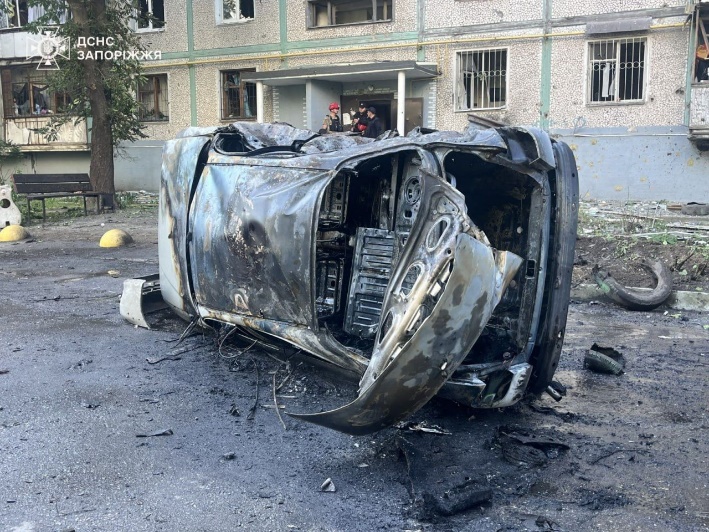
The aftermath of a Russian attack on the city of Zaporizhzhia, Ukraine. (State Emergency Service)
THE DAY’S RECKONING
The St. Petersburg International Economic Forum closed on June 6 with a second Ukrainian strike series. First, on June 3, the oil terminal and the corvette Boikyi. Then, on June 6, as delegates filed out of Expoforum: the Kronstadt Naval Base again, multiple strikes confirming hits on the 15th Naval Arsenal and the Kronstadt Naval Yard. The Petergofskaya Oil Depot in Lomonosov — west of the city across Neva Bay. The Neste Oil Terminal in Lomonosov. The ammunition and vehicle arsenal of the Russian 1060th Material-Technical Support Center in Bolshaya Izhora. Fires confirmed. Leningrad Oblast Governor Beglov called on residents to stay inside. It was, Russian journalists noted, the first time since the full-scale invasion began that St. Petersburg’s governor had issued such an instruction.
Putin had spent two days at SPIEF claiming Russia’s economy was stable, its military was advancing on all fronts, and its cities were secure. The smoke over St. Petersburg was visible from the conference hall. ISW’s assessment of his battlefield claims: Russian forces have seized or controlled only about 40 square kilometers net in May while losing nearly 280. Militarnyi, citing Ukrainian military sources, calculated it differently but concluded similarly: Ukraine liberated roughly 250 square kilometers in May while Russia seized 130. The rate of Russian advance in 2026 is approximately one-sixth of 2025’s pace, and Ukraine liberated more territory than Russia seized in both April and May.
On the roads, the consequences are becoming administrative. Occupation head Pasechnik issued a decree banning commercial passenger transport from the M-14 Rostov-Crimea highway and M-15 Belgorod-Mariupol highway in occupied Luhansk Oblast. Commuter rail service in Luhansk Oblast was also suspended. Ukrainian drones have achieved fire control over Luhansk City, Starobilsk, Alchevsk, Bryanka, and Kadiivka — all on or near those routes. The fuel crisis generated by Ukraine’s refinery campaign is forcing Crimean drivers to cross the Kerch Bridge to buy gasoline in Krasnodar Krai. In Tatarstan, 600 kilometers from Ukraine’s border, only expensive diesel is available; cheaper grades are gone. The war has arrived in the fuel tank of every car in occupied Ukraine and is spreading north through Russia’s regions.
SECOND STRIKE ON ST. PETERSBURG DURING SPIEF: KRONSTADT, ARSENAL, TWO OIL TERMINALS, SUPPLY CENTER
The Ukrainian General Staff reported on June 6 that Ukrainian forces struck the following targets overnight June 5 to 6, all within a 25-kilometer arc west and south of St. Petersburg: the Kronstadt Naval Base, main base of the Russian Baltic Fleet; the Russian Navy’s 15th Arsenal near Lomonosov; the Petergofskaya Oil Depot in Lomonosov; the Neste Oil Terminal in Lomonosov; and the weapons, ammunition, and vehicle arsenal of the Russian 1060th Material-Technical Support Center of the Leningrad Military District in Bolshaya Izhora. The SBU confirmed strikes against the 15th Arsenal. Ukrainian Special Operations Forces reported multiple drones reaching the Kronstadt Naval Base. Geolocated footage and photos confirmed strikes against the 15th Arsenal and the Kronstadt Naval Yard. Leningrad Oblast authorities acknowledged a fire near Bolshaya Izhora.
St. Petersburg Governor Beglov called on residents to stay inside for the duration of the strikes — reportedly the first such instruction issued since February 2022. The Kronstadt Naval Base houses the Baltic Fleet’s main repair and maintenance infrastructure; the 15th Arsenal stores naval ammunition; the 1060th Material-Technical Support Center handles rear logistics for the entire Leningrad Military District. The combined target set represents the naval logistics and ammunition backbone of Russia’s Baltic Fleet and northwestern military district, struck on the closing day of an international economic forum whose purpose was to project Russian stability and strength. ISW assessed that Russian air defenses are overextended across the vast rear area they must protect, and that the Kremlin has prioritized Moscow over St. Petersburg in its air defense resource allocation.
RUSSIA’S ADVANCE RATE FALLS TO ONE-SIXTH OF 2025; UKRAINE LIBERATED MORE GROUND IN MAY
Two independent Ukrainian military sources converged on the same conclusion in assessments published on June 6. Militarnyi, citing sources within the Ukrainian military, reported that Ukrainian forces “restored control” or cleared Russian infiltrators from approximately 250 square kilometers in May while Russian forces seized only 130 — the first month in which Ukrainian net gains exceeded Russian advances since the 2023 counteroffensive. The same source reported that in April 2026, Ukrainian forces liberated or cleared about 80 square kilometers while Russia seized 150 to 160.
ISW’s parallel calculation: Russian forces seized or infiltrated about 40 square kilometers in May 2026, while losing control of approximately 280. ISW’s infiltration layer counts areas where Russian forces maintain a limited presence without doctrinal control; excluding those areas, Russia’s net May balance was sharply negative. In April, Russia seized or infiltrated about 28 square kilometers while losing about 116. ISW’s rate calculation from the full December 2025–May 2026 period: Russia gained 40.64 square kilometers net while losing 281.1. Comparing the same period in 2024–2025: 515.84 square kilometers gained. The 2026 figure is 7.87 percent of the prior year’s pace. Over 71,000 Russian service members are now assigned to the Oleksandrivka direction alone, where Ukraine has seized the tactical initiative and forced Russian forces to transfer additional troops defensively. Russian battlefield performance in May was, by multiple independent accounts, the worst of any comparable period in the full-scale war.
M-14 HIGHWAY BANNED FOR COMMERCIAL TRAFFIC IN LUHANSK; COMMUTER RAIL SUSPENDED; KERCH BRIDGE GRIDLOCK
Occupied Luhansk Oblast Head Pasechnik issued a decree on June 6 banning commercial passenger transport vehicles from using the M-14 Rostov-Crimea highway (locally designated R-280) and the section of the Belgorod-Mariupol highway (R-150) running through occupied Luhansk Oblast. Private vehicles were advised not to use the highways; bus services will operate on modified routes. Commuter train service in occupied Luhansk Oblast was suspended entirely. ISW assessed the decree reflects Ukraine’s achievement of drone-enabled fire control over Luhansk City, Starobilsk, Alchevsk, Bryanka, and Kadiivka — all located on or near these routes — since the 3rd Army Corps announced the operation on May 31.
In Crimea, Sevastopol occupation governor Razvozhaev announced that TES and ATAN gas stations will only sell 20 liters of gasoline to customers with pre-purchased coupons, with general gasoline sales eliminated. Krasnodar Krai and Crimea channels reported Crimean drivers crossing the Kerch Bridge to buy gasoline in Temryuksky Raion — causing all-day queues at the Kerch Bridge from the Crimean side. In Tatarstan, Russian opposition outlet Vazhnye Istorii reported long lines at gas stations selling only expensive diesel, with cheaper grades unavailable. Russian opposition sources have now documented gasoline shortages in Belgorod, Kursk, Leningrad, Saratov, Ryazan, Moscow, Tomsk, Murmansk, Voronezh, Oryol, Novgorod, Kamchatka, the Republic of Karelia, and Krasnoyarsk Krai. ISW assessed Russia will struggle to control these shortages more effectively than in 2025, when shortages emerged only in fall — they have arrived in early June this year.
UST-LABINSK OIL DEPOT STRUCK IN KRASNODAR KRAI; SATELLITE BDA CONFIRMS RYAZAN AND TAMBOV DAMAGE
The Ukrainian General Staff and SBU reported overnight June 5 to 6 strikes on the Ust-Labinsk oil depot in Krasnodar Krai, causing fires at three petroleum product tanks confirmed by geolocated footage. Russian regional authorities acknowledged the strike. In the Kostyantynivka direction, Ukrainian K2 drones struck a warehouse of the Russian 90th Engineer Regiment in Yenakiieve, destroying four trucks; imagery confirmed damage to three or four Russian trucks east of occupied Novoazovsk; a smoke column was confirmed from a purported strike against a substation near occupied Khrestivka; and a fire was confirmed at Mariupol port following a Ukrainian strike, with NASA FIRMS thermal data confirming heat anomalies on June 6.
Satellite imagery published June 5–6 confirmed updated battle damage assessments: the June 3–4 strike on the Elastik propellant powder plant in Ryazan Oblast damaged one production building. Three new roof impacts on a workshop at the Michurinsk Progress Plant in Tambov Oblast were confirmed from the June 2–3 strike. The General Staff confirmed the May 31 Lazarevo station strike destroyed two storage tanks, damaged two more, and damaged pumping station buildings — independently confirmed by Radio Svoboda satellite imagery from June 4.
LAVROV: ‘ROOT CAUSES’ OF WAR MUST BE ADDRESSED; KREMLIN’S MAXIMALIST DEMANDS UNCHANGED
Russian Foreign Minister Lavrov stated in a video message for Russian Language Day on June 6 that restoring the rights of Russians and Russian speakers in Ukraine is a “necessary condition” for a long-term peace settlement. ISW assessed this as the latest iteration of the Kremlin’s fabricated “root causes” framing — language used to restate maximalist demands including Ukrainian territorial concession, prohibition on NATO membership, and forced linguistic and cultural policy changes. Putin’s June 5 SPIEF statements confirmed Russia is unwilling to deviate from its original war aims regardless of battlefield performance. ISW assessed that Putin remains committed to his theory of victory: that Russia can outlast Ukraine and the West through prolonged attrition, a belief reinforced by exaggerated military reports from his own command.
FRONTLINE: RUSSIAN ADVANCE NEAR SLOVYANSK; UKRAINIAN GAINS IN KOSTYANTYNIVKA; OLEKSANDRIVKA INITIATIVE SHIFTS
Military observer Mashovets reported on June 6 that Russian forces seized Lypivka southeast of Slovyansk and advanced from Zakitne to positions south of Kryva Luka, toward Riznykivka and Kalenyky, and along the Pryvillya-Malynivka-Tykhnovika axes toward the Siverskyi Donets-Donbas canal. Russian forces are approximately 15.5 kilometers from Slovyansk’s outskirts but are losing momentum under Ukrainian counterattacks. The 3rd Combined Arms Army, which has operated in this area since 2022, is at full strength but is overexerting its forces for small tactical gains — a persistent structural pattern. Mashovets assessed that even with the canal reached, Ukrainian forces operating in Lyman and Rai-Oleksandrivka will continue to engage Russian forces past that line.
Ukrainian forces recently advanced on the southwestern and western outskirts of Kostyantynivka, confirmed by geolocated footage from multiple dates in late May and early June. Ukrainian forces are operating in western and southern Kostyantynivka, on the northern outskirts of Ilinivka, and in northern Stepanivka — areas where Russian sources had previously claimed Russian presence. A Ukrainian brigade officer reported Russian forces recently conducted a motorized assault with IFVs in the Kostyantynivka direction and have replenished 80 percent of attacking units; Russian forces are attempting to reach the H-20 highway to encircle Ukrainian positions. In the Oleksandrivka direction, Spokesperson Voloshyn confirmed Ukrainian forces are restoring control over previously lost positions, have seized the tactical initiative in unspecified areas, forced Russian forces to go on the defensive, and are compelling transfer of additional Russian troops to the direction.
Russian forces recently advanced in western Rodynske north of Pokrovsk per geolocated footage from June 5 — ISW assessed Russian forces no longer hold a continuous FLOT in western and central Rodynske. In the Kupyansk direction, geolocated footage shows Russian servicemembers patrolling southeastern Kupyansk dachas after an infiltration mission. Russian forces resumed limited attacks in the Lyptsi direction near the Lypets River northeast of the settlement after a period of inactivity. Russian forces continued offensive operations in the Hulyaipole direction as Ukrainian forces counterattacked. Ukrainian forces struck a Russian manpower concentration near Petropavlivka east of Kupyansk and drone control points near Voskresenka and Odradne in the Oleksandrivka direction.
RUSSIAN FORCES CONTINUE ‘HUMAN SAFARI’ IN KHARKIV OBLAST; HIGHWAY P-46 TARGETED
Russian forces struck a police car near Staryi Saltiv east of Kharkiv City with an FPV drone on June 5, and struck a civilian riding a scooter near Slatyn northwest of Kharkiv City on the morning of June 6. ISW assessed these are part of Russia’s expanding human safari campaign — deliberate targeting of civilians and law enforcement — previously documented in Kherson Oblast and now spreading to Kharkiv. Defense technology advisor Beskrestnov reported Russian forces have begun striking the P-46 Kharkiv-Sumy highway near Bohodukhiv to disrupt Ukrainian supply lines to border positions. Donetsk Airport satellite imagery from April 22 confirmed Russian forces had by June 2 constructed 130 drone storage garages, four concrete warehouses, and four launchers at the airport for jet-powered Shahed operations, with additional air defense positions under construction.
OVERNIGHT STRIKE: 272 DRONES, 249 DOWNED; FIVE KILLED IN ZAPORIZHZHIA; DTEK THERMAL PLANT DAMAGED
Russian forces launched 272 Shahed, Gerbera, Italmas, Banderol, and Parodiya drones overnight June 5 to 6 from Oryol, Kursk, Bryansk, Primorsko-Akhtarsk, Millerovo, and occupied Hvardiyske. Ukrainian air defenses downed 249. Nineteen drones struck 11 locations; debris fell on 13 more. Ukrainian officials reported strikes on civilian infrastructure in Kharkiv and Odesa oblasts. DTEK, Ukraine’s largest private energy company, confirmed that Russian forces struck one of its thermal power plants, causing significant damage — the 11th strike on DTEK TPPs in the 2025–2026 winter-into-spring season, and nearly the 230th since the full-scale invasion began.
In Zaporizhzhia city, a drone strike on a local enterprise killed five workers. Regional Military Administration Head Fedorov confirmed the casualties — initially reported as two, rising to five as emergency teams completed their assessment. In Kherson, a 75-year-old man was killed in a drone strike in the Korabelnyi district on June 4; a separate strike injured a 12-year-old boy in a residential building, and a drone struck an ambulance on hospital grounds, wounding three medical workers. In Chernihiv on June 5, strikes on a private enterprise and a parking lot injured eight people and destroyed 37 vehicles. In northern Sumy Oblast, Russian forces continued limited offensive operations without advancing; Ukrainian forces counterattacked. Russian forces are also reportedly striking the P-46 Kharkiv-Sumy highway near Bohodukhiv to interdict Ukrainian supply lines.
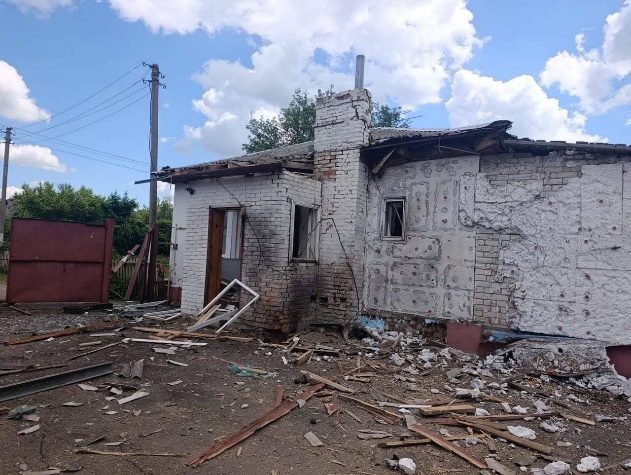
The aftermath of a Russian attack on Chernihiv Oblast, Ukraine. (Viacheslav Chaus/Telegram)
DONETSK AIRPORT DRONE BASE: 130 GARAGES, FOUR WAREHOUSES, CONSTRUCTION ONGOING
Ukrainian OSINT sources reported on June 5, citing satellite imagery from April 22, that Russian forces had constructed by June 2 at the Donetsk Airport: 130 drone storage garages, four concrete drone warehouses, four launchers, and new positions for air defense systems. The airport serves as a Shahed-type drone launch hub operated by the Rubikon unit, and as a major Russian logistics base. Russian forces use jet-powered drones from the airport but the satellite imagery does not capture the corresponding jet infrastructure. The USF’s 1st Separate Center previously confirmed achieving fire control over the airport, systematically destroying launchers, transport vehicles, and crews. Construction of new positions continued in parallel with Ukrainian strikes, indicating Russia is attempting to expand the facility faster than Ukraine can degrade it.
BELARUSIAN OPPOSITION: REGIME FRACTURES, POST-LUKASHENKO SCENARIOS, AND TRUMP’S OVERTURES
Franak Viachorka, adviser to Belarusian opposition leader Tsikhanouskaya and head of her foreign policy department, gave an extended interview published June 6 following the delegation’s historic May visit to Kyiv. Key assessments: mid-level officials, regional authorities, regular army officers, and police personnel broadly oppose Lukashenko but lack a coordination mechanism; the pro-Russian clique is concentrated near Lukashenko and has shrunk; the Belarusian army does not want to fight Ukraine and would not pose a military threat to Ukrainian forces “hundreds of times stronger.” On post-Lukashenko succession: Moscow would attempt to install a proxy from within the KGB or older military generation but would face broad resistance; his sons are not viable successors; a coalition of pro-independence nomenklatura elements would contest Moscow’s choice.
On the U.S.-Belarus channel: Viachorka warned that Trump envoy Kellogg’s visit to Minsk and hand-shaking with Lukashenko risks legitimizing the regime rather than only securing prisoner releases. “The most important thing is not to freeze the situation.” On military preparedness: Russia and Belarus are modernizing Soviet infrastructure, building military bases, and deploying weapons along all borders except the Russian border — but Putin currently lacks manpower for a new front. “If there is a ceasefire, if Putin has some time to regroup, then we must not exclude escalation against other countries as well.” The Belarusian democratic forces’ mission opened a permanent office in Kyiv in May.
RUSSIA INSTALLS PANTSIR-SMD-E ON MOSCOW RESIDENTIAL HIGH-RISE; BALTIC FLEET’S 15TH ARSENAL
Geolocated footage published June 6 shows Russian authorities installing an additional Pantsir-SMD-E air defense system — the next-generation anti-drone variant stripped of cannons and optimized for miniature loitering munitions — on the roof of the “House in Sokolniki,” a business-class residential high-rise in Moscow’s Sokolniki district, via Mi-26 heavy transport helicopter on June 5. ISW assessed this reflects the Kremlin’s continued prioritization of Moscow’s air defense over St. Petersburg’s, even as Ukrainian drones struck St. Petersburg for the second time in four days. The 15th Naval Arsenal struck on June 6 near Lomonosov stores naval ammunition for the Baltic Fleet; the Kronstadt Naval Yard provides repair and maintenance for fleet vessels.
Ukraine struck St. Petersburg again on SPIEF’s closing day: Kronstadt, the 15th Naval Arsenal, two oil terminals, an ammunition supply center. The St. Petersburg governor told residents to stay inside for the first time since February 2022. Russia’s rate of advance in May was one-sixth of 2025’s pace. Ukraine liberated more ground than Russia seized.
Occupation authorities banned commercial traffic from the M-14 and M-15 highways in Luhansk Oblast and suspended commuter rail. Crimean drivers are queuing at the Kerch Bridge to buy gasoline in Krasnodar Krai. Five workers were killed in Zaporizhzhia. DTEK’s thermal plant was struck. Russia mounted another Pantsir on a Moscow apartment roof.
Day 1,564. Putin spoke about economic stability. The smoke rose over St. Petersburg. Different calculations, same answer: Russia is losing ground.
A PRAYER FOR UKRAINE
1. For the Five Workers in Zaporizhzhia
Lord, five workers died at a Zaporizhzhia enterprise on the morning of June 6 when Russian drones struck. They were at work. The strike came before the working day was fully underway, as emergency crews were still assessing the scope of what had been hit. Five. Receive them. Hold the families who will bury them this week. And let the casualty reports for Zaporizhzhia — which arrive with such regularity that the oblast has become a number rather than a place — be read as what they are: the deaths of specific people who were somewhere specific, doing something real.
2. For the DTEK Workers at the Thermal Power Plant
Father, DTEK’s thermal power plant was struck on June 5–6, causing significant damage. This was the 11th strike against DTEK’s thermal generation infrastructure during this heating season alone, and nearly the 230th since the full-scale invasion began. The workers who operate these facilities go to work knowing their plant has been hit before and will be hit again. They keep the electricity on for Ukraine’s hospitals, schools, and homes. Sustain them. Protect them. And let the international partners who are helping Ukraine repair and harden its energy infrastructure work with the urgency the summer window demands, before winter returns.
3. For the Three-Year-Old Who Is Home
God of healing, the three-year-old girl struck by shrapnel at the Kherson playground on May 27 was still in critical condition on May 28. We do not have an update. We pray she is healing. That the surgeons who worked on her succeeded. That she is somewhere — a hospital room, a recovery ward, a relative’s home — where she is safe and where her six-year-old sister can be nearby. We hold the unresolved in prayer because the war does not resolve neatly, and neither do its victims. Let her be well.
4. For Ukraine’s Drone Operators Over St. Petersburg
Lord, Ukrainian drone operators struck the Kronstadt Naval Base, the 15th Arsenal, two oil terminals, and an ammunition supply center in a single overnight operation on the closing day of Russia’s most important economic forum. They were operating from undisclosed locations, coordinating through laptops, flying over a thousand kilometers from Ukraine’s border. Putin had just finished two days of claiming his economy was stable and his military was winning. Sustain these operators. Let what they are building — the deep-strike capability that reaches St. Petersburg as easily as Belgorod — continue to accumulate into the pressure that changes calculations inside the Kremlin.
5. For Franak Viachorka and What He Is Waiting For
God of history, a Belarusian opposition adviser gave an interview on June 6 saying his country’s mid-level officials, officers, and regional administrators broadly oppose Lukashenko but are waiting for the moment to act. He said: combine street protests with nomenklatura defection. He said: if Ukraine wins, Belarus has a chance. He has been waiting for this moment since 2020, when his government-in-exile first took shape. He is still waiting. We pray for Tsikhanouskaya and Viachorka and everyone inside Belarus who is keeping something alive under a dictatorship. Let their waiting not be permanent. In Your mercy, in Your justice, in Your time — bring this war to its end, and let the ending be worthy of what Ukraine has endured.