
Ukraine Daily Briefing | June 7, 2026 | Day 1,565 of the Full-Scale Invasion
Prepared by Dayana Bozhyk
A Russian Shahed struck the Centralized Spent Nuclear Fuel Storage Facility in the Chornobyl Exclusion Zone at 2:10 a.m. on June 7, partially destroying the container reception building and damaging the adjacent IAEA administrative building — no radiation above normal limits, but IAEA Director General Grossi called it “deeply alarming” as the stored fuel was meters from the blast. Ukraine struck the Chonhar Bridge linking occupied Crimea to occupied Kherson Oblast using homemade Fire Point drones and the new Behemoth UAV — closing the Dzhankoi checkpoint and cutting the main fuel and ammunition route for the 37th Motor Rifle Brigade. Zelensky met Starmer, Macron, and Merz in London and the four leaders issued a joint statement setting five conditions for a just peace, as the FT revealed Zelensky had sent Abramovich to Putin in May with the same ceasefire offer Putin publicly rejected.
THE DAY’S RECKONING
At 2:10 a.m. on June 7, a Russian Shahed-type drone struck the Centralized Spent Nuclear Fuel Storage Facility in the Chornobyl Exclusion Zone, 15 kilometers from the former nuclear plant. The container reception building was partially destroyed. A 40 square-meter fire broke out and was extinguished. No radiation spike. No casualties among the staff. No spent nuclear fuel in the specific building at the time of the strike. Energoatom’s statement was careful and factual on all these points. IAEA Director General Grossi was not calm: “The incident is deeply concerning as it occurred at a facility containing large amounts of nuclear material, held in storage just metres away from the attacked building.” The IAEA administrative building was also damaged.
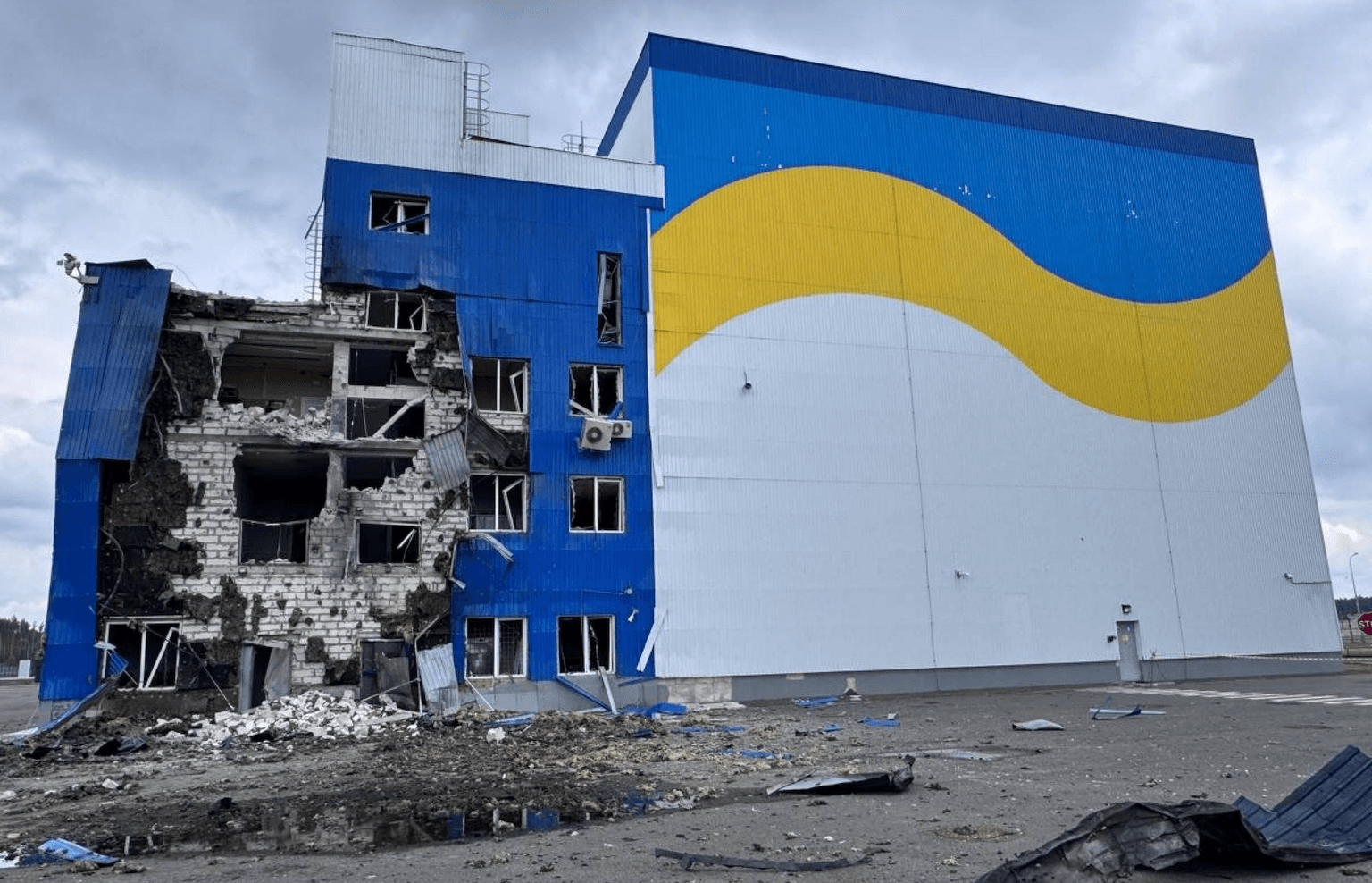
Damage to the Centralized Spent Nuclear Fuel Storage Facility in the Chornobyl Exclusion Zone following a Russian drone strike overnight. (Energoatom/Telegram)
This is the same facility zone where a Russian drone crash in May ignited 1,100 hectares of protected exclusion zone forest. It is the same area where Russian forces damaged the containment structure of Reactor No. 4 in February 2025 and knocked out substations in January 2026. The Kremlin has adopted a policy that accepts reckless strikes near nuclear infrastructure as a routine operational cost. The SBU called it a war crime. Ukraine’s Foreign Ministry demanded strong condemnation and increased pressure on Russia. Zelensky, in London, said: “There is clearly an exceedance of even Russia’s already sky-high arrogance.”
While the Chornobyl strike was being processed, Ukraine’s Code 9.2 drone unit and 1st Separate Assault Battalion struck the Chonhar Bridge — the primary land crossing from occupied Crimea into occupied Kherson Oblast. The attack used Fire Point FPV drones and the new Behemoth UAV — a Shahed-style platform with two warheads and a 300-kilometer range that flies at low altitude, below radar. The bridge deck was significantly damaged. The Dzhankoi road checkpoint was closed. The target was not symbolic: the 37th Motor Rifle Brigade’s fuel and ammunition runs from Crimea through that crossing. Battalion commander Filatov: “This was done specifically to block the supply routes for fuel and lubricants for the 37th Motor Rifle Brigade.” Unit commander Nastenko: “This is definitely just the beginning. Sit down, watch, and enjoy.”
In London, Zelensky met Starmer, Macron, and Merz and the four leaders issued a joint E3 statement: five conditions for peace, including an immediate complete ceasefire, negotiations starting from the current line of contact, robust security guarantees, Russian reparations, and protection of European and NATO interests. The FT revealed what none of them disclosed publicly: in May, Zelensky invited Roman Abramovich to Kyiv and asked him to carry a message to Putin — the same ceasefire offer, less antagonistically worded than the open letter. Putin sent back word that he saw no point in a meeting. Then, on June 5, he confirmed this publicly. The private channel and the public channel arrived at the same answer.
CHORNOBYL NUCLEAR FUEL FACILITY STRUCK; IAEA ADMINISTRATIVE BUILDING DAMAGED
A Russian Shahed-type drone struck the Centralized Spent Nuclear Fuel Storage Facility in the Chornobyl Exclusion Zone at 2:10 a.m. local time on June 7. The strike partially destroyed the facility’s container reception building, damaging its facade, windows, and doors; the blast wave also struck the nearby IAEA administrative building. Energoatom confirmed a 40 square-meter fire that was extinguished by emergency services. No personnel were injured. No spent nuclear fuel was stored in the specific reception building at the time of the strike. Automated monitoring and manual surveys confirmed background radiation remains within normal regulatory limits.
The SBU confirmed: “The explosion damaged the spent nuclear fuel reception and reloading building and the IAEA administrative building.” Ukraine’s Security Service called the strike a war crime and opened an investigation. IAEA Director General Grossi called the incident “deeply alarming” and stated it was “in direct contravention of key nuclear safety principles, notably the 7 Indispensable Pillars for nuclear safety and security during a military conflict.” The IAEA said it will send a team of experts to assess the damage. The facility is designed for long-term storage of spent nuclear fuel from Ukraine’s operating nuclear power plants — its purpose is permanent, its material inventory is permanent, and the proximity of the blast to that material is the core concern. ISW assessed the strike is consistent with the Kremlin’s documented policy of accepting reckless and high-risk drone strikes regardless of whether they are accidental or intentional.
CHONHAR BRIDGE STRUCK WITH FIRE POINT DRONES AND NEW BEHEMOTH UAV
Ukraine’s Code 9.2 drone unit and 1st Separate Assault Battalion struck the Chonhar Bridge connecting occupied Crimea to occupied Kherson Oblast overnight June 7, using Ukrainian-made Fire Point FPV drones and the new Behemoth long-range UAV. The Behemoth is a Shahed-class platform carrying two warheads, with a 300-kilometer combat range and low-altitude flight profile that makes it significantly harder to intercept than conventional attack drones. The operation was confirmed by the Ukrainian military, which released video footage of the strike. Occupation-installed Kherson Oblast head Saldo acknowledged bridge deck damage; the Dzhankoi checkpoint — a key land crossing on the Crimea-mainland route — was suspended “for security reasons.”
Commander Filatov (callsign Perun): “This was done specifically to block the supply routes for fuel and lubricants for the 37th Motor Rifle Brigade.” Commander Nastenko (callsign Flint): “The strike caused significant damage to the bridge, which will require a colossal amount of work to replace. We know from our sources that the enemy is very distressed.” The military described the operation as “not an isolated incident” but part of a systemic campaign to degrade Russian operations in the south. The strike follows Crimea’s complete gasoline rationing, the closure of commercial traffic on M-14 and M-15 highways in Luhansk Oblast, and the Ukrainian 3rd Special Operations Forces Regiment’s confirmation of fire control over the T-22-09 Melitopol-Chonhar highway.
ZELENSKY IN LONDON: E3 JOINT STATEMENT SETS FIVE CONDITIONS FOR PEACE
President Zelensky traveled to London on June 7 for bilateral talks with UK Prime Minister Starmer and E3 format discussions with Starmer, French President Macron, and German Chancellor Merz. The four leaders issued a joint statement setting five conditions they said “would need to be in place for a just and lasting peace.” First: an immediate and complete ceasefire. Second: negotiations beginning at the current line of contact. Third: robust and legally binding security guarantees for Ukraine, including a multinational enforcement force. Fourth: compensation for damages caused by Russia, with Russian assets remaining immobilized until Moscow ends the war and provides restitution. Fifth: European security interests safeguarded in any deal, with EU- and NATO-related elements requiring the consent of EU member states and NATO allies respectively.
The joint statement welcomed Ukraine’s battlefield advancements and its “ground-breaking use of drone technology”. Leaders discussed coordinating further support ahead of the G7 summit. Zelensky told Sky News: “We want to stop the war in a way where the war will not come back. The quickest way is to freeze and to move it to a diplomatic setting.” He said Europe must be at the negotiating table: “Europe should be strong.” Finnish President Stubb, in a separate interview, called for Europe to take the initiative on negotiations with Moscow, proposing a three-step escalation from EU to E3 to alternative formats. FM Sybiha: “By refusing Zelensky’s offer, Putin lost his chance to get out of his failed war. Things will only get worse for Russia.” Zelensky is scheduled to meet UK King Charles III on June 8.
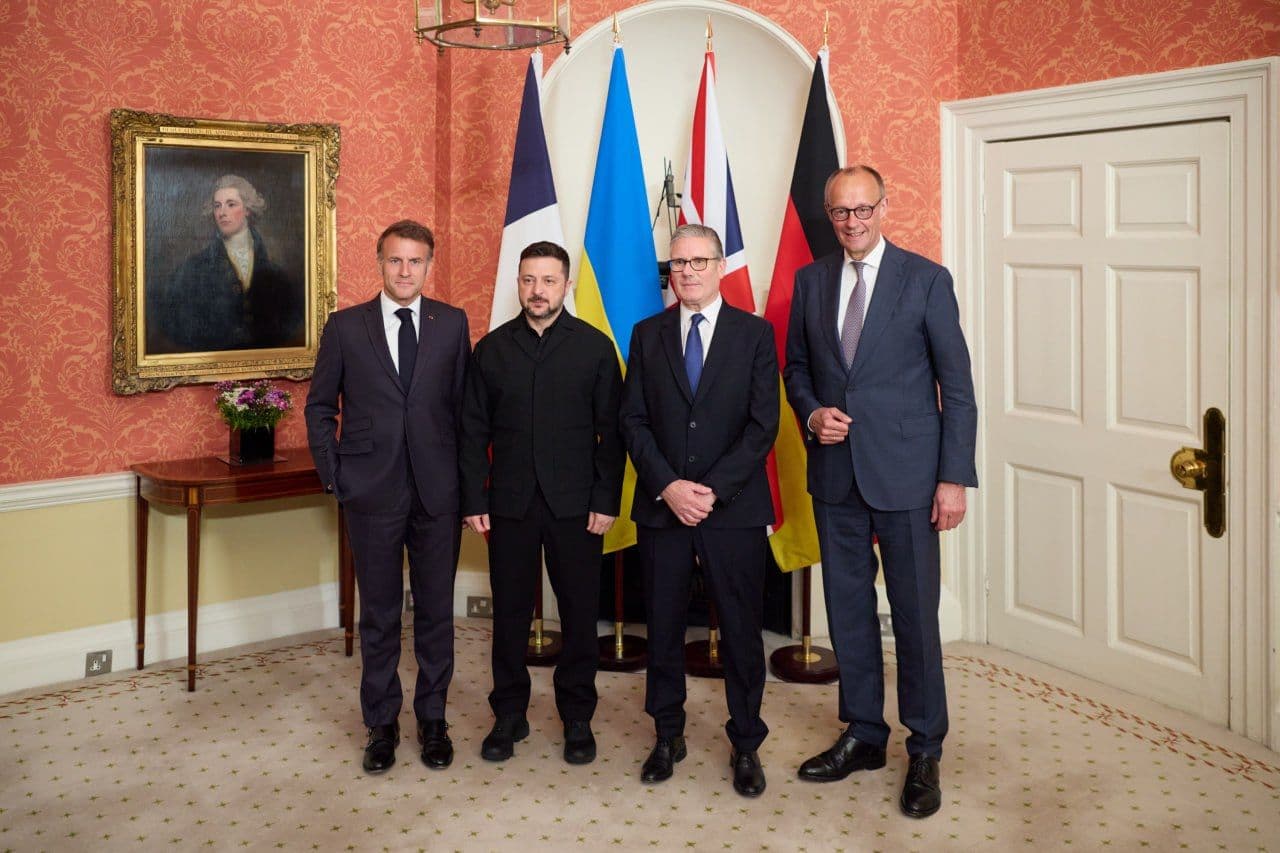
President Volodymyr Zelensky meets with the leaders of France, Britain, and Germany during a meeting of the E3 in London. (Presidential Office/Telegram)
ABRAMOVICH CARRIED ZELENSKY’S CEASEFIRE MESSAGE TO PUTIN IN MAY; PUTIN REJECTED IT THEN TOO
The Financial Times reported on June 7, citing four sources, that Zelensky invited Roman Abramovich to Kyiv in May and asked the Russian oligarch to carry a private message to Putin proposing a face-to-face summit. The message was less antagonistic than the subsequent open letter but conveyed the same essential content: Ukraine is ready to negotiate directly, the line of contact is the starting point, Zelensky is ready to meet anywhere outside Russia or Belarus. Zelensky confirmed the meeting in a Sky News interview: “He came, and he wanted to give me the message that they want to understand what we are ready to do. I said you can choose any time from tomorrow, you can choose any day, any format.”
Putin’s response: at SPIEF on June 5, he mentioned meeting “one of the representatives of our business circles” on May 21 and told him he saw no point in meeting Zelensky. The private channel produced the same answer as the public letter. Kyiv’s motivation for using Abramovich was to demonstrate continued good faith toward negotiations while U.S. diplomatic attention was focused on Iran. Abramovich has brokered prior prisoner exchanges and helped negotiate the Black Sea Grain Initiative. “He is needed because he is the only Russian the Ukrainians will tolerate. He gets along with everyone,” a source told the FT.
CRIMEA’S FUEL AND FOOD CRISIS; M-14 ROUTE CHANGES; RUSSIAN MILBLOGGERS’ ALARM
Sevastopol occupation governor Razvozhaev announced on June 6 that TES gas stations will now only sell gasoline to holders of pre-purchased QR codes obtainable through Russia’s state-controlled Max messenger app. The number of available QR codes per day corresponds to the gasoline volume available for sale. QR codes for June 7 sold out within two hours of release. Each customer is now limited to 20 liters per week — down from 20 liters per day. Ukrainian occupation authorities in Zaporizhzhia Oblast claimed the M-14 in that region faces no similar restrictions, but a Mariupol mayoral adviser confirmed Russian forces have shifted Mariupol-Berdyansk logistics to smaller coastal roads, disguising military vehicles as civilian by repainting them white and changing truck-bed tent colors.
Food shortages are emerging in Crimea beyond fuel. Independent media Agenstvo reported residents complaining since June 5 about interrupted deliveries and restrictions on buckwheat, sugar, rice, and flour. Russian opposition outlet Astra reported occupation authorities are attributing these shortages to “natural harvesting cycle lulls.” Russian milbloggers are alarmed: one former Storm-Z instructor criticized Russian bureaucracy’s inability to respond to Ukraine’s growing strike depth; others complained the MoD and Gerasimov are not retaliating against Ukrainian bridges across the Dnipro. The ISW assessed these complaints indicate Ukraine’s strike campaigns have become a neuralgic point in the Russian ultranationalist information space, coinciding with poor battlefield performance and growing domestic discontent.
OVERNIGHT STRIKE: 236 DRONES, 215 DOWNED; SEVEN KILLED ACROSS UKRAINE
Russian forces launched 236 Shahed, Gerbera, Italmas, Banderol, and Parodiya drones overnight June 6 to 7 from Bryansk, Kursk, Oryol, Millerovo, Primorsko-Akhtarsk, occupied Donetsk Oblast, and occupied Cape Chauda. Ukrainian air defenses downed 215. Seventeen struck 13 locations; debris fell on nine more. Russian attacks killed at least seven people and injured 61 across Ukraine.
In Zaporizhzhia Oblast, a taxi driver was deliberately “hunted” by an FPV drone and killed; one person killed and 25 injured total. In Donetsk Oblast, two killed and five injured. In Mykolaiv Oblast, one killed and five injured. In Kharkiv Oblast, one killed and five injured. In Sumy Oblast, one killed and four injured. In Dnipropetrovsk Oblast, one killed, one injured. In Kherson Oblast, 14 injured across 38 targeted settlements. In Odesa Oblast, one injured, with a gas pipeline and church building also damaged. In Chernihiv, a drone hit a gas station, injuring a woman. Zelensky’s weekly accounting: 88 missiles, over 3,250 strike drones, and approximately 1,800 glide bombs launched against Ukraine from May 31 to June 6.
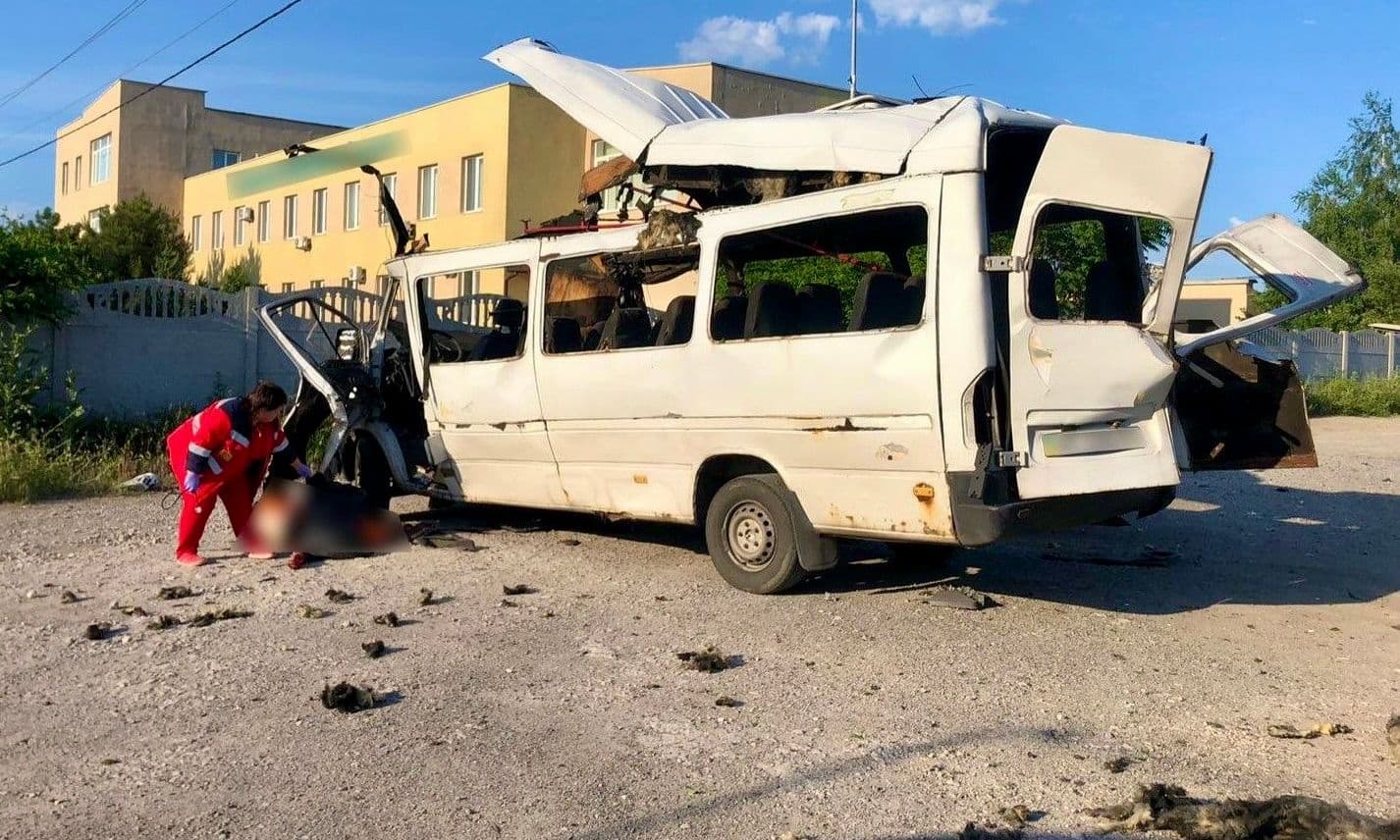
A Russian attack in Zaporizhzhia Oblast killed one person. (State Emergency Service / Telegram)
RUSSIAN FORCES STRIKE TWO HUMANITARIAN SEARCH-AND-RESCUE VESSELS IN BLACK SEA
Deputy Prime Minister Kuleba confirmed on June 6 that Russian forces struck two civilian vessels of Ukraine’s Maritime Search and Rescue Service while they were conducting a humanitarian mission in the Black Sea inside the designated Ukrainian maritime shipping corridor. The vessels carry explicit protection under the Second Geneva Convention, Article 27, which prohibits hostile operations against search-and-rescue boats performing their mandated functions. An unspecified number of crew members were injured; the Ukrainian Navy deployed immediately to evacuate casualties and salvage the boats. A Kremlin-affiliated milblogger claimed the strike was executed using remotely controlled Geran drones — a variant allowing Russian operators to send and receive data in real time and adjust flight paths to strike moving targets.
MID-RANGE STRIKES: S-400, OSA, PANTSIR STRUCK; LUHANSK HQ HIT; RAIL TARGETED
USF published video on June 7 confirming strikes on an S-400 Triumph, a 9K33 Osa, and a Pantsir-S1 surface-to-air system in occupied Ukrainian regions including Crimea, Luhansk, and Zaporizhzhia oblasts. Ukrainian forces struck the headquarters, medical point, warehouses, and military infrastructure of the 5th Cossack Reconnaissance-Assault “Terek” Brigade near Shchastia in occupied Luhansk Oblast. Unspecified logistics facilities and electronic warfare systems were struck in occupied Donetsk Oblast. USF drone operators struck Russian locomotives in occupied Donetsk and Luhansk oblasts and on Russian territory — head-on strike footage released by the 1st Separate Center and 414th Brigade.
The Semikolodezyanska oil depot and oil terminal in Edy-Kuyu, eastern Crimea, were struck on the night of June 6 to 7 by Special Operations Forces, confirmed by NASA FIRMS thermal data. The marine oil terminal in occupied Feodosia, which transfers oil products from railway cars to sea vessels, was also struck. The Ukrainian General Staff confirmed a strike on an armored bridge-laying vehicle in the Vovchansk direction; a Ukrainian brigade struck a Russian command and observation post near Malynovka, Belgorod Oblast, six kilometers from the international border. A vehicle on the H-20 Kostyantynivka-Donetsk City highway was struck, and a power station east of Zuhres near the H-21 highway was hit.
FRONTLINE: SLOVYANSK AXIS REMAINS ACTIVE; KOSTYANTYNIVKA INFILTRATIONS CONTINUE
Russian forces continued offensive operations in the Slovyansk direction on June 7 as Ukrainian forces counterattacked. The 3rd Combined Arms Army seized Lypivka and advanced toward the Siverskyi Donets-Donbas canal, but is losing momentum under Ukrainian pressure; Mashovets assessed the army’s characteristic overexertion pattern is reasserting itself. Russian milbloggers claimed advances in northwestern Kostyantynivka including Nahalivka Microraion, but other reports confirm continued close combat in southwestern Kostyantynivka, indicating Russian forces have not established control of infiltrated areas. A Ukrainian officer noted Russian forces are exploiting summer foliage for small-group infiltration in Kostyantynivka. Russian forces are attempting to reach the H-20 highway to encircle Ukrainian positions.
Ukrainian drone strikes are threatening Bakhmut as a Russian logistics hub, with a Ukrainian brigade confirming regular strikes on the city 11 kilometers from the frontline, where Russian forces are camouflaging warehouses and covering them with anti-drone nets. Ammunition shortages from larger logistics issues are being reported by Russian soldiers. Geolocated footage confirmed Ukrainian forces maintain positions north of Pokrovsk and southeast of Novopavlivka contrary to Russian claims. In northern Kharkiv Oblast, a Russian milblogger claimed Russian forces entered northern Kozacha Lopan; in the Kupyansk direction, Russian forces used tunnels built over three years for drone launches and logistics disruption. A Russian UGV equipped with a North Korean 107mm Type 75 MLRS launcher was reported in use near Vovchansk — the first confirmed integration of North Korean weapons onto Russian unmanned ground vehicles in this direction.
RUSSIA RECRUITING REAR AIR DEFENSE UNITS FOR MOSCOW; COMPETITION WITH FRONTLINE RECRUITMENT
A Russian milblogger amplified on June 6 an advertisement for the BARS-Moscow volunteer unit seeking air defense personnel on one-year contracts to protect Moscow City, Moscow Oblast, Kaluga Oblast, and other Russian federal subjects. Monthly salary: 220,000 rubles ($2,986) plus interception bonuses. The advertisement explicitly notes operators will work in Russia’s deep rear, far from frontlines, and that the contract fulfills conscript service requirements. ISW assessed that Russia’s deepening long-range strike campaign is forcing Russian regions to build local air defense units, creating manpower competition with frontline Ground Forces recruitment at a time when Russia’s monthly casualty rates already exceed recruitment rates.
ARMENIA’S ELECTION: PASHINYAN LEADS WITH 55%; PUTIN’S INTERVENTION FAILS
Armenia held parliamentary elections on June 7 with the highest voter turnout since 2018 — 58.97 percent by 8 p.m. local time. Exit polls showed Prime Minister Pashinyan’s Civil Contract party leading with 57 percent; the pro-Russian Strong Armenia party of Russian-Armenian billionaire Karapetyan trailed at 21.4 percent. Pashinyan declared victory in the early hours of June 8 after preliminary results showed Civil Contract at approximately 55 percent. His victory speech: “a historic victory,” pledging to crack down on oligarchs.
The election came under direct Russian pressure: Putin threatened a “Ukrainian scenario” for Armenia if it continues EU integration; Moscow pulled its ambassador from Yerevan; Russia threatened to cancel duty-free gas and petroleum export agreements; and Russian media ran disinformation campaigns accusing Pashinyan of crime and corruption. Russia was accused of busing Russian-Armenians back to vote. Trump endorsed Pashinyan on May 27. Armenia declared Pashinyan’s victory is a mandate to continue EU accession and reduce Russian structural dependencies — including the Russian Railways concession and the Russian co-owned nuclear plant.
LUBINETS: 8.5 MILLION UKRAINIANS DISPLACED SINCE 2014; POW VERIFICATION PROCESS BEGINS
Ukrainian Human Rights Ombudsman Lubinets disclosed at the World Ukrainian Summit that 8.5 million Ukrainians have left the country since Russian aggression began in 2014 — 5.7 million since February 2022. He called for maintaining the Temporary Protection Directive until all active combat ends and is expanding a network of advisors abroad for legal consultations. He flagged an Italian case in which local authorities seized a Ukrainian child for placement with foreign nationals, calling it a violation of international humanitarian law that prohibits adoption of children from countries at war.
Ukraine’s Ombudsman Lubinets met his newly appointed Russian counterpart Lantratova in Belarus on June 6 — their first meeting after her appointment in May. The three-hour talks resulted in an agreement to begin verifying full POW and civilian hostage lists from scratch. Ukraine emphasized priority categories: seriously wounded and ill prisoners, and those longest in captivity. Ukraine provided a list of penal colonies where POW rights are most severely violated, received preliminary assurances Russia would conduct monitoring visits, and proposed ICRC access and third-country ombudsmen for a monitoring mission. Lantratova has been accused of involvement in the forced deportation of Ukrainian children and supported Russia’s anti-LGBT legislation.
BELARUS DEEPENS CHINA TIES; LUKASHENKO’S GRODNO SPEECH
Belarusian Deputy PM Snopkov met PRC Vice President Han Zheng in Minsk on June 6 to discuss bilateral economic cooperation and attracting Chinese investment, particularly in industry. Economic Minister Chebotar announced plans to double Belarusian exports to China and Chinese FDI in Belarus by 2030, with Belarus positioned as a “convenient manufacturing platform” for joint projects. The deepening China-Belarus economic relationship offers Minsk an alternative revenue stream as Western sanctions continue.
In a public address in Grodno on June 6, Lukashenko used graphic language to dismiss any ground offensive into Ukraine: “Do we want to be cannon fodder there? No.” He simultaneously reaffirmed Belarus’s alliance with Russia and its readiness to “defend” Russia. He directed a message to Poland, Lithuania, and Ukraine: “We do not want to fight with them.” ISW assessed his remarks as an attempt to project a defensive posture while maintaining Kremlin alignment, following USF Commander Brovdi’s earlier public warning that Ukraine has pre-identified 500 military targets inside Belarus.
A drone hit the Chornobyl nuclear fuel storage facility at 2:10 a.m. Ukraine struck the Chonhar Bridge with a new weapons system that didn’t exist a year ago. In London, Zelensky and three European leaders issued five conditions for peace. The FT confirmed that in May, the same ceasefire offer was sent privately through Abramovich. Putin said no then too.
Seven Ukrainians were killed in overnight strikes. A taxi driver in Zaporizhzhia was deliberately hunted by an FPV drone. Two humanitarian rescue boats protected by the Geneva Convention were struck in the Black Sea. Crimea has no gasoline. The Chonhar crossing is closed. Armenia voted and chose Europe.
Day 1,565. Radiation levels near Chornobyl are normal. The arrogance levels are not.
A PRAYER FOR UKRAINE
1. For the Responders at the Chornobyl Exclusion Zone
Lord, at 2:10 in the morning on June 7, emergency services were called to a nuclear fuel storage facility in the Chornobyl Exclusion Zone, where a Russian drone had just started a fire in the container reception building — meters from where spent nuclear fuel is stored. They extinguished it. They confirmed the radiation levels. They did their jobs in the dark, in a zone that is still contaminated from 1986, with Russian drones still airborne overhead. Sustain every person who responds to emergencies in the exclusion zone. Give the IAEA’s expert team clarity when they arrive. And let the world’s reaction to a drone strike near nuclear material be proportional to what that actually means.
2. For the Taxi Driver in Zaporizhzhia
Father, a man was driving a taxi in Zaporizhzhia Oblast on June 7 when a Russian FPV drone found his vehicle. Governor Fedorov described it clearly: his car was “deliberately hunted.” He was not a soldier. He was not near a military target. He was working. The human safari — the deliberate hunting of civilians moving through ordinary streets — has claimed another person. Receive him. Hold his family. And let his death be in the record that will eventually be laid before the courts convened to hold this accountable.
3. For the Crews of the Two Rescue Boats
God of the sea, two Ukrainian Maritime Search and Rescue Service vessels were struck on June 6 while conducting a humanitarian mission in the Black Sea. They carried Geneva Convention protection. They were searching for people in distress. Russian forces struck them with remotely controlled drones capable of tracking moving targets. An unspecified number of crew members were injured. We pray for their recovery. And we hold the deliberateness of this targeting — a weapon designed to hit moving boats, used against boats that were legally protected from any attack — as evidence of what Russia’s war actually is.
4. For Zelensky in London
Lord, Zelensky met with the leaders of Britain, France, and Germany and they issued five conditions for peace. He has been carrying this offer — ceasefire at the line of contact, prisoner exchange, negotiations — through Abramovich in May, through an open letter in June, through a joint statement with Europe. Putin said no to Abramovich. Putin said no to the letter. Russia struck Chornobyl’s nuclear fuel facility the night before the London talks. Sustain Zelensky through this. And give the E3 leaders the persistence to stay at this table for as long as it takes — not to get credit for ending the war, but to actually end it.
5. For Armenia, Which Chose
God of history, Armenia voted on June 7. Russia threatened a Ukrainian scenario. Russia pulled its ambassador. Russia threatened to end duty-free gas. Russia sent disinformation. The Armenian people came out in numbers not seen since 2018. They voted for Europe. Pashinyan won. We give thanks for Armenians who know what a Ukrainian scenario looks like, who have watched what happened to their neighbors, who chose differently. And we pray that this choice — made clearly, publicly, under pressure — opens the path to the structural independence Armenia needs: its railways, its nuclear plant, its gas supply, free from the leverage of a country that weaponizes everything it controls. In Your mercy, in Your justice, in Your time — bring this war to its end, and let the ending be worthy of what Ukraine has endured.