
Ukraine Daily Briefing | July 10, 2026 | Day 1,598 of the Full-Scale Invasion
Prepared by Dayana Bozhyk
Polish Foreign Minister Radosław Sikorski confirmed that Poland has “credible information” Russia is planning provocations against NATO states, corroborating earlier US warnings. Reuters reported Russian gasoline production has fallen to about 65 percent of summer demand, forcing Russia to draw on federal reserves and import fuel from Belarus. Ukrainian forces struck oil refineries and terminals in Krasnodar Krai, Rostov Oblast, and Leningrad Oblast overnight and hit 48 Russian vessels in the Sea of Azov over five days, deepening the blockade of occupied Crimea. Commander-in-Chief Oleksandr Syrsky reported Ukraine has cut Russia’s rate of advance by more than half in the first six months of 2026, while Zelensky announced two new military commands focused on long-range strikes and rapid response. Russian attacks nationwide killed at least nine people and injured 77, including a second strike on Kramatorsk that killed two teenage siblings, and Ukraine’s Supreme Court rejected former President Petro Poroshenko’s lawsuit against sanctions imposed on him by Zelensky.
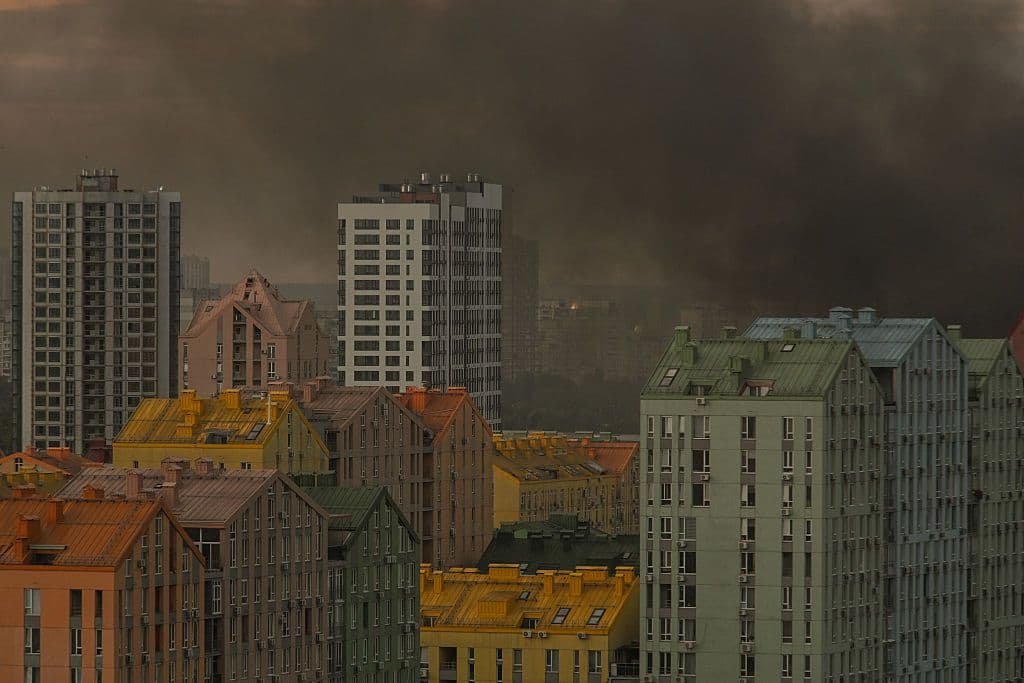
This photo shows smoke rising during Russian missile strikes on the Ukrainian capital of Kyiv early, amid the Russian invasion in Ukraine. Ukraine said Russian missile strikes on Kyiv wounded eight people, as Moscow escalates attacks on the Ukrainian capital. (Evgen Kotenko / AFP / Getty Images)
THE DAY’S RECKONING
Radosław Sikorski said the quiet part out loud on July 10: Poland has “credible information” that Russia is planning to provoke a NATO country, and he is saying so publicly specifically to talk Moscow out of it. That is what deterrence sounds like when it’s running low on other options — a foreign minister hoping a warning does the work a weapons system used to do.
Meanwhile, Russia’s own math kept failing in quieter ways. Gasoline production fell to 65 percent of what the country needs this summer, forcing Moscow to raid its own reserves and beg fuel from Belarus. Ukrainian drones found four more refineries and terminals overnight, and forty-eight tankers have now been hit in the Sea of Azov in five days — enough that a Ukrainian drone commander could joke, without much exaggeration, about whether the next captain sailing toward Crimea is being brave or just not paying attention. And on the ground, a war that Vladimir Putin keeps describing as a Russian juggernaut managed, according to Ukraine’s own commander-in-chief, to advance at less than half its 2025 pace — while still finding time to kill an 18-year-old woman and her 14-year-old brother in Kramatorsk in the same twenty-four hours.
SIKORSKI CONFIRMS: RUSSIA IS PLANNING PROVOCATIONS
Sikorski said at a July 9 press conference alongside French Foreign Minister Jean-Noël Barrot that Poland has “credible information” Russia is planning provocations against unspecified NATO countries, describing the statement as a deliberate public warning meant to dissuade Moscow from following through. Barrot confirmed France has independently observed an increase in Russian provocative activity. The confirmation follows a June 30 report from Polish outlet Onet that the US had privately warned Warsaw Russia was weighing a limited military provocation against Poland specifically. ISW assesses the warnings fit its long-running assessment of a Russian “Phase Zero” campaign — sabotage, drone incursions, and deniable provocations designed to test and unsettle NATO before any larger confrontation.
RUSSIA’S GASOLINE CRISIS DEEPENS
Reuters reported July 10, citing two industry sources and its own calculations, that Russian gasoline production has fallen to roughly 65 percent of peak summer demand — a shortfall of 40,000 to 45,000 metric tons a day against total demand of 115,000 to 120,000 tons, with June production alone falling 25 percent short. Intermediaries told Reuters Russia is tapping federal stockpiles and importing 6,000 tons of gasoline a day from Belarus to cover the gap. Deputy Prime Minister Alexander Novak publicly acknowledged for the first time that Ukrainian strikes have forced partial shutdowns at Russian refineries, promising additional supplies to affected regions. Reuters separately confirmed the Saratov Oil Refinery suspended operations July 7 after a Ukrainian strike damaged its only primary processing unit — the third time the facility has gone offline this year. Kazakhstan’s Interior Ministry said it deployed 59 additional police posts along its Russian border and imposed new entry restrictions after a sharp June rise in Russians attempting to smuggle cheap Kazakh gasoline home.
DEEP STRIKES CONTINUE
The Ukrainian General Staff reported strikes overnight on the Ilsky Oil Refinery in Krasnodar Krai — one of southern Russia’s largest, with 6.6 million tons of annual capacity — as well as the Kurgannefteprodukt oil terminal in Taganrog and the Azovnefteprodukt oil depot in Azov, both in Rostov Oblast, and the Novatek Ust-Luga terminal in Leningrad Oblast, 855 kilometers from the border and one of Russia’s largest gas-processing and light-petroleum facilities. Regional governors in Krasnodar and Rostov confirmed fires at all sites. The General Staff also reported hitting 18 Russian vessels overnight — 13 tankers, three cargo ships, a ferry, and a military auxiliary vessel — used to move fuel and supplies for Russia’s war effort. Separately, footage confirmed continued smoke rising from the TAIF-NK refinery in Tatarstan, struck July 7-8. Telegram channels reported a fire at the Moscow Oil Refinery in the Kapotnya district on July 10, though Russia’s Emergency Ministry denied any incident occurred there; the facility, Moscow’s primary gasoline and diesel supplier, was already expected to remain offline until year’s end after Ukrainian strikes in June, according to earlier Reuters reporting.
NO ADVANCES, FRONTLINES HOLD
Neither side made confirmed gains anywhere on July 10. A Ukrainian brigade in the Lyman direction reported Russian forces are increasingly abandoning soldiers and halting supply deliveries to some positions amid logistics strain. Near Kramatorsk, a Ukrainian brigade spokesperson said Russian forces have sharply escalated drone strikes while scaling back ground assaults over the past two weeks, after Russian command reportedly supplied 1,000 additional Molniya drones with orders to intensify attacks on the city, aiming to encircle rather than storm it directly. In the Kostyantynivka-Druzhkivka area, a Kremlin-affiliated milblogger’s own published map effectively conceded Ukrainian forces hold or have advanced into multiple areas Russian sources previously claimed — west of Chasiv Yar, north of Novopavlivka, and several villages north of Kostyantynivka. Near Pokrovsk, Ukrainian 7th Rapid Reaction Corps spokesperson Colonel Volodymyr Polevyi said Russia’s 41st and 51st Combined Arms Armies and the 76th Airborne Division are attempting to push through Hryshyne toward Dobropillya from the south, while Ukrainian forces interdict Russian logistics and strike command posts inside Pokrovsk itself. Ukrainian forces have recently advanced in the Oleksandrivka direction as well, according to geolocated footage. Occupied Zaporizhzhia and Kherson oblasts both reported significant power outages following Ukrainian strikes on energy infrastructure, with occupation officials in both regions confirming multi-district blackouts.
CRIMEA’S BLOCKADE INTENSIFIES: 48 VESSELS IN FIVE DAYS
USF commander Robert “Magyar” Brovdi reported Ukrainian forces struck 13 more Russian vessels near occupied Crimea overnight — 10 sanctioned shadow fleet tankers, a cargo ship, a ferry, and a tug — bringing the five-day total to 48 vessels struck. “I have a dilemma,” Brovdi joked, “when sending a tanker to Crimea, is the worm building up courage or stupidity?” Ukrainian forces also struck five electrical substations across Crimea overnight as part of what Brovdi calls the “Crimean Switch Off” campaign — in Molochne, Saky, Yevpatoria, and two in Medvedeve — bringing the total military targets struck in Crimea and southern occupied Ukraine overnight to 41. Brovdi separately reported USF drones hit 1,660 Russian targets along the front over the prior 24 hours, including 426 Russian troops. “We will stand,” he wrote. “Moscow will fall. We will restore Crimea.” Crimea-based monitoring channel Crimean Wind reported that only the eastern part of the peninsula has avoided major blackouts, with rolling outages elsewhere expected to last two weeks to a month and full restoration potentially taking months.
SYRSKY’S SIX-MONTH RECKONING
Commander-in-Chief Oleksandr Syrsky reported that Ukrainian forces reduced Russia’s rate of territorial advance by more than half during the first half of 2026, even as Russia maintained a nearly twofold advantage in personnel and equipment. “If previously the Russian army was conducting active offensive operations in 13 operational directions, now there are at most six or seven,” he said, adding that Ukraine’s ratio of assault operations to Russia’s now stands at roughly 40 to 60, with the sides “effectively approaching parity” in the pace of advance. Syrsky said Russian forces suffered average monthly losses of about 32,000 killed and wounded, and warned that “a turning point in the war is still far away,” with Russia continuing to pursue full control of Luhansk and Donetsk oblasts while expanding operations into Dnipropetrovsk and Zaporizhzhia. He said Ukraine’s Deep Strike campaign hit 697 targets inside Russia in the first half of the year, causing at least $6.1 billion in economic damage, while the Middle Strike campaign hit another 7,028 targets in occupied territory; Ukrainian artillery conducted more than 456,000 fire missions, missile forces carried out over 1,140 strikes, and the Air Force flew more than 1,100 strike missions over the same period. Syrsky said he has ordered front-line troop rotations at least every 60 days and reported a 12 percent drop in military crime over the first half of the year.
ZELENSKY BUILDS TWO NEW MILITARY COMMANDS
Zelensky announced the creation of a dedicated long-range strike command focused entirely on degrading Russia’s war-fighting capacity, along with a new Joint Rapid Response Forces branch merging assault infantry with drones, artillery, and other capabilities into a single fast-reacting formation. “This command must concentrate 100 percent of the available resources on degrading Russia’s war-fighting potential even more,” Zelensky said. He appointed Hero of Ukraine Brigadier General Dmytro Voloshyn, currently commander of the 8th Airborne Assault Corps, to lead the new rapid-response branch, citing his direct frontline experience. Zelensky also said Ukraine’s assault formations will see changes in how personnel are treated, with law enforcement agencies already taking related procedural steps.
KRAMATORSK’S SECOND STRIKE, AND THE REST OF THE COUNTRY’S TOLL
Russian forces struck Kramatorsk and nearby Bilenke twice on July 10; the second wave, seven airstrikes between 3:01 and 3:20 p.m. using FAB-250 guided bombs, hit apartment buildings and private homes, killing four people — including an 18-year-old woman and her 14-year-old brother — and wounding 13 more aged 35 to 75, according to the Donetsk regional prosecutor’s office, which opened a war crimes investigation. The strike came on top of an earlier Russian attack on the city the same day that caused damage but no confirmed deaths at the time.
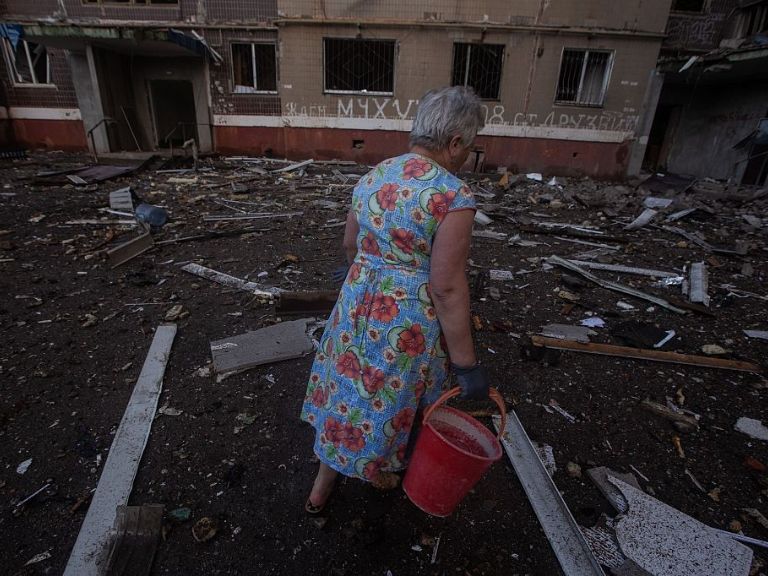
An elderly woman carries a bucket to collect debris in her destroyed neighborhood after a Russian airstrike in Kramatorsk, Ukraine. (Francisco Richart / Anadolu / Getty Images)
Nationally, regional authorities reported at least nine people killed and 77 injured over the prior 24 hours. In Donetsk Oblast, Russian forces killed two civilians in an airstrike on Shabelkivka that destroyed a home — rescuers recovered the bodies after clearing two metric tons of debris — and one more in Druzhkivka, with 10 more injured across 43 shelling attacks on the region. In Kherson Oblast, three people were killed and 34 injured, including three children, as Russian strikes damaged homes, a mobile communications tower, and a passenger bus. Zaporizhzhia City absorbed three guided aerial bombs that killed one person and injured at least 29, damaging residential buildings and forcing evacuations; one bomb remained unexploded in a residential area. Kharkiv Oblast lost one person with 11 injured, including a child, across the city and 10 other settlements. In Sumy Oblast, one person was killed and nine injured across more than 30 attacks on 24 settlements; separately, in the Trostianets, Konotop, and Sumy communities, a Russian jet-powered drone and other strikes injured six more people, two seriously. Dnipropetrovsk Oblast reported one person injured. Overnight, Russia launched 137 attack drones; Ukraine’s Air Force downed 114, while 18 struck 16 locations and debris fell at four more. In Kharkiv Oblast’s Bohodukhiv district, a separate overnight drone strike on the town of Valky killed a 50-year-old woman and left three more people injured or in acute stress, damaging five homes and two outbuildings.
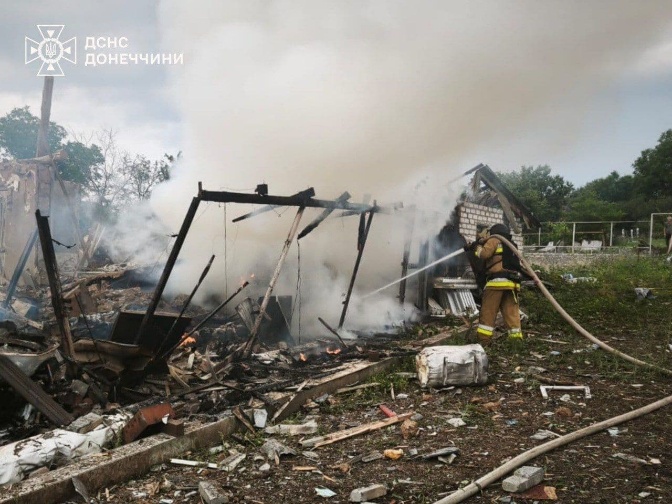
Aftermath of a Russian air strike that destroyed a home in Shabelkivka, Donetsk Oblast. (Ukraine’s State Emergency Service/Telegram)
POROSHENKO LOSES HIS CASE
Ukraine’s Supreme Court rejected former President Petro Poroshenko’s lawsuit seeking to overturn sanctions Zelensky imposed on him in February 2025, in a ruling presidential sanctions commissioner Vladyslav Vlasiuk called confirmation that Ukraine’s sanctions law “expressly allows sanctions to be imposed on individuals regardless of citizenship.” Poroshenko, Zelensky’s chief political rival and leader of the opposition European Solidarity party, called the ruling proof of “a government that is building authoritarianism instead of democracy” and said he would appeal to the Supreme Court’s Grand Chamber and the European Court of Human Rights, warning that “there is a strong likelihood that in July the EU will not open seven negotiating clusters needed to advance our accession process” because of eroding rule of law. The ruling reignited scrutiny of Ukraine’s Supreme Court itself, which has faced repeated corruption scandals — including the June conviction of former court chairman Vsevolod Kniazev, sentenced to five years for orchestrating a bribery scheme, and an ongoing NABU probe into three sitting justices. Legal experts, including DEJURE head Mykhailo Zhernakov, have long argued Ukraine’s practice of sanctioning its own citizens without court proceedings lacks due process protections, regardless of the individual case’s merits.
BRUSSELS OPENS A SECOND DOOR FOR UKRAINE AND MOLDOVA
Ambassadors from all 27 EU member states agreed July 10 to formally open negotiations on a second EU accession cluster for Ukraine and Moldova, covering foreign and security policy alignment, trade, and humanitarian cooperation; a formal signing ceremony is set for July 14. Both countries have been ready to open all six negotiating clusters for months, but unanimity requirements have let individual states, principally Hungary, block progress. Diplomats noted other countries, particularly Poland — whose agricultural and trucking sectors fear Ukrainian competition, and whose president remains in an ongoing dispute with Zelensky over Ukraine’s naming of a UPA-linked military unit — could still slow the remaining four clusters. The progress came just over a week into Ireland’s EU Council presidency, which has made enlargement a stated priority.
POLAND’S SECRET PATRIOTS COME TO LIGHT
Poland’s government confirmed this week it secretly transferred Patriot interceptors to Ukraine in March, after opposition Confederation party co-leader Krzysztof Bosak revealed the shipment publicly; Polish outlet Defense24 reported the transfer involved five PAC-3 missiles. Defense Minister Władysław Kosiniak-Kamysz defended the decision as an investment in Poland’s own security: “I’d rather those missiles intercept projectiles over Ukraine than have Russian missiles ever reach Poland.” Marcin Przydacz, a senior aide to President Karol Nawrocki, accused the government of “scaremongering” about Russian threats while secretly weakening Poland’s own defenses, asking whether the transfer was “betrayal or stupidity”; Kosiniak-Kamysz called the criticism hypocritical, noting the opposition’s own past governments supplied Ukraine with tanks and aircraft, and said Nawrocki had in fact been informed of the transfer in advance.
WASHINGTON SIGNALS, AND LAVROV’S COLD WATER
Republican Senator Lindsey Graham said during a Kyiv visit that he had reached agreement with the White House on a version of a long-stalled Russia sanctions bill, co-sponsored with Democratic Senator Richard Blumenthal, that would let the Trump administration impose tariffs and sanctions on countries buying discounted Russian oil and gas. Graham said he and Blumenthal would move to advance the bill with congressional leaders in the coming days. The announcement came as Russian Foreign Minister Sergey Lavrov said Russia would continue the war until its original 2024 territorial demands are met — full Ukrainian withdrawal from Donetsk, Luhansk, Kherson, and Zaporizhzhia oblasts and abandonment of NATO membership — directly contradicting Trump’s recent public optimism that Putin is ready to end the war. “Russia’s reserve of goodwill and hope has been completely exhausted,” Lavrov said, accusing the West of “feigning willingness to negotiate.” Kremlin spokesperson Peskov separately warned Russia would expand its “zone of military operations” in response to continued Ukrainian strikes.
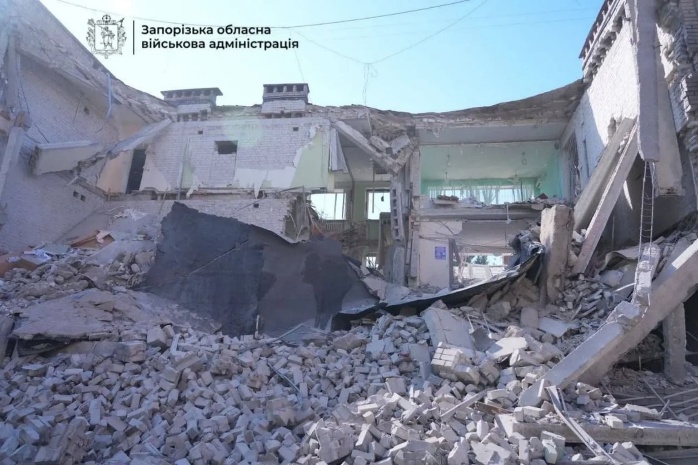
A destroyed building in Zaporizhzhia, following a Russian airstrike attack. (Ivan Fedorov / Zaporizhzhia Regional Military Administration / Telegram)
SMALL ITEMS
Russia’s embassy in The Hague issued a thinly veiled threat against the Netherlands after Dutch Prime Minister Rob Jetten publicly backed Ukrainian strikes on Russian territory, telling Russian state media that Dutch statements “are not only taken note of, but also factored into military and political planning.” Separately, two officials told the Kyiv Independent that a €100 million EU air-defense package for Moldova — the largest European defense package the country has ever received — is set for approval July 13 through the European Peace Facility, as Moldova’s exposure to Russian ballistic missile threats and the presence of Russian troops in Transnistria draws increased European attention. And independent Russian outlet Astra reported that military offices in St. Petersburg are recruiting for new mobile air-defense units protecting the city’s refineries, offering roughly $2,350 a month and explicitly promising no deployment to the Ukrainian front — a recruitment pitch aimed squarely at Russians who want to help the war effort from home rather than fight in it.
By the end of July 10, Russia’s own numbers kept confirming what its soldiers on the ground already knew: gasoline short by a third, refineries burning faster than they can be repaired, tankers vanishing in the Azov Sea five and six at a time. None of it stopped two teenagers from dying in Kramatorsk that afternoon, and none of it will stop the next Shahed launch either — but for a war Moscow insists it’s winning, an awful lot of its own institutions spent July 10 quietly admitting otherwise.
A PRAYER FOR UKRAINE
1. For the Siblings Killed Together in Kramatorsk
Lord, an eighteen-year-old woman and her fourteen-year-old brother died together this afternoon when a second wave of bombs hit their city. We do not know how a family begins to grieve two children lost in the same hour. We ask for mercy for whoever is left to mourn them, and for the thirteen others wounded beside them.
2. For the Woman Killed in Valky
God of the overlooked, a fifty-year-old woman in a small town most of the world will never hear of died last night when a drone found her home. We pray for her, for the neighbors whose houses burned alongside hers, and for every small town carrying this war’s weight without anyone outside it ever learning their names.
3. For the Families Still Waiting on Bodies in Shabelkivka
Father, rescuers spent hours today clearing two tons of rubble in Shabelkivka just to bring home the bodies of two people who should have had decades left. We pray for their families, and for the emergency workers who do this work again and again, one collapsed home at a time.
4. For a Country Trying to Prove Its Own Institutions Still Work
Lord of justice, this week a court ruled against a former president, and questions about that same court’s integrity rose right back up alongside the ruling. We pray for a justice system in Ukraine that can hold its own leaders accountable without becoming a tool for settling political scores — a balance this country is still fighting to find, even in the middle of a war for its survival.
5. For Every Warning Being Issued Before It’s Too Late
God of peace, this week a foreign minister said out loud that his country has reason to believe Russia is planning to provoke a war with someone else. We pray that the warning is heard, that cooler judgment prevails on every side, and that no other nation has to learn what Ukraine already knows about what comes after the warnings stop working.