
Ukraine Daily Briefing | July 11, 2026 | Day 1,599 of the Full-Scale Invasion
Prepared by Dayana Bozhyk
Russian border guards stopped accepting passage through the Kerch Strait after Ukrainian forces struck 76 vessels in the Sea of Azov since July 6, as Russian consumer gasoline prices jumped 6.88 percent in June. Zelensky signed decrees creating a long-range strike command and a new rapid-response ground force, and said he is reshaping Ukraine’s diplomatic corps to speed up weapons deliveries as Patriot interceptor stocks remain critically low. Russian attacks nationwide killed at least 17 people and injured well over 100, including a guided-bomb strike on Sumy that killed four, a ballistic missile strike on Odesa that killed two, and an overnight barrage on Kyiv, as Ukraine’s military charged a brigade commander and members of his unit with kidnapping and murdering two civilians.
THE DAY’S RECKONING
Russian border guards quietly stopped answering requests to sail through the Kerch Strait on the evening of July 10. No announcement, no explanation — just silence where ship traffic used to be. Ukraine’s drones did the talking instead: 76 vessels struck in the Sea of Azov since July 6, enough that ship-tracking data shows barely half the traffic that was moving through those waters two weeks ago. Wheat futures jumped on the news. A war that started over land has found a new way to squeeze the country that started it, one tanker at a time.
On the ground, the day found its own way to remind everyone that blockades and battle-damage assessments don’t stop what a guided bomb does to a bus stop. In Sumy’s Zarichnyi district, in the middle of an ordinary Saturday afternoon, two bombs hit a crowded street where people were waiting for a minibus. Four of them didn’t get on it. Odesa lost two more before the day was through, and Kyiv started the morning the way it’s started too many mornings lately — with ballistic missiles nobody could stop, because there was nothing left in the interceptor stockpile to stop them with. Somewhere in the middle of all of it, Ukraine’s own military filed murder charges against one of its own commanders. Even a country fighting for its life has to keep looking at itself honestly, or it isn’t really fighting for the thing it claims to be.
RUSSIA CLOSES THE KERCH STRAIT
The Ukrainian General Staff and USF commander Robert “Magyar” Brovdi reported Ukrainian forces struck 28 vessels in the Sea of Azov overnight — 21 tankers, four tugboats, two dry cargo ships, and a dredger — bringing the total struck since July 6 to 76. Brovdi said Russian authorities appear to have halted maritime traffic through the Kerch Strait entirely, and Reuters reported July 10, citing three grain-industry sources, that Russia temporarily suspended shipping through the Don-Azov Canal connecting the Sea of Azov to the Don River after the strikes intensified; one source said Russian border guards stopped accepting passage requests as of 6:10 p.m. local time on July 10, with no stated end date. Ship-tracking firm Starboard Maritime Intelligence recorded a drop from 267 vessels with active transponders in the Sea of Azov on June 30 to just 120 on July 11 — a possible 55 percent decline, though ISW cautioned some of that gap likely reflects ships switching off or spoofing their transponders to avoid detection rather than leaving the area entirely. Market analysts estimate up to a quarter of Russia’s wheat exports transit the Sea of Azov; wheat futures on the Euronext exchange rose as much as 4 percent on July 10, hitting a six-week high. Brovdi separately reported Ukrainian forces struck 53 additional military targets across Crimea and southern occupied Ukraine overnight as part of the ongoing “Crimean Switch Off” campaign.
RUSSIAN GASOLINE PRICES SPIKE
Kremlin news agency Interfax reported, citing Russia’s Federal State Statistics Service, that Russian consumer gasoline prices rose an average of 6.88 percent in June 2026 — compared to increases of just 0.85 percent in May, 0.61 percent in April, and roughly 1 percent or less in every other month over the past year. AI-92 gasoline rose 7.3 percent, AI-95 rose 6.7 percent, and diesel rose 7.1 percent in June alone; year-over-year, gasoline prices are now up 19.9 percent, dwarfing the roughly 11 percent annual increases recorded in both 2024 and 2025. At least 78 of Russia’s 83 federal subjects, along with occupied Ukraine, are experiencing gasoline shortages. ISW assesses Ukraine’s long-range strikes on refineries, combined with intermediate-range strikes on fuel deliveries during peak summer demand, are the primary driver of the spike.
RUSSIA’S TECH WAR: HACKED DOORBELLS AND A PLAN TO KILL STARLINK
The Telegraph reported, citing the Netherlands’ AIVD and MIVD intelligence services, that Russian state-linked hackers compromised internet-connected security cameras and home intercom systems across NATO countries and Ukraine to monitor military aid shipments — specifically targeting IP cameras along known logistics routes to identify weapon types and volumes moving to Kyiv, reportedly including hijacked doorbell cameras. Separately, a joint investigation by The Insider, Der Spiegel, and Le Monde revealed that Russia and China held secret discussions at the Third China-Russia Military-Technical Cooperation Forum in Guangzhou on “physical, electromagnetic, and cyber” methods to disable or destroy the Starlink satellite network Ukraine depends on for battlefield communications. Leaked presentation slides, reportedly authored by the China Aerospace Science and Technology Corporation, outlined cost-effective methods to destroy low-orbit satellites alongside jamming and virus-based cyberattacks, and proposed a formal China-Russia “security alliance” to pressure international regulators against Starlink operator SpaceX. Beijing has publicly maintained neutrality on the war.
ZELENSKY CREATES TWO NEW COMMANDS
Zelensky signed decrees July 10 formally establishing a Long-Range (Global) Influence Command focused on degrading Russia’s war-fighting capacity, and a Joint Rapid Response Forces branch within Ukraine’s Ground Forces, appointing Brigadier General Dmytro Voloshyn, current commander of the 8th Airborne Assault Corps, to lead the latter. In his July 11 evening address, Zelensky said he is preparing changes to Ukraine’s diplomatic corps specifically to speed up the delivery of weapons already promised by allies. “We need a new quality of engagement with Ukraine’s partners to ensure the implementation of our agreements on weapons supplies,” he said, without specifying which officials would be affected. He said the changes would also focus on securing the $80 billion in defense aid pledged for 2026 and advancing Europe’s own anti-ballistic missile production. The announcement comes as Ukraine’s stockpile of PAC-3 interceptors — the only weapon in its arsenal capable of reliably downing Russian ballistic missiles — has run completely dry, according to Ukrainian Air Force officials, a shortage that left Ukraine unable to intercept a single one of the 23 ballistic missiles and six Zircon hypersonic missiles Russia fired at Kyiv on July 6.
NO ADVANCES, FRONTLINES HOLD
Neither side made confirmed advances anywhere on July 11, though Russian forces continued claiming exaggerated gains, including a Ministry of Defense claim of seizing Bachivsk in Sumy Oblast that Ukrainian Northern Group of Forces spokesperson Colonel Vadym Mysnyk directly denied, saying Ukrainian forces control the settlement and repelled the infiltration attempt. A Kremlin-affiliated milblogger separately acknowledged Ukrainian forces control the southwestern outskirts of Kostyantynivka further than Russian sources had previously admitted, and that Ukrainian drone surveillance is preventing Russian forces from moving freely through parts of the city. In the Novopavlivka direction, the same milblogger conceded Ukrainian forces recently advanced and that it remains unclear whether Russian forces retain positions on the settlement’s southern outskirts, describing the area as a contested “grey zone.” A Ukrainian defense manufacturer reported Russian forces have begun fielding a new EW-resistant strike drone, the K-8 Dvushka, in Zaporizhzhia Oblast. Crimea-based partisan group Atesh reported Ukrainian strikes have destroyed nearly all of Russia’s high-speed motorboats in the Dnipro River delta near Kherson, impeding Russian resupply to river-island positions, with Russian command reportedly not replacing the lost boats. Russia’s federal government allocated 4.3 billion rubles ($55.9 million) to support Crimean tourism businesses struggling amid the peninsula’s ongoing blackouts and declining visitor numbers.
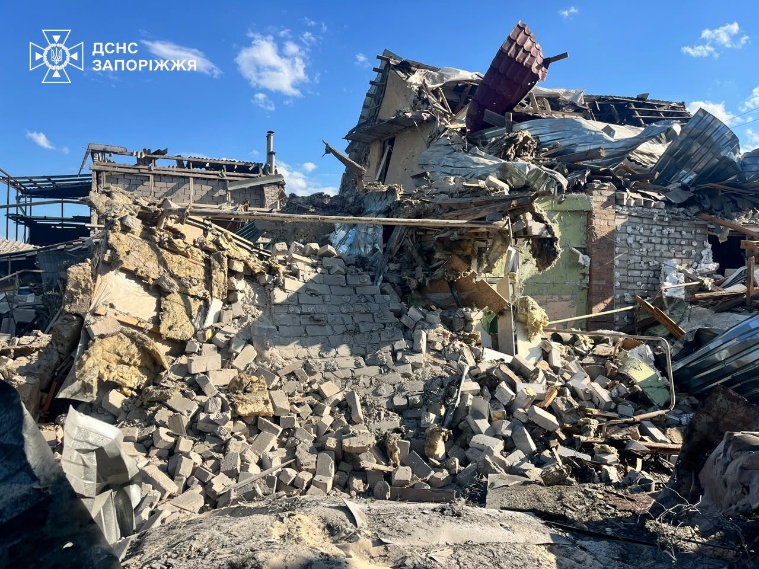
A home lies in ruins following a Russian airstrike on Zaporizhzhia. The attack injured at least four people, officials said. (Ukraine’s State Emergency Service/Telegram)
DEEP STRIKES CONTINUE: BATTLE DAMAGE FROM A WEEK OF FIRE
The Ukrainian General Staff released battle-damage assessments confirming the scale of recent strikes: the June 27 attack on the Titan-Barrikady research and production center in Volgograd caused roughly $105 million in damage; the July 4 strike on the St. Petersburg Oil Terminal damaged seven separate storage tanks and processing equipment; the July 6 strike on the Slavneft-Yanos refinery in Yaroslavl hit its main processing unit and damaged pipelines on two others; the July 8 strike on the Borisoglebsk military airfield in Voronezh Oblast set fire to 28 aviation fuel tanks holding 1,600 cubic meters of kerosene; and the July 8 strike on the TAIF-NK refinery in Tatarstan damaged its delayed coking unit, cable systems, and utility buildings. The General Staff also confirmed the July 10 strike on the Ilsky refinery in Krasnodar Krai caused fires at two separate processing units.
THE PAC-3 MATH
A detailed industry analysis found the scale of Ukraine’s Patriot shortage is structural, not just political. Lockheed Martin produces PAC-3 interceptors at a single factory in Arkansas, turning out roughly 500 to 600 missiles a year, while Ukrainian intelligence estimates Russia produces 700 to 800 ballistic missiles annually — and US air-defense doctrine calls for firing two PAC-3s per incoming missile for a high probability of a successful intercept, meaning even Lockheed’s entire annual output would only give Ukraine good odds against one in four Russian missiles. Missile expert Fabian Hoffmann of the Oslo Nuclear Project said establishing new production lines, whether in Ukraine or Europe, would likely take at least 12 months and probably longer; Reuters reported the new licensed production will most likely begin in Germany or another secure European country before any capability transfers to Ukrainian territory, given the security risks of running a missile assembly line in an active war zone. Polish Defense Minister Władysław Kosiniak-Kamysz said Poland has signed an agreement with the US, Germany, and Sweden to establish a European PAC-3 service center, with Warsaw overseeing eventual technology transfer to Ukraine, and estimated production could begin within weeks — though he acknowledged “it’s not easy.”
Ukraine’s own alternative, Fire Point’s Freya interceptor, is aiming for first test firings by the end of 2026 and serial production in early-to-mid 2027, using a German Hensoldt radar system under a recently signed cooperation agreement; German firm Diehl has also been reported as a possible partner. Ukrainian officials say a small emergency shipment of fewer than 20 PAC-3 missiles, with Poland among the donors, is expected by the end of July. UN/OHCHR preliminary figures found June 2026 among the deadliest months of the war for Ukrainian civilians specifically because of the interceptor shortage: 265 killed and 1,816 injured, driven largely by unintercepted ballistic missile strikes.
A DAY OF NATIONWIDE BOMBARDMENT
Russia launched six Iskander-M/S-400 ballistic missiles, four Kh-59/69 cruise missiles, two Kh-31 anti-radar missiles, and 121 drones overnight; Ukraine’s Air Force downed 111 drones and two cruise missiles, while all six ballistic missiles struck their targets. In Kyiv, explosions were heard from around 3:38 a.m. as ballistic missiles hit four districts, injuring 11 people, including an 11-year-old boy, with three hospitalized; fires broke out in a Dniprovskyi district warehouse and a Solomianskyi district office building, and windows shattered across Darnytskyi. Regional authorities’ morning tally put the day’s toll at 10 killed and 80 injured nationwide: seven killed in Donetsk Oblast (five in Bilenke, two in Kramatorsk) with 21 injured across 44 shelling attacks; two killed and three injured in Kharkiv Oblast; one killed and 30 injured in Zaporizhzhia City amid 1,011 strikes on 51 settlements; three injured in Kherson Oblast; six injured in Sumy Oblast; five injured in Dnipropetrovsk Oblast; and one injured in Chernihiv Oblast.
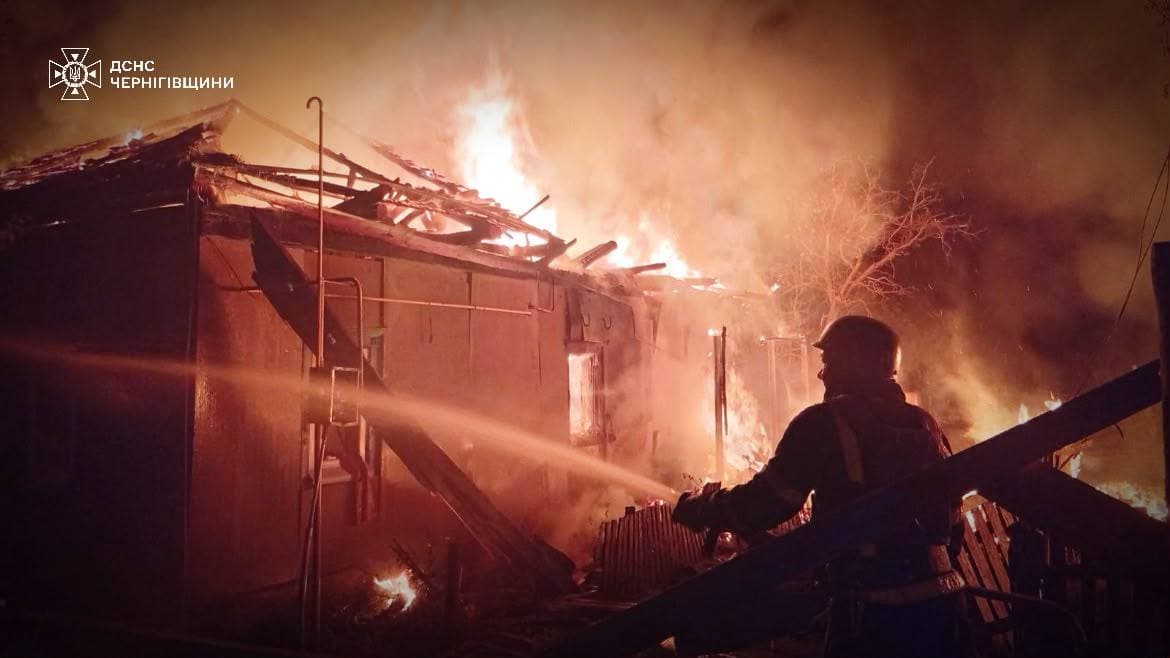
Firefighters extinguish a fire after a Russian Shahed-type drone struck a farm in the Snovsk community of Chernihiv Oblast overnight. (Ukraine’s State Emergency Service/Telegram)
The afternoon added substantially more. Around 10 a.m., three FAB-250 guided bombs hit central Slovyansk, killing a 67-year-old man pulled from the rubble of his own home and injuring three more, damaging 15 homes, four apartment buildings, and an administrative facility, Slovyansk military administration head Vadym Lyakh said. In Kharkiv, an Italmas drone struck a civilian enterprise in the Nemyshlianskyi district, injuring seven and partially destroying a warehouse, while a separate strike hit a gas station in Shevchenkivskyi and a strike on Izium injured four more. Then, at 2:44 p.m., Russian forces dropped guided bombs on a crowded street in Sumy’s Zarichnyi district, hitting a public transit stop where people waited for a passenger minibus. Sumy Regional Military Administration head Oleh Hryhorov confirmed four killed and 17 injured, all requiring hospitalization, and warned residents to avoid the area given the risk of a follow-up “double-tap” strike. In Odesa, a ballistic missile struck a civilian infrastructure facility, killing two people and wounding a 24-year-old man with shrapnel, regional head Oleh Kiper said. Combined with the morning’s nationwide toll, Russian strikes killed at least 17 people and injured well over 100 across Ukraine on July 11.
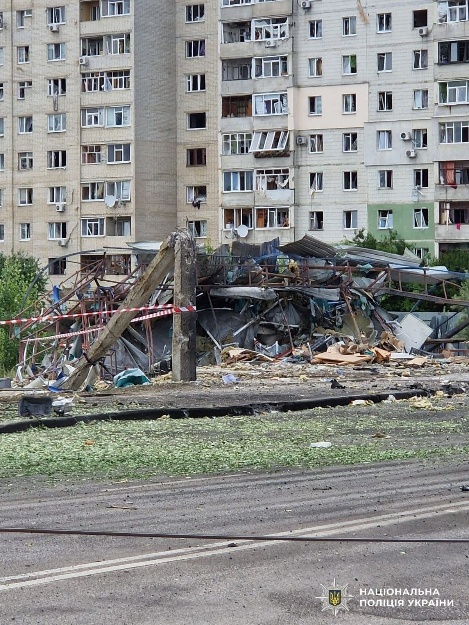
The aftermath of a Russian guided aerial bomb strike on the city of Sumy. (Sumy Regional Military Administration)
A BRIGADE COMMANDER CHARGED WITH MURDER
Ukraine’s military charged Stanislav Luchanov, until recently commander of the 155th “Anne of Kyiv” Brigade, along with several members of his unit, with kidnapping and murdering two civilian brothers in Kyiv Oblast the night of June 27–28; the victims were reportedly taken to Poltava Oblast and killed. Luchanov has since abandoned his post without authorization and is at large. Nine soldiers from the brigade have been detained, and Commander-in-Chief Oleksandr Syrsky ordered an internal investigation and announced strengthened oversight measures to prevent similar incidents. The case follows the recent suspension of the 425th Separate Assault Regiment’s commander, known as “Skelia,” over alleged abuses linked to 26 noncombat deaths in his unit — Luchanov previously served as Skelia’s chief of staff. The 155th Brigade, originally a flagship French-trained modernization project, has faced repeated scandal, including the earlier arrest of its founding commander over mass desertions.
VYSHNEVE: UKROBORONPROM EXECUTIVES FACE CRIMINAL LIABILITY
Zelensky said July 11 that senior officials at Ukroboronprom, Ukraine’s state defense conglomerate, broke the law by allowing an ammunition depot to be located in the residential Kyiv suburb of Vyshneve, where it detonated during Russia’s July 6 attack, killing seven people and injuring 29. “There are designated locations in Ukraine for storing weapons and ammunition — all of which are specified to be located away from residential buildings,” Zelensky said, adding that the SBU has identified the heads of two Ukroboronprom-affiliated enterprises as primarily responsible, with deputies and other officials also under investigation; names have not been made public. Zelensky said Ukroboronprom’s sprawling structure of roughly 100 enterprises needs stronger internal oversight and ordered the SBU to inspect other similar facilities nationwide. Kyiv Oblast administration head Mykola Kalashnyk said roughly 300 emergency workers remain in Vyshneve around the clock five days after the attack: “We must not only eliminate the consequences of the Russian attack, but also restore every house, every street, and return people a sense of security and normal life.”
SMALL ITEMS
The Ukrainian Nuclear Society formally disputed IAEA Director General Rafael Grossi’s April assessment that staffing shortages at the Russian-occupied Zaporizhzhia Nuclear Power Plant are “not a major issue,” saying the number of licensed specialists authorized to manage reactor safety has collapsed from 159 before occupation to just 22, and citing documented torture and detention of plant employees by Russian forces that makes safe operation impossible under current conditions. Separately, EU foreign ministers are set to meet in Brussels July 13 to discuss financing and protecting Ukraine’s energy grid ahead of winter alongside urgent air-defense needs, with Foreign Minister Andrii Sybiha attending in person; one diplomat told Suspilne that France, Italy, and Spain continue issuing Schengen visas to Russian citizens even as a small group of states carries most of the burden of supporting Ukraine. The same day, Zelensky is expected in Paris for a Coalition of the Willing summit hosted by President Emmanuel Macron, with at least 25 heads of state and government expected and Moldova and North Macedonia set to join the 35-nation coalition.
By the end of July 11, Russia’s own strait was closing on itself, its own consumers were paying nearly 20 percent more for gasoline than a year ago, and its own hackers were reduced to spying through neighbors’ doorbell cameras to figure out what Ukraine’s allies were sending next. None of it stopped a guided bomb from finding a bus stop in Sumy at 2:44 in the afternoon. Both of those things were true on the same Saturday, in the same war, and neither canceled the other out.
A PRAYER FOR UKRAINE
1. For Everyone Waiting for a Minibus in Zarichnyi
Lord, four people did not survive an ordinary wait for public transportation this afternoon in Sumy. We ask for peace for their families, and for the seventeen who were hurt beside them — for the specific terror of an afternoon errand turning into a rescue scene, and for whatever comfort can reach people living through that.
2. For the 67-Year-Old Man Pulled From His Own Home
God of the faithful, a man in Slovyansk died today in the rubble of the house he lived in, killed by bombs that also damaged fifteen of his neighbors’ homes. We pray for whoever loved him, and for a city that keeps having to rebuild the same streets over and over.
3. For the Two Brothers Taken From Their Own Yard
Father, this week Ukraine’s own military charged one of its commanders with kidnapping and killing two civilian brothers — a horror made no easier by coming from inside the army meant to protect them. We pray for the victims’ family, for real accountability rather than a quiet cover-up, and for a country trying to hold itself to its own standards even at its most exhausted.
4. For a Nation Waiting on Missiles That Have Not Yet Arrived
Lord, Ukraine’s air defenders spent today with nothing left to stop a ballistic missile, watching six of them fall exactly where they were aimed. We pray for the interceptors still sitting in stockpiles somewhere, for the diplomacy trying to move them faster, and for everyone sleeping tonight in a city that ballistic missiles can still reach unopposed.
5. For Vyshneve, Rebuilding a Street at a Time
God of restoration, five days after an ammunition depot exploded in their town, three hundred rescue workers are still in Vyshneve, and its people are still waiting to feel safe in their own homes again. We pray for their patience, for honest accountability from those responsible, and for the day this town gets to be ordinary again.