
Ukraine Daily Briefing | July 16, 2026 | Day 1,604 of the Full-Scale Invasion
Prepared by Dayana Bozhyk
Ukraine’s parliament confirmed Serhii Koretsky as prime minister and approved his full cabinet on July 16, while President Volodymyr Zelensky named acting SBU chief Yevhen Khmara as interim defense minister, pending a parliamentary vote. Ousted defense minister Mykhailo Fedorov held a press conference accusing Commander-in-Chief Oleksandr Syrsky of blocking military reforms and “figuring out how to divide the country” instead of how to win the war, as thousands protested his dismissal in Kyiv and other cities and a wave of officials, including an Air Force deputy commander, resigned in solidarity. Outgoing British Prime Minister Keir Starmer made a farewell visit to Kyiv, pledging £300 million toward 16 Gripen fighter jets. Russia struck Kyiv with ballistic missiles overnight, killing two, and hit Odesa for a second consecutive night, while Ukraine’s naval drone campaign struck its 147th Russian vessel since July 6.
THE DAY’S RECKONING
Ukraine spent July 16 doing something no country at war really wants to do in public: arguing with itself, loudly, about how to keep fighting. A new prime minister was sworn in. A new cabinet was seated. And the defense minister who’d just been pushed out of it stood in front of cameras and said the general running Ukraine’s army had, in his telling, given up on winning the war and started thinking instead about how to split the country. Syrsky answered by talking about defending Kyiv in 2022. Neither man backed down. Thousands of people who didn’t work for either of them filled the streets anyway.
None of it paused the war outside. Ballistic missiles hit Kyiv again before dawn, the seventh time this month. Odesa took its second strike in as many nights. And somewhere in the Sea of Azov, a Ukrainian drone found the 147th Russian vessel struck since the start of July, quietly doing the thing both sides of the argument in Kyiv claimed to actually want — making Russia pay for a war it started. Ukraine did not get to choose between having a functioning government and having a functioning war effort on July 16. It just had to run both at once, arguments and all.
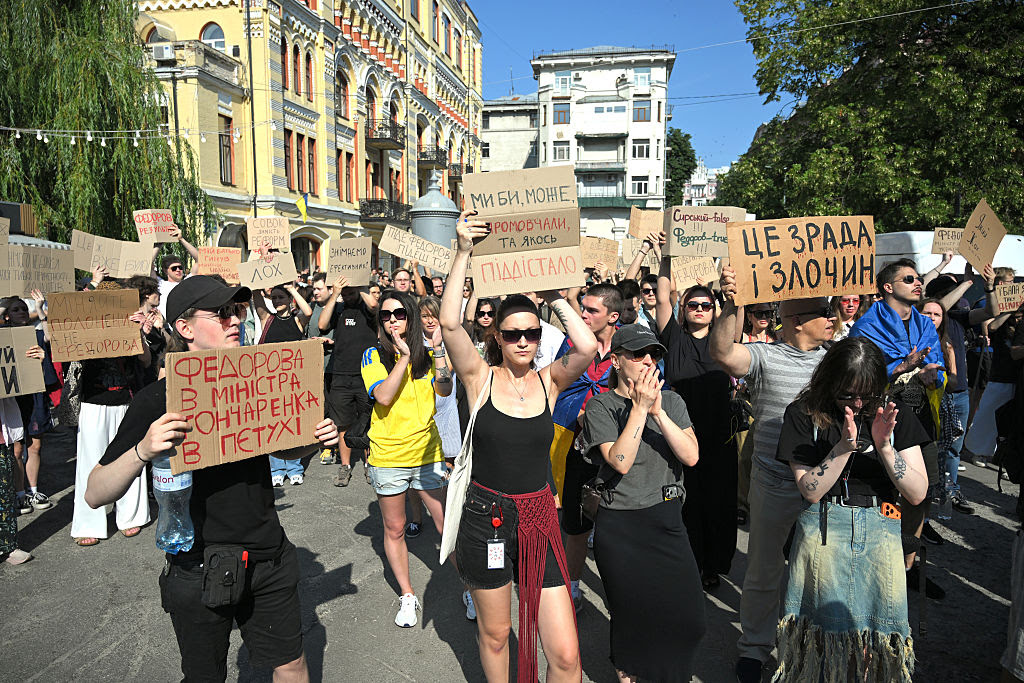
Activists hold placards during a rally against the dismissal of former Defense Minister Mykhailo Fedorov in Kyiv. (Yevhen Kotenko/Ukrinform/NurPhoto via Getty Images)
KORETSKY CONFIRMED AS PM, CABINET APPROVED AMID PROTESTS
Ukraine’s parliament confirmed Serhii Koretsky as prime minister July 16, with 289 of 392 lawmakers voting in favor, one against, seven abstaining, and 21 not voting. Hours later, parliament approved his full cabinet 264 to 15, with 19 abstaining. Most ministers kept or moved into their posts without major changes: Denys Shmyhal remained first deputy prime minister and energy minister, Serhii Marchenko stayed finance minister, and Viktor Lyashko stayed health minister. New appointments included National Police chief Ivan Vyhivskyi as interior minister, McKinsey partner Oleksandr Kravchenko as economy minister, legal policy committee chair Denys Maslov as justice minister, and Mykolaiv Oblast Governor Vitaliy Kim as veterans affairs minister. Kyiv Oblast head Mykola Kalashnyk became infrastructure and reconstruction minister, and Ukraine’s EU ambassador Vsevolod Chentsov became deputy prime minister for European integration. Notably absent from the vote: a defense minister and a foreign minister, both positions parliament left open pending future nominations.
Zelensky named acting SBU chief Yevhen Khmara as interim defense minister the same day, without yet submitting the appointment to parliament for confirmation — a legal gap some analysts questioned. “Once the necessary legal procedures are completed, I will ask lawmakers to support Yevhen Khmara’s appointment as defense minister,” Zelensky said, citing Khmara’s experience running long-range strike operations and Ukraine’s Alpha special operations unit, and noting his role liberating Snake Island in 2022. Interior Minister Ihor Klymenko, whom lawmakers had widely expected to get the job, remains “one of the candidates,” Zelensky said, but no formal nomination has been filed for him either. Khmara’s expected deputy, Oleksandr Poklad, would become acting SBU chief in his place — a move anti-corruption groups criticized given Poklad’s role leading the SBU’s widely condemned 2025 crackdown on Ukraine’s independent anti-corruption bureau, NABU.
FEDOROV FIRES BACK
Fedorov held an emergency press conference July 16, publicly confirming he had pushed Zelensky to replace both Syrsky and General Staff Chief Andrii Hnatov, calling it necessary to “defeat the enemy asymmetrically, with minimal losses.” He said he accepted Zelensky’s decision to keep Syrsky months ago and tried to make the working relationship function, but that Syrsky then blocked nearly all of his reform initiatives. “Instead of thinking about how to win the war asymmetrically, he figured out how to divide the country,” Fedorov said. He denied ever issuing Zelensky an ultimatum, and said he declined Zelensky’s July 15 offer to stay on as a presidential adviser: “My goal was never to become a minister, remain a minister, or simply hold a position.” Fedorov credited his tenure with raising drone interception rates from 83 to 91 percent and cruise missile interception from 47 to 87 percent, expanding ground robotic system procurement from 12,000 to 50,000 units, and saving an estimated $100 million through competitive procurement tenders that he said “threatened powerful interests” inside the ministry.
Syrsky responded on Telegram without directly engaging Fedorov’s specific accusations, instead invoking Ukraine’s 2022 defense of Kyiv: “I am proud that thanks to the Kyiv defense operation in 2022, we managed to defend our capital. And now this city can host briefings, shape visions, and make decisions,” he wrote, thanking Fedorov for his service and wishing him well. Public Anti-Corruption Council head Yuriy Hudymenko described the clash as generational, “a conflict between a young technocrat and a general from a largely post-Soviet military school.” Joint Forces commander Major General Mykhailo Drapatyi offered a more pointed assessment, writing that Fedorov’s team had made “a real attempt to change the rules” and that reform “cannot end with the replacement of a minister, a team, or the head of a particular branch” — it must continue “until fair and understandable rules become the norm.”
A CASCADE OF RESIGNATIONS
Air Force Deputy Commander Colonel Pavlo Yelizarov, whom Fedorov had appointed in January to lead air defense reform, announced his resignation July 16, calling Fedorov’s dismissal “a great evil for the country’s defense capability” and saying he would not continue serving even in the reserves. Fedorov’s advisers Serhiy “Flash” Beskrestnov and Serhii Sternenko both announced July 15 they would no longer work with the ministry; Sternenko called Fedorov “the best defense minister in our entire history.” Separately, Zelensky dismissed Tymur Tkachenko as head of the Kyiv City Military Administration by decree on July 16, giving no public reason. Protests against Fedorov’s dismissal drew an estimated 1,000 to 2,000 people to Kyiv on the morning of July 16 alone, part of demonstrations reported in at least 18 cities including Lviv, Kharkiv, Chernihiv, Ternopil, Vinnytsia, and even Brussels; European Commissioner for Defense Andrius Kubilius had separately warned before the dismissal that removing Fedorov would “raise the question of why such a person is being replaced.”
STARMER’S FAREWELL
Outgoing British Prime Minister Keir Starmer made what his office described as his final visit to Kyiv before stepping down July 20, pledging £300 million ($405 million) to help deliver 16 Gripen fighter jets to Ukraine in partnership with Sweden, building on Kyiv’s June agreement to purchase the aircraft with deliveries beginning as early as 2029. “Our cast-iron support for Ukraine will always endure,” Starmer said, calling Ukraine “one of the most battle-hardened, tech-savvy, creative military forces in the world” and “a net contributor to collective security.” Zelensky awarded Starmer Ukraine’s Order of Freedom, and the two laid a wreath at Kyiv’s Wall of Remembrance. Starmer’s office said his two years in office saw the UK deliver more than 250,000 drones, roughly 8,000 missiles, and 350,000 artillery rounds to Ukraine, alongside £3 billion in annual military support; he will be succeeded by incoming Labour leader Andy Burnham, who has pledged continuity on Ukraine policy. Separately, Sweden approved a $145 million contribution to the World Bank’s IDA Crisis Facility 2.0 for Ukraine, expected to unlock roughly three times that amount in additional recovery loans.
FEDOROV’S LAST ACT
An EU official confirmed to the Kyiv Independent that Fedorov filed a substantial package of weapons “product schedules” with the EU just before his July 15 exit, seeking to unlock financing from Ukraine’s €90 billion EU support loan for both European-made air defense systems, including the French-Italian SAMP/T and Ukraine’s own Freya interceptor, and non-European systems like PAC-3 interceptors, which require a special derogation since the loan is intended to prioritize European industry. The official said the filing contained “a bunch of product schedules” with “lots of European products” but “some derogations too,” and that Fedorov’s abrupt departure could complicate the review, since it raises exactly the kind of question Kubilius had flagged days earlier. Nine EU countries had already signed a July 2 letter urging that Ukraine be allowed to source US weapons with EU funds, suggesting the request has support even without Fedorov in office to advocate for it directly.
NO ADVANCES, FRONTLINES HOLD
Russian forces recently advanced west of the Travyanske Reservoir in northern Kharkiv Oblast, while Ukrainian forces recently advanced and cleared Russian infiltrators from central Andriivka-Klevstove near Oleksandrivka. Elsewhere the front held without confirmed movement on either side. A Ukrainian officer in the Slovyansk direction said Russian assault frequency has risen from five to seven attacks a day in spring to 22 to 26 a day now, with Russian forces attacking in small groups by vehicle or on foot and holding an advantage in glide bombs that complicates Ukrainian rear logistics. In the Kostyantynivka-Druzhkivka area, Russian forces continue relying on small dismounted infiltration groups rather than mechanized assaults, with a Ukrainian drone battalion commander noting Russian forces are increasingly adopting Ukrainian tactics and using professional technical specialists rather than pure coercive discipline to integrate new soldiers. A Ukrainian brigade spokesperson said Russian forces are intensifying FPV drone strikes on civilians evacuating on foot toward Druzhkivka; separate strikes hit residential buildings and a post office in Kramatorsk, injuring three. Near Pokrovsk, 7th Airborne Assault Corps commander Brigadier General Yevhen Lasiychuk said Ukrainian forces are working to form a 100-kilometer “kill zone” using intermediate-range drones and artillery to destroy Russian units before they can disperse into infiltration groups. In the Zaporizhzhia direction, 1st Separate Assault Regiment commander Dmytro “Perun” Filatov reported Ukrainian strikes have forced Russian forces to cut artillery use by 60 percent and drone use by 30 percent, even as Russian mobile fire teams have raised their drone interception rate from 20 to 40 percent using positions hidden in windbreaks.
UKRAINE’S MARITIME CAMPAIGN TOPS 147 VESSELS
Ukrainian Navy spokesperson Captain Dmytro Pletenchuk said Ukraine’s naval drone campaign has paralyzed Russian fuel shipping to occupied Crimea and is now threatening the Novorossiysk-Bosphorus and Don-Bosphorus shipping lanes that carry up to 20 percent of Russia’s crude oil exports; Novorossiysk is Russia’s largest seaport. Pletenchuk said Russian forces failed to reinforce air defenses along these routes despite years of Ukrainian warnings, and that Russian warships now risk becoming targets themselves if they attempt to escort cargo vessels. USF commander Robert “Magyar” Brovdi reported Ukrainian forces struck 11 more vessels overnight — five oil tankers, a gas tanker, three dry cargo ships, and two tugboats — bringing the total struck since July 6 to 147, split between 117 in the Sea of Azov and 30 in the Black Sea. Brovdi said the strikes aim to disable vessels’ navigation and communications rather than breach their hulls, leaving ships “blind and deaf” rather than risking oil spills. The Ukrainian General Staff separately confirmed strikes on six tankers and two tugboats overnight, and the SBU reported its Mamai naval drones struck the shadow fleet tankers Louise 1 and Banda specifically.
RUSSIA TURNS TO INDIA AS ITS ELITES MOVE MONEY ABROAD
Reuters reported that major Russian energy companies, including Rosneft, Gazprom Neft, and Lukoil, are approaching Indian refiners for emergency gasoline supplies, with at least one cargo already transferred ship-to-ship near Egypt and expected to reach Murmansk Oblast around July 26. A source told Reuters Russia is unlikely to recover about 40 percent of its lost refining capacity before mid-September even if Ukrainian strikes stopped immediately. Separately, Bloomberg reported that wealthy Russians, including individuals close to Putin, are increasingly moving assets into cryptocurrency, gold, and foreign property, driven by fear of the Kremlin’s escalating nationalization campaign; Russia’s Prosecutor General nationalized the country’s largest agricultural holding in May, part of a pattern breaking Putin’s own 2000 promise to oligarchs that their privatized Soviet-era assets would remain untouched in exchange for political loyalty.
POLAND WARNS OF RUSSIAN SURVEILLANCE NEAR NATO DRILLS
Polish Deputy Prime Minister and Defense Minister Władysław Kosiniak-Kamysz said Poland scrambled fighter jets July 15 after detecting Russian surveillance of NATO air defense integration exercises near the Baltic Sea, intercepting two Russian Su-30SM2 fighters flying from Kaliningrad Oblast with Swedish aircraft assistance; the Russian jets did not enter Polish airspace. ISW assesses the surveillance fits Russia’s continuing “Phase Zero” campaign to gather intelligence and set psychological conditions ahead of potential future provocations against NATO.
HUNGARY INVESTIGATES ITS OWN FORMER FOREIGN MINISTER
Hungarian Prime Minister Péter Magyar said July 16 that authorities have opened an official investigation into former Foreign Minister Péter Szijjártó’s ties to Russia, without disclosing details due to the classified nature of the materials involved. Szijjártó served under former Prime Minister Viktor Orbán, maintained frequent contact with Moscow throughout the war, and consistently opposed EU sanctions on Russia. The probe is part of Magyar’s broader effort to distance Hungary from its predecessor’s Russia-friendly foreign policy since his election.
THE MONACO CASE’S STRANGE NEW TWIST
French newspaper Nice-Matin reported that Ukrainian businessman Vadym Iermolaiev, the target of the June 29 Monaco bombing, has now accused officers of Ukraine’s military intelligence agency (HUR) of attempting to assassinate him personally, and has formally requested protection guarantees from Monegasque, French, and Ukrainian authorities for himself, his family, and witnesses in the case. Ukraine’s Prosecutor General’s Office and SBU have said the two men charged in the killing of bombing suspect Anastasiia Berezovska — HUR officer Yevhen Reut and former SBU volunteer Vitaliy Zhykovych — acted without their agencies’ knowledge. Iermolaiev, a sanctioned former Ukrainian businessman who has held Cypriot citizenship since 2017, denies Ukrainian allegations that he collaborated with Russia.
THE DAY’S TOLL
Russia launched eight Iskander-M/S-400 ballistic missiles, four Kh-22/32 cruise missiles, one Kh-31P anti-radar missile, five Banderol loitering munitions, and 146 drones overnight; Ukraine’s Air Force downed three ballistic missiles and 129 drones, while five ballistic missiles, the anti-radar missile, and 16 drones struck their targets. Ballistic missiles hit Kyiv shortly before 1 a.m., killing two people and injuring six, including a 16-year-old boy, and damaging warehouses and non-residential buildings; explosions from drone strikes were also reported in Kharkiv, and air raid alerts sounded as far away as Vinnytsia Oblast. It was Russia’s seventh ballistic missile attack on Kyiv this month. That evening, a Russian missile struck Odesa again, killing two and injuring at least eight, including children, damaging residential buildings, a religious institution, and a preschool — the fifth consecutive day Odesa Oblast has been struck, following an attack that killed three and injured six there in the early hours of July 15. Sumy absorbed five guided bomb strikes in the early morning hours, two hitting the city center directly and damaging a multistory non-residential building, less than six hours after a previous guided bomb strike on the city’s outskirts; casualty details were still being confirmed. Earlier Thursday, seven people, including a four-year-old child, were wounded in Russian attacks across Sumy district.
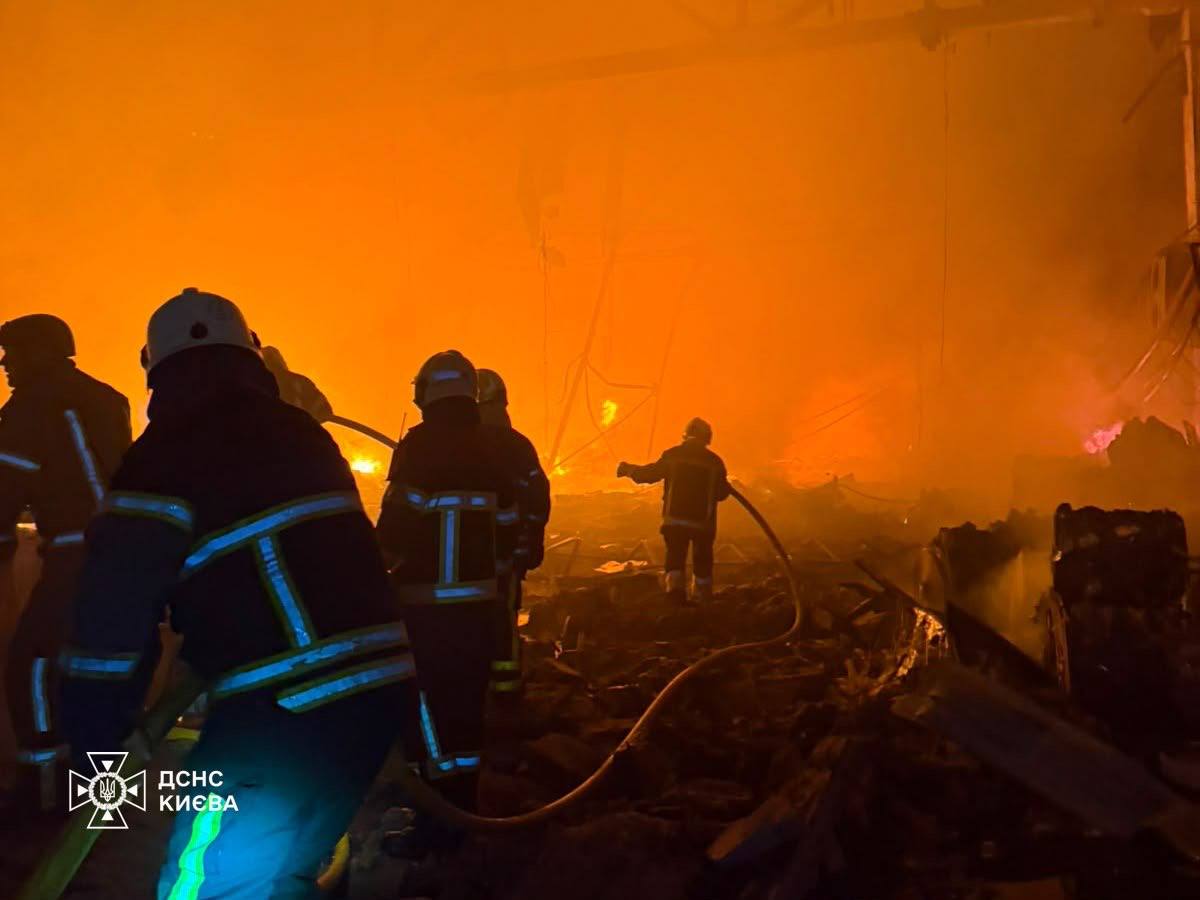
Firefighters work to extinguish a blaze following a Russian ballistic missile attack on Kyiv overnight. The attack killed at least two people and injured six others, officials said. (Ukraine’s State Emergency Service)
SMALL ITEMS
Ukraine’s Coordination Headquarters for the Treatment of Prisoners of War announced the repatriation of 501 bodies Russia claims are Ukrainian service members, with mandatory explosive-safety screening now standard before identification work begins, following past discoveries of explosive devices hidden in returned remains. And Russian social media company VK confirmed its Max messaging app — developed under FSB supervision and pre-installed on Russian phones with extensive surveillance features — was removed from the Google Play store, following the EU’s July 13 sanctions on Max and VK and Apple’s earlier June 25 removal of both apps from its own store; VK simultaneously sold its RuStore app marketplace to its own executive, a move the European Commission has not yet said whether it considers an attempt to dodge the sanctions.
By the end of July 16, Ukraine had a new prime minister, a new cabinet, an unresolved defense ministry, and a public argument between its most popular reformer and its top general that neither side showed signs of walking back. Kyiv had also taken its seventh ballistic missile attack of the month, and a Ukrainian sea drone had quietly notched its 147th kill in the water since the start of the campaign. The war did not wait for Ukraine’s government to finish arguing with itself before continuing exactly as it had the day before.
A PRAYER FOR UKRAINE
1. For the Two Killed Before Dawn in Kyiv
Lord, ballistic missiles found Kyiv again before one in the morning, the seventh time this month, killing two people and hurting a sixteen-year-old boy. We ask for peace for their families, and for a capital that keeps having to measure its nights in how many missiles made it through.
2. For Odesa, Struck Again
God of the weary, Odesa has now been hit for a fifth consecutive day, two more dead this evening on top of everyone lost the night before. We pray for the injured, including the children among them, and for a city that cannot seem to get one clear night to itself.
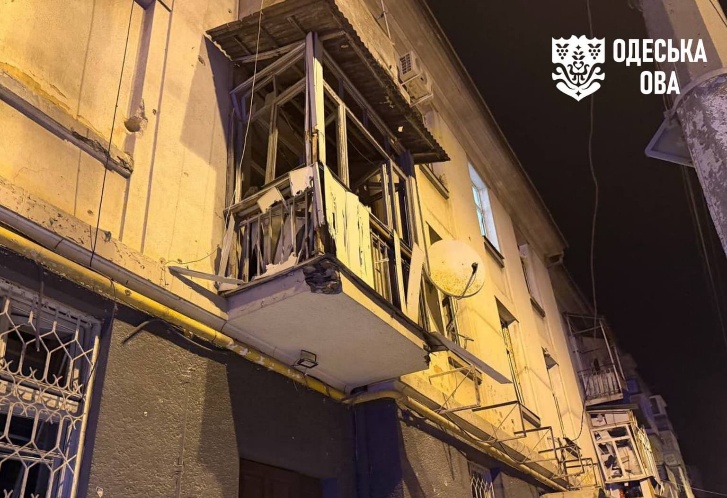
The aftermath of a Russian drone attack on a hotel in Odesa overnight. (Odesa Oblast Governor Oleh Kiper / Telegram)
3. For a Country Watching Its Own Leaders Argue in Public
Father, this week Ukraine’s defense minister and its top general aired a bitter dispute in full public view, while thousands took to the streets in a dozen cities. We do not know who is right. We pray for wisdom for everyone making these decisions, for a resolution that serves the soldiers on the front line rather than either man’s pride, and for a country that can hold this disagreement without losing its unity.
4. For the Soldiers Who Resigned in Protest
Lord, this week an Air Force officer gave up his post, and advisers walked away from a ministry they believed in, because they could not stay quiet about a decision they saw as dangerous. We pray for their consciences, and for a military that can hear honest dissent without treating it as disloyalty.
5. For Ukraine’s New Government, Untested and Already at War
God of wisdom, a new prime minister and a new cabinet took office today in the middle of a war that has no patience for a learning curve. We pray for Serhii Koretsky and every minister sworn in today, that they lead with more courage than caution, and that Ukraine’s government, however it reshapes itself, never loses sight of who it exists to protect.