
Ukraine Daily Briefing | July 17, 2026 | Day 1,605 of the Full-Scale Invasion
Prepared by Dayana Bozhyk
Ukrainians rallied in Kyiv and other cities for a second straight day to demand Mykhailo Fedorov’s reinstatement as defense minister, as President Volodymyr Zelensky offered Ihor Klymenko the separate post of National Security and Defense Council secretary and the Cabinet formally approved Yevhen Khmara as acting defense minister. Russia’s Moscow Exchange fell 4.24 percent on July 16, its steepest single-day drop since September 2022, followed by a further decline July 17, as fuel shortages and war spending strain the broader economy. Ukraine’s Security Service destroyed a Tu-95 strategic bomber at Russia’s Engels air base and struck the Slavneft-YANOS refinery in Yaroslavl, while Ukrainian naval drones struck their 159th Russian vessel since July 6 and launched a large-scale attack across occupied Crimea. Ukrainian media defied a court injunction to publish an investigation into the State Investigation Bureau chief’s brother. Russian attacks nationwide killed at least seven people and injured 67.
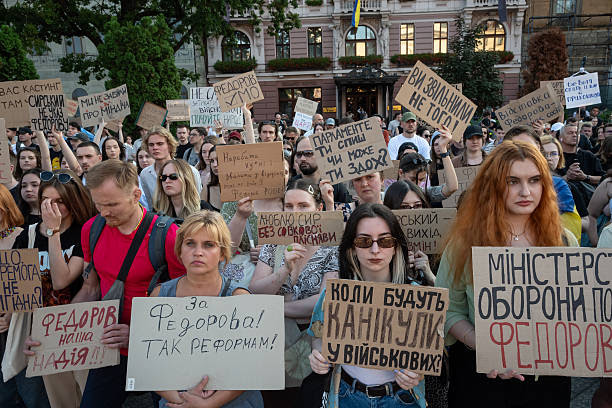
Ukrainians attend a rally to protest President Volodymyr Zelensky’s decision to dismiss Defense Minister Mykhailo Fedorov after six months in office in Lviv, Ukraine. The demonstrators also call for the dismissal of Commander-in-Chief Oleksandr Syrskyi. (Olena Znak/Anadolu via Getty Images))
THE DAY’S RECKONING
For a second day, Kyiv had two things happening in its streets at once: protesters demanding a defense minister back, and a general economy back home in Russia quietly falling apart in ways no protest could match. Russia’s stock market had its worst day since the early weeks of the 2022 invasion. A state bank’s shares hit an all-time low. And a Ukrainian drone found a Tu-95 bomber sitting on a runway in Saratov Oblast and tore its tail clean off — the second time in as many months Ukraine has managed exactly that trick.
Back in Kyiv, Zelensky spent the day trying to lower the temperature without reversing course: an offer here, a new title there, a promise that he “hears” the protesters even as he kept his original decision in place. Ihor Klymenko, the man everyone assumed would get the defense ministry, got a different job instead. Yevhen Khmara, the quiet former spy chief nobody in the streets was chanting for, got confirmed anyway. None of the compromises satisfied the crowds. None of them slowed the war outside, either — Sumy took five more guided bombs before most of the country had finished arguing about who should run its army.
UKRAINE’S GOVERNMENT CRISIS, DAY TWO
Protesters gathered again in Kyiv and other cities July 17 for a second consecutive day, continuing to demand Fedorov’s reinstatement and criticizing Zelensky’s decision to retain Syrsky. Zelensky said after the first day of protests that he “understands, hears, and responds” to public concerns, but protesters said he had done nothing to reverse the dismissal itself. Zelensky instead offered Klymenko, the former interior minister widely expected to take the defense portfolio, the separate post of National Security and Defense Council secretary — a powerful coordinating role currently held by Rustem Umerov, whose own future, including his role leading Ukraine’s stalled trilateral peace talks with Russia and the US, remains unclear. “The appointment decree is already being prepared,” Zelensky said. The Cabinet of Ministers formally approved Khmara’s appointment as acting defense minister July 17, though his confirmation as permanent minister still requires a separate parliamentary vote Zelensky has not yet scheduled; there is no indication Foreign Minister Andrii Sybiha will be replaced, with his reappointment requiring only routine legislative approval at parliament’s next session August 18.
The reshuffle rippled further through Kyiv’s security apparatus. Zelensky formally appointed Oleksandr Poklad as acting SBU chief by decree, with Maksym Tsutskiridze named temporary head of the National Police in Poklad’s place — a move anti-corruption activists criticized given Poklad’s role leading the SBU’s widely condemned 2025 crackdown on Ukraine’s anti-corruption bureau. Fedorov adviser Serhiy “Flash” Beskrestnov confirmed he declined an offer to stay on at the Defense Ministry under new leadership, saying “for moral reasons, I cannot stay in the Defense Ministry without Mykhailo,” but accepted a new role as presidential adviser on defense technologies after a call with Zelensky, saying he would continue assisting Fedorov informally. Separately, Zelensky swapped Ukraine’s two senior EU-facing diplomats: Vsevolod Chentsov, formerly Ukraine’s ambassador to the EU, becomes deputy prime minister for European integration, while Taras Kachka, the outgoing deputy prime minister, becomes ambassador to Brussels — the same two people, different titles, with Kachka additionally tasked with bilateral trade negotiations. Former acting Digital Transformation Minister Oleksandr Bornyakov also announced he is leaving the ministry, following Oksana Ferchuk’s appointment to the post as part of the broader reshuffle.
RUSSIAN REACTIONS: PESKOV SHRUGS, PROPAGANDISTS CELEBRATE
Kremlin spokesperson Dmitry Peskov downplayed the significance of Ukraine’s reshuffle, telling reporters “broadly speaking, it makes no difference who the defense minister is,” and said Moscow’s priority remains a Ukrainian “responsible decision” to end the war on Russian terms. Other Kremlin-aligned voices disagreed sharply. Former Ukrainian lawmaker and collaborator Oleg Tsaryov credited Fedorov with growing Ukraine’s drone manufacturer base from 7 to more than 500 companies and its electronic-warfare producer base from 2 to 200. Russian pro-war Telegram channels openly celebrated the dismissal as “excellent news,” with one demanding, partly in jest, that Elon Musk restore Starlink access for Russian drones now that Fedorov was gone — an unintentional acknowledgment of how much Fedorov’s Starlink restrictions had actually hurt Russian operations. Moscow City Duma lawmaker Andrei Medvedev called the negative Ukrainian reaction to the dismissal “a positive development for us,” while military blogger Yuri Kotenok, despite using slurs to describe Fedorov’s team as “techno-fascists,” rejected Kyiv’s official explanation and said the real story was a struggle between technology-driven warfare and traditional command culture — the same divide Ukrainian analysts have identified. One propaganda channel falsely claimed the protests were a staged “cardboard Maidan” orchestrated by Western elites to punish Zelensky for his contacts with Trump.
RUSSIA’S ECONOMY CRACKS
Russia’s Moscow Exchange Composite Index fell 4.24 percent to close around 2,022 points on July 16 — its steepest single-day decline since September 26, 2022 — before falling further to roughly 1,958 points by the end of trading July 17. Shares in majority state-owned VTB Bank fell 6 percent to an all-time low of 57.8 rubles (about 74 cents) on July 16. ISW assesses the decline reflects a broader financial strain extending well beyond the fuel shortages driven by Ukraine’s refinery campaign, including unsustainable war spending, rising inflation, labor shortages in construction and services, depletion of Russia’s sovereign wealth fund, and a deterrent effect on investment from the Kremlin’s escalating nationalization of private assets.
UKRAINE DESTROYS A STRATEGIC BOMBER AT ENGELS, AGAIN
Ukraine’s Security Service and Zelensky announced July 17 that Ukrainian forces destroyed a Tu-95 strategic bomber at the Engels air base in Saratov Oblast, roughly 800 kilometers from the border, severing the aircraft’s tail section in what the SBU called a strike causing “critical damage.” Neither the SBU nor Zelensky specified the exact date of the strike, though Russian Telegram channels reported drone activity at Engels overnight on July 15–16. “Every strategic bomber taken out of action means dozens of missiles that are never launched at Ukrainian cities,” the SBU said. The strike echoes Ukraine’s June 2025 Operation Spiderweb, in which FPV drones smuggled into Russia inside trucks destroyed at least eight Tu-95MS bombers across four airfields in a single coordinated attack, causing an estimated $7 billion in damage and disabling over a third of Russia’s cruise-missile-carrying bomber fleet.
DEEP STRIKES AND A LARGE-SCALE ATTACK ON CRIMEA
The Ukrainian General Staff confirmed strikes on the Slavneft-YANOS oil refinery in Yaroslavl — one of Russia’s largest, with roughly 15 million tons of annual capacity — sparking a fire, alongside a road bridge in Kursk Oblast near the border and an automobile bridge near Kozino, Kursk Oblast, both used for Russian military logistics. Ukrainian forces separately launched a large-scale attack across occupied Crimea, with explosions and fires reported in Kerch, Koktebel, and Feodosia; fires broke out at the Kerch railway station, including in train cars and warehouses, and on the Arabat Spit near Russian positions, including close to a former military airfield outside Baherove. Traffic across the Kerch Strait Bridge was suspended for nearly seven hours, from 9:43 p.m. to 5:13 a.m., with roughly 1,200 vehicles left waiting. The Ukrainian General Staff also reported strikes on a Russian Svetlyak-class patrol ship, the TES-Terminal-1 oil terminal, and a fuel depot near Kerch, plus heat anomalies detected near electrical substations, a pumping station, and the Chornomorneftegaz gas plant across the peninsula. Sevastopol’s occupation governor acknowledged worsening power outages and said authorities are prioritizing electricity for hospitals and pumping stations; Russian opposition outlet Meduza reported satellite data showing nighttime illumination across Crimea has dropped fivefold since late June and has not recovered. Novaya Gazeta reported that occupation authorities in northern Crimea now require residents to obtain military registration before receiving compensation for the outages.
UKRAINE’S MISSILE FORENSICS
Presidential sanctions commissioner Vladyslav Vlasiuk said forensic analysis of an Iskander-M missile and the Oreshnik missile used in the May 24 strike on Bila Tserkva confirms Russia continues sourcing components from the US, Taiwan, Switzerland, Japan, and China alongside domestic and Belarusian parts, some dated to 2024 and 2025 production runs, despite international trade restrictions. The Oreshnik’s components, by contrast, came exclusively from Russian and Belarusian suppliers, including Belarus-based Integral and the Transistor plant; Polish Institute of International Affairs analysts have separately found the Oreshnik’s warheads follow predictable ballistic paths without evasive maneuvers, making the weapon theoretically more vulnerable to NATO missile defenses than Russia’s marketing suggests. “Future international efforts should be aimed precisely at breaking these supply chains,” Vlasiuk said, adding that Ukraine has shared detailed manufacturer and serial-number data with partners.
NO ADVANCES, FRONTLINES HOLD
Neither side made confirmed advances anywhere on July 17. Elements of Ukraine’s 425th Separate Assault Regiment “Skelia” cleared a Russian-occupied building in northern Kozacha Lopan and repelled a Russian infiltration attempt across the international border. A Ukrainian brigade spokesperson in the Kupyansk direction said Russian forces rely heavily on infiltration and glide-bomb strikes against rear positions and civilian targets, using ATVs for logistics but not yet ground robots at scale. In the Lyman direction, a Ukrainian brigade spokesperson said Russian infantry are losing the initiative but continue targeting Ukrainian supply lines across the Siverskyi Donets and Oskil rivers with drones and glide bombs. Near Kostyantynivka, a Ukrainian drone battalion commander said Ukrainian strikes now destroy roughly 90 percent of Russian armored vehicles before they reach the front, while Russian forces scale up counter-drone teams in the Dobropillya-Druzhkivka rear. Near Pokrovsk, a Ukrainian command post head said Russian soldiers must now march up to 50 kilometers to reach the front because of Ukrainian strikes on vehicles, while Russian forces hide D-30 howitzers by removing their wheels to avoid detection. Ukraine’s Donetsk Oblast administration head Vadym Filashkin reported Russian forces are increasing glide bomb and drone use against frontline settlements across the oblast. Syrsky said Russia continues pursuing its “buffer zone” strategy in northern Ukraine despite Ukraine’s layered defenses, and Ukraine’s GUR warned that Russian command has ordered the elite Rubikon drone unit and frontline operators to intensify strikes specifically on civilian gas stations, buses, trucks, and cars in frontline and border areas, using real-time-guided drones rather than preset-coordinate weapons like the Shahed.
MARITIME CAMPAIGN TOPS 159 VESSELS
USF commander Robert “Magyar” Brovdi reported Ukrainian forces struck 12 more Russian shadow fleet vessels in the Black Sea July 17 — nine dry cargo ships, an oil tanker, a gas carrier, and a tugboat — bringing the total struck since July 6 to 159, split between 117 in the Sea of Azov and 42 in the Black Sea. Separately, Ukraine’s Omega special forces unit said it struck a Russian Su-24M bomber at Crimea’s Saky air base, hitting the aircraft’s nose section and fuel tanks in two passes. The Insider reported, citing open-source tracking, that Russia has no vessels remaining in the Mediterranean Sea for the first time since 2013 — a consequence, ISW assesses, of Russia redirecting its limited naval assets to defend the increasingly contested Black Sea and Sea of Azov instead.
A COURT BAN DEFIED
Multiple Ukrainian outlets — including Dzerkalo Tyzhnia, RFE/RL, Ukrainska Pravda, Hromadske, Suspilne, and Bihus.info — published an investigative report July 17 into 143 apartments the brother of State Investigation Bureau chief Oleksiy Sukhachov acquired between 2018 and 2020 at prices far below market value, despite a July 6 Kyiv court injunction barring the Anti-Corruption Action Center, Slidstvo.info, and journalist Alina Stryzhak specifically from publishing it. The injunction was issued by Pechersk District Court judge Serhiy Vovk, who anti-corruption watchdogs say has a lengthy record of controversial, allegedly politically motivated rulings; he denies the accusations. Journalist Maksym Savchuk, a co-author of the investigation not named in the injunction, said he was legally free to share the report with other outlets and did so. The bureau denied wrongdoing, saying family ties alone don’t establish improper influence and that the underlying case had been transferred between police and the bureau multiple times without charges. Anti-Corruption Action Center deputy director Olena Shcherban called the original injunction “manifestly unlawful,” and opposition lawmaker Yaroslav Zheleznyak renewed calls for Sukhachov’s dismissal and an overhaul of the bureau’s leadership selection process, which anti-corruption groups have long criticized as non-transparent.
A MILLION TARGETS
Ukraine’s Defense Ministry reported Ukrainian drone units have struck more than 1 million verified targets since the start of 2026, accounting for roughly 90 percent of all Russian targets hit. Monthly strikes have nearly doubled since January, from 105,800 to 200,218 in June, and Ukrainian drone attacks have killed or seriously wounded an estimated 193,500 Russian soldiers so far this year. Ukraine’s Defense Procurement Agency awarded 333.6 billion hryvnia ($7.5 billion) in drone contracts in the first half of 2026, twice the amount over the same period last year, with FPV drones representing the largest share.
THE DAY’S TOLL
Russia launched one Kh-31P anti-radar missile, seven Kh-59/69 guided missiles, and 130 Shahed-type drones overnight; air raid sirens sounded twice across Kyiv and other regions after warnings of a possible ballistic missile launch from Taganrog, though no strikes, damage, or casualties were reported from that specific threat. Regional authorities reported at least seven people killed and 67 injured nationwide over the prior 24 hours, with Odesa struck again during peak tourist season. Sumy absorbed five guided bomb strikes in the early morning hours — two hitting the city center directly, damaging a multistory non-residential building and shattering hundreds of windows in surrounding buildings, less than six hours after a previous strike on the city’s outskirts. Emergency services remained deployed at impact sites as the full extent of casualties and damage was still being assessed. The EU separately sanctioned Russia’s ABS Electro group of companies and its director, Iryna Kharisova, for supplying electronics that make Shahed and Geran drones more resistant to Ukrainian electronic warfare, and for supporting automated systems in Russia’s energy sector; EU foreign policy chief Kaja Kallas said “the more Moscow attacks civilians, the more sanctions must be imposed.”
SMALL ITEMS
HUR officer Andriy Chernyak said Russia is deliberately avoiding public mobilization talk ahead of autumn’s State Duma elections but that the risk of a new wave afterward remains real, since Russia’s existing training infrastructure only lacks the manpower to fill it — “cannon fodder,” as he put it, not new training centers. Chernyak said he sees no signs of an imminent Russian invasion staged from Belarus, though roughly 50,000 Belarusian troops and Russian support units remain stationed there. Separately, researchers reported a surge in anti-Ukrainian hate incidents across Poland, which they linked to Russian disinformation campaigns compounding existing political tensions over issues like Ukraine’s UPA naming controversy. And Kremlin spokesperson Peskov dismissed US intelligence findings on Russian election interference as “unattributed,” responding to a 25-minute White House speech in which Trump named Russia, China, and Iran as top security threats.
By the end of July 17, Russia’s own stock exchange had posted its worst day in nearly four years, a Tu-95 bomber sat wrecked on a runway in Saratov Oblast, and Crimea’s bridge had gone dark for seven hours under Ukrainian fire. In Kyiv, a second day of protests ended with a compromise nobody in the streets had actually asked for. Both governments, in their own ways, spent July 17 discovering that the things they could control were smaller than the things they couldn’t.
A PRAYER FOR UKRAINE
1. For Sumy, Struck Twice Before Sunrise
Lord, Sumy took five guided bombs in the early hours of today, less than six hours after the last strike on its outskirts. We pray for everyone caught in that repetition, for windows that keep shattering and buildings that keep cracking, and for a city that cannot seem to get one full night without fire falling on it.
2. For a Nation Arguing With Itself in the Middle of a War
Father, for a second day, Ukrainians filled the streets demanding answers their president has not fully given. We do not know who is right in this dispute. We ask for patience for everyone still waiting to be heard, wisdom for everyone making these decisions, and a country that comes through this disagreement more united, not less.
3. For Every Official Trying to Do Right by a Broken System
Lord, this week journalists defied a court order to tell the truth about an investigation into a public official’s family, at real risk to themselves. We pray for their safety, for a justice system that protects truth-telling rather than punishing it, and for the day when defending the public’s right to know doesn’t require this much courage.
4. For the Ordinary People Living Through Russia’s Unraveling
God of mercy, this week Russia’s own stock market cratered and its own state bank hit record lows — consequences that will land hardest on ordinary Russians who never chose this war. We pray for anyone across that border quietly suffering for decisions made far above them, and for the wisdom of leaders on all sides to find a way out of this before more people, anywhere, pay for it.
5. For a Bridge That Went Dark for Seven Hours
God of small mercies, tonight in Crimea the Kerch Strait Bridge sat closed for seven hours, twelve hundred cars waiting in the dark for a war they did not start to let them pass. We pray for everyone stuck in that line, for everyone living under blackout after blackout on that peninsula, and for an end to this war that reaches every person still waiting for their lights to come back on.