
Ukraine Daily Briefing | July 18, 2026 | Day 1,606 of the Full-Scale Invasion
Prepared by Dayana Bozhyk
Russian Chief of the General Staff Valery Gerasimov claimed sweeping advances across Donetsk Oblast on July 18, including Russian forces entering Dobropillya and reaching within five kilometers of Kramatorsk — claims ISW found no evidence to support, even as Ukraine’s own 425th Regiment released footage of its soldiers holding a flag inside Kostyantynivka’s House of Culture. Ukrainian drones struck two Wildberries logistics warehouses deep inside Russia, Moscow’s answer to Amazon, causing an estimated $1.2 billion in damage, alongside an oil depot near Moscow and a second consecutive night of strikes on a Russian patrol ship at Kerch. Ukraine’s naval campaign struck its 172nd vessel since July 6, forcing Russia to divert elite drone units and an anti-aircraft regiment from the front to defend its shipping. Russian attacks nationwide killed at least 11 people and injured 62, and Hungary’s president resigned under pressure from the country’s new pro-European government.
THE DAY’S RECKONING
Valery Gerasimov gave a short speech on July 18 and claimed Russian forces had entered Dobropillya, reached the outskirts of Kramatorsk, and nearly seized three more towns besides. None of it was true, according to the people actually tracking the war without a script — and the clearest rebuttal came from soldiers, not analysts: Ukraine’s own 425th Regiment filmed themselves holding a flag inside a cultural center in Kostyantynivka, the exact city Gerasimov and Putin had already declared captured two weeks earlier.
While Moscow’s general staff was busy inventing a map, Ukrainian drones were busy erasing a real one — a warehouse belonging to Russia’s largest online retailer, big enough to process 7.4 million packages a day, now on fire in Moscow Oblast. A second one burned in Tambov. An oil depot burned near Noginsk. And in the water, a Russian patrol ship took its second hit in as many nights near Kerch, one more entry in a naval campaign that has now forced Russia to pull elite drone crews off the actual front line just to babysit its own tankers. Two governments spent July 18 telling two very different stories about who is winning. Only one of them had video evidence.
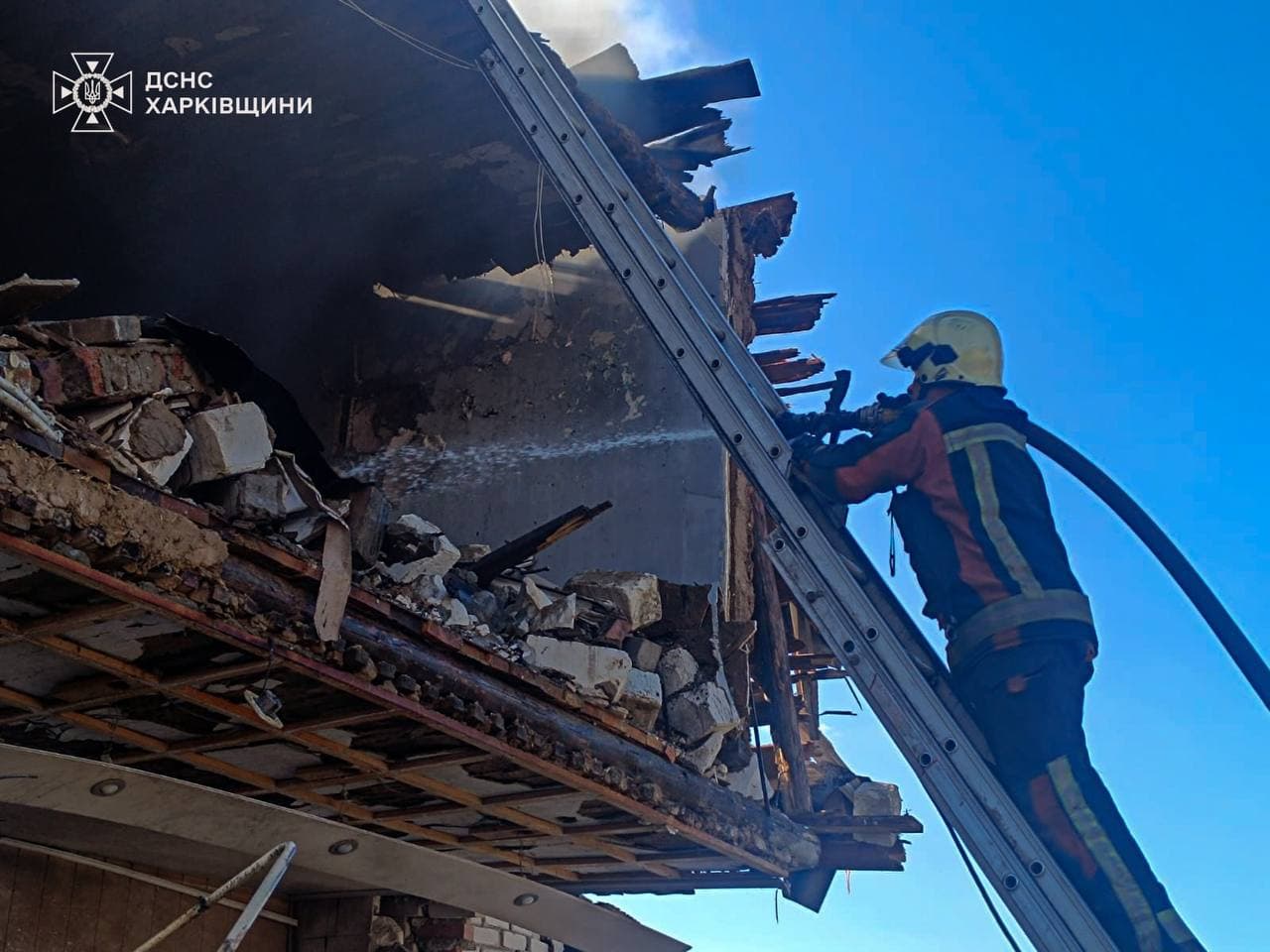
A rescue worker extinguishes a fire following a Russian attack on the city of Izium, Kharkiv Oblast. The strike injured seven people, including three children. (Ukraine’s Emergency Service)
GERASIMOV’S LATEST EXAGGERATION
Gerasimov conducted a choreographed inspection of the Western Grouping of Forces headquarters and claimed Russian forces had entered Pidlyman, seized Pyskunivka, reached Mykolaivka, advanced within five kilometers of Kramatorsk, entered Oleksiyevo-Druzhkivka, entered Dobropillya and Hannivka, nearly seized Shevchenko, Krasnoyarske, and Svitle, and seized Myrne — plus repeated an earlier claim that Russian forces are advancing west from Kupyansk, a town Russian forces have not actually seized. ISW found no evidence supporting any of the Dobropillya, Hannivka, Oleksiyevo-Druzhkivka, Svitle, or Krasnoyarske claims, and found Russian forces remain 8.5 kilometers from Pidlyman, three kilometers from Pyskunivka, nine kilometers from Mykolaivka, 6.1 kilometers from both Kramatorsk and Oleksiyevo-Druzhkivka, and 7.2 to 7.3 kilometers from Dobropillya and Hannivka. Notably, no Russian milbloggers — who typically break news of genuine advances before official channels do — had even claimed most of these locations. ISW assesses Gerasimov’s unusually short speech and thin claims may reflect how little time has passed since his last choreographed appearance July 3, or simply that Russian forces have little left to report: Russian forces lost territory at a rate of about 1.6 square kilometers per day between July 1 and 17.
Ukraine’s own soldiers offered the clearest counter-evidence. The 425th Skala Regiment published footage July 18 showing Ukrainian troops holding a flag inside the House of Culture in western Kostyantynivka and said its forces had conducted a clearing operation and control the city; another officer in the area said Ukrainian forces control a significant part of it. ISW could not confirm Ukrainian forces control the entire city, but continues to assess that Russian infiltrators — an estimated 100 to 150 as of June — hold scattered positions rather than the city itself.
UKRAINE STRIKES RUSSIA’S LARGEST ONLINE RETAILER
Ukrainian drones struck two logistics warehouses belonging to Wildberries, Russia’s largest online retailer, overnight in Elektrostal, Moscow Oblast, and Kotovsk, Tambov Oblast — roughly 500 and 700 kilometers from the front, respectively. Zelensky initially did not specify the facilities’ military relevance, but said in an evening address that the warehouses stored “navigation equipment, components for drone production, and other supplies for the Russian army.” Independent Russian outlet Important Stories estimated the Moscow facility processed up to 7.4 million items daily and the Tambov center up to 1.4 million, with combined damages potentially exceeding 100 billion rubles ($1.2 billion) based on comparisons to a 2024 Wildberries fire in St. Petersburg; Russian business outlet Vedomosti separately estimated Wildberries lost roughly 7 percent of its total warehouse capacity. Moscow Oblast Governor Andrei Vorobyov claimed the Elektrostal strike killed one person and injured 61; Tambov Oblast Governor Yevgeny Pervyshov claimed the Kotovsk strike killed seven and injured 24. Russian officials broadly condemned the strikes as terrorism and accused Ukraine of deliberately targeting civilians — a characterization ISW notes stands in some tension with Russia’s own sustained campaign against Ukrainian civilian postal and logistics infrastructure throughout the war. Russian opposition outlet Meduza separately reported that Ozon, another major Russian e-commerce platform, quietly changed its seller agreements in June to remove its obligation to compensate sellers for force-majeure losses — a change Russian media only noticed after this week’s strikes.
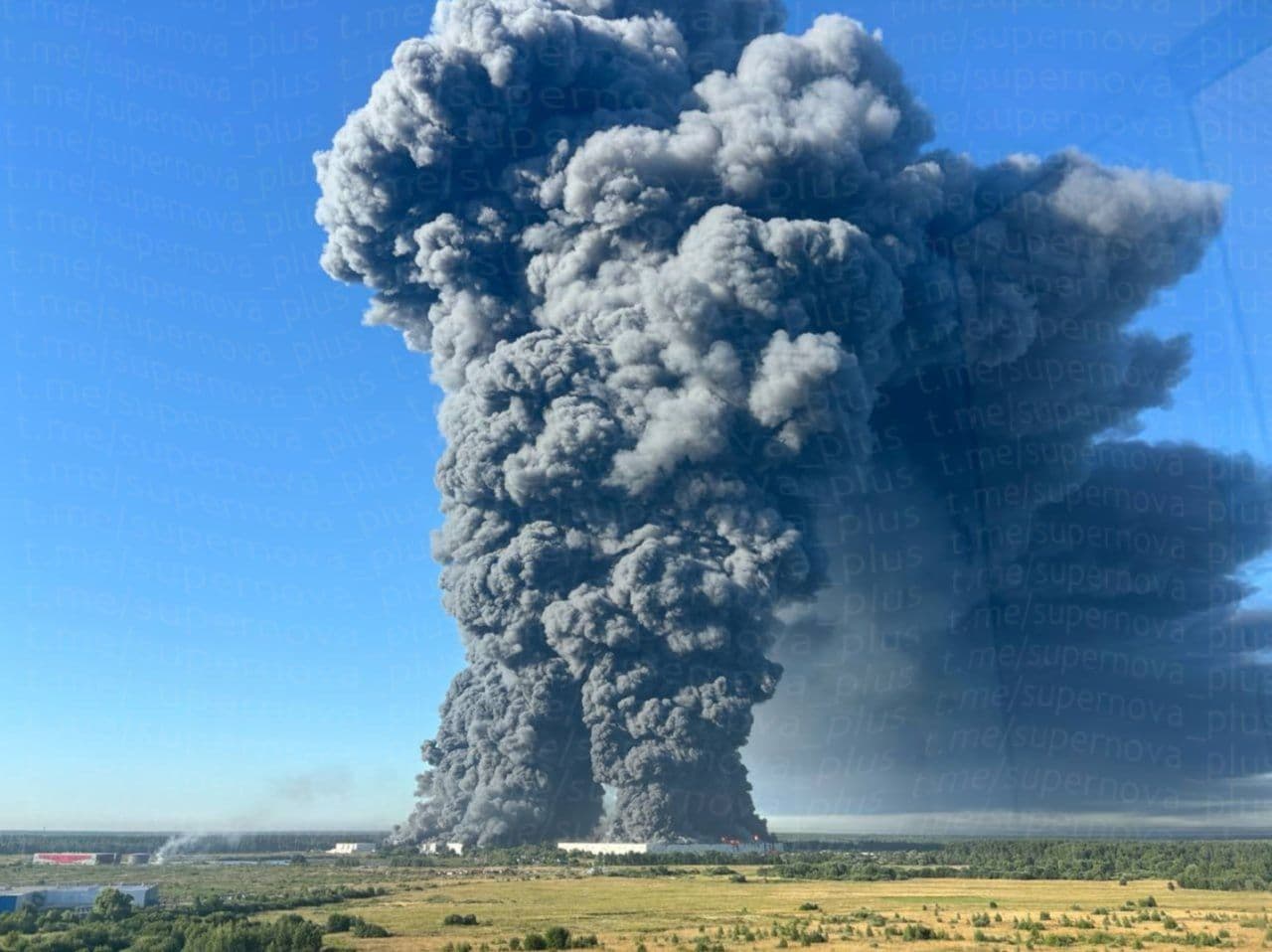
A photo of a purported strike on a Wildberries fulfillment center in Moscow Oblast overnight following a reported Ukrainian drone attack. (Supernova_plus/Telegram)
THE MARITIME BLOCKADE FORCES RUSSIA TO PULL UNITS FROM THE FRONT
USF commander Robert “Magyar” Brovdi reported Ukrainian forces struck 13 more Russian vessels over the past day — eight dry cargo ships, an oil tanker, a gas tanker, two floating cranes, and a tugboat — bringing the total struck since July 6 to 172. Brovdi said the sustained pressure has forced Russia to redeploy up to 200 drone crews from the elite Rubikon Center for Advanced Unmanned Technologies away from the front line, all of the 51st Air Defense Division, and an entire anti-aircraft regiment from the Black Sea Fleet, assigning one drone crew to defend each vessel. Ukrainian OSINT source Voidgroup reported that Black Sea Fleet commander Admiral Sergei Pinchuk ordered elements of the fleet to begin compiling evacuation lists for servicemembers’ families in occupied Sevastopol as of July 10, covering naval engineering, ship repair, medical, and administrative units stationed there. Ukrainian naval reserve officer Andriy Ryzhenko said Ukrainian forces have struck more than 100 river-sea class vessels in the past ten days, each capable of ferrying up to 7,000 tons of fuel to Crimea, which needs roughly 5,000 tons a day just for civilian use. Reuters reported that grain analyst Andrey Sizov of SovEcon assessed Russian wheat exports could fall short by 5 to 10 million tons if Russia cannot maintain shipping through the Sea of Azov.
NO ADVANCES, FRONTLINES HOLD
Neither side made confirmed advances anywhere on July 18. Ukrainian forces cleared Russian infiltrators from positions north of Kharkiv City in Shevchenka and Kozacha Lopan, and a source tracking Russia’s Northern Grouping of Forces acknowledged Ukrainian forces again control Kupyansk-Vuzlovyi after earlier Russian infiltration. In the Lyman direction, a Ukrainian brigade spokesperson said drone pressure is forcing Russian forces to conduct logistics entirely on foot or by drone, and geolocated footage confirmed Ukrainian forces still hold positions in central Lyman despite Russian claims otherwise. In the Novopavlivka direction, a Ukrainian brigade spokesperson said Russian forces dropped 27 guided bombs on the town in a single day; a Russian milblogger’s own map acknowledged neither side controls southwestern Novopavlivka. In the Oleksandrivka direction, Ukrainian forces advanced or held positions while a Ukrainian drone pilot reported Russian infiltrators increasingly assault through open fields rather than treelines, continuing to advance even under FPV strikes. Near Orikhiv, Ukrainian forces destroyed a Russian platoon-sized motorized assault involving eight servicemembers and four ATVs. Ukraine’s intermediate-range campaign struck a railway bridge over the Bila River near occupied Sabivka, electrical substations across occupied Luhansk Oblast, and substations near occupied Mariupol and Yasynivka in Donetsk Oblast.
DEEP STRIKES CONTINUE
The Ukrainian General Staff reported striking the Nefto-Service oil depot in Noginsk, Moscow Oblast, roughly 490 kilometers from the border, causing a fire Governor Vorobyov acknowledged. Kursk Oblast Governor Alexander Khinshtein claimed Ukrainian strikes on an unspecified power facility cut electricity for more than 46,000 consumers. In occupied Crimea, USF forces struck electrical substations in Shchebetovka, Kerch, Hlazivka, and Vulkanivka between July 15 and 18, and Crimean Wind reported a possible strike on the Balaklava Thermal Power Plant following an explosion in Sevastopol, plus more than 20 impacts at the Hvardiiske airfield. The Ukrainian General Staff confirmed striking a Russian Svetlyak-class patrol ship near Kerch for the second consecutive night.
A DISPUTED DEATH AT ZAPORIZHZHIA’S NUCLEAR PLANT
Ukraine’s State Regulatory Commission and nuclear operator Energoatom rejected a claim by Russian nuclear agency Rosatom’s CEO that a Ukrainian drone strike killed Alexander Yakovlev, the Russian occupation-appointed chief engineer at the Zaporizhzhia Nuclear Power Plant. Ukrainian officials said Yakovlev held no legitimate legal authority at the plant, since Ukraine’s only recognized chief engineer, Denys Marynenko, has been denied access since Russian forces occupied the facility. The IAEA confirmed only that Russian authorities had notified it of Yakovlev’s reported death, without independently verifying Ukrainian responsibility.
HUNGARY’S PRESIDENT STEPS DOWN UNDER PRESSURE
Hungarian President Tamas Sulyok agreed July 18 to sign constitutional amendments ending his term on July 20, while sharply criticizing the process that forced him out. “The next President of Hungary will be the President who violated the constitutional values,” Sulyok said, calling it a trampling of institutional independence “for the sake of power.” Prime Minister Péter Magyar, whose Tisza party ousted longtime Russia-friendly leader Viktor Orbán in April elections, had accused Sulyok of shielding Orbán-era abuses and given him a May 31 deadline to resign voluntarily; when he didn’t, parliament passed amendments including a 12-year term limit for lawmakers and the legal basis for a new National Asset Recovery and Protection Office, alongside language ending Sulyok’s term. National Assembly Speaker Ágnes Forsthoffer will serve as acting president while parliament selects a permanent successor within 30 days.
Separately, Mykolaiv Oblast Military Administration head Vitaliy Kim formally resigned his post on July 17 to take up the veterans affairs ministry post offered to him as part of Ukraine’s broader government reshuffle, though as of July 18 he had not yet received the official appointment.
AI DRONES CUT RUSSIAN RECRUITS’ SURVIVAL TO MINUTES, CIA SAYS
CIA Director John Ratcliffe told a defense summit that Ukrainian AI-guided drones have reduced the average battlefield survival time for newly arrived Russian recruits to 20 to 30 minutes, attributing the shift to increasingly autonomous, cost-effective strike platforms; US officials estimate Russia is losing roughly 7,000 soldiers a week as a result. Separately, presidential defense technology adviser Serhiy “Flash” Beskrestnov reported Russian forces are increasingly shifting from mass drone swarms to isolated, manually piloted strikes flown at altitudes as low as 22 meters to evade radar and interceptors, releasing footage of one such Shahed that Ukrainian forces still managed to down. Ukraine’s growing body of real combat data is also drawing interest from allied militaries: Australia’s army recently tested a German-made Vector reconnaissance drone whose software was refined using Ukrainian battlefield data, and US firm Enabled Intelligence released a 500,000-hour drone footage dataset for training autonomous systems, now accessible to approved users in the US, Ukraine, and NATO states.
RUSSIA RECRUITS BOTSWANA CITIZENS UNDER FALSE PRETENSES
Botswana’s International Relations Ministry warned July 18 that Russia is luring its citizens into the country under false pretenses “at an alarming rate” and forcing them into combat, urging citizens to be wary of unusually high salaries, unclear contracts, or travel without proper documentation, and acknowledging its ability to assist trafficking victims once they reach Russia is “extremely limited.” Ukraine’s HUR has separately estimated Russia plans to recruit at least 18,500 foreign fighters in 2026, with Foreign Minister Andrii Sybiha reporting in February that at least 1,780 African nationals are already fighting for Russia amid intensifying Russian propaganda efforts across the continent via TASS and RT.
THE DAY’S TOLL
Russia launched two Iskander-M ballistic missiles, two Onyx anti-ship missiles, three Kh-59/69 cruise missiles, and 90 Shahed-type drones overnight; Ukraine’s Air Force downed one cruise missile and 69 drones, while missiles and 19 drones struck 19 locations and debris fell at five more, with Odesa Oblast the primary target. Regional authorities reported at least 11 people killed and 62 injured nationwide over the prior day. A Russian strike killed a 77-year-old man in Odesa, and a separate strike later damaged a Marshall Islands-flagged vessel at the port, injuring four of its 17 crew. Kherson Oblast lost three people with 18 injured across 41 struck settlements; a further morning strike on the Korabelnyi district injured five more, including a 14-year-old boy. Zaporizhzhia Oblast lost one person with two injured, including a child, amid 851 strikes on 51 settlements. Donetsk Oblast lost three people with eight injured. In Dnipropetrovsk Oblast, an FPV drone struck a bus carrying agricultural workers home from work in Marhanets, killing a 48-year-old man and injuring eight more; one more person was injured in Kryvyi Rih. Kharkiv Oblast lost two people with 17 injured, including five children, across 30 struck settlements — among them a 40-year-old man killed in a missile strike on Kharkiv’s Shevchenkivskyi district that damaged a school and administrative building, and eight more injured by guided bombs in Izium, including an 8-year-old boy and a 16-year-old girl. Chernihiv Oblast reported six injured, including an entire family of five — parents and three sons aged 7, 11, and 17, the youngest in serious condition — struck in Novhorod-Siverskyi. Sumy Oblast reported two injured.
Russia struck again as the day continued: in Odesa’s port, a coordinated strike hit a commercial vessel flying the flag of Antigua and Barbuda, killing one person and injuring three, destroying warehouses and fuel reservoirs; Russian forces then struck a second time as emergency crews responded to the first attack, damaging rescue equipment without further casualties. In Kryvyi Rih, a jet-powered Shahed struck a facility and ignited a fire, killing one civilian, according to Dnipropetrovsk Oblast head Oleksandr Hanzha.
By the end of July 18, Russia’s chief of the general staff had described a map that does not exist, and Russia’s own online retailers, oil depots, and shadow fleet had absorbed the kind of damage that does. A flag in a cultural center in Kostyantynivka and a burning warehouse outside Moscow told the truer story of the day — not the speech in between them.
A PRAYER FOR UKRAINE
1. For the Family of Five in Novhorod-Siverskyi
Lord, a family of five — parents and three young sons — was struck together today in their own home, the youngest boy now in serious condition. We ask for his healing, and for his parents and brothers as they wait beside him, and for a village that has learned it is not far enough from this war to be safe.
2. For the Workers on the Marhanets Bus
God of the ordinary evening commute, a bus carrying farm workers home from a long day’s work was struck today, and one of them did not make it home at all. We pray for his family, and for the eight who were hurt beside him, riding home on a road that should never have been dangerous.
3. For the 77-Year-Old Man in Odesa
Father, an elderly man in Odesa did not survive today’s strike, one more name added to a city that has now spent weeks absorbing this kind of loss. We pray for whoever knew him and grieves him tonight, and for the rescue workers who were struck a second time today just for trying to help others.
4. For the Soldiers Still Proving the Truth With Their Own Faces
Lord, this week Ukrainian soldiers filmed themselves, unmasked, holding a flag in a city the enemy already claimed to have taken — risking exposure just to tell the truth. We pray for their safety, for the truth to keep outrunning the propaganda, and for a day when soldiers no longer need to risk their own faces just to correct a lie.
5. For Every Nation Whose Citizens Are Being Deceived Into This War
God of the deceived, this week Botswana warned its own people that Russia is luring them into combat under false promises. We pray for every person tricked into a war that was never theirs, for the countries trying to protect their citizens from half a world away, and for an end to this war before it reaches for anyone else.